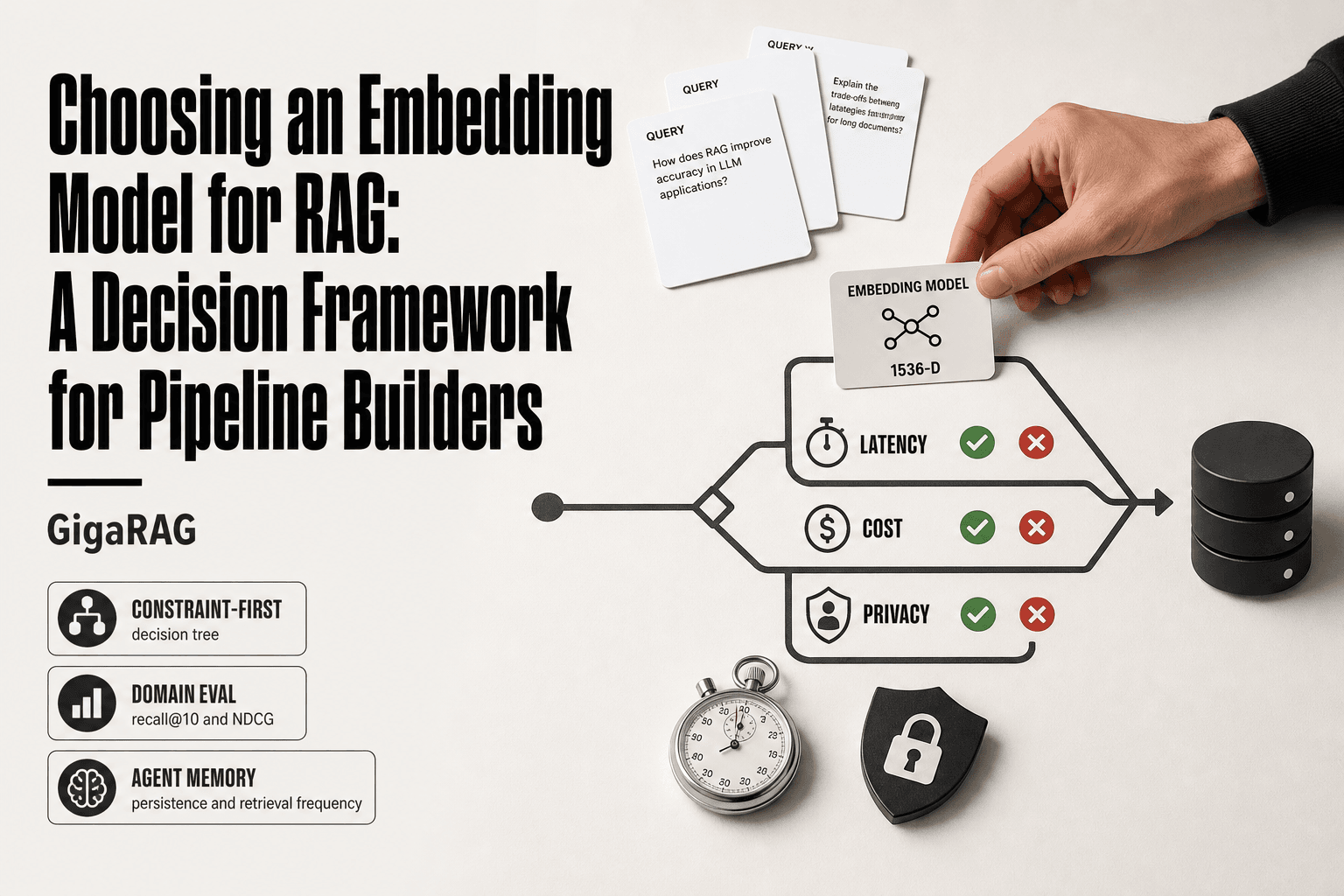
Choosing an Embedding Model for RAG: A Decision Framework for Pipeline Builders
Choosing an embedding model for RAG is the one decision pipeline builders keep getting wrong, not because the options are bad but because the conversation is dominated by MTEB leaderboards that don't answer the only question that matters: what works in your pipeline, under your constraints, for your retrieval task. Most guides recycle the same model lists and call it a day. They don't tell you that a model topping a general benchmark can fail on medical queries, or that a 30% latency increase might kill your agent's response time before quality ever becomes the issue. This guide is built for RAG pipeline builders and agent memory developers who need a decision framework, not a benchmark dump. GigaRAG's agent memory platform was built to handle exactly these retrieval challenges, so the guidance here comes from the constraints we had to solve in production. You'll get a constraint-first decision tree, evaluation criteria that work on your own data, an honest section on what embeddings cannot do, and answers to the questions practitioners actually ask.
| At a glance | Details |
|---|---|
| Core decision driver | Constraints first, benchmarks second |
| Key trade-off | Quality vs latency vs cost vs privacy |
| Hosted vs local | Hosted for speed, local for control |
| Dimension size | Bigger isn't always better |
| Agent memory needs | Persistence and retrieval frequency matter |
| What embeddings can't do | Reasoning, facts, temporal awareness |
In This Guide
- What Is an Embedding Model and Why It Matters for RAG
- Hosted API Embeddings vs Local Open-Source Embeddings
- The Role of Embeddings in Agent Memory vs. Standard RAG
- Choosing An Embedding Model For Rag: A Step-by-Step Guide
- Criteria for Choosing an Embedding Model for RAG
- Why MTEB Isn't Enough: Benchmarking for Your Specific Use Case
- Comparing Embedding Models: A Constraint-First Decision Tree
- Open-Source vs. Proprietary Embedding Models: An Honest Comparison
- Fine-Tuning and Domain Adaptation: When It's Worth It
- What Embedding Models Cannot Do: Honest Limitations
- Common Mistakes When Choosing an Embedding Model for RAG
- Final Thoughts: A Repeatable Process for Embedding Selection
What Is an Embedding Model and Why It Matters for RAG
An embedding model converts text into dense vectors (lists of numbers) where similar meanings sit close together in vector space, letting RAG systems retrieve relevant passages by semantic similarity rather than keyword matching.
What is an embedding?
An embedding is a list of numbers, typically 384 to 3,072 of them, that represents a chunk of text. The model learns to place similar texts near each other in this numeric space. "How do I reset my password" and "I forgot my login credentials" land close together even though they share no words. That's the whole trick.
Behind the scenes, the model passes text through layers of neural network transformations. The final layer outputs a vector. You never read the vector directly. You store it in a vector database and compare it against other vectors using cosine similarity or dot product.
How embeddings power RAG retrieval
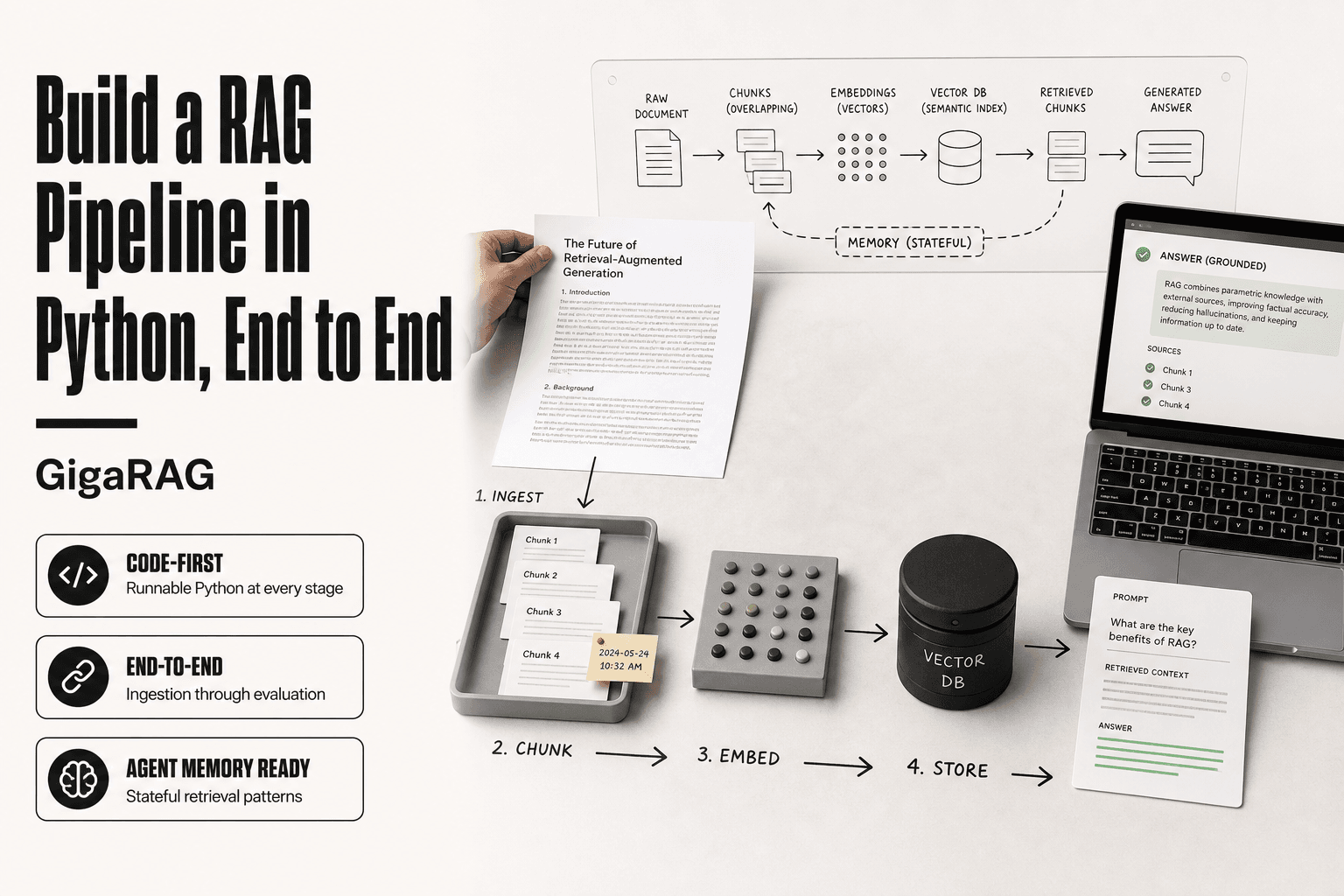
RAG works in two steps: retrieve relevant context, then generate an answer from that context. Embeddings handle the first step.
When a user asks a question, you embed that question with the same model you used for your documents. The vector database finds the nearest document vectors. Those documents become the context your LLM reads. If retrieval pulls the wrong passages, the LLM generates a wrong or incomplete answer no matter how capable it is.
The honest answer is that retrieval quality sets a ceiling on answer quality. A strong LLM can't compensate for a weak embedding model that keeps surfacing irrelevant chunks.
Why embedding choice directly impacts answer quality
Different embedding models map text to vector space differently. A model trained on general web text may struggle with legal contracts or medical records. A model tuned for code won't capture the nuance of customer support tickets.
The main catch is that no single embedding model wins everywhere. A model that tops MTEB leaderboards might perform poorly on your domain. You need to test against your own data, not someone else's benchmark.
In practice, the embedding model you choose determines what your RAG system can retrieve. Pick wrong, and you'll spend weeks debugging why answers feel shallow, only to find the retrieval layer was pulling the wrong context all along.
[!note] Public leaderboards like MTEB rank models on generic tasks, but retrieval quality on your specific domain and query distribution can differ substantially, so always validate candidates on a small labeled sample of your own data before committing.
Hosted API Embeddings vs Local Open-Source Embeddings
| Factor | Hosted API Embeddings | Local Open-Source Embeddings |
|---|---|---|
| Setup effort | Low, just an API key | Higher, needs infra and ops |
| Cost model | Pay per token, scales with use | Fixed infra cost, no per-token fee |
| Latency | Network round-trip per call | In-process, no network hop |
| Data privacy | Data leaves your environment | Data stays on your hardware |
| Model control | Limited to vendor versions | Full control, can fine-tune |
The Role of Embeddings in Agent Memory vs. Standard RAG
Standard RAG is stateless. You embed a query, retrieve chunks, generate an answer, and forget everything. Agent memory is different. An agent accumulates context across turns, tasks, and sometimes days. That changes what you need from an embedding model.
How agent memory differs from one-shot RAG
In one-shot RAG, retrieval happens once per query. You can afford a slow, high-dimensional model because latency is measured in milliseconds, not minutes. Agent memory flips that. An agent retrieves constantly: to check what it learned earlier, to recall a user preference, to find a past decision that bears on the current step.
The consequence is that your embedding model becomes a persistent part of the agent's working memory, not a one-time lookup. If retrieval is slow or noisy, the agent makes worse decisions at every step, and those errors compound.
Persistence and retrieval frequency considerations
Agent memory stores embeddings for the long haul. A conversation from last week, a document ingested last month, a preference captured yesterday. All of it sits in the same vector space, waiting to be queried.
That persistence creates two constraints. First, your embedding model must stay consistent over time. If you swap models mid-project, old embeddings and new embeddings won't align, and retrieval quality collapses. You either re-embed everything or you don't switch.
Second, retrieval frequency drives cost. An agent might run dozens of similarity searches per task. A model that costs $0.0001 per query is fine for one-shot RAG. Multiply that by 50 retrievals per task across thousands of tasks, and the bill becomes a line item you can't ignore.
Context window interactions and embedding choice
Here's what happens behind the scenes. An agent retrieves memories, stuffs them into a context window, and asks an LLM to reason over them. The context window is finite. Every retrieved chunk consumes tokens that could go to instructions or new information.
That means precision matters more than recall in agent memory. A one-shot RAG system can tolerate a few irrelevant chunks in the top 10. An agent can't. Irrelevant memories crowd out useful ones and push the agent toward worse decisions.
The practical takeaway: for agent memory, favor embedding models with strong precision on your domain, even if they cost more or run slower. A model that returns the right three chunks beats one that returns seven chunks where four are noise. Test recall@5, not recall@20. Your context window will thank you.
[!tip] For agent memory systems, separate your embedding choice for long-term persistent memory from the one used for short-lived working context; the former benefits from stability and deduplication, while the latter can favor lower latency and smaller dimensions.
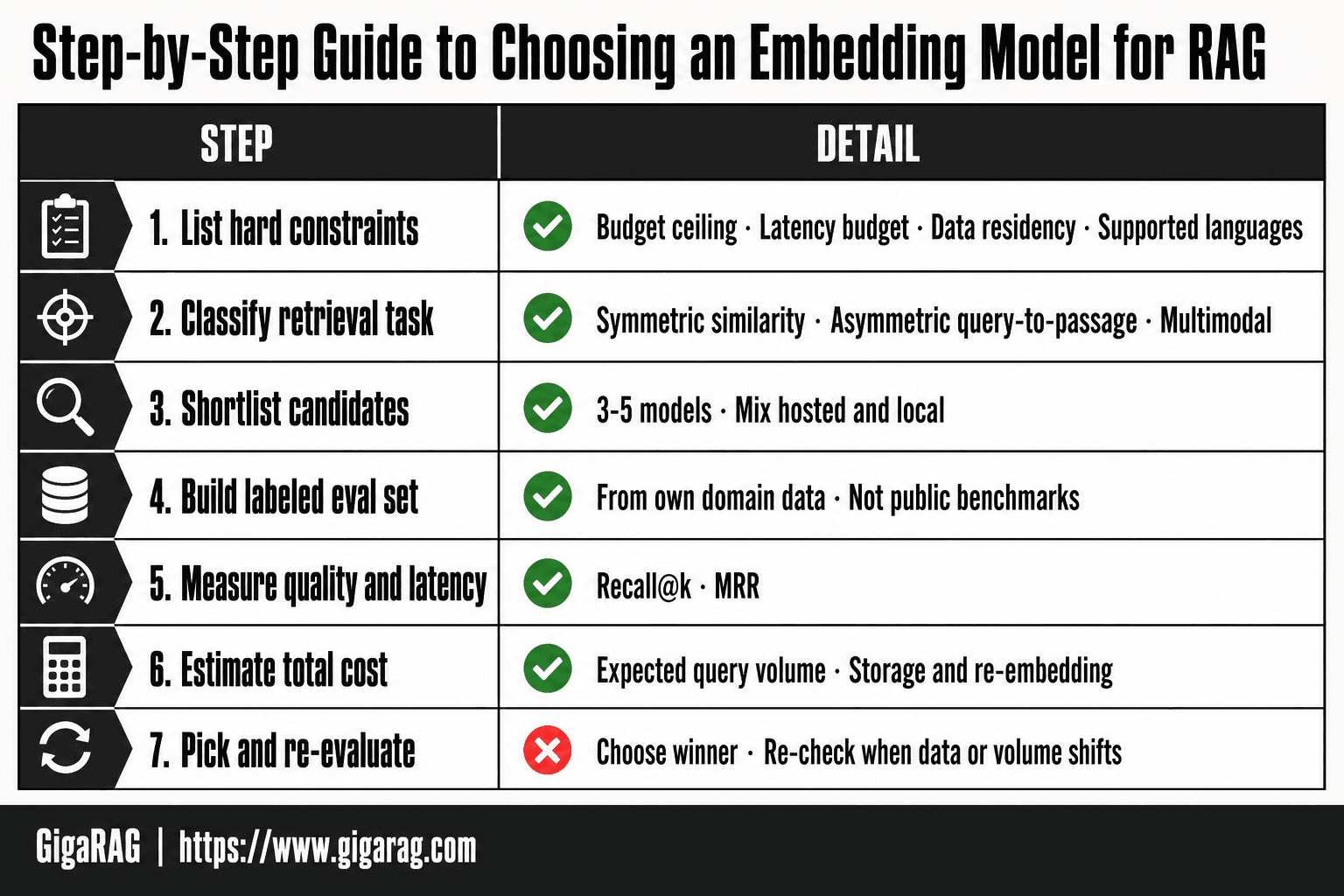
Choosing An Embedding Model For Rag: A Step-by-Step Guide
- List your hard constraints: budget ceiling, latency budget, data residency, and supported languages.
- Classify your retrieval task: symmetric similarity, asymmetric query-to-passage, or multimodal.
- Shortlist 3-5 candidate models that fit those constraints, mixing hosted and local options.
- Build a small labeled eval set from your own domain data, not public benchmarks.
- Measure retrieval quality (recall@k, MRR) and latency on that set for each candidate.
- Estimate total cost at your expected query volume, including storage and re-embedding.
- Pick the winner, then re-evaluate whenever your data distribution or volume shifts.
Criteria for Choosing an Embedding Model for RAG
You can't evaluate an embedding model in a vacuum. The right model for a legal document retrieval system is the wrong model for a multilingual customer support bot. The criteria below are the dimensions that actually move the needle in production.
Performance on your domain (not just MTEB)
MTEB scores tell you how a model performs on a grab bag of public datasets. They don't tell you how it handles medical terminology, code snippets, or your company's internal jargon. A model that ranks #1 on MTEB can underperform a mid-tier model on your specific retrieval task.
The honest answer is that you need to test on your own data. Take 200 to 500 real queries from your system, label the relevant chunks, and measure recall@10. That number matters more than any leaderboard position.
Cost and latency trade-offs
Embedding models charge per token, and those tokens add up. A model with 4,096 dimensions costs more to store and query than one with 768. Latency compounds the problem: if your pipeline embeds 10,000 documents at ingestion and runs 50 queries per second at inference, a 200ms model versus a 20ms model is the difference between a responsive system and a queue.
The main catch is that cheaper models often sacrifice precision. You need to know your latency budget before you shop.
Vector dimensionality and storage implications
Dimensionality determines your vector database bill. A 3,072-dimension embedding consumes four times the storage of a 768-dimension one, and similarity search slows down accordingly. Some models support Matryoshka Representation Learning, which lets you truncate dimensions without retraining. That flexibility is worth checking for if storage costs matter to you.
Open-source vs. proprietary models
Open-source models like those from the sentence-transformers ecosystem give you control: you can run them locally, fine-tune them, and avoid per-token API fees. Proprietary models from OpenAI, Cohere, and Voyage often lead on benchmark performance and require zero infrastructure.
The trade-off is straightforward. Open-source costs engineering time. Proprietary costs money per query and sends your data to a third party.
Language and multimodal support
If your RAG pipeline handles documents in French, Japanese, and Arabic, a model trained primarily on English will retrieve poorly across most of your corpus. Check the model's training data and its multilingual benchmark scores before committing. The same logic applies to multimodal pipelines: if you're embedding images alongside text, you need a model built for that, not a text-only model stretched past its design.
Privacy and deployment constraints
Some industries can't send data to external APIs. Healthcare, finance, and legal work often require on-premise or VPC deployment. That constraint eliminates most proprietary models immediately. If privacy is a hard requirement, your shortlist is open-source models you can self-host, and your evaluation criteria shift toward models that run efficiently on your available hardware.
Why MTEB Isn't Enough: Benchmarking for Your Specific Use Case
MTEB is the industry's default scoreboard, and it's useful for exactly one thing: narrowing a field of hundreds of models down to a shortlist of twenty. It is not a prediction of how any model will perform on your data. The moment you treat a leaderboard position as a purchase decision, you've outsourced your evaluation to a benchmark that was never designed for your pipeline.
What MTEB measures (and misses)
MTEB aggregates performance across 58 datasets spanning classification, clustering, retrieval, and semantic similarity. The retrieval tasks use public corpora like Wikipedia and StackExchange. Your corpus is not Wikipedia. If you're building RAG over internal documentation, legal contracts, or product catalogs, the vocabulary, query patterns, and document structure differ enough that MTEB's ranking can invert.
The deeper problem is that MTEB scores are averages. A model can rank #3 overall while performing poorly on the retrieval tasks that matter to you, because its strength lies in clustering or classification. The leaderboard doesn't surface that variance. You have to dig into the per-task breakdown, and even then, none of those tasks are yours.
Building a domain-specific evaluation set
Start with 200 to 500 real queries. Pull them from your search logs, support tickets, or the questions your users actually ask. Don't synthesize them. Synthetic queries are cleaner than real ones, and that's the problem: they miss the typos, the domain shorthand, the half-formed questions that make retrieval hard.
For each query, label the relevant chunks in your corpus. One to three relevant chunks per query is enough. This labeling is tedious, but it's the entire ballgame. A model's performance on this set is the only number that predicts production behavior.
Metrics that matter: recall@10, NDCG, latency
Recall@10 answers one question: did the relevant chunk show up in the top ten results? For RAG, that's the metric that determines whether your LLM sees the right context at all. If recall@10 is 0.6, four out of ten queries never surface the correct chunk, and no amount of prompt engineering fixes that.
NDCG adds a quality dimension: it rewards models that rank the most relevant chunk first, not just somewhere in the top ten. That matters when your context window is tight and you can only pass three or four chunks to the LLM.
Latency is the metric leaderboards ignore entirely. Measure embedding time per query at your expected throughput. A model that takes 500ms per query is fine for batch ingestion and useless for a synchronous agent loop.
A reproducible evaluation workflow
Here's the workflow I use. It takes about a day and saves weeks of debugging later.
- Extract 300 real queries from your logs.
- Label relevant chunks for each query.
- Embed your corpus once per candidate model.
- Run the queries, compute recall@10 and NDCG.
- Measure p50 and p95 latency per query.
- Drop any model below your latency budget, then pick the best recall@10 among the survivors.
Run this before you commit to a model, and re-run it whenever your corpus shifts significantly. The model that wins today may not win in six months.
Comparing Embedding Models: A Constraint-First Decision Tree
The previous section gave you a way to measure models on your own data. This section gives you the order of operations. Constraints come first. Model lists come last.
Step 1: Define your hard constraints
Write down three things before you look at a single model name: your latency budget, your cost ceiling, and your deployment boundary. Latency is the most common killer. If your agent loop needs a response in under 200ms, any model that embeds a query in 300ms is disqualified, no matter its recall. Cost compounds: at a million queries per month, a $0.0001 per-token difference becomes real money. Deployment boundary is binary: can you call an external API, or must the model run inside your VPC? That one constraint eliminates half the field immediately.
Step 2: Match constraints to model categories
Once you know your constraints, the categories sort themselves.
Tight latency, high volume: look at smaller dense models in the 384 to 768 dimension range. They embed fast and store cheap. You trade some recall for speed, which is usually the right trade in a synchronous loop.
Specialized domain, privacy required: open-source models you can self-host. You control the data path, and you can fine-tune later if the off-the-shelf recall disappoints. The cost is engineering time: someone has to run the inference server.
Multilingual or cross-modal retrieval: you need a model trained on that specific task. General-purpose English models underperform here, and no amount of prompt tweaking fixes a model that never saw your language during training.
Maximum recall, budget flexible: proprietary API models with higher dimensionality. They cost more per query and add network latency, but if your use case is batch retrieval or offline indexing, neither of those matters.
Step 3: Shortlist and test
Pick two or three models from the category that matches your constraints. Don't test ten. The evaluation workflow from the previous section takes about a day per model if you're thorough, and testing ten models means ten days you don't have.
Run your domain-specific evaluation set against each candidate. Record recall@10, NDCG, p50 latency, and cost per million queries. Then make the call based on the constraint you defined in Step 1. If latency is your hard limit, the fastest model that clears your recall floor wins. If recall is the priority, the highest-scoring model that stays under your cost ceiling wins.
Step 4: Validate before production
The shortlist winner is a hypothesis, not a decision. Run it in shadow mode against live traffic for a week. Log the queries where retrieval failed, and eyeball them. You'll find patterns your evaluation set missed: a query type you didn't label, a document format the model handles poorly, a latency spike under concurrent load.
Fix what you can with chunking or preprocessing before you swap models. The model is rarely the only variable. If shadow mode shows recall@10 below your floor, go back to Step 3 and test the runner-up. That's the loop. It's not glamorous, but it beats discovering the problem in production.
Open-Source vs. Proprietary Embedding Models: An Honest Comparison
The decision tree in the previous section sorts you into a category. This section gives you the honest trade-offs inside that category. No vendor is paying for this, and the answer is not "it depends on your needs" without telling you what it depends on.
When open-source models are the right choice
Open-source wins when you have three constraints: privacy, budget, or customization. If your data can't leave your VPC, the decision is made for you. Self-hosting a model like BGE or E5 means the embedding happens on your hardware, and no third party ever sees a query. That's not a feature, it's a compliance requirement.
Budget is the second trigger. API costs scale linearly with query volume, and at a million queries per month, even cheap per-token pricing adds up. An open-source model costs you GPU or CPU time, which you're probably already paying for. The marginal cost per query is close to zero.
Customization is the third. If your domain has vocabulary a general model never saw, fine-tuning an open-source model on your own data is the only path. Proprietary APIs don't let you touch the weights.
When proprietary models justify their cost
Proprietary wins on three fronts: ease of use, support, and peak performance. You call an API and you're done. No inference server to run, no model updates to manage, no GPU allocation to fight over. For a small team shipping a product, that's real engineering time saved.
Support matters when retrieval breaks at 2 a.m. and you need someone to answer. Open-source communities are helpful, but they're not on a service-level agreement. Proprietary vendors are.
Peak performance is the honest one. The top of the MTEB leaderboard is dominated by proprietary models, and if your use case demands maximum recall and you have the budget, that's the rational choice. You're paying for the last few points of recall@10, and sometimes those points matter.
Hidden costs of both approaches
Open-source has a hidden cost: engineering time. Someone has to deploy the model, monitor it, update it, and debug it when retrieval quality drops. That person is not building features. Over a year, that salary dwarfs most API bills.
Proprietary has a hidden cost too: lock-in. Your embeddings are tied to a vendor's model version. When they deprecate a model or change their API, you re-embed your entire corpus or accept degraded retrieval. That's a migration you'll do on their schedule, not yours.
The honest answer is that most teams should start proprietary and switch to open-source only when a hard constraint forces it. Privacy requirements, extreme query volume, or a domain-specific fine-tuning need are the three triggers. Everything else is premature optimization.
Fine-Tuning and Domain Adaptation: When It's Worth It
Fine-tuning an embedding model means continuing training on your own data so the model learns what "similar" means in your domain. Off-the-shelf models know that "bank" relates to "river" and "finance." They don't know that in your legal corpus, "consideration" means a specific contract doctrine, not a polite thought. Fine-tuning teaches that.
The honest answer is that most teams shouldn't fine-tune. Not because it doesn't work. Because it usually doesn't pay for itself.
When fine-tuning delivers real gains
Fine-tuning earns its cost when your domain has vocabulary or relationships a general model gets wrong. Medical text, legal contracts, code in a niche language, internal product names. If your retrieval misses are caused by the model not understanding your terms, fine-tuning fixes that directly.
You also need data. Not a few hundred examples. Thousands of query-document pairs where you know the correct match. If you have that, and you've measured that off-the-shelf recall@10 is below what your pipeline needs, fine-tuning is the next lever.
A third trigger: your corpus is stable. Fine-tuning bakes in assumptions about what your data looks like. If your documents change weekly, the model goes stale fast.
When fine-tuning is a waste of time
If your retrieval problems come from bad chunking, fine-tuning won't help. The model can't fix documents split mid-sentence. If your misses are because the answer isn't in the corpus, no amount of training changes that. If you haven't measured baseline recall@10, you're tuning blind.
Fine-tuning also fails when your domain is actually general. Most business documents are not that specialized. A strong off-the-shelf model already handles contracts, emails, and product docs well enough that fine-tuning gains are marginal. You'll spend a week of engineering time for a 2% recall bump you could have gotten by fixing your chunk size.
And if you don't have labeled data, stop. Synthetic data from an LLM can work, but it introduces its own errors. You'll be fine-tuning on hallucinations.
A practical fine-tuning checklist
Before you start, check each box:
- You've measured baseline recall@10 and NDCG on your own test set.
- You have at least 5,000 labeled query-document pairs.
- Your domain vocabulary is genuinely specialized, not just business jargon.
- Your corpus is stable enough that a model trained today still matches data six months out.
- You've ruled out chunking, preprocessing, and retrieval strategy as the real problem.
If all five are true, fine-tune an open-source model. Start with a small one, measure against your baseline, and stop if the gain doesn't justify the engineering time. If any box is unchecked, spend your time elsewhere.
What Embedding Models Cannot Do: Honest Limitations
Embeddings are a retrieval tool. They map text to vectors so similar text lands close together. That's it. They don't think, and treating them like they do is the fastest way to ship a broken pipeline.
Embeddings don't reason or verify facts
An embedding model can tell you that two passages are semantically similar. It cannot tell you which one is true. If your corpus contains a wrong answer, the embedding will happily retrieve it because it matches the query. The model has no mechanism for checking facts, weighing evidence, or rejecting a claim.
This matters in RAG because retrieval quality and answer quality are different things. You can get perfect recall@10 and still surface garbage if your source documents are garbage. Embeddings retrieve. Your LLM reasons. Don't ask the embedding to do the LLM's job.
Embeddings struggle with temporal and causal relationships
Embeddings capture similarity, not sequence. "The company launched the product" and "the product was launched by the company" are nearly identical vectors. But "the company will launch the product" and "the company launched the product" are also close, even though one is past and one is future. The model doesn't track time.
Causal relationships are worse. "The server crashed because of a memory leak" and "the memory leak happened after the server crashed" embed near each other. The embedding sees shared vocabulary and similar context. It doesn't see that one sentence reverses the cause. If your RAG pipeline needs temporal or causal precision, embeddings alone won't get you there. You need metadata filters, timestamps, or a reranking step.
Embedding drift: when your model goes stale
Embeddings are snapshots of a model's understanding at training time. Your data changes. New terms appear. Old terms shift meaning. The model doesn't update itself.
Drift shows up as slowly degrading recall. Queries that used to retrieve the right document start missing. You won't notice it in a single query. You'll notice it in aggregate metrics over months. The fix is re-evaluating your embedding model on a schedule, not waiting for users to complain. If your corpus evolves quickly, check quarterly. If it's stable, yearly is enough.
Common Mistakes When Choosing an Embedding Model for RAG
Most embedding selection mistakes aren't exotic. They're the same three errors repeated across teams, and they all trace back to one thing: picking a model before defining what the pipeline actually needs.
Over-indexing on benchmark scores
MTEB scores are a starting point, not a verdict. A model that tops the leaderboard on general retrieval tasks can underperform on your domain by a wide margin. Benchmarks measure average performance across many tasks. Your pipeline runs one task, on one corpus, with one latency budget.
The fix is simple. Build a small evaluation set from your own data, maybe 50 to 100 query-document pairs, and measure recall@10 directly. That number tells you more than any leaderboard. A model scoring 62 on MTEB but 0.91 on your eval set beats a model scoring 68 on MTEB but 0.78 on your data. Benchmarks narrow the shortlist. Your data picks the winner.
Ignoring latency and cost until production
Latency is a production constraint, not an afterthought. A 7B-parameter embedding model might deliver marginally better retrieval than a 110M-parameter model, but if it adds 80ms per query and you're serving 1,000 queries per second, that's 80 extra seconds of compute every second. You can't fix that with a faster database.
Cost compounds the same way. Proprietary embedding APIs charge per token. At high query volume, a model that's 2% better on recall can cost 10x more to run. The honest question is whether that 2% matters for your use case. For customer support retrieval, probably not. For medical or legal search, maybe. Decide before you build, not after the bill arrives.
Treating embedding choice as a one-time decision
Your embedding model is not a set-and-forget choice. Your corpus changes. New document types appear. Query patterns shift. A model that worked at launch can degrade silently over months as embedding drift sets in.
Schedule re-evaluation. If your corpus evolves quickly, check recall on your eval set quarterly. If it's stable, yearly is enough. When you re-evaluate, test against the same eval set so the comparison is fair. And keep your eval set updated too. An eval set that doesn't reflect current queries will tell you the model is fine while your users are seeing worse results.
Final Thoughts: A Repeatable Process for Embedding Selection
Choosing an embedding model for RAG isn't a one-time decision. It's a loop: define constraints, shortlist candidates, test on your own data, deploy, monitor, repeat. The teams that get this right treat embedding selection the way they treat database indexing or caching. It's infrastructure. It needs maintenance.
The process is simple enough to write on a sticky note. Start with your hard constraints: budget, latency, language, deployment environment. Those constraints eliminate most of the market before you ever look at a benchmark. Then build a small eval set from your own queries and documents. Fifty to a hundred pairs is enough to separate real contenders from leaderboard noise. Measure recall@10 and NDCG. Pick the model that wins on your data, not the one that wins on MTEB.
That's the whole framework. Constraints first, benchmarks second, your data last and loudest.
If you're building agent memory rather than one-shot RAG, the same process applies but the constraints get tighter. Persistence, retrieval frequency, and context window interactions all push you toward models with lower latency and smaller footprints. GigaRAG's agent memory platform was designed to simplify exactly this workflow, handling the embedding and retrieval layer so you can focus on the decision that matters: what your pipeline actually needs.
The honest answer is that there's no best embedding model. There's a best model for your constraints, your data, and your budget. Find it, test it, and re-test it when your corpus changes. That's the repeatable part.
Frequently Asked Questions
How do I choose an embedding model for RAG in Python?
Start by defining your constraints (latency, cost, privacy, language), then shortlist models that fit. Use a library like sentence-transformers for local models or a hosted API client, and evaluate candidates on a small labeled set from your own data using recall@k or MRR before committing.
What is the best embedding model for similarity search?
There is no single best model; it depends on your data, language, and constraints. Models that score well on retrieval benchmarks are a reasonable starting point, but you should validate on your own domain because generic benchmark performance does not always transfer.
Are open-source embedding models good enough for RAG?
In many cases yes. Open-source models have closed much of the gap with hosted options and offer advantages in cost predictability, privacy, and customization. The right choice depends on whether you can meet your quality and latency targets with a local deployment.
How do I choose an embedding model for agent memory?
Agent memory has different needs than one-shot RAG: persistence, deduplication, and retrieval frequency matter. Favor models with stable embeddings and consider separating the model used for long-term memory from the one used for short-lived context to balance quality and latency.
What should I consider when picking a local embedding model?
Check hardware requirements, inference speed, model size, and whether the model supports your languages and domain. Also consider quantization options and whether you can fine-tune it later if retrieval quality falls short.
Do I need a multimodal embedding model?
Only if your retrieval corpus includes images, audio, or other non-text modalities that must be searched alongside text. For text-only RAG, a strong text embedding model is usually simpler and more cost-effective.
How often should I re-evaluate my embedding model choice?
Re-evaluate when your data distribution changes significantly, when query volume or latency requirements shift, or when a new model clearly outperforms your current one on your own eval set. There is no fixed schedule; tie it to changes in your pipeline.
About GigaRAG
GigaRAG is for agent memory and RAG pipeline builders. get this right. Whether you are working through choosing an embedding model for rag or something adjacent, we publish what we have actually tested, including where it falls short.