Pipeline Orchestration for RAG and Agent Memory Builders
Pipeline orchestration for RAG and agent memory builders is a different problem than anything most orchestration guides cover. Traditional ETL fails loudly: a batch job dies, you get an alert, you rerun it. RAG pipelines fail quietly. Embeddings go stale. Retrieval returns partial results that look complete. Memory drifts between sessions. An LLM call returns something slightly different every time, which breaks any assumption of determinism your DAG was built on. Most pipeline orchestration content is written for data engineers moving rows between warehouses. It doesn't address failure modes where the "data" is a vector, the "transformation" is a model call, and the "state" is what an agent remembers. GigaRAG exists for exactly this niche, but this guide isn't a sales pitch. It's a field report: a plain definition of orchestration, an honest tool comparison through the RAG lens, and a concrete pattern you can implement this week.
| At a glance | Details |
|---|---|
| Core purpose | Coordinate retrieval, embedding, and memory steps reliably |
| Key challenge | State management across RAG and agent memory |
| Common tools | Airflow, Dagster, Prefect, Flyte, Kubeflow |
| RAG-specific need | Handle stale embeddings and partial retrievals |
| Agent memory need | Persist and version conversation state |
| What it can't fix | Poor chunking or embedding quality |
In This Guide
- What Is Pipeline Orchestration?
- Airflow vs Dagster for RAG and Agent Memory Pipelines
- Pipeline Orchestration vs. Workflow Automation: What's the Difference?
- Pipeline Orchestration: A Step-by-Step Guide
- Why RAG and Agent Memory Pipelines Need Different Orchestration Thinking
- Key Capabilities to Look for in Pipeline Orchestration Tools
- Pipeline Orchestration Tools Compared for RAG Builders
- A Practical Pipeline Orchestration Pattern for RAG with Agent Memory
- What Pipeline Orchestration Cannot Do for Your RAG System
- Common Mistakes in Pipeline Orchestration for RAG
- Final Thoughts on Pipeline Orchestration for RAG and Agent Memory
What Is Pipeline Orchestration?
Pipeline orchestration is the coordination of dependent tasks into a reliable, ordered flow: you define what runs, in what order, what happens when a step fails, and how state moves between steps. It's the difference between a pile of scripts and a system you can trust.
Orchestration vs. a simple script
A script runs top to bottom and dies on the first error. Orchestration tracks each task's state, retries failures, and lets you resume from the point of failure instead of restarting. You get a dependency graph, not a linear sequence.
What orchestration means for RAG pipelines specifically
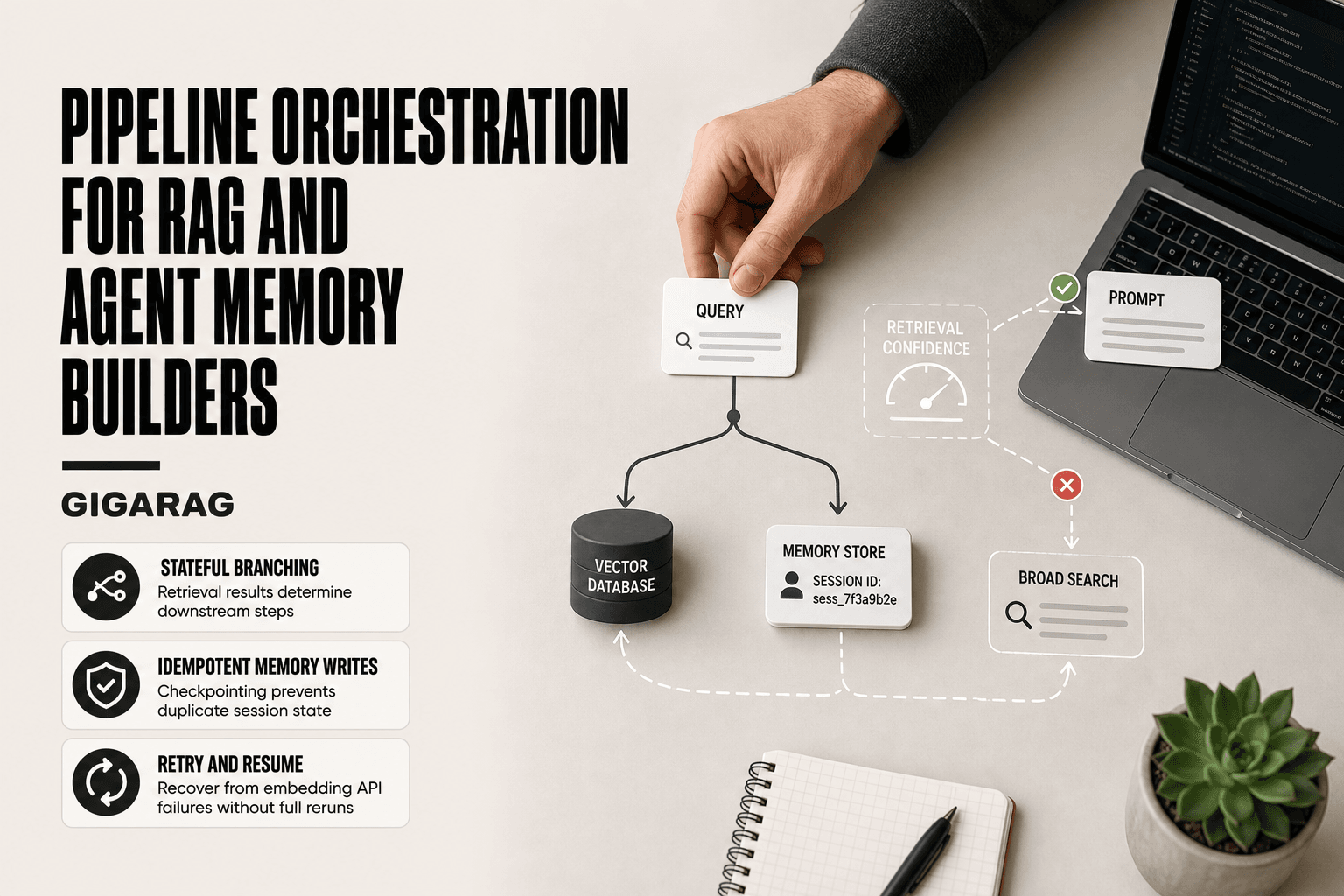
For RAG and agent memory, orchestration coordinates retrieval, embedding, memory writes, and LLM calls as one graph. A retrieval result determines whether you embed, which memory you read, and what the LLM sees next. That's dynamic branching, not a fixed path. Orchestration gives you retries on flaky embedding APIs, checkpointing before memory writes, and visibility into where a pipeline stalled. It won't improve your chunking or embeddings. It makes the steps you already have run dependably.
[!note] Orchestration cannot fix poor chunking strategies or low-quality embeddings; it only coordinates the steps you define.
Airflow vs Dagster for RAG and Agent Memory Pipelines
| Factor | Apache Airflow | Dagster |
|---|---|---|
| Primary abstraction | DAGs of tasks | Software-defined assets |
| State management | Task-level, external via XCom | Asset-level, built-in materialization |
| RAG/agent memory fit | Requires custom sensors for embeddings | Native support for data assets and partitions |
| Learning curve | Moderate, mature ecosystem | Steeper, opinionated but modern |
| Community and support | Large, established | Growing, active |
Pipeline Orchestration vs. Workflow Automation: What's the Difference?
Workflow automation moves a task from A to B to C. It's linear, stateless, and assumes each step completes the same way every time. Orchestration manages dependencies, state, retries, and branching where the next step depends on what the previous step returned.
That distinction matters for RAG. A retrieval step doesn't always return the same shape of result. Sometimes you get high-confidence chunks, sometimes sparse context, sometimes an API timeout. A workflow tool can't branch on that. An orchestrator can.
When a workflow tool is enough
If your pipeline is ingestion only: pull documents, chunk them, embed them, upsert to a vector store. No branching, no conditional logic, no state you need to recover. A workflow tool or even a cron job with a script handles that fine. Adding orchestration here is overhead.
When you need true orchestration
You need orchestration when retrieval results determine downstream steps. Low confidence scores trigger a fallback retriever. A memory write fails and you need to resume without duplicating it. An LLM call times out and you retry with backoff. That's stateful, dynamic, and recoverable. Workflow automation doesn't do any of that.
[!tip] For RAG pipelines, use asset-based orchestration (like Dagster) to track data lineage and automatically re-run downstream tasks when embeddings or memory states change.
Pipeline Orchestration: A Step-by-Step Guide
- Define your pipeline stages: document ingestion, chunking, embedding, indexing, retrieval, and memory update.
- Choose an orchestration tool that supports dynamic workflows and state persistence (e.g., Airflow, Dagster, Prefect).
- Implement idempotent tasks for each stage to handle retries without duplicating data.
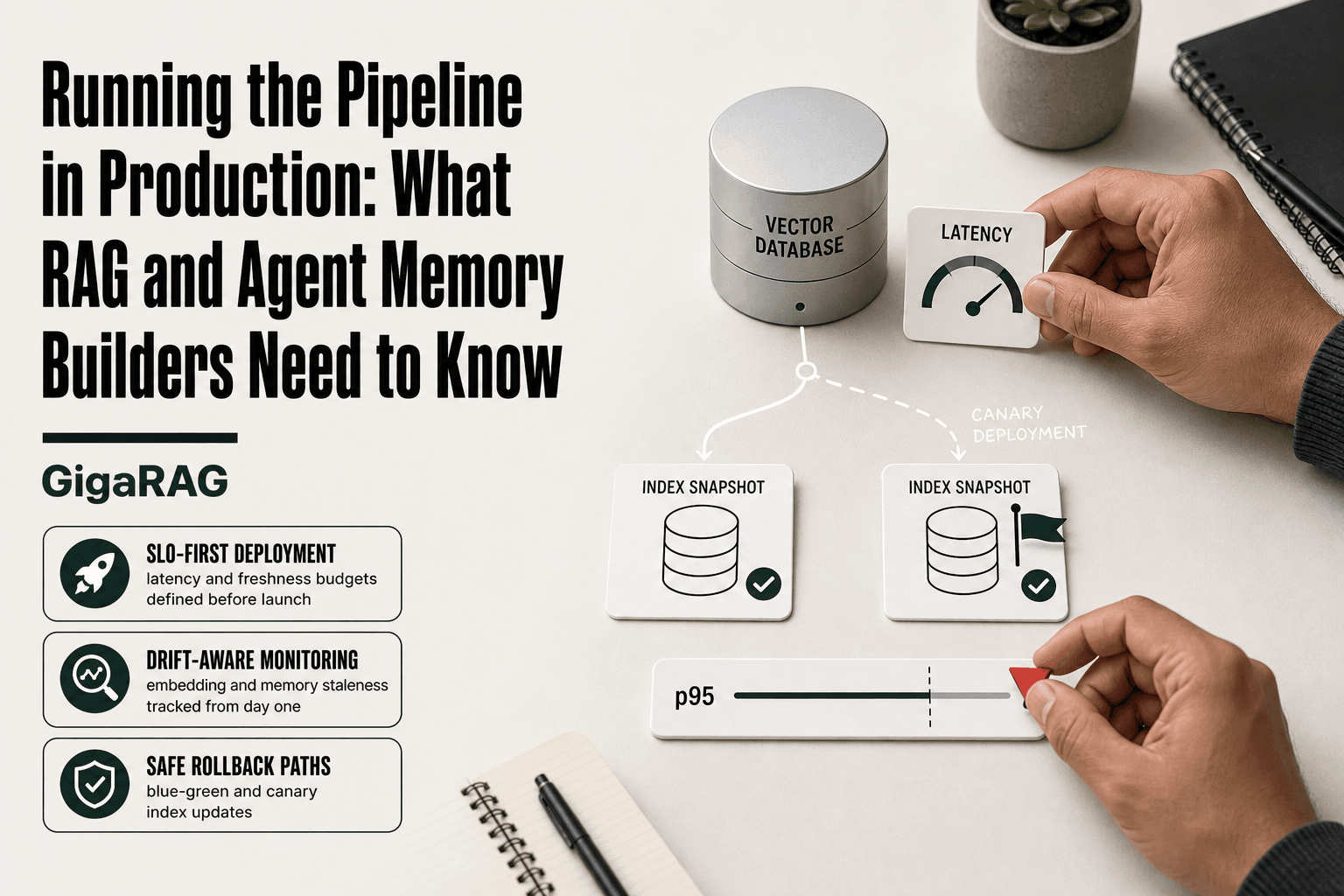
- Set up monitoring and alerting for stale embeddings, retrieval failures, and memory drift.
- Integrate a vector database and ensure orchestration triggers re-embedding when source documents change.
- Add a memory store (e.g., Redis, PostgreSQL) and orchestrate read/write operations for agent conversations.
- Test failure scenarios: simulate partial retrievals and memory corruption to validate recovery.
Why RAG and Agent Memory Pipelines Need Different Orchestration Thinking
Traditional ETL orchestration assumes deterministic steps: a transform either succeeds or fails, and you retry it. RAG pipelines break that assumption at every turn. LLM calls return different outputs for the same input. Embeddings go stale as your corpus changes. Memory writes can partially succeed. The orchestration layer has to treat non-determinism as the default, not the exception.
State management across retrieval and generation steps
A RAG pipeline carries state between steps that classic ETL never touches. Retrieval returns chunks with confidence scores. Those scores determine whether you generate an answer, fall back to a broader search, or ask the user for clarification. The orchestrator has to pass that state forward, not just track task completion. Losing it means the generation step runs blind.
Memory persistence and versioning
Agent memory isn't a cache you can rebuild from source. It accumulates across sessions, and each write changes what the agent knows. Orchestration has to handle versioning here: what did the memory store look like before this write, and can you roll back if the write corrupts state? Checkpointing before memory writes is non-negotiable. A failed write that leaves the store half-updated is worse than no write at all.
Handling non-deterministic LLM calls in a DAG
A DAG assumes you can define dependencies upfront. LLM calls don't fit that shape. The same prompt can return a valid answer, a refusal, or a timeout. Your orchestrator needs retry logic with backoff, but also a fallback path when retries don't help. That means dynamic task generation: the DAG grows or shrinks based on what the LLM actually returned. Static graphs can't express that.
Key Capabilities to Look for in Pipeline Orchestration Tools
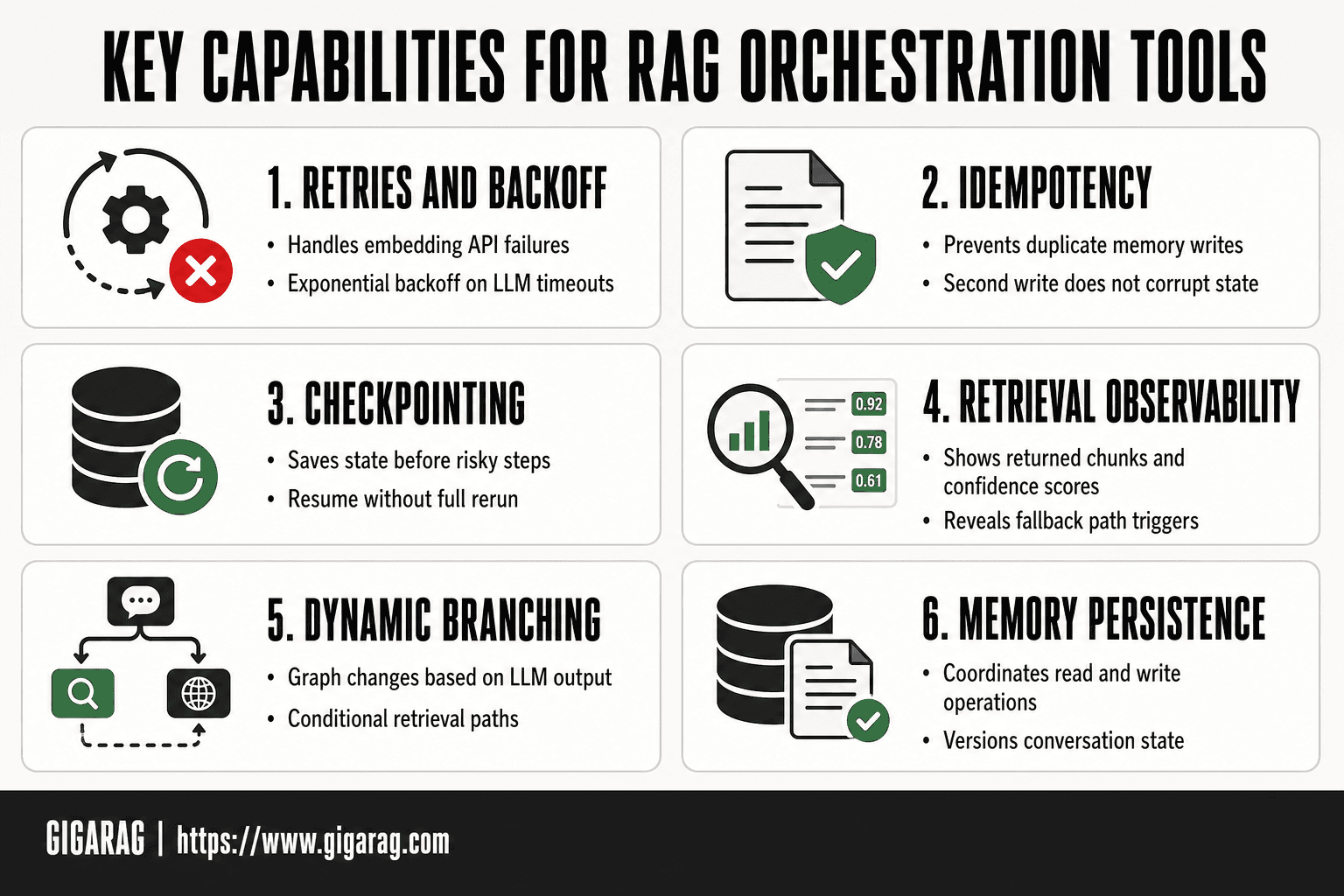
Most orchestration tools advertise the same feature list. For RAG and agent memory pipelines, six capabilities matter. The rest is noise.
Retries, idempotency, and checkpointing
Embedding APIs fail. LLM calls time out. Retries with exponential backoff are table stakes. But retries alone aren't enough: a retried memory write that runs twice corrupts state. Idempotency means the second write doesn't duplicate or overwrite what the first one did. Checkpointing saves pipeline state before risky steps, so a failure doesn't force a full rerun from scratch.
Observability into retrieval quality
You need to see what the retriever actually returned, not just that the retrieval task completed. Which chunks came back? What were the confidence scores? Did the fallback path trigger? Tools that only show task status hide the failures that matter most in RAG pipelines.
Dynamic branching based on LLM outputs
Static DAGs can't express "if retrieval confidence is below 0.7, run a broader search." You need dynamic task generation: the graph changes shape based on what the LLM or retriever returns. Look for tools that support conditional branching natively, not as a bolt-on.
Pipeline Orchestration Tools Compared for RAG Builders
Four tools dominate the conversation. Only one was built for RAG and agent memory. The other three are general-purpose data pipeline tools you can bend to the job, with varying degrees of awkwardness.
Apache Airflow
Airflow is the incumbent. It's batch-oriented, scheduler-driven, and designed for ETL workloads that run on a clock. For RAG pipelines, that's a mismatch. Dynamic LLM workflows don't fit Airflow's static DAG model well. You can make it work with XComs and branching operators, but you'll fight the framework. The main catch: Airflow assumes tasks are deterministic and scheduled. LLM calls are neither.
Dagster
Dagster is asset-centric. You define data assets and the dependencies between them, and Dagster tracks lineage and freshness. That's genuinely useful for RAG pipelines where embeddings and vector store state drift over time. Dagster's asset model makes backfills and partial recomputation cleaner than Airflow. But its dynamic branching support is weaker than Prefect's, and you'll write more boilerplate for conditional LLM workflows.
Prefect
Prefect is Python-native and handles dynamic flows well. You write plain Python functions, decorate them, and Prefect manages retries, state, and observability. For RAG pipelines with conditional retrieval and memory writes, Prefect's dynamic task generation is the most natural fit among the general-purpose tools. The tradeoff: Prefect's asset model is less mature than Dagster's, so lineage tracking requires more manual work.
GigaRAG
GigaRAG is purpose-built for agent memory and RAG pipelines. It coordinates retrieval, embedding, memory persistence, and LLM calls as a single orchestrated flow, with checkpointing and idempotency built in. You don't bolt on dynamic branching; it's the default. The honest limitation: GigaRAG is not a general-purpose data pipeline tool. If you need to orchestrate warehouse loads alongside your RAG pipeline, you'll still need Airflow or Dagster for that half.
A Practical Pipeline Orchestration Pattern for RAG with Agent Memory
Here's a concrete pattern you can adapt. It's not a framework-specific tutorial. It's the shape of the DAG, and where orchestration earns its keep.
Step 1: Define the DAG for a RAG pipeline
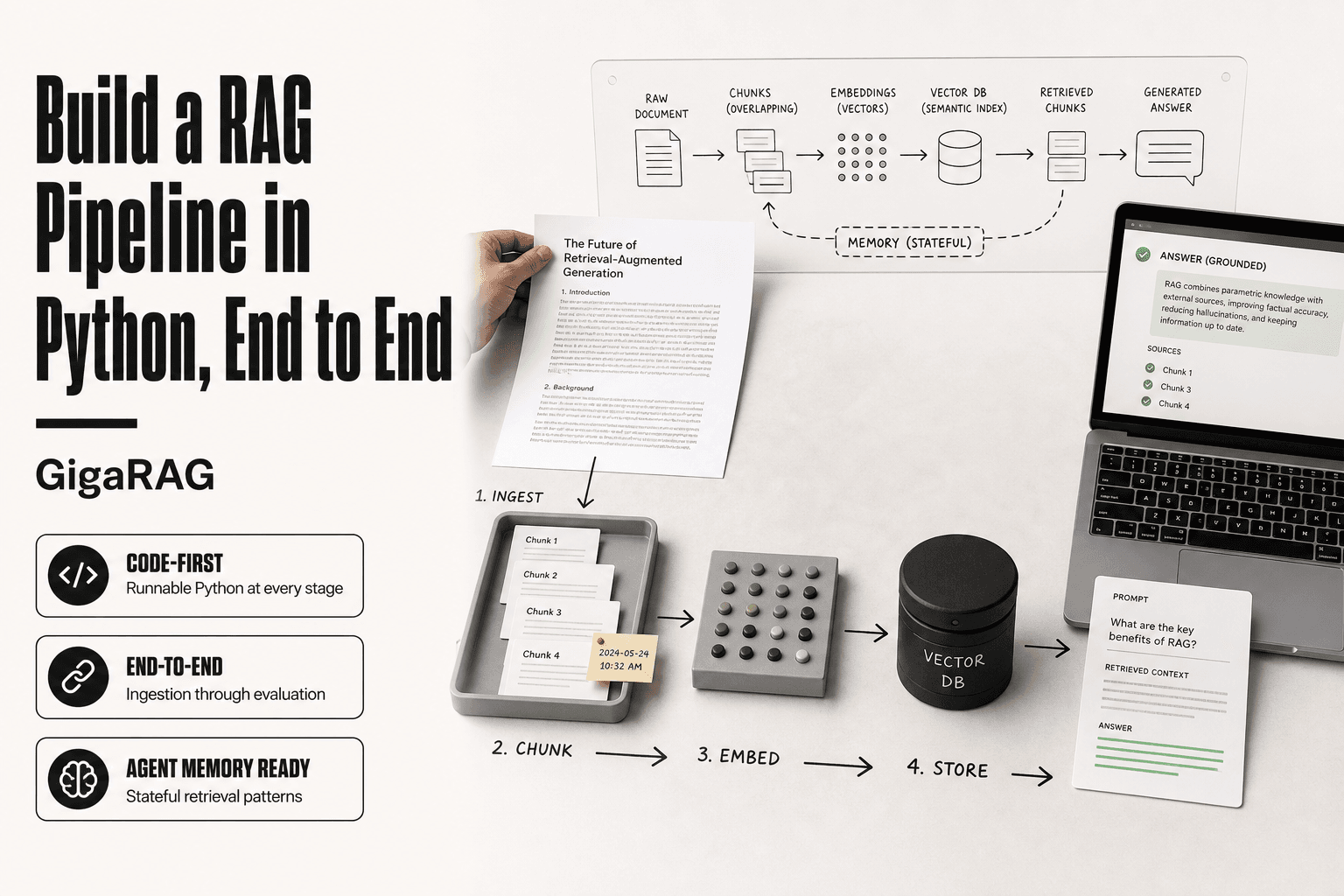
Start with eight nodes: ingest, chunk, embed, upsert, retrieve, memory read, generate, feedback capture. Ingest pulls documents from your source. Chunk splits them. Embed calls your embedding API. Upsert writes vectors to your store. Retrieve queries it. Memory read pulls prior session state. Generate calls the LLM. Feedback capture records what the user did with the answer.
The dependency graph is linear until retrieval. After retrieval, branch on confidence score. If confidence is below your threshold, route to a clarification prompt instead of generation. That's the first place orchestration beats a script: conditional branching based on runtime data, not hardcoded paths.
Step 2: Add retries and checkpointing
Embedding APIs fail. Rate limits hit mid-batch. Wrap the embed node in retry logic with exponential backoff: three attempts, 2s, 4s, 8s. Checkpoint after upsert, not before. If the pipeline dies mid-embed, you resume from the last successful chunk, not from zero.
Step 3: Wire in memory persistence
Memory writes are the riskiest node. A duplicate write corrupts session state. Make the memory write idempotent: include a session ID and turn ID in the payload, and have the memory store reject duplicates. Checkpoint before the write, so a failure after the write doesn't trigger a replay.
Step 4: Add observability hooks
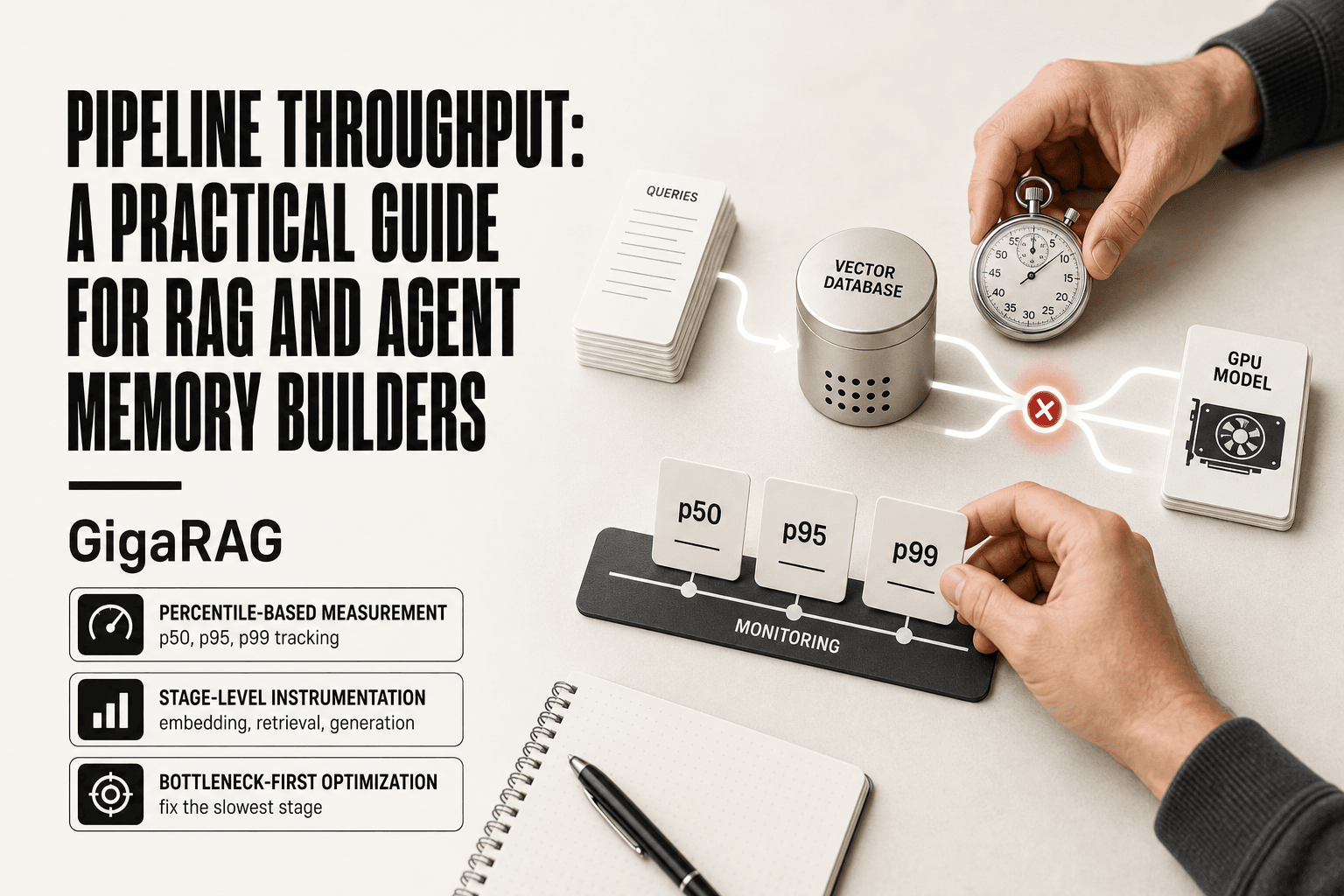
Log retrieval confidence, embedding latency, and memory write status at each node. You can't debug a RAG pipeline from logs that only show task success or failure. You need the intermediate values.
What Pipeline Orchestration Cannot Do for Your RAG System
Orchestration coordinates steps. It does not improve them. A retry on a bad embedding call just gets you the same bad embedding, faster and more reliably.
Quality problems orchestration can't solve
Bad chunking stays bad. If you split documents at arbitrary 500-token boundaries, no DAG fixes the retrieval misses that follow. Poor embedding quality is the same story: orchestration won't rescue a model that maps "bank" and "river" to the same vector. Weak retrieval relevance, prompt engineering failures, hallucination in generation. None of these are coordination problems. They're component problems. Fix the component, then orchestrate it.
When orchestration is overkill
A single script that ingests, embeds, and upserts once a day doesn't need a DAG. It needs a cron job. Orchestration adds operational overhead: a scheduler to run, a UI to maintain, state to debug. If your pipeline has no branching, no retries, no partial failure states, a script is honest about what it is. Add orchestration when failure modes demand it, not before.
Common Mistakes in Pipeline Orchestration for RAG
Most failures come from treating LLM pipelines like batch ETL. They aren't.
Assuming LLM calls are deterministic
The same prompt returns different outputs across runs. Temperature, model updates, and context drift all shift results. If your DAG assumes a retrieval step always returns the same shape, downstream tasks break silently. Design for variance: validate outputs, branch on confidence, and never hard-code expected content.
Skipping idempotency on memory writes
A retry after a partial failure can write the same memory twice. Duplicate entries corrupt retrieval quality and bloat your vector store. Make every memory write idempotent: use deterministic IDs, upsert instead of insert, and check for existing records before writing.
Over-orchestrating simple pipelines
A retrieval flow with one embedding call and one LLM call doesn't need a DAG. It needs a function. Adding orchestration to simple flows creates debugging overhead without preventing failures. Start with a script. Add orchestration when you hit real branching, retries, or partial failure states.
Final Thoughts on Pipeline Orchestration for RAG and Agent Memory
Pipeline orchestration coordinates steps. It doesn't improve them.
That's the whole lesson. A DAG with retries, checkpoints, and observability will run your retrieval and memory writes reliably. It won't fix bad chunking, weak embeddings, or a prompt that returns irrelevant context. Those are quality problems, and orchestration is a coordination layer.
Choose tools based on what your pipeline actually does. Batch-oriented tools like Airflow fit scheduled ingestion. Python-native tools like Prefect and Dagster handle dynamic branching better. If agent memory and RAG retrieval are your core workload, GigaRAG is purpose-built for that: memory persistence, retrieval coordination, and state management without bolting on workarounds.
Start simple. A script handles one embedding call and one LLM call fine. Add orchestration when you hit real failure modes: partial retrievals, memory write retries, or branching on retrieval confidence. Complexity should earn its place.
Frequently Asked Questions
What is orchestration in DevOps?
Orchestration in DevOps refers to the automated coordination of multiple systems, tools, and services to execute complex workflows. It ensures that tasks run in the correct order, handle dependencies, and recover from failures. In RAG pipelines, orchestration manages the flow from data ingestion to retrieval and memory updates.
What are some good orchestration tools for data pipelines?
Popular orchestration tools include Apache Airflow, Dagster, Prefect, Flyte, and Kubeflow Pipelines. For RAG and agent memory, consider tools that support dynamic workflows, state persistence, and integration with vector databases and LLM APIs. Dagster and Prefect are often favored for their modern Python-native interfaces.
What is an example of orchestration?
An example is a RAG pipeline that ingests new documents, chunks them, generates embeddings, updates a vector index, and then refreshes an agent's memory store. Orchestration ensures these steps run in sequence, with retries and monitoring, so the agent always has access to the latest information.
What is the difference between workflow and orchestration?
A workflow is a defined sequence of tasks, while orchestration is the automated execution and management of that workflow, including scheduling, error handling, and state management. Orchestration adds reliability and observability to workflows, especially in complex systems like RAG pipelines.
How does pipeline orchestration handle stale embeddings in RAG?
Orchestration can detect when source documents change and trigger re-embedding and re-indexing tasks. It can also schedule periodic checks for embedding freshness. However, orchestration alone cannot fix poor embedding quality; it only ensures the process runs reliably.
Can orchestration manage agent memory persistence?
Yes, orchestration can coordinate read and write operations to memory stores like Redis or PostgreSQL. It can also version memory states and handle rollbacks if needed. This ensures agents have consistent and up-to-date context across interactions.
About GigaRAG
GigaRAG is for agent memory and RAG pipeline builders. get this right. Whether you are working through pipeline orchestration or something adjacent, we publish what we have actually tested, including where it falls short.