You hand off a task between AI agents when the first one runs out of room, and that's where most developers watch their pipeline fall apart. The first agent has been working through a retrieval-augmented generation task: it pulled documents, ranked them, built embeddings, walked through three rounds of reasoning. Then it hits its context limit. It passes the task to a second agent. And that second agent starts from zero. No retrieved documents. No query history. No intermediate reasoning. It doesn't even know what the first agent was trying to answer.
Handoff is not just message passing. It's memory continuity. That's the gap this guide is built around, and it's the gap platforms like GigaRAG are designed to close by giving agents a shared memory layer and RAG pipeline infrastructure that survives the boundary.
This guide covers a vendor-neutral handoff protocol you can implement in any agent framework, how to preserve RAG context and retrieval state across handoffs, and the honest limits of what handoffs can and cannot fix.
| At a glance | Details |
|---|---|
| Core problem | Context loss when agents hand off tasks |
| Key insight | Handoff is memory continuity, not just messaging |
| What to preserve | Retrieved docs, embeddings, query history, state |
| Protocol style | Vendor-neutral, framework-agnostic template |
| Biggest risk | Receiving agent starts from zero |
| Best practice | Serialize and transfer a context bundle |
In This Guide
- What Is an AI Agent Handoff?
- Message Passing vs Memory Continuity Handoff
- Why Handoffs Break: The Context and Memory Gap
- How To Hand Off A Task Between Ai Agents: A Step-by-Step Guide
- Designing a Handoff Protocol: The Contract Approach
- Preserving RAG Context Across Handoffs
- How to Hand Off a Task Between AI Agents: Step-by-Step
- Common Mistakes to Avoid in Agent Handoffs
- What Handoffs Cannot Solve: Honest Limitations
What Is an AI Agent Handoff?
An AI agent handoff is the transfer of task state, context, and control from one agent to another, so the receiving agent can continue the work without starting from zero.
A handoff happens when one agent hits a boundary it can't cross: a context limit, a skill gap, or a routing decision. The agent packages what it knows and passes it to a second agent that picks up the task.
Handoff vs. message passing: what's the difference?
Message passing sends data. A handoff transfers responsibility. When Agent A sends a message to Agent B, A keeps working. When A hands off to B, A stops and B owns the task from that point forward. The difference is control, not content.
Why handoff is a memory continuity problem
The receiving agent only knows what the payload tells it. Retrieved documents, intermediate reasoning, and query history all live in the first agent's context. If the handoff doesn't carry that state, the second agent starts blind. That's the core challenge: handoff isn't a routing problem. It's a memory problem.
[!note] Handoffs cannot fully preserve context if the receiving agent uses a different embedding model or retrieval index; in such cases, you must re-embed or re-index the transferred documents, which may introduce latency and inconsistency.
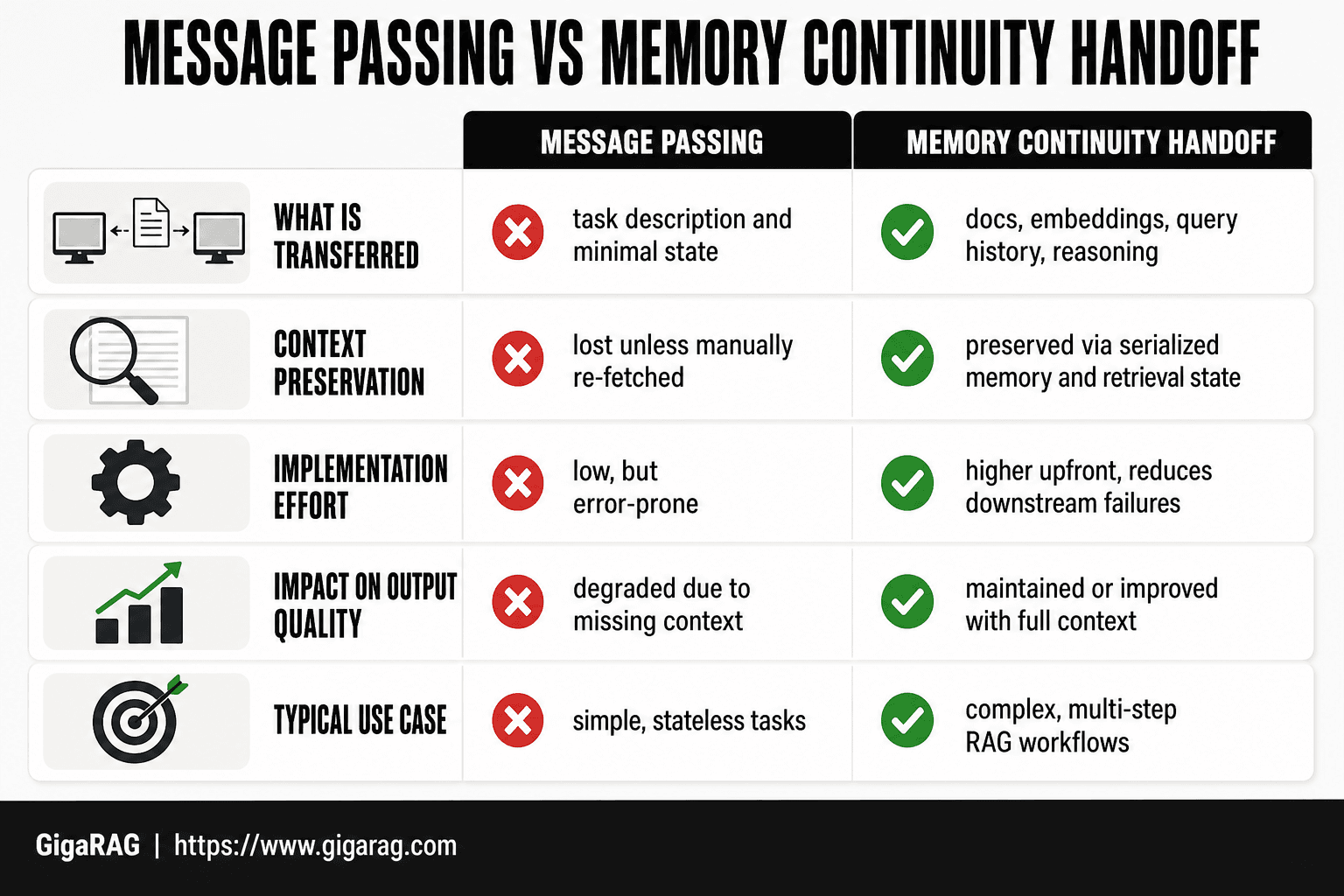
Message Passing vs Memory Continuity Handoff
| Factor | Message Passing | Memory Continuity |
|---|---|---|
| What is transferred | Only the task description and minimal state | Full context bundle: docs, embeddings, query history, reasoning |
| Context preservation | Lost unless manually re-fetched | Preserved via serialized memory and retrieval state |
| Implementation effort | Low, but error-prone | Higher upfront, but reduces downstream failures |
| Impact on output quality | Degraded due to missing context | Maintained or improved with full context |
| Typical use case | Simple, stateless tasks | Complex, multi-step RAG workflows |
Why Handoffs Break: The Context and Memory Gap
Handoffs fail for three reasons, and all three trace back to one thing: the receiving agent doesn't have what the first agent had.
Context window exhaustion as the primary trigger
Every model has a hard limit on how much it can hold at once. When an agent hits that limit mid-task, it has two options: stop or hand off. The handoff is forced, not planned. The agent is already degraded by the time it packages its state, because the context it's trying to summarize is the same context that's overflowing. You're asking a full container to describe its contents.
Lost retrieval state: when the second agent doesn't know what the first agent found
A RAG agent doesn't just reason. It retrieves. It pulls documents, ranks them, and builds answers on top of specific passages. That retrieval state, which documents were pulled, which embeddings matched, which passages were rejected, lives only in the first agent's working memory. If the handoff payload carries just the final answer, the second agent inherits a conclusion with no evidence chain. It can't verify, can't extend, and can't correct.
The memory continuity gap: why message passing isn't enough
Passing a message is not the same as passing a memory. A message says "here's what I concluded." A memory says "here's what I knew, what I retrieved, what I ruled out, and why." Most handoff implementations send the first. The second agent then spends its first turns reconstructing context the first agent already had. That's not a handoff. That's a restart with extra steps.
[!tip] For developers building RAG pipelines, always include the original query and top-k retrieved document IDs in the context bundle so the receiving agent can re-fetch if needed, and consider using a shared vector store to minimize re-embedding overhead.
How To Hand Off A Task Between Ai Agents: A Step-by-Step Guide
- Define a context bundle schema that includes task state, retrieved documents, embeddings, query history, and intermediate reasoning.
- Serialize the context bundle into a portable format (e.g., JSON with base64-encoded embeddings) before handoff.
- Pass the serialized bundle to the receiving agent along with the handoff request, ensuring the transport is secure and reliable.
- Instruct the receiving agent to deserialize and integrate the bundle into its own memory and retrieval systems.
- Validate that the receiving agent has correctly loaded the context by asking it to summarize key retrieved documents and task state.
- Log the handoff event and context bundle for debugging and audit purposes.
- Monitor the receiving agent's performance and compare against the sending agent's baseline to detect context loss.
Designing a Handoff Protocol: The Contract Approach
The fix for the memory continuity gap is a handoff contract: a structured, machine-readable payload that captures task state, retrieved knowledge, and provenance before the first agent lets go. The contract is the boundary object. Both agents agree on its shape ahead of time, so the receiving agent can parse it without guessing.
What goes into a handoff contract?
A contract carries what the second agent needs to continue, not just what the first agent concluded. Task identity comes first: a task_id so the handoff can be traced. Then agent_role, so the receiving agent knows what the first agent was responsible for. Then the working state: retrieved_documents, intermediate_results, and next_steps. Provenance matters too. The contract should record which documents were pulled, which were rejected, and why.
A minimal handoff payload template
Here's a starting shape. It's deliberately small. Add fields only when a real handoff breaks without them.
{
  "task_id": "t_8f3a",
  "agent_role": "research",
  "retrieved_documents": [
    {"id": "doc_42", "relevance": 0.91},
    {"id": "doc_17", "relevance": 0.84}
  ],
  "intermediate_results": ["draft summary", "open questions"],
  "next_steps": ["verify citation", "synthesize final answer"]
}
That's the core. You can extend it with query_history, rejected_documents, or confidence scores when your pipeline needs them.
Structured vs. unstructured handoff: why JSON beats prose
Prose handoffs force the receiving agent to parse natural language, which means it can misread, skip, or hallucinate fields. JSON is explicit. Every field has a name and a type. The receiving agent doesn't interpret; it reads. That's the difference between a contract and a note.
Preserving RAG Context Across Handoffs
The contract carries task state. It doesn't carry the retrieval pipeline itself. When the second agent picks up, it needs the documents the first agent pulled, the embeddings it computed, and the query trail that led there. Otherwise it re-runs retrieval from scratch and gets different results.
What to preserve: retrieved documents, embeddings, and query history
Three things matter. Retrieved documents, because re-fetching may return different or stale content. Embeddings, because recomputing them costs tokens and time, and slight model drift changes similarity scores. Query history, because the second agent needs to know what was already asked and what remains open. Preserve all three, or the handoff is a restart.
Shared memory stores vs. context summarization
You have two options. A shared memory store (Redis, Postgres, or a vector database) holds the full retrieval state. The second agent reads from it directly. No summarization loss. The cost is infrastructure: you need a store both agents can reach.
Context summarization compresses retrieved documents into a paragraph the second agent reads. Cheaper, but lossy. Summaries drop exact quotes, page numbers, and low-ranked documents that might matter later. Use summarization only when the store is unavailable or the task is simple.
Provenance tracking: keeping the chain of retrieval intact
Provenance means recording where each retrieved document came from and which agent pulled it. Without it, the second agent can't tell good retrieval from bad. It trusts everything or nothing. Attach a source_id and retrieval_agent to every document in the contract. The chain stays intact, and debugging gets easier.
How to Hand Off a Task Between AI Agents: Step-by-Step
You've designed the contract and decided how to preserve RAG state. Now wire it up. These six steps work with any agent framework.
Step 1: Define the handoff trigger
Pick the exact condition that fires a handoff. Context window at 85% capacity. A task type the current agent doesn't handle. A confidence score below threshold. Write it as a rule, not a feeling. If the trigger is vague, you'll get handoffs at the wrong time or none at all.
Step 2: Design the handoff contract
Build the JSON payload from the previous section. Include task_id, agent_role, retrieved_documents, embeddings reference, query_history, and next_steps. Keep it machine-readable. The receiving agent parses it, not a human.
Step 3: Implement the handoff mechanism
Choose the transport. A tool call, a message queue, or a shared database row. The first agent writes the contract, the second agent reads it. Don't pass prose back and forth. Pass the structured payload.
Step 4: Preserve RAG context and memory
Point the contract at the shared memory store. If you're using context summarization instead, generate it at handoff time and attach it. The second agent loads the store or the summary before doing anything else.
Step 5: Test for loops and failures
Run a handoff where the second agent hands back to the first. Does it stop? Add a max_handoff_count to the contract. Increment it each transfer. Kill the task at three.
Step 6: Monitor handoff quality
Log every handoff: trigger, payload size, retrieval state preserved, time to first token on the receiving agent. Watch for handoffs that lose documents or restart retrieval. That's your signal the contract is too thin.
That's how to hand off a task between AI agents without losing the thread.
Common Mistakes to Avoid in Agent Handoffs
Most handoff failures aren't architectural. They're the same five mistakes repeated across codebases.
Losing retrieval state between agents
The first agent retrieves documents, filters them, ranks them. The second agent starts from zero and re-runs retrieval. You lose the ranking decisions and the rejected candidates. Pass the retrieved_documents array and the query_history in the contract. Don't make the second agent guess what the first one found.
Creating infinite handoff loops
Agent A hands to B, B hands back to A. No exit condition. Add a max_handoff_count field and increment it on every transfer. Kill the task at three. Test the loop explicitly before shipping.
Over-summarizing context and losing critical details
Summarization saves tokens but drops specifics. A summary that says "customer wants a refund" loses the order number, the reason, and the prior conversation. If the detail matters for the next step, it goes in the contract as a field, not in a prose summary.
Treating handoff as a simple API call
A handoff isn't a function call. It's a state transfer. If you treat it like a REST endpoint, you'll pass a message and lose the memory. The contract has to carry retrieval state, provenance, and task history. Skip that and the second agent starts blind.
What Handoffs Cannot Solve: Honest Limitations
Handoffs are a mechanism, not a memory. They move state from one agent to another. They don't create state that was never captured. If the first agent didn't write down what it found, the second agent can't recover it. No protocol fixes that.
Handoffs cannot restore context you didn't preserve
If the first agent retrieved documents but never stored them, the handoff contract has nothing to carry. The second agent starts blind regardless of how well you designed the transfer. Preservation has to happen before the handoff, not during it. You can't hand off what you didn't keep.
Handoffs cannot fix poor task decomposition
A handoff between two agents working on a badly split task just moves the confusion. If the subtask boundaries are fuzzy, the receiving agent inherits the ambiguity. The contract can carry state, but it can't clarify a task that was never clear to begin with. Fix the decomposition first. Then design the handoff.
Handoffs are not a substitute for memory architecture
A shared memory store, a retrieval pipeline, a provenance log. These are infrastructure. A handoff protocol sits on top of them. If you skip the architecture and rely on handoffs alone, you're passing messages between agents that keep forgetting. The handoff works. The system doesn't.
That's the honest limit of how to hand off a task between AI agents: the protocol only carries what you captured.
Frequently Asked Questions
What is handoff in agentic AI?
Handoff in agentic AI refers to the process where one AI agent transfers a task to another agent, typically along with some context or state. It is a coordination mechanism in multi-agent systems to distribute workload or specialize capabilities.
How to make AI agents talk to each other?
AI agents can communicate through message passing protocols, shared memory stores, or direct API calls. The key is to define a common data format and transport layer, such as JSON over HTTP or a message queue, and ensure both agents can serialize and deserialize the shared context.
How to isolate AI agents?
Isolation of AI agents can be achieved through sandboxing, separate memory spaces, and access controls. However, for handoffs, you need controlled sharing; use a context bundle that is explicitly passed rather than shared global state to maintain isolation while enabling continuity.
Who are the big 4 AI agents?
The term 'big 4 AI agents' is not standard; it may refer to major AI assistant platforms like OpenAI's ChatGPT, Google's Gemini, Microsoft's Copilot, and Anthropic's Claude. These are general-purpose agents, not necessarily designed for multi-agent handoffs.
What should be included in a handoff context bundle?
A context bundle should include the task description, current state, retrieved documents, embeddings (or references to them), query history, and any intermediate reasoning. This ensures the receiving agent can continue without losing prior work.
How to handle embeddings when handing off between agents?
If both agents use the same embedding model and vector store, you can pass document IDs or vectors directly. Otherwise, you must re-embed the documents using the receiving agent's model, which can be costly; consider standardizing on a shared embedding model for interoperability.
About GigaRAG
GigaRAG is for agent memory and RAG pipeline builders. get this right. Whether you are working through How to Hand Off a Task Between AI Agents or something adjacent, we publish what we have actually tested, including where it falls short.