What Is a Knowledge Graph? A Practical Guide for LLM Engineers
What is a knowledge graph for LLM engineers? It's the question you hit when your RAG pipeline keeps failing multi-hop questions, or your agent forgets what the user said three turns ago. Vector-only retrieval is great at finding similar text. It's bad at knowing that Alice reports to Bob, Bob owns the Acme account, and therefore Alice's permissions flow through Bob. A knowledge graph fixes that. It's a structured map of entities and their relationships, stored as nodes and edges, that gives an LLM explicit relational context instead of hoping the embeddings capture it. GigaRAG was built for exactly this: agent memory and RAG pipelines that need persistent, structured recall. But here's the honest part. A knowledge graph is not a silver bullet. It adds schema design, maintenance, and real infrastructure cost, and plenty of use cases don't need it. This guide covers what a KG actually is, how it works with LLMs, when it helps, when it doesn't, how to build one, and how to evaluate it in production.
| At a glance | Details |
|---|---|
| What it is | Entities and typed relationships stored as a graph |
| Core unit | Triples: subject, predicate, object |
| Best for | Multi-hop queries and persistent agent memory |
| Typical stack | Extraction LLM, graph store, retrieval layer |
| Main cost | Schema design and extraction quality upkeep |
| Skip when | Single-hop lookups over small static corpora |
In This Guide
- What Is a Knowledge Graph?
- Knowledge Graph vs Vector RAG: Which Fits Your Pipeline?
- How Knowledge Graphs and LLMs Work Together
- What Is A Knowledge Graph For Llm Engineers: A Step-by-Step Guide
- Knowledge Graphs for Agent Memory
- Knowledge Graphs in RAG Pipelines: GraphRAG Explained
- When NOT to Use a Knowledge Graph
- How to Build a Knowledge Graph for LLM Applications
- Evaluating Knowledge Graph Quality in Production
- Tools and Frameworks for LLM Knowledge Graphs
- Common Mistakes When Building a Knowledge Graph for LLM Engineers
- Final Thoughts: Is a Knowledge Graph Right for Your LLM Project?
What Is a Knowledge Graph?
A knowledge graph is a structured map of entities and their relationships, stored as nodes and edges, that gives LLMs explicit relational context instead of making them infer it from raw text.
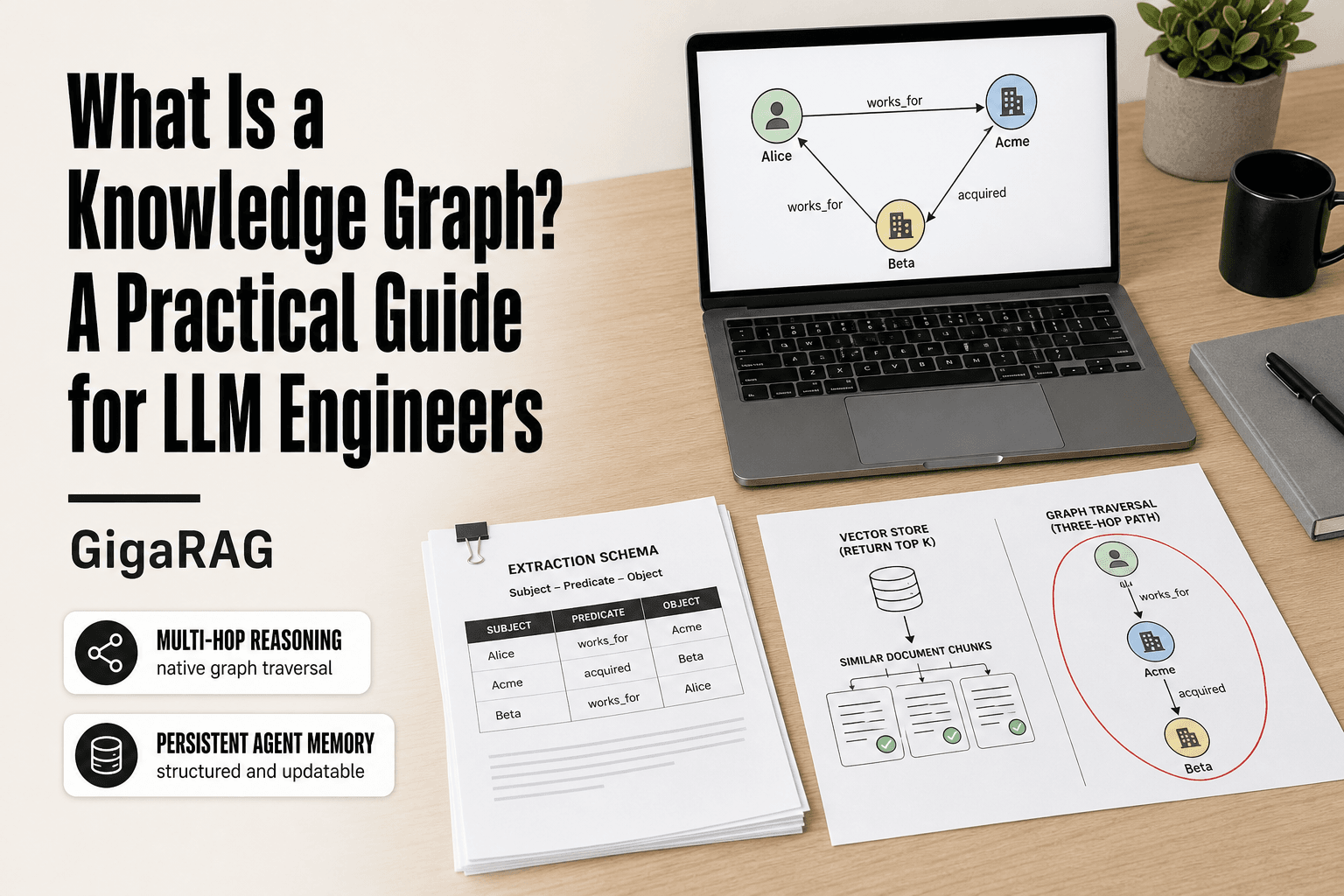
A vector store says "these chunks are similar." A knowledge graph says "Alice works for Acme, Acme acquired Beta, Beta competes with Gamma." That second sentence carries structure the first one can't.
Nodes, edges, and triples: the building blocks
Nodes are entities: people, companies, products, events. Edges are the relationships between them: works_for, acquired, competes_with. A triple packages one fact as subject-predicate-object: (Alice, works_for, Acme). That's the whole unit.
Graphs chain triples into paths. Alice works for Acme, Acme acquired Beta, so Alice indirectly has a connection to Beta. A vector search won't surface that unless the text says it outright. A graph traversal will.
Schema-based vs. schema-free knowledge graphs
A schema-based KG enforces an ontology up front. You define entity types and allowed relationships before you load data. This keeps the graph clean but slows you down when the domain shifts.
A schema-free KG lets you add nodes and edges as you discover them. LLMs extract whatever they find, and the graph grows organically. It's messier, but it's also how most LLM-built graphs actually start. You can add constraints later once you see what the data looks like.
How a KG differs from a database, a vector store, and an ontology
A relational database stores rows and columns. You query with SQL, and joins are explicit but rigid. A KG stores relationships as first-class objects, which makes multi-hop queries natural.
A vector store stores embeddings and returns similar chunks. It's great for semantic search, but it has no notion of direction or relationship type. "Alice works for Acme" and "Acme works for Alice" produce nearly identical embeddings. A KG keeps those distinct.
An ontology is the rulebook. A knowledge graph is the data that follows the rules, or doesn't, if you go schema-free. You can have an ontology without a graph, and a graph without a formal ontology.
[!note] A knowledge graph does not replace your vector index; most production systems run both, using vectors for broad recall and the graph for relationship-aware retrieval.
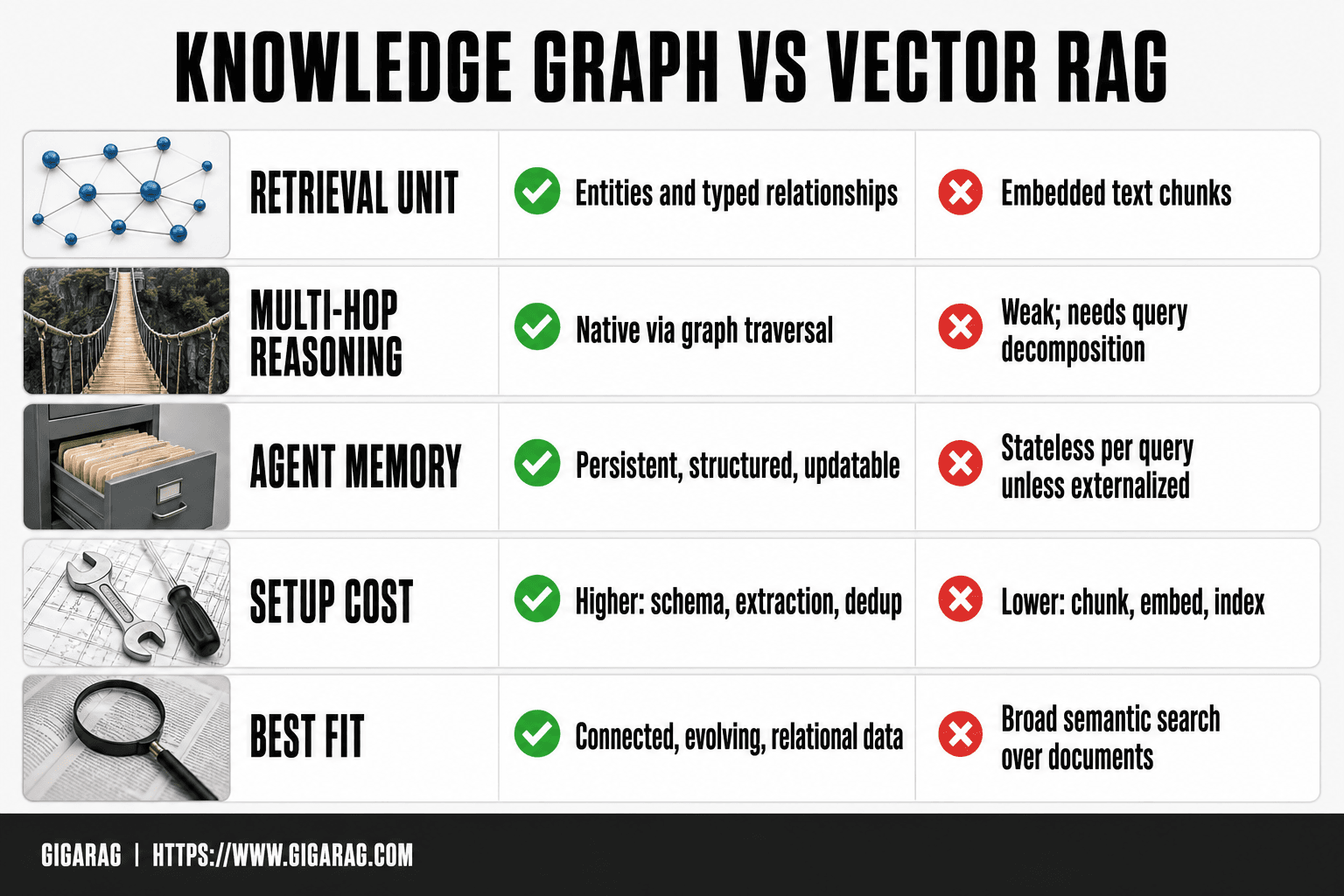
Knowledge Graph vs Vector RAG: Which Fits Your Pipeline?
| Factor | Knowledge Graph | Vector RAG |
|---|---|---|
| Retrieval unit | Entities and typed relationships | Embedded text chunks |
| Multi-hop reasoning | Native via graph traversal | Weak; needs query decomposition |
| Agent memory | Persistent, structured, updatable | Stateless per query unless externalized |
| Setup cost | Higher: schema, extraction, dedup | Lower: chunk, embed, index |
| Best fit | Connected, evolving, relational data | Broad semantic search over documents |
How Knowledge Graphs and LLMs Work Together
LLMs are pattern matchers trained on text. Knowledge graphs are explicit stores of entities and relationships. Each covers a weakness in the other.
What LLMs are bad at: relational reasoning and long-term memory
An LLM predicts the next token. It doesn't natively track that Alice works for Acme, Acme acquired Beta, and Beta competes with Gamma as three linked facts. Ask it a multi-hop question across those relationships, and it may guess. It may also contradict itself across turns, because its context window is the only memory it has, and that window fills up.
The model can reason about relationships when they're spelled out in the prompt. The problem is getting the right relationships into the prompt in the first place. Vector retrieval helps with topical similarity, but it doesn't preserve direction or relationship type.
What KGs give LLMs: explicit structure and multi-hop paths
A knowledge graph stores relationships as first-class objects. When you query it, you get back paths, not just similar chunks. That means the LLM receives the exact chain of facts it needs: Alice works for Acme, Acme acquired Beta. The model doesn't have to infer the connection. It just reads it.
This is grounding. The graph constrains what the model can claim, because the claims come from a structure you built and can inspect. Multi-hop questions become graph traversals instead of guesswork.
What LLMs give KGs: automated construction and natural language querying
Building a knowledge graph by hand is slow. You need someone to read documents, identify entities, and type out triples. An LLM does this in seconds. You feed it text, it extracts entities and relations, and you load the triples into the graph. The extraction isn't perfect, but it's fast enough that you can build a graph from thousands of documents without a team of annotators.
LLMs also make querying easier. Instead of writing Cypher or SPARQL, you can ask a question in plain English, and the LLM translates it into a graph query. The graph does the traversal. The LLM does the translation and the final answer. Each tool does what it's good at.
[!tip] For agent memory specifically, version your graph writes with timestamps and source IDs so you can audit, roll back, or expire facts when the underlying data changes.
What Is A Knowledge Graph For Llm Engineers: A Step-by-Step Guide
- Define the entity and relationship types your queries actually need
- Extract candidate triples from source text with an LLM using a constrained schema
- Normalize and deduplicate entities across documents before loading
- Load triples into a graph store and index the properties you filter on
- Add a retrieval layer that converts a user question into a graph query
- Ground the LLM's answer in the retrieved subgraph and cite the source triples
- Evaluate retrieval precision and answer accuracy, then iterate on the schema
Knowledge Graphs for Agent Memory
An agent that only keeps vector embeddings of past turns has a working memory, not a memory. It can retrieve similar text. It can't retrieve the fact that Alice is Bob's manager, or that Bob approved the Q3 budget, or that the budget was later revised. Those relationships are what let an agent act consistently across a long conversation.
Why vector-only agent memory fails at relational recall
Vector stores retrieve by similarity. Ask "who approved the budget?" and you get back chunks that mention budgets and approvals. You might get the right chunk. You might get three chunks about different budgets, different people, and different quarters, and the model has to sort out which one applies.
The failure is structural. A vector embedding flattens a relationship into a position in space. "Alice manages Bob" and "Bob manages Alice" produce embeddings that are close together, because the words are nearly identical. But the direction of the relationship is the entire point. A vector store can't tell you which one is true.
How a KG stores agent state: entities, facts, and session context
A knowledge graph stores agent state as triples. Each triple is a fact with a direction: Alice manages Bob. Bob approved Budget-Q3. Budget-Q3 was revised to 1.2 million. The agent reads these triples as explicit context, not as fuzzy similarity.
Session context works the same way. You create a Session node, link it to the entities the user mentioned, and attach facts as they emerge. When the user says "actually, change that to 1.5 million," you update the triple. The old fact is gone or versioned. The agent doesn't have to guess which number is current.
The graph also persists across sessions. A vector store can store conversation history, but it can't tell you that the user's company acquired a competitor last month unless that fact happens to appear in a retrieved chunk. A graph stores it as a relationship and keeps it available.
Example: a multi-turn agent conversation with and without a KG
A user asks an agent to help plan a product launch. Over ten turns, they mention the product name, the launch date, the target market, three competitors, and a budget constraint.
Without a KG, the agent holds all of this in its context window. By turn eight, the window is crowded. The agent starts dropping details or contradicting itself. It says the launch is in March when the user said June. It forgets the budget constraint entirely.
With a KG, each turn updates the graph. The product node links to a launch date, a market, three competitor nodes, and a budget figure. When the user asks "will we beat Competitor X on price?" the agent queries the graph, pulls the competitor's price point and the budget constraint, and answers with the actual numbers. The context window stays lean. The graph does the remembering.
Knowledge Graphs in RAG Pipelines: GraphRAG Explained
A knowledge graph is not better than RAG. It's a different retrieval layer you can put under RAG. The question isn't which one wins. It's what kind of questions your users ask.
VectorRAG vs. GraphRAG vs. HybridRAG: what's the difference?
VectorRAG is the default. You embed documents, store the embeddings, and retrieve chunks by similarity to the query. It works well for "find me the passage about X." It fails when the answer requires connecting facts that live in different chunks.
GraphRAG replaces or augments the vector store with a knowledge graph. The pipeline extracts entities and relationships from your corpus, builds a graph, and retrieves by traversing edges instead of comparing embeddings. Ask "who manages the person who approved the Q3 budget?" and GraphRAG walks the path: Budget-Q3 -> approved by -> Bob -> managed by -> Alice. VectorRAG would need the answer to already exist in a single chunk.
HybridRAG runs both. It retrieves vector chunks for surface-level similarity and graph paths for relational structure, then merges the results before the LLM sees them. The merge step is where most implementations get sloppy.
How GraphRAG retrieval works: from query to graph traversal
The query goes through an LLM first. The LLM extracts the entities and the relationship the user is asking about. "Who manages Bob?" becomes a lookup for a manages edge pointing to Bob.
Then the graph does the work. A traversal starts at the Bob node, follows the manages edge in the correct direction, and returns Alice. For multi-hop questions, the traversal continues: Alice -> approved -> Budget-Q3. Each hop adds one fact. The LLM gets a path, not a pile of similar chunks.
The main catch is extraction quality. If the LLM misreads the query and extracts the wrong entity, or if the graph is missing the edge, the traversal returns nothing useful. VectorRAG degrades gracefully with fuzzy matches. GraphRAG fails hard on missing edges.
Cost and complexity tradeoffs of each approach
VectorRAG is the cheapest to build. You need embeddings and a vector store. That's it. Retrieval is fast, and the infrastructure is mature.
GraphRAG costs more up front. You need an extraction pipeline, an ontology or schema decision, a graph database, and a traversal layer. Every new document type means new extraction prompts and new edge cases. The payoff is multi-hop accuracy that vector-only retrieval can't touch.
HybridRAG costs the most and is the hardest to run well. You're maintaining two retrieval systems and a merge step. The merge step has to rank vector chunks against graph paths, which is not a solved problem. If you don't need multi-hop reasoning, HybridRAG is overkill. If you do need it, GraphRAG alone often gets you most of the way.
In practice, start with VectorRAG. Add GraphRAG when you can name the specific multi-hop questions your users ask that vector retrieval keeps missing. Skip HybridRAG until you've measured that gap and know the graph alone isn't closing it.
When NOT to Use a Knowledge Graph
A knowledge graph is a tool, not a default. You don't need one just because your RAG pipeline exists. You need one when your queries require connecting facts that live in different places. If they don't, a graph adds cost without adding answers.
Signs your use case doesn't need a knowledge graph
Your data is small. A few hundred documents, a few thousand rows. Vector retrieval over that corpus already works, and the multi-hop questions you're failing on can be counted on one hand. Adding a graph means building an extraction pipeline and a database for a problem you don't have.
Your queries are simple lookups. "What's the refund policy?" or "Find the pricing page." These are single-chunk retrievals. A vector store handles them in milliseconds. A graph traversal adds latency and a schema you have to maintain.
Your data has no relational structure. If your corpus is marketing copy, blog posts, or support tickets where entities don't connect to each other in meaningful ways, there's nothing for a graph to model. You'd be building nodes and edges for the sake of building them.
Your write frequency is high. Graphs are expensive to update. Every new entity and relationship needs extraction, deduplication, and insertion. If your data changes hourly and your queries are simple, a document store or vector store wins on operational cost.
Alternatives: vector stores, SQL, document stores, or plain prompts
Vector stores handle similarity search and single-hop retrieval. If your users ask "find me the thing about X," that's enough.
SQL handles structured data with known relationships. If your data already lives in tables with foreign keys, you already have a graph. It's called a relational database. Query it directly.
Document stores handle unstructured text with simple filters. If you need keyword search plus metadata filtering, MongoDB or Elasticsearch gets you there without an ontology.
Plain prompts handle small contexts. If your entire knowledge base fits in a context window, paste it in. No retrieval layer at all.
The hidden costs: maintenance, schema design, and expertise
Maintenance is the one nobody budgets for. Entities drift. Relationships change. Your extraction prompts need updates as your data evolves. A graph that isn't maintained becomes a source of wrong answers, which is worse than no graph.
Schema design is a trap. You can spend weeks modeling your ontology before you've extracted a single entity. Most teams over-engineer the schema and under-deliver the extraction.
Expertise is scarce. Graph databases, traversal queries, and entity resolution are specialized skills. If nobody on your team has run a graph in production, you're signing up for a learning curve on top of your actual product work.
The honest answer: start with the simplest thing that answers your users' questions. Add a knowledge graph when you can name the specific multi-hop queries you're failing. Not before.
How to Build a Knowledge Graph for LLM Applications
You've decided a knowledge graph is worth it. You can name the multi-hop queries you're failing. Here's the path from zero to a working KG in your RAG or agent pipeline. It's four steps, and you can run the first three in a weekend.
Step 1: Design your ontology (or go schema-free)
Start schema-free. Don't model entity types and relationships before you've seen your data. Run extraction on a sample of your corpus, look at what entities and relations actually appear, then formalize the ones that matter. A schema you design before extraction is a guess. A schema you design after extraction is a map.
If you do need a schema, keep it small. Five to ten entity types and ten to twenty relation types covers most use cases. Every type you add is a type you have to maintain.
Step 2: Extract entities and relations with LLMs
Feed chunks of your corpus to an LLM with a prompt that returns triples: subject, predicate, object. Use a JSON schema in your prompt so the output is parseable. LangChain and LlamaIndex both ship graph extraction modules that wrap this pattern.
The catch: LLM extraction is noisy. You'll get duplicate entities, inconsistent names, and relations that don't make sense. That's expected. Don't try to fix it in the prompt. Fix it in the next step.
Step 3: Fuse and deduplicate knowledge
Entity resolution is where most KGs fall apart. "Acme Corp," "Acme Corporation," and "Acme Inc." are the same entity, but your extractor doesn't know that. Run a deduplication pass: embed each entity name, cluster near-duplicates, and merge them. For high-stakes merges, have an LLM confirm the match before you combine.
Relations need the same treatment. Two extractions might give you "Alice works at Acme" and "Alice is employed by Acme Corp." Normalize relation names to a fixed vocabulary. Merge the triples.
Step 4: Integrate with your RAG or agent pipeline
Load the fused graph into a graph database. Neo4j is the default choice; Memgraph works if you want in-memory speed. Then wire it into retrieval: for a query, extract entities with an LLM, look them up in the graph, traverse one or two hops, and feed the resulting subgraph into your prompt as context.
For agents, write entity and relation updates back to the graph as the agent learns new facts. That's what turns a static graph into agent memory.
Start with one hop. Multi-hop traversal is where latency and complexity explode. You can add depth once you've measured that one hop isn't enough.
Evaluating Knowledge Graph Quality in Production
You built the graph. Now you need to know if it's any good. Most teams skip this step and find out the hard way when retrieval returns wrong answers. The honest answer is you need three layers of metrics: extraction accuracy, graph completeness, and downstream task performance. Each catches a different failure mode.
Entity and relation extraction accuracy
Measure precision and recall on a labeled sample. Take 200 to 500 documents, hand-label the entities and relations, and compare against what your extractor produced. Precision tells you how many extracted triples are correct. Recall tells you how many real triples you missed.
Aim for precision above 0.90 before you trust the graph in production. Recall below 0.70 means your extractor is blind to a third of your data. Fix precision first: wrong triples poison retrieval more than missing ones do.
Graph completeness and coverage
Completeness asks a different question: does the graph contain the entities and relations your queries actually need? Sample 100 real user queries, check how many can be answered from the graph alone. If the number is below 0.80, your coverage is the bottleneck, not your retrieval.
Also track entity resolution quality. Duplicate entities that should have been merged are a silent killer. Spot-check 50 entity clusters per week. If more than 5 percent contain obvious duplicates, your fusion step needs work.
Downstream metrics: retrieval quality and task performance
The graph can score well on extraction and still fail your users. Measure what matters: retrieval hit rate, answer correctness, and latency. For RAG, compare answer quality with and without the graph on the same query set. If the graph doesn't improve answers, it's overhead.
For agents, track task completion rate across sessions. A KG that improves memory should show up as fewer repeated questions and fewer wrong turns. If you can't measure a downstream difference, you don't have a quality problem. You have a relevance problem.
Tools and Frameworks for LLM Knowledge Graphs
The tooling landscape splits into three layers: graph databases that store the graph, LLM frameworks that build and query it, and platforms that package both. You don't need all three. Most teams start with one database and one framework, then add a platform only when maintenance becomes a full-time job.
Graph databases: Neo4j, Memgraph, and others
Neo4j is the default choice for a reason: Cypher is the most documented graph query language, and the community is large enough that most problems have a known answer. Memgraph is a solid alternative when you need in-memory speed and don't want to pay Neo4j's enterprise pricing. Both handle the core job: storing nodes, edges, and properties, then traversing them fast.
Keep in mind that graph databases are not magic. If your graph has under 10,000 nodes, a Postgres table with a join table will work fine and cost you nothing new to learn. The database matters when traversal depth and relationship density grow past what SQL joins can handle without falling over.
LLM frameworks: LangChain, LlamaIndex, and graph transformers
LangChain and LlamaIndex both ship graph integrations. LangChain's LLMGraphTransformer extracts entities and relations from text and writes them to Neo4j or Memgraph. LlamaIndex offers KnowledgeGraphIndex for building a graph from documents and querying it alongside vector retrieval. Both are reasonable starting points.
The main catch is that these integrations are thin wrappers. They handle extraction and basic querying, but entity resolution, schema evolution, and deduplication are still on you. Graph transformers like GraphSAGE and GAT are a different beast entirely: they learn embeddings over graph structure, useful for node classification and link prediction, but overkill for most RAG and agent memory work.
Purpose-built platforms for agent memory and RAG
If you're building agent memory or a GraphRAG pipeline and don't want to assemble the pieces yourself, a platform can save you the integration work. GigaRAG is one option here: it packages graph construction, storage, and retrieval for agent memory and RAG use cases. The tradeoff is less control over the underlying graph and a dependency on the vendor's roadmap.
The honest answer is that platforms make sense when the alternative is hiring a graph engineer. If you have one on staff, you'll get more flexibility from Neo4j plus your own pipeline. If you don't, a platform gets you to production faster, with the usual lock-in caveats.
Common Mistakes When Building a Knowledge Graph for LLM Engineers
Most failed knowledge graph projects don't fail because the graph database was wrong. They fail because the team made one of three mistakes early and then spent months paying for it. Here's what they look like in practice.
Over-engineering the ontology before you have data
The classic failure mode: you spend three weeks designing a perfect ontology with 40 entity types and 60 relation types. Then you run extraction on your actual documents and discover that 30 of those types never appear, and the relations you actually need aren't in the schema at all.
Start schema-free. Let the LLM extract whatever entities and relations it finds, then look at what actually shows up. After a few hundred documents, patterns emerge. Promote the recurring ones to a formal schema. This takes a day, not a month.
Skipping entity resolution and deduplication
LLMs are sloppy at knowing when two mentions are the same thing. "Apple" the company and "Apple" the fruit. "John Smith" in document one and "J. Smith" in document two. If you skip entity resolution, your graph fills with duplicate nodes, and multi-hop queries return garbage because the path breaks at the duplicate.
The fix is a deduplication pass after extraction. Compare candidate entities by name similarity, context, and embedding distance. Merge anything above your threshold. It's boring work. It's also the difference between a graph that answers questions and one that just stores noise.
Treating the KG as a one-time build instead of a living system
A knowledge graph goes stale. New documents arrive, old facts change, entities merge or split. If you built the graph once and left it, you now have a snapshot of what your data looked like three months ago. That's worse than no graph at all, because it looks authoritative.
Build for incremental updates from day one. That means versioning your extraction pipeline, scheduling re-extraction on changed documents, and tracking when each node and edge was last updated. The maintenance cost is real. Budget for it before you start.
Final Thoughts: Is a Knowledge Graph Right for Your LLM Project?
The decision comes down to one question: do your queries need relationships, or just similarity?
If your RAG pipeline fails on multi-hop questions, or your agent forgets who the user is between turns, a knowledge graph is worth the investment. The relational structure gives you something vector stores can't: explicit paths between entities that survive context window resets.
If your use case is simple lookup, small datasets, or high write frequency, skip it. A vector store or SQL database will get you there faster and cheaper. The honest answer is that most projects don't need a knowledge graph. The ones that do tend to know it within a week of hitting retrieval limits.
That's what a knowledge graph for LLM engineers is: a targeted fix for relational recall, not a default architecture.
Start small. Build a schema-free KG on a few hundred documents, measure retrieval quality against your vector-only baseline, and scale only if the numbers justify it. If you're building agent memory or a RAG pipeline and want the graph layer handled for you, GigaRAG is built for exactly that. Otherwise, Neo4j and a weekend of extraction code will tell you what you need to know.
Frequently Asked Questions
What is an LLM knowledge graph?
It is a graph of entities and typed relationships that an LLM either queries for grounded context or helps construct from unstructured text. The graph supplies structure and multi-hop connectivity; the LLM supplies language understanding and generation.
Is a knowledge graph better than RAG?
Neither is universally better. Vector RAG excels at broad semantic search over documents, while a knowledge graph excels at multi-hop questions and persistent, updatable memory. Many production systems combine both rather than choosing one.
Is the knowledge graph still relevant?
Yes. As LLM applications move toward agents that need durable memory and relationship-aware retrieval, graphs address failure modes that flat vector search handles poorly. Relevance has shifted from web-scale graphs to task-specific ones.
When should I NOT use a knowledge graph?
Skip it when your queries are single-hop lookups, your corpus is small and static, or you lack the engineering capacity to maintain extraction quality and schema evolution. In those cases, a well-tuned vector index or even keyword search is simpler and sufficient.
How do I evaluate knowledge graph quality in production?
Track extraction precision and recall against a labeled sample, entity resolution error rates, and retrieval hit rate on real queries. Pair those with end-to-end answer accuracy and latency so graph quality is tied to user-visible outcomes.
What tools can I use to build a knowledge graph with LLMs?
Common patterns include LLM-based triple extraction with schema constraints, graph stores for persistence, and retrieval layers that translate questions into graph queries. Tool choices vary; pick based on your existing stack and query patterns rather than benchmarks alone.
Can a knowledge graph serve as agent memory?
Yes. A graph gives agents structured, persistent memory where facts and relationships can be added, updated, or expired over time. This supports cross-turn context and auditable recall better than stuffing raw conversation history into a prompt.
About GigaRAG
GigaRAG is for agent memory and RAG pipeline builders. get this right. Whether you are working through what is a knowledge graph, for llm engineers or something adjacent, we publish what we have actually tested, including where it falls short.