What Is GraphRAG? A Practical Guide for RAG Pipeline Builders
Your support agent gets the question: "Which customer reported the same billing bug as the one in last month's escalation, and what did we tell them?" Vector RAG returns three chunks about billing bugs. None of them connect the two customers. The answer is wrong, but it's confident.
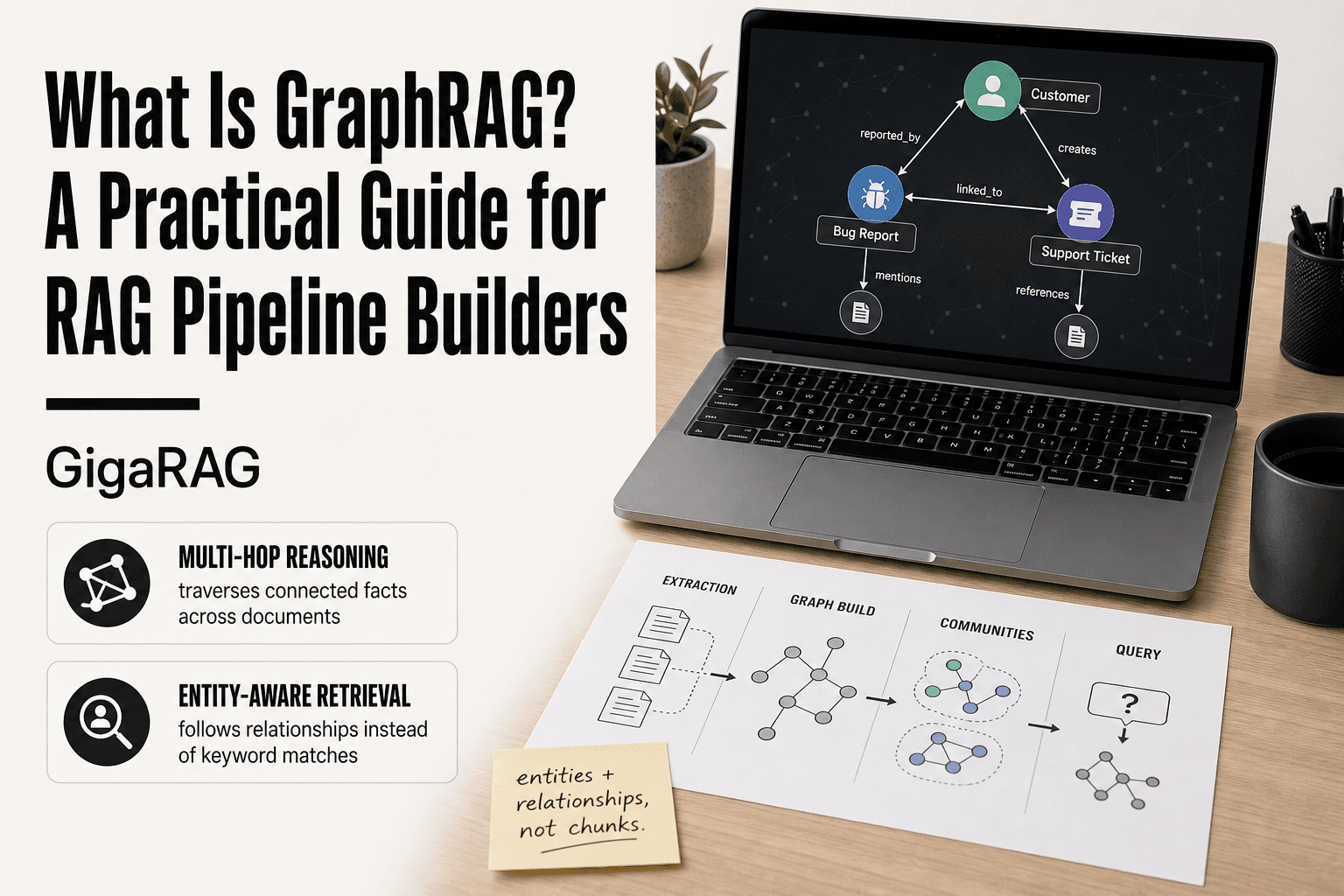
That's the failure mode that defines what GraphRAG is for. Traditional RAG retrieves text chunks by similarity. It doesn't know that a customer, a bug report, and a support ticket are related entities. GraphRAG indexes those entities and the relationships between them, so retrieval follows connections instead of just matching words.
This guide is for RAG pipeline builders and agent memory developers deciding whether GraphRAG is worth the added complexity. It covers the definition, the full pipeline from documents to graph to answers, how it differs from vector RAG, honest limitations, and the cases where you should skip it entirely. GigaRAG operationalizes this idea for agent memory and RAG pipelines, but the mechanics here apply to any implementation.
| At a glance | Details |
|---|---|
| What it is | RAG over a knowledge graph, not just vectors |
| Core idea | Entities and relationships become retrievable context |
| Best for | Multi-hop questions and relationship-heavy data |
| Main cost | Graph build and maintenance overhead |
| Typical stack | LLM extraction plus graph store plus vector index |
| Not a silver bullet | Poor fit for simple lookup or tiny corpora |
In This Guide
- What Is GraphRAG? A Simple Definition
- GraphRAG vs Traditional Vector RAG: Key Differences
- How GraphRAG Works: From Documents to Graph to Answers
- What Is Graphrag: A Step-by-Step Guide
- GraphRAG vs Traditional RAG: Key Differences That Matter
- Why GraphRAG Matters for Agent Memory and RAG Pipelines
- When to Use GraphRAG (and When to Skip It)
- Common Mistakes When Implementing GraphRAG
- What GraphRAG Cannot Do: Honest Limitations
- How RAG Differs from an LLM (and Where GraphRAG Fits)
- What Is GraphRAG? The Bottom Line
What Is GraphRAG? A Simple Definition
GraphRAG is a retrieval method that builds a knowledge graph from your documents, then uses that graph's structure, not just text similarity, to decide what context an LLM sees when it answers a question.
The one-sentence definition
GraphRAG stands for Graph Retrieval-Augmented Generation. The short version: instead of searching your documents as flat chunks of text, you first extract entities (people, places, things) and the relationships between them, build a graph from that, and let the LLM retrieve from the graph at query time. The graph becomes the index.
What GraphRAG actually produces: entities, relationships, communities
Behind the scenes, GraphRAG turns raw text into three things. Entities are the nouns: a customer, an invoice, a product, a policy. Relationships are the verbs connecting them: "submitted," "references," "violates." Communities are clusters of tightly connected entities that the system detects automatically, then summarizes. That last part matters. A community summary gives the LLM a high-level view of a topic without forcing it to read every connected chunk.
A 30-second mental model
Think of vector RAG as a librarian who finds books by keyword match. Think of GraphRAG as a librarian who knows which books cite each other, which authors work together, and which ideas cluster into schools of thought. Ask a question that spans two books, and the second librarian can walk you across the shelf. The first one hands you two books and hopes you connect them yourself.
[!note] GraphRAG is an architectural pattern, not a single product or library; implementations vary widely in how they extract entities, store the graph, and combine graph traversal with vector search.
GraphRAG vs Traditional Vector RAG: Key Differences
| Factor | GraphRAG | Traditional Vector RAG |
|---|---|---|
| Retrieval unit | Entities, relationships, and community summaries | Text chunks ranked by embedding similarity |
| Multi-hop reasoning | Traverses connected facts across documents | Often misses links unless chunks happen to co-occur |
| Setup complexity | Higher: extraction, schema, graph store, indexing | Lower: chunk, embed, and store in a vector DB |
| Update cost | Graph edits and re-summarization can be expensive | Re-embed changed chunks; simpler incremental updates |
| Best-fit queries | Relationship and 'how does X connect to Y' questions | Direct lookup and single-passage questions |
How GraphRAG Works: From Documents to Graph to Answers
The pipeline has four stages. Each one costs compute, and each one can fail quietly. Here's what actually happens.
Step 1: Entity and relationship extraction
An LLM reads your documents in chunks and pulls out entities and the relationships between them. This is not a keyword scan. The model has to decide that "Acme Corp" in paragraph one and "Acme" in paragraph four are the same entity, and that "Acme acquired Beta" is a relationship worth keeping. Extraction is the most expensive stage because every chunk gets at least one LLM pass. For a corpus of 10,000 documents, that's 10,000 or more inference calls before you've answered a single question.
Step 2: Building the knowledge graph
Extracted entities become nodes. Relationships become edges. The graph lands in a graph database, typically Neo4j or a similar store, where each node carries properties like name, type, and source document. Edges carry relationship type and sometimes a description. This is where entity resolution happens: duplicate mentions of the same real-world thing get merged into one node. Get this wrong and you'll have three separate "Acme Corp" nodes that never talk to each other. The graph is only as useful as its deduplication.
Step 3: Community detection and summarization
The system runs a community detection algorithm, usually Leiden, to find clusters of tightly connected nodes. Each community gets summarized by an LLM into a short description of what that cluster is about. These summaries become a second retrieval layer. Instead of searching only raw chunks, the system can now retrieve a community summary that covers a whole topic at once. That's the mechanism behind multi-hop answers: the summary already connects entities that appear far apart in the source text.
Step 4: Query-time retrieval and answer generation
When a question arrives, GraphRAG can retrieve at multiple levels: specific entities, their relationships, community summaries, or raw text chunks. The retrieved context gets assembled and passed to the LLM, which generates the answer. The honest catch: this stage is not magic. If extraction missed a relationship in step one, no amount of clever retrieval recovers it. The graph is a filter, not a source of new facts.
[!tip] If you are building agent memory, start by logging the multi-hop questions your current vector pipeline gets wrong, then use that failure set as the acceptance test for any GraphRAG prototype before committing to the added infrastructure.
What Is Graphrag: A Step-by-Step Guide
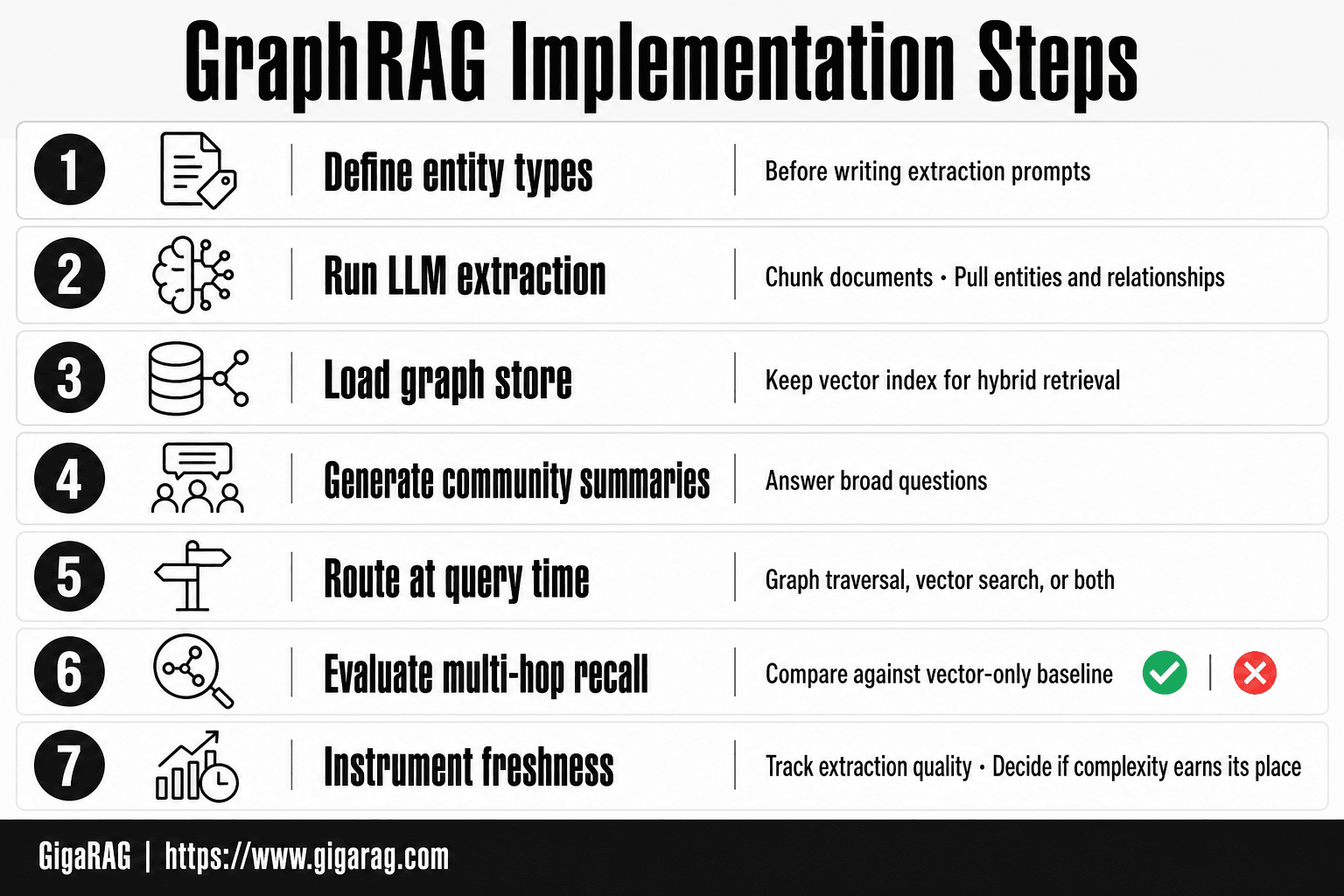
- Define the entity and relationship types your agent memory actually needs before writing any extraction prompt.
- Chunk your source documents and run an LLM extraction pass to pull entities and relationships into a structured schema.
- Load the extracted triples into a graph store and keep a vector index over the same source chunks for hybrid retrieval.
- Generate community or cluster summaries so the retriever can answer broad questions, not just point lookups.
- At query time, detect whether the question needs graph traversal, vector search, or both, and route accordingly.
- Evaluate on a held-out set of multi-hop questions and compare recall against your existing vector-only baseline.
- Instrument graph freshness and extraction quality, then decide whether the added complexity earns its place in production.
GraphRAG vs Traditional RAG: Key Differences That Matter
Traditional RAG stores text chunks in a vector database and retrieves the top-k most similar chunks for any query. GraphRAG stores entities, relationships, and community summaries in a graph database. The retrieval unit is different, and that changes everything downstream.
Retrieval unit: chunks vs entities and relationships
Vector RAG retrieves chunks: fixed slices of text, usually 256 to 512 tokens. The system doesn't know what's inside a chunk. It just knows the chunk's embedding is close to the query's embedding. GraphRAG retrieves entities and relationships: named things and how they connect. A query about "Acme's suppliers" pulls the Acme node and its supplier edges, not whatever chunk happens to mention Acme.
Multi-hop reasoning: why flat vector search fails
Multi-hop questions require connecting facts that live in different documents. Vector search fails here because similarity is local. The chunk that answers "Who did Acme acquire?" may have no lexical overlap with the chunk that answers "What happened to that company's CEO?" GraphRAG handles this by traversing edges. The graph already encodes that Acme acquired Beta, and that Beta's CEO left six months later. Retrieval follows the path instead of hoping two chunks happen to be similar.
Context assembly: communities and summaries vs top-k chunks
Vector RAG assembles context by stacking the top-k chunks, usually 3 to 10, into the prompt. The LLM has to stitch them together. GraphRAG can retrieve a community summary instead: a pre-written description of a whole topic cluster. That summary already connects the entities, so the LLM gets structured context rather than raw fragments.
Cost and latency implications
GraphRAG costs more up front. Extraction, graph building, and community summarization all require LLM passes before any query arrives. Vector RAG just needs embeddings, which are cheaper. At query time, graph traversal can be faster than vector search for relationship-heavy questions, but the indexing bill is one you pay regardless of whether anyone ever asks a question.
Why GraphRAG Matters for Agent Memory and RAG Pipelines
Agent memory is the difference between a chatbot that answers one question and an assistant that remembers what you told it three turns ago. Most agent memory systems today are logs: flat lists of past messages, retrieved by similarity. That works until the agent needs to connect two things that were never said in the same message.
Agent memory as a graph, not a log
A log stores what happened. A graph stores what's true. When your agent learns that a user works at Acme, and later learns that Acme was acquired by Beta, a log keeps those as two separate entries. A graph connects them: the user node links to Acme, Acme links to Beta. The next time the user asks "who owns my company now?", the agent follows the edge instead of hoping a similarity search surfaces both facts.
The practical consequence: graph memory lets an agent answer questions it was never explicitly told the answer to. That's the whole point of relationship-aware context.
Multi-hop recall across conversation turns
Vector-based memory degrades as conversations get long. Each turn adds another chunk, and similarity search gets noisier with every retrieval. Graph memory degrades differently. The graph grows, but retrieval stays anchored to entities. When a user references "the project we discussed last week", the agent can resolve that to a specific project node and pull its connected context, even if the project name never appears in the current turn.
This matters most for agents that span multiple sessions. A support agent that forgets the customer's account tier every morning is useless. A graph-backed agent can load the customer node and walk its edges: account, open tickets, past purchases, escalation history.
Integrating GraphRAG into an existing RAG pipeline
You don't rip out your vector database. You add a graph alongside it. The vector index handles fast, fuzzy retrieval for simple questions. The graph handles relationship-heavy queries and long-term memory. A router decides which path a query takes, or both run and the results merge.
The honest catch: this doubles your infrastructure. Two stores, two indexing pipelines, two retrieval paths. For a single-purpose RAG app, that's overkill. For an agent that needs to remember state across sessions and reason over relationships, it's the difference between a system that works and one that keeps losing the thread.
When to Use GraphRAG (and When to Skip It)
GraphRAG is not a better vector RAG. It's a different tool for a different job. The question isn't which one wins. The question is which one matches your data and your queries.
Signals that GraphRAG is worth the complexity
You should consider GraphRAG when your questions require connecting facts that live in different documents. Multi-hop questions like "which suppliers for our Berlin office have raised prices in the last quarter?" need relationship traversal, not similarity search. A vector index can find chunks about suppliers and chunks about Berlin and chunks about price changes. It cannot reliably connect them.
Another signal: your data is relationship-heavy by nature. Supply chains, org charts, legal precedents, medical ontologies, dependency graphs. If the connections between entities carry as much meaning as the entities themselves, a graph earns its keep.
A third signal: you need agent memory that persists across sessions and supports transitive reasoning. The previous section covered this. If your agent must answer questions it was never directly told, graph memory is the mechanism that makes that possible.
Signals that vector RAG is still the right call
If your questions are single-hop, stick with vectors. "What's the refund policy?" doesn't need a graph. It needs one good chunk retrieved fast. Vector RAG does that cheaper and with less moving parts.
If your corpus is small, skip GraphRAG. Under a few thousand documents, the extraction and indexing cost buys you little that a well-tuned vector pipeline can't already do. The graph only pays off when the relationship space is too large to hold in a prompt or too tangled for similarity search to navigate.
If your latency budget is tight, vector RAG wins. Graph traversal adds query-time overhead. Community summarization adds more. For a customer-facing chatbot that must respond in under 500 milliseconds, that overhead may be unacceptable.
A simple decision checklist
Run through these before you commit:
- Do your queries require connecting facts across documents? If no, use vector RAG.
- Does your data have meaningful relationships between entities? If no, use vector RAG.
- Is your corpus large enough that flat retrieval keeps missing? If no, use vector RAG.
- Can you tolerate higher indexing cost and query latency? If no, use vector RAG.
- Do you need multi-session agent memory with transitive recall? If yes, GraphRAG is worth prototyping.
The honest answer is that most RAG pipelines don't need GraphRAG. They need better chunking, better embeddings, and better reranking. GraphRAG earns its complexity only when relationships are the point.
Common Mistakes When Implementing GraphRAG
Most GraphRAG failures aren't architectural. They're implementation mistakes that waste weeks before the first useful query.
Treating GraphRAG as a drop-in replacement for vector search
GraphRAG doesn't replace your vector index. It sits beside it. Teams that rip out vector search and swap in a graph discover their single-hop queries got slower and their answers got worse. The graph handles relationship traversal. Vectors handle similarity. You need both.
Underestimating extraction and indexing cost
Entity and relationship extraction runs an LLM over every document, sometimes multiple passes. A corpus that indexes in minutes with embeddings can take hours or days with GraphRAG. Token costs scale linearly with document count. Budget for this before you start, not after the first indexing job times out.
Ignoring graph quality and entity resolution
The graph is only as good as the extraction. If your LLM extracts "Acme Corp", "Acme Corporation", and "Acme" as three separate entities, your traversal breaks. You need an entity resolution step that merges duplicates. Skip it and your graph becomes a tangle of near-misses that no query can navigate.
Over-indexing on communities at query time
Community summaries are useful for global questions. They're dead weight for local ones. If every query triggers community detection and summarization, latency balloons and answers get vague. Route queries: local questions hit entities and relationships directly. Global questions touch communities. Don't run the full pipeline for every ask.
What GraphRAG Cannot Do: Honest Limitations
GraphRAG solves a real problem, but it isn't magic. Here's what it won't fix, no matter how well you build it.
It does not eliminate hallucination
The LLM still generates the final answer. GraphRAG changes what context the model sees, not how the model reasons over it. If the graph contains a wrong relationship, the model can confidently repeat it. If the graph is missing an edge, the model can invent one to fill the gap. GraphRAG reduces hallucination on multi-hop questions by giving the model better grounding. It does not make the model truthful.
It is not a database replacement
A knowledge graph is not a system of record. It's a derived artifact built from your documents by an LLM. That means it contains extraction errors, merged entities that shouldn't be merged, and relationships the model inferred but never actually stated. Don't point GraphRAG at a question that needs transactional accuracy: account balances, order status, inventory counts. Use your database for that. Use GraphRAG for questions about how things relate.
It does not remove the need for good data
Garbage in, garbage out applies harder here. Vector RAG degrades gracefully with messy data: bad chunks just rank lower. GraphRAG amplifies mess. A single mislabeled relationship can send traversal down the wrong path and poison every answer that touches it. If your source documents are inconsistent, contradictory, or full of duplicate entities, the graph will be too. Clean data is a prerequisite, not an optimization.
It is not faster or cheaper than vector RAG
Indexing is slower. Query time can be slower. Token costs are higher. A vector index builds in minutes and answers in milliseconds. GraphRAG can take hours to index and seconds to answer a multi-hop query that touches communities. If your latency budget is tight or your corpus is small, vector RAG wins on cost and speed. GraphRAG earns its overhead only when the relationship structure actually changes the answer quality.
How RAG Differs from an LLM (and Where GraphRAG Fits)
An LLM is a reasoner. It predicts the next token from everything it saw during training. RAG is a context provider. It fetches relevant material at query time and hands it to the LLM so the model reasons over fresh, specific information instead of whatever it memorized.
LLM as reasoner, RAG as context provider
The LLM does the thinking. RAG does the fetching. Without RAG, an LLM answers from its weights alone, which means it can't see documents you added after training and it can't cite where an answer came from. With RAG, the model gets a bundle of retrieved text alongside your question. It still generates the answer. It just has better material to work from.
GraphRAG as a structured context provider
GraphRAG is RAG with a different retrieval unit. Instead of pulling top-k text chunks, it pulls entities, relationships, and community summaries from a knowledge graph. The LLM is unchanged. What changes is the shape of the context: structured connections instead of flat passages. That's the whole distinction. Same reasoner, better-organized evidence.
What Is GraphRAG? Frequently Asked Questions
Can you explain RAG in a simple way?
RAG, or Retrieval-Augmented Generation, fetches relevant text from your documents at query time and hands it to an LLM alongside your question. The LLM then answers using that fresh material instead of relying only on what it memorized during training.
Is ChatGPT a RAG?
ChatGPT can use RAG when it has access to a retrieval tool, but the base model is not RAG. RAG is an architecture: a retriever plus a generator. ChatGPT is a generator that sometimes gets a retriever attached.
What are the key differences between GraphRAG and traditional RAG?
Traditional RAG retrieves text chunks by vector similarity. GraphRAG retrieves entities, relationships, and community summaries from a knowledge graph. The retrieval unit is different, and that changes how multi-hop questions get answered.
How is RAG different from LLM?
An LLM is a reasoner that predicts tokens from its training data. RAG is a context provider that fetches relevant material at query time. RAG doesn't replace the LLM. It gives the LLM better material to reason over.
Is GraphRAG always better than vector RAG?
- GraphRAG is better for multi-hop questions and relationship-heavy data. Vector RAG is better for single-hop questions, small corpora, and tight latency budgets. Most RAG pipelines don't need GraphRAG.
How much does GraphRAG cost compared to traditional RAG?
GraphRAG costs more up front. Extraction, graph building, and community summarization all require LLM passes before any query arrives. Vector RAG just needs embeddings, which are cheaper. The indexing bill is one you pay regardless of whether anyone ever asks a question.
Can I use GraphRAG for agent memory?
Yes. Graph memory stores what's true, not just what happened. When your agent learns that a user works at Acme, and later learns that Acme was acquired by Beta, a graph connects them. The next time the user asks "who owns my company now?", the agent follows the edge.
What tools or frameworks should I use to build GraphRAG?
Microsoft GraphRAG is the most common open-source starting point. Neo4j is the typical graph database. GigaRAG operationalizes the same idea for agent memory and RAG pipelines. The mechanics in this guide apply to any implementation.
What Is GraphRAG? The Bottom Line
GraphRAG is a retrieval method that builds a knowledge graph from your documents, then uses that graph's structure to decide what context an LLM sees. It earns its complexity when relationships are the point: multi-hop questions, agent memory, supply chains, org charts, legal precedents. It doesn't earn it when your questions are single-hop, your corpus is small, or your latency budget is tight.
The honest answer is that most RAG pipelines don't need GraphRAG. They need better chunking, better embeddings, and better reranking. But when flat retrieval keeps missing because the connections between entities carry the meaning, GraphRAG is the difference between a system that works and one that keeps losing the thread.
Frequently Asked Questions
Can you explain RAG in a simple way?
RAG, or retrieval-augmented generation, means fetching relevant text from an external store and feeding it to a language model so the model answers from your data instead of only its training weights. Traditional RAG retrieves text chunks by embedding similarity; GraphRAG retrieves from a structured graph of entities and relationships.
Is ChatGPT a RAG?
- ChatGPT is a generative model; RAG is a retrieval architecture you add around a model. You can use ChatGPT or another LLM as the generation step inside a RAG or GraphRAG pipeline, but the model itself is not RAG.
What are the key differences between GraphRAG and traditional RAG?
Traditional RAG ranks text chunks by vector similarity, which works well for direct lookups but often fails on multi-hop questions. GraphRAG builds a knowledge graph of entities and relationships, so retrieval can traverse connected facts and answer relationship-heavy questions that vector search tends to miss.
How is RAG different from an LLM?
An LLM is the generator that produces text from its parameters. RAG is a system that augments that generator with retrieved context at inference time, so answers can reflect your documents and update without retraining the model.
When should I not use GraphRAG?
Skip GraphRAG when your queries are simple lookups, your corpus is small, or your data has few meaningful relationships. The extraction, graph storage, and maintenance overhead only pays off when multi-hop reasoning and relationship traversal are core to your use case.
Does GraphRAG replace vector search?
Usually not. Most practical GraphRAG pipelines keep a vector index alongside the graph and route queries to whichever retrieval mode fits, because vector search remains strong for direct passage lookup while the graph handles traversal.
What does GraphRAG cost to run?
Costs come from LLM extraction passes over your corpus, graph storage, and re-summarization when data changes. Exact figures depend on corpus size and model choice, so benchmark on your own data rather than relying on generic estimates.
About GigaRAG
GigaRAG is for agent memory and RAG pipeline builders. get this right. Whether you are working through what is graphrag or something adjacent, we publish what we have actually tested, including where it falls short.


