Multi-Tenant RAG Architecture: A Practical Guide for Agent Memory and Pipeline Builders
Multi-tenant rag architecture sounds like an infrastructure problem until the first time your agent answers tenant A using tenant B's support history. If you're building agent memory for a SaaS product, you already know the tension: every tenant needs their own conversation state and retrieval context, but the moment you share a pipeline, you've opened a door for data leakage. GigaRAG was built for exactly this problem, and the patterns here come from running it in production, not from a whitepaper.
The honest answer is that there's no single right architecture. There are three: silo, pool, and bridge. Each trades isolation strength against cost and operational complexity, and the choice depends on tenant count, data sensitivity, and how stateful your agent conversations need to be.
This guide covers the three isolation patterns, the security failure modes that actually happen, how to store per-tenant agent memory without contamination, and when multi-tenancy is the wrong call entirely. It's framework-agnostic, so you can apply it whether you're on a managed service or running your own vector database.
| At a glance | Details |
|---|---|
| Core isolation patterns | Shared, silo, and hybrid |
| Primary risk | Cross-tenant data leakage |
| Key mitigation | Row-level security and tenant IDs |
| Agent memory storage | Tenant-scoped conversation tables |
| Retrieval context | Filter by tenant at query time |
| When to avoid | Single-tenant or low-scale use |
In This Guide
- What Is Multi-Tenant RAG Architecture?
- Shared vs. Silo Architecture: Which Fits Your Multi-Tenant RAG?
- The Three Core Isolation Patterns: Silo, Pool, and Bridge
- Multi-tenant Rag Architecture: A Step-by-Step Guide
- Isolation Model Trade-Offs: Cost, Complexity, and Security
- Tenant-Isolated Agent Memory: Handling Stateful Conversations
- Security and Data Filtering in Multi-Tenant RAG
- What Can Go Wrong: Tenant Data Isolation Failure Modes
- When NOT to Use Multi-Tenant RAG Architecture
- Implementation Guidance for Multi-Tenant RAG Pipelines
- Cost Optimization and Observability for Multi-Tenant RAG
What Is Multi-Tenant RAG Architecture?
Multi-tenant RAG architecture is a retrieval system where one shared infrastructure serves many tenants while keeping each tenant's data, conversation history, and retrieval context fully isolated. A tenant is a customer, a workspace, or a team. The system serves all of them from one deployment, but no tenant can see or retrieve another tenant's data.
A concrete example: SaaS support agent with per-tenant knowledge bases
Imagine a support agent product used by 40 different software companies. Each company uploads its own docs, FAQs, and past tickets. One RAG pipeline indexes all of it. When a user at Company A asks a question, the system retrieves only from Company A's knowledge base. Company B's docs never enter the context window.
How multi-tenancy differs from single-tenant RAG
Single-tenant RAG means one deployment per customer. You run a separate vector database, a separate index, and a separate pipeline for each tenant. Multi-tenant RAG shares the infrastructure. The isolation happens through filtering, not through physical separation. That's the core trade-off: cheaper to run, harder to secure.
[!note] Multi-tenancy is not a single pattern; it spans a spectrum from fully shared to fully siloed. The choice depends on your tenants' data sensitivity, scale, and budget—there's no one-size-fits-all.
Shared vs. Silo Architecture: Which Fits Your Multi-Tenant RAG?
| Factor | Shared (Pooled) | Silo (Dedicated) |
|---|---|---|
| Cost efficiency | High—resources pooled | Low—per-tenant overhead |
| Isolation strength | Logical only, risk of leaks | Physical, strong isolation |
| Scalability | Easier to scale horizontally | Complex with many tenants |
| Operational overhead | Lower—centralized management | Higher—per-tenant maintenance |
| Best for | Small tenants, cost-sensitive | Large tenants, compliance-heavy |
The Three Core Isolation Patterns: Silo, Pool, and Bridge
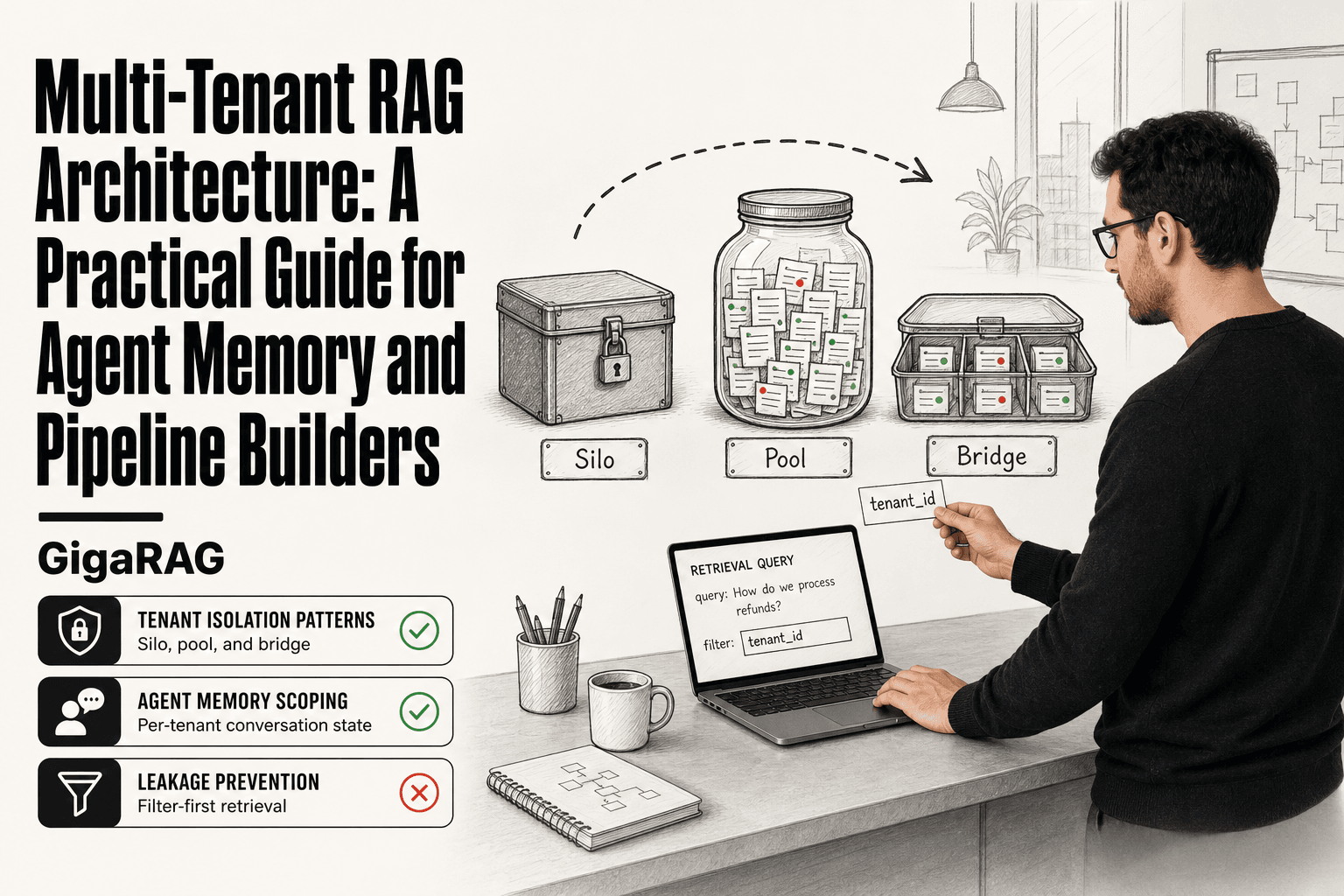
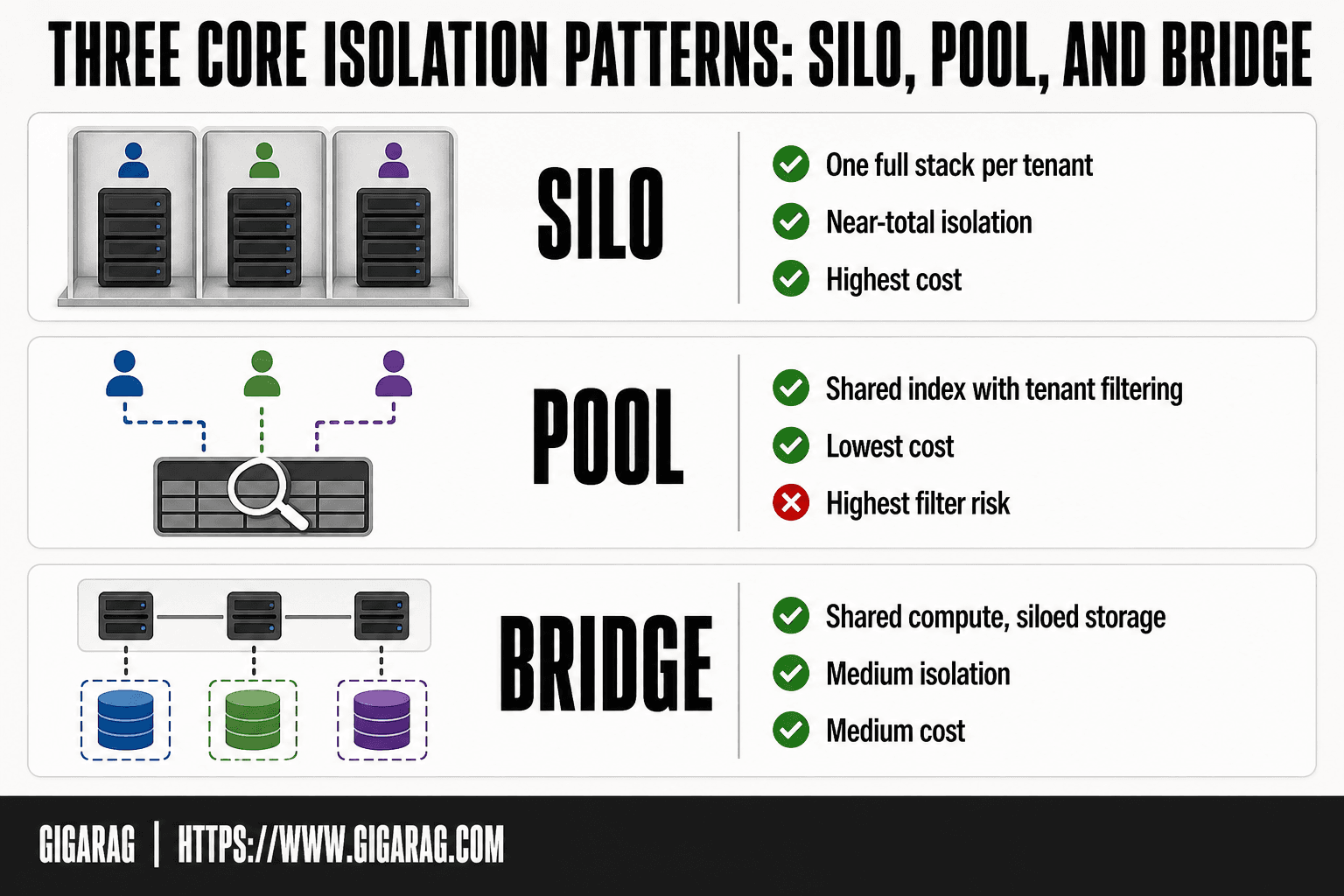
You have three ways to isolate tenants in a RAG system. They sit on a spectrum from full physical separation to full logical separation. The names come from AWS, but the patterns are framework-agnostic.
Silo: one full stack per tenant
Silo gives each tenant their own vector database, index, embedding pipeline, and retrieval service. Nothing is shared. Tenant A's data lives in a separate database from Tenant B's, on separate infrastructure or at least separate namespaces.
Isolation is near-total. A misconfigured filter can't leak data because there's no shared index to filter. The cost is obvious: 40 tenants means 40 databases, 40 pipelines, 40 things to monitor and patch.
Pool: shared infrastructure with tenant filtering
Pool puts every tenant's data in one shared index. A tenant_id field on every chunk marks ownership. At query time, the system appends a filter: only retrieve chunks where tenant_id matches the caller.
This is the cheapest pattern to run. One pipeline, one database, one deployment. The risk moves entirely into the filter. If the filter is missing, wrong, or bypassed, you leak data across tenants.
Bridge: shared components with tenant-specific overlays
Bridge shares the heavy infrastructure: the embedding model, the orchestrator, the retrieval service. But each tenant gets their own index or collection within the shared database. Think of it as pooled compute with siloed storage.
This gives you better blast radius than pool. A bad filter on Tenant A's collection can't reach Tenant B's chunks because they're in a different collection. You still run one deployment, so costs stay lower than full silo.
Comparison table: isolation strength vs cost vs complexity
| Pattern | Isolation strength | Cost | Complexity |
|---|---|---|---|
| Silo | Highest | Highest | Low per tenant, high overall |
| Pool | Lowest | Lowest | Low to build, high to secure |
| Bridge | Medium | Medium | Medium |
The honest answer is that most teams start with pool, hit a security review, and move to bridge. Silo is for regulated industries or very small tenant counts.
[!tip] For agent memory, store conversation state in a separate table keyed by (tenant_id, session_id) to avoid mixing retrieval context with chat history. Always include tenant_id in your vector metadata and filter at query time—never rely on post-query filtering alone.
Multi-tenant Rag Architecture: A Step-by-Step Guide
- Identify all data sources and add a tenant_id field to every record.
- Store tenant_id in the vector index metadata for each chunk.
- Enforce row-level security in your vector database to filter by tenant_id.
- Scope conversation history tables by tenant_id for agent memory.
- Pass the tenant_id as a filter parameter in every retrieval query.
- Test isolation by simulating cross-tenant queries and verifying empty results.
Isolation Model Trade-Offs: Cost, Complexity, and Security
The pattern you pick changes what you spend, what you maintain, and what you can promise a security reviewer. None of the three is wrong. Each is wrong for someone.
When silo makes sense despite the cost
Silo is the only pattern that survives a hostile audit without argument. If a tenant asks "can anyone else's query touch my data?", the answer is no, and you can prove it with the infrastructure diagram. That proof has a price: 40 tenants means 40 databases to patch, back up, and monitor. You don't choose silo for efficiency. You choose it when a single cross-tenant leak would end the contract or trigger a regulator.
Pool pattern: maximizing efficiency without leaking data
Pool wins on cost because there's one of everything. One index, one pipeline, one bill. The trade is that every query path must carry the tenant filter, and every new engineer must understand why that filter is load-bearing. The honest answer is that pool is safe when the filter is enforced in one place, not scattered across every retrieval call.
Bridge pattern: the middle path for growing SaaS
Bridge is what most teams land on after their first security review. You share the expensive parts: the embedding model, the orchestrator, the deployment. You separate the storage. A bad filter can't cross collections, so the blast radius shrinks without doubling your infrastructure bill. The cost is that you now manage per-tenant collections, which means migration scripts and per-collection index tuning. It's not free. It's just cheaper than silo and safer than pool.
Tenant-Isolated Agent Memory: Handling Stateful Conversations
Agent memory is where multi-tenant RAG gets hard. A stateless retrieval call needs a filter. A stateful agent needs a filter that follows the conversation across turns, and that's a different problem.
Storing per-tenant conversation history
Store conversation history in a tenant-scoped table or collection. Each row carries a tenant_id, a conversation_id, and the message turn. The retrieval query joins on tenant_id first, conversation_id second. Never rely on the conversation_id alone: if an ID is guessed or leaked, the tenant filter is the only thing standing between one customer's chat and another's.
The honest answer is that conversation history doesn't belong in your vector index. It belongs in a regular database with tenant-level row isolation. You vectorize only what the retriever needs: the current query, recent turns, and any retrieved context worth caching.
Maintaining retrieval context across turns
Retrieval context shifts as the conversation moves. A follow-up question like "what about the billing one?" means nothing without the previous turn. You need to carry forward the entities, filters, and retrieved chunks that the last response used. Store that as a tenant-scoped context object, updated after each turn.
The main catch is staleness. If a tenant's knowledge base updates mid-conversation, cached context goes bad. Version the context object and re-retrieve when the version changes.
Memory isolation patterns for agent pipelines
Silo gives you memory isolation for free: each tenant's conversation store and context cache live in their own stack. Pool forces you to enforce tenant_id on every read and write, including the cache. Bridge splits the difference: shared conversation logic, tenant-scoped storage.
In practice, most agent teams start with pool and add tenant-scoped collections only when a security review demands it. The filter is cheap until it isn't.
Security and Data Filtering in Multi-Tenant RAG
Tenant isolation at the retrieval layer is not one check. It's three separate things, and conflating them is how leaks happen.
Identity vs authorization vs data filtering
Identity answers "who is this user?" Authorization answers "what is this user allowed to see?" Data filtering answers "which documents belong to this tenant?" You need all three, in that order, on every retrieval call.
The honest answer is that most RAG pipelines skip authorization entirely. They authenticate the user, then filter by tenant_id and call it done. That works until a tenant has internal roles: a manager who can see all support tickets, an agent who can see only their own. Tenant filtering is not a substitute for authorization. It's a coarser layer underneath it.
Metadata filtering as the primary enforcement mechanism
Metadata filtering is where tenant boundaries actually get enforced. Every chunk you index carries a tenant_id in its metadata. Every query carries the same tenant_id as a filter. The vector database applies the filter before similarity search runs, so chunks from other tenants never enter the candidate set.
Here's what happens behind the scenes: the filter narrows the search space first, then the embedding similarity ranks within that space. If you apply the filter after retrieval, you've already pulled cross-tenant chunks into memory. That's a leak waiting to happen.
Make sure the filter is mandatory. A missing tenant_id on a query should return zero results, not all results. Default-deny is the only safe default.
Common security pitfalls in tenant isolation
The most common pitfall is a filter that's optional in code. A developer writes the retrieval function with a tenant_id parameter, then one caller forgets to pass it. The query runs unfiltered. Every tenant's data comes back.
Shared caches are the second pitfall. If you cache retrieval results without a tenant key, tenant A gets tenant B's cached chunks. The cache key must include tenant_id, always.
The third is embedding leakage. Two tenants with similar documents produce similar embeddings. That's fine if your filter runs first. It's catastrophic if you rely on embedding distance alone to separate tenants. Embeddings don't know about tenants. Your filter does.
What Can Go Wrong: Tenant Data Isolation Failure Modes
You can build the right pattern and still leak data. The failures below are not hypothetical. They show up in production systems that passed code review.
Cross-tenant leakage via embedding similarity
Embeddings cluster by meaning, not by tenant. Two tenants with similar support docs produce nearly identical vectors. If your filter runs after similarity search, the retriever pulls tenant B's chunks for tenant A's query because they look relevant. The fix is order: filter first, then rank. Never the reverse.
Misconfigured metadata filters
A filter that's optional is a filter that fails. One caller forgets the tenant_id parameter and the query runs wide open. Default-deny is the only safe posture: a missing tenant_id returns zero results, not all results. Test this explicitly. Write a retrieval call without tenant_id and confirm it returns nothing.
Shared cache and session state contamination
Caches keyed by query string alone will serve tenant A's results to tenant B. The cache key must include tenant_id, always. Same rule for session state: conversation history, retrieval context, and any in-memory buffers need tenant scoping. A shared session object is a cross-tenant leak waiting for the next request.
When NOT to Use Multi-Tenant RAG Architecture
Multi-tenancy adds real complexity. You pay for it in every query path, every cache key, every filter you write. Sometimes that cost buys you nothing.
Small tenant counts with strict regulatory isolation
If you serve three enterprise clients, each under a different data residency law, don't build a pool. Build three silos. The overhead of tenant filtering, per-tenant encryption, and audit logging across a shared index will exceed the cost of running separate stacks. Regulatory isolation is not a feature you bolt on. It's a reason to keep systems apart.
When tenant data is fundamentally incompatible
Tenants with different schemas, different embedding models, or different chunking strategies don't belong in one index. Forcing them together means lowest-common-denominator design. You'll write conditional logic everywhere. Separate pipelines are simpler and faster to change.
Signs you should start single-tenant and migrate later
Start single-tenant when you have fewer than five tenants, no shared data model, or an unproven product. Migration to multi-tenant is mechanical: add tenant_id to your metadata, reindex, add filters. It's a weekend of work, not a rewrite. The reverse migration, from a tangled multi-tenant system back to silos, is not.
Implementation Guidance for Multi-Tenant RAG Pipelines
The patterns above matter only if you can build them. Here's the framework-agnostic path.
Indexing strategy: tenant-aware chunking and metadata
Every chunk you index carries a tenant_id. No exceptions. Attach it at ingestion time, not at query time. You can't filter on metadata that isn't there.
Chunking strategy should account for tenant data shape. If tenants share a schema, chunk uniformly. If they don't, chunk per tenant before indexing. Don't force one chunk size across incompatible document types.
Store tenant_id as a top-level metadata field, not buried in a nested object. Most vector databases filter faster on flat fields.
Retrieval-time filtering patterns
Two patterns dominate. Pre-filtering applies the tenant_id filter before vector search. Post-filtering runs the search, then discards results from other tenants.
Pre-filtering is safer. You never retrieve another tenant's chunks, so leakage through embeddings is impossible. Post-filtering risks returning fewer results than you asked for after filtering.
Use pre-filtering when your vector database supports it. Most do.
Framework-agnostic code structure
Keep tenant context in one place: the request object. Pass it through indexing, retrieval, and generation. Don't thread tenant_id through every function call as a loose parameter.
class TenantContext:
    tenant_id: str
    filters: dict
One context object. Every pipeline stage reads from it. When you add a new tenant, you add a row, not a code path.
Test isolation explicitly. Write a test that queries as tenant A and asserts zero tenant B chunks in the result. Run it in CI. Cross-tenant leakage is a regression, not a surprise.
Cost Optimization and Observability for Multi-Tenant RAG
Most multi-tenant RAG guides stop at isolation. They skip the two things that decide whether the system survives contact with production: what it costs per tenant, and whether retrieval actually works for each one.
Per-tenant cost tracking and allocation
Tag every embedding, index, and inference call with tenant_id. Without that, you can't bill accurately or spot a tenant whose usage is out of line with what they pay.
The main cost drivers are embedding volume, index storage, and LLM tokens per query. Track all three per tenant. A tenant with heavy ingestion but light queries costs differently than one with heavy query traffic.
Set per-tenant budgets. Alert when a tenant crosses 80% of their allocation. This catches runaway agents before the bill arrives.
Observability: monitoring retrieval quality per tenant
Log retrieval latency, result count, and filter hit rate per tenant. Filter hit rate matters most: if a tenant's queries keep returning zero results after filtering, their index is probably misconfigured.
Watch for tenants whose retrieval latency spikes while others stay flat. That points to tenant-specific data problems, not infrastructure issues.
Evaluation strategies for multi-tenant RAG
Run evaluation per tenant, not just globally. A global average hides a tenant whose retrieval quality collapsed.
Build a small golden set per tenant: 20 to 50 query-answer pairs. Run it on every pipeline change. If tenant A's score drops while tenant B's holds, the change broke something tenant-specific.
Multi-tenant rag architecture is a set of trade-offs, not a single best practice. Pick the isolation pattern that matches your tenant count and sensitivity, enforce the filter at the retrieval layer, and test isolation explicitly. The architecture you choose matters less than whether you can prove, on every query, that the right tenant got the right data.
Frequently Asked Questions
What is an example of a multi-tenant architecture?
A classic example is a SaaS application where multiple customers share the same application instance and database, but each customer's data is logically separated by a tenant identifier. For instance, in a multi-tenant RAG system, each tenant has its own documents and conversation history, but they all use the same underlying vector database and model infrastructure.
Is Kafka a multi-tenant?
Kafka itself is not inherently multi-tenant, but it can be used to build multi-tenant systems. Kafka supports topics, which can be partitioned per tenant, and you can enforce access control lists (ACLs) to restrict which clients can read or write to specific topics. This allows you to isolate tenant data streams while sharing the same Kafka cluster.
What are the different architectures of multimodal RAG?
Multimodal RAG architectures vary in how they handle different data types like text, images, and audio. Common approaches include: (1) fusing all modalities into a single vector space, (2) using separate indexes per modality and merging results, or (3) using a two-stage pipeline where one modality guides retrieval of another. Each has trade-offs in retrieval accuracy and computational cost.
Is multi-tenancy good for SaaS?
Multi-tenancy is generally good for SaaS because it reduces operational costs by sharing infrastructure across customers, making it easier to scale and update. However, it introduces complexity around data isolation and security. For most SaaS products, multi-tenancy is the standard, but you must implement robust isolation to prevent data leaks.
How do you prevent cross-tenant data leakage in RAG?
Prevent leakage by enforcing tenant_id at every layer: in the vector index metadata, in the database row-level security, and in the retrieval query filters. Additionally, use separate namespaces or collections per tenant if your vector database supports it. Regularly test with cross-tenant queries to ensure no data bleeds through.
What are the trade-offs between shared and silo multi-tenant RAG?
Shared architecture is cost-efficient and easier to manage, but offers weaker isolation and can suffer from performance interference between tenants. Silo architecture provides strong isolation and predictable performance, but is more expensive and harder to scale. A hybrid approach can balance these by grouping tenants with similar needs.
About GigaRAG
GigaRAG helps GigaRAG is for agent memory and RAG pipeline builders. get this right. Whether you are working through multi-tenant rag architecture or something adjacent, we publish what we have actually tested, including where it falls short.