Pipeline Failure Recovery and Dead Letter Handling for RAG and Agent Memory
Pipeline failure recovery and dead letter handling is the difference between a 3 AM page and a 3 AM fix. Here's the scene: a support doc with a stray null byte hits your ingestion worker, the chunker throws, the vector store write fails silently, and your agent's memory is now serving stale answers. Retries won't save you. The message isn't transient. It's poison, and it will fail again on every attempt until someone removes it by hand.
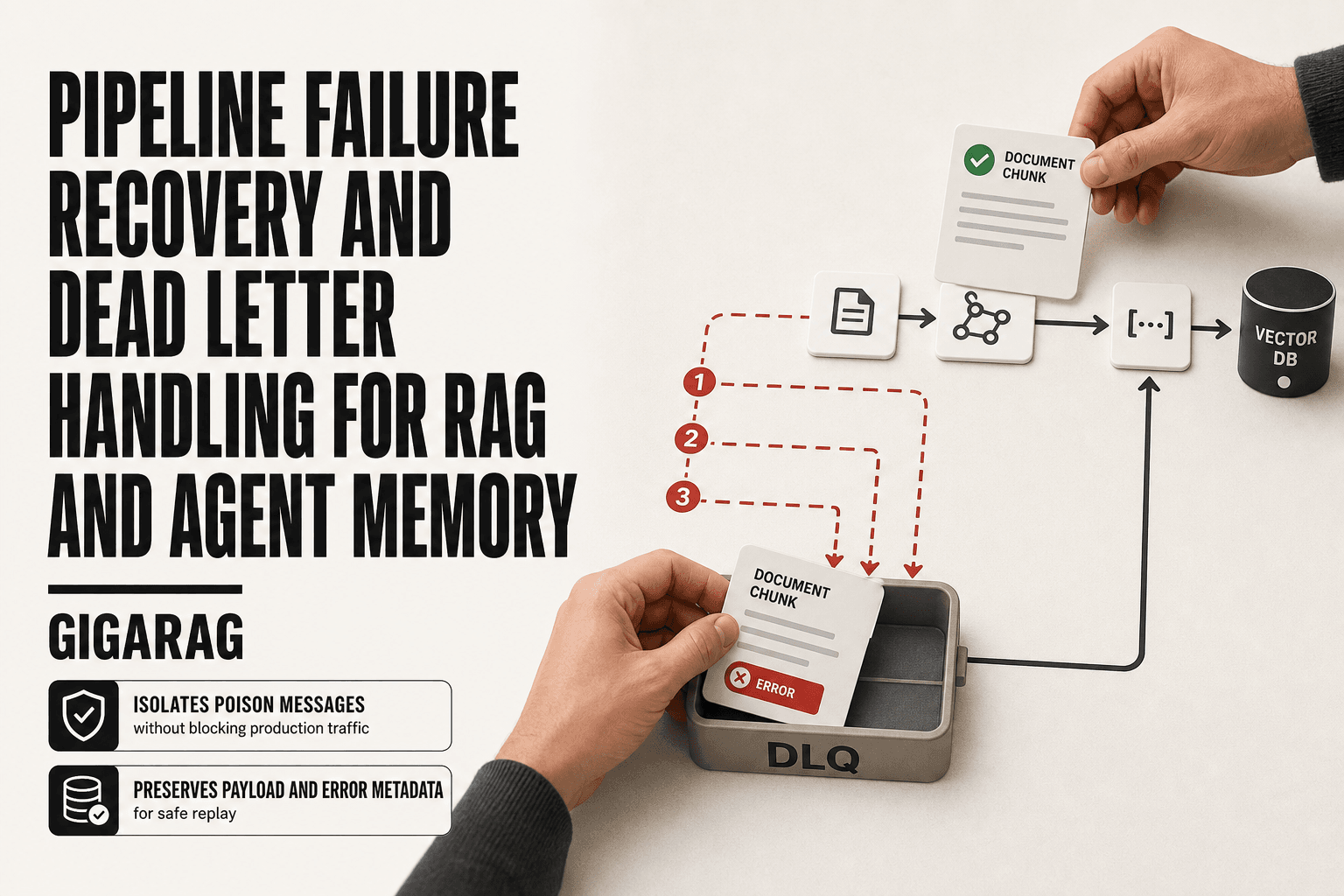
That's what a dead letter queue is for: a side channel that catches messages after retries are exhausted, preserves the original payload and error metadata, and lets you inspect and replay them without blocking production traffic. This guide is written for backend and ML engineers building RAG and agent memory systems. It covers the mechanics, the AI-specific failure modes most DLQ guides skip (embedding API timeouts, vector dimension mismatches, LLM output validation), and copy-pasteable Kafka and RabbitMQ implementations. GigaRAG is one platform that helps RAG builders handle these failure modes, but the patterns here work with any stack.
| At a glance | Details |
|---|---|
| Core pattern | Route failed messages to a DLQ for later replay |
| AI-specific failures | Embedding timeouts, vector conflicts, LLM validation errors |
| Key benefit | Isolate failures without blocking production traffic |
| Common tools | Kafka, RabbitMQ, Pub/Sub dead letter topics |
| Replay strategy | Inspect, fix, and re-inject with idempotency keys |
| When overkill | Low-volume pipelines with simple retry and logging |
In This Guide
- What Is a Dead Letter Queue?
- Kafka vs RabbitMQ for Dead Letter Handling
- How Dead Letter Queues Work
- Pipeline Failure Recovery And Dead Letter Handling: A Step-by-Step Guide
- Pipeline Failure Recovery and Dead Letter Handling in RAG Pipelines
- Common Use Cases and Patterns
- Implementing a DLQ in Kafka
- Implementing a DLQ in RabbitMQ
- Best Practices for Dead Letter Handling
- When DLQs Are Overkill
- Monitoring and Observability for DLQs
What Is a Dead Letter Queue?
A dead letter queue (DLQ) is a holding area for messages that a consumer could not process after a set number of retries. Instead of crashing the pipeline or silently dropping the message, the broker routes it to the DLQ for inspection and replay.
The point is isolation. A bad message shouldn't block the good ones behind it. When a consumer fails on a poison message, it can loop forever: retry, fail, retry, fail. The DLQ breaks that loop.
DLQ vs retry logic vs log pipeline
Retry logic handles transient failures: a timeout, a brief outage, a rate limit. You retry with backoff and the message eventually succeeds. A DLQ handles permanent failures: the message is malformed, the schema doesn't match, or the payload violates a constraint no amount of retrying will fix.
A log pipeline records what happened. A DLQ holds what failed. Logs tell you the error; the DLQ gives you the original message so you can fix it and replay it.
What belongs in a DLQ
Messages that fail after exhausting retries. Malformed payloads. Schema violations. Anything a consumer rejects as unprocessable.
What doesn't belong: messages that failed once due to a blip. Those go back through retry. The DLQ is for the ones retry can't save.
[!note] Dead letter queues are not a substitute for proper error handling; they should be part of a broader resilience strategy that includes retries, circuit breakers, and idempotent operations.
Kafka vs RabbitMQ for Dead Letter Handling
| Factor | Kafka | RabbitMQ |
|---|---|---|
| Dead letter mechanism | Dead letter topic via consumer configuration | Dead letter exchange with routing keys |
| Retry support | Manual retry topics or framework-level retries | Built-in retry with TTL and dead lettering |
| Ordering guarantees | Per-partition ordering preserved | Per-queue ordering, may be affected by retries |
| Operational complexity | Higher, requires topic management and monitoring | Lower, exchange and queue management is simpler |
| Best for | High-throughput, event-streaming RAG pipelines | Task-queue style agent memory writes |
How Dead Letter Queues Work
A message lands in a DLQ after a consumer fails it more times than the retry policy allows. The broker doesn't decide what's poison. Your retry threshold does.
Retry thresholds and backoff
You set a max retry count, usually 3 to 5. Each retry waits longer: 1 second, 5 seconds, 30 seconds. Exponential backoff gives transient failures room to clear. When the count is exhausted, the broker routes the message to the DLQ and moves on.
The threshold matters. Too low and you DLQ messages a brief outage would have fixed. Too high and poison messages block the queue while retrying.
What a production DLQ should preserve
Three things: the original payload, the error that killed it, and the retry count. Without the error, you're debugging blind. Without the payload, you can't replay. Most brokers attach this as headers or metadata automatically, but don't assume it. Check your broker's DLQ configuration.
Replay mechanics
Replay means publishing the DLQ message back to the original queue after you've fixed the cause. You don't edit the DLQ message in place. You copy it, fix it, and republish. The original stays in the DLQ as an audit trail.
A simple flow: producer sends message, consumer fails, retry count increments, threshold exceeded, message routes to DLQ, operator inspects, fixes, replays. That's the whole mechanic.
[!tip] For RAG pipelines, include the original document ID and embedding model version in the dead letter metadata so you can replay with the correct context and avoid vector dimension mismatches.
Pipeline Failure Recovery And Dead Letter Handling: A Step-by-Step Guide
- Identify failure points in your pipeline: embedding API calls, vector store writes, and LLM output validation.
- Configure your message broker to route failed messages to a dead letter queue or topic after a set number of retries.
- Enrich dead letter messages with metadata: error type, timestamp, original payload, and retry count.
- Set up monitoring and alerts on DLQ depth to detect spikes in failures.
- Build a replay mechanism that allows you to inspect, fix, and re-inject dead letter messages safely.
- Test failure scenarios regularly by injecting malformed messages and verifying DLQ behavior.
Pipeline Failure Recovery and Dead Letter Handling in RAG Pipelines
A DLQ in a RAG pipeline doesn't hold messages. It holds document chunks, embedding batches, and memory writes. The failure modes are different, but the mechanic is the same: isolate the poison, keep the pipeline moving.
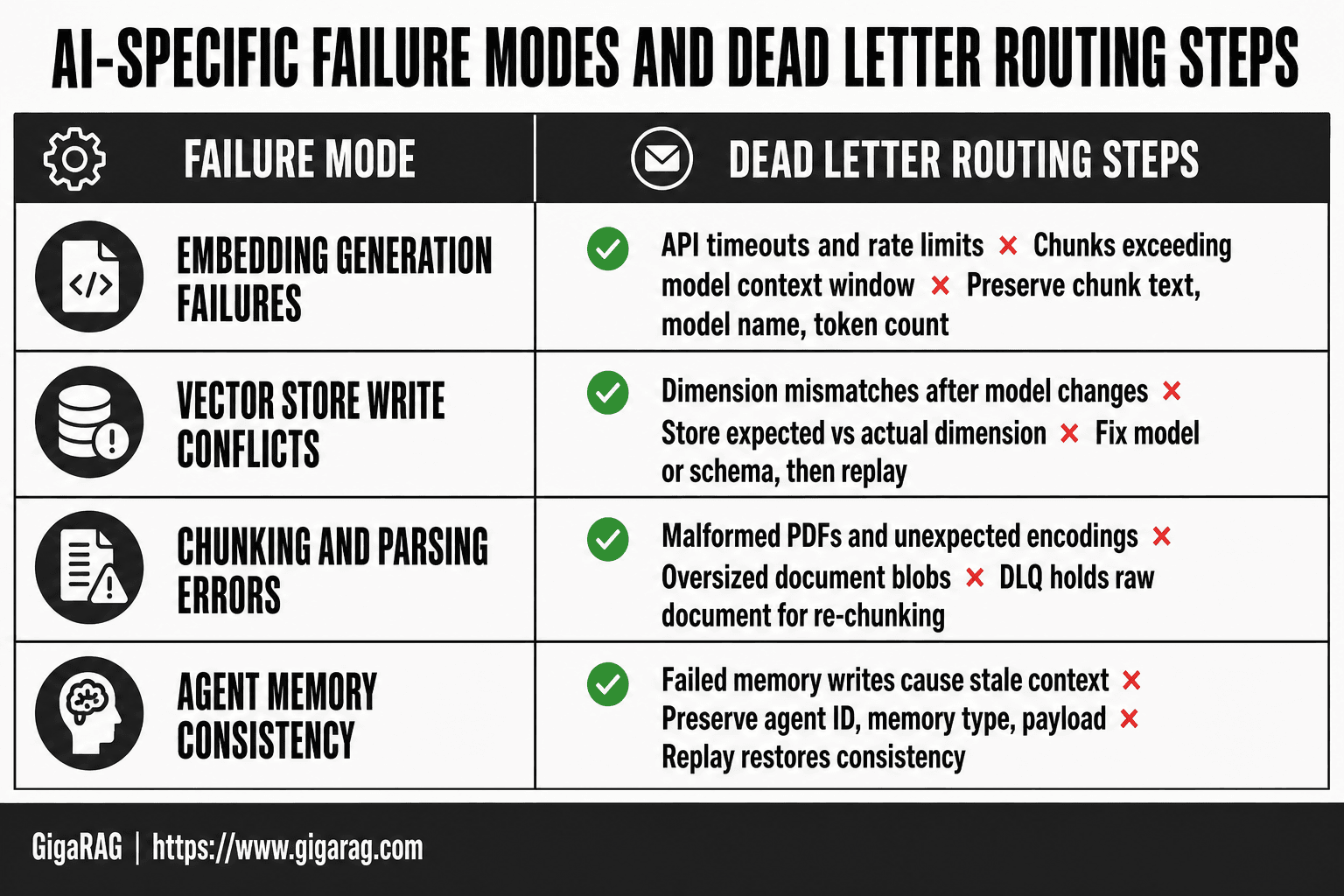
Embedding generation failures
Embedding APIs time out. Rate limits kick in. A batch of 500 chunks fails because the provider throttled you at 400. Retry with backoff handles the transient case. But a chunk that's too long for the model's context window will fail every time, no matter how many retries you give it.
That chunk belongs in a DLQ. Not the whole batch. Split the batch, isolate the bad chunk, and let the other 499 proceed. Your DLQ entry should preserve the chunk text, the model name, the token count, and the API error code.
Vector store write conflicts
Dimension mismatches are the classic poison. You switch embedding models from 768 to 1536 dimensions, and every in-flight chunk now fails the vector store's schema check. Retrying won't help. The data itself is wrong.
A DLQ catches these writes before they crash the consumer. The entry stores the chunk, the expected dimension, the actual dimension, and the collection name. You fix the embedding model or the schema, then replay.
Chunking and parsing errors
Malformed PDFs, unexpected encodings, a document that's one giant 40,000-token blob. These fail at the chunking stage, before embedding even starts. The DLQ entry here is the raw document, not the chunk. You need the source to re-chunk it after fixing the parser.
Agent memory consistency
Agent memory stores are write-heavy. A failed memory write means the agent retrieves stale context and gives wrong answers. The DLQ holds the failed memory operation: the agent ID, the memory type, the payload, and the store's error. Replaying it restores consistency without rebuilding the entire memory index.
The honest answer is that a DLQ won't fix your embedding model or your parser. It gives you a place to put the failures while you do.
Common Use Cases and Patterns
DLQs earn their keep in specific, recurring failure shapes. You'll recognize most of them from any message-driven system. One of them is unique to RAG.
Schema validation failures
A producer changes a field type, or a consumer expects a version the producer doesn't send. The message fails validation on every retry because the data itself is wrong. This is the cleanest DLQ case: route it, alert the owning team, and fix the schema before replaying. Don't leave these in the main queue. They'll block every consumer behind them.
Poison messages
A poison message is one that will never succeed, no matter how many times you retry it. Malformed JSON, a null required field, a payload too large for the consumer's buffer. The pattern is the same: retry a bounded number of times, then dead-letter. The key is bounding the retries. Unbounded retry turns a poison message into a queue stall.
Partial batch failures in embedding pipelines
This is the RAG-specific case. You batch 200 chunks for embedding, and 3 fail because they exceed the model's token limit. You don't want to dead-letter the whole batch. You want to split it: send the 197 good chunks through, route the 3 failures to the DLQ with their chunk text and error codes. The batch succeeds partially, and nothing blocks the pipeline.
The honest answer is that most DLQ use cases are variations on one theme: isolate the failure, preserve the payload, and keep the healthy traffic moving.
Implementing a DLQ in Kafka
Kafka doesn't ship a built-in DLQ. You build one with a separate topic and a consumer that routes failures there. Here's a Spring Boot implementation you can adapt.
Kafka DLQ with Spring Boot
@Bean
public ConcurrentKafkaListenerContainerFactory<String, String> kafkaFactory(
        KafkaTemplate<String, String> template) {
    ConcurrentKafkaListenerContainerFactory<String, String> factory =
        new ConcurrentKafkaListenerContainerFactory<>();
    factory.setCommonErrorHandler(new DefaultErrorHandler(
        (record, ex) -> template.send("documents-dlq", record.key(), record.value()),
        new FixedBackOff(1000L, 3)));
    return factory;
}
The DefaultErrorHandler retries a failed message 3 times with a 1-second pause between attempts. If it still fails, the lambda sends the original key and value to documents-dlq. The main consumer never crashes.
Retry and backoff configuration
FixedBackOff is fine for quick failures like schema mismatches. For embedding API timeouts, use exponential backoff:
new ExponentialBackOff(1000L, 2.0)
This starts at 1 second and doubles each retry. Set a max via ExponentialBackOffWithMaxRetries. Don't retry validation errors at all. Check the exception type and route straight to the DLQ.
Inspecting and replaying from the dead letter topic
Consume from documents-dlq with a plain listener. Log the key, value, and failure timestamp. To replay, produce the message back to the original topic after fixing the root cause. Keep the original offset in a header so you can trace where it failed.
The main catch: this pattern works for single-message failures. Partial batch failures need custom logic to split the batch before dead-lettering.
Implementing a DLQ in RabbitMQ
RabbitMQ has native dead letter support, which makes this simpler than the Kafka route. You declare a dead letter exchange once, point a queue at it, and the broker handles routing when messages are rejected or expire.
Dead letter exchanges and queues
A dead letter exchange is just a normal exchange you designate as the destination for failed messages. When a consumer rejects a message without requeueing, or the message TTL expires, or the queue hits its length limit, RabbitMQ republishes the message to that exchange with added headers.
import pika

params = pika.ConnectionParameters('localhost')
conn = pika.BlockingConnection(params)
ch = conn.channel()

# The dead letter exchange
ch.exchange_declare(exchange='documents-dlx', exchange_type='direct')

# The DLQ bound to it
ch.queue_declare(queue='documents-dlq', durable=True)
ch.queue_bind(queue='documents-dlq', exchange='documents-dlx', routing_key='failed')

# The main queue, pointed at the DLX
args = {'x-dead-letter-exchange': 'documents-dlx',
        'x-dead-letter-routing-key': 'failed'}
ch.queue_declare(queue='documents', durable=True, arguments=args)
The x-dead-letter-routing-key controls where dead-lettered messages land. You can use the original routing key instead, but a fixed key like failed keeps all failures in one place for inspection.
TTL and retry configuration
RabbitMQ doesn't retry natively. The common pattern is a retry queue with a TTL that routes back to the main queue after a delay.
# Retry queue: messages wait 5 seconds, then go back to 'documents'
retry_args = {'x-dead-letter-exchange': '',
              'x-dead-letter-routing-key': 'documents',
              'x-message-ttl': 5000}
ch.queue_declare(queue='documents-retry', durable=True, arguments=retry_args)
A consumer that fails sends the message to documents-retry with a retry count header. After 5 seconds it reappears in documents. When the count hits your threshold, route to the DLX instead. This is manual retry logic, not broker-enforced, so your consumer code owns the count.
Replaying from the DLQ
Dead-lettered messages carry headers RabbitMQ adds automatically: x-death with the reason, the original queue, and the timestamp. Inspect those before replaying.
def inspect_dlq(ch):
    for method, props, body in ch.consume('documents-dlq', auto_ack=False):
        print(props.headers.get('x-death'))
        ch.basic_ack(method.delivery_tag)
        break
To replay, publish the body to documents with the original routing key. Strip the x-death header first so the message doesn't look pre-failed. The main catch: RabbitMQ's dead lettering is per-message, so a batch failure means splitting the batch yourself before rejecting individual items.
Best Practices for Dead Letter Handling
A DLQ that nobody watches is just a slower way to lose data. The practices below are what separates a recovery path from a junk drawer.
Preserve original payload and metadata
Never transform the message before it lands in the DLQ. Store the raw payload, the original topic or queue name, the retry count, the error message, and a timestamp. The error message tells you what went wrong. The raw payload tells you whether it's worth fixing. If you strip headers or re-serialize the body, replay becomes guesswork.
Monitor and alert on DLQ depth
Track queue depth and the age of the oldest message. Alert when depth grows faster than your replay rate, not just when it crosses a fixed number. A DLQ that fills slowly is a bug. One that fills fast is an outage. Set the alert threshold low enough that you catch the second one before it takes down the pipeline.
Automate replay safely
Replay only messages that meet two conditions: the failure was transient, and the message is idempotent. Embedding API timeouts qualify. Vector dimension mismatches don't. Before automated replay, verify the consumer handles duplicates without corrupting the vector store. If it doesn't, keep replay manual.
When DLQs Are Overkill
A DLQ is not a default. For most failures in a RAG pipeline, a retry with backoff handles it. If the embedding API times out, retry. If the vector store rejects a write due to a transient lock, retry. You don't need a queue for that.
When retry logic is enough
Retry works when the failure is transient and the message is still valid. Embedding API rate limits, network blips, brief vector store outages. These resolve in seconds or minutes. A retry loop with exponential backoff and a cap of three to five attempts covers them. Adding a DLQ here just moves the message somewhere you have to check later.
Hidden costs of DLQ maintenance
Every DLQ is a second system to operate. You need monitoring, alerting, replay tooling, and someone on call who understands why messages land there. That's real engineering time. If your pipeline processes a few thousand documents a day and fails on two, a log line with the error and payload is cheaper than a queue.
Anti-patterns to avoid
Don't use a DLQ as permanent storage. Messages sitting there for weeks are not recovered, they're forgotten. Don't route every error to the DLQ, either. Schema mismatches and malformed documents won't fix themselves on replay. Log them, drop them, and move on.
Monitoring and Observability for DLQs
A DLQ you don't watch is just a slower way to lose messages. You need metrics on queue depth, age of oldest message, replay success rate, and failure classification. Without these, you won't know your agent's memory is stale until a user asks a question the system can't answer.
Key DLQ metrics
Track four numbers. Queue depth tells you if failures are accumulating or draining. Age of oldest message shows whether anything is being replayed at all. Replay success rate separates fixable failures from poison messages. Failure classification groups messages by error type so you can spot a systemic issue, like an embedding API outage, versus one bad document.
Alerting thresholds
Alert on depth, not on individual messages. A single dead letter is noise. Ten in an hour is a signal. Set the threshold based on your normal failure rate. If you average two DLQ messages a day, alert at ten. If you average fifty, alert at two hundred. Alert on age too: any message older than 24 hours means replay is broken or nobody is looking.
Connecting DLQ health to RAG pipeline health
Stale agent memory is a symptom of an unmonitored DLQ. When chunks fail to embed and sit in the queue, your vector store is missing context. The agent doesn't know it's missing anything. It just answers wrong. DLQ depth is a leading indicator of retrieval quality. Watch it before your users do.
Pipeline failure recovery and dead letter handling is not a feature you bolt on after the first outage. It's the difference between a pipeline that degrades gracefully and one that fails silently. Build the DLQ before you need it, monitor it like production infrastructure, and your agent's memory stays as current as your ingestion pipeline.
Frequently Asked Questions
What is a dead letter queue in Kafka?
A dead letter queue (DLQ) in Kafka is a topic where messages are sent when they cannot be processed successfully after a certain number of retries. It allows you to isolate problematic messages without blocking the main consumer. You can then inspect and reprocess them later.
How do I implement a dead letter queue in Kafka?
You can implement a DLQ in Kafka by configuring your consumer to catch exceptions and produce failed messages to a separate dead letter topic. Many frameworks like Spring Kafka provide built-in support with DeadLetterPublishingRecoverer. Ensure you include error details and retry count in the message headers.
What are best practices for dead letter queues?
Best practices include setting a maximum retry limit, enriching dead letter messages with metadata, monitoring DLQ depth, and having a clear process for inspecting and replaying messages. Also, ensure idempotency in your processing to avoid duplicates during replay.
How does RabbitMQ handle dead lettering?
RabbitMQ uses dead letter exchanges (DLX) to route messages that are rejected, expire, or exceed a queue length limit. You declare a DLX and bind it to a queue, then set the 'x-dead-letter-exchange' argument on your main queue. This allows flexible routing of failed messages.
What are AI-specific failure modes in RAG pipelines?
AI-specific failure modes include embedding API timeouts, vector dimension mismatches when the model changes, vector store write conflicts, and LLM output validation failures. These require specialized handling because they often involve external services and non-deterministic outputs.
When are dead letter queues overkill?
DLQs may be overkill for low-volume pipelines where manual intervention is feasible, or when failures are rare and easily fixed by simple retries. They add operational overhead, so evaluate if the complexity is justified by your failure rate and recovery requirements.
About GigaRAG
GigaRAG is for agent memory and RAG pipeline builders. get this right. Whether you are working through pipeline failure recovery and dead letter handling or something adjacent, we publish what we have actually tested, including where it falls short.