Recall vs Precision in Retrieval: What RAG and Agent Memory Builders Need to Know
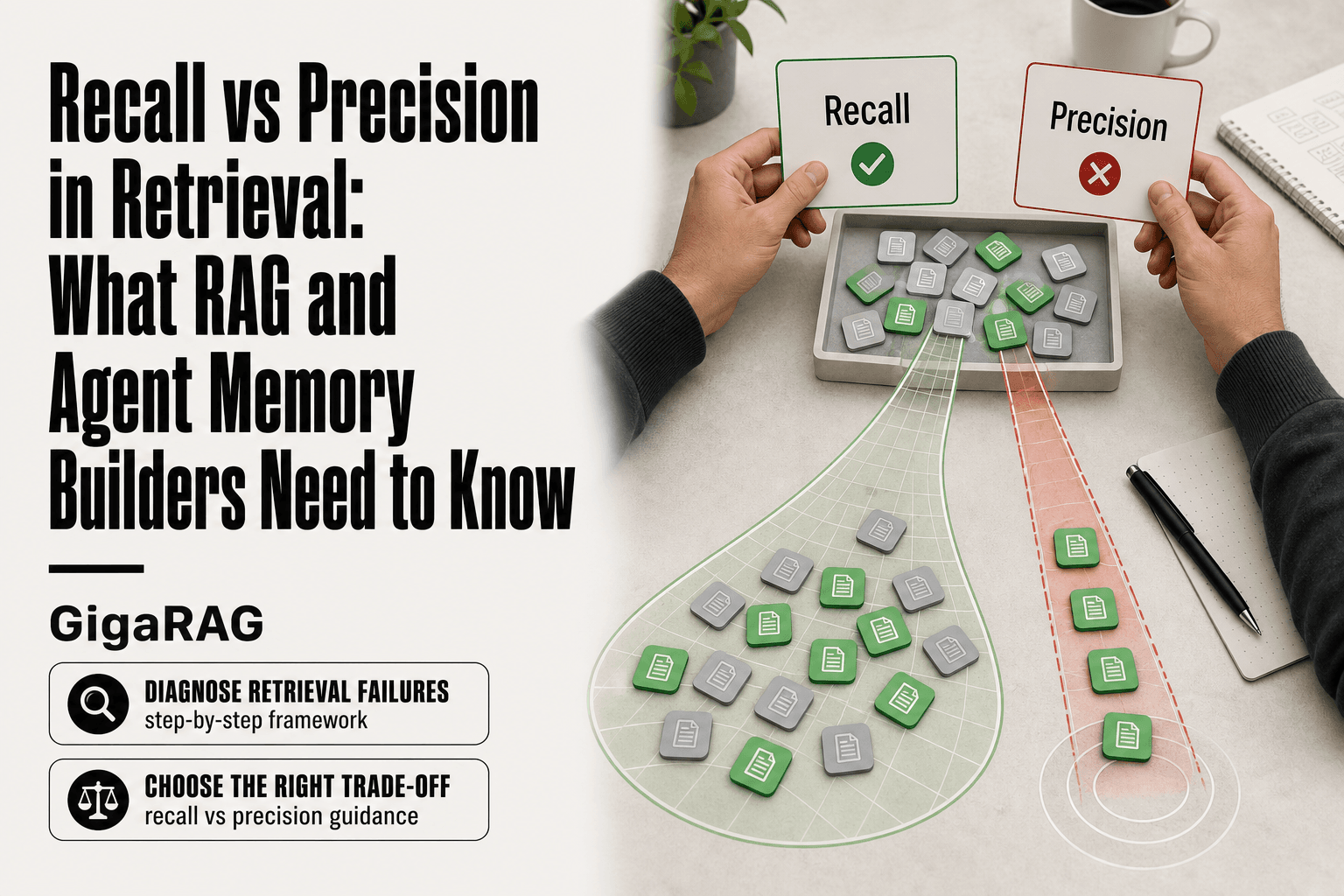
Recall vs precision in retrieval is the fork in the road every RAG builder hits when their pipeline returns wrong answers despite having the right documents sitting in the vector store. You've embedded everything, you've tuned your chunking, and the LLM still hallucinates or misses the point. Is retrieval the problem, or is generation? Two numbers tell you, but only if you know which one to look at. Most builders check neither, because the distinction feels academic until a production system starts failing in ways that cost real money and user trust. This guide gives you a practical diagnostic framework you can run today, explicit guidance on when to prioritize precision over recall and vice versa, and a clear statement of what these metrics cannot tell you. GigaRAG, a platform for agent memory and RAG pipelines, uses this same evaluation approach under the hood.
| At a glance | Details |
|---|---|
| Recall measures | Fraction of relevant items retrieved |
| Precision measures | Fraction of retrieved items that are relevant |
| Key trade-off | Improving one often lowers the other |
| Primary use | Diagnose retrieval vs generation failures |
| When to prioritize recall | High-stakes, missing info costly |
| When to prioritize precision | Limited context, noise harmful |
In This Guide
- What Is Recall in Retrieval?
- Recall vs Precision: Core Differences
- What Is Precision in Retrieval?
- Recall Vs Precision In Retrieval: A Step-by-Step Guide
- Recall vs Precision in Retrieval: The Core Trade-Off
- When to Prioritize Precision Over Recall in Retrieval
- When to Prioritize Recall Over Precision in Retrieval
- A Diagnostic Framework for Recall and Precision in RAG Pipelines
- What Recall and Precision Cannot Tell You
- How to Remember the Difference Between Recall and Precision
- Common Mistakes When Measuring Recall vs Precision in Retrieval
- Putting It Together: A Practical Workflow for Retrieval Evaluation
What Is Recall in Retrieval?
Recall measures how many of the relevant documents your retrieval system actually found. If 10 documents in your vector store contain the answer, and your pipeline retrieves 7 of them, recall is 0.7. It's a completeness score: did you miss anything that mattered?
The recall formula in plain English
Recall = relevant documents retrieved / total relevant documents available.
You count true positives on top, and true positives plus false negatives on the bottom. False negatives are the relevant documents you didn't retrieve. They're invisible in your pipeline output, which is why recall is hard to measure without ground truth.
A concrete RAG example: 10 relevant documents, 7 retrieved
Say you're building a support bot. A customer asks about refund policy. Your vector store has 10 chunks that contain refund information. Your retriever returns 7 of them. Recall is 7/10, or 70%. The other 3 relevant chunks never reached the LLM. If the answer lives in one of those 3, the bot will fail even though the information was in your database.
What high recall tells you (and what it doesn't)
High recall means you're not missing much. That's useful when missing a document is expensive: legal discovery, medical literature search, compliance checks.
But recall says nothing about noise. You could retrieve every relevant document plus 50 irrelevant ones and still score 100% recall. Precision is the metric that catches that problem. The two numbers answer different questions, and you need both to diagnose a retrieval pipeline.
[!note] Recall and precision are computed at a specific cutoff (k). A system can have high recall at k=100 but low precision, and vice versa. Always report the k value when comparing metrics.
Recall vs Precision: Core Differences
| Factor | Recall | Precision |
|---|---|---|
| Definition | Proportion of all relevant documents that are successfully retrieved | Proportion of retrieved documents that are actually relevant |
| Formula | True Positives / (True Positives + False Negatives) | True Positives / (True Positives + False Positives) |
| Primary goal | Avoid missing relevant information | Avoid including irrelevant information |
| Typical use case | Legal discovery, medical diagnosis, agent memory where missing facts is costly | Customer-facing search, summarization, contexts with limited token budget |
| Impact of increasing k | Recall tends to increase (more relevant items found) | Precision tends to decrease (more irrelevant items included) |
What Is Precision in Retrieval?
Precision measures how many of the documents you retrieved were actually relevant. If your pipeline returns 7 documents and 4 of them contain the answer, precision is 0.57. It's a signal-to-noise score: did you waste the LLM's context window on anything that didn't matter?
The precision formula in plain English
Precision = relevant documents retrieved / total documents retrieved.
You count true positives on top, and true positives plus false positives on the bottom. False positives are the irrelevant documents you did retrieve. They're visible in your pipeline output, which makes precision easier to measure than recall, but only if you've labeled what "relevant" means for each query.
A concrete RAG example: 7 retrieved documents, 4 relevant
Same support bot, same refund question. Your retriever returns 7 chunks. You check them against ground truth and find 4 actually contain refund information. Precision is 4/7, or 57%. The other 3 chunks are noise: maybe they mention "refund" in passing, or the embedding model matched them on a semantically adjacent term like "return policy" from a different context. Those 3 chunks consume tokens and can pull the LLM toward a wrong answer.
What high precision tells you (and what it doesn't)
High precision means most of what you retrieved was worth retrieving. That's valuable when context window space is tight or every token costs money.
But precision says nothing about completeness. You could retrieve one perfectly relevant document and miss nine others, and still score 100% precision. Recall catches that problem. The two metrics are complements, not substitutes: recall asks "did I find everything?", precision asks "was what I found worth finding?"
[!tip] For agent memory systems, prioritize recall when the cost of missing a critical fact outweighs the cost of including irrelevant context. Use a two-stage approach: high-recall retrieval followed by a precision-focused re-ranker.
Recall Vs Precision In Retrieval: A Step-by-Step Guide
- Create a labeled evaluation set with queries and known relevant documents.
- Run your retrieval pipeline and log retrieved documents for each query.
- Compute recall: for each query, count how many relevant documents were retrieved out of all relevant documents.
- Compute precision: for each query, count how many retrieved documents are actually relevant.
- Identify failure mode: low recall means missing relevant docs; low precision means too many irrelevant docs.
- Adjust retrieval strategy: for low recall, increase k or improve embeddings; for low precision, add re-ranking or filters.
- Re-evaluate after changes to ensure improvement without harming the other metric.
Recall vs Precision in Retrieval: The Core Trade-Off
Recall and precision pull in opposite directions. Retrieving more documents raises recall but lowers precision; retrieving fewer does the reverse. You can't maximize both at once, so you pick which failure costs more.
Why you can't maximize both at once
The tension is structural. Recall rewards casting a wide net. Precision rewards a narrow one. If you set top-k to 50, you'll catch more relevant documents, but you'll also drag in dozens of irrelevant ones. If you set top-k to 3, you'll keep the noise out, but you'll miss relevant documents that ranked 4th or 5th.
Same story with a similarity threshold. Lower it to 0.5 and recall climbs, precision drops. Raise it to 0.9 and precision climbs, recall drops. Every retrieval parameter is a dial between the two. You turn it one way to fix one metric, and the other metric moves against you.
The F1 score: a balanced compromise
F1 is the harmonic mean of recall and precision. It punishes extreme imbalance. A system with 100% recall and 10% precision scores an F1 of 0.18, not 0.55. That's the point: F1 won't let you hide a terrible precision score behind a great recall score, or vice versa.
The formula: F1 = 2 × (precision × recall) / (precision + recall).
In practice, F1 is useful when you don't have a reason to favor one metric over the other. It gives you a single number to track across pipeline changes.
When F1 hides more than it reveals
F1 treats recall and precision as equally important. They rarely are. In a legal discovery system, missing one relevant document is a disaster. In a customer support bot, retrieving one irrelevant chunk can trigger a hallucinated answer. Those two systems need different trade-offs, but F1 reports the same balance for both.
F1 also collapses the mechanism. A score of 0.7 could mean 0.7 recall and 0.7 precision, or 0.9 recall and 0.57 precision. You can't diagnose a retrieval problem from F1 alone. You need the two numbers separately.
When to Prioritize Precision Over Recall in Retrieval
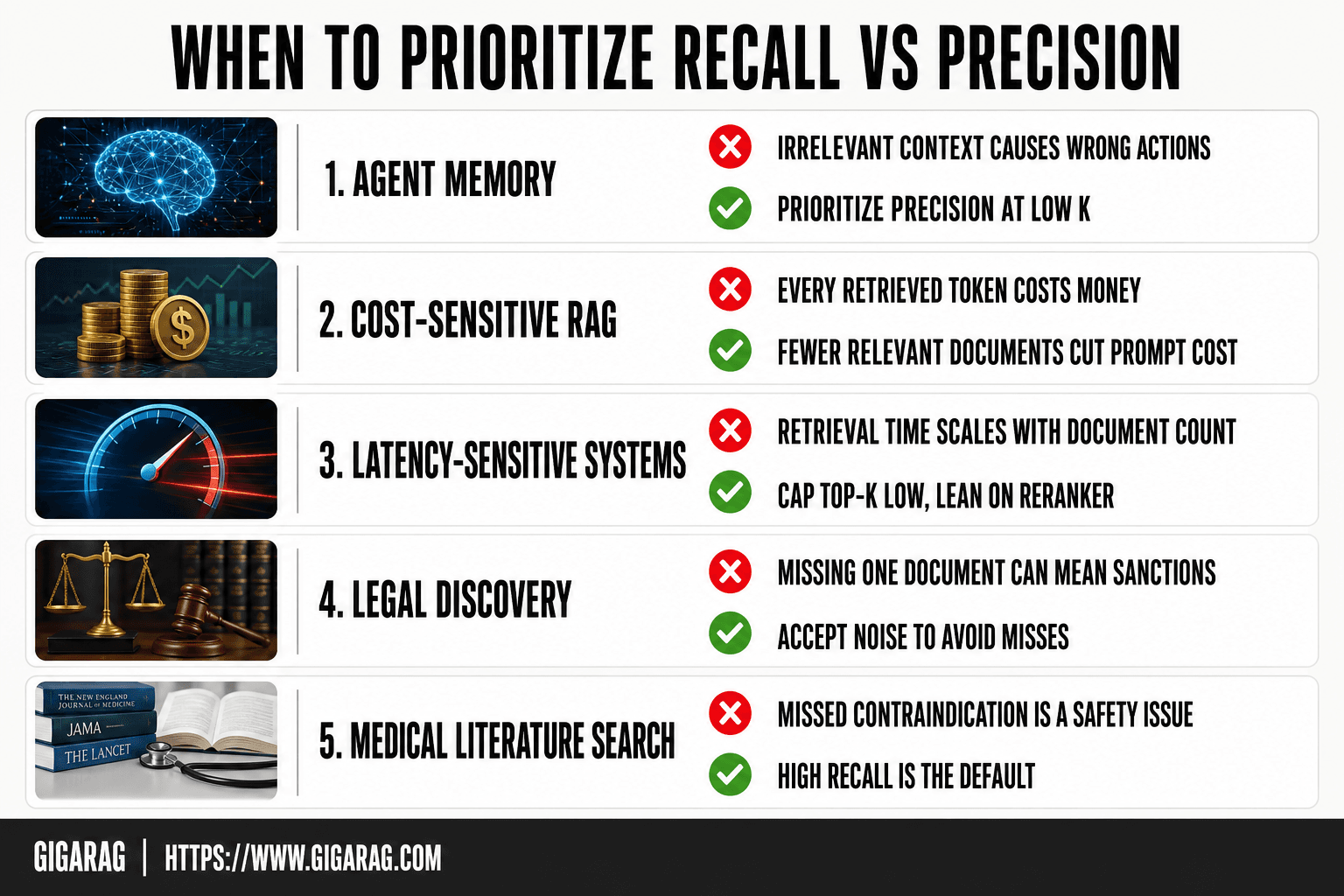
Precision wins when the cost of a wrong document exceeds the cost of a missed one. That's the whole decision in one line. The three cases below are where that trade tips clearly toward precision.
Agent memory: why irrelevant context is dangerous
An agent retrieves context, then acts on it. If that context is wrong or off-topic, the agent doesn't just waste a step. It can take a wrong action, write a wrong value, or send a wrong message. Irrelevant context is a direct cause of hallucination in agent memory systems. You want the retrieved context to be right, not just present. Precision at 3 or 5 matters more than recall at 20.
Cost-sensitive RAG: every retrieved token costs money
Every document you stuff into a prompt costs tokens. Ten irrelevant chunks at 500 tokens each is 5,000 wasted tokens per query. At scale, that's real money. If your pipeline pays per token, precision is a cost-control lever. Retrieving 3 relevant documents instead of 10 mixed ones cuts your prompt cost by two-thirds without hurting answer quality.
Latency-sensitive systems: fewer, better documents
Retrieval time scales with the number of documents you fetch and rerank. A system that needs answers in under 200ms can't afford to pull 50 candidates and rerank them all. Fewer, higher-precision documents mean faster responses. In practice, you'll cap top-k low and lean on a strong reranker to keep precision high at that small k.
When to Prioritize Recall Over Precision in Retrieval
Recall wins when a missed document costs more than a noisy one. Legal discovery is the cleanest case. Missing one relevant email in a subpoena response can mean sanctions. Retrieving 200 irrelevant ones just means more review time. You'll take that trade every time.
When missing a document is worse than retrieving noise
Medical literature search works the same way. A clinician checking drug interactions needs every relevant study, not just the most relevant three. A missed contraindication is a patient safety issue. An irrelevant abstract is a minor annoyance. High recall is the default.
High-recall RAG: the cost of casting a wide net
High recall isn't free. You'll pay in tokens, latency, and answer quality. Pulling 50 chunks when 8 are relevant means your LLM has to sort through 42 distractors. That increases hallucination risk and slows generation. You're trading retrieval misses for generation errors.
Balancing recall with context window limits
Context windows are finite. You can't retrieve everything. The practical move is a two-stage pipeline: high recall at the retrieval stage, then a reranker to push the best documents to the top before truncation. You get broad coverage without blowing the window.
A Diagnostic Framework for Recall and Precision in RAG Pipelines
When retrieval underperforms, guessing wastes cycles. You need a repeatable process: establish ground truth, measure both metrics, identify the failure mode, then fix the right layer. Here's the framework I use.
Step 1: Establish ground truth for your retrieval set
You can't measure recall or precision without knowing which documents are actually relevant. Build a labeled set: 50 to 100 queries, each with a list of document IDs that should be retrieved. This is tedious but non-negotiable. Without it, every metric is a guess.
Step 2: Measure recall and precision separately
Run your queries against the pipeline. For each query, count true positives, false positives, and false negatives. Recall is true positives divided by all relevant documents. Precision is true positives divided by all retrieved documents. Track them separately. A combined score hides which one is broken.
Step 3: Diagnose the failure mode (low recall vs low precision)
Low recall means you're missing relevant documents. The fix is usually chunking or embedding. Low precision means you're retrieving noise. The fix is usually reranking or filtering. If both are low, your ground truth is probably wrong or your embedding model is a poor fit for the domain.
Step 4: Apply targeted fixes — chunking, embedding, reranking
For low recall: smaller chunks, overlapping windows, or a better embedding model. For low precision: add a reranker, raise the similarity threshold, or filter by metadata. Don't change everything at once. Change one thing, re-measure, repeat.
What Recall and Precision Cannot Tell You
A perfect recall score doesn't mean your RAG pipeline gives good answers. It means you retrieved the right documents. What the LLM does with them is a separate problem. Same with precision: retrieving only relevant documents doesn't guarantee the answer is correct, complete, or useful.
Metrics don't measure answer quality
Recall and precision measure retrieval, not generation. You can hit 100% on both and still get hallucinations if the LLM misreads the context or the documents themselves contain errors. A retrieval metric tells you whether the right text reached the model. It says nothing about what the model did next.
The dangers of over-optimizing one metric
Push recall to 100% and you'll retrieve everything, including noise that eats your context window and confuses the model. Push precision to 100% and you'll filter so aggressively that you miss the one document that actually answers the query. Both failure modes look good on a dashboard. Neither serves users.
These metrics can also be gamed. Tune your threshold on the test set and scores climb. Ship that threshold to production and real queries behave differently. The number improves. The system doesn't.
What else to track: latency, cost, hallucination rate
Retrieval quality is one signal among several. Track end-to-end latency: a perfect retrieval that takes three seconds is useless in a chat interface. Track cost per query: high recall means more tokens, which means more money. Track hallucination rate downstream: if answers are wrong despite good retrieval, the problem is generation, not search.
User satisfaction is the metric that matters most. Ask whether people get useful answers, not whether your recall score moved from 0.82 to 0.85.
How to Remember the Difference Between Recall and Precision
Recall is about not missing things. Precision is about not adding noise. That's the whole distinction. If you remember nothing else, remember that.
A simple mnemonic for retrieval builders
Think of Recall as Retrieving everything Relevant. Think of Precision as Picking only the Perfect matches. The letters do the work for you.
The 'fishing net' mental model
Picture a fishing net. A wide net catches every fish in the lake, but it also drags up old boots, seaweed, and tin cans. That's high recall: you got everything, including junk. A spear catches one fish and nothing else. That's high precision: everything you pulled out is what you wanted, but you probably missed a few fish still swimming.
For retrieval, the question is always: do you want the net or the spear?
Common Mistakes When Measuring Recall vs Precision in Retrieval
Most retrieval problems aren't metric problems. They're measurement problems. You can't fix what you measured wrong.
Evaluating on too few queries
A test set of 10 queries tells you almost nothing. Retrieval quality varies wildly by query type: short keyword queries, long natural language questions, domain-specific jargon, edge cases. Ten queries might all be easy ones. Your recall score looks great. Production traffic destroys it.
Build a test set of at least 100 queries. More if you can. Mix query types deliberately. Include the queries that failed in production. Those are the ones that matter most.
Ignoring ranking position (precision at k vs overall)
Precision at k measures precision in the top k retrieved documents. Overall precision measures precision across everything you retrieved. These are different numbers. Confusing them is common.
If you retrieve 20 documents and the LLM only reads the top 5, precision at 20 is irrelevant. What matters is precision at 5. Measure precision at the k your pipeline actually uses. Not a bigger number that looks better.
Not re-evaluating after every pipeline change
You changed the chunk size. You swapped embedding models. You added a reranker. Did you re-measure recall and precision? Most builders don't. They assume the change helped because it felt right.
Every pipeline change shifts the retrieval distribution. A new embedding model might improve recall on some query types and tank precision on others. You won't know unless you measure. Re-run your evaluation suite after every change. Not once a quarter. Every change.
Putting It Together: A Practical Workflow for Retrieval Evaluation
You've got the definitions, the trade-offs, and the diagnostic framework. Here's the workflow that ties it together. This is the loop I run on every retrieval pipeline I touch.
The 5-step evaluation workflow
Step 1: Build your ground truth set. Pick 100+ real queries. For each, mark which documents in your vector store are actually relevant. This is tedious. It's also the only way to get numbers you can trust. No ground truth, no evaluation.
Step 2: Measure both metrics separately. Run your queries. Calculate recall and precision at the k your pipeline actually uses. Don't combine them yet. You need to see which one is broken.
Step 3: Diagnose the failure mode. Low recall means you're missing relevant documents. Fix chunking, try a different embedding model, or add query expansion. Low precision means you're retrieving noise. Tighten your similarity threshold, add a reranker, or reduce k.
Step 4: Apply one fix at a time. Change the chunk size. Re-measure. Swap the embedding model. Re-measure. Add a reranker. Re-measure. One variable per run. Otherwise you won't know what worked.
Step 5: Re-evaluate on production traffic. Your test set is a proxy. Real queries will surprise you. Log retrieval misses in production and feed them back into your ground truth set. The loop never really closes.
How GigaRAG helps you implement this
GigaRAG is built for agent memory and RAG pipelines that need this workflow running continuously. It gives you the evaluation harness to track recall vs precision in retrieval across pipeline changes, so you're not hand-rolling metric dashboards every time you swap an embedding model. The platform handles ground truth management and re-evaluation, which is the part most builders skip because it's boring.
The honest catch: GigaRAG won't fix a bad chunking strategy for you. It shows you the numbers. You still have to make the call. But having the numbers in one place, updated after every change, is the difference between guessing and knowing.
Frequently Asked Questions
When to prioritize precision over recall?
Prioritize precision when the cost of including irrelevant information is high, such as in customer-facing search results, summarization tasks, or when your context window is limited. High precision ensures that the retrieved documents are almost all relevant, reducing noise for the LLM.
How to remember precision vs recall?
Use mnemonics: Precision = Purity (how pure are the retrieved results?), Recall = Reach (how much of the relevant information did you reach?). Alternatively, recall is about not missing anything, precision is about not including junk.
Is precision the same as recall?
No, they are distinct metrics. Precision measures the fraction of retrieved items that are relevant, while recall measures the fraction of relevant items that are retrieved. A system can have high precision but low recall (retrieves few but all relevant) or high recall but low precision (retrieves many, including irrelevant).
What is a good precision and recall score?
There is no universal threshold; it depends on the application. For many RAG systems, a recall above 0.8 and precision above 0.7 is considered strong, but always align with your use case. In high-stakes domains like healthcare, recall may need to be near 1.0.
How do recall and precision affect RAG performance?
Low recall means the LLM may lack necessary information to answer correctly, leading to hallucinations or incomplete answers. Low precision means the LLM may be distracted by irrelevant context, also degrading answer quality. Both metrics are crucial for reliable RAG.
Can I optimize both recall and precision at the same time?
There is often a trade-off, but you can improve both by enhancing retrieval quality, such as using better embeddings, hybrid search, or re-ranking. However, beyond a point, increasing one may decrease the other, so you must balance based on your application's needs.
About GigaRAG
GigaRAG is for agent memory and RAG pipeline builders. get this right. Whether you are working through recall vs precision in retrieval or something adjacent, we publish what we have actually tested, including where it falls short.