RAG Research: What Pipeline Builders Actually Need to Know
RAG research has a translation problem. Pipeline builders read the surveys, learn the taxonomy, and still don't know which chunking strategy to use or why their agent's memory keeps failing. The academic papers optimize for citation counts. You need decisions. This guide cuts through that gap. It's built for developers and technical leads building agent memory systems and RAG pipelines, not for researchers curating reading lists. GigaRAG shows up here as one implementation option, but the real work is understanding what the research actually means when you're staring at a vector database and a latency budget. You'll get a practical filter for reading papers, a clear breakdown of what RAG cannot do, and honest criteria for when not to use it at all. No vendor bias. No academic padding. Just what to build, what to skip, and what to expect when your retrieval quality isn't where you need it.
| At a glance | Details |
|---|---|
| What it is | Retrieval-augmented generation: fetch context, then generate |
| Core pipeline | Chunk, embed, index, retrieve, rerank, generate, evaluate |
| Main research areas | Retrieval quality, chunking, reranking, evaluation, agent memory |
| Where it fails | Bad retrieval, stale index, no grounding, wrong-tool use |
| Agent memory fit | Strong for factual recall, weak for procedural learning |
| When to skip RAG | Small stable corpora, pure reasoning, no external knowledge need |
In This Guide
- What Is RAG Research (and Why Most of It Won't Help You)
- RAG vs Fine-Tuning: Which Do You Actually Need?
- RAG Research Fundamentals: Components and Workflow
- Rag Research: A Step-by-Step Guide
- Key RAG Research Papers Worth Your Time
- RAG for Agent Memory: What Changes
- What RAG Research Cannot Do: Limitations and Failure Modes
- When Not to Use RAG
- Practical RAG Research: Evaluating Papers for Pipeline Impact
- Common Mistakes When Building RAG Pipelines
- Is ChatGPT a RAG Model?
- Getting Started with RAG Research: A Practical Roadmap
What Is RAG Research (and Why Most of It Won't Help You)
RAG research is the body of published work on retrieval augmented generation: how to pull relevant text from a knowledge base, stuff it into a prompt, and get a grounded answer from an LLM. That's the whole field. Papers in this space test chunking strategies, embedding models, re-ranking methods, and generator behaviour. Most of it won't help you.
Here's why. Academic RAG research optimises for benchmark scores on datasets like Natural Questions or HotpotQA. Pipeline builders optimise for latency, cost, and whether the answer is actually right for their users. Those are different problems. A paper that improves recall by 2% on a public benchmark might add 300ms of latency and double your token spend. That's a bad trade in production.
The academic vs. practitioner divide in RAG research
The divide is structural. Researchers need novelty to publish. Practitioners need reliability to ship. So papers chase new architectures: graph-based retrieval, self-reflective retrievers, agentic loops that query the knowledge base multiple times. Each one shows a small gain on a held-out test set.
You don't need novelty. You need to know whether a technique holds up when your documents are messy, your queries are vague, and your users ask things nobody anticipated. Most papers don't test that. They test clean datasets with clear answers.
What counts as 'useful' research for pipeline builders
Useful research answers one of four questions. Does it improve retrieval quality without adding meaningful latency? Does it reduce token cost? Does it improve grounding, meaning fewer hallucinations? Does it make evaluation easier?
If a paper doesn't touch one of those four, skip it. You won't miss anything. The foundational papers and a handful of surveys are worth reading. The rest is noise until you hit a specific problem and need a specific fix.
[!note] RAG does not teach a model new reasoning skills or guarantee factual accuracy; it only supplies retrieved context that the generator may still ignore or misread. Treat retrieval quality and evaluation as the primary levers, not the generator.
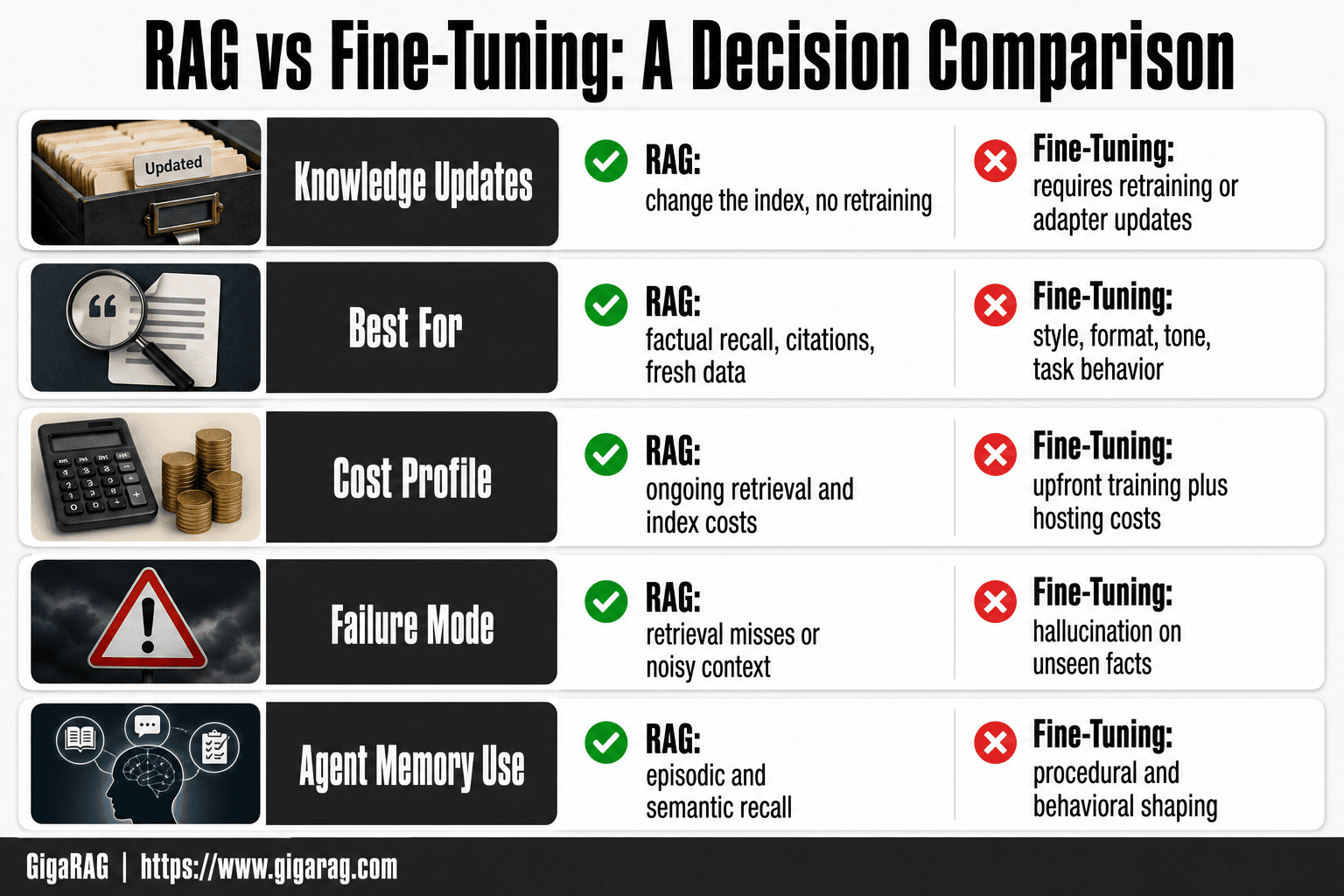
RAG vs Fine-Tuning: Which Do You Actually Need?
| Factor | RAG | Fine-Tuning |
|---|---|---|
| Knowledge updates | Change the index; no retraining | Requires retraining or adapter updates |
| Best for | Factual recall, citations, fresh data | Style, format, tone, task behavior |
| Cost profile | Ongoing retrieval and index costs | Upfront training plus hosting costs |
| Failure mode | Retrieval misses or noisy context | Hallucination on unseen facts |
| Agent memory use | Episodic and semantic recall | Procedural and behavioral shaping |
RAG Research Fundamentals: Components and Workflow
RAG works by pulling relevant text from a knowledge base, adding it to your prompt, and letting the LLM generate an answer grounded in that text. Four components do this: retriever, knowledge base, integration layer, generator.
The four core components every RAG pipeline has
The retriever finds relevant chunks. It takes your query, converts it to a vector, and searches for similar embeddings. The knowledge base is where your documents live, chunked and indexed. The integration layer stuffs retrieved text into the prompt template. The generator is the LLM that produces the answer.
Every RAG system has these four. What changes is how each one is built.
How research papers map to specific components
Papers map cleanly. Chunking research targets the knowledge base. Embedding and re-ranking research targets the retriever. Prompt formatting and context window studies target the integration layer. Grounding and hallucination work targets the generator.
When you read a paper, ask which component it touches. If it doesn't improve one of them, skip it.
The Naive vs. Advanced vs. Modular paradigm from the key survey
The Gao et al. survey splits RAG into three paradigms. Naive RAG is retrieve-then-read: one retrieval pass, one generation pass. Advanced RAG adds pre-retrieval and post-retrieval improvements like query rewriting and re-ranking. Modular RAG breaks the pipeline into swappable parts, letting you add iterative retrieval or memory modules.
Most production systems sit somewhere between Advanced and Modular. Naive RAG is a starting point, not a destination.
[!tip] For agent memory specifically, keep episodic memory (past interactions) and semantic memory (facts) in separate indexes with different retention and retrieval policies, then evaluate them separately; mixing them is a common cause of noisy, hard-to-debug retrieval.
Rag Research: A Step-by-Step Guide
- Identify the pipeline stage the paper targets: retrieval, chunking, reranking, generation, or evaluation.
- Check whether the benchmark matches your domain, corpus size, and query distribution.
- Look for the baseline: does it beat naive dense retrieval and BM25, or only a weak strawman?
- Assess reproducibility: are code, data, and hyperparameters available?
- Estimate integration cost: latency, index size, and operational complexity added.
- Test the smallest change first on your own eval set before adopting the full method.
- Document what improved, what regressed, and what you could not measure.
Key RAG Research Papers Worth Your Time
Most RAG papers won't change what you build. A handful will. Here's the short list, with the one takeaway from each that actually affects a pipeline decision.
The foundational RAG paper (Lewis et al., 2020)
Lewis et al. introduced retrieval augmented generation at Facebook AI Research in 2020. The paper showed you could combine a pre-trained retriever with a pre-trained seq2seq generator and fine-tune them together, getting better results than either component alone on open-domain question answering.
The takeaway that matters: RAG wasn't invented to fix hallucinations. It was invented to give LLMs access to external knowledge without retraining them. That distinction still drives design decisions. If your goal is grounding, RAG helps. If your goal is teaching the model new behaviour, it won't.
The comprehensive survey (Gao et al., 2023)
Gao et al.'s survey is the one practitioners actually cite. It organises RAG research into the Naive, Advanced, and Modular paradigms and catalogues the techniques under each: query rewriting, hybrid search, re-ranking, iterative retrieval, memory modules.
The practical value is the taxonomy itself. When you hit a retrieval quality problem, the survey tells you which category of fix to reach for. Chunking problem? Knowledge base. Retrieval misses? Retriever or re-ranking. It won't tell you which specific technique works for your data, but it narrows the search from hundreds of papers to a dozen.
Recent papers on agentic RAG and memory
Agentic RAG research is moving fast and most of it is not ready for production. The papers worth watching are the ones that treat retrieval as a multi-step process: retrieve, evaluate, decide whether to retrieve again, then generate. That loop matters for agent memory systems where a single retrieval pass is rarely enough.
The honest takeaway: read these papers for architecture patterns, not for benchmarks. Benchmarks in agentic RAG are inconsistent across papers, so a 5-point improvement on one dataset tells you little about your pipeline. The architecture patterns, like retrieval loops and memory consolidation, transfer directly.
RAG for Agent Memory: What Changes
Standard RAG assumes a stateless query: retrieve, inject, generate, done. Agent memory breaks that assumption. The agent carries state across turns and sessions, and what it retrieves must change as that state changes.
Why agent memory is harder than document retrieval
Document retrieval has a fixed corpus. Agent memory doesn't. The memory store grows with every interaction, and old entries lose relevance or need updating. You're not just retrieving from a knowledge base. You're retrieving from a partial, messy record of everything the agent has done.
The second problem is timing. A document retriever can return the same chunks for the same query every time. An agent memory system has to decide what's relevant now, given the current conversation, not just what matches the query text. That means retrieval quality depends on context you can't precompute.
Memory types: working, episodic, semantic
Agent memory research splits into three buckets. Working memory is the current context window: what the agent can see right now. Episodic memory is a log of past interactions: what happened, when, with whom. Semantic memory is distilled knowledge: facts and patterns extracted from episodes.
Most RAG pipelines only handle the semantic bucket. They retrieve from a curated corpus. Agent memory systems have to handle all three, and the hard part is consolidation: turning episodic logs into semantic knowledge without losing the details that still matter.
How RAG research applies (and doesn't) to memory systems
The retrieval techniques transfer. Chunking, embedding, re-ranking, hybrid search: all of it works for memory stores the same way it works for documents. The difference is that memory stores are dynamic, so you need re-indexing and decay policies that document RAG never considers.
What doesn't transfer is the evaluation. Document retrieval benchmarks measure precision and recall against a fixed ground truth. Memory retrieval has no fixed ground truth. The right memory for a given turn depends on the agent's goals, which shift. You can't score it the way you score a QA dataset.
The honest takeaway: treat RAG research as a toolbox for the retrieval mechanics, not a blueprint for memory architecture. The architecture decisions, consolidation, decay, what to keep in working memory, are agent-specific problems the RAG literature barely touches.
What RAG Research Cannot Do: Limitations and Failure Modes
RAG papers promise grounding, but the pipeline itself has sharp edges. Here's what the research doesn't fix, no matter how many papers you read.
The 'sufficient context' problem: more context can mean more hallucinations
The assumption behind RAG is simple: give the model the right context, and it'll generate the right answer. The reality is messier. When you stuff a context window with retrieved chunks, some of those chunks are noise. The model can't always tell which retrieved passage matters, so it blends them. The result is a confident answer that mixes facts from three different sources, none of which fully support the claim.
This isn't a retrieval failure. It's a generation failure caused by retrieval succeeding too broadly. More context gives the model more material to confuse. The fix isn't always better retrieval. Sometimes it's less context, or cleaner context, or a re-ranker that's aggressive about dropping low-scoring chunks.
When retrieval quality is the bottleneck
RAG can't rescue a bad retriever. If your embeddings don't capture the right similarity, or your chunking splits a key fact across two chunks, the generator never sees what it needs. You'll get a plausible answer built from the wrong passages, and it'll look just as confident as a correct one.
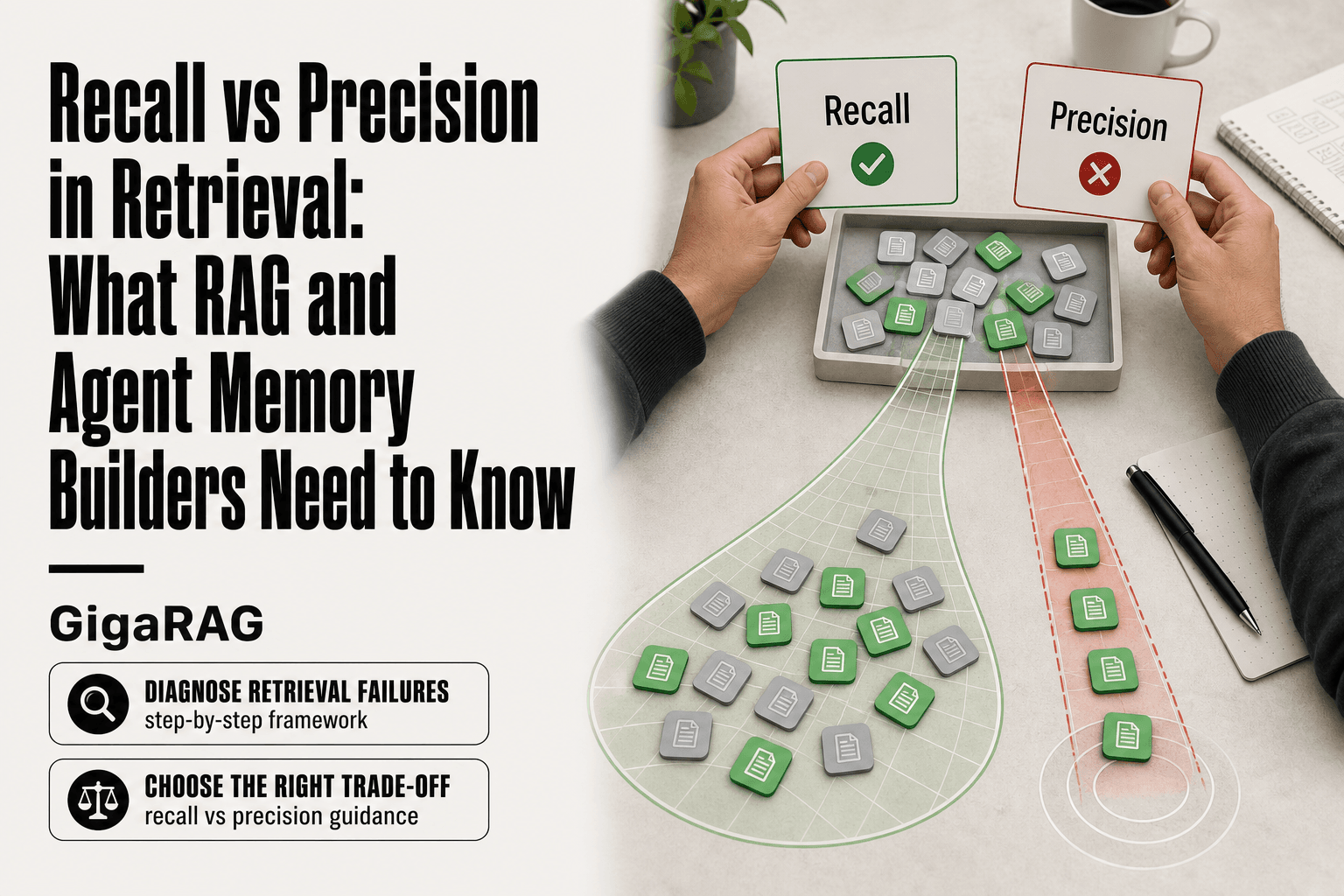
The honest answer is that most RAG failures are retrieval failures in disguise. The generator is doing its job: producing fluent text from whatever you hand it. If you hand it garbage, you get fluent garbage. No amount of prompt engineering or model choice fixes that. You have to measure recall and precision at the retrieval layer, not just eyeball the final output.
What RAG won't fix about your LLM
RAG doesn't make a weak model strong. If your generator can't reason over multiple retrieved facts, or can't follow instructions reliably, adding a retriever won't change that. RAG improves grounding, not reasoning. The model still has the same context window limits, the same tendency to over-trust its own priors, and the same failure modes on long or ambiguous inputs.
It also doesn't replace fine-tuning. RAG is a runtime injection mechanism. Fine-tuning changes the model's weights. They solve different problems. If your model needs to learn a new task or a new format, RAG won't teach it that. If your model needs access to facts that change frequently, fine-tuning is the wrong tool. The two overlap, but they're not substitutes.
When Not to Use RAG
RAG solves a specific problem: grounding generation in external knowledge at runtime. It is not a default. Before you build a pipeline, check whether a simpler approach already works.
RAG vs. fine-tuning: a decision framework
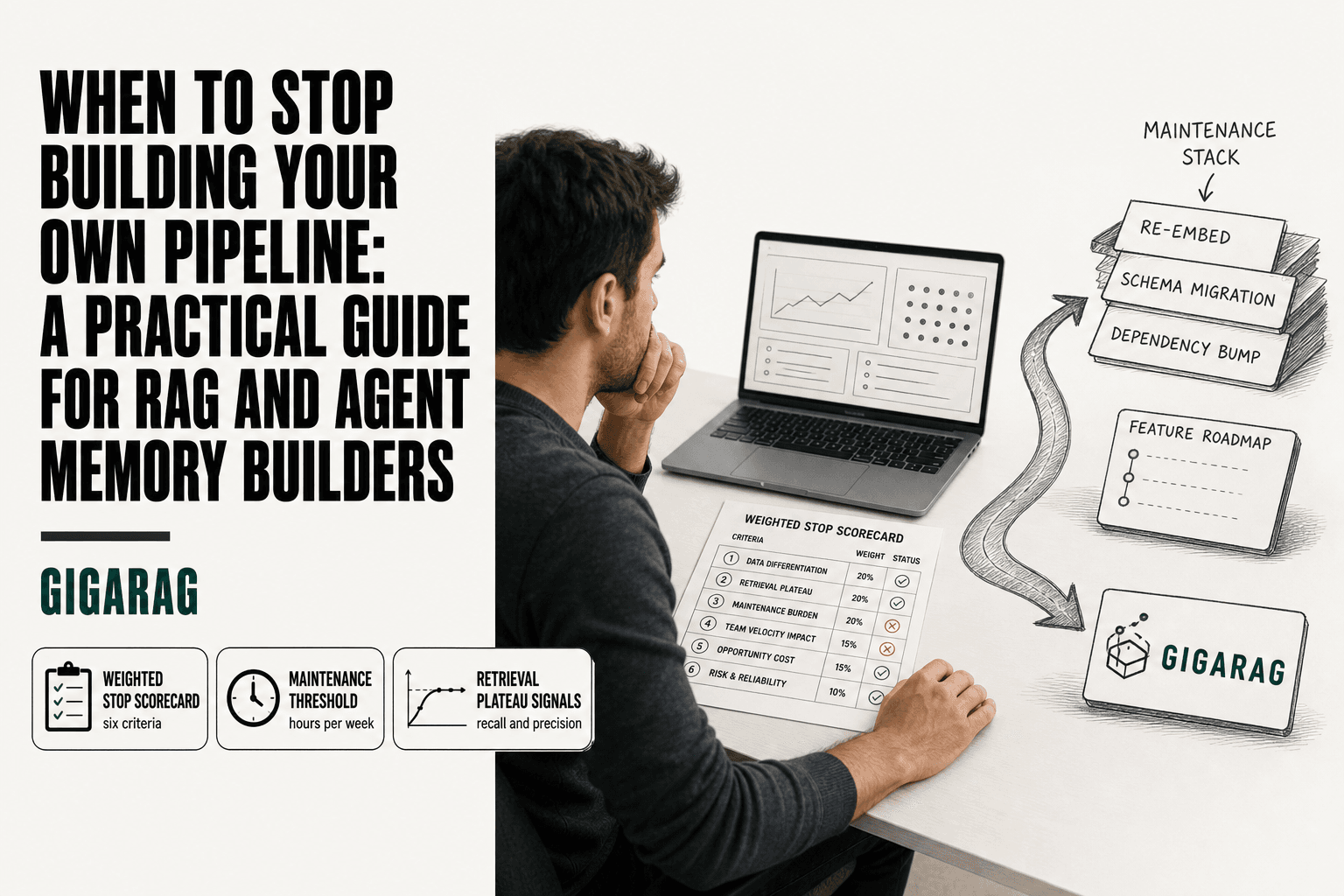
Fine-tuning changes the model's weights. RAG injects context at inference time. Use fine-tuning when the task is stable: a fixed format, a consistent style, a domain the model needs to internalize. Use RAG when the knowledge changes often, or when you need to cite sources, or when you can't afford to retrain.
If your knowledge base updates daily, fine-tuning is a losing game. If your task never changes and your data fits in a prompt, RAG is overhead.
When a simple prompt or database query is enough
A lot of RAG pipelines exist because someone wanted to use RAG, not because they needed it. If your knowledge base is small enough to fit in a context window, just paste it. If your data is structured and your queries are predictable, a SQL query beats a vector search every time.
The test is simple: can a human answer the question with the same data in front of them? If yes, you don't need retrieval. You need a prompt.
Latency and cost dealbreakers
Every retrieval step adds latency: embedding the query, searching the index, re-ranking, then generating. For a chatbot, that's fine. For a real-time API where you need a response in 50 milliseconds, it's not.
Token cost compounds too. Retrieved context gets prepended to every request. If you're retrieving 2,000 tokens per query and serving a million queries a day, that's real money. Sometimes the honest answer is: fine-tune a smaller model and skip retrieval entirely.
Practical RAG Research: Evaluating Papers for Pipeline Impact
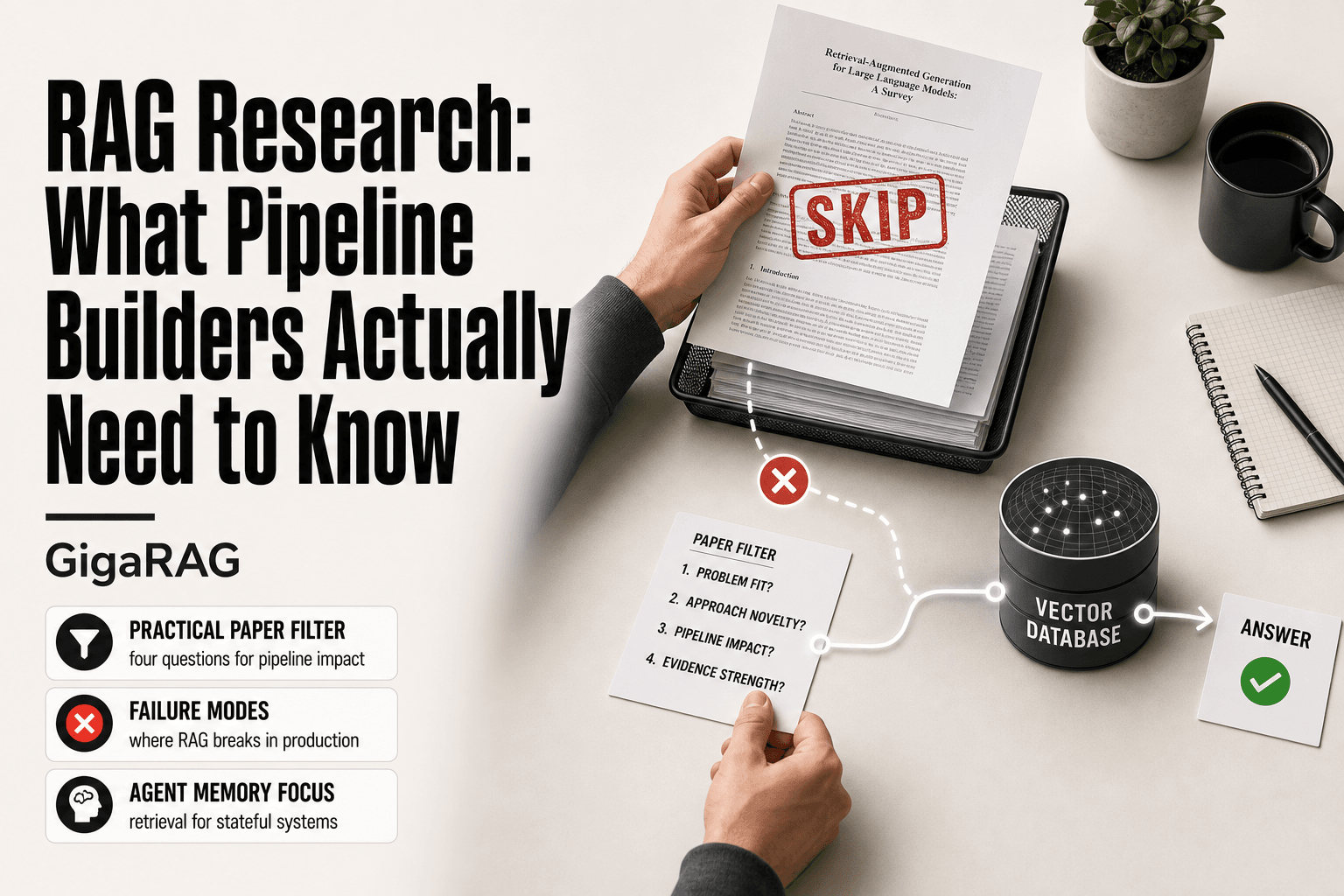
Most RAG papers won't change what you build. The filter is simple: does it improve retrieval quality, reduce latency, cut cost, or improve grounding? If it doesn't touch one of those four, skip it.
The four questions to ask about any RAG paper
Read the abstract, then ask:
- Does it improve retrieval quality? Look for measured recall or precision gains on a benchmark you recognize.
- Does it reduce latency? A clever re-ranking method that adds 200ms per query is a non-starter for real-time systems.
- Does it cut cost? Fewer tokens retrieved, smaller embeddings, or cheaper models all count.
- Does it improve grounding? Fewer hallucinations, better citation accuracy, or more faithful generation.
If the paper answers none of these, it's academic. That's fine. It's just not for you.
How to spot vendor bias in RAG research
Vendor papers benchmark their own stack against a strawman. Watch for three tells: they compare against a naive RAG baseline nobody runs in production, they omit re-ranking from the baseline, or they report only their best run. Check who funded the work. A vector database vendor's paper will rarely show their product losing to an open-source alternative.
Building a personal RAG research filter
Set up a simple triage. Skim the abstract for one of the four questions. Check the evaluation section for real numbers on a standard benchmark. If both pass, read the method. If not, move on.
Keep a running list of papers that changed a decision you made. That list, not the latest arXiv feed, is your actual research base.
Common Mistakes When Building RAG Pipelines
Most RAG pipelines fail quietly. They return plausible-looking answers that are wrong, and nobody notices until a user complains. The mistakes below are the ones I see repeated across production systems.
Chunking mistakes that kill retrieval quality
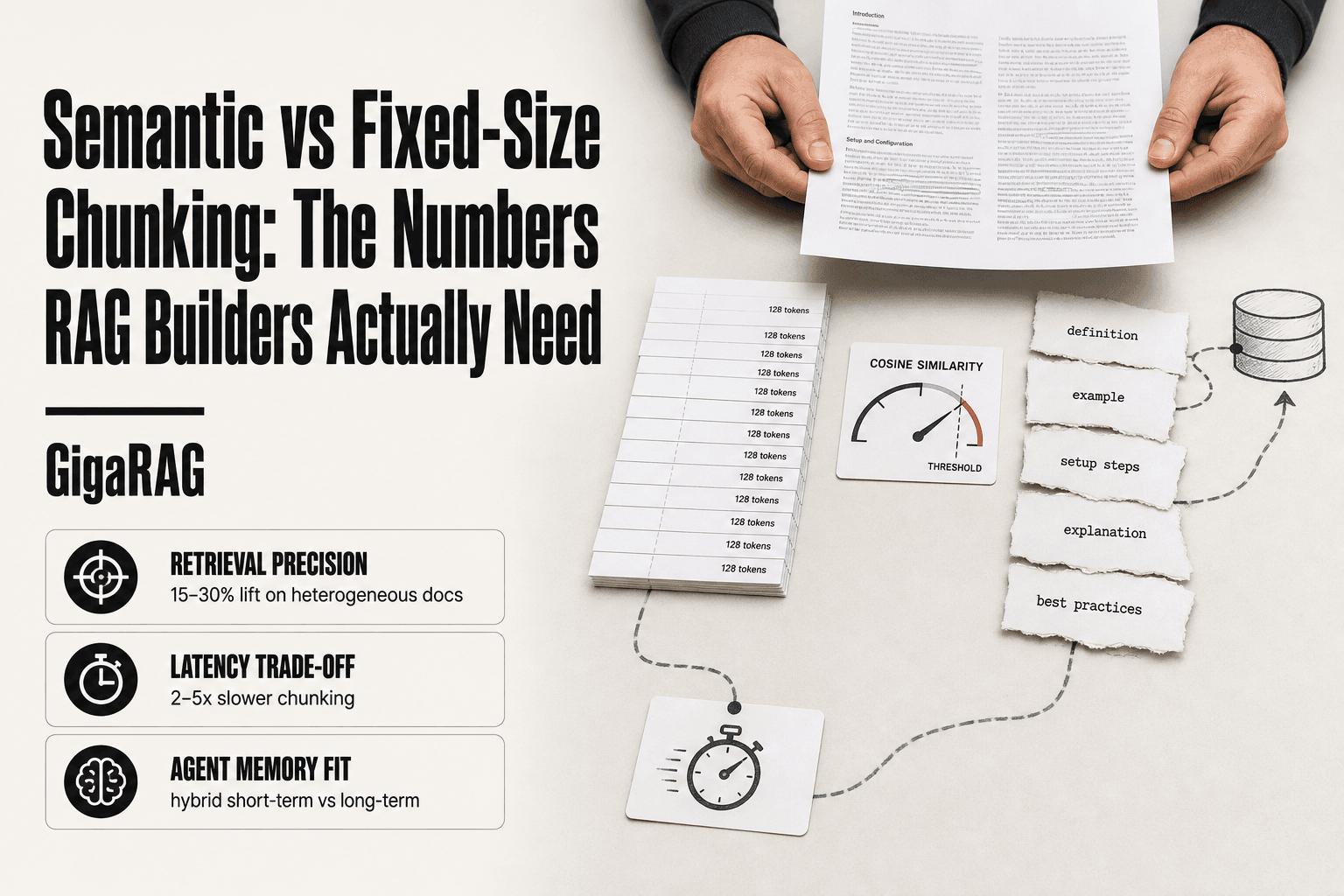
Naive chunking is the biggest one. Splitting documents into fixed 500-token chunks with no overlap breaks sentences mid-thought, and the embedding model can't recover meaning from a fragment. You get retrieval that finds the right document but the wrong passage.
The fix is simple: chunk on semantic boundaries like paragraphs or sections, not arbitrary token counts. Add 10-15% overlap between chunks so context doesn't get cut at the edges. Test different chunk sizes against your actual queries. A chunk size that works for legal contracts won't work for chat logs.
Why you need re-ranking (and when you don't)
Embedding similarity is a rough first pass. It gets you candidates, not answers. A re-ranker like a cross-encoder reads the query and passage together and scores relevance properly. Without it, your top-5 results will include near-misses that look fine but aren't.
You can skip re-ranking when your corpus is small, under a few thousand chunks, or when latency is tight and your retrieval quality is already good enough. Measure it before you add it.
The evaluation gap: most pipelines are never measured
Here's the uncomfortable truth: most teams ship RAG without any retrieval evaluation. They eyeball a few outputs, declare it working, and move on. Then retrieval quality drifts as the corpus grows and nobody knows why answers got worse.
Build a small eval set of 50-100 real queries with known relevant passages. Run it after every change to chunking, embeddings, or re-ranking. If you're not measuring recall and precision, you're not doing rag research. You're guessing.
Is ChatGPT a RAG Model?
- ChatGPT is not a RAG model by default. It's a large language model trained on a fixed dataset with a knowledge cutoff. When you ask it a question, it generates an answer from what it learned during training. It doesn't retrieve anything from an external knowledge base at inference time.
That said, ChatGPT can be the generator component inside a RAG pipeline. You can build a system where a retriever pulls relevant documents from your own corpus, feeds them into the prompt, and ChatGPT generates a grounded answer using that context. The retrieval part is yours. The generation part can be ChatGPT.
The confusion comes from features like web browsing. When ChatGPT browses the web, it is doing something RAG-like: fetching external content and using it to ground the response. But that's a product feature bolted onto the model, not the model itself. The underlying GPT architecture has no built-in retrieval mechanism.
So the honest answer: ChatGPT is a generator, not a RAG system. You can make it part of one, but you're building the retrieval half yourself.
Getting Started with RAG Research: A Practical Roadmap
Stop reading surveys. Start building. You'll learn more from one broken pipeline than from ten papers.
Week 1: Read the foundational paper and build a naive RAG
Read Lewis et al. (2020), the paper that named RAG. One pass. Don't annotate. Then build the simplest possible pipeline: a vector database, an embedding model, a retriever that pulls the top 5 chunks, and a generator that answers from those chunks. Use whatever stack you already know. LangChain, LlamaIndex, or raw Python with a local vector store.
Your first version will be bad. That's the point. You need a baseline to measure against.
Week 2: Add evaluation and measure retrieval quality
Pick three metrics: recall@k, precision@k, and answer faithfulness. Build a test set of 20 to 30 questions you already know the answers to. Run your pipeline. Write down the numbers.
Most people skip this step. Don't. Without a baseline, every change you make is a guess.
Week 3: Iterate on chunking and re-ranking
Change one thing at a time. Try smaller chunks. Try overlapping chunks. Add a re-ranking step. Measure after each change. Keep the change if recall goes up, revert it if it doesn't.
GigaRAG can help here: it handles chunking, retrieval, and re-ranking as configurable components, so you can test these variations without rebuilding the pipeline each time. But the loop is the same whether you use a tool or write it yourself: change, measure, keep or revert.
RAG research won't hand you a finished architecture. It hands you a set of levers. Pull the ones that move your numbers, ignore the rest, and measure everything.
Frequently Asked Questions
Is ChatGPT a RAG model?
Not inherently. ChatGPT is a generative model; when it browses the web or uses retrieval tools, that is RAG applied on top. The base model alone is not a retrieval system.
Why is RAG outdated?
Naive RAG, meaning a single retrieve-then-generate pass, is increasingly seen as insufficient for complex tasks. The field has moved toward agentic and iterative RAG, but the core retrieval-plus-generation pattern remains widely used and useful.
What is LLM vs RAG?
An LLM is the generative model; RAG is an architecture that augments it with retrieved external context. They are complementary, not competing: RAG uses an LLM as its generator.
What is RAG in AI for dummies?
RAG lets an AI look things up before answering. Instead of relying only on training data, it retrieves relevant documents and includes them in the prompt so the answer is grounded in specific sources.
What is the difference between RAG and agentic RAG?
Standard RAG retrieves once and generates. Agentic RAG lets the model decide when and what to retrieve, possibly across multiple steps, tools, and iterations, which suits agent memory and multi-hop tasks.
When should I not use RAG?
Skip RAG when your knowledge is small and stable enough to fit in a prompt, when the task is pure reasoning with no external facts, or when retrieval quality cannot be made reliable for your domain.
How do I keep up with RAG research without reading every paper?
Track a few benchmark leaderboards and survey papers, follow the main retrieval and evaluation venues, and filter papers by whether they target a pipeline stage you actually operate. Prioritize reproducible work with code and clear baselines.
About GigaRAG
GigaRAG is for agent memory and RAG pipeline builders. get this right. Whether you are working through rag research or something adjacent, we publish what we have actually tested, including where it falls short.