How to Preserve Project Decisions Across AI Sessions
You ask an AI agent to continue work on a project, and it contradicts a decision you made three sessions ago. Not because the model is broken. Because nobody wrote the decision down in a place the agent could find it. Preserving project decisions across AI sessions is a solvable engineering problem for developers building RAG pipelines and agent memory systems. It's not a model limitation. It's a storage and retrieval design problem.
The good news: the patterns are concrete. You need a decision log, a vector store or knowledge graph, and metadata that tracks provenance and rationale. You don't need to re-explain yourself every session. Tools like GigaRAG sit in this space, but the patterns here apply regardless of what you run.
This guide covers what counts as a project decision, why context windows alone can't hold them, how to build a decision log for RAG pipelines, and what session memory honestly cannot do.
| At a glance | Details |
|---|---|
| Core problem | AI sessions lose project decisions, causing inconsistent outputs |
| Solution | Decision log with structured storage and retrieval |
| Key components | Capture, store, retrieve, and inject decisions |
| Storage format | Structured records with rationale and provenance |
| Retrieval method | Semantic search plus metadata filtering |
| Limitation | No perfect recall; requires manual curation |
In This Guide
- What It Means to Preserve Project Decisions Across AI Sessions
- Conversation History vs. Decision Log
- Why Context Windows Alone Cannot Preserve Project Decisions
- Preserve Project Decisions Across AI Sessions: A Step-by-Step Guide
- Types of Memory Your Agent Needs
- Designing a Decision Log for RAG Pipelines
- Storing and Retrieving Decisions in Agent Memory
- Common Mistakes When Preserving Project Decisions Across AI Sessions
- Evaluating Your Decision Preservation Layer
- What You Cannot Expect from Session Memory
- Where GigaRAG Fits
What It Means to Preserve Project Decisions Across AI Sessions
Preserving project decisions means storing the conclusions your team reached, along with why you reached them, so an AI agent can retrieve them in later sessions instead of re-deriving or contradicting them.
What counts as a project decision
A project decision is a conclusion that changes what you build. "We're using Postgres, not MongoDB." "The API returns snake_case." "We rejected websockets because of proxy timeouts." These are not preferences. They are constraints.
Why decisions are different from conversation history
Conversation history is a transcript. It records what was said, including dead ends, questions, and small talk. Decisions are the output of that conversation: the filtered, agreed-on result. Storing the transcript without extracting decisions means your agent has to re-read every argument to find the conclusion. That's slow and unreliable.
The cost of losing decisions between sessions
When a decision disappears, the agent doesn't know it's missing. It produces output that contradicts what your team already settled. You catch the error, re-explain, and lose trust. The fix is not a bigger context window. It's a decision log.
[!note] A decision log is not a substitute for human oversight; it must be curated and validated to avoid propagating errors.
Conversation History vs. Decision Log
| Factor | Conversation History | Decision Log |
|---|---|---|
| What it stores | Raw dialogue, including noise | Curated decisions with rationale |
| Retrieval accuracy | Low; relies on keyword or semantic match | High; structured metadata enables precise filtering |
| Provenance | Often unclear who said what and why | Explicit source, timestamp, and context |
| Maintenance | Automatic but bloated | Manual curation but focused |
| Use case | Casual chat continuity | Project-critical decision preservation |
Why Context Windows Alone Cannot Preserve Project Decisions
A context window is a buffer, not a filing system. It holds whatever you feed it for the current request, then it's gone. Relying on it to preserve decisions fails in two ways: it truncates, and it forgets what it never truncated.
Token limits and truncation
Every model has a hard token ceiling. When a session grows past that ceiling, the oldest content gets dropped. Not summarized, not archived. Dropped. The decision you made in session one is the first thing to go. You won't get a warning. The agent will simply answer as if that decision never happened.
Why decisions get lost even when context fits
Even when a decision still fits inside the window, it competes with everything else: code snippets, error messages, back-and-forth. The model weighs all of it. A decision buried three turns back can be outvoted by newer, contradictory context. Fitting is not the same as being retrieved.
The difference between context and memory
Context is what the model can see right now. Memory is what you can retrieve on demand. Context is volatile and bounded. Memory is persistent and searchable. If you want a decision to survive across sessions, it has to live in memory, not in the window. The window is where decisions go to die.
[!tip] For RAG pipeline builders: store decisions as separate documents with metadata (project, date, status) and use a hybrid search (keyword + vector) to retrieve them, ensuring both precision and recall.
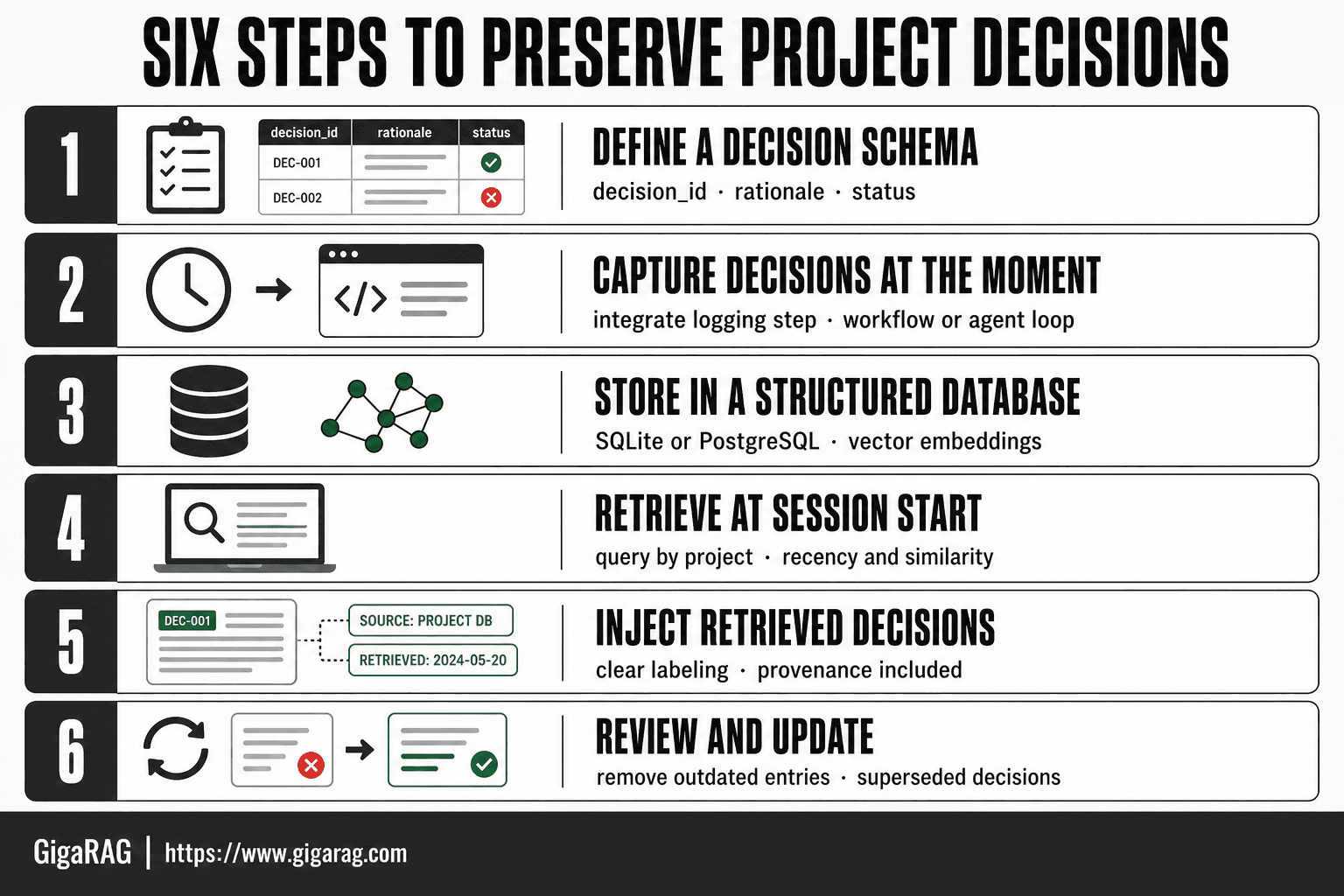
Preserve Project Decisions Across AI Sessions: A Step-by-Step Guide
- Define a decision schema: include fields like decision_id, timestamp, author, rationale, alternatives, and status.
- Capture decisions at the moment they are made: integrate a logging step into your workflow or agent loop.
- Store decisions in a structured database (e.g., SQLite or PostgreSQL) with vector embeddings for semantic search.
- Retrieve relevant decisions at session start: query by project, recency, and semantic similarity to the current task.
- Inject retrieved decisions into the AI's context window with clear labeling and provenance.
- Regularly review and update the decision log to remove outdated or superseded entries.
Types of Memory Your Agent Needs
Memory isn't one thing. An agent that preserves project decisions needs at least three kinds, and they store different material. Mixing them is the fastest way to build a system that retrieves the wrong thing at the wrong time.
Short-term vs long-term memory
Short-term memory is the working buffer: the current session, the last few turns, the code you just pasted. It's volatile and cheap to access. Long-term memory is what survives between sessions: decisions, rationale, constraints. The honest answer is that most agents only have short-term memory out of the box. Long-term memory is something you build.
Episodic memory for session history
Episodic memory stores what happened: "On March 12, we agreed to switch from Postgres to SQLite for the prototype." It's a log of events, ordered by time. This is useful for auditing and for reconstructing context, but it's not where decisions should live. Episodic memory tells you what was said. It doesn't tell you what still holds.
Semantic memory for project decisions
Semantic memory stores what is true: "The prototype uses SQLite, not Postgres." It's the distilled, current state of the project. This is where decisions belong. When an agent needs to know which database to use, it should query semantic memory, not replay the session where the decision was made. Build semantic memory as the source of truth. Use episodic memory to explain why.
Designing a Decision Log for RAG Pipelines
A decision log is a structured record of what was decided, why, and when. It's not a chat transcript. It's the distilled output: decision, rationale, constraints, and status. For RAG pipelines, this log becomes the retrieval source for semantic memory.
Decision log schema
Keep the schema flat. Six fields cover most cases:
decision_id: unique identifier, UUID worksdecision: one sentence stating what was decidedrationale: why, in two or three sentencesconstraints: what this decision rules outstatus:active,superseded, ordeprecatedtimestamp: ISO 8601
Don't add fields for who made the decision unless you need audit trails. Provenance matters, but agent-generated decisions rarely need attribution beyond the session ID.
Storing decisions in a vector store
Store each decision as a document with the decision and rationale fields embedded together. The constraints and status fields go into metadata, not the embedding. That way semantic search finds decisions by meaning, while metadata filtering handles lifecycle: you can exclude deprecated decisions without re-embedding anything.
Retrieving decisions with metadata filtering
Query with two conditions: semantic similarity on the embedded text, plus status = "active" in the metadata filter. This is the pattern that prevents stale decisions from resurfacing. If a decision gets superseded, update its status rather than deleting it. Deletion destroys the audit trail.
Code example: logging a decision
import uuid
from datetime import datetime, timezone

def log_decision(store, decision, rationale, constraints):
    doc_id = str(uuid.uuid4())
    store.add(
        id=doc_id,
        text=f"Decision: {decision}\nRationale: {rationale}",
        metadata={
            "decision_id": doc_id,
            "constraints": constraints,
            "status": "active",
            "timestamp": datetime.now(timezone.utc).isoformat(),
        },
    )
    return doc_id
This is the minimum viable pattern. It captures what was decided, why, and what it rules out. Retrieval is a semantic search with a status filter. That's the whole mechanism.
Storing and Retrieving Decisions in Agent Memory
Agent memory differs from standard RAG in one way: the agent writes to it, not just reads from it. A RAG pipeline retrieves decisions you logged. An agent logs decisions as it works, then retrieves them later. The storage layer has to handle both directions.
Vector stores for semantic retrieval
Vector stores work when you need to find a decision by meaning, not by keyword. "We chose Postgres over MySQL" should match a query like "what database did we settle on." Embeddings handle that. The catch: vector stores don't track relationships between decisions. They treat each decision as an island.
Knowledge graphs for decision relationships
Knowledge graphs store decisions as nodes with typed edges: supersedes, depends_on, conflicts_with. This matters when one decision constrains another. If you chose React, that decision constrains the state management choice. A graph query can trace that chain. A vector search can't.
Hybrid approaches
Most agent memory systems need both. Vector search for recall, graph for structure. Store the decision text and embedding in the vector store, then link the decision ID to graph nodes. Query the vector store first, then walk the graph from the matched node to find related decisions.
When to use each
Start with a vector store. It's simpler and covers most retrieval needs. Add a graph when decisions start interacting: when one choice rules out another, or when you need to answer "what does this decision depend on." Don't build the graph first. You'll spend weeks modeling relationships before you have enough decisions to justify it.
Common Mistakes When Preserving Project Decisions Across AI Sessions
Most decision-preservation systems fail because of how they're built, not because the model can't remember. Four mistakes show up repeatedly.
Over-retention and noise
Logging every decision, including trivial ones, buries the important ones. Retrieval precision drops as the store fills with "changed button color to blue." Keep only decisions that constrain future work.
Missing decision rationale
Storing the what without the why is the most common failure. "We chose Postgres" is useless three sessions later. "We chose Postgres because we need JSONB and the team knows it" prevents re-litigating the choice.
Poor metadata and filtering
Decisions without metadata can't be filtered by project, date, or status. You retrieve everything or nothing. Add project_id, status, and superseded_by fields from day one.
Treating decisions like chat logs
Chat logs are chronological noise. Decisions are structured facts. If you store raw conversation and hope retrieval finds decisions, it won't. Extract decisions explicitly and store them separately.
Evaluating Your Decision Preservation Layer
You can't fix what you don't measure. Three checks tell you whether decisions actually survive across sessions.
Retrieval accuracy for decisions
Build a test set of 20 to 50 real decisions, each with a query that should retrieve it. Measure precision and recall. Precision tells you how much noise comes back. Recall tells you what you're missing. Both matter. A system with 90% recall but 40% precision buries the right answer in junk.
Consistency testing across sessions
Run the same prompt through five fresh sessions. The agent should give the same answer every time. If it contradicts itself, the decision isn't being retrieved reliably. Log every mismatch.
Measuring decision drift
Track when decisions change. If a decision flips without a new decision record explaining why, that's drift. Count drift events per week. The number should stay near zero.
What You Cannot Expect from Session Memory
Session memory is a retrieval layer, not a brain. It stores what you logged and returns what matches a query. It doesn't reconstruct the full context of every past session.
No perfect reconstruction
You'll never get back the exact state of a conversation. Embeddings compress meaning. Chunking splits text. Retrieval returns fragments. The agent fills gaps with inference, and sometimes it fills them wrong.
Memory is not documentation
A decision log records that a choice was made. It doesn't replace the design doc explaining why. If the rationale never got written down, memory can't recover it.
The risk of over-retention
Storing everything makes retrieval worse. Noise buries the decisions that matter. You'll trade missed context for wrong context.
Where GigaRAG Fits
GigaRAG is one option in the agent memory and RAG pipeline space. It focuses on agent memory and RAG pipelines specifically, not general chat history. If you're already building with a vector store and a decision log, GigaRAG can slot into that stack.
The patterns in this article apply regardless of tool choice. A decision log schema works in any vector database. Metadata filtering works in any retrieval layer. GigaRAG doesn't change the fundamentals of preserving project decisions across AI sessions. It just packages some of them.
The honest answer is that no tool replaces the design work. You still need to decide what counts as a decision, how to chunk it, and what metadata to attach. GigaRAG handles retrieval and storage. You handle the judgment.
Frequently Asked Questions
How can you tailor AI to give you the responses you want more often?
By providing structured context about your project's decisions, constraints, and preferences. A decision log with clear rationale helps the AI align with your expectations across sessions.
What is the best way to summarize chat history for decision preservation?
Instead of summarizing entire conversations, extract key decisions and their rationale into a structured format. This reduces noise and improves retrieval accuracy.
Can I use vector databases to store project decisions?
Yes, vector databases can store embeddings of decision records for semantic search. Combine them with metadata filters (e.g., project ID, date) to narrow results.
How do I handle conflicting decisions across sessions?
Maintain a status field (e.g., active, superseded) and a version history. When retrieving, prioritize the most recent active decision and flag conflicts for human review.
What are the limitations of session memory systems?
They cannot guarantee perfect recall, may retrieve irrelevant decisions, and require ongoing curation. They also depend on the quality of the initial capture.
How often should I update the decision log?
Update it whenever a significant decision is made or revised. Regular reviews (e.g., weekly) help keep the log accurate and relevant.
About GigaRAG
GigaRAG helps GigaRAG is for agent memory and RAG pipeline builders. get this right. Whether you are working through How to Preserve Project Decisions Across AI Sessions or something adjacent, we publish what we have actually tested, including where it falls short.