RAG vs Fine-Tuning vs Long Context: Which Should You Choose?
RAG vs Fine-Tuning vs Long Context is a decision most agent memory and RAG pipeline builders face after they've already burned a sprint on the wrong path. You start with retrieval, someone suggests fine-tuning, a new model ships with a 1M token window, and suddenly the architecture you shipped last quarter looks like a guess. It probably was. The honest answer is that each approach solves a different problem, and picking wrong costs weeks of rework, not hours. I've watched teams default to fine-tuning because it felt more "real" than a vector database, then discover the model still can't answer questions about last Tuesday's incident. GigaRAG is built for the RAG side of this equation, but this article won't sell you a magic solution. It will give you a practical comparison with explicit limitations, a step-by-step decision framework, and an FAQ that answers the questions engineers actually ask before committing to production.
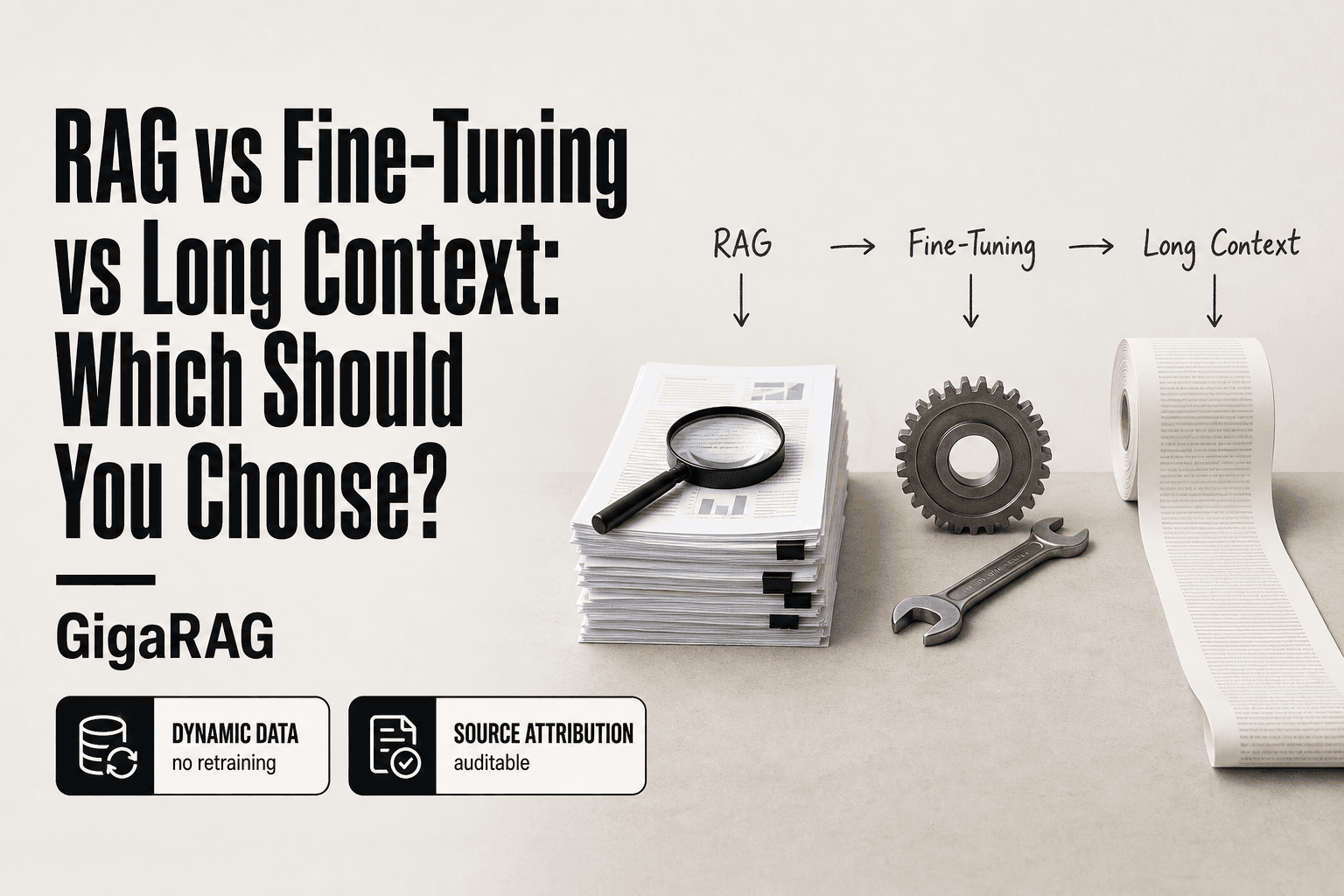
| At a glance | Details |
|---|---|
| Best for | Dynamic data, low latency, no retraining |
| Best for | Static style/tone, deep domain skills |
| Best for | Very long docs, simple queries |
| Key limitation | RAG needs retrieval quality; can miss context |
| Key limitation | Fine-tuning costly, needs retraining for updates |
| Key limitation | Long context: high cost, may lose focus |
In This Guide
- What Is RAG?
- RAG vs Fine-Tuning vs Long Context: Which Fits Your Agent Memory?
- What Is Fine-Tuning?
- RAG Vs Fine-Tuning Vs Long Context: A Step-by-Step Guide
- What Is Long Context?
- RAG vs Fine-Tuning: The Core Difference
- When to Use RAG
- When to Use Fine-Tuning
- When Long Context Actually Makes Sense
- What You Cannot Do with RAG, Fine-Tuning, or Long Context
- Cost Considerations for Production Systems
- Hybrid Approaches: Combining RAG and Fine-Tuning
- Decision Framework: How to Choose
- Common Mistakes When Choosing RAG vs Fine-Tuning vs Long Context
- Final Thoughts
What Is RAG?
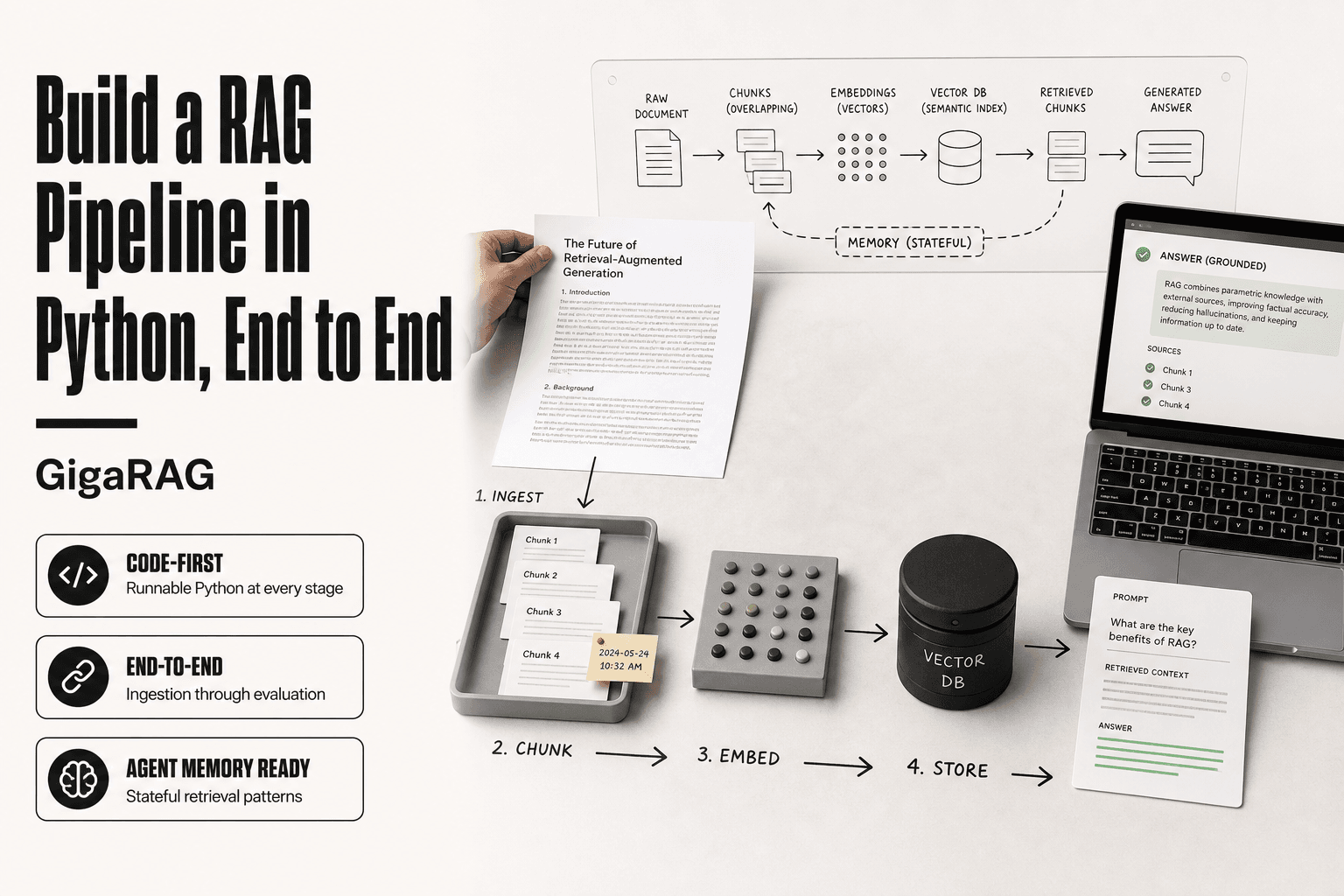
Retrieval augmented generation (RAG) is a pattern that gives an LLM access to external data at inference time. Instead of relying only on what the model learned during training, RAG fetches relevant documents, chunks, or records from a data store, stuffs them into the prompt, and lets the model generate an answer grounded in that retrieved context.
The three steps are retrieval, augmentation, and generation. Retrieval finds the most relevant pieces from your data. Augmentation inserts those pieces into the prompt alongside the user's question. Generation is the model producing a response that uses the retrieved material as its source of truth.
How RAG works in a production pipeline
In production, RAG is not just "search then ask." The pipeline starts with an embedding model that converts your documents into vectors. Those vectors live in a vector database. When a query arrives, the same embedding model converts the query into a vector, and the database returns the nearest neighbours. A re-ranking step often follows to improve precision before the top chunks reach the LLM.
Chunking strategy matters more than most teams expect. If you split documents too coarsely, retrieval returns noise. Too finely, and the model loses context. Most production systems tune chunk size, overlap, and the number of retrieved chunks per query. The model then generates from that retrieved context, and you can log which chunks were used for auditability.
Why RAG matters for agent memory
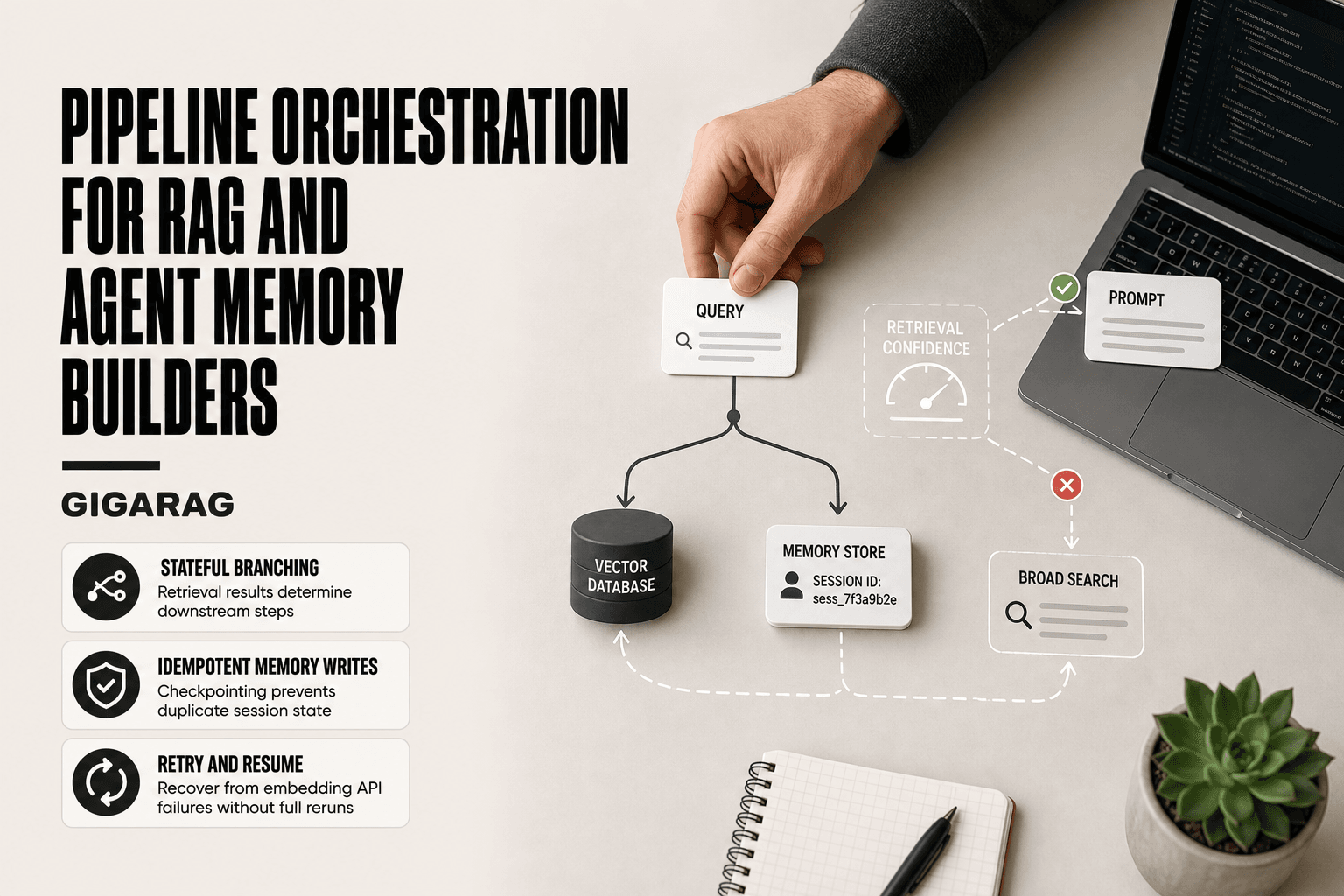
Agents need state. A stateless LLM forgets everything between calls. RAG gives you a way to persist memory outside the model: conversation history, user preferences, domain documents, previous tool outputs. The agent retrieves what's relevant to the current turn instead of carrying everything forward.
That's the core advantage for agent builders. You can update the memory store without retraining anything. Add a new document, and the next retrieval picks it up. Delete a stale record, and it stops appearing. The model's weights never change, which means you keep full control over what the agent knows and can prove where each answer came from.
[!note] RAG, fine-tuning, and long context are not mutually exclusive—many production systems combine RAG with fine-tuning for domain style, or use long context for specific tasks. The choice depends on your data volatility, latency needs, and budget.
RAG vs Fine-Tuning vs Long Context: Which Fits Your Agent Memory?
| Factor | RAG | Fine-Tuning |
|---|---|---|
| Data freshness | Real-time via external sources | Static; requires retraining for new data |
| Implementation cost | Moderate; needs vector DB and pipelines | High; needs training infra and expertise |
| Latency | Adds retrieval step; can be optimized | Inference only; no extra retrieval latency |
| Statefulness | Can store conversation history externally | Limited; context window only |
| Best for | Dynamic knowledge, citations, scalability | Style/tone, domain-specific skills, low-latency inference |
What Is Fine-Tuning?
Fine-tuning is training a pre-trained model further on a smaller, task-specific dataset. The model's weights change. It learns to produce outputs in a particular style, follow a specific format, or handle a narrow domain better than the base model did.
What fine-tuning actually changes in the model
The weights. That's it. Fine-tuning adjusts the parameters that were already learned during pre-training, nudging them toward your data. It changes how the model behaves: tone, structure, output format, adherence to domain conventions. It does not reliably add new facts. A fine-tuned model can learn patterns from your examples, but it won't memorise a specific document and recall it verbatim on demand. That's a retrieval job.
Common fine-tuning methods: LoRA, PEFT, full fine-tuning
Full fine-tuning updates every weight in the model. It's expensive and needs serious GPU time. PEFT (parameter-efficient fine-tuning) updates only a small subset of parameters. LoRA is the most common PEFT method: it injects low-rank matrices into the attention layers and trains only those, keeping the base model frozen. LoRA cuts memory and compute costs by roughly 90% compared to full fine-tuning, which is why most teams start there.
[!tip] For agent memory, start with RAG to handle dynamic conversation history and external knowledge, but fine-tune a small adapter if you need consistent response formatting or domain terminology. Keep a fallback to long context for single-document deep dives.
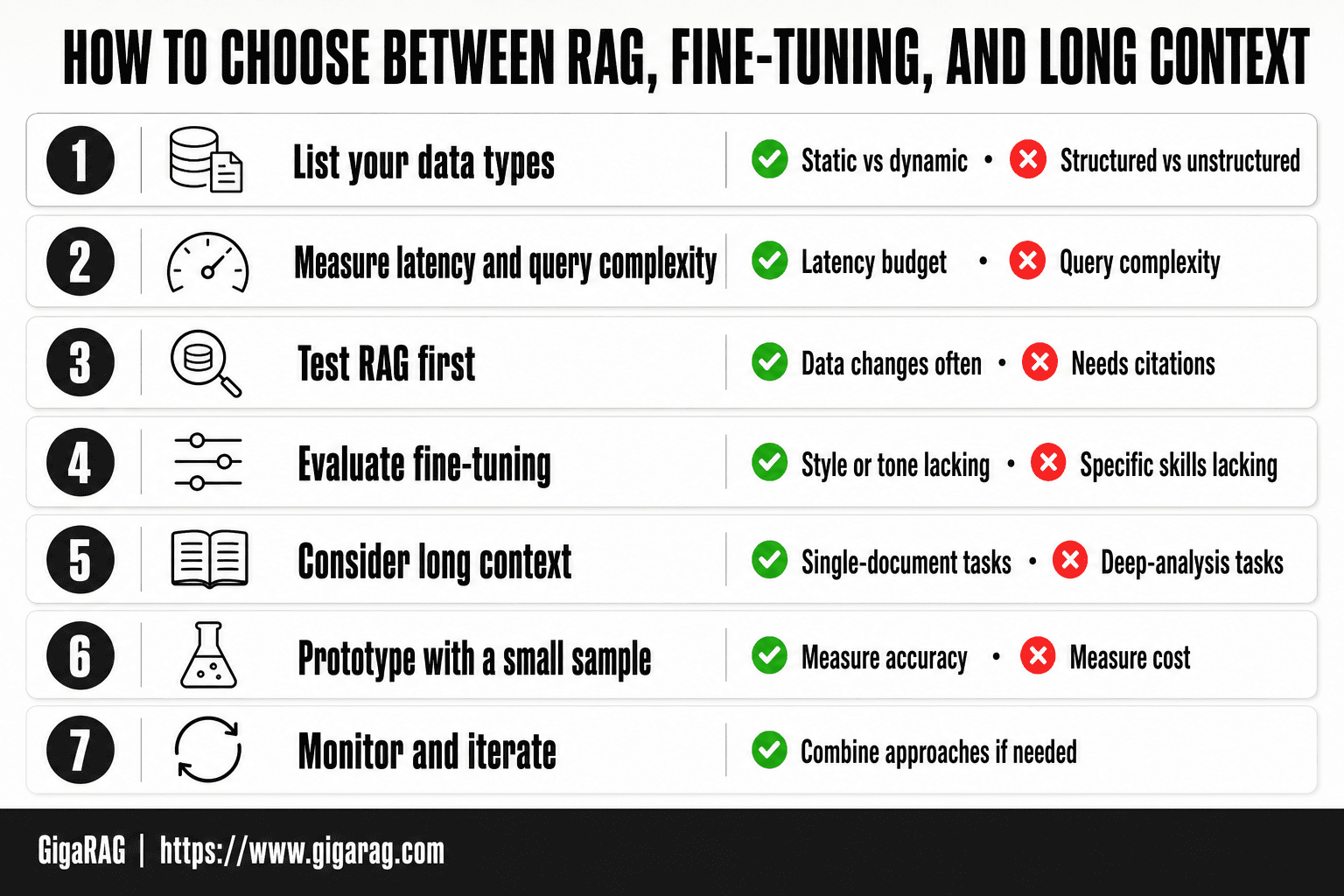
RAG Vs Fine-Tuning Vs Long Context: A Step-by-Step Guide
- List your data types: static vs dynamic, structured vs unstructured.
- Measure your latency budget and query complexity.
- Test RAG first if data changes often or needs citations.
- Evaluate fine-tuning only if style/tone or specific skills are lacking.
- Consider long context for single-document, deep-analysis tasks.
- Prototype with a small sample to measure accuracy and cost.
- Monitor and iterate; combine approaches if needed.
What Is Long Context?
Long context means stuffing everything into the prompt. No retrieval step, no weight updates. You pass the model your documents, your history, your instructions, and it answers from what's in front of it. The approach is simple because there's no pipeline to build.
How long context models changed the comparison
Two years ago, a 4K token window made this a non-starter for most production work. You couldn't fit a single codebase, let alone a conversation history. Modern models changed that. Claude and Gemini now offer 1M-token windows. GPT-4o handles 128K. That's enough for a few hundred pages of documentation or a full day of agent logs.
The honest answer is that long context works well for small, bounded tasks. One-off document analysis, quick prototyping, summarising a single long file. You don't need embeddings, a vector database, or a retrieval pipeline. You just pass the text and ask.
The hidden costs of long context
The main catch is that long context is not free. Every token in the prompt costs money and time. A 100K-token prompt takes seconds to process before the model generates a single word. Latency scales with prompt size, not output size.
Attention also degrades. Models don't read a 1M-token context the way you read a page. They attend unevenly, and information buried in the middle gets missed more often than information at the start or end. For agent memory, where you're retrieving specific facts from a long history, that's a real problem. You pay for every token, but the model doesn't use every token equally.
RAG vs Fine-Tuning: The Core Difference
RAG retrieves relevant documents at query time and feeds them into the prompt. Fine-tuning bakes knowledge into the model's weights through training. RAG keeps knowledge external and swappable. Fine-tuning makes it internal and static.
Mechanism: retrieval vs weight update
RAG doesn't change the model. It changes what the model sees. When a query comes in, a retriever pulls relevant chunks from a vector database, those chunks get added to the prompt, and the model generates an answer grounded in that retrieved text. The model's weights stay frozen. You can swap the documents, re-embed them, and the model's behaviour changes immediately without any training.
Fine-tuning is the opposite. You take a base model and run training steps on a dataset of examples. Those steps update the weights. The model learns patterns, style, and domain associations from the data. After fine-tuning, the knowledge is in the weights. You can't point to a specific document the model is drawing from, because the information has been distributed across millions of parameters.
Here's why this matters for agent memory. RAG gives you a memory you can inspect, update, and delete from. Fine-tuning gives you a memory that's baked in and hard to change without retraining.
Data freshness and knowledge cutoff
RAG has no knowledge cutoff in the traditional sense. The retrieval index is whatever you put in it. Add today's incident report to the vector database, and the model can answer questions about it on the next query. No training run required. For agent memory systems where state changes constantly, that's the difference between a system that stays current and one that goes stale.
Fine-tuning freezes knowledge at the moment of training. If your domain shifts, you retrain. That's a compute cost, a data prep cost, and a deployment cost. For domains that move slowly, that's fine. For anything with daily or weekly updates, it's a maintenance burden.
Cost and maintenance comparison
The cost profiles are inverted. RAG costs money at inference time: every query pays for retrieval plus the extra tokens in the prompt. Fine-tuning costs money upfront: you pay for training compute and data preparation, then inference is cheaper because you're not stuffing context.
Maintenance follows the same split. RAG maintenance is operational: you manage a vector database, re-embed documents, tune chunking and retrieval. Fine-tuning maintenance is a retraining cycle: you collect new examples, retrain, evaluate, redeploy. Neither is free. The question is which cost you'd rather pay repeatedly.
When to Use RAG
RAG is the right call when your data changes faster than your training cycle, when you need to show your work, and when you can't afford to retrain every time something shifts. It's not the answer for everything. But for three specific situations, it's the clear winner.
Dynamic or frequently updated data
If your knowledge base updates daily, weekly, or in real time, RAG beats fine-tuning on maintenance alone. You re-embed the new documents, and the model answers from them on the next query. No training run, no evaluation cycle, no redeployment.
Think about a support agent that needs today's pricing changes or an incident response system that pulls from live runbooks. Fine-tuning means retraining every time the runbook changes. RAG means updating an index. The honest answer is that if your data has a shelf life measured in days, fine-tuning is a non-starter.
Need for source attribution and auditability
RAG lets you point at the exact document that produced an answer. That's not a nice-to-have in regulated industries. It's the difference between shipping and not shipping.
When a retrieval pipeline returns chunks, you can log which chunks went into the prompt. You can show a compliance officer the source. You can debug a wrong answer by inspecting what was retrieved. Fine-tuning can't do any of that. The knowledge is distributed across weights, and there's no document to point at.
Agent memory and stateful retrieval
Agent memory systems need state that persists across turns and updates as the agent learns. RAG gives you a memory you can write to, read from, and clear. Store conversation summaries, task results, and user preferences in a vector database. Retrieve the relevant bits on the next turn.
That's statefulness without retraining. When an agent finishes a task and you want it to remember what happened, you embed the result and move on. Fine-tuning would require collecting examples and running a training job for every new memory. That's not practical. Long context works for a single session, but it doesn't persist across sessions without you managing that state yourself. RAG is the only approach where memory is a first-class, inspectable, updatable thing.
When to Use Fine-Tuning
Fine-tuning earns its keep when you need the model to behave differently, not just know different things. RAG changes what the model sees. Fine-tuning changes how the model responds. That distinction drives every decision below.
Style, tone, and behavior adaptation
If your model needs to write like your brand, follow a strict output format, or handle a specific interaction pattern, fine-tuning is the tool. You train on examples of the behavior you want, and the model internalizes it. No prompt engineering gymnastics at inference time.
A legal document generator that must always output clauses in a specific structure is a classic case. You can prompt for that, but the model drifts. Fine-tune on 500 examples of correctly formatted clauses, and the format becomes the default. The main catch is that you need those examples. If you can't produce a few hundred high-quality demonstrations of the behavior, fine-tuning won't help.
Domain specialization with stable knowledge
Fine-tuning works when your domain knowledge is stable and you have enough examples to teach it. Think medical coding, tax law, or a proprietary schema that hasn't changed in years. The knowledge gets baked into the weights, and the model applies it consistently without retrieval overhead.
The honest answer is that this only pays off when the knowledge is genuinely stable. If your domain updates quarterly, you're signing up for a retraining cycle every quarter. That's fine if the accuracy gain justifies it. It's not fine if RAG would get you 95% of the way with zero training runs.
Latency-sensitive production systems
Here's where fine-tuning has a real edge over RAG. A RAG pipeline adds retrieval time: embedding the query, searching the vector database, re-ranking, then stuffing context into the prompt. That's often 200-500ms before the model even starts generating.
Fine-tuning skips all of that. The knowledge is already in the model. You send the query, you get the response. For a real-time chatbot or an API that needs sub-100ms responses, that difference matters. The tradeoff is that you've moved the cost upstream: you paid for training compute and data preparation instead of paying for retrieval at inference time.
When Long Context Actually Makes Sense
Long context looks like the simplest option. You skip retrieval, skip training, and stuff everything into the prompt. For some jobs, that's genuinely the right call. For production systems, it usually isn't.
Small datasets and rapid prototyping
If your entire knowledge base fits in a few hundred thousand tokens, long context works. You don't need a vector database, an embedding model, or a retrieval pipeline. You load the documents, ask the question, get an answer. That's the whole system.
Rapid prototyping is where this shines. You're testing whether a use case is viable, not building something that will serve a thousand requests a day. Long context lets you validate the idea in an afternoon. If it works, you can build the RAG pipeline later. If it doesn't, you've lost nothing.
One-off tasks fit here too. Analyzing a single contract, summarizing a long transcript, comparing a handful of documents. You'll never query that data again, so building retrieval infrastructure around it is wasted effort.
Production limitations: cost, latency, attention degradation
The problems start when long context meets production traffic.
Cost is the first wall. Every request re-sends the entire context. A 100k-token prompt at $0.005 per 1k input tokens costs $0.50 per call. A thousand calls a day is $500. RAG sends a few hundred tokens of retrieved context instead, cutting that cost by 90% or more.
Latency compounds the problem. Models process input tokens before generating output. A 100k-token prompt takes seconds to process before the first response token appears. That's fine for a batch job. It's not fine for an interactive agent.
Attention degradation is the quiet killer. Models don't read long contexts evenly. They weight the beginning and end heavily, and lose track of details in the middle. Research on "lost in the middle" shows accuracy drops measurably as documents get buried in long prompts. You're paying more for worse retrieval.
The honest answer is that long context is a prototyping tool and a one-off task tool. It's not a production architecture for anything that gets queried repeatedly.
What You Cannot Do with RAG, Fine-Tuning, or Long Context
Every approach has a ceiling. Teams burn weeks because they expect a method to do something it was never designed to do. Here's what each one won't do for you, stated plainly.
What RAG cannot do
RAG cannot teach the model new reasoning patterns. It retrieves text and stuffs it into the prompt, but the model still reasons the way it was trained to reason. If your base model is bad at multi-step deduction on financial data, adding a retrieval layer won't fix that. You'll get the right documents in context and still get the wrong answer.
RAG also cannot fix bad retrieval. If your embeddings are weak, your chunking is wrong, or your re-ranking is missing, the pipeline fails before generation even starts. The model can only work with what retrieval hands it. Garbage in, garbage out applies here more than anywhere else.
And RAG won't give you consistent output formatting. You can prompt for JSON, but the model will occasionally break format under pressure. That's a generation problem, not a retrieval problem.
What fine-tuning cannot do
Fine-tuning cannot reliably inject fresh facts. You can fine-tune on a dataset of current product prices, and the model will learn some of them. It will also hallucinate others, blend dates together, and confidently state prices that were never in the training set. Fine-tuning changes how the model behaves, not what it knows with precision.
It also cannot make a model truthful about things it never saw. If your fine-tuning data has gaps, the model fills those gaps with plausible-sounding fiction. That's not a bug you can train away. It's how language models work.
Fine-tuning won't give you source attribution. The model doesn't remember which training example a fact came from, so you can't trace an answer back to a document. If auditability matters, fine-tuning alone fails that requirement.
What long context cannot do
Long context cannot scale cheaply. Every token in the context window costs money on every single request. A 200k-token prompt at $0.005 per 1k input tokens is $1.00 per call. At a thousand calls a day, that's $1,000 daily before you've generated a single output token. RAG sends a few hundred tokens of retrieved context instead.
It also cannot guarantee the model actually read everything. Attention degrades across long inputs. Documents in the middle of a 100k-token prompt get weighted less than documents at the start or end. You're paying for tokens the model effectively ignores.
Long context won't give you stateful memory across sessions. Each request is stateless. You re-send the entire history every time, and the model has no persistent memory of what it learned in a previous conversation. Agent memory needs something closer to a retrieval layer or an external store.
Cost Considerations for Production Systems
Cost is where most teams get the decision wrong. They compare approaches on accuracy and forget that production costs compound monthly. A choice that looks cheap in a prototype can cost five figures a quarter once traffic arrives. Here's the breakdown by cost driver.
Inference cost: long context vs RAG retrieval
Long context is the most expensive option per request, and the math is unforgiving. Every token in your context window gets billed on every call, whether the model uses it or not. A 100k-token prompt at $0.005 per 1k input tokens costs $0.50 per request. At 10,000 requests a day, that's $5,000 daily before output tokens. RAG sends a few hundred tokens of retrieved context instead, so the same request might cost $0.01 to $0.05 in input tokens. The gap widens as your context grows.
Fine-tuning doesn't change inference cost much. A fine-tuned model costs roughly the same per token as its base model, sometimes a bit more on hosted platforms. The savings come from shorter prompts: you don't need to stuff examples and instructions into every call because the model already learned them.
Training cost: fine-tuning compute and data prep
Fine-tuning has an upfront cost the other two approaches don't. LoRA fine-tuning on a 7B model can run on a single A100 for a few hours, which is maybe $50 to $200 in cloud compute. Full fine-tuning on a 70B model is a different story: multiple GPUs, days of training, thousands of dollars. Data prep adds more. You need hundreds or thousands of high-quality examples, and cleaning that dataset takes real engineering time. RAG and long context have zero training cost. You pay as you go.
Infrastructure cost: vector databases and pipelines
RAG shifts cost from tokens to infrastructure. You need a vector database, an embedding pipeline, and ongoing index maintenance. A managed vector database starts around $70 to $100 per month for small workloads and scales up with data volume. Embedding millions of documents costs money upfront and on every update. You also need to monitor retrieval quality, re-rank results, and fix chunking when it breaks. Long context and fine-tuning skip all of that. The honest tradeoff: RAG has lower per-request cost but higher fixed infrastructure cost. Long context has zero infrastructure but brutal per-request cost. Fine-tuning sits in the middle, with upfront training cost and standard inference pricing.
Hybrid Approaches: Combining RAG and Fine-Tuning
Hybrid approaches use RAG and fine-tuning together, each doing what the other can't. Fine-tuning handles style, behavior, and domain fluency. RAG handles fresh facts and source attribution. The combination is powerful, but it doubles your moving parts. You now maintain a training pipeline and a retrieval pipeline, and a failure in either one degrades the whole system.
Fine-tuned retrieval models
Retrieval quality is the weakest link in most RAG pipelines. A generic embedding model doesn't know your domain's jargon, so it retrieves the wrong chunks. Fine-tuning the embedding model on your domain data fixes this. You train it to rank relevant chunks higher using pairs of queries and correct documents. The result: retrieval precision improves measurably, often by 10 to 20 points on your eval set. The catch is you need labeled query-document pairs, which are tedious to build. And every time your document corpus shifts significantly, you may need to retrain.
Fine-tuned generation with RAG grounding
Here you fine-tune the LLM itself, but keep RAG in the loop. The fine-tuned model learns your domain's tone, output format, and reasoning style. RAG still supplies the facts at inference time. This works well for structured outputs: a fine-tuned model that produces JSON from retrieved legal clauses, or a support model that writes responses in your brand voice while grounding claims in retrieved docs. The fine-tuned model is less likely to ignore the retrieved context, because it was trained on examples where the answer came from the provided passages.
When hybrid is worth the complexity
It depends on two things: how bad your retrieval is today, and how specific your output format needs to be. If generic retrieval already works and your output is plain prose, skip the hybrid. You're adding training infrastructure for marginal gain. If retrieval precision is below 70% on your eval set, or if you need a very specific output structure, the hybrid earns its keep. Start with fine-tuned retrieval alone. Add generation fine-tuning only after retrieval quality is solid, because a fine-tuned generator can't compensate for bad retrieval.
Decision Framework: How to Choose
You've seen the trade-offs. Now you need a way to apply them to your project without spending a week in meetings. The framework below works in order. Each step eliminates options until one remains.
Step 1: Assess data dynamism
Ask how often your knowledge base changes. If it updates daily or weekly, RAG is your default. You re-index documents and the model picks up new facts without retraining. If your knowledge is stable for months at a time, fine-tuning becomes viable. Long context works only when the data fits in the prompt and changes rarely enough that you can rebuild prompts by hand.
Here's the test: if you can't predict what the model needs to know at query time, you need retrieval. If you can enumerate the knowledge in advance, fine-tuning or long context may work.
Step 2: Define latency and cost budgets
Latency is the first constraint to pin down. RAG adds retrieval time: embedding the query, searching the vector database, re-ranking. That's typically 50 to 200 milliseconds on top of generation. Fine-tuning adds zero latency at inference. Long context adds token processing time, which grows with prompt size.
Cost follows the same split. RAG costs scale with retrieval infrastructure and document volume. Fine-tuning has an upfront training cost but cheap inference. Long context costs scale with every query, because you pay for all those tokens every time. If you serve 100,000 queries a day, long context gets expensive fast.
Step 3: Evaluate auditability and control needs
If you need to show where an answer came from, RAG is the only option that gives you source attribution natively. You can trace a generated claim back to a specific chunk. Fine-tuning bakes knowledge into weights, so you can't point to a source. Long context technically has the sources in the prompt, but the model doesn't reliably cite them.
Control matters too. With RAG, you update knowledge by swapping documents. With fine-tuning, you retrain. With long context, you edit prompts. The question is which failure mode you can live with.
Step 4: Match approach to constraints
Run your answers through this table:
- Dynamic data + auditability + cost sensitivity: RAG.
- Stable data + style/behavior adaptation + low latency: fine-tuning.
- Small dataset + rapid prototyping + one-off tasks: long context.
- Dynamic data + specific output format: hybrid, starting with fine-tuned retrieval.
If two approaches still look viable, pick the one with fewer moving parts. That's usually RAG, because you can add fine-tuning later without throwing away the retrieval pipeline. The reverse is harder.
Common Mistakes When Choosing RAG vs Fine-Tuning vs Long Context
Most teams don't pick the wrong approach because they lack information. They pick it because they skip the cheap test first.
Defaulting to fine-tuning without trying RAG first
Fine-tuning feels like the "real" solution. You train a model, it learns your domain, done. But RAG gets you 80% of the way in an afternoon. You index documents, wire up retrieval, and test. If retrieval quality is the bottleneck, fine-tuning won't fix it. If the model already answers well with retrieved context, you've saved yourself weeks of training and a maintenance burden you didn't need.
Underestimating long context token costs
Long context looks free because there's no infrastructure. There's no vector database, no embedding pipeline, no re-ranking. You just stuff everything into the prompt. But you pay for those tokens on every single query. A 100,000-token prompt at 100 queries a day is 10 million tokens daily. That's real money, and it scales linearly with usage. RAG costs scale with document volume, not query volume.
Ignoring retrieval quality in RAG pipelines
RAG is only as good as what it retrieves. Teams spend weeks tuning the generator and zero time on chunking, embedding, or re-ranking. Then they blame RAG when answers are wrong. The fix is usually retrieval, not the model. Check what chunks actually come back before you touch anything else.
Overfitting fine-tuned models to narrow datasets
Fine-tune on 500 examples from one source and you get a model that's great at that source and brittle everywhere else. It loses the general reasoning that made the base model useful. The honest test: does your fine-tuned model still answer questions outside your training distribution? If not, you've traded flexibility for a narrow win.
The primary keyword, RAG vs fine-tuning vs long context, keeps coming back to the same point: test the cheap option before you commit to the expensive one.
Final Thoughts
The decision comes down to three questions. Is your data changing? Is your latency budget tight? Do you need to show your work?
RAG wins when data moves and auditability matters. Fine-tuning wins when style and stable domain knowledge matter more than freshness. Long context wins for prototypes and small datasets, and loses when cost scales with every query.
The honest answer is that most production systems need RAG first. You can add fine-tuning later if retrieval quality plateaus. You can add long context for edge cases where the full document genuinely needs to be in the prompt. But you can't skip the retrieval layer and expect agent memory to work at scale.
If you're building the RAG side of this decision, GigaRAG handles the pipeline pieces that eat your time: ingestion, chunking, embedding, and retrieval for agent memory. It won't make the architectural choice for you. That's yours. But once you've picked RAG vs fine-tuning vs long context, it removes the plumbing work so you can test the decision in a day instead of a week.
Frequently Asked Questions
Why choose RAG over fine-tuning?
RAG is often chosen over fine-tuning when you need up-to-date information, want to avoid retraining costs, or require citations for transparency. It allows you to inject new knowledge instantly without modifying model weights, making it ideal for dynamic data and scalable knowledge bases.
What is the difference between RAG and fine-tuning?
RAG retrieves relevant external information at inference time and augments the prompt, while fine-tuning updates the model's weights on a specific dataset. RAG is cheaper to update and provides source citations, but fine-tuning can improve style and domain-specific reasoning without retrieval latency.
What is better than RAG?
There is no universal 'better'—it depends on your use case. For static, well-defined tasks, fine-tuning may yield higher accuracy. For very long documents, long-context models can be simpler. Hybrid approaches often outperform any single method by combining retrieval with fine-tuned style.
What is the top 5 LLM?
As of early 2025, leading LLMs include GPT-4, Claude 3.5, Gemini 1.5, Llama 3.1, and Mistral Large. However, the 'best' model varies by task, cost, and latency requirements—always benchmark on your own data.
Can RAG and fine-tuning be used together?
Yes, they are complementary. You can fine-tune a model to follow your domain's style and then use RAG to supply current facts. This combination often yields better results than either alone, especially for agent memory systems that need both reliable formatting and up-to-date knowledge.
What are the limitations of long context?
Long context models can handle large inputs but suffer from higher computational cost, potential loss of focus on relevant parts, and may not truly reason over all tokens. They also have a fixed window, so they cannot access information beyond that limit without external memory.
About GigaRAG
GigaRAG is for agent memory and RAG pipeline builders. get this right. Whether you are working through RAG vs Fine-Tuning vs Long Context: Which Should You Choose? or something adjacent, we publish what we have actually tested, including where it falls short.