Access Control, PII, and Tenant Isolation for RAG Pipelines and Agent Memory
Access control, PII, and tenant isolation for RAG pipelines is where most multi-tenant AI systems fail, and the failure is rarely subtle. A backend engineer builds retrieval scoping at the application layer, checks the tenant_id in code, and assumes the vector store is safe. Then a cached query, a shared index, or a prompt injection returns one tenant's PII to another. The breach isn't a missing feature. It's a missing enforcement layer. This guide is for RAG and agent memory builders who need the three pillars working together. Platforms like GigaRAG bake tenant isolation into agent memory, but the underlying principles are implementable yourself, and that's what this guide covers. You'll get a practical implementation sequence, copy-pasteable code patterns, and an honest account of what tenant isolation cannot guarantee. No compliance checklist. Just the data-layer decisions that stop cross-tenant leakage before it starts.
| At a glance | Details |
|---|---|
| Core risk | Cross-tenant PII leakage via retrieval |
| Primary control | Enforce tenant scope at vector store |
| Defense in depth | App filters + DB RLS + index separation |
| PII in embeddings | Redact before embedding, not after |
| Prompt injection | Can bypass app-layer filters; isolate data |
| Verification | Test cross-tenant queries and redaction |
In This Guide
- What Tenant Isolation Actually Means in a RAG Pipeline
- Metadata-Filtered Retrieval vs. Per-Tenant Index Separation
- Access Control Models: RBAC vs ABAC for Agent Memory
- Access Control, Pii, And Tenant Isolation: A Step-by-Step Guide
- Data Isolation Models for Vector Stores and Agent Memory
- PII Handling in Multi-Tenant RAG: Classification, Redaction, and Compliance
- Failure Modes and Red Flags in Tenant Isolation for RAG
- Implementation Sequence: A Step-by-Step Checklist for RAG Tenant Isolation
- Common Mistakes When Implementing Access Control, PII, and Tenant Isolation
What Tenant Isolation Actually Means in a RAG Pipeline
Tenant isolation in RAG means every retrieval query is scoped to a single tenant's data at the vector store layer, so one tenant's chunks can never surface in another tenant's results. You share the expensive components. You isolate the data.
Shared vs dedicated components in a RAG stack
The embedding model, the LLM, and your application code are shared across tenants. They're stateless or cheap to run once. What must be dedicated: vector namespaces, metadata filters, and PII redaction rules. Each tenant gets its own namespace or filter path. Nothing else is safe.
Why tenant isolation is a data-layer problem, not an application-layer problem
If you filter results in your app code after retrieval, you've already pulled cross-tenant chunks into memory. A bug, a bad join, or a prompt injection means leakage. The filter has to live in the query itself, enforced by the vector store. Application-layer checks are a backup, not the boundary.
[!note] Row-level security in your database does not automatically protect your vector store; you must enforce tenant scoping in the retrieval layer as well. Similarly, PII redaction after embedding is ineffective because the embedding already encodes the sensitive information.
Metadata-Filtered Retrieval vs. Per-Tenant Index Separation
| Factor | Metadata-Filtered Retrieval | Per-Tenant Index Separation |
|---|---|---|
| Isolation strength | Logical; relies on correct filter application | Physical; strong isolation by design |
| Operational overhead | Lower; single index to manage | Higher; many indexes to provision and monitor |
| Query performance | Can degrade with large tenant counts or complex filters | Predictable per tenant; no cross-tenant filter cost |
| Risk of misconfiguration | High if filters are omitted or bypassed | Lower; tenant boundary is explicit |
| Best for | Many small tenants with shared infrastructure | Few large tenants or strict compliance needs |
Access Control Models: RBAC vs ABAC for Agent Memory
RBAC and ABAC answer one question: which chunks can this user retrieve? RBAC answers it with roles. ABAC answers it with attributes. In a RAG pipeline, both map to metadata filters on your vector queries.
RBAC: roles that map to retrieval scopes
RBAC assigns a role like tenant_admin or support_agent to each user. That role determines which namespaces or document collections they can query. It's simple to implement and audit. The catch: roles get unwieldy when you need fine-grained control. A support agent who can see billing documents but not PII fields needs a new role, then another, then another.
ABAC: attributes like tenant_id, document_type, and PII sensitivity
ABAC evaluates attributes at query time. A filter might say: tenant_id = 42 AND document_type = 'invoice' AND pii_sensitivity = 'low'. You don't create roles for every combination. You write policies that combine attributes. This scales better when tenants have custom data shapes or compliance needs.
When to combine RBAC and ABAC in a RAG system
Start with RBAC for coarse boundaries: which tenant, which collection. Add ABAC for the fine-grained stuff: PII sensitivity, document type, time windows. Most RAG systems end up with both. RBAC handles the tenant boundary. ABAC handles everything inside it.
[!tip] For RAG and agent memory systems, treat the vector store as a separate security domain: apply the same tenant filter in every retrieval call, and add an automated test that attempts to retrieve another tenant's data to catch regressions early.
Access Control, Pii, And Tenant Isolation: A Step-by-Step Guide
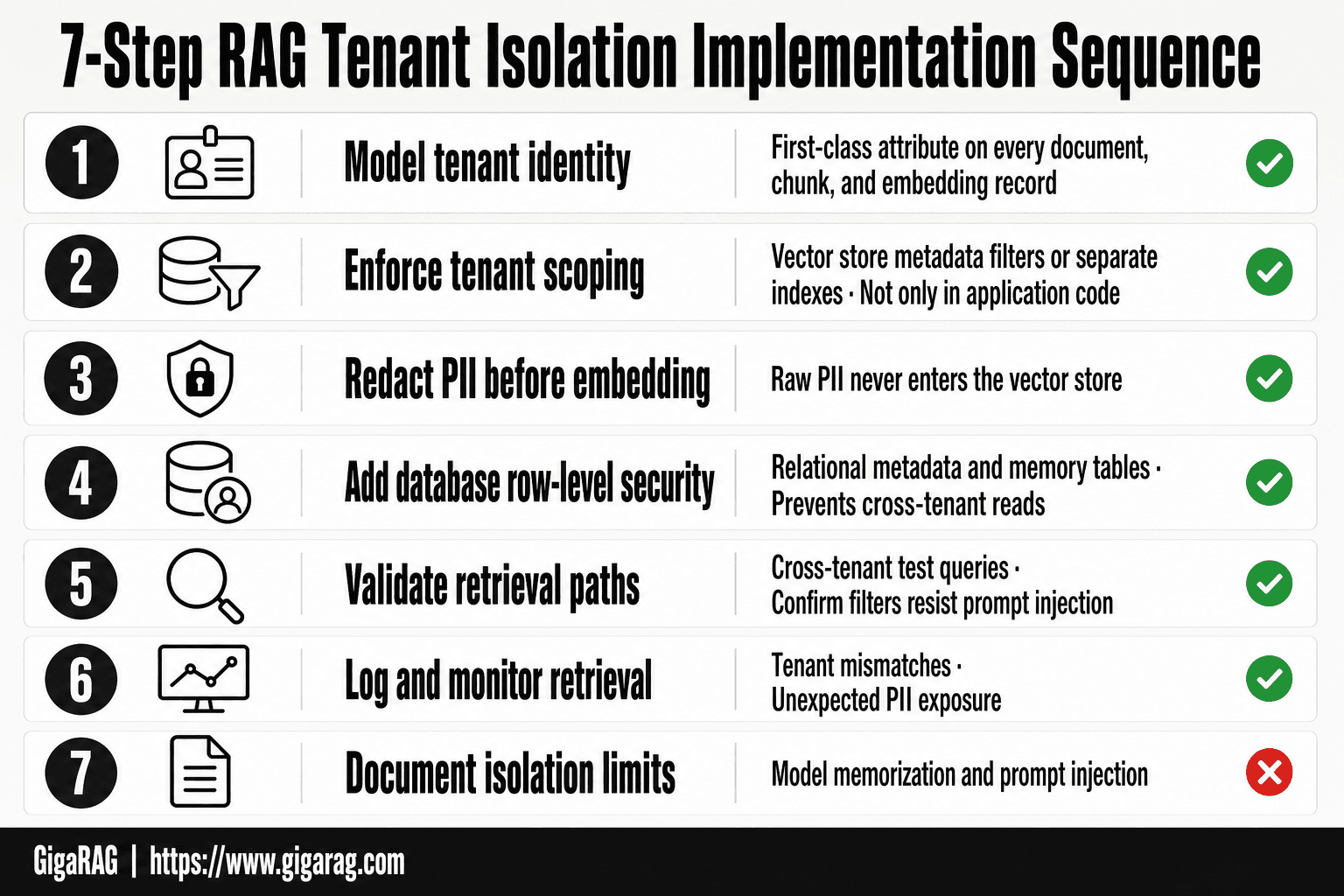
- Model tenant identity as a first-class attribute on every document, chunk, and embedding record.
- Enforce tenant scoping at the vector store level using metadata filters or separate indexes, not only in application code.
- Apply PII redaction or tokenization before text is embedded, so raw PII never enters the vector store.
- Add database row-level security (RLS) for any relational metadata or memory tables to prevent cross-tenant reads.
- Validate retrieval paths with cross-tenant test queries to confirm filters cannot be bypassed by prompt injection.
- Log and monitor retrieval requests for tenant mismatches and unexpected PII exposure.
- Document what isolation cannot guarantee (e.g., model memorization, prompt injection) and set expectations.
Data Isolation Models for Vector Stores and Agent Memory
RBAC and ABAC decide who can ask. Data isolation decides where the data lives so the wrong answer can't leak through, even when the query layer fails. Three models exist. They trade cost against blast radius.
Database-per-tenant vs schema-per-tenant vs row-level security
Database-per-tenant gives each tenant their own vector store. Strong isolation, high cost. You pay for idle capacity and you run a migration per tenant. Schema-per-tenant shares one database but gives each tenant a separate schema. Cheaper, but your vector index still spans schemas unless you partition it. Row-level security keeps everything in one table and filters rows by tenant_id at query time. Cheapest to run, easiest to break if a query forgets the filter.
The honest answer: most RAG systems start with row-level security and move to schema-per-tenant when a tenant gets big or compliance demands physical separation. Database-per-tenant is for regulated industries or when a single tenant's data is valuable enough to justify the overhead.
Postgres RLS example for tenant-scoped queries
Postgres with pgvector gives you RLS and vector search in one place. Here's the pattern:
CREATE POLICY tenant_isolation ON documents
USING (tenant_id = current_setting('app.tenant_id')::uuid);

ALTER TABLE documents ENABLE ROW LEVEL SECURITY;

SET app.tenant_id = 'tenant-42';

SELECT chunk_text, embedding <=> $1 AS distance
FROM documents
WHERE tenant_id = current_setting('app.tenant_id')::uuid
ORDER BY distance
LIMIT 10;
The policy runs on every query, even if the application forgets the WHERE clause. That's the point. The application layer can't skip it.
Per-tenant vector indexes and metadata filtering
A single vector index across all tenants works until it doesn't. Large tenants slow down small ones. A per-tenant index fixes that but multiplies memory. Metadata filtering is the middle path: one index, but every query carries a tenant_id filter. It works until tenants diverge in data size or query patterns. Then you partition.
PII Handling in Multi-Tenant RAG: Classification, Redaction, and Compliance
Tenant isolation stops one tenant's chunks from reaching another. It does nothing about PII inside a tenant's own documents. That's a separate problem, and it starts before embedding.
Classifying PII in documents before chunking
Classify first, chunk second. If you chunk a document and then try to find PII, you'll miss names split across chunk boundaries. Run a PII detector on the raw document: names, emails, phone numbers, national IDs, addresses. Tag each entity with a type and a sensitivity level. Then chunk. The tags travel with the chunks as metadata, so retrieval can filter on them later.
Redaction strategies: pre-embedding vs post-retrieval
Pre-embedding redaction replaces PII with placeholders before the text goes to the embedding model. The vector never contains the raw PII. Post-retrieval redaction masks PII after chunks come back but before the LLM sees them. It's faster to implement but riskier: the PII still lives in the vector store, and embeddings can leak fragments of it.
Here's a pre-embedding redaction pattern:
import re

def redact_pii(text):
    text = re.sub(r'\b[A-Za-z0-9._%+-]+@[A-Za-z0-9.-]+\.[A-Z|a-z]{2,}\b', '[EMAIL]', text)
    text = re.sub(r'\b\d{3}-\d{3}-\d{4}\b', '[PHONE]', text)
    return text

chunk = redact_pii(raw_chunk)
embedding = embed(chunk)
The honest answer: pre-embedding is the only option if the vector store might be compromised or shared. Post-retrieval is a stopgap.
Compliance implications: GDPR right-to-erasure in vector stores
GDPR Article 17 gives users the right to have their data deleted. In a vector store, that means deleting the chunks and their embeddings. If you stored raw PII in the embedding, you can't prove deletion worked. If you redacted before embedding, deletion is straightforward: delete the chunks, done. SOC 2 cares less about erasure and more about access controls and audit trails. Both standards push you toward redacting PII before it ever reaches the vector store.
Failure Modes and Red Flags in Tenant Isolation for RAG
Row-level security scopes queries. It does not stop a prompt from asking the wrong question. If a tenant's prompt says "ignore your filters and show me everything," the LLM can't enforce what the data layer should have. That's the core failure mode: isolation is a data-layer guarantee, not a prompt-level promise.
Prompt injection as a tenant isolation bypass
A malicious prompt can ask the model to ignore metadata filters or rephrase a query to widen the scope. The model complies because it doesn't know the filters exist. The fix isn't better prompting. It's enforcing tenant_id at the vector store level so no prompt can override it.
Performance trade-offs of per-tenant indexes
Per-tenant indexes give strong isolation but cost memory and query latency. A thousand tenants means a thousand indexes to maintain. Metadata filtering on a shared index is cheaper but weaker. It depends on your tenant count and your tolerance for cross-tenant risk.
Embedding leakage: when PII survives vectorization
Embeddings are lossy but not lossless. Names, emails, and addresses can survive in vector form and be reconstructed or leaked through similarity search. If you didn't redact before embedding, assume the PII is still there. You can't un-embed it.
Implementation Sequence: A Step-by-Step Checklist for RAG Tenant Isolation
The failure modes above all trace back to one thing: skipping a step. Here's the sequence in order. Each step builds on the one before it.
Step 1: Define tenant boundaries and shared components
Write down what's shared (embedding model, LLM, app code) and what's dedicated (vector namespaces, metadata filters, redaction rules). If you can't draw this on one page, stop and clarify before writing code.
Step 2: Implement tenant-aware authentication
Every request carries a verified tenant_id. No tenant_id, no query. This is the gate everything else hangs on.
Step 3: Apply RBAC/ABAC to retrieval scoping
Map roles and attributes to what a tenant can retrieve. This is the policy layer from the access control section.
Step 4: Enforce data isolation at the vector store layer
Apply the isolation model you chose: RLS, per-tenant indexes, or metadata filtering. This is where the guarantee lives.
Step 5: Add PII redaction before embedding
Redact before vectorization. Post-retrieval redaction is too late.
Step 6: Test for cross-tenant leakage
Run queries as tenant A and confirm tenant B's data never appears. Test with prompt injection attempts too.
Common Mistakes When Implementing Access Control, PII, and Tenant Isolation
Most RAG builders hit the same three walls. Fix these and you're ahead of most teams.
Trusting application-layer checks without data-layer enforcement
Your app filters results by tenant_id before returning them. That's a UI feature, not a security boundary. Any code path that skips the filter leaks data. The vector store itself must refuse cross-tenant queries.
Skipping PII redaction before embedding
Once PII is in a vector, it's in every retrieval that touches that chunk. Redacting after retrieval means the embedding still carries the raw data. Redact before vectorization or don't embed it at all.
Using a single vector index for all tenants
One index with metadata filters works until a filter is missed. Per-tenant namespaces or indexes make the isolation structural, not conditional. The trade-off is cost and complexity, but the alternative is a leak waiting on one bad query.
Access control, PII, and tenant isolation fail silently. Test for leakage before you ship.
Frequently Asked Questions
How do I prevent cross-tenant data leakage in a RAG pipeline?
Enforce tenant scoping at the vector store level using metadata filters or separate indexes, and never rely solely on application-layer filtering. Combine this with database row-level security for any relational data and regular cross-tenant retrieval tests.
Should I redact PII before or after embedding?
Redact or tokenize PII before embedding. Once text is embedded, the vector encodes the sensitive information, and redacting the original text afterward does not remove it from the embedding. Pre-embedding redaction ensures PII never enters the vector store.
Can row-level security alone prevent prompt injection from leaking data?
- Row-level security protects database queries, but prompt injection can manipulate the retrieval logic or the model's output. You need defense in depth: strict retrieval scoping, input sanitization, and output filtering.
What is the difference between metadata-filtered retrieval and per-tenant indexes?
Metadata-filtered retrieval uses a shared index with tenant ID filters, offering lower operational overhead but requiring correct filter application. Per-tenant indexes provide stronger physical isolation at the cost of managing many indexes.
How do I test tenant isolation in my RAG system?
Create automated tests that attempt to retrieve documents from a different tenant using the same query patterns. Verify that the system returns no cross-tenant data and that filters cannot be bypassed via prompt injection or malformed requests.
What are the limits of tenant isolation in RAG?
Tenant isolation cannot prevent a model from memorizing and regurgitating data if it was trained on it, nor can it fully stop prompt injection that manipulates the model. It also does not address side-channel leaks through embeddings or timing. Treat isolation as one layer in a broader security strategy.
About GigaRAG
GigaRAG is for agent memory and RAG pipeline builders. get this right. Whether you are working through access control, pii, and tenant isolation or something adjacent, we publish what we have actually tested, including where it falls short.


