Agentic RAG Explained: What Pipeline Builders Need to Know
Agentic RAG explained for pipeline builders comes down to one failure you've already hit: your traditional RAG pipeline does fine on single-shot lookups, then collapses the moment a query needs three steps of reasoning, a midstream change in intent, or a follow-up that depends on the first answer. You know the pattern. One retrieval, one generation, wrong result. Agentic RAG replaces that fixed flow with an agent that plans, retrieves, evaluates, and decides whether to retrieve again before it generates anything. That loop is the whole difference, and it changes your architecture, your memory design, and your cost model.
Most coverage of agentic RAG stops at the concept. This guide doesn't. It's for people who build pipelines, not people who browse vendor pages. I'll reference GigaRAG where it's relevant, since it's a platform built for agent memory and RAG pipelines, but this isn't a pitch. You'll get what agentic RAG is, how the retrieval loop works, how to build one step by step, and what it cannot do.
| At a glance | Details |
|---|---|
| Core idea | LLM agent controls retrieval and reasoning loop |
| Key difference | Multi-step planning vs single-shot retrieval |
| Memory types | Short-term context, long-term vector, episodic |
| Best for | Multi-hop, ambiguous, tool-using queries |
| Main trade-off | Higher latency and cost per query |
| Not a fix for | Bad data quality or weak base retrieval |
In This Guide
- What Is Agentic RAG?
- Traditional RAG vs Agentic RAG: What Changes in Your Pipeline
- Agentic RAG vs. Traditional RAG: What Actually Changes
- Agentic Rag Explained: A Step-by-Step Guide
- How Agentic RAG Works: The Retrieval Loop
- Agent Types in Agentic RAG
- Agent Memory in Agentic RAG
- Agentic RAG Use Cases That Actually Work
- Building Agentic RAG: A Practical Implementation Overview
- What Agentic RAG Cannot Do
- Common Misconceptions About Agentic RAG
- Final Thoughts on Agentic RAG
What Is Agentic RAG?
Agentic RAG is retrieval augmented generation where an agent controls the retrieval process. Instead of one fixed retrieve-then-generate step, the agent plans, decides, and iterates until it has enough context to answer.
The core idea: an agent that decides how to retrieve
Traditional RAG runs a single query against a vector database, grabs the top results, and hands them to an LLM. Agentic RAG puts a decision-maker in front of that pipeline. The agent reads the question, figures out what it actually needs, and chooses how to get it. That might mean one retrieval or five. It might mean querying three different sources. The agent decides.
How agentic RAG differs from "RAG with extra steps"
The difference is control. A pipeline with extra steps still follows a fixed path. An agentic system changes course mid-task. If the first retrieval returns garbage, the agent reformulates the query and tries again. If the question has two parts, the agent handles them separately. The loop is the point.
[!note] Agentic RAG does not replace your retrieval stack; it orchestrates it. If your base retriever returns poor results, an agent will simply loop longer and spend more tokens without improving the answer.
Traditional RAG vs Agentic RAG: What Changes in Your Pipeline
| Factor | Traditional RAG | Agentic RAG |
|---|---|---|
| Retrieval pattern | Single retrieve-then-generate pass | Iterative retrieve-reason-retrieve loop |
| Query handling | One query embedding per request | Query rewriting, decomposition, sub-queries |
| Memory | Stateless per request | Short-term, long-term, and episodic memory |
| Tool use | None or fixed pipeline | Dynamic tool and API selection |
| Latency and cost | Lower, predictable | Higher, variable per query |
Agentic RAG vs. Traditional RAG: What Actually Changes
Traditional RAG: one retrieval, one generation
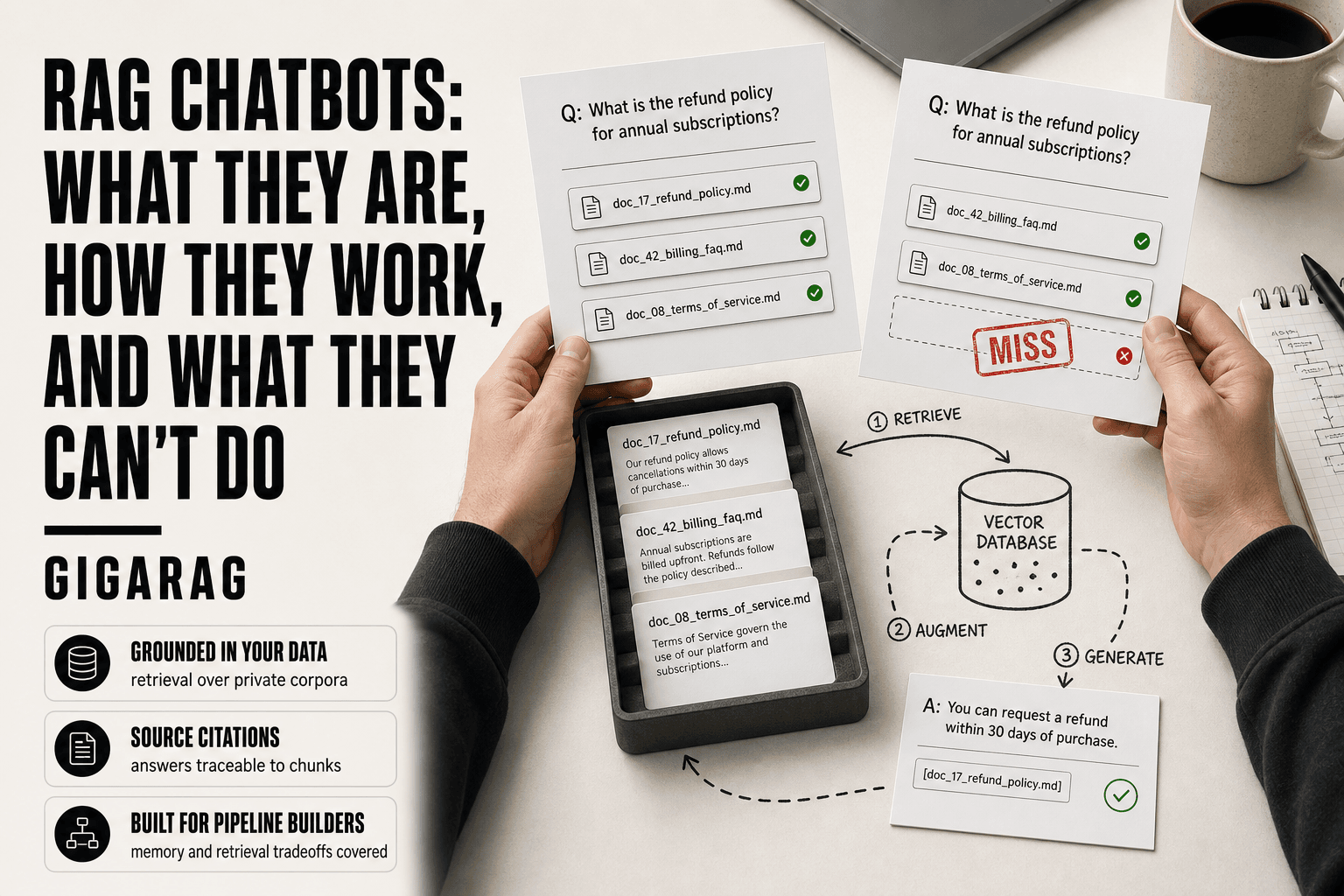
The flow is fixed. Embed the query, search the vector store, pull the top-k chunks, stuff them into the prompt, generate. If the retrieved chunks don't answer the question, the pipeline doesn't know. It generates anyway. You get a confident answer built on irrelevant context.
Agentic RAG: a loop of plan, retrieve, evaluate, repeat
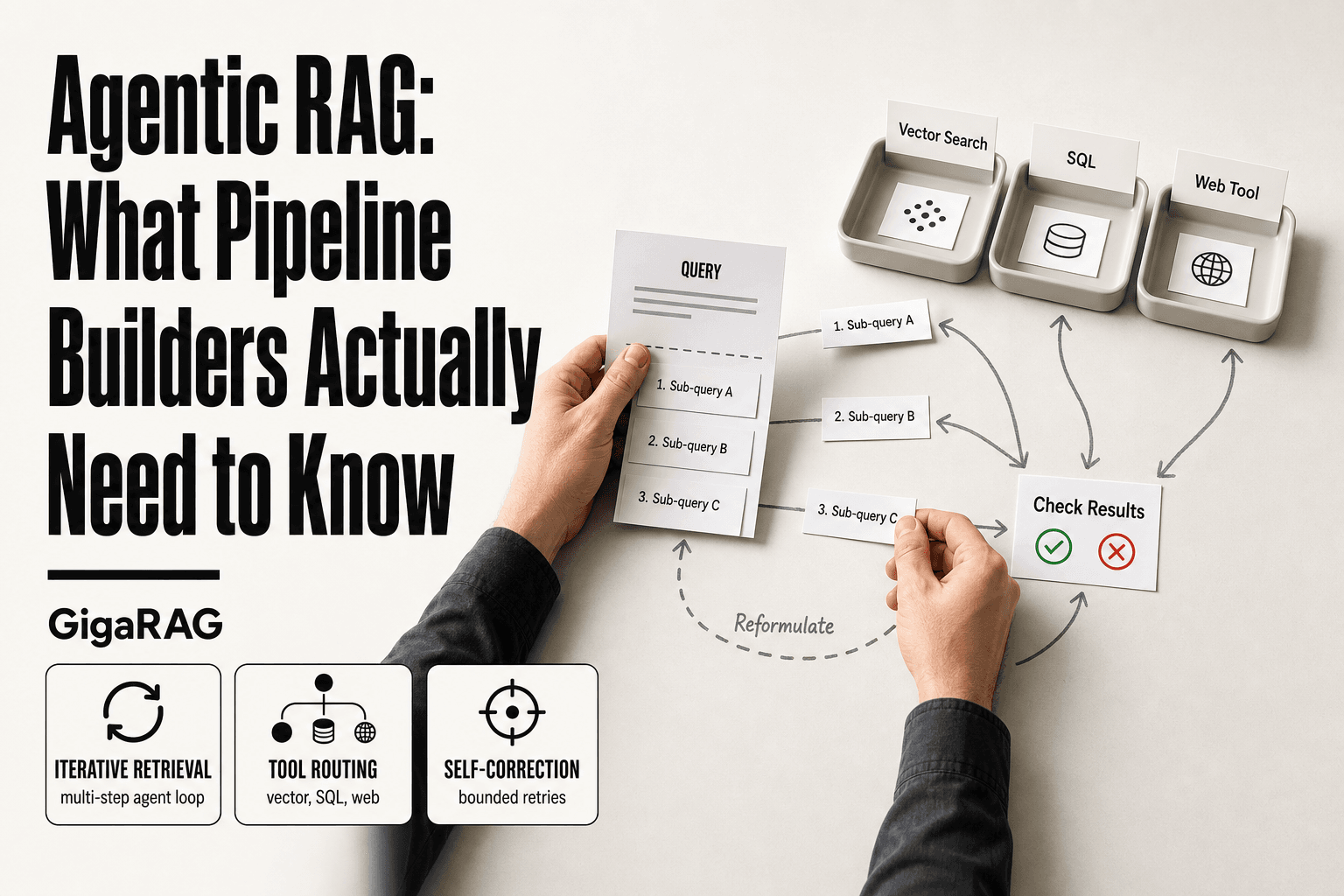
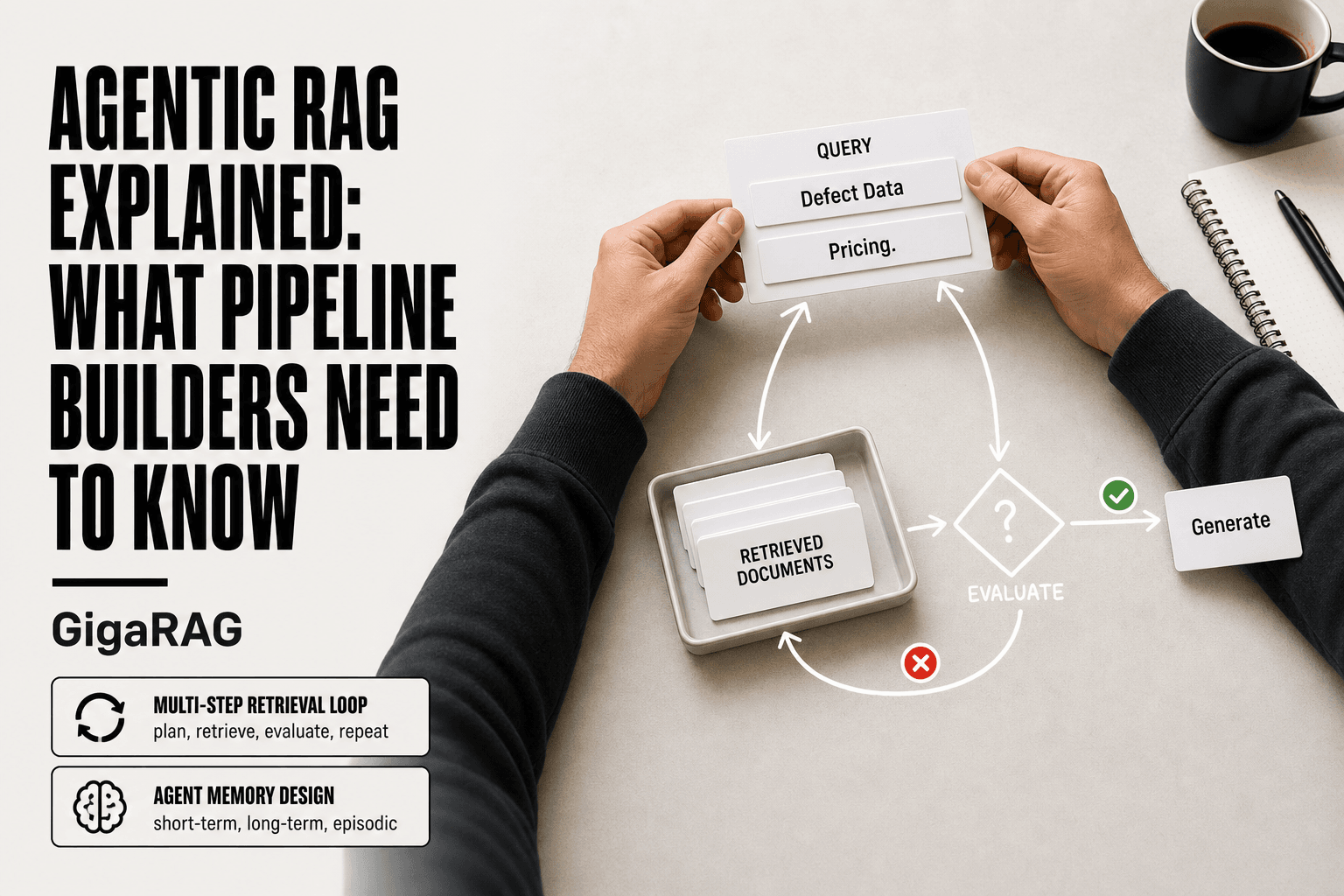
The agent treats retrieval as a decision, not a step. It plans what to look for, retrieves, checks whether the results are good enough, and decides to stop or go again. A multi-hop question like "Which supplier had the lowest defect rate last quarter, and what did we pay them?" becomes two retrievals: one for defect data, one for pricing. The agent chains them.
What changes in your pipeline architecture
You're no longer building a straight line. You're building a loop with a stopping condition. That means new components: a planner that decomposes queries, an evaluator that scores retrieval quality, and tool definitions that let the agent call your vector store, your SQL database, or your document search. The retrieval layer becomes a set of tools the agent can invoke, not a single fixed call.
[!tip] For pipeline builders: start by logging every query where your current RAG fails due to multi-step reasoning. Use those real failures as your agentic RAG test set before writing any agent code — it keeps you from over-engineering for problems you do not have.
Agentic Rag Explained: A Step-by-Step Guide
- Define the agent's toolset: retriever, reranker, calculator, and any domain APIs it can call.
- Choose an agent framework and wire the retriever as a callable tool with clear input/output schemas.
- Implement a planning step that decomposes the user query into sub-tasks before retrieval.
- Add a memory layer: short-term scratchpad for the current task, vector store for long-term facts, and a log for episodic recall.
- Build a reflection or self-critique loop so the agent can judge whether retrieved context is sufficient.
- Set guardrails: max iterations, token budget, and fallback to a single-shot RAG response.
- Evaluate with multi-hop and ambiguous queries, tracking both answer quality and cost per query.
How Agentic RAG Works: The Retrieval Loop
The loop is the whole game. A traditional pipeline runs once and stops. An agentic one runs until it decides the answer is good enough or it hits a limit.
Step 1: The agent analyzes the query
The agent reads the question and figures out what kind of task it is. Is this a single fact lookup? A comparison? A multi-hop chain? The analysis sets the strategy. A vague query like "what's our churn situation" gets treated differently from "show me churn by cohort for Q3."
Step 2: Planning — decompose or route
The agent breaks the query into sub-questions or picks a tool. For "which supplier had the lowest defect rate and what did we pay them," it plans two retrievals: defect data first, then pricing. It may also decide the query needs no retrieval at all.
Step 3: Retrieval and evaluation
The agent calls the tool, gets results, and scores them. Are the chunks relevant? Do they answer the sub-question? If the score is low, it reformulates and retrieves again. This is where agentic RAG earns its latency cost.
Step 4: Iterate or generate
Good enough? Generate the answer. Not good enough? Loop back to planning with what it learned. The agent keeps a short-term memory of what it already tried, so it doesn't repeat failed retrievals. Most frameworks cap iterations at three to five to keep latency sane.
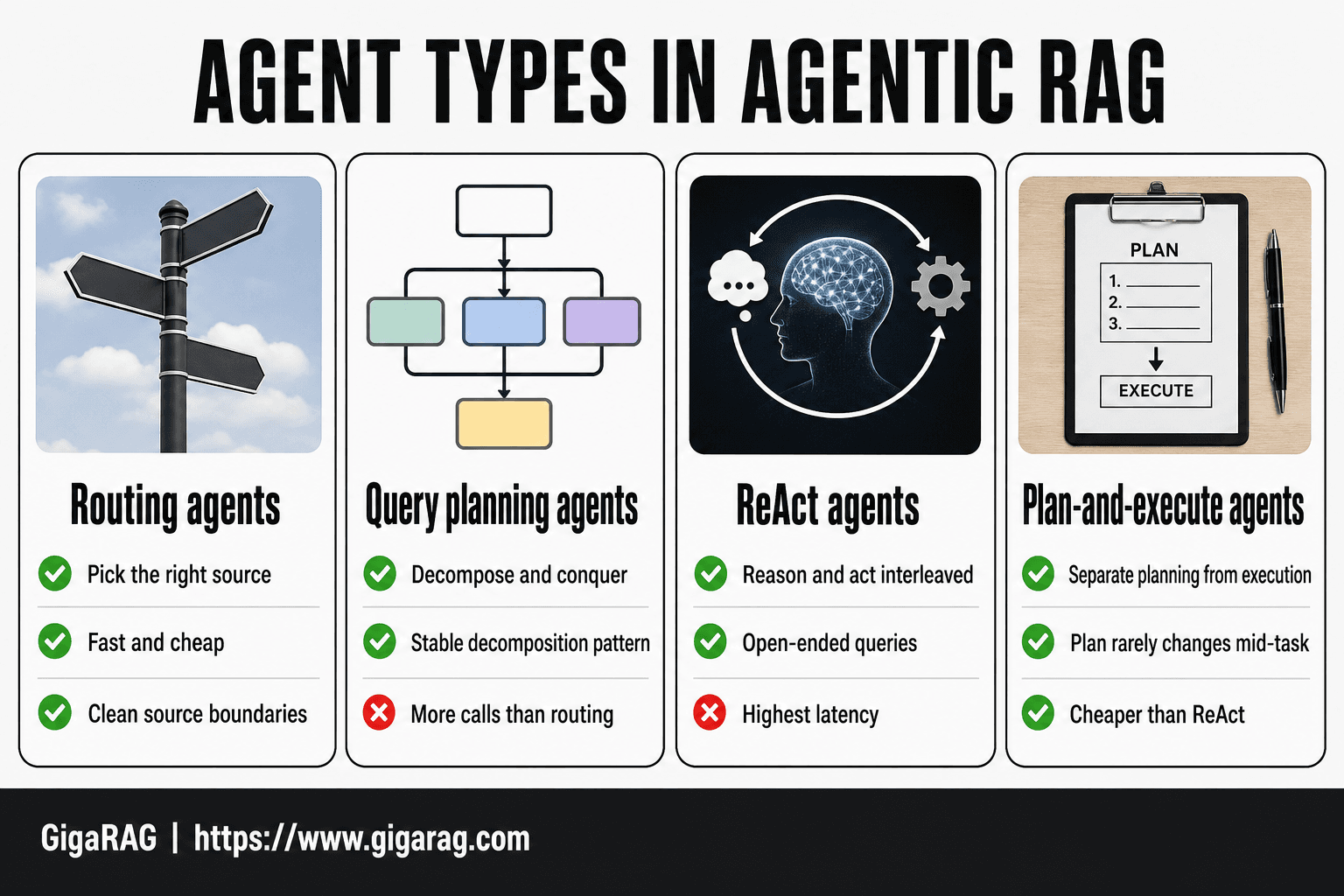
Agent Types in Agentic RAG
You won't build every agent type. You'll pick one based on how predictable your queries are and how much latency you can eat.
Routing agents: pick the right source
A routing agent classifies the query and sends it to one tool. Fast, cheap, and dumb. Use it when you have clean source boundaries: support tickets go to the CRM, product specs go to the docs. Latency cost is one extra LLM call.
Query planning agents: decompose and conquer
The agent splits a complex query into sub-questions, retrieves for each, then stitches answers together. Right choice when queries are multi-hop but the decomposition pattern is stable. Costs more calls than routing, but each call is simpler.
ReAct agents: reason and act interleaved
ReAct alternates thought, action, and observation. The agent reasons, calls a tool, reads the result, reasons again. Best for open-ended queries where you can't predict the retrieval path upfront. Highest latency and most failure modes.
Plan-and-execute agents: separate planning from execution
The agent writes a full plan first, then executes each step without re-planning. Cheaper than ReAct because reasoning happens once. Use it when queries are complex but the plan rarely changes mid-task.
Agent Memory in Agentic RAG
Memory is what separates an agent that answers one question from an agent that holds a conversation. Most agentic RAG discussions skip it. That's a mistake: memory determines whether your agent repeats retrievals, forgets user context, or learns anything across sessions.
Short-term memory: what the agent holds during a task
Short-term memory is the working state of a single task. It holds the original query, decomposed sub-questions, intermediate retrieval results, and decisions the agent made along the way. Without it, the agent can't evaluate whether a retrieval answered the question or whether it needs another pass. In practice, this lives in the agent's context window or a scratchpad. The catch: context windows fill up. You'll need to decide what to keep and what to drop.
Long-term memory: what persists across sessions
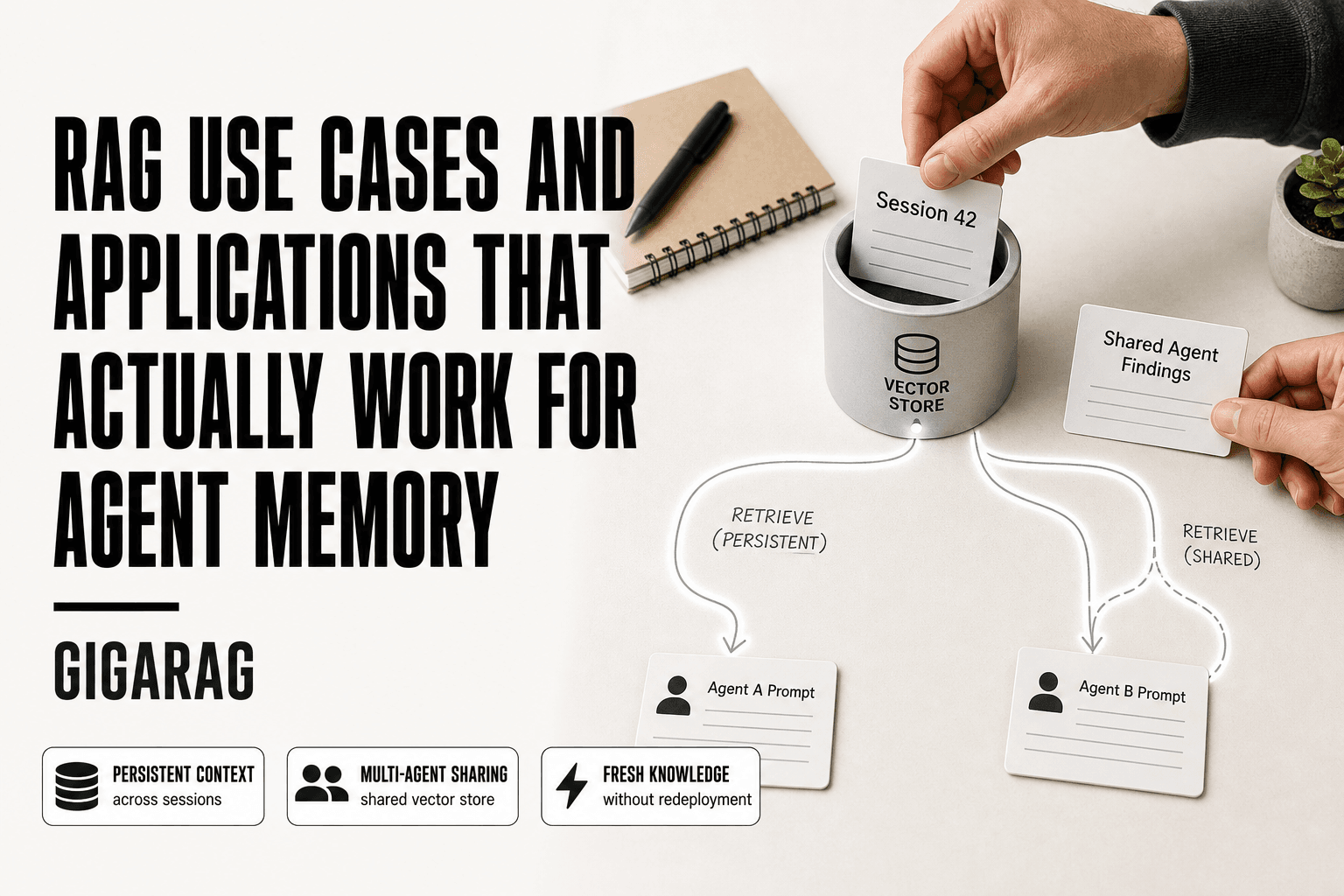
Long-term memory stores what the agent should remember between tasks. User preferences, past corrections, learned patterns about which sources work. This is where agentic RAG diverges from a stateless pipeline. A support agent that remembers a customer's product tier doesn't re-ask. A research agent that remembers which document collection failed last time skips it.
Agentic RAG Use Cases That Actually Work
Agentic RAG earns its complexity only when a query needs more than one retrieval. Here are four cases where the loop pays off.
Multi-hop research and synthesis
A question like "which supplier had the lowest defect rate last quarter, and what did we change after that?" needs two retrievals chained together. Traditional RAG returns fragments. An agent retrieves the defect data, then uses it to find the follow-up actions.
Customer support with follow-up questions
Support queries rarely arrive fully specified. "My invoice is wrong" needs the agent to ask which invoice, retrieve account details, then pull billing history. Agency means the agent can request missing information before retrieving.
Compliance and document review
Checking a contract against three policies requires cross-document reasoning. The agent retrieves each policy, compares clauses, and flags conflicts. It can also decide when it has enough evidence to answer.
Personalized recommendations
Recommendations need user history plus current inventory plus past feedback. An agent retrieves each source, weighs them, and adjusts when a recommendation misses.
Building Agentic RAG: A Practical Implementation Overview
You don't need a new stack. You need a loop. Here's the build order.
Step 1: Choose your agent framework
LangGraph, LlamaIndex, and AutoGen all handle the control flow. Pick one you can debug. The framework matters less than your retrieval tools.
Step 2: Design retrieval tools
Each tool is one retrieval action: vector search, keyword search, SQL query, API call. Give the agent three to five tools, not twenty. Too many tools means the agent picks wrong.
Step 3: Implement the plan-retrieve-evaluate loop
The agent plans, calls a tool, checks the result, then decides: retrieve again or answer. Cap iterations at three to five. Unbounded loops burn tokens.
Step 4: Add memory
Short-term memory holds the current task state. Long-term memory persists user preferences and learned patterns. Start with short-term only. Long-term memory is where projects stall.
Step 5: Evaluate and iterate
Track retrieval precision, answer faithfulness, and latency per query. If the agent loops more than twice on average, your tools are too coarse. Fix tools before tuning prompts.
What Agentic RAG Cannot Do
Agentic RAG is not a fix for a broken pipeline. It adds decision-making on top of retrieval, but it inherits every weakness underneath.
It does not fix bad retrieval
If your chunks are split badly or your embeddings miss relevant documents, the agent will retrieve garbage and reason about it confidently. The loop doesn't improve recall. It just repeats the same bad search more times.
It does not eliminate hallucinations
The agent can cite sources and still get the answer wrong. More retrieval steps mean more chances to pull in conflicting or irrelevant text. Grounding helps, but it doesn't guarantee truth.
It adds latency and cost
Every iteration is another LLM call. A three-step loop costs roughly three times a single-shot RAG query. For high-volume pipelines, that's real money.
It does not replace good data engineering
Dirty data, missing metadata, and stale indexes break agentic RAG faster than traditional RAG. The agent multiplies whatever quality you put in.
Common Misconceptions About Agentic RAG
Is ChatGPT a RAG model?
- ChatGPT is a fine-tuned LLM with baked-in knowledge, not a retrieval system. It doesn't query a vector database at inference time. Some ChatGPT features (browsing, file upload) bolt retrieval on top, but the core model isn't RAG.
Agentic RAG vs. agentic AI
Agentic AI is the broad category: any AI that plans and acts autonomously. Agentic RAG is one specific pattern inside it, where the agent's actions are retrieval steps. Not every agentic AI system touches a knowledge base.
Agentic RAG is not a replacement for fine-tuning
They solve different problems. Fine-tuning bakes style, tone, and domain patterns into the model weights. Agentic RAG gives the model access to fresh, external knowledge at query time. You'll often want both.
Final Thoughts on Agentic RAG
Agentic RAG explained in one line: it's retrieval where an agent decides what to fetch, when to stop, and what to do next. That's the whole shift. Traditional RAG runs one retrieve-then-generate pass. Agentic RAG runs a loop, and the loop is the product.
The honest take is that most pipelines don't need it. If your queries are single-hop and your documents are clean, a standard RAG setup is faster and cheaper. Agentic RAG earns its latency and cost when queries require planning: multi-hop questions, ambiguous intent, or follow-ups that change what you need mid-task.
Where it's heading is clearer memory. The next generation of these systems won't just retrieve better; they'll remember what worked across sessions, which sources failed, and what your users actually asked for. That's the gap GigaRAG is built for: agent memory and RAG pipelines that persist state instead of starting cold every query. The tools are here. The hard part is knowing when to use them.
Frequently Asked Questions
Is Agentic RAG better than RAG?
It depends on the query type. Agentic RAG is better for multi-hop, ambiguous, or tool-requiring questions because it can plan and iterate. For simple factual lookups, traditional RAG is faster, cheaper, and often just as accurate.
Is ChatGPT a RAG model?
- ChatGPT is a generative LLM. RAG is a technique that augments an LLM with external retrieval. You can build a RAG or agentic RAG system using ChatGPT as the underlying model, but ChatGPT itself is not RAG.
Can you explain RAG to a beginner?
RAG (Retrieval-Augmented Generation) means the model first looks up relevant documents from a knowledge base, then uses those documents to write its answer. It reduces hallucination by grounding responses in retrieved evidence.
Why is RAG outdated?
RAG is not outdated; the basic single-shot pattern is just insufficient for complex queries. Agentic RAG extends RAG with planning, memory, and tool use rather than replacing it. Most production systems still rely on retrieval at their core.
What is agent memory in agentic RAG?
Agent memory is how the system retains information across steps and sessions. It typically includes short-term context (the current reasoning trace), long-term memory (a vector store of past facts), and episodic memory (logs of past interactions the agent can recall).
What can agentic RAG not do?
It cannot fix poor data quality, cannot guarantee factual accuracy without good retrieval, and cannot eliminate hallucination entirely. It also adds latency and cost, so it is not suitable for every query.
Do I need a framework to build agentic RAG?
Not strictly, but frameworks like LangGraph, LlamaIndex, or CrewAI handle orchestration, memory, and tool calling so you can focus on your domain logic. You can also build it manually with function calling if you prefer full control.
About GigaRAG
GigaRAG is for agent memory and RAG pipeline builders. get this right. Whether you are working through agentic rag explained or something adjacent, we publish what we have actually tested, including where it falls short.