Agentic RAG: What Pipeline Builders Actually Need to Know
Agentic RAG keeps showing up in conference talks and vendor decks, and most of what pipeline builders get is either an academic survey or a sales pitch. The honest answer is that agentic RAG is a real architectural shift, but it's not magic. It means replacing the single retrieve-then-generate pass with an agent that plans queries, routes across tools, checks its own output, and retrieves again when the first pass misses.
If you're building agent memory systems or RAG pipelines, you need to know what changes, what breaks, and what you can't expect. This guide is written for you, not for a general audience. It covers the definition, the real differences from traditional RAG, the architecture, implementation steps, limitations, and the questions builders ask most. GigaRAG is one resource worth checking as you go. What you won't get here is hype. What you'll get is a practical map of what works, what doesn't, and where agentic RAG is honestly not worth the complexity.
| At a glance | Details |
|---|---|
| Core idea | LLM agent decides retrieval actions |
| Key difference | Iterative, multi-step vs single-shot |
| Best for | Multi-hop, ambiguous, tool-rich queries |
| Main trade-off | Latency and cost vs accuracy |
| Typical stack | LangChain/LlamaIndex + vector DB |
| Maturity | Emerging; evaluate before production |
In This Guide
- What Is Agentic RAG?
- Agentic RAG vs Traditional RAG: What Changes for Builders
- Agentic RAG vs. Traditional RAG: What Actually Changes
- Agentic Rag: A Step-by-Step Guide
- How Agentic RAG Works: Components and Architecture
- Agentic RAG for Agent Memory: What Builders Need to Know
- Step-by-Step: Building an Agentic RAG Pipeline
- Agentic RAG Limitations: What You Cannot Expect
- Agentic RAG Use Cases: Where It Actually Shines
- Common Mistakes When Building Agentic RAG
- Final Thoughts on Agentic RAG
What Is Agentic RAG?
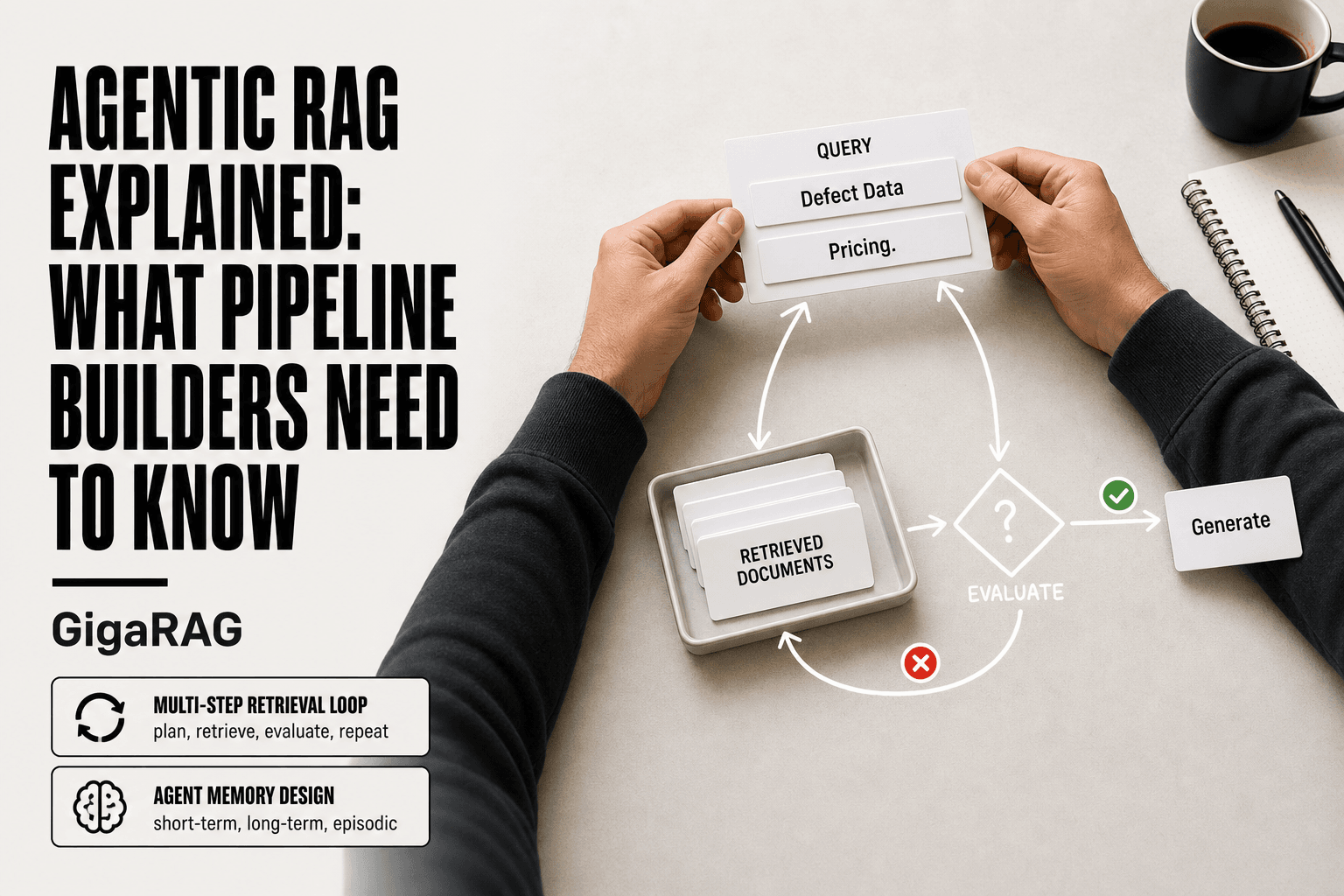
Agentic RAG is retrieval-augmented generation where an AI agent controls the retrieval process, deciding what to search for, when to search, and whether the results are good enough. Instead of retrieving once and generating once, the agent loops: it plans queries, fetches documents, checks them, and retries when the answer isn't there.
The core idea: agents that reason about retrieval
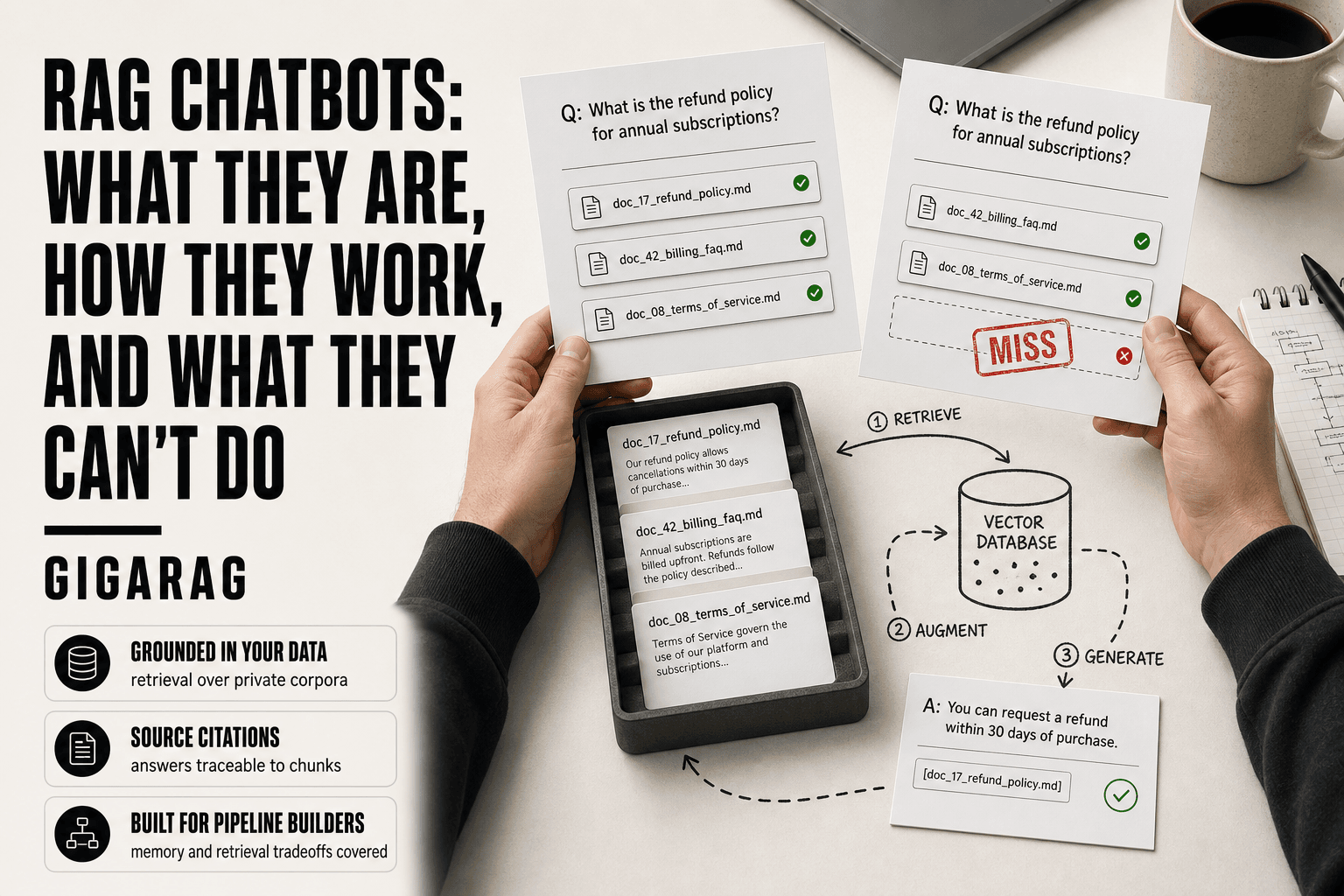
Traditional RAG follows a fixed path. You embed a query, pull the top-k chunks from a vector database, stuff them into a prompt, and generate. The system doesn't think about whether those chunks actually answer the question.
Agentic RAG puts a reasoning loop around that path. The agent treats retrieval as a tool it can call, inspect, and call again. If the first search returns irrelevant results, it reformulates the query. If the question has multiple parts, it breaks them apart and retrieves for each one. The agent decides when it has enough context to answer, and when it needs to go back for more.
How agentic RAG extends traditional RAG
The shift is from pipeline to control loop. A traditional RAG system executes steps in order. An agentic RAG system decides its next step based on what it just saw.
That means three new capabilities. Query planning: the agent decomposes complex questions before retrieving. Self-correction: it evaluates retrieved context and retries when quality is low. Tool use: it can pull from multiple sources, a vector database, a web search, an API, and route each sub-question to the right one.
The cost is latency and complexity. Every reasoning step adds a model call. You'll see exactly how much in the limitations section.
[!note] Agentic RAG is not a single algorithm but a pattern: an LLM agent orchestrates retrieval and other tools over multiple steps. The term appears in recent research and frameworks, but implementations vary widely, so benchmark against your own data.
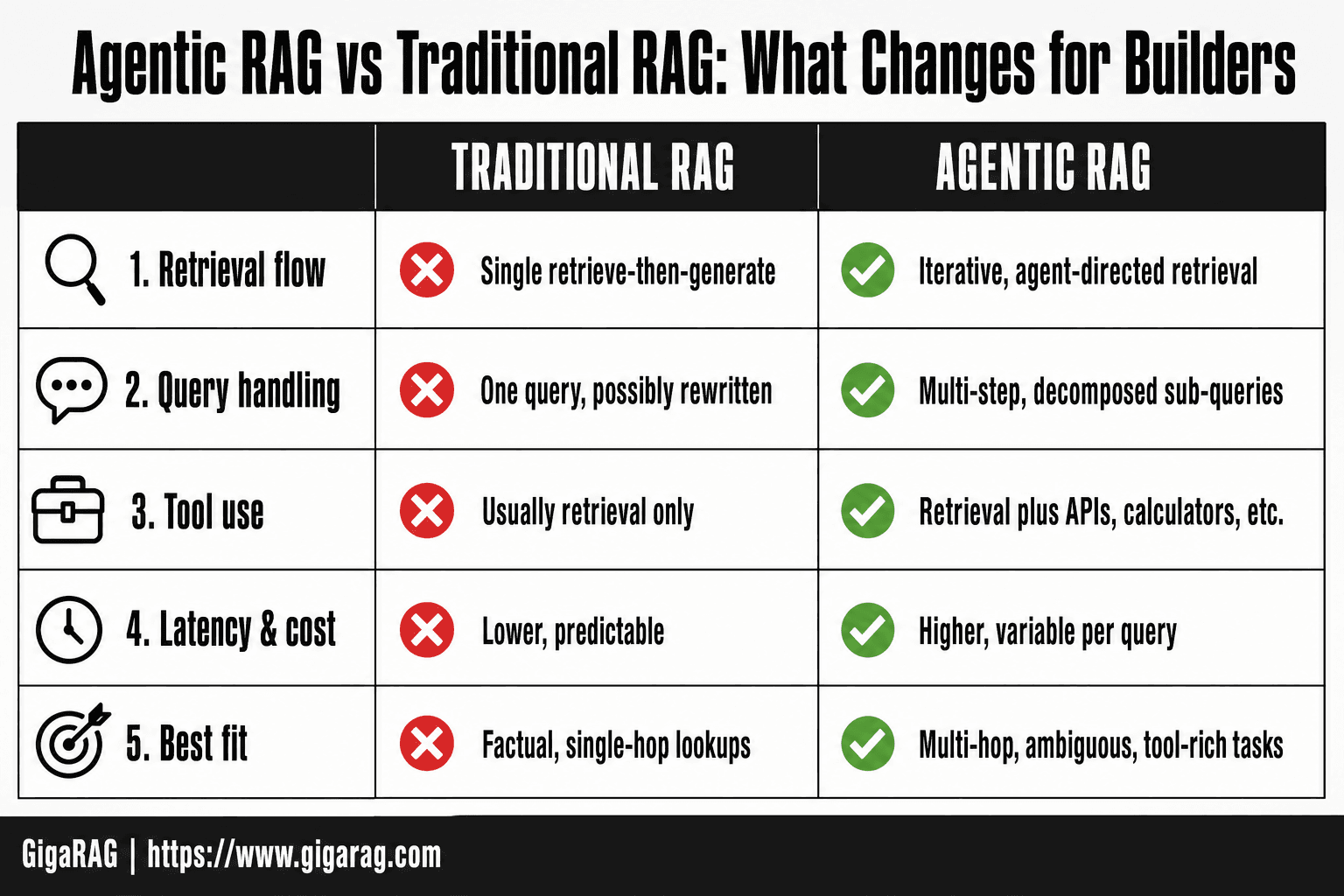
Agentic RAG vs Traditional RAG: What Changes for Builders
| Factor | Traditional RAG | Agentic RAG |
|---|---|---|
| Retrieval flow | Single retrieve-then-generate | Iterative, agent-directed retrieval |
| Query handling | One query, possibly rewritten | Multi-step, decomposed sub-queries |
| Tool use | Usually retrieval only | Retrieval plus APIs, calculators, etc. |
| Latency & cost | Lower, predictable | Higher, variable per query |
| Best fit | Factual, single-hop lookups | Multi-hop, ambiguous, tool-rich tasks |
Agentic RAG vs. Traditional RAG: What Actually Changes
The difference isn't a feature. It's who's in charge.
Traditional RAG: a linear pipeline
Traditional RAG runs a fixed sequence: embed the query, retrieve top-k chunks, stuff them into the prompt, generate. The system never asks whether the chunks are relevant. It retrieves once, even if the results are garbage. If the answer isn't in those chunks, you get a confident wrong answer or a refusal. There's no second pass.
Agentic RAG: a control loop with reasoning
Agentic RAG wraps retrieval in a decision loop. The agent plans queries, calls retrieval as a tool, inspects what comes back, and decides whether to stop or search again. Bad results trigger a reformulated query. Multi-part questions get decomposed before any retrieval happens. The agent keeps looping until it has enough context or hits a step limit.
Key differences in retrieval, reasoning, and action
Retrieval goes from single-shot to iterative. Reasoning goes from implicit (the model just answers) to explicit (the model plans, evaluates, and corrects). Action goes from one fixed path to tool selection across multiple sources.
The honest answer: agentic RAG isn't always better. It's better when retrieval quality is uncertain or questions are complex. It's worse when you need low latency and predictable cost. Every reasoning step is another model call.
[!tip] For agent memory builders: start with a small, well-defined set of tools and a hard iteration cap (e.g., 3-5 retrieval rounds). Log every agent decision so you can debug why it retrieved what it did — this is where most pipelines fail silently.
Agentic Rag: A Step-by-Step Guide
- Define the agent's retrieval goals and decide which tools it can call (vector search, keyword search, APIs).
- Choose an orchestration framework (e.g., LangChain, LlamaIndex) and a vector store that fits your latency budget.
- Design the agent loop: plan, retrieve, reflect, and decide whether to retrieve again or answer.
- Implement memory: store past interactions and retrieved context so the agent can reuse them across steps.
- Add guardrails: cap iterations, set timeouts, and validate tool outputs to control cost and failure modes.
- Evaluate on your own multi-hop queries, comparing accuracy, latency, and cost against a traditional RAG baseline.
- Iterate on prompts, retrieval strategies, and memory policies based on evaluation results.
How Agentic RAG Works: Components and Architecture
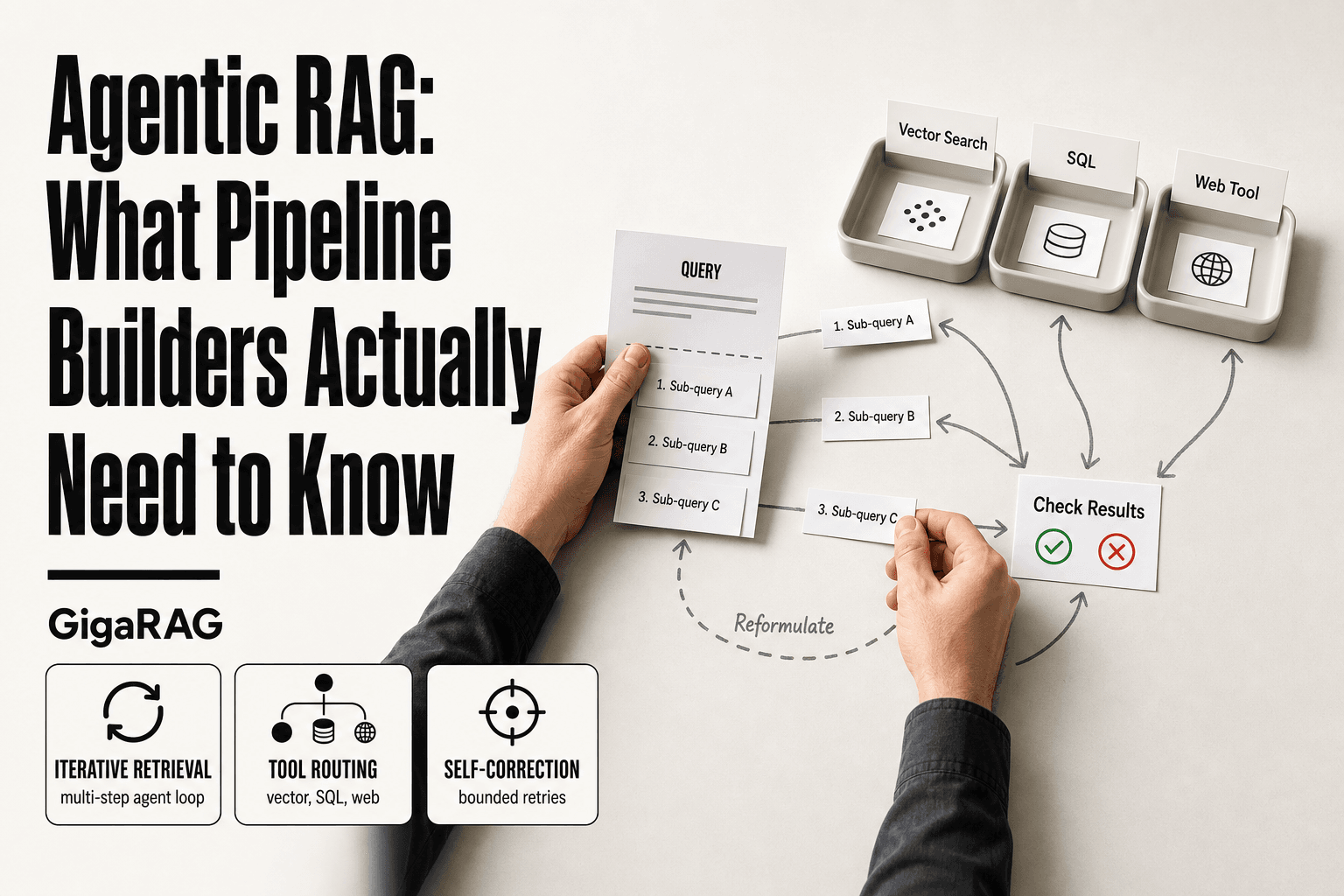
Agentic RAG isn't one component. It's a loop with four moving parts: planning, routing, self-correction, and memory. Each part adds a model call, which is why the architecture costs more than traditional RAG.
Query planning and decomposition
The agent starts by deciding what it actually needs to know. A question like "compare our Q2 churn across enterprise and SMB accounts, then suggest retention moves" doesn't map to one retrieval. The planner breaks it into sub-queries: churn by segment, retention benchmarks, past campaign results. Each sub-query gets its own retrieval pass.
Routing and tool selection
Routing decides where each sub-query goes. Vector search for semantic matches, SQL for structured metrics, a web tool for fresh data, an internal API for customer records. The agent picks tools based on what the sub-query demands, not a fixed pipeline. Wrong tool choice is a real failure mode: the agent can route a factual lookup to a vector store and get back a plausible-sounding but wrong chunk.
Self-correction and iterative retrieval
After retrieval, the agent inspects what came back. Empty results trigger a reformulated query. Low-confidence chunks trigger a second pass with different keywords or a different tool. The loop continues until the agent has enough context or hits a step limit. Step limits are not optional. Without one, a confused agent can loop forever, burning tokens on every pass.
Memory management in agentic RAG
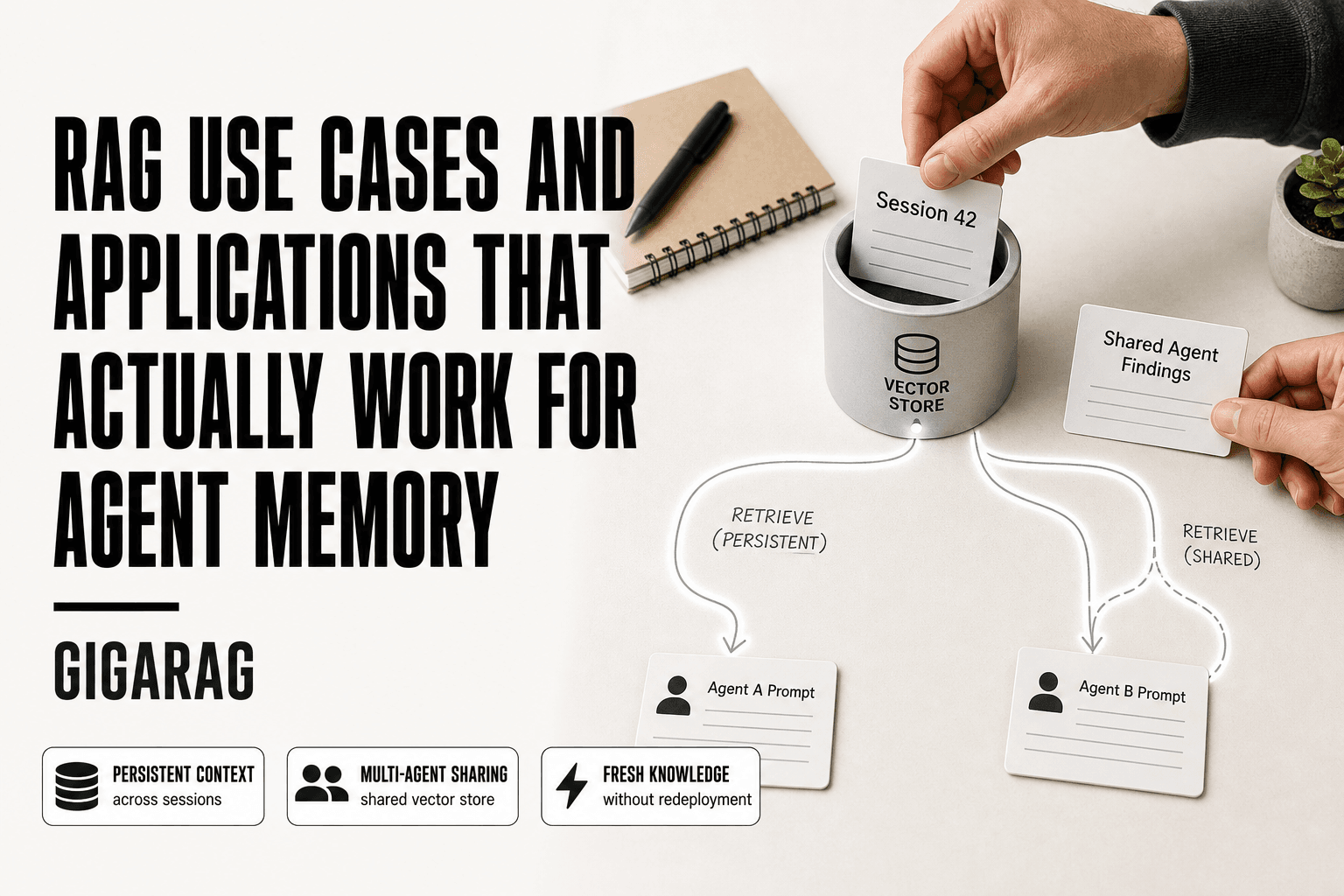
Memory is what lets the agent carry context across steps and across sessions. Short-term memory holds the current task's retrieved chunks and intermediate answers. Long-term memory stores distilled facts, user preferences, and past decisions in a vector store or database. The agent writes to memory after each task, then retrieves from it on the next one. The catch: memory writes are themselves model calls, and bad memory writes poison future retrievals.
Agentic RAG for Agent Memory: What Builders Need to Know
Agent memory is not a feature you bolt on. It's the retrieval layer your agent queries every time it needs to remember something. Agentic RAG changes how that layer behaves.
How agentic RAG improves agent memory
Traditional memory retrieval is a single pass: embed the query, pull the top-k chunks, done. Agentic RAG turns that into a loop. The agent can reformulate a memory query when the first pass returns nothing useful. It can route different memory types to different stores: facts to a vector DB, user preferences to a key-value store, recent events to a rolling buffer. It can also write to memory selectively, deciding what's worth keeping instead of dumping everything.
The payoff is recall quality. An agent that retrieves once gets whatever the embedding happens to surface. An agent that iterates can chase a memory across multiple stores until it finds the right one.
Memory architectures that work with agentic RAG
Three patterns hold up in practice. First, a two-tier split: a fast short-term buffer for the current session, a slower long-term store for distilled facts. Second, typed memory: separate stores for episodic, semantic, and procedural memory, each with its own retrieval path. Third, write-time filtering: the agent summarizes before storing, so long-term memory stays dense instead of bloated.
None of these require a specific framework. They require discipline about what gets written and when.
Common memory pitfalls in agentic RAG
The main catch is write pollution. Every memory write is a model call, and a bad write sticks around. If the agent stores a wrong fact with high confidence, future retrievals will surface it and reinforce the error.
Latency compounds too. Each memory operation adds a model call, and memory-heavy agents can spend more time managing memory than answering. Keep memory writes sparse and retrieval passes bounded.
Step-by-Step: Building an Agentic RAG Pipeline
You don't need a PhD to build one. You need a framework, a retrieval layer, and a loop that knows when to stop.
Step 1: Choose your agent framework
Start with LangGraph or LlamaIndex. LangGraph gives you explicit control over the state machine: nodes for retrieval, reasoning, and tool calls, edges that define when the loop continues or exits. LlamaIndex wraps more of this behind higher-level abstractions, which is faster to prototype but harder to debug when the agent does something unexpected.
Don't start from scratch. The orchestration logic (retry, fallback, tool dispatch) is fiddly and framework authors have already solved the boring parts. Pick the framework whose mental model you can hold in your head.
Step 2: Design your retrieval layer
Your agent is only as good as what it can pull. Chunk your documents deliberately: 200 to 500 tokens per chunk works for most text, smaller for code. Embed with a model that matches your domain. Add a re-ranker if your initial top-k is noisy.
Keep the retrieval layer boring. The agent adds reasoning on top, but if the underlying search is weak, no amount of iteration fixes it.
Step 3: Implement query routing and planning
Before retrieval, have the agent classify the query. Is it a fact lookup, a comparison, or a multi-step synthesis? Route each type to a different path: single-shot retrieval for facts, parallel retrieval for comparisons, sequential retrieval for synthesis.
Planning means the agent writes out the sub-questions it needs to answer before it starts pulling. This is where most of the value comes from. A query like "how did our churn change after the pricing update" becomes three retrievals: churn before, churn after, pricing change details.
Step 4: Add self-correction and iterative retrieval
Give the agent a way to judge its own answers. After the first pass, have it check: did I answer the question? Is there a gap? If yes, reformulate and retrieve again. Cap the iterations at three. More than that and you're burning tokens without much gain.
Self-correction works best when the agent has a concrete signal to check against, like a citation or a confidence score. Vague "try again" loops just spin.
Step 5: Evaluate and iterate
Build a small eval set: 20 to 50 real queries with expected answers. Run the pipeline, score retrieval hit rate and answer quality. Track where the agent fails: bad routing, weak retrieval, or poor synthesis. Fix the weakest link before adding more agent behavior.
Most pipelines fail at retrieval, not reasoning. Check that first.
Agentic RAG Limitations: What You Cannot Expect
Agentic RAG is not a faster RAG. It's a slower, more expensive one that sometimes gets better answers.
Latency and cost trade-offs
Every reasoning step costs tokens. A query that traditional RAG answers in one retrieval pass might take three to five passes with an agent. Expect 3x to 10x the latency and token spend. If your use case needs sub-second responses, agentic RAG won't fit.
Complexity and debugging challenges
When the agent routes wrong or loops twice before answering, you can't just check the retrieval log. You have to trace the full decision path: why it chose that tool, why it reformulated the query, where the loop should have exited. Debugging is harder because the failure modes are emergent, not linear.
When agentic RAG is overkill
If your queries are single-hop fact lookups, traditional RAG is enough. Agentic RAG earns its cost only when queries need decomposition, multi-source synthesis, or iterative refinement. Don't add an agent loop to a problem a vector search already solves.
Agentic RAG Use Cases: Where It Actually Shines
The previous section covered when agentic RAG is overkill. Here's the flip side: three places where the extra latency and token spend actually pay for themselves.
Multi-step research and synthesis
A query like "compare the pricing models of the top three vector databases and explain which fits a startup" can't be answered in one retrieval pass. The agent decomposes it, pulls pricing pages, pulls reviews, pulls benchmark posts, then synthesizes a coherent answer. Traditional RAG returns fragments. Agentic RAG returns a finished brief.
Customer support with dynamic knowledge
Support tickets rarely map to one help doc. A user reports an error, the agent checks the error code against internal logs, retrieves the relevant runbook, then asks a clarifying question before answering. That loop, retrieve, check, clarify, retrieve again, is exactly what agentic RAG is built for. Static RAG answers the wrong question confidently.
Code generation with iterative retrieval
When a developer asks for a function that uses a specific library version, the agent retrieves the docs, writes a draft, runs it against a sandbox, sees the deprecation warning, retrieves the migration guide, and rewrites. Each iteration is a retrieval step. The result is working code, not a plausible snippet.
Common Mistakes When Building Agentic RAG
Most failed agentic RAG projects don't fail because the concept is wrong. They fail because builders add complexity before fixing the basics.
Overcomplicating the agent loop
You don't need a five-step reasoning chain with reflection, critique, and replanning on day one. Start with a single loop: retrieve, check, answer. Add self-correction only when you see a specific failure mode. Every extra step adds latency and a new place for the agent to go off the rails. I've watched teams spend weeks tuning a planner that never fires because their retrieval was the actual bottleneck.
Ignoring retrieval quality
The agent can only reason about what retrieval returns. If your chunks are poorly sized or your embeddings are stale, no amount of agent intelligence fixes it. Test retrieval in isolation before you build any agentic layer on top. A simple RAG pipeline with excellent retrieval beats an agentic one with mediocre retrieval every time.
Underestimating evaluation
You can't improve what you can't measure. Build a small eval set of real queries early, maybe 50 to 100, and score retrieval hit rate and answer quality before and after each change. Without that baseline, you're guessing. The honest answer is that most teams skip this and then can't explain why their agent regressed after a prompt tweak.
Final Thoughts on Agentic RAG
Agentic RAG isn't a magic upgrade. It's a control loop that trades latency and cost for better answers on queries that need multiple retrieval steps. If your queries are simple lookups, stick with traditional RAG. If they require reasoning across sources, the trade is worth it.
The builders who get the most from agentic RAG are the ones who fix retrieval first, add agent loops second, and measure everything. Start small. One loop. One router. A real eval set.
If you're building agent memory or RAG pipelines and want a resource that skips the hype, GigaRAG is worth a look. It's built for exactly this kind of work, and it won't pretend agentic RAG solves problems it doesn't.
Frequently Asked Questions
Is Agentic RAG better than RAG?
It depends on the task. Agentic RAG can be more accurate for multi-hop or ambiguous queries because it retrieves iteratively and can use tools. However, it adds latency and cost, so traditional RAG is often better for simple, single-hop lookups.
Is ChatGPT a RAG model?
- ChatGPT is a generative LLM; RAG is a technique that augments an LLM with external retrieval. ChatGPT can be used as the generator within a RAG pipeline, but it is not itself a RAG model.
Why is RAG outdated?
Traditional RAG is not outdated; it remains effective for many use cases. The critique is that single-shot RAG struggles with complex, multi-step queries, which is why agentic approaches are emerging as an extension, not a replacement.
What is LLM vs RAG?
An LLM is the underlying language model that generates text. RAG is an architecture that combines an LLM with a retrieval system to ground responses in external data. They are complementary: RAG uses an LLM.
How does agentic RAG handle memory?
Agentic RAG can maintain memory by storing past interactions, retrieved documents, and intermediate reasoning steps. This memory is then available to the agent in subsequent retrieval decisions, enabling more coherent multi-turn behavior.
What are the main limitations of agentic RAG?
Key limitations include higher latency and cost due to multiple LLM calls, potential for error propagation across steps, and complexity in debugging. It also requires careful guardrails to prevent infinite loops or excessive tool use.
About GigaRAG
GigaRAG is for agent memory and RAG pipeline builders. get this right. Whether you are working through agentic rag or something adjacent, we publish what we have actually tested, including where it falls short.