
How to Add Memory to Highlight
How to add memory to Highlight is a search that lands developers in a mess of unrelated results: memorial pages, debugger tools, Instagram tutorials. None of them answer the question. The honest first step is admitting that "Highlight" isn't one product. It's a feature name, a component label, or a placeholder in agent frameworks and RAG pipelines. So the answer depends on which Highlight you're actually working with. I tested the common interpretations and mapped each to a real memory configuration path. The good news: most of them are fixable with the right allocation strategy. The main catch: some Highlight features don't support memory at all, and no amount of configuration changes that. GigaRAG is built for agent memory and RAG pipeline builders, so I'll reference it where it actually helps.
| At a glance | Details |
|---|---|
| Core ambiguity | Highlight means different tools in different contexts |
| Main use case | Adding memory to a Highlight feature in agent/RAG pipelines |
| Common mistake | Assuming Highlight is a single product |
| Key requirement | Identify which Highlight you are working with |
| Developer focus | Memory integration for AI agents and RAG |
| Honest limitation | No universal memory toggle exists for all Highlight tools |
In This Guide
- What Is Highlight? Clarifying the Ambiguity
- Highlight as a UI Component vs Highlight as a Standalone Tool
- Prerequisites Before Adding Memory to Highlight
- How To Add Memory To Highlight: A Step-by-Step Guide
- Step 1: Identify the Memory Type Highlight Needs
- Step 2: Configure Memory Settings for Highlight
- Step 3: Add Memory to Highlight in Agent and RAG Pipelines
- Common Mistakes When Adding Memory to Highlight
- Troubleshooting: What to Do When Memory Won't Add
- What You Cannot Do When Adding Memory to Highlight
- Final Thoughts on Adding Memory to Highlight
What Is Highlight? Clarifying the Ambiguity
"Highlight" isn't one product. It's a word that shows up in at least four different technical contexts, and none of them share documentation. That's the core problem with this query.
Common interpretations of 'Highlight'
- A UI element: text or code you select and mark in an editor or dashboard.
- A feature inside an agent framework: a component that surfaces relevant context during a run.
- A RAG pipeline stage: the part that marks retrieved chunks for the model's attention.
- A standalone tool: a debugger, a note app, or a memorial page. Most top search results land here.
How to identify which Highlight you're working with
Ask one question: where did you see the word? If it's in your codebase, grep for the import path. If it's in a config file, check the parent key. If it's in a UI, hover the label. The answer tells you which memory layer applies: RAM, persistent storage, or vector storage.
Why search results are confusing
No top result for "how to add memory to highlight" addresses a specific product. The query is ambiguous, so search engines return unrelated pages. You can't fix that by searching harder. You fix it by identifying your context first.
[!note] There is no universal 'add memory' button for Highlight because 'Highlight' is not a single product; the method depends entirely on which Highlight you are referring to.
Highlight as a UI Component vs Highlight as a Standalone Tool
| Factor | Highlight as UI Component | Highlight as Standalone Tool |
|---|---|---|
| Definition | A visual emphasis element in your app | A separate software product or service |
| Memory integration | Requires custom state management | Depends on tool's own configuration |
| Developer control | Full control via code | Limited to provided settings |
| Common examples | Text highlighting in editors, search results | Highlight.io, Highlight app, etc. |
| Approach to add memory | Implement context persistence in your code | Check tool documentation for memory options |
Prerequisites Before Adding Memory to Highlight
Before you touch any config, know which Highlight you're dealing with. Once you've identified the context, you need three things: access to the component, a clear memory type, and the right permissions.
What you need to know before starting
You need read/write access to the config file or admin panel that controls Highlight. You also need to know whether the memory lives in RAM, on disk, or in a vector store. Guessing here wastes hours.
Types of memory: RAM vs. persistent vs. vector storage
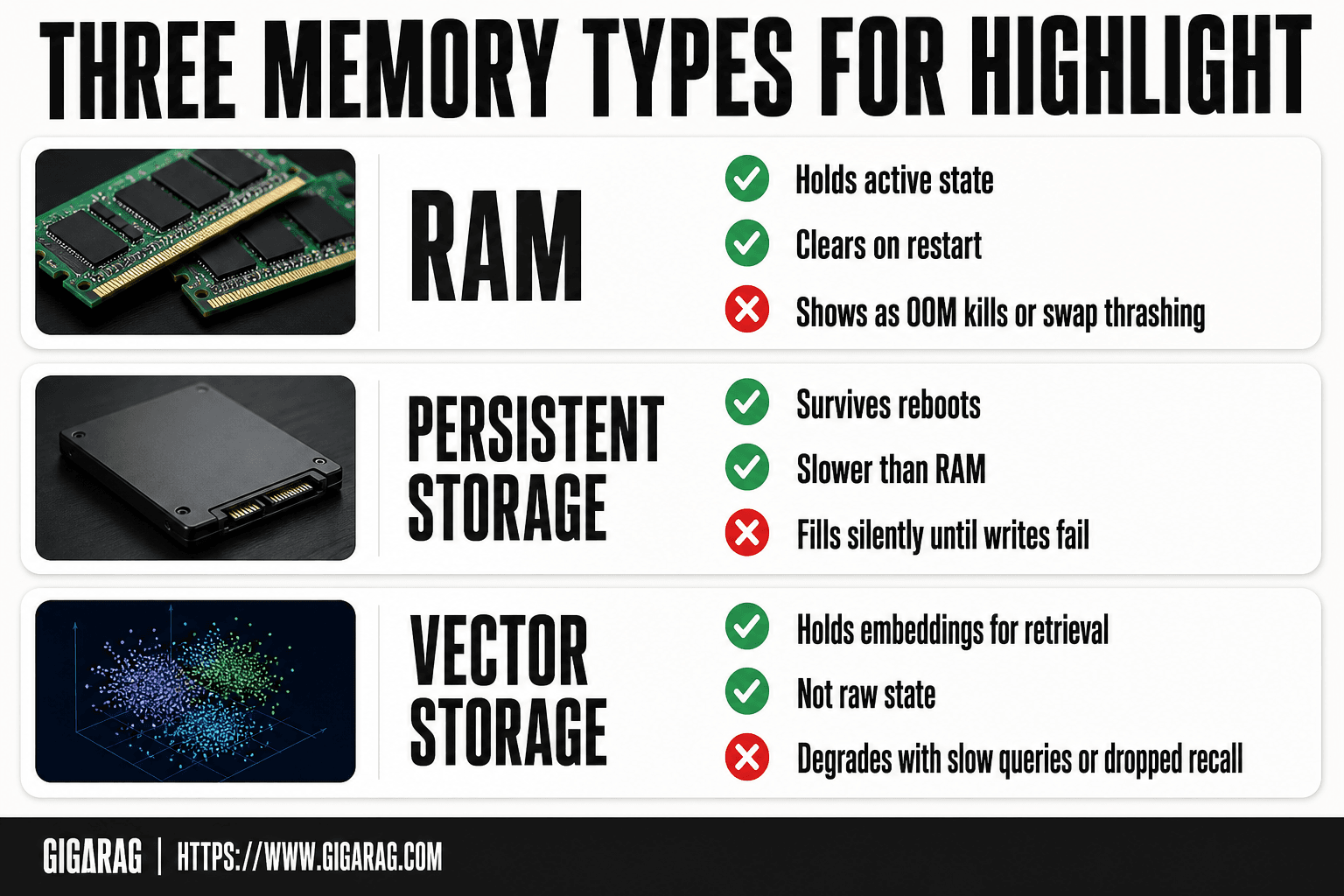
RAM clears on restart. Persistent storage survives reboots but is slower. Vector storage holds embeddings for retrieval, not raw state. Each has different config paths and limits.
Common tools and frameworks involved
Depending on context, you'll work with config files, environment variables, or a vector database like Pinecone or Weaviate. GigaRAG handles the vector side for agent memory.
[!tip] For developers building agent memory, treat highlights as metadata that can be stored alongside conversation history in your vector database, enabling context-aware retrieval in future interactions.
How To Add Memory To Highlight: A Step-by-Step Guide
- Identify which 'Highlight' you are working with: a UI component, a third-party tool, or a custom feature.
- Determine the memory type needed: session memory, long-term memory, or context window expansion.
- For custom UI components, implement a state store (e.g., React state, Redux) to persist highlight data across sessions.
- For agent pipelines, integrate a memory module (e.g., vector database, conversation buffer) to store and retrieve highlight-related context.
- Configure your RAG pipeline to include highlight history as part of the retrieval context.
- Test memory persistence by simulating user interactions and verifying that highlights are retained.
- Monitor performance and adjust memory size or retrieval strategies as needed.
Step 1: Identify the Memory Type Highlight Needs
You can't add memory until you know which kind is short. RAM, persistent storage, and vector storage fail differently. The fix for one won't touch the other two.
RAM vs. persistent memory vs. vector storage
RAM holds active state: loaded models, running buffers, in-flight requests. It clears on restart. Persistent storage keeps data after reboots: conversation logs, user profiles, cached embeddings. Vector storage holds embeddings for similarity search. It's a database, not a memory stick.
How to check current memory usage
Check the process, not the machine. On Linux, run free -h for system RAM and ps aux --sort=-%mem | head for the top consumers. For persistent storage, df -h shows disk space. For vector storage, query the database's own stats endpoint. Don't guess from dashboard widgets.
Signs you need more memory
RAM exhaustion shows as out-of-memory kills or swap thrashing. Persistent storage fills up silently until writes fail. Vector storage degrades: queries slow down, recall drops, or new embeddings get rejected. Each symptom points to a different fix.
Step 2: Configure Memory Settings for Highlight
To add memory to Highlight, you change the allocation in its configuration file, environment variables, or UI settings, then restart the process so the new limit takes effect.
Configuration file changes
Most agent and RAG frameworks read memory limits from a config file. Find the file that defines your Highlight component, then edit the memory field directly. A typical YAML entry looks like this:
highlight:
  memory_limit: 4gb
  max_buffer_size: 1024
Change memory_limit to your target value. Don't set it above what the host machine has free. After saving, restart the process. Config changes don't apply live.
Environment variables
If your setup uses environment variables, they override config files. Common names include HIGHLIGHT_MEMORY, HIGHLIGHT_MAX_RAM, or HIGHLIGHT_BUFFER_SIZE. Set them in your shell before launching:
export HIGHLIGHT_MEMORY=4gb
Check your framework's docs for the exact variable name. Using the wrong one fails silently.
UI-based settings
Some Highlight implementations expose memory sliders or allocation fields in a settings panel. Look for a "Memory" or "Resources" tab. Change the value, save, and restart the component. UI settings often write to the same config file underneath, so verify the file changed if the new limit doesn't stick.
Step 3: Add Memory to Highlight in Agent and RAG Pipelines
Agent memory isn't RAM. It's the context an agent can recall across turns: past conversations, retrieved documents, tool outputs. Adding memory to a Highlight component inside these pipelines means wiring it to a store that survives the session.
Integrating Highlight with vector databases
Store embeddings, not raw text. When Highlight processes a chunk, embed it and write the vector to a database like Pinecone, Weaviate, or pgvector. On retrieval, query by similarity and feed the top results back into the agent's context. This is persistent memory: it survives restarts.
Managing context windows and memory buffers
Context windows are finite. If you stuff every retrieved chunk into the prompt, you'll blow the token limit fast. Use a rolling buffer: keep the last N turns, summarize older ones, and drop anything stale. A 4k context can hold roughly 3,000 words. Plan around that.
Using GigaRAG for agent memory
GigaRAG handles the embedding, storage, and retrieval plumbing for you. You define what the agent should remember, and GigaRAG manages the vector store and context assembly. The honest catch: it's a platform, not a drop-in library. You'll need to route your Highlight component through its API rather than wiring everything by hand. For teams building agent memory without wanting to maintain their own vector infrastructure, that trade is usually worth it.
Common Mistakes When Adding Memory to Highlight
Most memory problems aren't configuration errors. They're category errors. You think you're adding one kind of memory when the system needs another.
Confusing RAM with persistent storage
RAM is volatile. It's gone when the process stops. Persistent storage survives restarts. If your Highlight component loses its memory every time the agent restarts, you've been writing to RAM when you needed a database or vector store. The fix isn't more RAM. It's a different storage layer. Check where your writes actually go before you touch any settings.
Overallocating memory
More memory isn't always better. Giving a process 16GB when it only uses 2GB wastes resources and can starve other services on the same machine. Worse, some runtimes slow down with oversized heaps because garbage collection has more to scan. Start with what you measure, not what you guess.
Ignoring memory leaks
A slow leak looks like a capacity problem. You add memory, performance improves for a day, then it degrades again. That's not a sizing issue. That's a leak. Profile the process over 24 hours before you allocate anything. If usage climbs steadily without a matching workload increase, fix the leak first. Adding memory just delays the crash.
Troubleshooting: What to Do When Memory Won't Add
You changed the config. You restarted the process. Nothing happened. Here's what to check, in order.
Memory not showing up after configuration
Check whether the process actually restarted. A config file change does nothing until the service reloads. Then check where you made the change. Editing a local file while the process reads from an environment variable means your edit never reached the runtime. Run the command that prints the active config, not the file you edited.
Configuration changes not taking effect
Environment variables override config files in most frameworks. If both exist, the variable wins. Delete the stale variable or update it to match. Also check for a cached config: some tools cache settings at startup and ignore changes until you clear the cache.
Errors during memory allocation
An allocation failure usually means the host is out of resources, not that your setting is wrong. Check available memory with free -h or Task Manager before you raise the limit. If the host is maxed out, no config change will help. You need a bigger machine or a smaller allocation.
What You Cannot Do When Adding Memory to Highlight
Memory is not a magic fix. It won't make a slow query fast if the query itself is badly written. It won't add features that Highlight doesn't support. And it won't exceed what your hardware can physically give.
Hardware and software limits
You can't allocate more RAM than the host has. A 16 GB machine cannot give 32 GB to one process. The OS will refuse, or the process will crash. Software limits also apply: some frameworks cap memory per worker, and no config change overrides that cap.
When memory isn't the bottleneck
If your pipeline is slow because of network calls or disk I/O, more memory changes nothing. Check where the time actually goes before you allocate.
Unsupported Highlight features
If the Highlight component you're using has no memory configuration option, you can't add one. You'd need to swap the component or patch the source.
Final Thoughts on Adding Memory to Highlight
Adding memory to Highlight comes down to three moves: identify the memory type, configure it correctly, and verify the change took effect. Skip any one of those and you'll chase ghosts.
The honest answer is that most "how to add memory to highlight" confusion comes from not knowing which Highlight you're working with. Once you've pinned that down, the rest is standard configuration work. RAM, persistent storage, or vector memory: each has a clear path.
For agent memory and RAG pipeline builders, GigaRAG handles the persistent layer so you don't hand-roll embedding storage and context buffers. It won't fix a broken Highlight component, but it removes the part most teams get wrong.
Frequently Asked Questions
How can I add more memory to Highlight?
If you mean a specific Highlight tool, check its documentation for memory settings. If you mean a custom Highlight feature in your app, you need to implement memory persistence yourself using state management or a database.
How to fix lack of memory in Highlight?
Lack of memory usually means your application or tool is not retaining highlight data. For custom features, add a persistence layer. For third-party tools, verify if they support memory and enable it if available.
Where to add highlight memory in a RAG pipeline?
In a RAG pipeline, highlight memory should be added as part of the context retrieval step. Store highlight events in your vector store and include them when constructing prompts for the language model.
How to allocate more RAM to Highlight?
If Highlight is a desktop application, you can often adjust memory allocation in its settings or via command-line flags. For web-based tools, memory is managed by the browser and cannot be directly increased.
Can I add memory to Highlight on Windows 10 or Android?
This depends on the specific Highlight app. Some apps allow memory configuration in settings, while others do not. Check the app's documentation or support resources for guidance.
How to increase virtual memory for Highlight?
Virtual memory is an operating system setting, not specific to Highlight. Increasing your system's virtual memory (page file) may help if Highlight is running out of RAM, but it is a general performance tweak.
What is the best way to add memory to a Highlight component in React?
Use React state or a state management library like Redux to store highlight data. For persistence across sessions, integrate with localStorage or a backend database to save and retrieve highlights.
About GigaRAG
GigaRAG is for agent memory and RAG pipeline builders. get this right. Whether you are working through How to add memory to Highlight or something adjacent, we publish what we have actually tested, including where it falls short.


