Agentic RAG vs Traditional RAG: What Pipeline Builders Need to Know
Agentic RAG vs traditional RAG is a question every pipeline builder hits eventually, usually after the first time a single-pass retriever returns three irrelevant chunks and the LLM confidently answers from them. Most comparisons oversimplify the difference into "one retrieves once, the other retrieves multiple times." That's not wrong, but it misses the point. The real difference is reasoning, memory, and state: traditional RAG is stateless and single-pass, agentic RAG is an LLM orchestrating retrieval, tool calls, and self-correction across multiple steps. The honest answer is that agentic RAG adds latency, cost, and debugging surface, and for a lot of use cases it's overkill. GigaRAG is built for agent memory and RAG pipelines, so I've had to make this call in production, not just in theory. This guide covers the architectural differences, the memory and state management no top result explains, and a decision framework for when agentic RAG is actually worth the added complexity.
| At a glance | Details |
|---|---|
| Core difference | Fixed pipeline vs autonomous agent loop |
| Best for | Simple lookups vs multi-step reasoning tasks |
| Latency | Low and predictable vs higher and variable |
| Cost profile | Lower, mostly fixed vs higher, scales with steps |
| State management | Stateless per query vs persistent memory across sessions |
| When to avoid | High-volume simple queries vs strict latency budgets |
In This Guide
- What Is Traditional RAG?
- Traditional RAG vs Agentic RAG: Architecture and Trade-offs
- What Is Agentic RAG?
- Agentic Rag Vs Traditional Rag: A Step-by-Step Guide
- Agentic RAG vs Traditional RAG: Key Differences at a Glance
- Agent Memory and State Management in Agentic RAG
- When Agentic RAG Is Not Worth It
- How to Choose: A Decision Framework for Pipeline Builders
- Common Mistakes When Building Agentic RAG Pipelines
- Final Thoughts: Agentic RAG vs Traditional RAG
What Is Traditional RAG?
Traditional RAG is a retrieve-then-generate pipeline. You embed your documents, store them in a vector database, and at query time you retrieve the top-k most similar chunks. Those chunks get stuffed into the LLM's context window alongside the user's question. The model generates an answer grounded in what you retrieved. That's the whole architecture.
The retrieve-then-generate flow
The flow is linear. A user asks a question. An embedding model converts that question into a vector. Your vector database runs a similarity search and returns the closest chunks, typically 3 to 10. Those chunks get concatenated into a prompt template. The LLM reads the prompt and produces an answer.
There's no loop here. One retrieval, one generation, done. If the first retrieval misses the right chunk, the answer is wrong and nothing corrects it.
Where traditional RAG works well
Traditional RAG shines on simple, factoid questions over a static knowledge base. "What's our refund policy?" or "How do I reset my password?" retrieve cleanly because the relevant chunk is semantically close to the question. Latency is predictable: one embedding call, one vector search, one LLM call. Cost is low for the same reason. If your documents don't change often and your questions map directly to specific passages, traditional RAG is hard to beat.
The core limitations: single-pass retrieval, no reasoning, no memory
The problems start when questions require more than one hop. "Compare our Q3 refund rate to Q2" needs two retrievals and a synthesis step. Traditional RAG retrieves once, so it can't gather both pieces unless they happen to sit in the same chunk.
Multi-step reasoning is absent. The model can only work with what the single retrieval pass gave it. If the answer requires pulling data from three documents and combining them, traditional RAG fails silently.
There's no memory either. Each query is stateless. The system doesn't remember what you asked five minutes ago, so follow-up questions like "what about for enterprise customers?" start from zero. That statelessness is the single biggest gap when you compare traditional RAG to agentic approaches.
[!note] Traditional RAG and agentic RAG are not mutually exclusive; many production systems use a hybrid approach where a traditional pipeline handles simple queries and an agentic loop is invoked only for complex ones.
Traditional RAG vs Agentic RAG: Architecture and Trade-offs
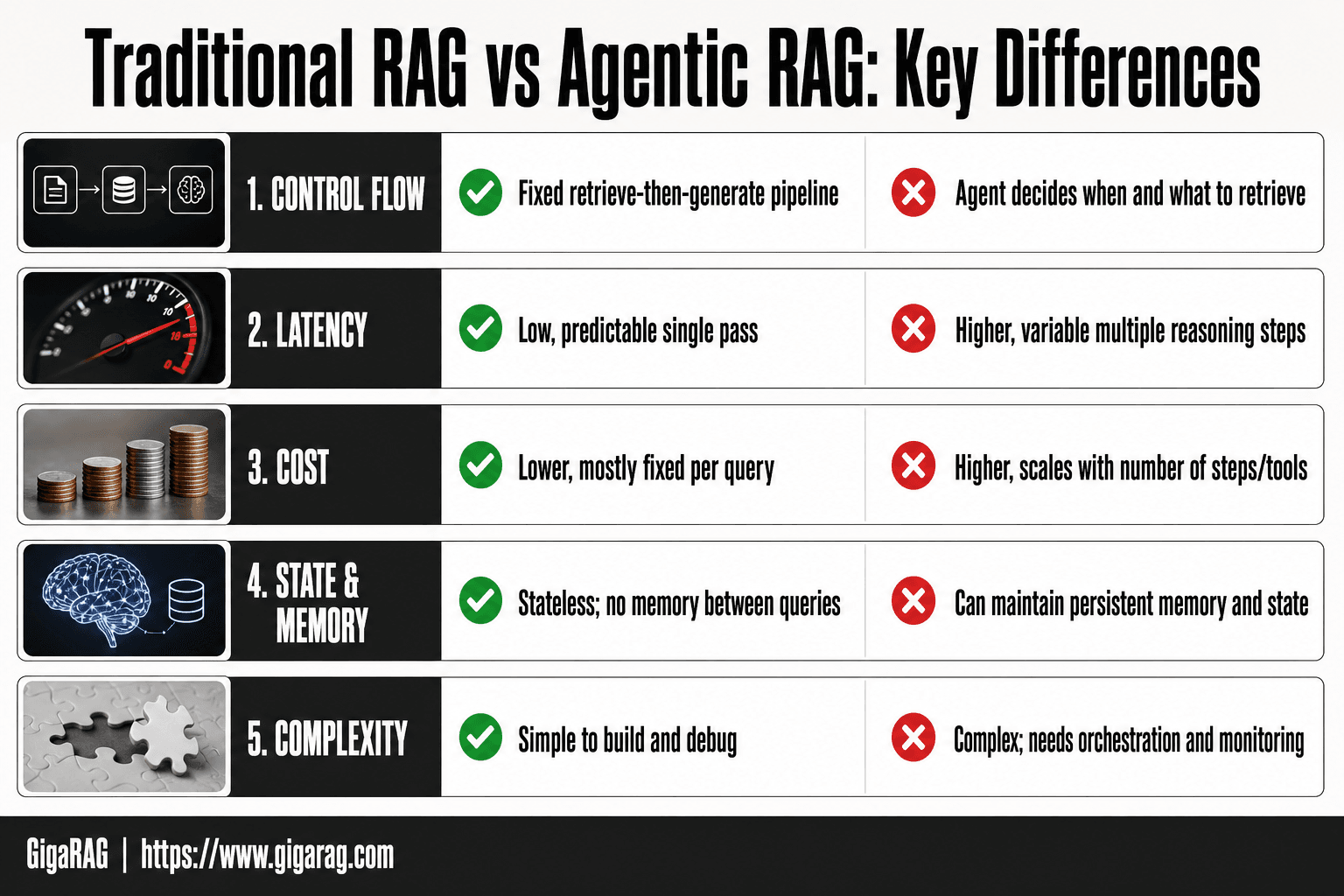
| Factor | Traditional RAG | Agentic RAG |
|---|---|---|
| Control flow | Fixed retrieve-then-generate pipeline | Agent decides when and what to retrieve |
| Latency | Low, predictable (single pass) | Higher, variable (multiple reasoning steps) |
| Cost | Lower, mostly fixed per query | Higher, scales with number of steps/tools |
| State & memory | Stateless; no memory between queries | Can maintain persistent memory and state |
| Complexity | Simple to build and debug | Complex; needs orchestration and monitoring |
What Is Agentic RAG?
Agentic RAG is a RAG architecture where an LLM agent controls retrieval as a multi-step process: it plans, retrieves, evaluates what it got, and decides whether to retrieve again or use a tool. Traditional RAG retrieves once and generates once. Agentic RAG treats retrieval as a loop the model itself drives.
The agent loop: plan, retrieve, evaluate, repeat
The agent starts with a plan. Given a question, it decides what information it needs before it touches the vector database. Then it retrieves. Then it evaluates: did the chunks answer the question, or are there gaps?
If there are gaps, the agent loops. It might rewrite the query, retrieve from a different collection, or call a tool like a calculator or an API. The loop continues until the agent decides it has enough to answer, or until it hits a max iteration limit you set.
That evaluation step is the key difference. Traditional RAG has no evaluation. It retrieves once and trusts the result. An agent checks its own work.
How agentic RAG enables multi-step reasoning
Multi-step reasoning means the answer requires combining information from multiple sources, in sequence. "What was our Q3 refund rate, and how does that compare to the industry benchmark for our sector?" needs two retrievals and a comparison step.
An agent handles this by breaking the question into sub-tasks. First retrieval: internal refund data. Second retrieval: the industry benchmark, possibly from an external source or a different collection. Then a synthesis step. The agent holds the intermediate results in its context and builds toward a final answer.
Traditional RAG can't do this because it has no mechanism for holding state between retrievals. The agent loop is that mechanism.
Design flexibility: agents choose their own tools and retrieval strategies
The agent isn't locked into one retrieval strategy. You give it a set of tools: vector search, keyword search, a SQL query tool, a web search API, maybe a calculator. The agent picks which tool to use based on what the current step needs.
That flexibility matters because different questions need different retrieval approaches. A factual lookup needs semantic search. A numeric comparison needs a database query. A question about recent events needs web search. An agentic system can route each sub-task to the right tool instead of forcing everything through one embedding pipeline.
The trade-off is that you now have to design and maintain that tool set, and the agent can pick wrong. More on that in the cost section.
[!tip] For pipeline builders: implement a fallback mechanism where the agentic loop is only triggered when the traditional RAG confidence score falls below a threshold. This keeps average latency and cost low while still handling hard queries.
Agentic Rag Vs Traditional Rag: A Step-by-Step Guide
- Map your query types: list the questions your system must answer and note how many require multi-step reasoning or tool use.
- Measure your latency budget: determine the maximum acceptable response time for your users.
- Estimate cost per query: calculate token usage for a single-pass pipeline vs a multi-step agent loop.
- Assess state needs: decide whether your application requires memory across sessions or user interactions.
- Prototype the simplest architecture: start with traditional RAG and add agentic components only where needed.
- Test with real queries: run a representative sample through both approaches and compare accuracy, latency, and cost.
- Decide and document: choose the architecture that meets your requirements and record the trade-offs for future reference.
Agentic RAG vs Traditional RAG: Key Differences at a Glance
The difference isn't just "one retrieves once, the other retrieves multiple times." It's about what the system can do with what it retrieves, and whether it remembers anything between steps.
Retrieval strategy: single-pass vs iterative
Traditional RAG retrieves once. One query, one embedding lookup, one set of chunks, one generation. If the chunks are wrong, the answer is wrong. Agentic RAG retrieves in a loop: retrieve, evaluate, decide whether to retrieve again with a rewritten query or a different tool. The agent stops when it has enough, not when the first retrieval returns.
Reasoning: none vs multi-step
Traditional RAG has no reasoning step. It concatenates retrieved chunks and asks the LLM to generate from them. Agentic RAG breaks a question into sub-tasks, retrieves for each, and synthesizes across steps. "Compare our Q3 refund rate to the industry benchmark" requires two retrievals and a comparison. Traditional RAG can't hold the first result while it fetches the second.
Memory and state: stateless vs stateful
Traditional RAG is stateless. Every query starts from zero. Agentic RAG holds intermediate results in context across the loop, and can persist state to external memory between sessions. That state is what lets an agent build on previous steps instead of starting over.
Latency, cost, and complexity trade-offs
The honest answer is that agentic RAG is slower and more expensive. Every loop iteration is another LLM call, and every call adds latency and tokens. A single-pass RAG query might take 1-2 seconds. An agentic query with three retrieval steps could take 10-30 seconds and cost 3-5x more in LLM tokens. Complexity scales too: you're now debugging a loop, not a pipeline.
Agent Memory and State Management in Agentic RAG
The previous section mentioned state as a differentiator. Here's what that actually means in practice.
Short-term vs long-term agent memory
Short-term memory is the context window. It holds the current task, the retrieved chunks, the intermediate reasoning steps, and any tool outputs. It's volatile. When the session ends, it's gone.
Long-term memory is external. It persists across sessions in a database, a vector store, or a dedicated memory layer. The agent writes to it deliberately: a fact it learned, a user preference, a decision it made and why.
The distinction matters because they fail differently. Short-term memory fails by overflowing. Long-term memory fails by returning stale or irrelevant entries.
How state persists across retrieval steps
State is just the accumulated record of what the agent has done so far. In a single agent loop, state lives in the context window. The agent retrieves, evaluates, and appends its evaluation to the context before deciding the next step. Each iteration builds on the last because the previous step's output is still visible.
Across sessions, state needs explicit persistence. The agent serializes its working memory to a store at the end of a task. On the next session, it loads that state back in. This is not automatic. You build it, or you use a platform that handles it.
The main catch is that state persistence is a design decision, not a feature you toggle. What gets saved, when it gets saved, and how it gets retrieved all need to be specified.
Why memory is the real differentiator for pipeline builders
Traditional RAG treats every query as independent. That's fine for a FAQ bot. It breaks down when the user asks a follow-up: "What about last quarter?" The system has no idea what "last quarter" refers to.
Agentic RAG with memory can hold that context. It can also learn from past retrievals. If a particular query pattern consistently returns bad chunks, the agent can store that and adjust its strategy next time.
The honest answer is that memory is what turns a retrieval pipeline into something that behaves like a system with experience. It's also the hardest part to get right. Most teams underestimate how much engineering goes into deciding what to remember and what to forget.
When Agentic RAG Is Not Worth It
The previous section covered what memory buys you. Now the honest part: most RAG use cases don't need any of it.
Agentic RAG is overkill when your retrieval task is a single pass over a static knowledge base. If a user asks a question and the right chunk answers it, an agent loop adds nothing but cost and delay. You're paying for reasoning you don't use.
Latency: agent loops are slower by design
A traditional RAG call is one retrieval plus one generation. An agentic loop is that, plus planning, evaluation, and possibly three to five more retrievals before it settles on an answer. Each step is a round trip to the LLM. Expect two to five times the latency of a single-pass system, depending on how many iterations the agent runs. For a customer-facing chatbot where users expect sub-second responses, that's a dealbreaker.
Cost: every extra LLM call adds up
Traditional RAG costs roughly one LLM call per query. Agentic RAG costs one call per step in the loop. A five-step agent is five times the token spend before you factor in tool calls and longer prompts. At scale, that's the difference between a $500 monthly bill and a $2,500 one. The math is simple: if your query volume is high and your task is simple, you're burning money.
Complexity: debugging multi-step agents is hard
When a traditional RAG pipeline returns a bad answer, you check the retrieval and the prompt. When an agent returns a bad answer, you have to trace every step it took: what it retrieved, why it retrieved it, what it decided to do next, and where the reasoning went wrong. That's a distributed debugging problem. Most teams don't have the tooling for it.
Use cases where traditional RAG still wins
Internal documentation search. FAQ bots over a fixed knowledge base. Customer support deflection where queries are predictable. Any system where the question maps cleanly to a chunk and the answer doesn't require synthesis across multiple sources.
If your retrieval is already working, don't add an agent.
How to Choose: A Decision Framework for Pipeline Builders
You've seen the trade-offs. Now you need a way to decide for your own use case. Here's a framework that works in practice.
Five questions to ask before choosing agentic RAG
Ask these in order. If you answer no to the first two, stop and build traditional RAG.
- Does a single retrieval pass answer most user queries correctly? If yes, you don't need an agent.
- Do your queries require synthesizing information across multiple documents or sources? If no, traditional RAG handles it.
- Do you need the system to remember context from earlier in the conversation or from previous sessions? That's a memory requirement, and it pushes you toward agentic.
- Can your latency budget absorb two to five times the response time of a single-pass system? If not, agentic is off the table.
- Do you have engineering capacity to debug multi-step agent failures? If your team is one person, the answer is usually no.
A simple decision tree: traditional vs agentic
Start with task complexity. Simple retrieval over a static knowledge base means traditional RAG. Multi-step reasoning, tool use, or cross-document synthesis means agentic.
Then check latency. Sub-second requirements rule out agent loops. If you can tolerate a few seconds, agentic stays viable.
Then check budget. Agentic costs roughly three to five times more per query. If your volume is high and margins are thin, traditional wins.
Then check memory. If the use case needs state across turns or sessions, agentic is the only option. Traditional RAG is stateless by design.
What to prototype first
Build the traditional RAG pipeline first, even if you suspect you'll need agentic later. It's faster to stand up, and it gives you a baseline for retrieval quality. Once you have that baseline, add a single agent step, like query rewriting or self-reflection, and measure the improvement. If the improvement doesn't justify the added latency and cost, you have your answer.
Don't start with a full agent loop. Start with one step and see if it earns its keep.
Common Mistakes When Building Agentic RAG Pipelines
Most pipeline builders moving from traditional to agentic RAG hit the same walls. Here are the four that cost the most time.
Over-retrieving and blowing the context window
An agent that retrieves on every loop iteration will stuff the context window fast. Ten retrieval steps at five chunks each is fifty chunks, and most of them are irrelevant by step three. Cap retrievals per turn and drop stale chunks between iterations. The agent doesn't need everything it ever saw.
Forgetting to persist state between sessions
Traditional RAG is stateless, so builders carry that habit over. The agent retrieves, answers, and forgets. Next session starts cold. If your use case needs memory, persist conversation summaries and key facts to a store the agent reads at session start. Without that, you've built an expensive single-pass system.
No cost controls or iteration limits
An agent loop without a max iteration count will run until it burns your budget. Set a hard cap, usually three to five iterations, and a token budget per turn. Log every LLM call so you can see where money goes. If a query needs more than five loops, it's probably a bad query, not a hard problem.
Skipping agent decision logging
When an agentic pipeline fails, you need to know what the agent decided at each step and why. Log the plan, the retrieval query, the chunks returned, and the final answer. Without that trail, debugging a multi-step failure is guesswork. Traditional RAG fails in one place. Agentic RAG fails in five, and you'll need the log to find which one.
Final Thoughts: Agentic RAG vs Traditional RAG
The decision comes down to one question: does your use case need reasoning across multiple steps, or does it need a fast answer from a known set of documents?
Traditional RAG wins when the task is simple retrieval. A support bot over a static knowledge base, a document Q&A tool, a semantic search endpoint. One pass, low latency, predictable cost. You don't need an agent for that.
Agentic RAG earns its complexity when the query demands planning, tool use, or memory. Multi-hop questions, research tasks, anything where the answer isn't in a single chunk. The agent loop costs more and runs slower, but it solves problems a single pass can't touch.
The honest answer is that most pipelines don't need agentic RAG yet. Start traditional. Add agentic behavior only when a real query pattern breaks the single-pass model.
Where this is headed: agent memory is becoming the default, not the exception. Pipelines that persist state across sessions will outlast the stateless ones, because users expect continuity. GigaRAG is built for exactly that, with agent memory and RAG pipelines as first-class concerns rather than bolt-ons. But the architecture choice still comes first. Pick the simplest thing that solves the problem, then add complexity only when the problem demands it.
Frequently Asked Questions
What is the difference between traditional RAG and agentic RAG?
Traditional RAG follows a fixed retrieve-then-generate pipeline: it retrieves documents once and generates an answer. Agentic RAG uses an autonomous agent that can decide when to retrieve, which tools to use, and how many steps to take, often maintaining state across interactions.
Is agentic RAG worth it?
It depends on your use case. Agentic RAG is worth it when your queries require multi-step reasoning, tool use, or persistent memory. For simple, high-volume lookups, traditional RAG is usually more cost-effective and faster.
What are the 7 types of RAG?
Common categorizations include naive RAG, advanced RAG, modular RAG, agentic RAG, graph RAG, hybrid RAG, and corrective RAG. The exact list varies by source, but the key distinction is between fixed pipelines and agent-driven architectures.
Is ChatGPT a RAG model?
No, ChatGPT is a large language model, not a RAG system. However, ChatGPT can be integrated into RAG pipelines as the generator component, and some ChatGPT features use retrieval-augmented techniques.
When should I avoid agentic RAG?
Avoid agentic RAG when you have strict latency requirements, very high query volumes, or simple factual lookups. The added complexity, cost, and variable latency may not be justified.
Can I combine traditional and agentic RAG?
Yes, a hybrid approach is common. You can use traditional RAG for straightforward queries and route complex ones to an agentic loop, balancing performance and cost.
About GigaRAG
GigaRAG is for agent memory and RAG pipeline builders. get this right. Whether you are working through agentic rag vs traditional rag or something adjacent, we publish what we have actually tested, including where it falls short.


