Autocompact Thrash Loop: A Technical Explainer for Agent Memory Builders
Your agent just compacted at 16% context usage. No warning, no log entry, no error. It silently summarized away the conversation state you spent twenty minutes building, then kept working as if nothing happened. That's an autocompact thrash loop: repeated, unnecessary auto-compaction that degrades agent performance instead of protecting it. The honest answer is that this isn't a one-off bug in Claude Code or Codex. It's a systemic design problem in how context management thresholds get set and triggered. GigaRAG exists because agent memory builders keep hitting this wall. This guide covers why thrash loops happen, what you can and cannot do about them, and how to design context management that avoids them entirely.
| At a glance | Details |
|---|---|
| What it is | Repeated auto-compaction cycles that destroy agent context |
| Root cause | Token accounting mismatch between client and model |
| Key symptom | Compaction triggers at low reported context usage |
| Who is affected | Agent memory and RAG pipeline builders |
| Can you disable it? | Not fully in Claude Code; workarounds exist |
| Main risk | Irrecoverable loss of critical conversation state |
In This Guide
- What Is an Autocompact Thrash Loop?
- Client-Side vs Server-Side Token Accounting: Why Thrash Loops Happen
- Reported Symptoms: What Users Actually See
- Autocompact Thrash Loop: A Step-by-Step Guide
- Root Causes: Why Auto-Compaction Thrashes
- What You Cannot Do: Honest Limitations
- Practical Workarounds and Mitigations
- Design Principles for RAG Pipeline Builders
- Diagnosing Your Autocompact Thrash Loop
- Final Thoughts on Autocompact Thrash Loops
What Is an Autocompact Thrash Loop?
An autocompact thrash loop is a failure mode where an AI agent repeatedly triggers context compaction, loses critical state, and re-triggers compaction on the rebuilt context, degrading performance without making progress.
The basic mechanism of auto-compaction
Auto-compaction summarizes older context when a token threshold is crossed. The agent replaces raw history with a compressed version, freeing space for new tokens. It's meant to be invisible.
What "thrashing" means in this context
Thrashing happens when compaction fires too often, too early, or without need. The agent compacts, loses detail, then immediately needs that detail again. It re-fetches, re-compacts, and loops. Tokens burn. State fragments.
Why it matters for agent reliability
A thrash loop breaks the core promise of context management: that the agent keeps what it needs. When compaction is unpredictable, the agent's behavior becomes unpredictable too. You can't trust the output if you can't trust the memory.
[!note] In Claude Code, auto-compact cannot be fully disabled through a supported setting; community workarounds exist but may break with updates. Always verify current behavior against your installed version.
Client-Side vs Server-Side Token Accounting: Why Thrash Loops Happen
| Factor | Client-Side Estimation | Server-Side Ground Truth |
|---|---|---|
| Token counting method | Heuristic or tokenizer approximation | Exact model tokenizer count |
| Trigger accuracy | Can fire early or late | Fires at true threshold |
| Context loss risk | High — may compact prematurely | Lower — compacts only when needed |
| Observability | Opaque to the engineer | Visible in API usage fields |
| Mitigation | Add buffer margins, log estimates | Trust server-reported usage |
Reported Symptoms: What Users Actually See
The failure modes are not subtle. Users report four distinct symptom clusters, each pointing to a different underlying trigger. One agent compacts silently at 16% context usage. Another refuses to compact at 100%. A third runs git checkout mid-commit. The common thread: none of it is visible until something breaks.
Silent compaction with no visible indicator
The agent compresses context without telling you. No log line, no status change, no warning. You notice only when the agent forgets a variable you defined ten turns ago or repeats a step it already completed. The compaction happened, the state is gone, and you have no timestamp to correlate against.
Premature triggering at low context usage
Users report auto-compact firing at 16% context usage. That's not a threshold problem. That's a miscalculation. The agent thinks it's near the limit when it has 84% headroom. The result: unnecessary summarization, lost detail, and a context window that never actually fills.
Failure to trigger at high context usage
The opposite failure. Context hits 100%, the agent should compact, and nothing happens. The session stalls, errors out, or starts dropping the oldest tokens without summarization. Raw history vanishes. No compressed version replaces it.
Unsafe side effects (e.g., git checkout during commit)
Compaction is supposed to be read-only. It isn't always. Users report the agent running git checkout during a commit sequence, discarding uncommitted work. The compaction routine appears to interact with the agent's tool calls in ways that produce destructive side effects. That's the worst case: not just lost context, but lost work.
[!tip] For agent memory builders: log both your client-side token estimate and the server-reported usage on every turn. The delta between them is your thrash risk indicator — if it exceeds a few percent, add that as a buffer before your compaction threshold.
Autocompact Thrash Loop: A Step-by-Step Guide
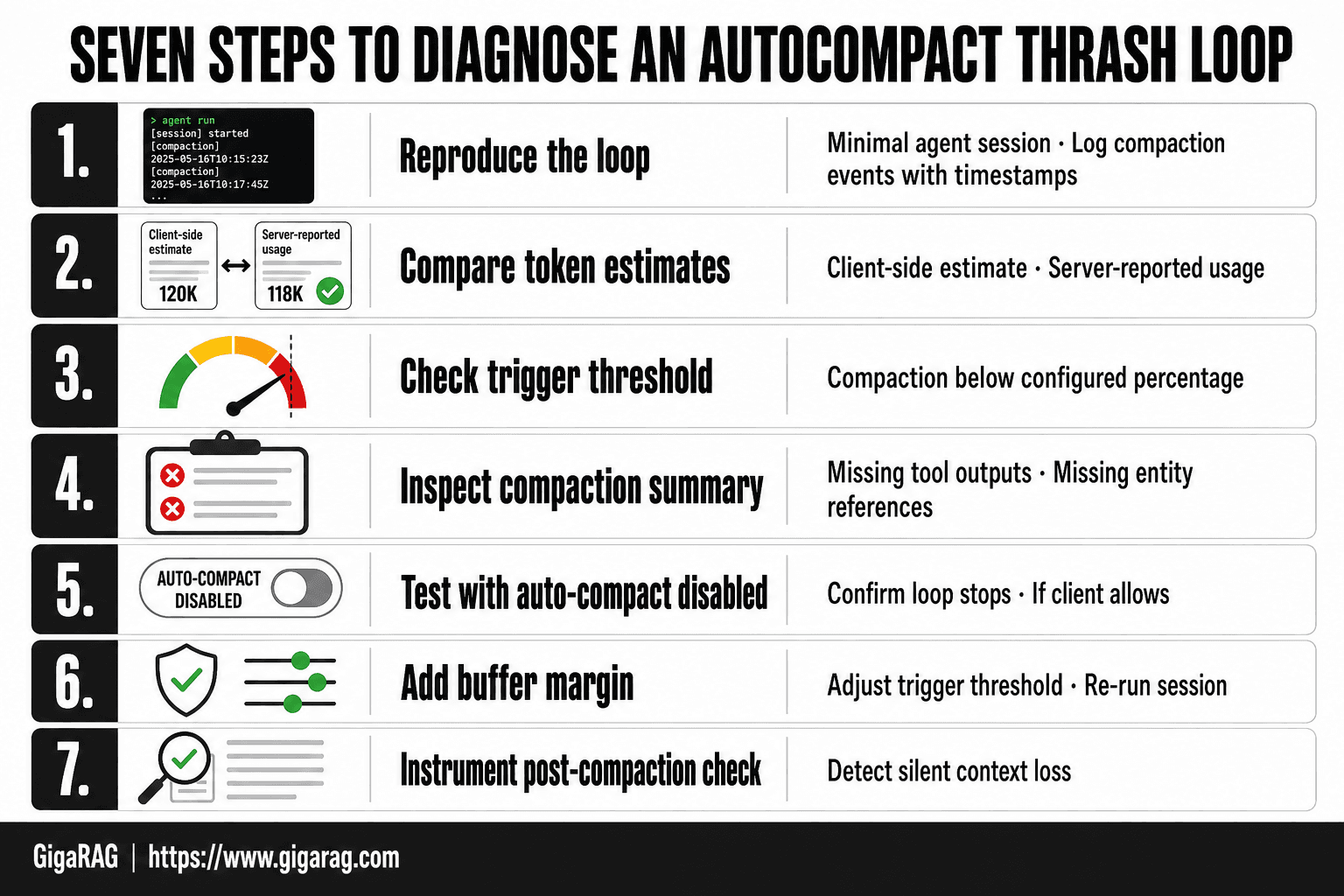
- Reproduce the loop with a minimal agent session and log every compaction event with timestamps.
- Compare client-side token estimates against server-reported usage to find the accounting gap.
- Check whether compaction triggers below your configured threshold percentage.
- Inspect the compaction summary for dropped state — look for missing tool outputs or entity references.
- Test with auto-compact disabled (if your client allows) to confirm the loop stops.
- Add a buffer margin to your trigger threshold and re-run the session.
- Instrument a post-compaction state check to detect silent context loss.
Root Causes: Why Auto-Compaction Thrashes
The symptoms vary, but they share one root: the compaction trigger is a heuristic, not a measurement. It estimates context pressure from signals that drift. When the estimate is wrong, the agent compacts too early, too late, or in a loop.
How auto-compaction thresholds work
Auto-compaction watches context usage as a percentage of the token budget. When usage crosses a configured threshold (often 90-95%), the agent summarizes older turns into a compressed block, freeing tokens for new work. The threshold is a single number. The context it measures is not.
Why premature triggering happens
Premature compaction at 16% means the usage estimate is inflated. The agent counts tokens it shouldn't: tool output buffers, system prompt overhead, or cached fragments that don't actually consume budget. The estimate says "nearly full." Reality says 84% headroom. The agent compacts anyway, and the loop begins: compaction frees tokens, usage drops, the estimate stays inflated, and the next trigger fires on the next turn.
Why compaction sometimes fails to trigger
The inverse failure is a stale estimate. Context hits 100%, but the usage counter hasn't updated. The agent keeps appending tokens until the window hard-overflows, at which point the platform evicts oldest-first with no summarization. Raw history is gone. No compressed version replaces it.
The role of context fragmentation
Each premature compaction fragments context. Summaries stack on summaries. The agent loses the ability to distinguish what it actually knows from what it summarized away. That degraded state makes the next estimate worse, which makes the next trigger more likely. The thrash loop is self-reinforcing.
What You Cannot Do: Honest Limitations
Some fixes don't exist. Chasing them wastes time.
No full disable option in Claude Code
You can't turn auto-compaction off. The setting adjusts the threshold, not the behavior. Compaction will still run when the estimate crosses it.
No way to recover context lost to compaction
Once compaction summarizes a turn, the raw text is gone. Git history won't restore it. Session logs won't either. The summary replaces the original.
No guarantee that settings changes will prevent thrashing
Raising the threshold delays triggers. It doesn't fix a broken usage estimate. If the counter is inflated, you'll still compact early, just at a higher number.
Practical Workarounds and Mitigations
None of these fix the underlying bug. They reduce how often you hit it.
Adjusting context_threshold in settings.json
Set context_threshold higher than the default. A value of 0.9 or 0.95 delays compaction until the estimate approaches the true limit. This helps when the counter is inflated and triggers early. It does nothing when the counter is accurate but the compaction itself is broken.
Monitoring context usage manually
Watch the context percentage before each major step. If it jumps unexpectedly, you've caught a bad estimate before compaction fires. Keep a running note of what the agent has loaded. Tedious, but it works.
Restarting sessions to reset compaction state
A fresh session clears the accumulated context and the compaction state together. This is the bluntest fix. You lose the working context, but you also lose the thrash loop. Use it when the agent starts compacting repeatedly in a short window.
Design Principles for RAG Pipeline Builders
The thrash loop isn't a Claude Code bug you patch around. It's a design failure you can avoid in your own systems.
Predictable compaction triggers vs. heuristic thresholds
Don't trigger compaction on a fuzzy "context usage" estimate. Trigger it on explicit events: a completed task boundary, a user confirmation, a hard token ceiling. Heuristics drift. Events don't.
Preserving critical context during compaction
Mark certain context as non-compactable before you start. System prompts, user constraints, active tool schemas. Compaction should summarize the working memory, never the guardrails.
Designing for observability and user control
Log every compaction event with a before/after token count and a reason. Show the user what got summarized. Let them undo it. Silent compaction is the root of the thrash loop's worst failures.
Avoiding context fragmentation in long-running agents
Long sessions fragment context: the agent re-reads stale summaries and re-derives lost state. Compact in place, not by appending a new summary. Keep one canonical memory, updated incrementally.
Diagnosing Your Autocompact Thrash Loop
You've seen the symptoms. Now figure out which failure mode you're in. Work through these four questions in order.
Is compaction silent or visible?
If you never saw a compaction message but context vanished, you're in the silent failure mode. The agent compacted without telling you. That's the hardest one to catch, because nothing looks wrong until state is already gone.
At what context percentage does it trigger?
Note the number. Triggering at 16% is premature. Triggering at 100% is too late. Both are bugs, but they need different fixes: premature means the threshold is miscalibrated, late means the trigger never fired at all.
Does it trigger repeatedly in a loop?
Compaction runs, context drops, then compaction runs again minutes later. That's the thrash loop proper. The agent compacts, loses state, re-derives it, and compacts again. Check whether the post-compaction context is actually smaller. If not, the loop will never end.
Are there unsafe side effects?
Did compaction run a git checkout, drop a tool schema, or clear a user constraint mid-task? That's the dangerous failure mode. Treat it as a data loss bug, not a performance issue.
Final Thoughts on Autocompact Thrash Loops
The autocompact thrash loop isn't a bug you patch. It's a design failure you engineer around.
Every reported symptom points the same direction: compaction triggers are heuristic, silent, and unaccountable. You can't fully disable them in Claude Code. You can't recover context once it's gone. What you can do is treat context management as a system you design, not a setting you tweak.
For agent memory builders, the lesson is clear. Predictable triggers beat heuristic thresholds. Explicit state beats silent eviction. If you're building a RAG pipeline or agent memory layer, tools like GigaRAG help you manage context on your own terms instead of inheriting someone else's compaction logic.
Thrash loops will keep appearing until compaction becomes observable and controllable. Until then, design your systems so a bad autocompact thrash loop can't destroy the work.
Frequently Asked Questions
What is an autocompact thrash loop?
It is a cycle where an agent's auto-compaction triggers repeatedly, often because the client's token count disagrees with the model's actual usage. Each compaction discards context, which can cause the agent to re-accumulate tokens and trigger compaction again. The result is wasted tokens and progressive state loss.
Why does auto-compact trigger at low context usage?
The client-side token estimator likely overcounts relative to the model's tokenizer, or the threshold is applied to a different metric than actual context length. This mismatch causes compaction to fire before the real limit is reached. Logging both estimates reveals the gap.
Can I disable auto-compact in Claude Code?
There is no officially supported setting to fully disable auto-compact in Claude Code as of current releases. Some users attempt workarounds, but these are unsupported and may change. Check the latest documentation for your version.
What context is lost during auto-compaction?
Compaction replaces older messages with a summary, so any detail not captured in that summary is gone. This often includes tool call outputs, intermediate reasoning, and specific entity references. Once compacted, the original messages are not recoverable from the session.
How do I prevent context thrashing in my RAG pipeline?
Use server-reported token usage as ground truth, add a safety buffer to your compaction threshold, and design your agent to externalize critical state to a durable store. Also instrument compaction events so you can detect loops early.
Is autocompact thrash loop a bug or a design issue?
It is primarily a design issue arising from distributed token accounting and lossy summarization. While specific implementations may have bugs, the loop emerges from architectural choices. Builders should treat it as a systemic risk, not a one-off defect.
About GigaRAG
GigaRAG is for agent memory and RAG pipeline builders. get this right. Whether you are working through autocompact thrash loop or something adjacent, we publish what we have actually tested, including where it falls short.


