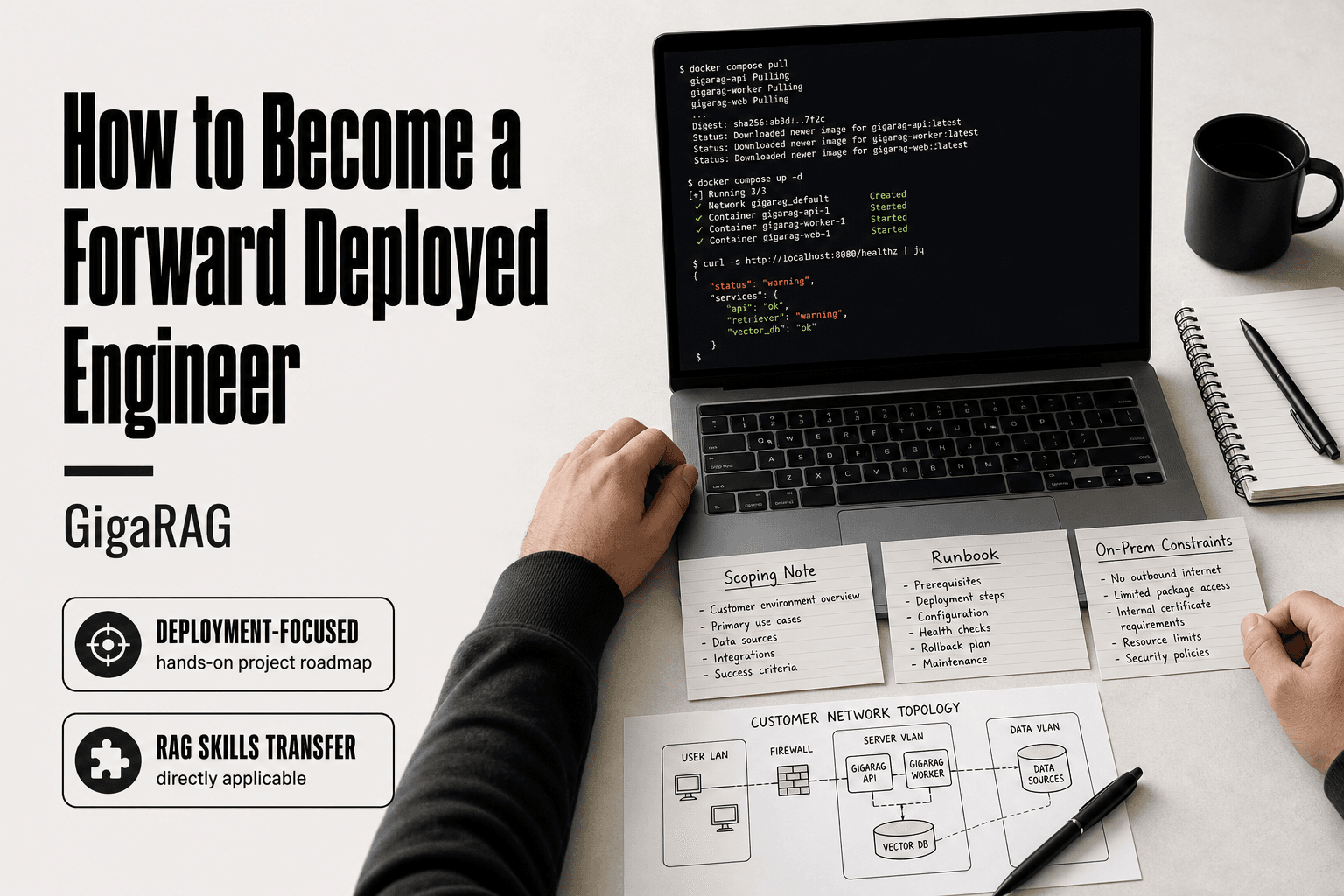
How to Become a Forward Deployed Engineer
How to become a forward deployed engineer is a question that gets buried under viral LinkedIn posts promising $1M salaries and 30-day transformations. Here's the reality check: the job is hard, customer-facing, and mostly unglamorous. An FDE takes working software, deploys it inside a customer's messy production environment, and stays until it actually works. Not a sales pitch. Not a demo. A deployment.
If you already build RAG pipelines or agent memory systems, you're closer than you think. Tools like GigaRAG, which handle agent memory and RAG infrastructure, are exactly the kind of systems FDEs deploy every week. Your skills transfer directly. What you lack is the customer-facing reps, the scoping discipline, and the stomach for on-prem constraints.
This guide covers the concrete roadmap: the skills you need, a hands-on deployment project, honest salary and demand numbers, and the parts of the job that burn people out. No hype. Just what works.
| At a glance | Details |
|---|---|
| Role | Customer-facing engineer deploying AI in production |
| Core skills | Software engineering, RAG, agent memory, communication |
| Typical background | Software or ML engineer with deployment experience |
| Salary range | Varies widely; verify at publish |
| Demand | Growing, especially at AI-native companies |
| Time to transition | Months of focused project work, not weeks |
In This Guide
- What Is a Forward Deployed Engineer?
- Forward Deployed Engineer vs Backend Engineer: What's the Difference?
- What Skills Do You Need to Become a Forward Deployed Engineer?
- How To Become A Forward Deployed Engineer: A Step-by-Step Guide
- How to Become a Forward Deployed Engineer: A Step-by-Step Roadmap
- Hands-On Project: Deploy a RAG Pipeline in a Simulated Customer Environment
- What You Should NOT Expect from an FDE Career
- Forward Deployed Engineer Salary and Job Demand
- Is Becoming a Forward Deployed Engineer Worth It?
- Final Thoughts on Becoming a Forward Deployed Engineer
What Is a Forward Deployed Engineer?
A forward deployed engineer (FDE) is a software engineer who works on-site or directly with customers to deploy, customize, and fix a company's product in the customer's own environment. The role blends engineering with customer work: you write code, debug production systems, and sit in the same room as the people using what you built.
The term comes from Palantir, which made the role famous in the 2010s. FDEs there didn't just hand off software. They flew to customer sites, integrated the product with the customer's data, and stayed until it worked.
FDE vs. solutions engineer vs. sales engineer
A sales engineer supports the sale. They demo the product, answer technical questions, and help close the deal. Once the contract is signed, they move on.
A solutions engineer sits between sales and delivery. They design how the product fits the customer's stack, often before the deal closes, and may stay through early implementation.
An FDE does the actual deployment work. You're not selling or designing. You're in the codebase, wiring the product to the customer's systems, and owning the outcome until it runs in production.
Where FDEs sit in the org chart
FDEs usually report into engineering, not sales. That matters. It means your performance is judged on whether the deployment works, not whether the customer signed.
Why the role exists (the deployment gap)
Most enterprise software fails at the last mile. The product works in the vendor's cloud. It breaks in the customer's data center, behind their firewall, with their weird permissions and legacy systems. FDEs exist to close that gap.
[!note] A forward deployed engineer is not a sales engineer or a solutions architect; the role is hands-on engineering embedded with customers, not just configuring a product.
Forward Deployed Engineer vs Backend Engineer: What's the Difference?
| Factor | Forward Deployed Engineer | Backend Engineer |
|---|---|---|
| Primary focus | Customer deployments and outcomes | Internal systems and services |
| Customer contact | High; embedded with client teams | Low to none |
| Travel | Often required, varies by company | Rare |
| Success metric | Customer adoption and satisfaction | System reliability and performance |
| Skill emphasis | Engineering plus communication | Deep technical specialization |
What Skills Do You Need to Become a Forward Deployed Engineer?
The skills split into two buckets: the ones you already have if you build RAG pipelines, and the ones you'll need to develop. The good news is the first bucket is bigger than most people think.
Technical skills: APIs, deployment, debugging in production
You need to be comfortable reading other people's code and wiring systems together. That means REST APIs, authentication flows, and data formats like JSON. You'll write integration code, not greenfield features.
Deployment is the core skill. You need to know how to get software running on a machine you don't control: Docker, environment variables, reverse proxies, SSL certificates. You'll debug issues you can't reproduce locally because the customer's environment is the only place they happen.
Production debugging is different from local debugging. You're reading logs, tracing requests across services, and checking whether a database query is slow because of the customer's data volume or your code. You won't have time to set up a clean repro. You'll fix things in place.
RAG and agent memory skills you already have
If you build RAG pipelines, you already know embeddings, vector databases, chunking strategies, and retrieval quality. Those transfer directly. FDEs at AI infrastructure companies deploy exactly these systems.
You also know what breaks. You've seen retrieval return irrelevant chunks. You've watched an agent forget context mid-conversation. You've debugged why a pipeline returns stale data. That intuition is the hard part to teach. The deployment mechanics you can learn on the job.
Non-technical skills: communication, stakeholder management, scoping
You'll spend a third of your time talking to people who don't write code. You need to explain why a deployment is delayed without blaming the customer's infrastructure. You need to push back when a customer asks for something that won't work, and offer a smaller thing that will.
Scoping is the skill that separates FDEs who burn out from FDEs who last. You need to define what "done" means before you start, in writing, with the customer's sign-off. Otherwise the deployment never ends.
The skill most FDE candidates underestimate
Writing. Not code. Documents.
A deployment isn't finished when the system runs. It's finished when the customer's engineers can operate it without you. That means runbooks, architecture notes, and decision records explaining why you chose one approach over another. Most engineers treat documentation as an afterthought. FDEs can't. The document is the deliverable as much as the code is.
[!tip] If you already build RAG pipelines, create a public case study of deploying one in a simulated customer environment—include architecture diagrams, failure modes, and how you'd explain it to a non-technical buyer. This directly demonstrates FDE readiness to hiring managers.
How To Become A Forward Deployed Engineer: A Step-by-Step Guide
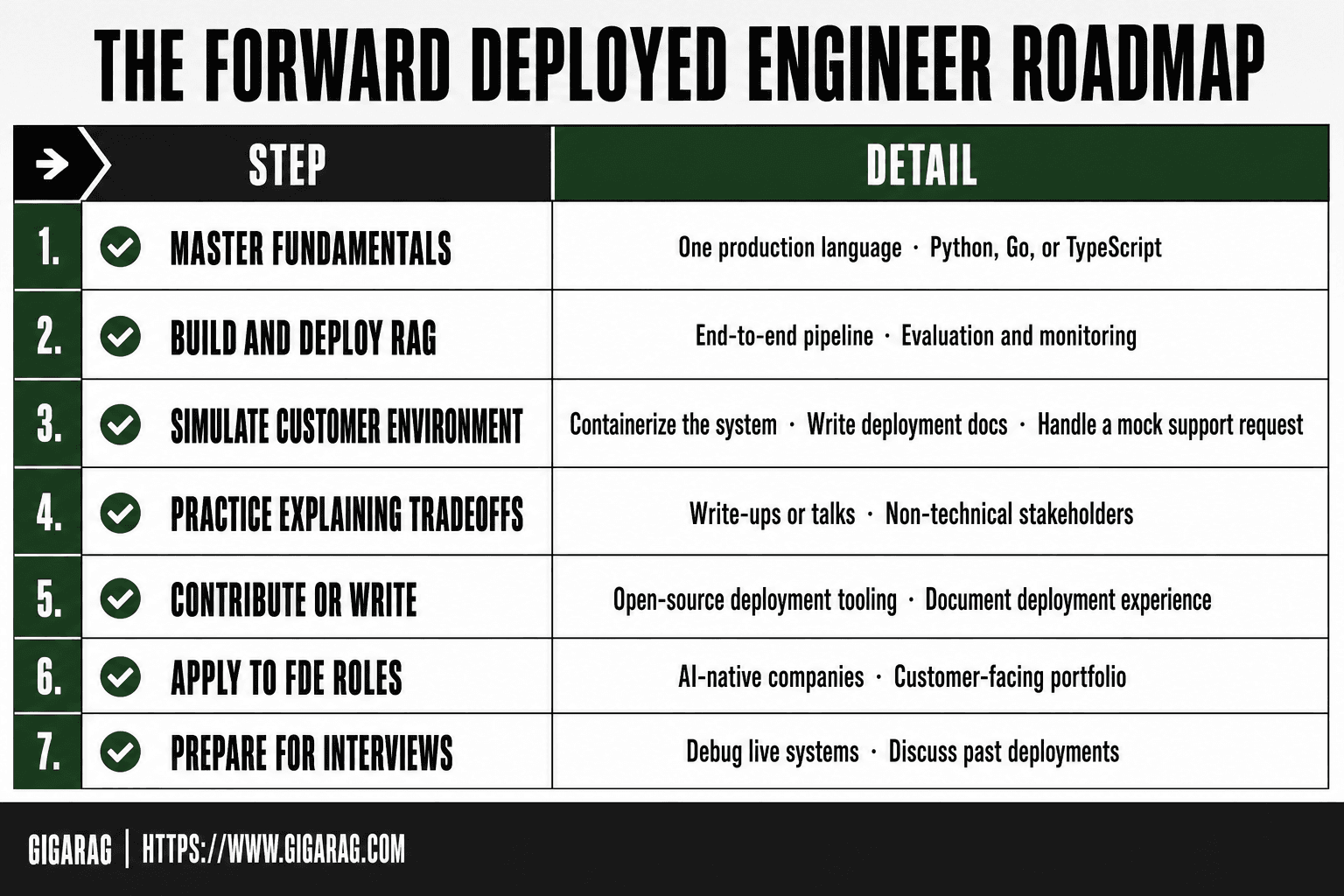
- Master software engineering fundamentals and one production language (Python, Go, or TypeScript).
- Build and deploy a RAG pipeline or agent memory system end-to-end, including evaluation and monitoring.
- Simulate a customer environment: containerize your system, write deployment docs, and handle a mock support request.
- Practice explaining technical tradeoffs to non-technical stakeholders through write-ups or talks.
- Contribute to open-source deployment tooling or write about your deployment experience.
- Apply to FDE roles at AI-native companies, emphasizing customer-facing projects in your portfolio.
- Prepare for interviews by rehearsing debugging live systems and discussing past deployments.
How to Become a Forward Deployed Engineer: A Step-by-Step Roadmap
The skills section told you what you need. This section tells you what to do, in order, starting this week. Each step has one concrete action. Don't skip the audit.
Step 1: Audit your current skills against the FDE baseline
Make a two-column list. Left column: skills you can demonstrate today. Right column: skills you've read about but never used in production. Be honest. If you've only deployed a RAG pipeline on your laptop, that goes in the right column.
The baseline is: you can deploy a working system to a machine you don't control, debug it when it breaks, and explain what you did to someone who doesn't code. If you can't do all three, the gap is your roadmap.
Action this week: write the list. It takes 30 minutes. You'll see exactly where you stand.
Step 2: Build one deployment-focused project
Don't build another demo. Build something that simulates a customer deployment. Take a RAG pipeline you've already built and deploy it to a cloud VM with Docker. Add authentication. Add logging. Add a health check endpoint.
Then break it on purpose. Kill the vector database mid-query. Change the embedding model version. Restrict memory to 512MB. Fix each failure and write down what you did. That written record is your interview material.
The point isn't the pipeline. It's the deployment story you can tell.
Step 3: Learn to scope and communicate technical tradeoffs
Pick a real technical decision you made recently. Write a one-page note explaining what you chose, what you rejected, and why. Include the cost of each option. Not just money: maintenance burden, latency, failure modes.
Then show it to someone non-technical. If they can't follow it, rewrite it. This is the skill that gets you hired. FDE interviews test whether you can explain tradeoffs under pressure, not whether you can recite architecture diagrams.
Step 4: Target FDE roles at AI infrastructure companies
The companies hiring FDEs right now are the ones selling vector databases, agent frameworks, and RAG tooling. Your existing skills map directly to their products. You're not starting from zero.
Look for roles with "forward deployed" or "deployment engineer" in the title. Read the job description for the word "customer." If it appears more than twice, it's an FDE role even if the title says something else.
Step 5: Prepare for the FDE interview process
FDE interviews are not LeetCode marathons. Expect a take-home deployment task, a system design conversation about a customer scenario, and a role-play where you scope a project with a "customer" who changes requirements mid-conversation.
Practice the role-play. Have a friend play a customer who asks for something unreasonable. Practice saying no without losing the deal. That's the interview.
Hands-On Project: Deploy a RAG Pipeline in a Simulated Customer Environment
The roadmap told you to build a deployment-focused project. Here's the full version. This simulates what an FDE actually does: take a working system, drop it into a constrained environment, and make it work for a customer who has specific requirements.
Project setup: a RAG pipeline with a vector database
Start with a RAG pipeline you've already built. If you don't have one, build a minimal version first: a document loader, an embedding step, a vector store, and a retrieval function that feeds context into an LLM. Use any stack you know. Postgres with pgvector is fine. Chroma is fine. The stack doesn't matter for this project.
The pipeline should answer questions from a small document set. Ten to twenty documents is enough. You're not testing retrieval quality here. You're testing deployment.
Simulate customer constraints: on-prem, limited compute, custom data
Now add constraints. A real customer won't give you a clean cloud environment. They'll give you a VM with 4GB of RAM, no internet access from the app server, and a requirement that data never leaves their network.
Make these constraints real. Deploy your pipeline to a local VM or a Docker container with memory capped at 2GB. Disable outbound network access from the app container. Load a customer-specific document set that includes messy formatting, duplicate content, and at least one PDF that's actually a scanned image.
Then run your pipeline. Watch it break. Fix it. Write down every failure and what you changed. That log is the deliverable.
Deliverables: deployment doc, scoping note, demo walkthrough
You need three artifacts when you finish. First, a deployment doc: step-by-step instructions for reproducing your setup on a fresh machine. Include every command, every environment variable, every gotcha. A stranger should be able to follow it without asking you a question.
Second, a scoping note: one page explaining what you would tell a customer about this deployment. What works, what doesn't, what it costs to run, and what you'd need from them to make it production-ready. This is the FDE skill that separates you from a backend engineer.
Third, a demo walkthrough: a five-minute recorded video where you show the pipeline working, break it live, and fix it. Talk through what you're doing as you do it. Hiring managers watch these. A calm, clear walkthrough of a broken system beats a polished demo of a toy.
What You Should NOT Expect from an FDE Career
The honest part. If you're chasing the viral posts, you'll quit before you start.
The $1M salary claim: what's real and what's marketing
The "$1M in 30 days" posts are engagement bait. They count total contract value, not your take-home. An FDE at Palantir or a well-funded AI startup can earn $150k to $250k base, with equity and performance bonuses on top. That's real money. It is not $1M in a year.
The $1M number shows up when someone lands a massive enterprise deal and counts the full contract as their "salary." That's like a realtor claiming they made $2M because they sold a $2M house. The commission is a fraction. Same here.
Why a course alone won't get you hired
No course gets you an FDE job. The role requires production scars: you broke something in a customer's environment, you fixed it under pressure, you explained the tradeoff to a non-technical stakeholder who was angry about it. A course can teach you the vocabulary. It cannot simulate the pressure.
Hiring managers look for evidence you've deployed something real and handled the fallout. The project in the previous section gets you closer than any certificate. Build it, break it, document it. That's the credential.
The parts of the job that burn people out
Travel is the first one. FDEs spend 30 to 50 percent of their time on-site or in customer calls. You will not be heads-down coding. You'll be in a conference room explaining why the model hallucinated during a demo.
The second is context switching. You'll debug a vector store at 9am, scope a new feature at 11, and sit in a procurement call at 2. If you need long uninterrupted blocks to do good work, this role will exhaust you.
The third is the emotional load. You carry the customer's frustration. When the deployment fails, you're the face of it. Not the salesperson. Not the PM. You.
Forward Deployed Engineer Salary and Job Demand
The honest answer is: it depends on company stage, deal size, and how much of your comp is variable. Base salaries run $120k to $180k at startups and $150k to $250k at Palantir or larger AI infrastructure companies. Total comp with equity and bonuses lands between $180k and $350k for most FDEs. The $1M claims are contract value, not your pay.
Salary ranges by company stage
Early-stage startups pay $110k to $150k base with meaningful equity. The equity is lottery tickets. Mid-stage companies ($50M to $500M raised) pay $140k to $190k base plus performance bonuses tied to deployment milestones. Public companies and Palantir pay the top of the range: $160k to $250k base, with total comp reaching $300k to $400k for senior FDEs who close large deals.
Is the FDE role in demand right now?
Yes, but narrowly. AI infrastructure companies need people who can deploy RAG pipelines and agent systems into messy enterprise environments. The demand is real because the deployment gap is real: most companies can build a demo, few can ship it to production for a paying customer. That said, the total number of FDE roles is small compared to pure software engineering. You're competing for hundreds of openings, not tens of thousands.
How FDE compensation differs from pure engineering roles
Pure engineers get predictable base plus equity. FDEs get a larger variable component: performance bonuses, deployment bonuses, and sometimes commission tied to deal outcomes. That means your comp swings more. A bad quarter for deals hits your bonus. A good quarter can add $30k to $50k. If you want stable, predictable income, pure engineering pays more consistently. If you're comfortable with variance and want upside tied to customer outcomes, FDE comp rewards that.
Is Becoming a Forward Deployed Engineer Worth It?
It depends on what you want your week to look like. If you like building things, talking to customers, and fixing problems in unfamiliar environments, the role pays well and teaches fast. If you want deep, uninterrupted coding time, it's a bad trade.
Who should pursue the FDE path
You should pursue it if you already build RAG pipelines or agent memory systems and want to see them work in production for real users. The role rewards people who can debug under pressure, explain technical tradeoffs to non-technical stakeholders, and stay calm when a deployment breaks at 4pm on a Friday. If you get energy from solving a customer's specific problem rather than building a general-purpose tool, FDE work fits.
Who should NOT pursue the FDE path
Don't pursue it if you need predictable hours. FDEs travel, join customer calls at odd times, and carry pager-style urgency when deployments fail. Don't pursue it if you hate context switching. A typical day bounces between writing code, writing scoping docs, and sitting in customer meetings. Don't pursue it if you want to go deep on one codebase for years. FDEs touch many systems shallowly.
The long-term career trajectory
FDEs typically move in three directions. Some become founding engineers or technical co-founders, because they've learned how to sell and ship at the same time. Some move into solutions architecture or technical sales leadership, where the customer-facing skills compound. Some return to pure engineering with a rare skill: they know what breaks in production because they've broken it themselves. The role is a strong launchpad, not a terminal destination.
Final Thoughts on Becoming a Forward Deployed Engineer
The roadmap is simple: audit your skills, build one deployment-focused project, learn to scope tradeoffs, then target FDE roles at AI infrastructure companies. Your RAG and agent memory work already covers the hardest technical part. What's left is the customer-facing reps.
That's the honest advantage. Most candidates applying for forward deployed engineer roles have never deployed a vector database under real constraints or debugged a retrieval pipeline that worked in dev but failed in production. You have. The gap between you and the role is smaller than the job postings make it look.
Tools like GigaRAG, built for agent memory and RAG pipelines, are exactly the kind of systems FDEs deploy for customers. Knowing how they work from the inside gives you a head start most applicants don't have. If you're ready to put in the work, the path to becoming a forward deployed engineer is shorter than you think.
Frequently Asked Questions
What is the salary of a forward deployed engineer?
Forward deployed engineer salaries vary widely by company, location, and experience. At AI-native startups, total compensation can include significant equity, while larger companies may offer higher base salaries. Because ranges shift quickly, check current levels on sites like Levels.fyi or Glassdoor and verify at publish.
Is a forward deployed engineer in demand?
Demand is growing as more companies need engineers who can deploy AI systems directly with customers. However, the role is still concentrated in AI-native and enterprise software companies. It's not yet as ubiquitous as general software engineering roles.
How much do FDEs get paid?
Pay depends on the company stage, your experience, and location. Early-stage startups may offer lower cash but higher equity, while established firms may pay more in base. There is no single figure; research specific companies and verify at publish.
Is a forward deployed engineer worth it?
It can be worth it if you enjoy customer-facing work and want to see your code used in production quickly. The tradeoff is less deep technical focus and more context-switching. It's a strong path for engineers who like variety and impact.
What skills are required for a forward deployed engineer?
You need strong software engineering skills, experience with cloud deployment, and familiarity with AI/ML systems like RAG pipelines. Equally important are communication, empathy, and the ability to debug under pressure with a customer watching.
Can I become a forward deployed engineer without a degree?
Yes, many FDEs come from non-traditional backgrounds. A portfolio of deployed projects and demonstrated customer-facing experience often matters more than a degree. Focus on building and shipping real systems.
How long does it take to become a forward deployed engineer?
If you already have software engineering experience, transitioning can take months of focused effort on deployment projects and communication skills. There is no fixed timeline; it depends on your starting point and the roles you target.
About GigaRAG
GigaRAG is for agent memory and RAG pipeline builders. get this right. Whether you are working through how to become a forward deployed engineer or something adjacent, we publish what we have actually tested, including where it falls short.


