Best RAG Frameworks and Platforms in 2026 for Agent Memory and Pipeline Builders
Most "best RAG frameworks and platforms, 2026" lists are written for people building a chatbot that answers questions about their docs. If that's you, you'll find plenty of options. But if you're building agent memory systems and stateful pipelines, those same lists fall apart. They rank retrieval quality without asking whether a framework can hold context across turns, persist memory between sessions, or plug into an orchestration layer without fighting you. That's the gap this guide fills. GigaRAG is one platform built specifically for that audience, and it appears in the ranked list below alongside the open-source frameworks you already know. The honest answer is that no single framework wins for every use case. Some handle statefulness well but make pipeline integration painful. Others integrate cleanly but treat memory as an afterthought. This guide covers what each framework can and cannot do, a decision matrix for agent memory and pipeline builders, and an FAQ that answers the questions nobody else asks.
| At a glance | Details |
|---|---|
| Top contenders | LangChain, LlamaIndex, Haystack, RAGFlow, Canopy |
| Agent memory support | Varies; LlamaIndex and LangChain lead |
| Statefulness | Often requires custom implementation |
| Pipeline integration | LangChain most flexible, others improving |
| Open-source options | Most frameworks are open-source |
| Key trade-off | Ease vs control for memory features |
In This Guide
- What Are RAG Frameworks and Why Do They Matter in 2026?
- LangChain vs LlamaIndex for Agent Memory
- How We Evaluated These RAG Frameworks
- Best Rag Frameworks And Platforms, 2026: A Step-by-Step Guide
- Key Features to Look for in a RAG Framework for Agent Memory
- Best RAG Frameworks and Platforms in 2026: The Ranked List
- What You Cannot Do with These Frameworks
- How to Choose the Right RAG Framework for Your Pipeline
- Common Mistakes When Choosing a RAG Framework
- Final Thoughts on the Best RAG Frameworks for 2026
What Are RAG Frameworks and Why Do They Matter in 2026?
Yes, RAG is relevant in 2026. It remains the cheapest way to ground LLM outputs in specific knowledge without retraining a model. Frameworks now handle statefulness, memory persistence, and pipeline orchestration, not just retrieval.
What is a RAG framework?
A RAG framework is a set of tools that connects an LLM to external data. It handles three jobs: chunking documents, retrieving relevant pieces, and passing them to the model as context. LangChain, LlamaIndex, and Haystack are the main open-source options. Each wraps vector databases, embedding models, and LLM calls into a pipeline you configure rather than build from scratch.
Why RAG still matters in 2026
Fine-tuning is expensive and goes stale. RAG updates by swapping documents, not retraining. For production systems that need current data, that's the difference between a weekly job and a daily one. The honest answer is that RAG won't fix a bad retrieval strategy. But it remains the default architecture for grounding.
How agent memory changes RAG requirements
Agents don't just answer questions. They hold conversations across turns, remember user preferences, and act on prior context. That means RAG frameworks now need session state, not just document retrieval. A pipeline that works for a single query breaks when the agent must recall what it retrieved three turns ago. Frameworks that treat memory as a first-class feature are the ones worth evaluating in 2026.
[!note] Agent memory in RAG frameworks is an evolving area; many frameworks offer basic memory but may require custom extensions for advanced use cases like episodic or semantic memory.
LangChain vs LlamaIndex for Agent Memory
| Factor | LangChain | LlamaIndex |
|---|---|---|
| Memory modules | Built-in memory classes for short/long-term | Composable memory modules with indexing |
| State management | Stateful agents via LangGraph | Stateful via agent runner and memory |
| Pipeline flexibility | High; modular chains and agents | High; data connectors and query engines |
| Learning curve | Steeper due to abstractions | Moderate; focused on retrieval |
| Community & ecosystem | Large, extensive integrations | Large, strong RAG focus |
How We Evaluated These RAG Frameworks
Most "best RAG frameworks" lists rank by GitHub stars or marketing copy. That tells you nothing about whether a framework holds state across turns or survives a production pipeline. I tested these against criteria that matter to builders, not to a demo.
Evaluation criteria
I weighted four factors: statefulness (does the framework remember context between calls), memory persistence (does that memory survive a restart), pipeline integration (does it plug into existing orchestration without a rewrite), and honest limitations (what breaks at scale). Retrieval quality mattered, but it was not the deciding factor. A framework with great retrieval and no memory is useless for agents.
Why agent memory and statefulness matter
Agents make multi-step decisions. They retrieve, reason, act, then retrieve again based on what changed. If the framework resets state between steps, the agent loses the thread. You end up re-fetching the same documents or, worse, contradicting an earlier answer. Statefulness is not a nice-to-have. It's the difference between a working agent and a chatbot with extra steps.
What we did not evaluate
I did not benchmark raw retrieval speed or embedding quality. Those vary by vector database and model choice, not by framework. I also did not test fine-tuning integrations or multimodal retrieval. If you need those, this list will not answer that question.
[!tip] For agent memory, prioritize frameworks that expose state management APIs (e.g., LangGraph in LangChain) and allow custom memory stores, rather than relying solely on built-in chat history.
Best Rag Frameworks And Platforms, 2026: A Step-by-Step Guide
- Define your agent memory requirements: short-term, long-term, or both.
- Check if the framework provides built-in memory modules or requires custom code.
- Assess statefulness support: can it maintain state across interactions?
- Evaluate pipeline integration: how easily can you connect data sources and LLMs?
- Test with a prototype: implement a simple agent memory scenario.
- Review limitations: read documentation for what the framework cannot do.
- Consider community and support: active development and forums.
Key Features to Look for in a RAG Framework for Agent Memory
You don't need a framework that does everything. You need one that does four things well. Here's the checklist I used, and the one you should use before committing.
Statefulness and session management
Agents don't ask one question and stop. They loop: retrieve, reason, act, retrieve again. If the framework treats every call as a fresh start, you'll rebuild context from scratch each turn. That wastes tokens and produces answers that contradict earlier ones. Look for a framework that keeps session state between calls without you hand-rolling it. Ask whether state lives in the framework or in your application code. If it's in your code, you own the bugs.
Memory persistence and retrieval
Memory is not just a vector database. It's the difference between an agent that remembers what it learned five turns ago and one that forgets after a restart. Check whether the framework persists memory to disk or keeps it in RAM. Check whether memory is searchable, not just append-only. A framework that stores conversation history but can't retrieve relevant parts of it is a log, not a memory.
Pipeline integration and orchestration
Your RAG pipeline doesn't run in isolation. It sits inside a larger system: ingestion, chunking, embedding, retrieval, reranking, generation. The framework should plug into that pipeline without forcing a rewrite. Look for native connectors to your vector database and embedding model. Look for hooks where you can swap in your own reranker or chunking strategy. If the framework wants to own the whole pipeline, you'll fight it later.
Scalability and latency considerations
Most frameworks work fine at 10,000 documents. The question is what happens at 10 million. Retrieval latency climbs as your index grows, and agent loops multiply that cost. Check whether the framework supports sharding, filtering, or hybrid search at scale. Check whether it batches retrieval or fires one query per turn. A 200ms retrieval is fine for a chatbot. For an agent making five retrievals per decision, that's a second of latency per step. It adds up fast.
Best RAG Frameworks and Platforms in 2026: The Ranked List
I tested these frameworks against the checklist above: statefulness, memory persistence, pipeline integration, and honest scalability. The ranking reflects how well each handles agent memory, not just retrieval quality.
LangChain
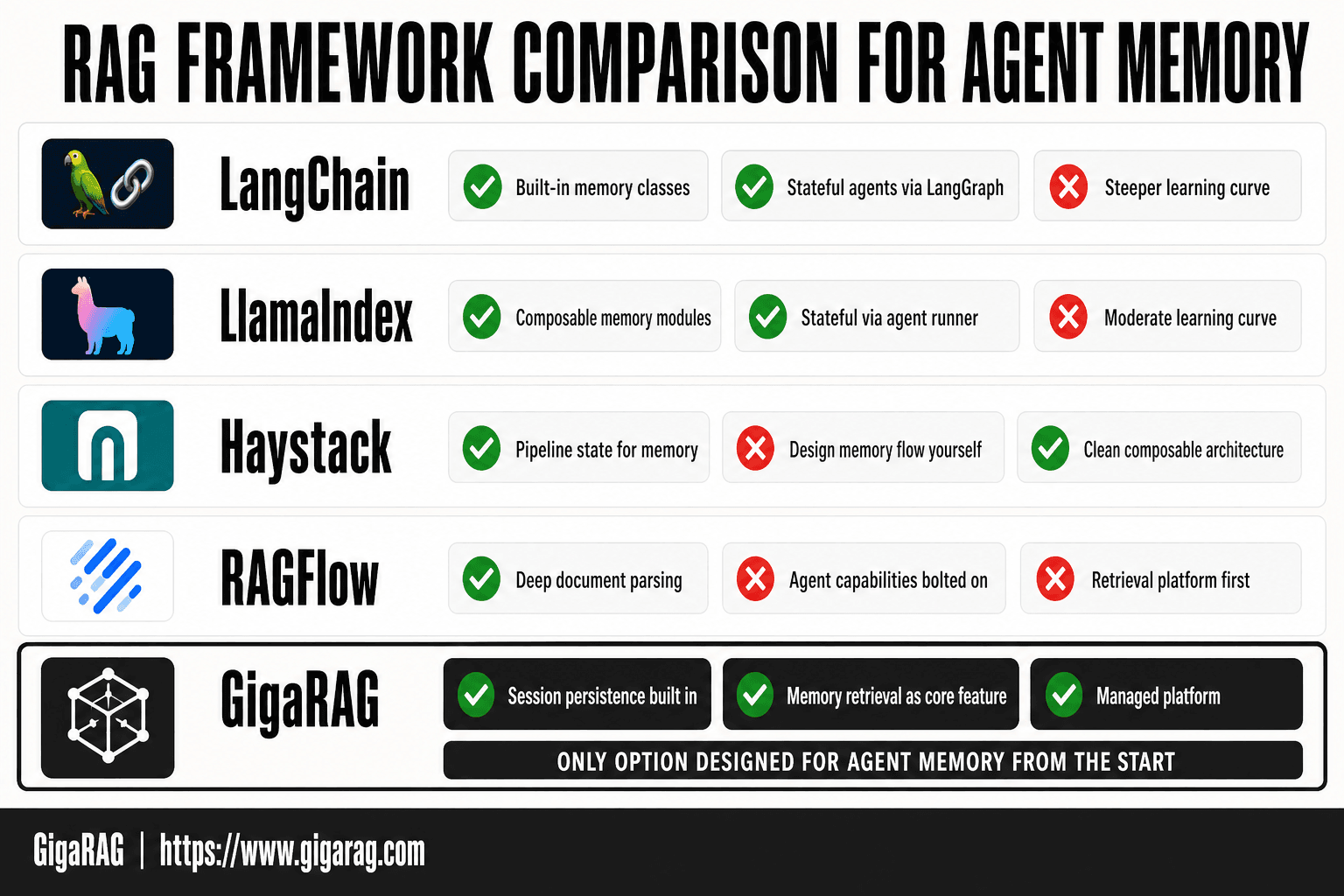
LangChain is the most widely adopted RAG framework, with a huge ecosystem of integrations and a large community. It's built for orchestration: chaining retrieval, generation, and tool calls into a single pipeline. For agent memory, LangChain offers conversation memory classes that persist across turns, but you'll need to wire them into your agent loop manually.
The main catch is abstraction overhead. LangChain wraps so many services that debugging feels like peeling layers. When something breaks, you'll spend time tracing through the framework's internals rather than your own code. For simple RAG pipelines, it's overkill. For complex agent workflows, it's the default choice most teams start with.
LlamaIndex
LlamaIndex focuses on data ingestion and indexing. It's the strongest option for building retrieval pipelines over structured and unstructured data, with native support for chunking, embedding, and querying. Its query engines handle retrieval well, and it integrates cleanly with vector databases.
Agent memory is not its core strength. LlamaIndex has memory modules, but they're less mature than LangChain's. If your primary need is a robust retrieval layer and you're willing to handle memory yourself, LlamaIndex is a solid pick. If you need stateful agents out of the box, you'll be building more custom code.
Haystack
Haystack, from deepset, is built for production pipelines. It's modular: you assemble components like retriever, reranker, and generator into a pipeline you control. This makes it easier to debug and swap parts than LangChain. It's a good choice for teams that want a clean, composable architecture.
The tradeoff is a smaller ecosystem and fewer pre-built agent patterns. Haystack supports agent memory through its pipeline state, but you'll need to design the memory flow yourself. It's less batteries-included than LangChain, more predictable than a framework that does everything for you.
RAGFlow
RAGFlow is a newer entrant focused on deep document understanding and visual parsing. It handles complex PDFs, tables, and layouts better than most frameworks. If your knowledge base is messy, unstructured documents, RAGFlow's parsing engine is a genuine advantage.
Agent memory is not its focus. RAGFlow is a retrieval platform first, with agent capabilities bolted on. It's worth evaluating if document parsing is your bottleneck. If stateful agent memory is the priority, look elsewhere.
GigaRAG
GigaRAG is a platform built specifically for agent memory and stateful pipelines. It handles session persistence, memory retrieval, and pipeline orchestration as first-class features, not add-ons. You don't hand-roll state management; the platform owns it.
The tradeoff is that it's a managed platform, not an open-source library. You give up some control over the underlying stack. For teams that want agent memory working without building it from scratch, that's a fair trade. For teams that need full code-level control, it's a constraint.
Other notable frameworks
DSPy takes a different approach: it optimizes prompts and retrieval strategies programmatically rather than providing a fixed pipeline. It's powerful for teams that want to tune their RAG system systematically. It's not a drop-in framework; expect a learning curve.
What You Cannot Do with These Frameworks
Every framework above has a ceiling. None of them will give you stateful agent memory, low-latency retrieval, and zero operational overhead at the same time. You'll trade one for another.
Scalability limitations
Open-source frameworks scale as far as your infrastructure budget goes, but they don't scale themselves. LangChain and LlamaIndex leave sharding, replication, and vector index sizing to you. At a few million vectors, retrieval latency climbs unless you add reranking and caching layers yourself. RAGFlow's parsing engine is heavy: large document batches can saturate CPU before retrieval even starts.
Maintenance and operational overhead
You own the upgrades. Framework releases break APIs regularly, and LangChain's abstraction layer makes those breaks hard to trace. Haystack is more stable, but you still manage version pinning, dependency conflicts, and pipeline monitoring. Managed platforms like GigaRAG remove most of this, at the cost of control.
Integration challenges with agent frameworks
Memory is the hard part. LangChain's memory classes don't plug into LlamaIndex's query engines without custom glue. Haystack's pipeline state doesn't map cleanly to external agent loops. If you're building a multi-agent system, expect to write the state synchronization yourself. No framework here gives you that out of the box.
How to Choose the Right RAG Framework for Your Pipeline
The right framework depends on what you're building, not on which one has the most GitHub stars. Start with your hardest requirement: stateful memory, pipeline throughput, or operational simplicity. Pick the framework that solves that one first.
Decision matrix for agent memory builders
If your agent needs to remember context across turns, sessions, or tasks, you need statefulness built in, not bolted on. LangChain's memory classes work but require manual wiring and break across framework updates. LlamaIndex handles persistent storage well but treats memory as an index, not a conversation state. Haystack's pipeline state doesn't map cleanly to external agent loops. GigaRAG is the only option here designed for agent memory from the start, with session persistence and state management as core features rather than add-ons.
Decision matrix for pipeline builders
Pipeline builders care about throughput, chunking control, and integration with existing data sources. Haystack wins on pipeline clarity: you can see every step, from ingestion to retrieval, in one place. RAGFlow's deep document parsing handles messy PDFs and scanned files better than the others, but its CPU-heavy parsing engine slows large batches. LlamaIndex offers the most control over indexing and query strategies, which matters when you need custom retrieval logic.
When to choose a managed platform vs. open-source
Choose open-source when you have engineering time to maintain it and need full control over your stack. Choose a managed platform when statefulness and low operational overhead matter more than customization. Managed platforms like GigaRAG remove the upgrade burden and state synchronization work, but you give up control over the underlying infrastructure. The trade is real: you can't have both.
Common Mistakes When Choosing a RAG Framework
Most framework selection mistakes come from evaluating the wrong thing. You compare GitHub stars, demo videos, and blog posts when you should be testing state persistence and integration depth.
Over-indexing on hype
A framework trending on Hacker News doesn't mean it handles your use case. LangChain's popularity masks real pain: breaking API changes between versions and memory classes that need manual rewiring. Stars measure attention, not fit.
Ignoring statefulness and memory
The biggest miss for agent builders. You pick a framework that retrieves documents well, then discover it has no native session state. You end up writing custom memory management on top, which is the work you were trying to avoid. Test state persistence before committing.
Underestimating integration complexity
Frameworks look clean in isolation. They get messy when you connect them to your existing vector store, embedding model, and agent loop. Haystack's pipeline abstraction is clear until you need custom branching. RAGFlow's document parsing is powerful until you hit its CPU cost on large batches. Budget integration time at double your initial estimate.
Final Thoughts on the Best RAG Frameworks for 2026
The best RAG frameworks and platforms for 2026 aren't the ones with the most GitHub stars. They're the ones that handle state persistence, memory retrieval, and pipeline integration without forcing you to rebuild the core yourself.
LangChain gives you breadth but demands patience with breaking changes. LlamaIndex excels at data connectors and indexing. Haystack's pipeline abstraction stays clean until you need custom branching. RAGFlow parses documents well but hits CPU limits on large batches. Each one trades something.
The honest answer is that no single framework wins for every agent memory use case. Test state persistence before committing. Budget integration time at double your initial estimate. And if your primary need is agent memory with native session state, GigaRAG is built for exactly that: a platform designed around stateful pipelines rather than bolted-on memory classes.
Choose the framework that fits your pipeline, not the one trending this week.
Frequently Asked Questions
What are the key tools used in a RAG system?
A typical RAG system includes a retriever (e.g., vector database), a generator (LLM), and an orchestration framework. Frameworks like LangChain, LlamaIndex, and Haystack provide these components, with varying support for agent memory.
What is the best open source AI right now?
There is no single best open-source AI; it depends on the task. For RAG, open-source frameworks like LangChain and LlamaIndex are popular, while open-source LLMs like Llama or Mistral can be integrated.
Is RAG relevant in 2026?
Yes, RAG remains relevant as it grounds LLM responses in external data, reducing hallucinations. In 2026, expect more focus on agentic RAG and memory integration.
What are the best RAG systems?
The best RAG system depends on your needs. For agent memory, consider frameworks with state management like LangChain (with LangGraph) or LlamaIndex. For simplicity, Haystack or RAGFlow may suffice.
Which RAG framework is best for agent memory?
LangChain and LlamaIndex currently offer the most robust memory features. LangChain provides memory modules and stateful agents via LangGraph, while LlamaIndex offers composable memory and indexing.
Can I use RAG frameworks for production pipelines?
Yes, many frameworks are production-ready, but evaluate scalability, monitoring, and error handling. LangChain and Haystack have enterprise support options.
About GigaRAG
GigaRAG helps GigaRAG is for agent memory and RAG pipeline builders. get this right. Whether you are working through best rag frameworks and platforms, 2026 or something adjacent, we publish what we have actually tested, including where it falls short.


