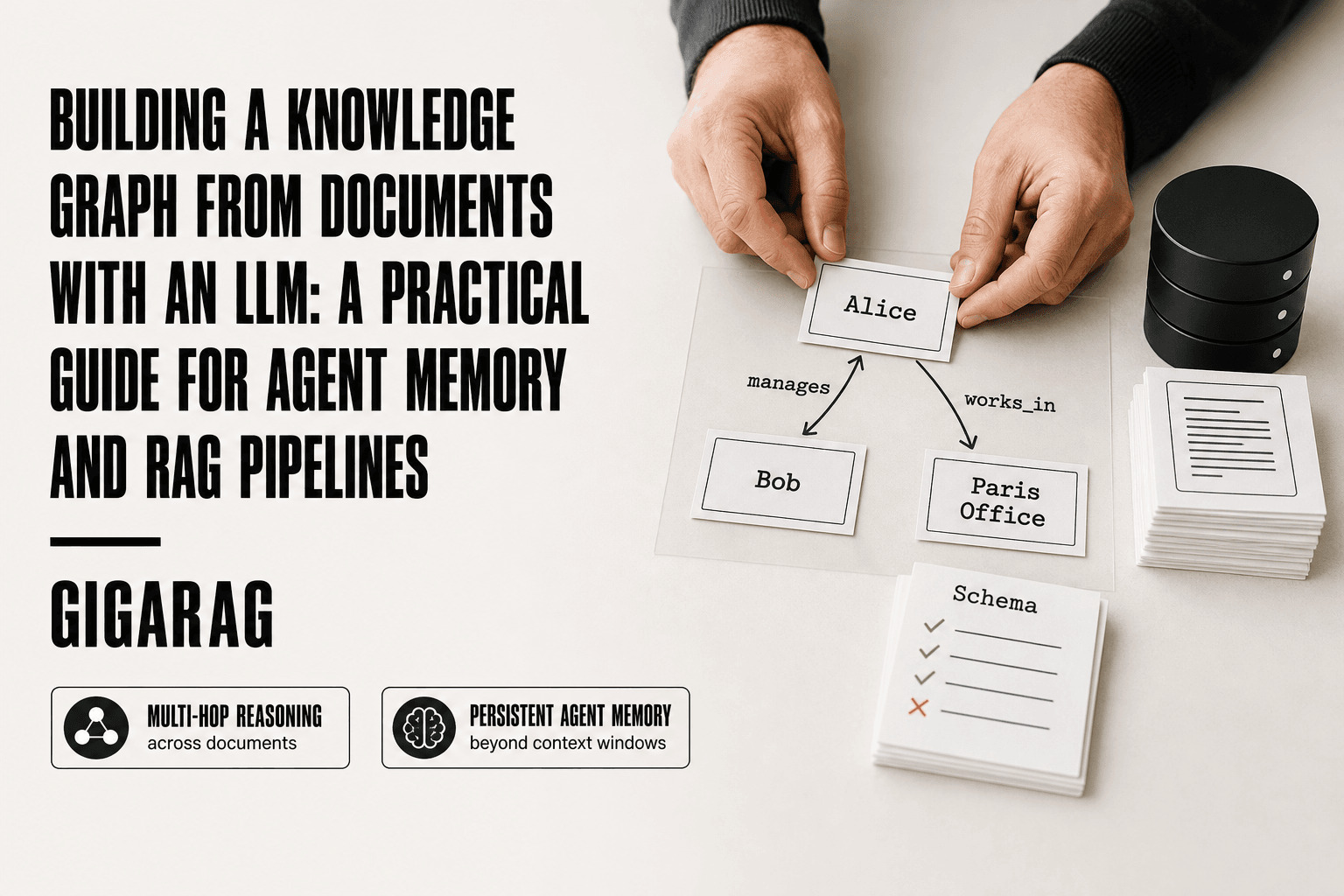
Building a Knowledge Graph from Documents with an LLM: A Practical Guide for Agent Memory and RAG Pipelines
Building a knowledge graph from documents with an LLM is everywhere right now for RAG and agent memory builders, and most of what's out there oversells it. The honest answer is that a knowledge graph is not a silver bullet. It adds a real schema you have to maintain, extraction costs you pay per token, and a resolution step that never quite finishes. You don't need one for every retrieval problem. But when your agent needs multi-hop reasoning across documents, or persistent state that survives a context window, a graph earns its overhead. GigaRAG is built for exactly that: agent memory and RAG pipelines that need structured relationships without the vendor lock-in. This guide covers the full pipeline: schema design, LLM extraction with code, knowledge fusion, storage and querying, a direct comparison of LLM vs. traditional NLP quality, and a decision framework for when not to build one.
| At a glance | Details |
|---|---|
| Core pipeline | Chunk, extract, resolve, store, query |
| Best extractor | LLM with strict schema + validation |
| Main cost driver | LLM tokens per chunk |
| Biggest failure mode | Hallucinated entities, inconsistent relations |
| When to skip KG | Simple lookup, small corpus, tight budget |
| Typical stack | Graph DB + vector index + LLM |
In This Guide
- What Is a Knowledge Graph (and Why It Matters for RAG and Agent Memory)
- LLM Extraction vs Traditional NLP for Knowledge Graphs
- The LLM Knowledge Graph Pipeline: A Five-Stage Overview
- Building A Knowledge Graph From Documents With An Llm: A Step-by-Step Guide
- Schema Design: Getting Your Ontology Right Before Extraction
- Entity and Relation Extraction with an LLM: Code-Level Walkthrough
- Knowledge Fusion: Resolving Duplicate Entities and Conflicting Relations
- Storing and Querying Your Knowledge Graph: Neo4j, Open-Source, and Beyond
- LLM Extraction Quality vs. Traditional NLP: What Actually Works
- When NOT to Build a Knowledge Graph from Documents with an LLM
- Maintaining and Updating Your Knowledge Graph Over Time
- Knowledge Graphs as Agent Memory: Architecture Patterns and Update Strategies
- Common Mistakes When Building a Knowledge Graph from Documents with an LLM
What Is a Knowledge Graph (and Why It Matters for RAG and Agent Memory)
A knowledge graph stores facts as nodes and edges: entities connected by typed relationships, each with properties you can query directly. Unlike a vector database that matches on semantic similarity, a graph lets you traverse explicit connections like "works at" or "cites" across multiple hops.
Knowledge graph vs. vector database: what each solves
A vector database answers "what is similar to this?" It embeds text and finds nearest neighbors. That's retrieval by resemblance.
A knowledge graph answers "how are these things connected?" It stores structure. You can ask who reported to whom, which papers cite which, what events preceded what. The relationships are first-class citizens, not inferred at query time.
The honest answer is they solve different problems. Vector search handles fuzzy matching across unstructured text. Graphs handle precise traversal across known relationships. Most RAG systems that need both use both.
Why RAG pipelines hit a ceiling without structured relationships
Vector-only RAG retrieves chunks that look relevant. It can't join facts across chunks. If one document says Alice manages Bob and another says Bob works in the Paris office, a vector search might retrieve both but won't connect them.
Multi-hop questions break this. "Who manages the person in the Paris office?" requires two traversals. A graph does that in one query. A vector database does it by luck.
Agent memory: why unstructured context isn't enough
Agents accumulate state across turns. Storing that as raw text means every recall is a similarity search. Storing it as a graph means the agent can update a specific fact, check for contradictions, and traverse what it learned.
That's persistent, structured memory. Unstructured context is a scratchpad. The graph is the ledger.
[!note] LLM-based extraction can hallucinate entities and produce inconsistent relations, so always validate outputs against a schema and keep source chunk references for every triple. Traditional NLP pipelines tend to be more consistent but cover fewer relation types on messy text.
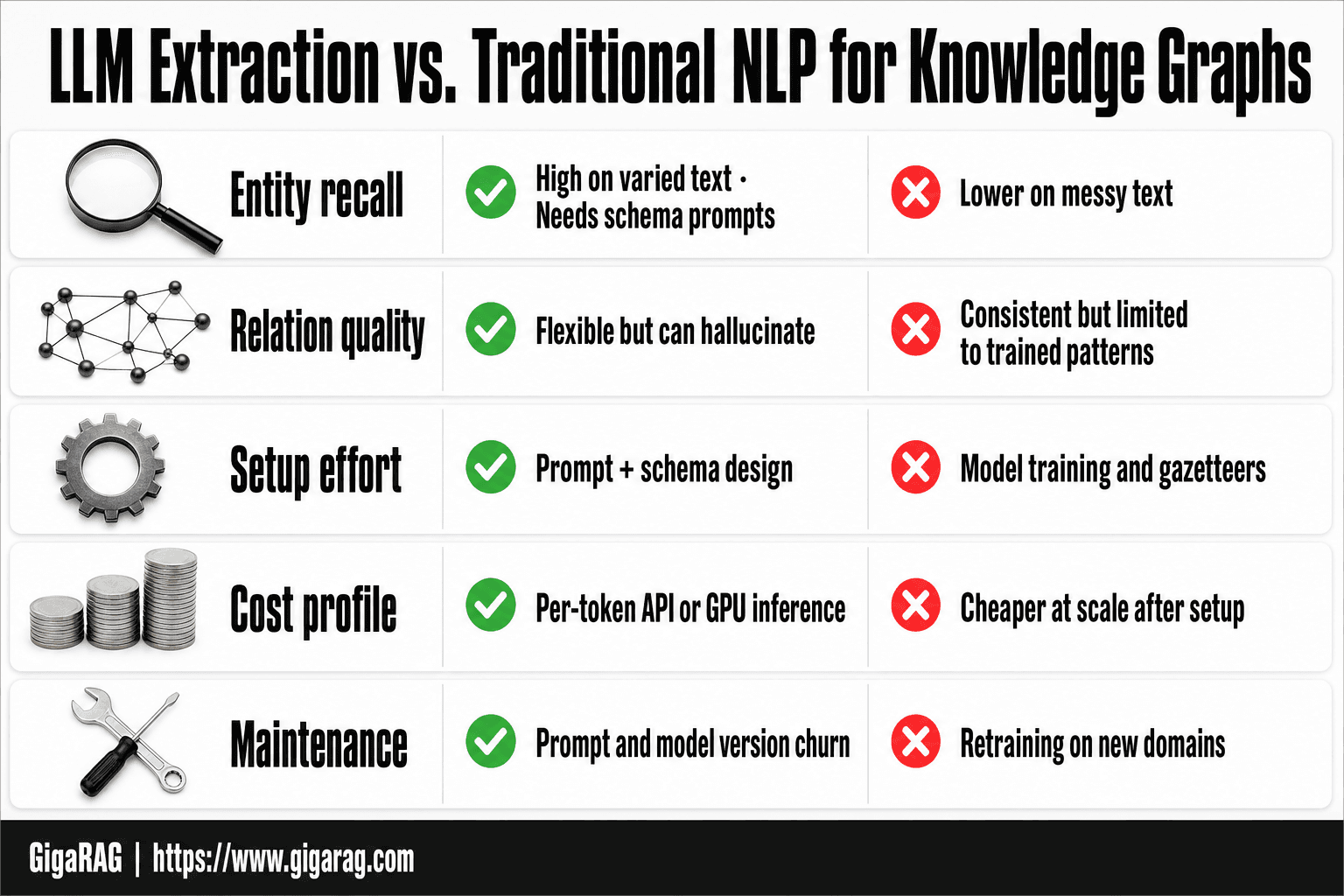
LLM Extraction vs Traditional NLP for Knowledge Graphs
| Factor | LLM Extraction | Traditional NLP |
|---|---|---|
| Entity recall | High on varied text; needs schema prompts | Lower on messy text; rule-bound |
| Relation quality | Flexible, but can hallucinate or drift | Consistent but limited to trained patterns |
| Setup effort | Prompt + schema design, then iterate | Model training, gazetteers, pipelines |
| Cost profile | Per-token API or GPU inference | Cheaper at scale after setup |
| Maintenance | Prompt and model version churn | Retraining on new domains |
The LLM Knowledge Graph Pipeline: A Five-Stage Overview
Building a knowledge graph from documents with an LLM isn't one prompt. It's five stages, each with its own failure modes. Here's the map.
Stage 1: Document ingestion and chunking
You split documents into chunks small enough for an LLM's context window. Chunk size matters more than most people admit. Too large and the model misses relations across the chunk. Too small and you lose the context needed to identify what an entity actually is. Most builders land between 500 and 1,500 tokens per chunk, with overlap.
Stage 2: Schema and ontology design
Before extraction, you define what you're looking for. Entity types, relation types, properties. A medical corpus needs "drug," "condition," "interacts_with." A corporate corpus needs "person," "department," "reports_to." Skip this and the LLM invents its own schema, inconsistently, across every chunk.
Stage 3: LLM-driven entity and relation extraction
This is the core loop. You prompt the LLM to pull (subject, predicate, object) triples from each chunk. The output is structured JSON you can parse. Quality varies wildly, which the extraction quality section covers in detail.
Stage 4: Knowledge fusion and entity resolution
Extraction across chunks produces duplicates. "Alice Smith" in chunk 3 and "A. Smith" in chunk 17 are the same person. You merge them, resolve conflicts, and deduplicate before loading. Skip this and your graph is noise.
Stage 5: Graph storage and querying
The triples land in a graph database. Neo4j, Kuzu, Apache AGE. From there you query with Cypher or GQL for multi-hop traversal that vector search can't do.
[!tip] For agent memory and RAG, store a pointer from every graph node and edge back to the source chunk ID and document version. This lets you re-verify facts, re-extract after prompt changes, and avoid stale or orphaned knowledge in long-running agents.
Building A Knowledge Graph From Documents With An Llm: A Step-by-Step Guide
- Ingest and chunk documents with overlap, preserving section and source metadata.
- Define a strict entity and relation schema (types, allowed relations, cardinality).
- Prompt the LLM to extract triples per chunk, returning JSON that matches the schema.
- Validate and repair outputs: reject invalid types, deduplicate, and flag low-confidence items.
- Resolve entities across chunks using aliases, embeddings, and deterministic keys.
- Load nodes and edges into a graph store, and link each node to its source chunk IDs.
- Query the graph for retrieval or agent memory, and evaluate precision and recall on a labeled set.
Schema Design: Getting Your Ontology Right Before Extraction
Schema design is the stage most builders skip, and the one that determines whether your graph is queryable or noise. You're deciding three things before extraction: entity types, relation types, and properties. Get these wrong and every downstream stage compounds the error.
Entity types and relation types: a concrete example
Say you're building a graph from a corpus of research papers. Your entity types might be Paper, Author, Institution, Method, and Dataset. Relation types: cites, authored_by, affiliated_with, uses_method, evaluates_on. Properties sit on entities: Paper gets title, year, venue. Author gets name, h_index.
The test is whether your queries can traverse these. "Which institutions use method X?" needs Institution, Method, and uses_method. If you didn't define uses_method, that query dies.
How to let the LLM propose a schema from a document sample
Don't design in a vacuum. Feed the LLM 20 to 30 representative chunks and ask it to propose entity types, relation types, and properties. Then you edit. The LLM will surface types you'd miss, and it will also propose junk you need to cut. Treat its output as a draft, not a schema.
Schema iteration: aligning with downstream queries
Start from the queries your RAG pipeline or agent will actually run. Write those queries first. Then check: does the schema support them? If a query needs "which authors collaborate across institutions," you need a collaborates_with relation. If it's not there, add it before extraction. Iterating after extraction means re-running the whole pipeline.
Keep the schema small. Five to ten entity types, ten to fifteen relation types. Every addition increases extraction errors and fusion complexity.
Entity and Relation Extraction with an LLM: Code-Level Walkthrough
With your schema locked, you're ready to extract. The core mechanic is simple: feed a document chunk to an LLM, ask it to return triples in a structured format, parse the output, and validate it against your schema. Everything else is error handling.
Prompt design for structured triple extraction
Your prompt needs four things: the schema, the chunk, the output format, and explicit constraints. Here's a prompt that works:
You are extracting entities and relations from a document chunk.

Entity types: Paper, Author, Institution, Method, Dataset
Relation types: cites, authored_by, affiliated_with, uses_method, evaluates_on

Return only JSON. Format:
{"triples": [{"subject": "...", "predicate": "...", "object": "..."}]}

Rules:
- Use only the entity and relation types listed above.
- Extract only relations explicitly stated in the text.
- Do not infer relations that are not present.
- If no triples are found, return {"triples": []}.

Chunk:
{chunk_text}
The constraint "do not infer relations that are not present" is the single most important line. Without it, the LLM will happily connect entities based on background knowledge, and you'll get a graph full of plausible but false edges.
Parsing LLM output into (subject, predicate, object) triples
The LLM will occasionally return malformed JSON, extra commentary, or triples that violate your schema. You need a parser that handles all three.
import json
import re

def parse_triples(llm_output: str, valid_relations: set[str]) -> list[tuple[str, str, str]]:
    # Extract JSON block if the LLM wrapped it in markdown
    json_match = re.search(r'```json\s*(.*?)\s*```', llm_output, re.DOTALL)
    if json_match:
        llm_output = json_match.group(1)

    try:
        data = json.loads(llm_output)
    except json.JSONDecodeError:
        # Fallback: try to find any JSON object
        json_match = re.search(r'\{.*\}', llm_output, re.DOTALL)
        if not json_match:
            return []
        data = json.loads(json_match.group(0))

    triples = []
    for t in data.get("triples", []):
        subj, pred, obj = t.get("subject"), t.get("predicate"), t.get("object")
        if not all([subj, pred, obj]):
            continue
        if pred not in valid_relations:
            continue
        triples.append((subj.strip(), pred.strip(), obj.strip()))

    return triples
The parser does three jobs: strips markdown wrappers, recovers from partial JSON, and filters triples that use relations outside your schema. That last filter is your first line of defense against hallucinated relation types.
Code example: extracting triples from a document chunk
Here's the full extraction loop, framework-agnostic. It assumes you have an llm_call function that takes a prompt and returns a string.
def extract_triples_from_chunk(chunk: str, schema: dict) -> list[tuple[str, str, str]]:
    prompt = build_extraction_prompt(chunk, schema)
    output = llm_call(prompt)
    return parse_triples(output, set(schema["relations"]))

# Example schema
schema = {
    "entities": ["Paper", "Author", "Institution", "Method", "Dataset"],
    "relations": ["cites", "authored_by", "affiliated_with", "uses_method", "evaluates_on"]
}

chunk = """
Smith et al. (2023) introduce a new attention mechanism called SparseAttn.
The authors are affiliated with Stanford University. They evaluate their
method on the GLUE benchmark and cite Vaswani et al. (2017).
"""

triples = extract_triples_from_chunk(chunk, schema)
for s, p, o in triples:
    print(f"{s} --{p}--> {o}")
Expected output:
Smith et al. (2023) --authored_by--> Stanford University
SparseAttn --evaluates_on--> GLUE
Smith et al. (2023) --cites--> Vaswani et al. (2017)
Notice what's missing: the LLM didn't create a uses_method triple because the chunk doesn't explicitly state that SparseAttn is a method. That's the constraint working. You'll still get errors, but they'll be subtler.
Using LangChain's LLM Graph Transformer as a shortcut
If you don't want to hand-roll prompts and parsers, LangChain's LLMGraphTransformer does the extraction, parsing, and schema validation for you. It takes a list of documents and returns graph documents with nodes and relationships.
from langchain_experimental.graph_transformers import LLMGraphTransformer
from langchain_openai import ChatOpenAI

llm = ChatOpenAI(model="gpt-4o", temperature=0)
transformer = LLMGraphTransformer(
    llm=llm,
    allowed_nodes=["Paper", "Author", "Institution", "Method", "Dataset"],
    allowed_relationships=["cites", "authored_by", "affiliated_with", "uses_method", "evaluates_on"],
)

graph_documents = transformer.convert_to_graph_documents(documents)
The main catch: LLMGraphTransformer is in langchain_experimental, which means its API can change without notice. It also hides the prompt, so debugging extraction quality means reading LangChain source. For a quick prototype, it's worth it. For production, you'll likely want the explicit prompt and parser you control.
Keep in mind: extraction quality is only as good as your chunking. If a relation spans two chunks, neither the hand-rolled prompt nor the transformer will catch it. That's a fusion problem, not an extraction problem, and it's the next stage.
Knowledge Fusion: Resolving Duplicate Entities and Conflicting Relations
Extraction is messy by design. The same person appears as "Smith et al. (2023)" in one chunk and "J. Smith" in another. Two chunks disagree on a relation. Your graph now has noise.
Why LLM extraction creates duplicates and conflicts
Each chunk is processed independently. The LLM has no memory of what it extracted from the previous chunk, so it normalizes names differently every time. Chunk boundaries also split context: one chunk says "the authors," another names them. The LLM can't connect the two.
Conflicts are worse. One chunk says a method was evaluated on GLUE, another says SQuAD. Both extractions are correct for their chunks, but the graph can't hold both without a rule.
Entity resolution with embeddings and LLM re-ranking
Start with embeddings. Compute a vector for every entity name, cluster names with cosine similarity above 0.85, and merge clusters. That catches "Smith et al. (2023)" and "J. Smith" but misses "the Stanford group" and "Smith's team."
Re-rank the top candidates with an LLM. Give it two entity names and ask: same entity? The LLM catches what embeddings miss, but it costs tokens. Only re-rank pairs above the embedding threshold.
Conflict resolution: when two chunks disagree
You need a policy. The simplest: keep the most recent extraction, log the conflict. Better: store both with provenance, then query with a confidence score. The honest answer is that no policy is universally right. It depends on whether your graph serves retrieval or truth.
For retrieval, keep all candidates and let the query rank them. For truth, you need a human or a second LLM pass to adjudicate.
Storing and Querying Your Knowledge Graph: Neo4j, Open-Source, and Beyond
You've extracted triples and resolved duplicates. Now they need a home. The storage layer determines what queries you can run, how fast they return, and how much operational overhead you'll carry.
Choosing a graph database: Neo4j vs. open-source options
Neo4j is the default choice for most teams. It's mature, well-documented, and Cypher is the closest thing to a standard graph query language. The community edition is free but limits you to a single database and no horizontal scaling. That's fine for prototyping. It gets expensive when you need clustering.
Open-source alternatives have improved. Kuzu is an embedded graph database that runs in-process, which means no separate server to manage. Apache AGE layers graph queries on top of PostgreSQL, so you keep your existing Postgres infrastructure. TigerGraph offers a free tier but its query language, GSQL, has a steeper learning curve than Cypher.
The honest answer is that for most RAG and agent memory workloads, any of these work. The bottleneck is rarely the database. It's your extraction quality and query design.
Cypher queries for multi-hop retrieval in RAG
Multi-hop queries are where graphs beat vector search. Here's a Cypher query that finds papers citing a specific method, then returns the authors of those papers:
MATCH (p:Paper)-[:USES]->(m:Method {name: "LoRA"})
MATCH (p)-[:AUTHORED_BY]->(a:Author)
RETURN a.name, p.title
Two hops, one query. A vector database would need multiple round trips and manual joins.
For agent memory, you might query recent interactions with a specific entity:
MATCH (u:User)-[:ASKED_ABOUT]->(t:Topic)
WHERE u.id = $user_id
RETURN t.name, count(*) AS frequency
ORDER BY frequency DESC
LIMIT 5
Integrating graph queries into your RAG pipeline
Don't replace vector search. Combine them. Use vector search for broad topical recall, then use the graph to expand context with structured relationships. A common pattern: retrieve the top 10 chunks by embedding similarity, extract their entities, then query the graph for one-hop neighbors of those entities. That gives you related context the vector search missed.
The main catch is latency. Graph queries add 50-200ms per hop depending on your database and index setup. For a single-user agent that's fine. For a high-throughput RAG endpoint, you'll need to cache frequent queries or precompute common traversals.
Microsoft does have a knowledge graph tool: Microsoft Graph, but it's for organizational data like users, files, and calendar events, not for building document-derived knowledge graphs. Don't confuse the two.
LLM Extraction Quality vs. Traditional NLP: What Actually Works
The honest answer is that LLMs win on flexibility and lose on consistency. Traditional NLP is deterministic. An LLM is probabilistic. That single difference explains most of what you'll see in practice.
Accuracy: LLMs vs. spaCy and OpenIE on entity extraction
spaCy's NER model is fast and predictable. It extracts person, organization, location, and a handful of other types with high precision on standard text. But it misses domain-specific entities: drug names, legal citations, product SKUs. You can fine-tune it, but that requires labeled data and retraining.
OpenIE extracts open-domain relations without a fixed schema. It's useful for broad coverage but produces noisy, overlapping triples. You'll spend time cleaning its output.
LLMs extract entities and relations in one pass, with no training data. They handle domain-specific terms, nested entities, and implicit relations that rule-based systems miss. The tradeoff is consistency. Run the same chunk through an LLM twice and you may get different entity boundaries or relation labels. That's not a bug. It's the cost of flexibility.
Cost and latency: the hidden price of LLM extraction
spaCy processes roughly 10,000 tokens per second on a CPU. An LLM call takes 1-5 seconds for a single chunk, depending on model size and provider. At scale, that's a 100x to 1000x latency gap.
Cost compounds the problem. spaCy is free after setup. LLM extraction costs per token. A 1,000-document corpus at 500 tokens per chunk means 500,000 tokens per extraction pass. With GPT-4-class pricing, that's a real bill. With open-weight models on your own hardware, you trade money for GPU time and engineering effort.
Failure modes: hallucinated entities and inconsistent relations
LLMs hallucinate. They invent entities that don't appear in the text, especially when the prompt pushes for completeness. They also normalize inconsistently: "IBM" and "International Business Machines" may appear as two nodes in one run and one node in the next.
Traditional NLP fails differently. It misses entities entirely rather than inventing them. That's a safer failure mode for a knowledge graph, because a missing node is easier to spot than a fabricated one.
The practical takeaway: use LLMs for extraction when your domain is specialized or your schema is open-ended. Use traditional NLP when you need speed, determinism, and zero hallucination risk, and your entity types are standard.
When NOT to Build a Knowledge Graph from Documents with an LLM
A knowledge graph is a tool, not a default. You should skip it when the cost of building and maintaining the graph exceeds the value of the structured relationships it gives you. That threshold is lower than most vendor content admits.
When vector-only RAG is good enough
Vector RAG answers "what does this document say about X." It retrieves passages by semantic similarity and hands them to an LLM for synthesis. If your queries are single-hop, factoid, or extractive, that's all you need. You don't need a graph to answer "what's the refund policy" or "when was this report published."
The graph earns its keep on multi-hop questions: "which suppliers serve the customers who bought product Y" or "what changed between version 2 and version 4 of this contract." If your users don't ask those questions, don't build for them.
Corpus characteristics that make KGs unnecessary
Small corpora don't justify a graph. Under roughly 100 documents, vector retrieval with a decent chunking strategy covers most queries. The graph adds structure but no new information.
Homogeneous corpora are the same story. If every document follows one template (invoices, support tickets, lab reports), the relationships are predictable. A few metadata filters on a vector database get you the same filtering power without extraction, fusion, or a graph database.
The graph pays off when documents are heterogeneous, cross-reference each other, and contain entities that recur across many files. That's where the relational structure captures something vectors miss.
Maintenance overhead: the cost you'll keep paying
Extraction is a one-time cost. Maintenance is forever. Every new document needs extraction, entity resolution against the existing graph, and conflict handling. Every schema change means re-extracting or at least re-validating old nodes. Every hallucinated entity that slips through becomes a landmine your queries trip over later.
If you don't have a plan for who maintains the graph, who reviews extraction quality, and how updates get validated, you're not building an asset. You're building a liability with a graph database attached.
Maintaining and Updating Your Knowledge Graph Over Time
A knowledge graph decays the moment you stop feeding it. Documents change, new ones arrive, and the entities you extracted last month no longer match reality. If you built the graph as a one-time project, you built a snapshot. Snapshots go stale.
Incremental updates: adding new documents without full re-extraction
You don't re-extract the whole corpus when a new document lands. You extract only the new document, then run entity resolution against the existing graph. That means comparing new entities to existing nodes by embedding similarity, then merging matches or creating new nodes.
The catch is conflict handling. A new document may assert a relation that contradicts an existing one. You need a policy: latest wins, source-weighted voting, or flag for human review. Pick one before you need it.
Handling document changes and deletions
When a document changes, re-extract it and diff the triples against what's already in the graph. Add new triples, update changed properties, and remove triples that no longer appear. Deletions are harder: you need to know which nodes and edges came only from that document. If you didn't track provenance at extraction time, you can't safely delete anything.
Track source document ID on every node and edge. It's the difference between a graph you can update and a graph you're afraid to touch.
Dynamic knowledge memory for agentic systems
Agents that learn during a session need to write back to the graph. That means the graph isn't just a read-only index; it's a working memory. The agent extracts new facts from its interactions, resolves them against existing nodes, and writes the results.
The risk is memory bloat. Agents that write everything create graphs full of noise. You need a consolidation step: periodically prune low-utility nodes, merge near-duplicates, and summarize clusters of related facts into higher-level nodes. Without consolidation, the graph grows until queries slow down and answers get worse.
Knowledge Graphs as Agent Memory: Architecture Patterns and Update Strategies
The previous section covered maintenance for a mostly static corpus. Agent memory is different. The graph isn't a document index anymore; it's a working memory that changes every time the agent acts. That shift changes how you design read and write paths.
Read/write patterns: how agents query and update the graph
Agents read from the graph before acting, then write back after. The read is a targeted query: pull the subgraph around the current task, not the whole graph. A Cypher query that returns the entity and its one-hop neighbors is usually enough context.
The write is where most designs fail. Don't let the agent write raw triples directly. Route every write through a validation step that checks the triple against the schema, runs entity resolution against existing nodes, and rejects or flags conflicts. An agent that writes unchecked creates a graph you can't trust.
Memory consolidation: pruning and summarizing old knowledge
Consolidation runs on a schedule, not on every write. Every N interactions, or when the graph crosses a size threshold, you run a job that does three things: merges near-duplicate nodes, prunes nodes with no incoming edges and low query frequency, and summarizes clusters of related facts into higher-level nodes.
The summary step matters most. Ten facts about a specific meeting become one node representing the meeting outcome. You lose detail, but you keep the signal the agent actually needs for future decisions.
Avoiding memory bloat in long-running agents
Bloat comes from agents that treat the graph as a log. Every observation, every intermediate step, every failed attempt gets written. Within a few hundred interactions, queries slow down and retrieval returns noise.
The fix is a write policy. Only persist facts that meet a bar: new entities, changed relations, or outcomes that affect future behavior. Everything else stays in the agent's short-term context window and gets discarded. Track a confidence score and a source timestamp on every node. Consolidation then has something to work with: low-confidence nodes older than a threshold are candidates for pruning.
The honest answer is that agent memory graphs need more engineering than document graphs. You're building a system that writes to itself, and every write is a liability until proven otherwise.
Common Mistakes When Building a Knowledge Graph from Documents with an LLM
Most failures aren't LLM failures. They're pipeline design failures. Here are the five that show up most often.
Over-engineering the schema before seeing real queries
You don't know what your graph needs to answer until you've run real queries against it. Designing 40 entity types and 60 relation types up front is a guess. Start with five or six entity types and ten relations. Add more when a query fails because the structure isn't there.
Trusting LLM extraction without validation
The LLM will hallucinate entities, merge distinct people, and invent relations that aren't in the text. If you pipe extraction output straight into the graph, you'll build a confident lie. Validate every triple against the source chunk. Flag low-confidence extractions for review. A 95% accurate extractor still produces 50 bad triples per 1,000.
Ignoring entity resolution until the graph is unusable
"Jane Smith" in chunk one and "J. Smith" in chunk forty are the same person. If you don't resolve them, your graph has two nodes where one should exist, and multi-hop queries return incomplete answers. Run entity resolution during ingestion, not as a cleanup job later.
Underestimating token costs at scale
Extraction costs tokens per chunk, and re-extraction costs them again. A corpus of 10,000 documents at 2,000 tokens per chunk means 20 million tokens through the LLM. At current API prices, that's real money. Batch extraction, cache results, and don't re-extract unchanged chunks.
Skipping maintenance planning
The graph you build today is wrong tomorrow. Documents change, new entities appear, old relations stop being true. If you don't have an update path planned before you build, you'll end up with a stale graph you can't trust. Plan incremental updates from day one.
Building a knowledge graph from documents with an LLM is a real commitment. It pays off when your queries need multi-hop reasoning or your agent needs persistent structured memory. It doesn't pay off when vector search already answers your questions. The pipeline is five stages, each with its own failure modes, and the maintenance never stops. If you go in knowing that, you'll build something useful. If you go in expecting a silver bullet, you'll build a liability.
Frequently Asked Questions
How can I build a knowledge graph using LLM?
Chunk your documents, define an entity and relation schema, and prompt an LLM to extract triples as structured JSON. Validate the output, resolve duplicate entities, then load nodes and edges into a graph store linked to source chunks. Iterate on prompts and schema until extraction quality is stable on a labeled sample.
How can I create a knowledge graph using documents?
Start with ingestion and chunking, then extract entities and relations from each chunk. Normalize and deduplicate entities across chunks, and store the result in a graph database with provenance back to the original text. For retrieval, combine graph traversal with vector search over the same chunks.
Is the knowledge graph still relevant?
Yes, especially for multi-hop questions, agent memory, and domains where relationships matter more than raw text similarity. However, vector-only RAG is often sufficient for simple lookup tasks and small corpora. Choose a knowledge graph when you need explicit, queryable relationships and provenance.
Does Microsoft have a knowledge graph tool?
Microsoft offers graph-related capabilities across its data and AI stack, including Azure services and research projects. Specific product names and features change over time, so check current Microsoft documentation for the latest offerings rather than relying on older references.
What is the difference between LLM extraction and traditional NLP for knowledge graphs?
LLMs handle varied, messy text and can extract flexible relation types with less setup, but they may hallucinate entities and produce inconsistent relations. Traditional NLP is more consistent and cheaper at scale but requires training and struggles with open-domain text. Many teams use LLMs for extraction and traditional methods for validation.
When should I not use a knowledge graph?
Skip a knowledge graph when your queries are simple lookups, your corpus is small, or your budget and maintenance capacity are limited. If vector-only RAG already meets your accuracy and latency targets, adding a graph increases complexity without clear benefit. Revisit the decision when multi-hop reasoning or provenance becomes a requirement.
How do I handle hallucinated entities in LLM-based knowledge graph construction?
Constrain the LLM with a strict schema, require source spans for every extracted item, and run a validation pass that rejects unknown types or unsupported relations. Deduplicate and cross-check against known entities, and keep a human review loop for high-impact nodes. Track precision and recall on a labeled set to catch regressions.
About GigaRAG
GigaRAG is for agent memory and RAG pipeline builders. get this right. Whether you are working through building a knowledge graph from documents with an llm or something adjacent, we publish what we have actually tested, including where it falls short.


