Build vs Buy for Agent Memory and RAG Pipelines
Build vs buy advice for RAG pipelines is mostly useless when you're the one staring at a vector database, an embedding pipeline, and an agent that keeps forgetting context three turns into a conversation. You've read the generic SaaS frameworks. They don't map to chunking strategies, reranking logic, or memory consolidation. The stakes are real: build the wrong thing and you lose months of engineering time. Buy the wrong thing and you're locked into a vendor whose retrieval quality you can't measure or fix. GigaRAG exists as one buy option for agent memory, but it won't solve every problem either. The honest answer is that neither path removes the hard work of evaluation. What changes is who owns the failure when retrieval breaks. This guide covers the five questions that actually matter for RAG infrastructure, the real cost math including re-indexing and model migrations, when building makes sense, when buying makes sense, and what neither approach can deliver.
| At a glance | Details |
|---|---|
| Decision unit | Per pipeline stage, not whole stack |
| Build wins when | Retrieval is your product's edge |
| Buy wins when | Memory is undifferentiated plumbing |
| Hidden build cost | Ongoing eval, tuning, and on-call |
| Hidden buy cost | Egress, re-indexing, and lock-in |
| Neither delivers | Automatic retrieval quality or true memory |
In This Guide
- What Build vs Buy Means for RAG and Agent Memory
- Build vs Buy by RAG Pipeline Stage
- The Make-or-Buy Framework Applied to RAG Pipelines
- Build Vs Buy: A Step-by-Step Guide
- Build vs Buy Cost Analysis for RAG Infrastructure
- When Building Your Own RAG Pipeline Makes Sense
- When Buying Agent Memory and RAG Tooling Makes Sense
- The Buy & Build Hybrid Strategy for RAG
- What You Cannot Do With Either Approach
- How to Choose: A Build vs Buy Decision Checklist for RAG
What Build vs Buy Means for RAG and Agent Memory
Build vs buy for RAG means deciding which parts of your retrieval and memory stack you own and maintain yourself, and which you rent from a vendor. The decision applies separately to each component: ingestion, indexing, retrieval, memory, and evaluation. You can build some and buy others.
The components of a RAG stack you might build or buy
A RAG pipeline breaks into five pieces. Ingestion pulls documents in and chunks them. Indexing turns chunks into embeddings and stores them in a vector database. Retrieval finds relevant chunks for a query, often with reranking. Memory tracks what an agent has learned across turns and sessions. Evaluation measures whether retrieval actually returns what the query needs.
Each piece has a build cost and a buy cost. The vector database is the easiest to buy: managed options from Pinecone, Weaviate, and others start at a few hundred dollars a month. Custom retrieval logic is the hardest to buy, because it encodes your domain's rules for what counts as relevant.
Why generic build vs buy advice fails for retrieval infrastructure
Most build vs buy articles assume software that stays put once shipped. RAG infrastructure doesn't. Embedding models change, chunking strategies need rework, and retrieval quality drifts as your data grows. A decision that looks right at launch can rot within two quarters.
Generic advice also ignores evaluation. With a CRUD app, you know if it works. With retrieval, you need a harness that scores recall and precision against labeled queries. Most teams don't have one, and that absence quietly decides the build vs buy question for them.
[!note] Neither building nor buying gives you good retrieval quality by default — quality comes from evaluation, labeled data, and iteration, which remain your responsibility on both paths.
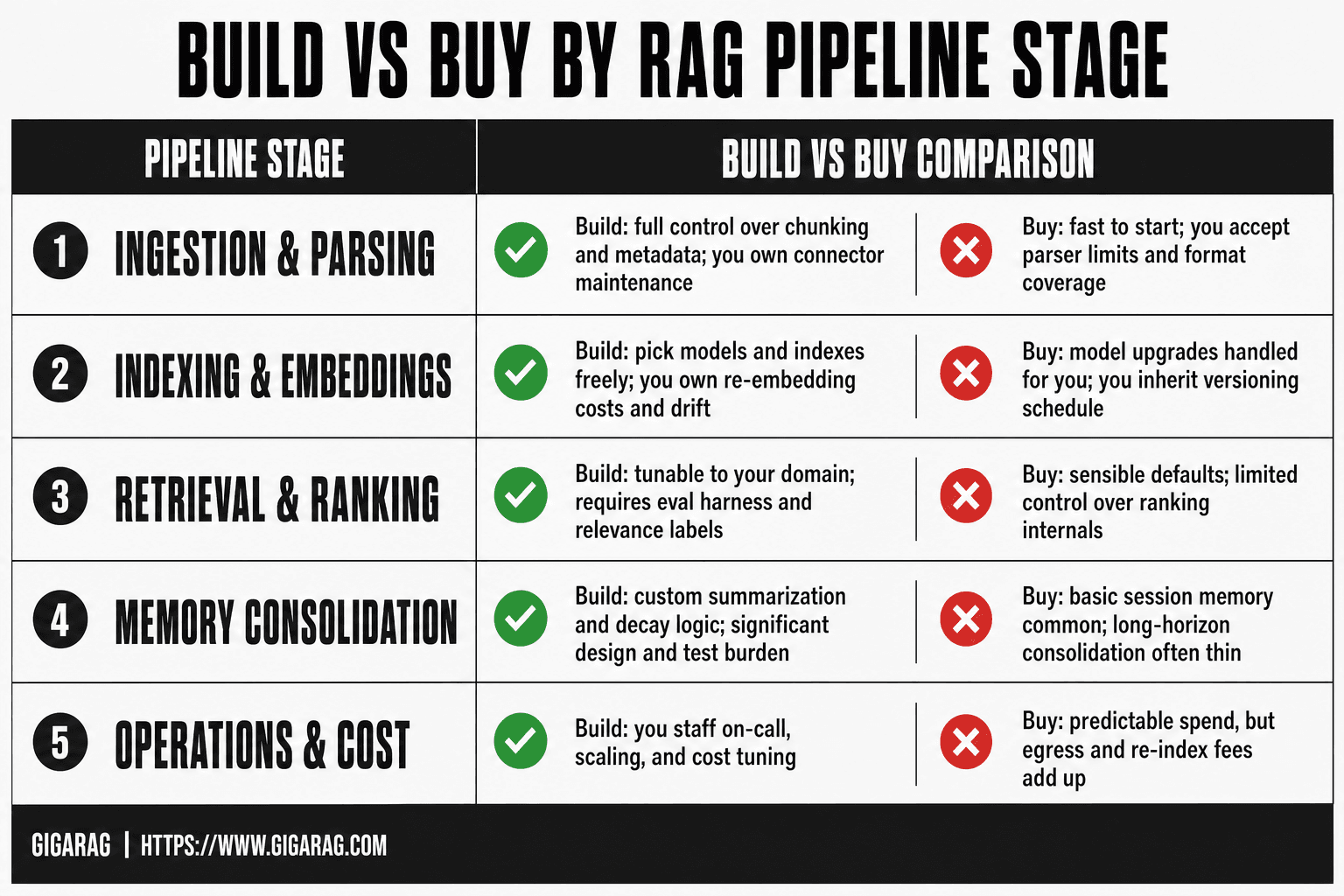
Build vs Buy by RAG Pipeline Stage
| Stage | Build In-House | Buy Managed |
|---|---|---|
| Ingestion & parsing | Full control over chunking and metadata; you own connector maintenance | Fast to start; you accept their parser limits and format coverage |
| Indexing & embeddings | Pick models and indexes freely; you own re-embedding costs and drift | Model upgrades handled for you; you inherit their versioning schedule |
| Retrieval & ranking | Tunable to your domain; requires eval harness and relevance labels | Sensible defaults; limited control over ranking internals |
| Memory consolidation | Custom summarization and decay logic; significant design and test burden | Basic session memory common; long-horizon consolidation often thin |
| Operations & cost | You staff on-call, scaling, and cost tuning | Predictable spend, but egress and re-index fees add up |
The Make-or-Buy Framework Applied to RAG Pipelines
Five questions decide this. They map directly to the components from the last section: ingestion, indexing, retrieval, memory, and evaluation. Answer them in order.
Question 1: Is retrieval quality a core differentiator for your product?
If your product wins because it finds the right chunk when competitors don't, you build. That retrieval logic is your moat. If retrieval is table stakes and your product wins on workflow, UX, or distribution, you buy. Don't spend engineering months on something your customers won't notice.
Question 2: Do you have the evaluation infrastructure to measure retrieval quality?
This is the gate. Without a harness that scores recall and precision against labeled queries, you can't tell if your build is working. You also can't tell if a vendor is lying to you. No eval harness means buy, because the vendor at least ships with one. Building eval from scratch is a quarter of work before you write a line of retrieval code.
Question 3: What is the true total cost of ownership for your RAG stack?
Count engineering time, not just vendor fees. A managed vector DB costs a few hundred dollars a month. A senior engineer costs $15,000 or more. If building retrieval takes three months, that's $45,000 before maintenance. Buying looks expensive until you do this math.
Question 4: What is your time-to-value requirement for agent memory?
If you need agent memory working in weeks, buy. Building memory consolidation, the layer that decides what an agent remembers across sessions, is the hardest part of the stack. It's not a weekend project. It's a research problem with no settled answer.
Question 5: Who will own memory consolidation and pipeline maintenance?
The honest answer: someone has to. Embedding models change. Chunking strategies need rework. Retrieval quality drifts. If you build, that's your team's permanent job. If you buy, the vendor owns it, but you own the vendor relationship and the migration risk when they change pricing or shut down.
[!tip] Before any build vs buy decision, spend one week building a small labeled eval set of real queries and expected passages for your domain; it is the only artifact that lets you compare a managed vendor against an in-house pipeline on your terms rather than on a demo.
Build Vs Buy: A Step-by-Step Guide
- Decompose your stack into four stages: ingestion, indexing, retrieval, and memory consolidation.
- For each stage, write down whether it is a differentiator for your product or undifferentiated plumbing.
- Define retrieval quality metrics and build a small labeled eval set before comparing any option.
- Estimate the true build cost: engineering weeks, ongoing eval maintenance, and on-call ownership.
- Estimate the true buy cost: subscription, egress, re-indexing, and migration effort if you leave.
- Prototype the highest-risk stage both ways for two weeks and compare against your eval set.
- Commit per stage, and document the exit criteria that would trigger a revisit.
Build vs Buy Cost Analysis for RAG Infrastructure
The honest answer is: it depends on what you count. Generic TCO advice misses the RAG-specific costs that actually decide this.
Engineering time vs vendor fees: the real math
A senior engineer costs $15,000 or more per month. Building retrieval, indexing, and memory consolidation takes three to six months before it works in production. That's $45,000 to $90,000 in salary alone, before you count the opportunity cost of not shipping your product.
A managed vector DB plus an embedding API runs a few hundred dollars a month at moderate scale. The gap looks obvious. It isn't, because the vendor fees scale with usage while engineering time is fixed. At high query volume, per-token pricing can exceed what you'd pay to run your own infrastructure.
Hidden costs of building: re-indexing, model migrations, evaluation
Embedding models change. When you swap from one model to another, every vector in your index is now incompatible. You re-embed your entire corpus. That's compute cost plus engineering time, and it happens every time a better model ships.
Then there's the evaluation harness. Without it, you can't measure retrieval quality. Building one takes a quarter. Maintaining it is permanent.
Hidden costs of buying: per-token pricing, lock-in, customization limits
Vendor pricing looks cheap at prototype scale. At production volume, per-token embedding and retrieval costs compound. You're also locked into their chunking strategy, their reranking logic, and their memory model. When your retrieval needs diverge from what the vendor supports, you can't fix it. You can only wait or migrate.
Migration means re-indexing everything anyway. You didn't escape that cost. You just deferred it.
When Building Your Own RAG Pipeline Makes Sense
Building is the right call when your retrieval problem is genuinely yours. Not when you want to own infrastructure for its own sake, but when off-the-shelf tooling can't express the thing you need to do.
You need custom retrieval algorithms or reranking logic
Standard vector search gets you cosine similarity over embeddings. That's it. If your product needs hybrid search with custom weighting, graph-based retrieval, or a reranker trained on your domain's relevance judgments, no vendor exposes that level of control. You'd be fighting their API to approximate what you could write directly in a few hundred lines.
The signal here is specificity. If your retrieval logic has a name inside your company, a paper you're implementing, or a metric only you track, build it.
Your data format or domain requires bespoke chunking
Chunking is where retrieval quality is won or lost, and it's deeply domain-specific. Legal documents need clause-aware splitting. Code needs AST-aware boundaries. Medical records need section and entity awareness. A vendor's fixed chunking strategy will silently degrade your retrieval, and you won't know until you evaluate.
When your data doesn't fit the vendor's assumptions, you're not saving engineering time by buying. You're spending it working around their constraints.
You have dedicated ML infrastructure and evaluation tooling
This is the threshold that actually decides it. If you already run an evaluation harness, have someone who owns embedding pipelines, and can measure recall and latency before shipping, the marginal cost of building retrieval is low. You've already paid for the expensive part.
Without that infrastructure, building means building the evaluation harness first. That's a quarter you don't get back.
When Buying Agent Memory and RAG Tooling Makes Sense
Buying is the right call when retrieval is a cost center, not a differentiator. If your product's value comes from the application layer, not the search layer, owning the pipeline is a tax you don't need to pay.
You need agent memory working in weeks, not quarters
A managed solution gets you ingestion, indexing, and retrieval in days. Building the same thing means writing the evaluation harness, tuning chunking, and debugging embedding drift before you ship anything. If your roadmap has a demo or a customer deadline attached, buy.
You don't have dedicated infrastructure for evaluation and maintenance
This is the honest threshold. Without someone who owns embedding pipelines and can measure recall before shipping, building means hiring first. Buying shifts that burden to a vendor who already runs the harness.
Your retrieval needs are standard enough for off-the-shelf solutions
Semantic search over documents with reasonable chunking covers most use cases. If that's you, don't build what a vendor already runs at scale. The main catch is lock-in, but that's cheaper than a quarter of engineering time spent on infrastructure you didn't need to own.
The Buy & Build Hybrid Strategy for RAG
The honest answer is that most teams shouldn't choose one path. They should split the stack. Buy the commodity layers where vendors have already solved the hard problems. Build the differentiated layers where your product actually competes.
This is the buy & build strategy, and it's the most practical path for RAG infrastructure. The top results don't cover it, but it's how most senior teams actually operate.
What to buy: vector storage, embedding infrastructure, monitoring
Vector databases are solved. Pinecone, Weaviate, Qdrant, pgvector — they all handle indexing, similarity search, and scaling better than anything you'd write in-house. Don't build a vector store. Same goes for embedding pipelines: OpenAI, Cohere, and Voyage all sell embeddings that work out of the box.
Monitoring is the third buy. Latency tracking, cost dashboards, and alerting on retrieval failures are commodity. A vendor tool gets you this in a day. Building it is a week you don't get back.
What to build: custom retrieval logic, memory consolidation, evaluation
Retrieval logic is where you differentiate. Hybrid search weighting, reranking, query rewriting — these are product decisions, not infrastructure. Build them.
Memory consolidation is the same. How your agent decides what to remember, what to forget, and when to summarize is core to your product. No vendor knows your users' context well enough to own that.
Evaluation is the third build. Your retrieval quality metrics are specific to your data and your users. A vendor can give you generic recall numbers. They can't tell you if your agent answers correctly for your customers. That harness is yours.
What You Cannot Do With Either Approach
No path removes the work. Building doesn't remove maintenance. Buying doesn't remove evaluation. You'll still need to test retrieval quality, monitor latency, and fix broken chunks. The choice is who does the work, not whether it gets done.
What building cannot give you: speed, maintenance relief, vendor support
Building gives you control. It doesn't give you time back. A custom retrieval pipeline takes months to get right, and then it needs someone to own it forever. Embedding model migrations, re-indexing, chunking bugs — that's all yours. When something breaks at 2 a.m., there's no support ticket. There's you.
What buying cannot give you: unlimited customization, zero lock-in, perfect retrieval
A vendor solves the commodity problems. It won't solve your retrieval quality. Off-the-shelf chunking works for standard text. It fails on your weird data formats, your domain-specific jargon, your edge cases. And lock-in is real: the more you build on a vendor's API, the harder it is to leave.
The honest answer is that both paths leave you holding something. Building leaves you holding the maintenance. Buying leaves you holding the evaluation. Pick which burden you'd rather carry.
How to Choose: A Build vs Buy Decision Checklist for RAG
You've read the trade-offs. Now score your situation. Three checks, done in an afternoon, will tell you more than another week of vendor calls.
Scoring your retrieval quality requirements
Write down your top three retrieval failure cases. If they're standard (missed synonyms, generic chunking), a vendor handles them. If they're domain-specific (legal citations, medical codes, your internal jargon), you'll need custom logic. Score each case: standard gets 0, custom gets 1. Two or more custom cases points to build.
Assessing your team's evaluation and maintenance capacity
Count who owns retrieval quality today. If the answer is nobody, buying won't fix that. You still need someone to run evals and monitor drift. One engineer with ML experience can maintain a bought stack. Building needs two or three, plus time for re-indexing and model migrations.
Calculating your true budget including hidden costs
Vendor fees are visible. Re-indexing after an embedding model change isn't. Neither is the eval harness you'll build either way. Estimate engineering hours for maintenance: bought stacks run 5-10 hours a week. Built stacks run 20-40. Multiply by your loaded cost per hour, then compare against vendor pricing.
Build vs buy is a decision you'll revisit as your data grows, your models change, and your team's capacity shifts. The framework above won't make the choice for you. It will make the choice honest.
Frequently Asked Questions
Is it cheaper to build rather than buy?
It depends on whether the stage is a differentiator. Building can be cheaper at scale for stable, well-understood components, but the ongoing cost of evaluation, tuning, and on-call is routinely underestimated. Buying is usually cheaper until your usage or customization needs outgrow the vendor's defaults.
What is the buy and build strategy?
Buy and build means purchasing commodity layers — such as managed vector storage or embedding APIs — while building the layers that differentiate your product, typically retrieval logic and memory consolidation. The point is to avoid treating the stack as a single all-or-nothing decision.
What is the make-or-buy framework?
A make-or-buy framework scores each component on strategic importance, internal capability, total cost of ownership, and switching risk. In RAG, apply it per pipeline stage rather than to the whole system, because ingestion, retrieval, and memory have very different economics.
What are build vs buy decisions?
Build vs buy decisions determine whether you develop a capability in-house or pay a vendor for it. For agent memory and RAG, the decision hinges on retrieval quality control, data gravity, latency, and how much operational burden your team can absorb.
Can you mix building and buying in a RAG pipeline?
Yes, and most mature teams do. A common split is buying managed embedding and vector storage while building custom retrieval ranking and memory consolidation. The risk is integration complexity, so define clear interfaces between bought and built stages.
What can neither building nor buying deliver for agent memory?
Neither path automatically produces reliable long-horizon memory or high retrieval precision. Both require you to define what should be remembered, how it is consolidated, and how you measure whether retrieval actually helped — work that stays with your team regardless of vendor.
About GigaRAG
GigaRAG is for agent memory and RAG pipeline builders. get this right. Whether you are working through build vs buy or something adjacent, we publish what we have actually tested, including where it falls short.


