Due to unexpected capacity constraints Claude errors hit RAG pipeline builders at the worst possible moment: mid-request, mid-retrieval, with a production agent waiting on a response that never comes. You've built the retrieval logic, tuned the embeddings, wired the memory store, and then Anthropic's infrastructure says no. Not a rate limit you can respect with a sleep timer. Not an auth failure you can fix with a key rotation. Just capacity. The existing search results offer browser-cache advice and "try again later" platitudes, which doesn't help anyone whose pipeline runs without a human at the keyboard. GigaRAG approaches this differently as a resilient agent memory layer, but before we get there, this guide covers why the error happens, immediate fixes you can ship today, architectural workarounds for RAG pipelines, honest limitations no generic guide will admit, and an FAQ for the questions developers actually ask. You'll leave with strategies that work in production, not tips that work in a support ticket.
| At a glance | Details |
|---|---|
| Error meaning | Claude API is temporarily overloaded |
| Typical trigger | Peak usage or infrastructure scaling |
| Immediate action | Retry with exponential backoff |
| Architectural fix | Add fallback models and caching |
| What you can't do | Guarantee zero capacity errors |
| Data loss risk | Yes, in long conversations |
In This Guide
- Why Does Claude Say It's at Capacity?
- Claude API vs. Self-Hosted Model for RAG Pipelines
- Immediate Fixes for Due to Unexpected Capacity Constraints Claude
- Due To Unexpected Capacity Constraints Claude: A Step-by-Step Guide
- Architectural Workarounds for RAG Pipeline Builders
- Agent Memory Strategies When Claude Is Unavailable
- What You Cannot Do or Should Not Expect
- Long-Term Strategies for Reducing Claude Dependency
- Common Mistakes When Handling Due to Unexpected Capacity Constraints Claude
- FAQ: Due to Unexpected Capacity Constraints Claude
Why Does Claude Say It's at Capacity?
Claude says it's at capacity because Anthropic's servers are handling more requests than they can process at that moment. The error isn't about your account, your code, or your prompt. It's a server-side constraint: demand has outpaced available compute, and Anthropic is turning away requests until load drops.
What the error actually means
When you encounter a "due to unexpected capacity constraints" message, Claude may be temporarily unable to process your request because of an infrastructure capacity issue. For the Claude API, Anthropic documents HTTP 529 as an overloaded_error, meaning the API is temporarily overloaded. Check the HTTP status code and error details to identify the specific failure. Every request to Claude consumes GPU or TPU resources. Those resources are finite. When too many requests arrive at once, the system has two choices: queue them or reject them. Anthropic rejects them.
The word "unexpected" matters. Anthropic provisions capacity based on forecasted demand. When actual demand spikes above forecast, the surplus requests get bounced. This isn't a bug in your integration. It's capacity planning meeting reality.
Capacity constraints vs. rate limits vs. account bans
These are three different things, and confusing them leads to wrong fixes.
For the Claude API, rate limits are generally applied at the organization level and measured using metrics such as requests per minute and input and output tokens per minute. Exceeding an applicable rate limit typically returns HTTP 429. Check the error details and Retry-After header, when provided, before deciding whether to reduce request rates or request higher limits.
A capacity constraint is generally a provider-side availability issue rather than a standard rate-limit violation. However, the scope can vary: an incident may affect a particular service, model, or subset of requests rather than every user. Check Anthropic's status page and inspect the response details before concluding that the problem is global. Retrying with backoff or routing eligible requests to another model or provider may help.
An account or permission problem is different from a capacity error. Authentication failures can return HTTP 401, permission failures can return HTTP 403, and billing problems can return HTTP 402. Check the response code and error details rather than assuming that a failed request means your account has been banned.
A capacity error is generally a temporary provider-side issue, but its scope and cause can vary. Check the error details and current service status before deciding whether it is a wider incident or a request-specific problem.
Why demand spikes cause intermittent failures
Demand for Claude can fluctuate, and temporary capacity constraints may occur when available processing capacity cannot accommodate incoming requests. However, without provider-specific operational data, it is not possible to attribute a particular incident to North American business hours, product launches, viral posts, or a specific capacity-planning strategy. The practical takeaway is to design your application to tolerate temporary service unavailability rather than assume that every request will succeed.
Temporary capacity constraints can cause intermittent failures. A request may succeed on a later attempt if the underlying issue has cleared, but the exact cause and recovery time depend on the incident. Build your application to handle temporary failures without assuming that every error is caused by a demand spike.
This is why retry logic matters. The capacity constraint is a temporary condition, not a permanent state.
[!note] A capacity-related error may indicate a temporary issue on Anthropic's side. Check the HTTP status code and error details to distinguish overload from rate limits, authentication failures, billing issues, or other errors. Retrying with appropriate backoff may help with transient failures, but repeated errors do not by themselves prove that a broader outage is occurring.
Claude API vs. Self-Hosted Model for RAG Pipelines
| Factor | Claude API | Self-Hosted Model |
|---|---|---|
| Capacity reliability | Subject to unexpected constraints | Depends on your infrastructure |
| Setup effort | Low (API key) | High (deployment, scaling) |
| Cost model | Pay-per-token | Fixed infrastructure cost |
| Model quality | State-of-the-art | Varies by model size |
| Maintenance | Managed by Anthropic | You handle updates and uptime |
Immediate Fixes for Due to Unexpected Capacity Constraints Claude
The error is temporary, but your pipeline is down right now. Here's what to do in the first five minutes.
Check Anthropic's status page first
Before touching your code, open status.anthropic.com. If Anthropic has posted an incident, you're not going to fix this with a retry loop. The status page tells you whether the problem is global, which endpoints are affected, and whether there's an estimated resolution time.
If the status page shows all systems operational, that does not necessarily mean the problem is localized or that a specific endpoint or region is overloaded. Check the error code, request details, model availability, and your application's configuration. If the issue persists, review Anthropic's documentation or contact support. If your architecture supports another model or provider, test whether routing eligible requests there restores service.
Retry with exponential backoff
Don't hammer the API. A tight retry loop makes the problem worse for everyone, including you. Anthropic's servers are already overloaded. Your retries add to the load and extend the outage.
Use exponential backoff with jitter: begin with a short delay, increase the delay after each failed attempt, and set a maximum delay and retry count. Respect any applicable Retry-After header, where provided, and distinguish temporary overload errors from authentication, validation, and billing errors that require a different fix. After the retry budget is exhausted, surface the failure or route the request to a configured fallback. Most HTTP libraries have this built in. If you're using Python, tenacity or backoff handle it in a few lines.
The honest answer: backoff doesn't guarantee success. It gives the spike time to clear and keeps you from being part of the problem.
Switch between API endpoints or models
Claude offers multiple models, and switching to another supported model may help if the original model is temporarily unavailable. However, do not assume that different models use independent capacity pools or that switching models will resolve an overload error. Select a currently supported model and test it against your application's quality, latency, and cost requirements.
For regional routing, the available options depend on how you access Claude. The standard Anthropic API, Amazon Bedrock, and Google Cloud Vertex AI have different endpoint and regional-routing arrangements. Verify the routing options supported by your chosen platform rather than assuming that a different region is available through every Anthropic API plan.
Reduce request size temporarily
Long prompts consume more compute. If you're sending a 100k-token context window, you're asking for a lot of resources at exactly the moment resources are scarce. Truncate the context, summarize the history, or split the request into smaller chunks. A smaller request has a better chance of squeezing through.
This is a stopgap, not a strategy. You're trading quality for availability. But when the alternative is a failed request, it's usually worth it.
[!tip] For RAG builders: pre-warm your cache with common embeddings and responses before peak hours, and use a circuit breaker pattern to fail fast to a fallback model when Claude returns capacity errors, preventing cascading failures in your pipeline.
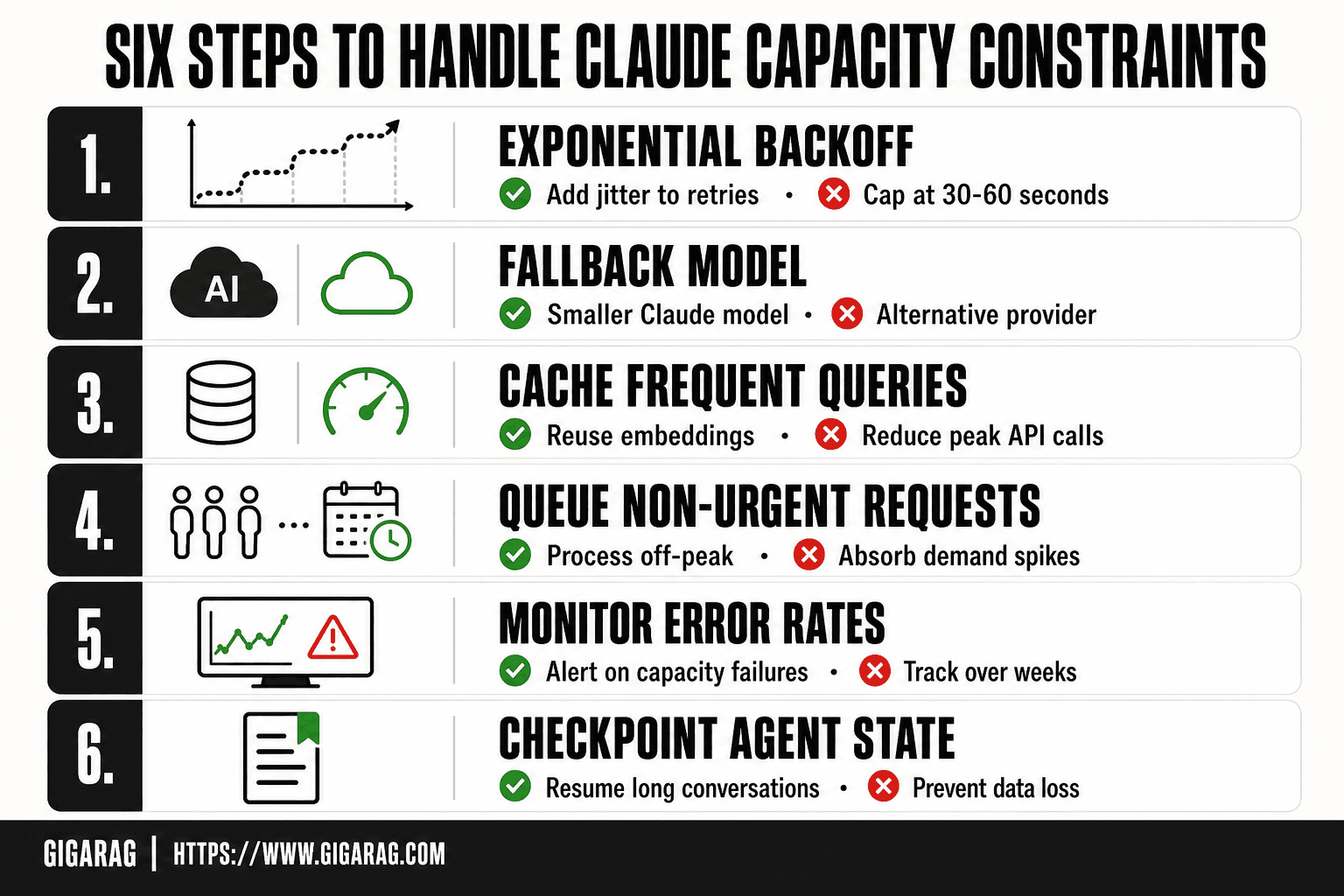
Due To Unexpected Capacity Constraints Claude: A Step-by-Step Guide
- Implement exponential backoff with jitter for all Claude API calls.
- Add a fallback model (e.g., a smaller Claude model or an alternative provider) for critical paths.
- Cache reusable responses where appropriate and reuse embeddings for unchanged content to reduce redundant processing and requests to the relevant providers.
- Queue non-urgent requests and process them during off-peak hours.
- Monitor error rates and set up alerts for capacity-related failures.
- Persist important conversation history and checkpoint agent state so tasks can recover from failed requests with minimal loss of completed work.
Architectural Workarounds for RAG Pipeline Builders
Immediate fixes keep you alive for five minutes. Architecture keeps you alive for the next capacity spike. The error will happen again. Build for it now.
Cache embeddings to avoid redundant embedding requests
Every time your pipeline regenerates embeddings for unchanged documents, it performs redundant work and incurs unnecessary computation and cost. Cache embeddings by document or chunk content hash so that unchanged content can reuse existing vectors. If your embedding provider is independent of Claude, this optimization reduces calls to that provider, but it does not directly reduce Claude API usage.
Store embeddings in your vector database keyed by a content hash. When a document hasn't changed, skip the embedding call entirely and reuse what you already have. The reduction in embedding requests depends on how much source content remains unchanged between ingestion runs. Measure cache-hit rates and embedding requests before and after implementing content-hash caching to quantify the actual savings in your pipeline.
The catch: cache invalidation is on you. If a document changes but your hash doesn't detect it, you'll serve stale embeddings. Use a strong hash and re-embed on any content change, not just metadata changes.
Implement a request queue with retry logic
Don't fire requests at Claude as fast as your pipeline produces them. Put them in a queue. A queue absorbs demand spikes on your side and lets you control the rate at which requests hit Anthropic's infrastructure.
Use a job queue like Celery, BullMQ, or AWS SQS. Set a concurrency limit that matches your Anthropic rate limit tier. When a request fails with a capacity error, push it back onto the queue with a delay. The queue becomes your buffer: requests wait in line instead of dying.
This works because capacity constraints are usually transient. A request that fails now might succeed in 30 seconds. The queue gives you that 30 seconds without losing the request.
Set up fallback models (local LLMs or alternative APIs)
Claude is down. What does your pipeline do? If the answer is "nothing," you've built a single point of failure.
Route failed Claude requests to a fallback. A local language model such as Llama or Mistral may handle tasks like summarization, extraction, and basic classification, depending on the model and available hardware. For embeddings, use a dedicated embedding model such as all-MiniLM-L6-v2 or a supported BGE model. Local inference avoids per-request API charges to an external provider, but it still incurs hardware, electricity, hosting, and maintenance costs. Benchmark quality and latency before using a local model as a production fallback.
The tradeoff is quality. A local model won't match Claude on complex reasoning. But for many RAG tasks, "good enough" keeps your pipeline running. Route only the hard cases back to Claude when capacity returns.
Use circuit breakers to prevent cascading failures
When Claude is down, failing fast is better than failing slow. A circuit breaker stops your pipeline from sending requests to a service that's already failing. After N consecutive failures, the breaker opens and requests fail immediately without hitting the API.
This prevents a capacity outage from becoming a full pipeline outage. Your ingestion keeps running, your queue keeps filling, and your fallback models handle what they can. When the breaker detects Claude is healthy again, it closes and traffic resumes.
Set the breaker to half-open after a cooldown period: send one test request, and if it succeeds, close the breaker. If it fails, keep it open and wait longer. This is standard resilience engineering, and it applies directly to LLM APIs.
Agent Memory Strategies When Claude Is Unavailable
Your RAG pipeline can queue and retry requests, but long-running agent tasks also need reliable state management. If a request fails, the application may need to restore the task's conversation history, completed steps, and tool results before continuing. Without persisted state, the agent may have to repeat work or may be unable to resume accurately.
Persist agent state outside Claude's context window
Claude's context window is not a persistent database. If important facts, decisions, or intermediate results exist only in the conversation context and your application does not retain them, a failed request or lost session can make recovery difficult. Store critical agent state outside the model's context window and reload the relevant information when retrying or resuming a task.
Store agent state in a persistent store: Postgres, SQLite, Redis, or a vector database. Write after every meaningful step, not just at the end. When Claude returns, the agent reloads its state and continues from where it stopped. The context window becomes a working buffer, not the source of truth.
The tradeoff is write overhead. Persisting after every step adds latency. Persist after every step that changes the agent's understanding of the task, and skip writes for pure lookups.
Checkpoint long-running agent tasks
A long-running agent task is a sequence of steps. If step 14 of 20 fails because Claude hit capacity, you don't want to restart from step 1.
Checkpointing means saving the agent's full state at defined intervals: every N steps, every M minutes, or before any expensive operation. When a failure occurs, the agent restores from the last checkpoint and resumes. You lose at most the work since that checkpoint.
This is not a Claude-specific pattern. It's how any long-running job survives infrastructure failure. The difference with agents is that the state includes conversation history, intermediate reasoning, and tool call results, not just a cursor position.
Make checkpoints idempotent. If the agent crashes after completing a step but before writing the checkpoint, the next run should detect the duplicate and skip it.
Design graceful degradation for memory retrieval
When Claude is unavailable, memory retrieval doesn't have to stop. It has to degrade.
Split memory retrieval into two paths. The fast path uses embeddings and vector search, which don't require Claude at all. The slow path uses Claude to re-rank, summarize, or synthesize retrieved memories. When Claude is down, the agent runs the fast path only. Results are less polished, but the agent keeps working.
Degraded retrieval can reduce answer quality if the system loses access to model-based reranking or synthesis. A local reranking model can help prioritize retrieved passages, while a separate language model can synthesize the results. Evaluate these components independently, because reranking and answer generation perform different tasks. The goal of degraded mode is to preserve useful functionality while making its limitations clear.
What you cannot do is preserve full reasoning quality without Claude. No local fallback replicates it. Design your agent so that degraded mode is acceptable for the task, or accept that the task waits until capacity returns.
What You Cannot Do or Should Not Expect
Every mitigation strategy in this guide reduces the blast radius of a Claude capacity outage. None of them eliminate it. If you're building a production RAG pipeline, you need to know where the floor is before you promise uptime to anyone else.
No guaranteed fix exists
Do not assume that a standard API tier guarantees uninterrupted service. Temporary overloads and other service errors can still occur, so retry logic, request queues, monitoring, and fallback models help reduce the impact on your application. Review the terms and service commitments applicable to your particular Anthropic agreement before making claims about capacity guarantees or service-level agreements.
Higher usage tiers or custom enterprise agreements may provide different rate limits or service commitments, depending on the agreement. However, do not assume that paying for a higher tier guarantees priority during an overload event or eliminates service interruptions. Check the applicable contract and service-level terms before relying on a specific availability commitment.
What you can do is measure your actual failure rate over weeks, not hours. That number tells you what your users will experience. Build for that number, not for zero.
Long conversations may lose context
Claude's context window is finite, and API applications must manage conversation history carefully. A failed request does not automatically erase the context stored by your application, but the model cannot continue from information that your application no longer retains or resends. If older messages were discarded to stay within the token limit, those messages cannot be reconstructed from the discarded context alone. Persist the conversation history, task state, and important intermediate results outside the model's context window so that failed requests can be retried and tasks can resume safely.
This is not a bug you can patch around. It's a property of stateless API calls. Your agent memory system must treat every Claude call as potentially the last one for that conversation thread.
Persist what matters before you send it. If a fact only exists in the context window and the request fails, that fact is gone.
Capacity issues cannot be fully engineered away
You can cache embeddings. You can queue requests. You can route to fallback models. You can checkpoint agent state. What you cannot do is make Claude's capacity constraints irrelevant to your system.
The underlying provider-side capacity is outside your application's control. However, response codes, error details, request IDs, response headers, and reported service incidents can help you investigate failures. Your ability to reserve capacity or use specific routing options depends on the service and agreement you use.
The best you can do is shrink the surface area where Claude's availability is a hard dependency. Every call you cache, every fallback you route, every piece of state you persist outside the context window reduces what breaks when capacity runs out. It never reaches zero.
Plan for degraded mode as a normal operating state, not an emergency. The pipelines that survive capacity outages are the ones that assumed they would happen.
Long-Term Strategies for Reducing Claude Dependency
The fixes in the previous sections keep your pipeline running when Claude stumbles. The strategies here shrink how much you need Claude in the first place. That's the difference between surviving an outage and barely noticing one.
Adopt a multi-provider LLM routing layer
A routing layer sits between your application and any single model provider. You send one request format, and the router decides which provider handles it based on availability, cost, and latency.
In practice, this means your RAG pipeline calls a routing endpoint instead of Claude's API directly. When Claude returns a capacity error, the router retries on a different provider without your application code changing. You configure routing rules once, then let the layer handle failover.
The main catch is that models differ. A prompt tuned for Claude may produce worse output on another provider. You'll need to test your prompts across every model in the rotation, not just the primary one.
Deploy local models for non-critical tasks
Not every LLM call in your pipeline needs frontier-model quality. Embedding generation, text classification, summarization of short passages, and entity extraction can often run on a local model without meaningful quality loss.
A locally hosted model may handle these tasks without depending on Anthropic's API availability. Its total cost depends on hardware, utilization, energy consumption, hosting, and maintenance. Keep Claude for tasks where its measured output quality justifies the cost and operational trade-offs, and evaluate local alternatives against the same requirements.
The tradeoff is setup time. You're now maintaining model weights, a serving layer, and GPU infrastructure. For a solo developer, that's real overhead. For a team already running containers, it's a weekend project.
Build a hybrid architecture with Claude as one component
The end state is a pipeline where Claude is a replaceable part, not the foundation. Your vector database stores embeddings generated locally. Your agent memory persists outside any model's context window. Your router sends requests to whichever provider is healthy.
Claude handles the tasks where it's genuinely better: complex reasoning, long-form generation, nuanced instruction following. Everything else runs on cheaper, more available infrastructure.
This is not a quick fix. It's an architectural direction you move toward over months. But each step reduces the number of places where a Claude capacity error can take down your system. The pipelines that treat Claude as one component among several are the ones that stop seeing this error as a crisis.
Common Mistakes When Handling Due to Unexpected Capacity Constraints Claude
Most capacity errors are survivable. The damage usually comes from what developers do next.
Aggressive retries that amplify the problem
A tight retry loop can generate unnecessary requests during an outage. Repeated retries may increase load on your application and consume additional request capacity. Use exponential backoff with jitter and a maximum retry count to limit repeated attempts.
Use exponential backoff with jitter. Start at one second, double each attempt, cap at a few minutes. If the error persists past five attempts, stop and check the status page.
Ignoring Anthropic's status page
Anthropic's status page provides information about reported service incidents and availability. When a capacity-related error appears, check the status page before making changes to your integration. A reported incident may explain the failure, but an operational status does not rule out every transient or request-specific problem. Retry tuning, reduced concurrency, and fallback routing may still help mitigate the impact, even when the underlying provider issue cannot be fixed by your application.
The worst time to configure a fallback is during an outage. You'll rush it, test it poorly, and ship something that breaks differently. Set up a fallback model before you need it. Even a smaller, cheaper model that handles 80% of requests is better than a hard failure.
No fallback model in place
The worst time to configure a fallback is during an outage. You'll rush it, test it poorly, and ship something that breaks differently. Set up a fallback model before you need it. Even a smaller, cheaper model that handles 80% of requests is better than a hard failure.
Storing critical state only in Claude's context
Claude's context window is not a database. If your agent's memory, task state, or conversation history is not retained by your application, recovery after a failed request may be difficult. Persist important state after meaningful steps, then reload it when retrying or resuming the task. This reduces the amount of work that may need to be repeated.
The most resilient applications are designed to handle temporary provider failures before they occur. Retry policies, persistent state, monitoring, and tested fallback paths help teams recover without unnecessarily repeating completed work.
FAQ: Due to Unexpected Capacity Constraints Claude
Why is Claude saying it's at capacity?
For the Claude API, an HTTP 529 overloaded_error means the API is temporarily overloaded. Check the error code and details to confirm the cause. A capacity error does not, by itself, mean that your account is banned or your API key is broken. If you receive HTTP 429, check whether you have exceeded a documented rate limit.
Why does Claude have usage limits and not ChatGPT?
Both Claude and ChatGPT have usage limits, but their error messages, availability behavior, and retry mechanisms can differ by product, model, and access method. Do not assume that one service silently queues requests while the other rejects them, or attribute the difference to infrastructure scale without supporting evidence. For API integrations, consult each provider's official error documentation and retry guidance. For the consumer applications, check the relevant product's usage-limit and availability information.
How to overcome Claude code limit?
The code limit is a separate issue from capacity constraints. It refers to the maximum tokens Claude can process in one request. To work around it: split large codebases into smaller chunks, summarize before sending, or use a RAG pipeline that retrieves only relevant code sections. Capacity errors need retries and fallbacks. Code limits need chunking.
How to fix model overloaded Claude?
Wait, then retry with backoff. Check Anthropic's status page first. If the outage is on their side, no code change fixes it. If it's intermittent, implement exponential backoff with jitter, starting at one second and doubling each attempt. Switch to a fallback model for non-critical requests while Claude recovers.
Is Claude down right now?
Check Anthropic's official status page for reported incidents. If the relevant service shows degraded performance, the incident may explain the error. If all systems are operational, a transient or request-specific issue may still be occurring. Check the response code and error details before deciding whether to retry, investigate your integration, or contact support.
What does "Claude is at capacity right now try again in a moment" mean?
This message generally indicates a temporary capacity or availability problem. For API requests, inspect the HTTP status code and error details to confirm the failure type. Waiting and retrying with appropriate backoff may help, but success is not guaranteed. If the error persists, check Anthropic's status page and consider a tested fallback where appropriate.
Can I get guaranteed capacity from Anthropic?
Do not assume that the standard API provides guaranteed capacity or uninterrupted availability. Anthropic's available usage tiers and custom enterprise arrangements may offer different limits or contractual terms; check the current agreement for details. A fallback model, an alternative provider, or a local deployment can reduce dependence on a single service, but none automatically guarantees uninterrupted operation. Design the system around the availability requirements of your workload and test its failure-handling behavior.
How do RAG pipelines handle Claude capacity constraints?
RAG pipelines need explicit failure handling if they depend on Claude for generation or synthesis. A resilient implementation can queue eligible requests, retry transient failures, persist task state, and route supported tasks to a tested fallback model or provider. Embedding caching reduces redundant embedding work but does not, by itself, resolve Claude generation failures. GigaRAG's relevance to this use case should be described in terms of the agent-memory and retrieval capabilities it actually provides.
Frequently Asked Questions
Why is Claude saying it's at capacity?
Claude's infrastructure experiences high demand during peak usage periods, leading to temporary capacity constraints. This is a server-side limitation, not an issue with your account or request.
Why does Claude have usage limits and not ChatGPT?
Both Claude and ChatGPT have usage limits, but they manifest differently. Claude's limits are often due to capacity constraints during high demand, while ChatGPT may use different throttling mechanisms. The error you see is specific to Claude's current infrastructure scaling.
How to overcome Claude code limit?
To work around Claude's capacity limits, implement retry logic with exponential backoff, use fallback models, and cache responses. For code generation, consider batching requests or using a local code model for non-critical tasks.
How to fix model overloaded Claude?
Model overload errors can be mitigated by reducing concurrent requests, adding jitter to retries, and using a queue system. If overload persists, switch to a smaller model or an alternative provider until capacity improves.
What does 'Claude is at capacity right now try again in a moment' mean?
This message indicates that Anthropic's servers are currently handling more requests than they can process. It's a transient error; waiting and retrying usually resolves it. For production systems, implement automatic retries with backoff.
Is Claude down?
Not necessarily down, but experiencing capacity constraints. Check Anthropic's status page for official updates. If the status is operational, the error is likely due to temporary overload.
About GigaRAG
GigaRAG is for agent memory and RAG pipeline builders. get this right. Whether you are working through due to unexpected capacity constraints claude or something adjacent, we publish what we have actually tested, including where it falls short.