If you build agent memory and RAG pipelines, you already know the standard portfolio advice doesn't fit. Most FDE guidance tells you to list projects and add screenshots. That's fine for a frontend demo. It says nothing about whether you can ship a retrieval system that holds up under real query load, or debug an embedding pipeline when a customer's data drifts. Hiring managers for forward deployed roles aren't checking for GitHub stars. They're checking for evidence you shipped under constraints, measured the outcome, and can explain what broke. Tools like GigaRAG help builders get systems into production faster, which is what gives you something worth writing about. This guide covers a repeatable case study structure for agent memory and RAG work, what to include and exclude, and the honest limits of what an FDE case study portfolio can guarantee.
| At a glance | Details |
|---|---|
| Primary audience | Engineers building agent memory & RAG pipelines |
| Goal | Demonstrate FDE readiness via case studies |
| Key structure | Problem → Constraints → Solution → Results → Limitations |
| What it proves | Shipping under real constraints, not just demos |
| What it can't do | Guarantee interviews or replace production experience |
| Example focus | Evaluating retrieval quality or scaling vector DBs |
In This Guide
- Why an FDE Case Study Portfolio Matters More Than a Resume
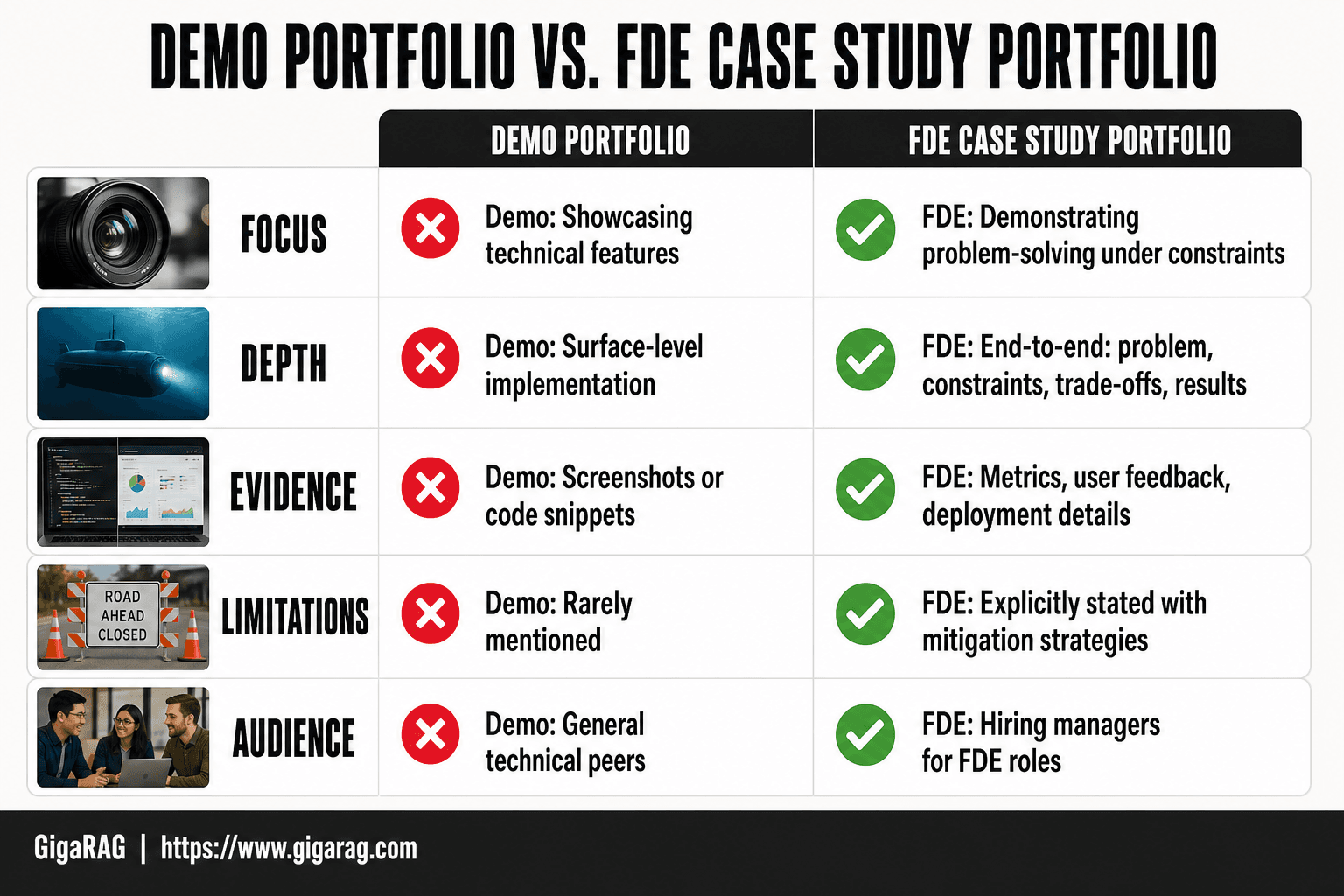
- Demo Portfolio vs. FDE Case Study Portfolio
- The Shape of a Strong FDE Case Study Portfolio Project
- FDE Case Study Portfolio: A Step-by-Step Guide
- The Case Study Technique: A Step-by-Step Writing Structure
- Case Study Examples for Agent Memory and RAG Pipeline Builders
- Project Ideas That Signal FDE Readiness
- What to Avoid in Your FDE Case Study Portfolio
- How to Present Your FDE Case Study Portfolio
- What an FDE Case Study Portfolio Cannot Do
- How Many Projects Do You Actually Need?
- Final Thoughts on Building Your FDE Case Study Portfolio
Why an FDE Case Study Portfolio Matters More Than a Resume
A resume says you know vector databases. A case study shows you shipped one under a latency budget with a customer waiting on the other end. For forward deployed engineer roles, that second signal is the one that gets you past the screen.
Here's why. FDE work is defined by constraints: tight timelines, messy customer data, unclear requirements, and production incidents that don't wait for a sprint. A resume can list "built RAG pipelines" and tell the reader nothing about whether you can handle any of that. A case study forces you to show the constraint, the decision you made under it, and what happened after.
What FDE interviewers actually look for
Interviewers aren't checking whether you can recite the transformer architecture. They're checking for evidence of three things: you shipped something real, you made tradeoffs under pressure, and you can explain why you made them.
The honest answer is that most candidates fail on the third one. They can build. They can't articulate the reasoning behind a chunking strategy or a retrieval threshold. A case study is practice for exactly that conversation, written down before the interview happens.
Why deployed projects beat demos
A demo proves the happy path works. A deployed project proves the unhappy paths got handled: the query that returned nothing, the embedding that drifted, the customer who asked for a feature you didn't plan.
That's the difference an interviewer can feel in the first two minutes. Demos show capability. Deployed work shows judgment. And judgment is the thing FDE teams are actually hiring for.
[!note] A portfolio cannot guarantee interviews, replace production experience, or compensate for weak fundamentals in distributed systems and data engineering.
Demo Portfolio vs. FDE Case Study Portfolio
| Factor | Demo Portfolio | FDE Case Study Portfolio |
|---|---|---|
| Focus | Showcasing technical features | Demonstrating problem-solving under constraints |
| Depth | Surface-level implementation | End-to-end: problem, constraints, trade-offs, results |
| Evidence | Screenshots or code snippets | Metrics, user feedback, deployment details |
| Limitations | Rarely mentioned | Explicitly stated with mitigation strategies |
| Audience | General technical peers | Hiring managers for FDE roles |
The Shape of a Strong FDE Case Study Portfolio Project
A portfolio-worthy project has three properties: it's deployed somewhere a real user touches it, it ran into at least one constraint you didn't choose, and it produced an outcome you can point to. Anything less is a demo with extra steps.
Deployed vs. demo: the difference that matters
A demo runs on your laptop with clean data and a scripted query. A deployed project runs on someone else's infrastructure with their messy inputs and their actual deadlines. The difference shows up in what you can write about afterward.
Demos let you describe what you built. Deployed projects let you describe what broke, what you changed, and what the user said when it worked. That second story is the one an interviewer can't get from a GitHub README.
What counts as a "real" constraint
A real constraint is one you didn't invent for the sake of the project. A latency budget from a customer contract. A vector database that had to fit in a fixed memory ceiling. A retrieval quality target set by someone who wasn't you.
Self-imposed constraints are fine for learning. They don't signal FDE readiness, because nobody had to live with the consequences of your tradeoff. The constraint has to come from outside.
One strong project beats five shallow ones
Five projects that each got to "it works on my machine" tell an interviewer you can start things. One project that shipped, broke, got fixed, and got adopted tells them you can finish things.
FDE work is finishing work. Pick the project where you had to make the hardest call and write that one up properly.
[!tip] For agent memory or RAG case studies, include a section on evaluation methodology—how you measured retrieval quality or memory accuracy—because FDEs are often judged on their ability to validate solutions in production.
FDE Case Study Portfolio: A Step-by-Step Guide
- Start with the problem: describe the user pain and why it mattered.
- Outline constraints: list technical, time, and resource limitations.
- Explain your solution: detail the architecture, key decisions, and trade-offs.
- Show results: quantify impact with metrics (e.g., retrieval accuracy, latency).
- Discuss limitations: honestly state what didn't work or what you'd improve.
- Reflect on lessons: what you learned and how it applies to future FDE work.
- Format for skimmability: use headings, bullet points, and visuals.
The Case Study Technique: A Step-by-Step Writing Structure
A strong FDE case study follows a fixed order: context, approach, outcome. Each section answers one question, and anything that doesn't answer that question gets cut.
The structure works because it mirrors how an interviewer thinks. They want to know what problem you faced, what you built in response, and whether it worked. Everything else is noise.
Context: the problem and the constraint
Start with the problem as the user experienced it, not as you experienced it. "Support tickets took 40 minutes to resolve because agents searched three disconnected systems" beats "I built a RAG pipeline."
Then name the constraint. Latency budget, data volume, accuracy target, whatever it was. One or two sentences. The constraint is what makes the story interesting, so don't bury it.
Keep this section under 150 words. If you need more than that to explain the problem, you're either explaining too much background or the problem wasn't sharp enough.
Approach: what you built and why
Describe the system you built in plain terms. Chunking strategy, embedding model, vector database, reranking step, whatever it was. Name the actual tools and versions.
Then explain the key decision. Why did you choose that chunk size? Why that embedding model over the cheaper one? Why a hybrid search instead of pure vector? One decision, explained in two or three sentences, is worth more than a full architecture diagram.
Don't describe every component. Describe the components where you made a call that mattered.
Outcome: metrics, adoption, and lessons
Lead with the number that mattered to the user. Retrieval precision went from 0.62 to 0.81. Average resolution time dropped from 40 minutes to 12. Latency stayed under 200ms at 10x the query volume.
Then state adoption. Who used it, how often, for how long. "Three support agents used it daily for two months" is real. "The team loved it" is not.
End with one lesson. What would you do differently? What broke that you didn't expect? One honest sentence here signals more maturity than three paragraphs of self-congratulation.
What to exclude: code dumps, jargon, and vanity metrics
No code blocks. A case study is not a README. If an interviewer wants to see code, they'll ask for the repo.
No unexplained jargon. "We used HNSW with an M of 16 and efConstruction of 200" means nothing unless you say why those values mattered for your constraint.
No vanity metrics. Stars, forks, page views, "the team was impressed." If the number didn't change a user outcome, leave it out.
The case study is done when someone who wasn't there can explain what you built, why you built it that way, and whether it worked. If they can't, cut more.
Case Study Examples for Agent Memory and RAG Pipeline Builders
The structure above works for any deployed project. Here's what it looks like applied to the systems you actually build.
Evaluating retrieval quality for a production RAG pipeline
Context: a support team's RAG system returned relevant documents for only 6 of 10 queries. The constraint was a 500ms latency budget and 50,000 documents.
Approach: you built an evaluation set of 200 real queries with graded relevance labels, then tested three chunking strategies and two embedding models against it. The key decision: switching from 512-token chunks to 256-token chunks with a reranking step, because precision on multi-hop queries improved without breaking the latency budget.
Outcome: retrieval precision went from 0.62 to 0.81 at 340ms p95. One lesson: your initial eval set was too easy, and the first two weeks of results overstated real performance.
Scaling a vector database under real query load
Context: a pilot with 10 users worked fine. At 200 concurrent users, p95 latency hit 3 seconds.
Approach: you profiled the bottleneck, found it was disk I/O on the HNSW graph, and moved to a larger instance with NVMe storage plus query caching for repeated embeddings. You also added a connection pool after discovering the client library opened a new connection per request.
Outcome: p95 latency dropped to 180ms at 200 concurrent users. Lesson: the bottleneck wasn't the vector search, it was the client library, and you spent a week profiling the wrong layer.
Reducing hallucination in an agent memory system
Context: an agent that summarized past conversations invented details 15% of the time. The constraint: no human review step allowed.
Approach: you added a retrieval step that pulled the exact conversation turns before summarization, then a verification prompt that checked each claim against retrieved text and dropped unsupported ones. The key decision: refusing to answer was better than answering wrong, so the agent returned "I don't have that in memory" instead of guessing.
Outcome: hallucination rate dropped from 15% to 2%, at the cost of a 9% increase in "no answer" responses. Lesson: the tradeoff was worth it for this use case, but you'd flag it differently for a customer-facing sales agent.
Project Ideas That Signal FDE Readiness
The examples above give you a shape. Here are project types that map directly to what FDE interviewers probe for: shipping under constraints, owning a decision, and learning from what broke.
An evaluation framework for a real use case
Don't build a generic eval harness. Build one for a specific system you can name. Pick a RAG pipeline or agent memory setup you already run, then write the eval set, the metrics, and the pass/fail thresholds. The signal isn't the code. It's that you defined what "good" means before you measured it.
A strong version: 150 to 300 labeled queries drawn from actual user logs, not synthetic ones. Include the queries where the system failed. Those are the ones that make the case study honest.
An enterprise integration with real constraints
Most FDE work happens inside someone else's stack. Build a project where you integrate your RAG or memory system with a tool you don't control: a CRM, a ticketing system, a Slack workspace, an internal API with rate limits and weird auth.
The constraint is the point. Document the auth flow you had to work around, the rate limit that forced batching, the schema mismatch that took three days to untangle. Interviewers read these sections closely because they mirror the actual job.
A post-mortem on something that broke in production
This is the highest-signal project type and the one most builders skip. Take a real incident: a memory system that corrupted state, a vector index that returned empty results after a deploy, a RAG pipeline that leaked source documents into responses.
Write what happened, what you missed, what you changed, and what you'd do differently. A post-mortem shows you can own a failure without hiding from it. That's rarer than shipping something that works.
What to Avoid in Your FDE Case Study Portfolio
Most portfolios don't fail because the projects are weak. They fail because the writer overclaims, hides the mess, or can't name a number. Interviewers read case studies looking for reasons to trust you. Give them one and they'll stop reading.
Red flags that get portfolios rejected
Unshipped work. If it never ran in front of a real user, it's a demo. Call it a demo or leave it out. Labeling a side project as production is the fastest way to lose credibility in an interview.
Missing metrics. "Improved retrieval quality" means nothing. "Cut hallucination rate from 12% to 4% on 200 logged queries" means something. No number, no case study.
Vague outcomes. "The client was happy" is not an outcome. Adoption, latency, cost, error rate: pick one and measure it.
Overclaiming. Saying you "built the entire system" when you integrated an existing pipeline will get caught. FDE interviewers probe the edges of your claims. If you can't defend a sentence, cut it.
Common mistakes when building an FDE case study portfolio
The most common mistake is writing what you learned instead of what you shipped. Learning matters, but it's not evidence. Evidence is a system running in production with a number attached.
Another: too many projects. Three shallow case studies read as weaker than one deep one. Depth is the signal.
Don't bury the constraint. If you had a tight deadline, a weird API, a schema that fought you, say so. That's the part interviewers actually want to read.
How to Present Your FDE Case Study Portfolio
A case study that sits in a repo or a PDF is only half the job. The other half is how you walk someone through it. Presentation decides whether the reader trusts the evidence or skims past it.
Structuring the narrative for an interviewer
Start with the constraint, not the solution. One sentence: what was broken, who felt it, and what stood in your way. Then the approach. Then the number. That order mirrors how you'd explain it to a customer, which is the skill FDE interviewers are actually probing for.
Keep the spoken version under three minutes. If you can't tell the story in three minutes, you haven't figured out what matters. Practice it out loud until the transitions feel obvious.
Tailor the emphasis to the room. A hiring manager cares about the business outcome. A staff engineer cares about the architecture decision. You don't need two case studies. You need one case study you can tilt.
Choosing the right medium: written, video, or both
Written is the default. It's scannable, linkable, and easy to update when a metric changes. A tight written case study with one diagram beats a ten-minute video that nobody finishes.
Video earns its place when the work is visual: a before-and-after of retrieval results, a walkthrough of an agent memory trace, a demo of the failure mode you fixed. Keep it under four minutes. Show the outcome in the first thirty seconds.
Both is fine if the video is a supplement, not a substitute. The written version carries the evidence. The video carries the proof that you can explain it out loud.
What an FDE Case Study Portfolio Cannot Do
A portfolio is evidence, not a guarantee. It gets you read. It doesn't get you hired.
No portfolio guarantees an interview
Hiring managers filter on fundamentals first. If your systems knowledge is shaky or you can't explain a vector index under pressure, a polished case study won't rescue you. The portfolio opens the door when the fundamentals are already there. It doesn't build them for you.
Timing matters too. A strong portfolio submitted to a role that's already mid-pipeline may sit unread. The honest answer is that a portfolio improves your odds, sometimes sharply, but odds are not outcomes.
Case studies cannot replace shipped experience
Writing about a system you built is not the same as running one in production. Interviewers probe for the scar tissue: the outage at 2 a.m., the customer who almost churned, the migration that went sideways. A case study can describe those moments. It can't manufacture them.
If you haven't shipped, the portfolio shows you can document and reason about systems. That's worth something. It is not a substitute for the thing itself.
How Many Projects Do You Actually Need?
Two. Maybe three. Not ten.
The honest answer is that one deep project, documented well, beats five shallow ones every time. Hiring managers don't count projects. They read for depth: did you hit a real constraint, make a tradeoff, and measure the result? One case study that shows all three signals more than a grid of demos.
The case for one deep project over five shallow ones
A deep project means you shipped something, it broke or underperformed, and you fixed it. That arc gives you a story with tension, a decision, and a number at the end. Five shallow projects give you five intros and no middle.
Start with one. Write it fully. If it's genuinely deep, stop there. Add a second only when it shows a different constraint: one on retrieval quality, one on scaling. Two distinct case studies cover most FDE interviews. A third is optional, and only if it's as deep as the first two.
Final Thoughts on Building Your FDE Case Study Portfolio
You don't need more projects. You need one documented well.
The pattern is simple: pick a system you shipped, write the constraint, the tradeoff, and the number. That's the whole technique. Everything else in this guide is scaffolding around those three moves.
The hard part isn't writing. It's having built something worth writing about. If you're still looking for that first deployed system, start there. Tools like GigaRag make it faster to ship agent memory and RAG pipelines that hold up under real use, which is exactly the kind of work that makes a strong FDE case study portfolio.
Write the case study while the details are fresh. Don't wait until you're job hunting. The portfolio is a byproduct of the work, not a separate project.
Frequently Asked Questions
What is an FDE case study portfolio?
An FDE case study portfolio is a collection of detailed project write-ups that demonstrate your ability to solve real-world problems as a Forward Deployed Engineer. It goes beyond code samples to show how you handle constraints, make trade-offs, and deliver results.
How many case studies should I include?
Quality over quantity: 2-3 in-depth case studies are better than many shallow ones. Focus on projects that highlight different aspects of FDE work, such as system design, debugging, and customer interaction.
Can I use work from my current job?
Yes, but anonymize sensitive information and get permission if needed. Focus on your contributions and the problem-solving process rather than proprietary details.
What if my project didn't have measurable results?
Describe qualitative outcomes, such as improved user satisfaction or reduced manual effort. You can also discuss what metrics you would have used and how you'd instrument them in the future.
How do I show limitations without looking weak?
Frame limitations as learning opportunities and show how you'd address them. This demonstrates self-awareness and a growth mindset, which are valued in FDE roles.
Should I include code in my case studies?
Include key code snippets or architecture diagrams to illustrate your approach, but avoid full repositories. Link to GitHub if appropriate, but keep the focus on the narrative.
About GigaRAG
GigaRAG is for agent memory and RAG pipeline builders. get this right. Whether you are working through FDE case study portfolio or something adjacent, we publish what we have actually tested, including where it falls short.