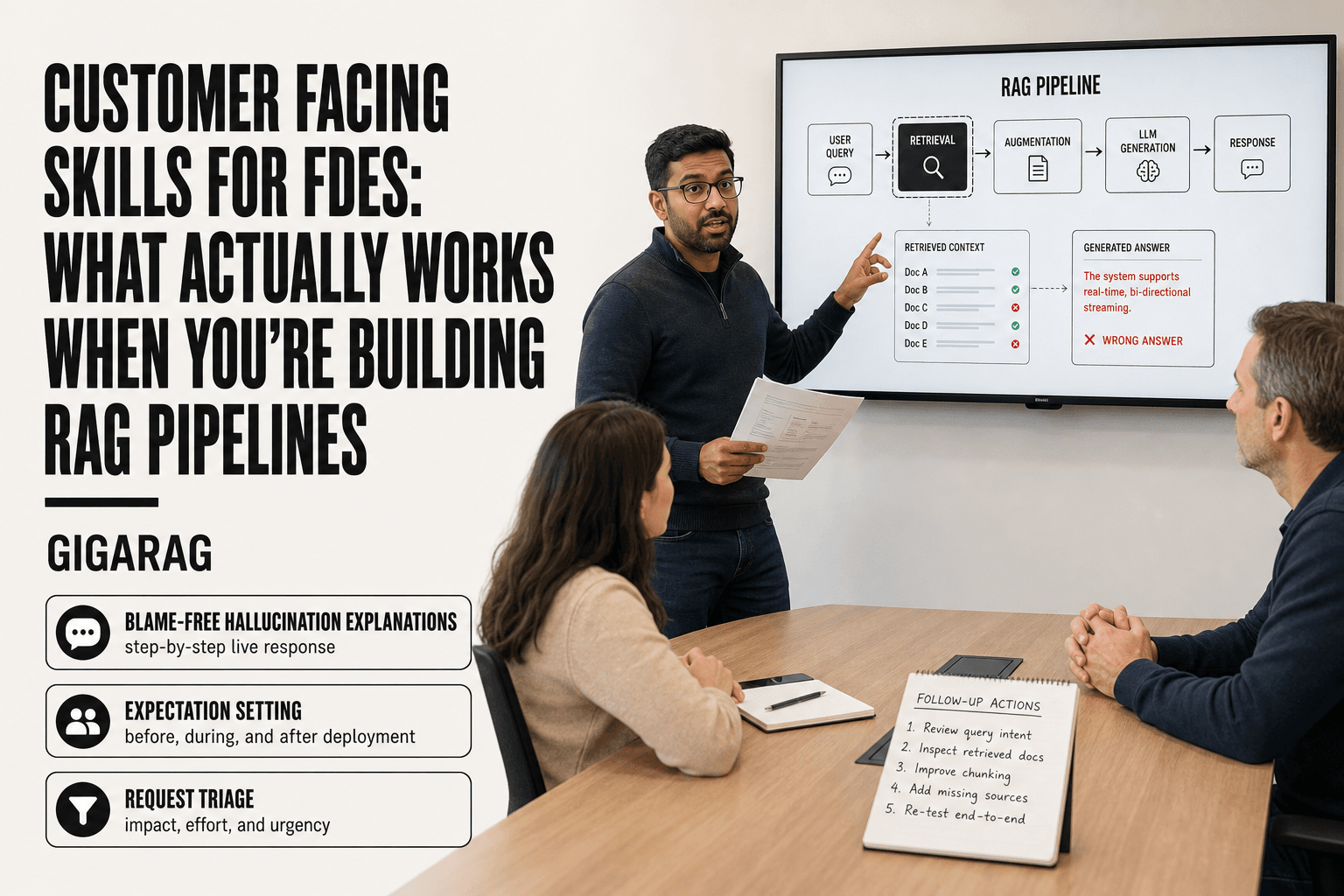
Customer Facing Skills for FDEs: What Actually Works When You're Building RAG Pipelines
Customer facing skills for FDEs get tested the moment a RAG pipeline demo goes sideways. You've deployed the system, the customer asks a question, and the answer comes back wrong. Maybe it hallucinated a source. Maybe it returned stale context from agent memory. The customer looks at you and says, "Why did that happen?" Your response in the next ten seconds determines whether the deployment survives.
Technical skills get you hired. Customer-facing skills determine whether your deployments stay deployed. This matters more in RAG and agent memory work than in traditional software, because the outputs are non-deterministic, the failures are visible, and the customer's fear isn't a bug report. It's that the system doesn't work and they just spent six figures on it. GigaRAG helps FDEs manage agent memory and RAG pipelines during deployments, but no tool replaces the conversation.
| At a glance | Details |
|---|---|
| Core skill | Translating RAG behavior into plain language |
| Biggest trap | Over-promising accuracy or latency |
| Key habit | Set expectations before the demo |
| Hardest moment | Explaining a hallucination live |
| Framework | Triage requests by impact and effort |
| What you can't control | Model updates and source data quality |
In This Guide
- What Is a Forward Deployed Engineer (FDE)?
- Explaining a Hallucination: Blame-Free vs Blame-Shifting
- Why Customer Facing Skills for FDEs Matter More in RAG and Agent Memory Deployments
- Customer Facing Skills For FDEs: A Step-by-Step Guide
- The Core Customer Facing Skills for FDEs
- Scenario-Based Tactics: What to Say When a RAG Pipeline Hallucinates
- What You Cannot Promise: Honest Limitations of RAG and Agent Memory Systems
- A Practical Framework for Prioritizing Customer Requests in RAG Deployments
- How to Prepare for Customer-Facing FDE Roles
- Common Mistakes When Applying Customer Facing Skills for FDEs
- Final Thoughts on Customer Facing Skills for FDEs
What Is a Forward Deployed Engineer (FDE)?
A forward deployed engineer (FDE) is an engineer who works directly with customers at their site or inside their environment to deploy, configure, and adapt a product to real-world use cases. Unlike a pure software engineer, an FDE owns the outcome of the deployment, not just the code.
The FDE role in one paragraph
An FDE sits inside the customer's world. You read their data, wire up their systems, and make the product work under constraints nobody anticipated in the roadmap. You write code, but you also run meetings, translate requirements, and push fixes the same week a customer reports a problem. The role exists because most technical products fail at the integration layer, not the feature layer.
Why FDEs sit between engineering and customer success
Customer success keeps the relationship healthy. Engineering builds the product. The FDE does the work neither can do alone: you take a general-purpose system and bend it to fit one customer's specific pipeline. That means you hear the unvarnished truth about what breaks, and you carry that truth back to the product team.
How FDE work differs from pure software engineering
A pure software engineer ships code to a codebase. An FDE ships a working deployment to a person who will use it tomorrow. The difference is accountability. You don't get to close the ticket when the code merges. You get to close it when the customer stops calling with problems. That's why customer-facing skills aren't a nice-to-have for FDEs. They're the job.
[!note] RAG pipelines cannot guarantee 100% retrieval accuracy or zero hallucination; retrieval quality depends heavily on source document structure, chunking strategy, and the customer's own data hygiene, none of which the FDE fully controls.
Explaining a Hallucination: Blame-Free vs Blame-Shifting
| Factor | Blame-Free Response | Blame-Shifting Response |
|---|---|---|
| Opening line | Acknowledge the output and thank them for catching it | Point out that the source document was unclear |
| Root cause framing | Walk through retrieval, context, and generation steps | Attribute the error to the model or the data team |
| Customer trust | Builds confidence that issues get investigated | Creates friction and defensiveness |
| Next step | Propose a concrete fix and a follow-up date | Leave the fix vague or assign it elsewhere |
| Long-term effect | Customer shares edge cases openly | Customer stops reporting issues |
Why Customer Facing Skills for FDEs Matter More in RAG and Agent Memory Deployments
RAG and agent memory systems break in ways traditional software doesn't. A CRUD app returns the same result every time. A RAG pipeline returns a different answer to the same question depending on which chunks the retriever pulled, which model version is live, and what the customer's data looked like last week. That changes every customer conversation you'll have.
The non-determinism problem: why RAG outputs are harder to explain
When a customer asks why the system gave two different answers to the same query, you can't point to a bug in the traditional sense. The code ran correctly. The retrieval just picked different context. Explaining that without sounding like you're making excuses is the core FDE skill in this space. You're not debugging logic. You're debugging probability.
Customer expectations vs. reality in agent memory systems
Customers hear "memory" and assume the agent remembers everything, perfectly, forever. What they actually get is a retrieval system with a context window and a decay curve. The gap between those two things is where most deployment friction lives. Your job is to close that gap before the customer discovers it on their own.
What customers actually fear when they hear "AI"
They don't fear the technology. They fear looking stupid in front of their boss when the system says something wrong in a meeting. They fear losing a deal because the agent gave a prospect bad information. They fear being blamed for a tool they didn't build and don't fully understand. Address those fears directly and the technical conversation gets easier.
[!tip] Before any customer demo, run the pipeline against the customer's actual documents, not your curated sample set — and keep a short list of known edge cases ready so you can say 'we already know about this one' instead of being surprised live.
Customer Facing Skills For FDEs: A Step-by-Step Guide
- Pause and acknowledge the unexpected output without defensiveness.
- Ask the customer what they expected and why, to understand their mental model.
- Walk through the retrieval step: what documents were fetched and whether they were relevant.
- Explain the generation step: how the model used (or misused) the retrieved context.
- State clearly what you can and cannot guarantee about accuracy and latency.
- Propose one concrete next step with a realistic timeline.
- Follow up in writing with what was observed and what will change.
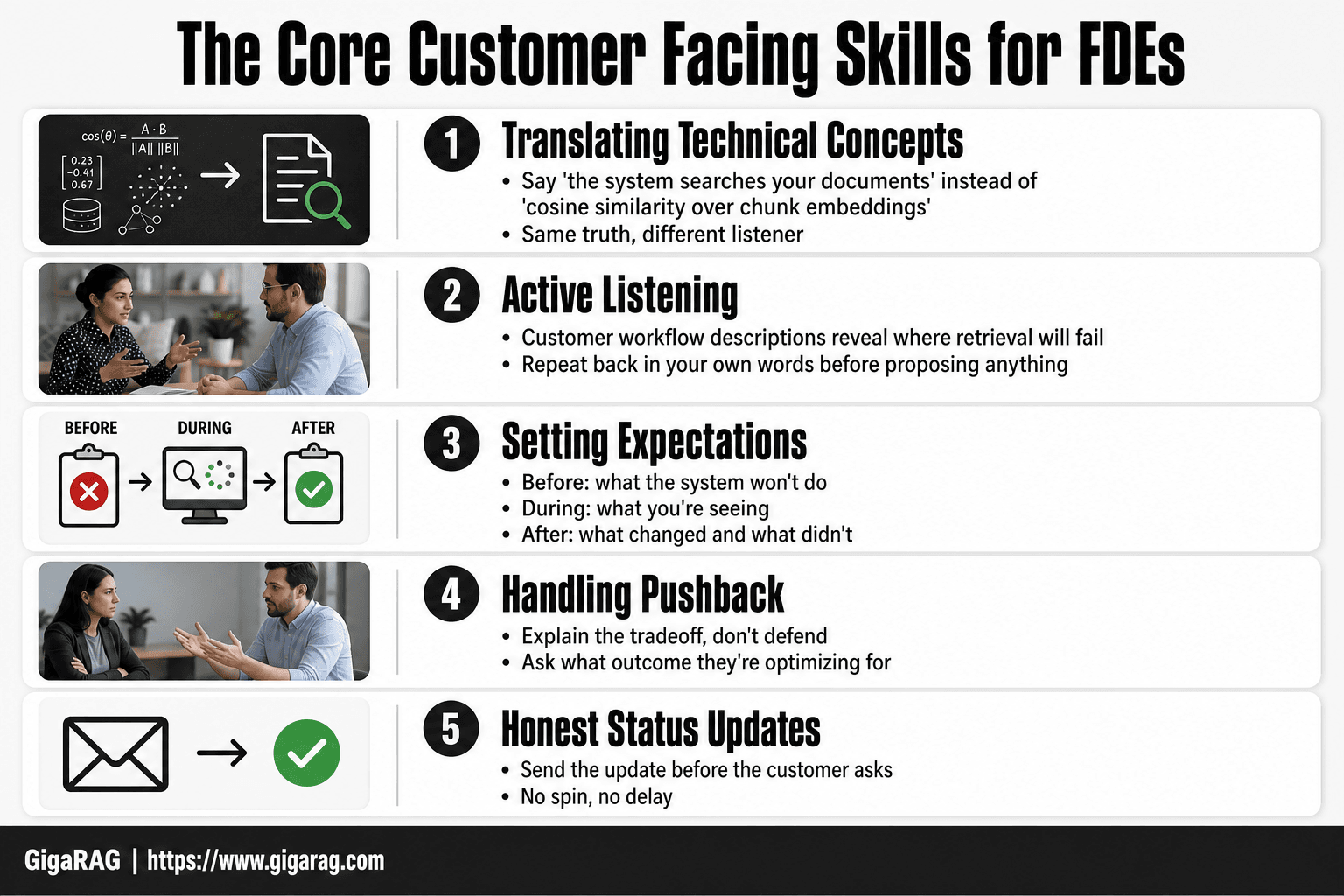
The Core Customer Facing Skills for FDEs
The technical skills get you into the room. The customer-facing skills decide whether the deployment survives the first month. For RAG and agent memory work, these skills aren't soft. They're load-bearing.
Translating technical concepts without dumbing them down
Your customer doesn't need to understand vector embeddings. They need to understand why the system sometimes returns the wrong answer and what you're doing about it. Say "the system searches your documents for relevant passages before answering" instead of "we run cosine similarity over chunk embeddings." Same truth. Different listener. The goal isn't simplification. It's translation.
Active listening during technical discovery calls
Most FDEs listen for the moment they can talk. That's backwards. When a customer describes their workflow, they're telling you where the retrieval will fail. "We update our pricing sheet weekly" means your embedding refresh schedule matters more than your model choice. Write down what they say, then repeat it back in your own words before proposing anything.
Setting expectations before, during, and after deployment
Before: tell them what the system won't do. During: tell them what you're seeing. After: tell them what changed and what didn't. A customer who hears "retrieval accuracy will improve as we tune the chunking strategy" is prepared for week one to be rough. A customer who hears "it'll work great" is not.
Handling pushback on technical decisions
Customers will push back on your chunk size, your model choice, your latency budget. Don't defend. Explain the tradeoff. "We chose 512-token chunks because your documents have short, dense sections. Larger chunks would pull in irrelevant context." If they still disagree, ask what outcome they're optimizing for. Often the pushback is really about a different concern they haven't named yet.
Building trust through honest status updates
The fastest way to lose a customer is to go quiet when things break. The fastest way to keep one is to send an update before they ask. "Retrieval quality dropped 12% after yesterday's data sync. We traced it to a formatting change in your source files. Fix is in progress." That's it. No spin. No delay. Trust compounds.
Scenario-Based Tactics: What to Say When a RAG Pipeline Hallucinates
Scripts help because the moment is awkward. The customer just watched your system confidently return a wrong answer. They're looking at you. What you say in the next ten seconds sets the tone for the entire deployment.
The hallucination conversation: acknowledging without overpromising
Start with the truth, not a defense. "That's a hallucination. The system retrieved a real passage but generated an answer that went beyond what the passage said." Name it. Don't call it a glitch or a bug. Those words imply a fixable mechanical failure. Hallucination is a known property of the architecture, and your customer needs to understand that.
Then separate what you can fix from what you can't. "I can tighten the retrieval threshold and add a guardrail that forces the model to stick to retrieved text. I can't promise zero hallucinations. No one can." That last sentence matters. Say it early. A customer who hears it in week one won't feel betrayed in week three.
The latency complaint: explaining tradeoffs honestly
The customer says the system feels slow. Don't apologize reflexively. Explain the tradeoff. "Right now we're running a larger model with a wider retrieval window. That gives you better answers but adds about 1.2 seconds per query. We can cut latency by shrinking the window or switching models, but answer quality will drop." Then ask which they want. It's their call. Your job is to make the cost visible.
The accuracy expectation: defining "good enough" with the customer
"Good enough" is a number, not a feeling. Ask the customer what failure rate they can live with. Most will say zero. Push back gently. "Zero isn't available. What's the actual threshold where this stops being useful for your team? 85%? 90%?" Once they name a number, you have a target to tune against. Before that, you're guessing.
The scope creep request: saying no without damaging the relationship
The customer asks for a feature that's outside the deployment scope. Don't say no. Say what it costs. "We can add that, but it means delaying the memory consolidation work by two weeks. Which matters more right now?" Scope creep isn't a refusal problem. It's a prioritization problem. Make the tradeoff explicit and let them decide.
What You Cannot Promise: Honest Limitations of RAG and Agent Memory Systems
Some things sit outside your control no matter how good your customer-facing skills are. Say so plainly. A customer who hears the limits early won't treat them as betrayals later.
Why 100% retrieval accuracy is not a realistic promise
Retrieval depends on the quality of the source documents, the embedding model, and the query phrasing. None of those are fully under your control. You can tune thresholds and re-rank results, but you can't guarantee the right chunk comes back every time. Promise a measurable improvement, not perfection.
Agent memory limitations: what "memory" actually means
Agent memory is not human memory. It's a retrieval system with a persistence layer. It doesn't understand context the way a person does. It stores and retrieves. When a customer asks why the agent "forgot" something, explain that memory retrieval failed, not that the agent chose to ignore it.
Latency, cost, and quality: the impossible triangle
You can optimize two of the three. Faster responses mean smaller models or narrower retrieval windows, which lowers quality. Higher quality means bigger models and wider windows, which raises cost and latency. There's no configuration that wins all three. Make the customer choose which two matter most.
When customer-facing skills cannot fix a broken product
No script saves a pipeline that returns wrong answers on simple queries. If the underlying retrieval is broken, the fix is engineering work, not communication. Say that directly. "This isn't a communication problem. We need to fix the retrieval before we talk about expectations." Customers respect that honesty more than another meeting.
A Practical Framework for Prioritizing Customer Requests in RAG Deployments
You can't do everything. The customer who asks for ten improvements in one call doesn't expect all ten. They expect you to know which three matter.
The three-axis prioritization matrix
Score every request on three axes: impact, effort, and urgency. Impact is how much the change improves retrieval quality or agent usefulness. Effort is engineering time, from hours to weeks. Urgency is the customer's stated deadline, not their tone of voice.
Plot the requests. High impact, low effort, high urgency: do it this sprint. High impact, high effort: schedule it and say when. Low impact, anything: defer it and say why. The matrix takes five minutes and stops you from treating every request as an emergency.
How to communicate priorities to customers
Show the customer the matrix. Not as a spreadsheet dump, but as a simple list: what you're doing now, what's next, what's waiting. "We're fixing the chunk overlap issue this week because it affects the most queries. The custom metadata filter is next, but it needs two weeks of engineering time."
Customers push back less when they see the tradeoff. If they want the metadata filter first, something else moves. Make them choose.
When to escalate vs. when to defer
Escalate when the request exposes a product gap that blocks the deployment. A broken retriever, a hallucination rate above what the customer can tolerate, a latency spike that makes the agent unusable. Those go to engineering immediately.
Defer when the request is a nice-to-have. A custom UI tweak, a new embedding model to test, a dashboard the customer might use. Say "not now" with a date attached. "We can look at this after the accuracy work lands in three weeks." That's not a no. It's a schedule.
How to Prepare for Customer-Facing FDE Roles
You can't learn this from a book. You learn it by doing it badly, then less badly.
Practice explaining RAG concepts to non-technical friends
Explain retrieval to someone who doesn't care about vectors. If they glaze over, you used jargon. Try: "The system searches a library of your documents, pulls the most relevant passages, and uses those to write an answer." If they ask a follow-up question, you're doing it right. Do this weekly. Ten minutes per session beats an hour of reading.
Shadow customer calls before leading them
Sit in on three calls. Don't talk. Watch how the senior FDE handles a latency complaint, a scope creep request, a customer who says "this isn't what we bought." Take notes on what they say and what they don't say. Then debrief after. Ask why they chose that phrasing. You'll learn more in three shadowed calls than in a month of solo work.
Build a personal glossary of plain-language AI terms
Write down every technical term you use in a week. Chunking, embedding, top-k, temperature, context window. Next to each, write the plain-English version you'd use with a customer. Keep it in a doc you actually open before calls. When you catch yourself reaching for jargon, swap in the glossary version. It feels awkward for a month. Then it's just how you talk.
Common Mistakes When Applying Customer Facing Skills for FDEs
Most FDE failures aren't technical. They're conversational. Here are the three that sink RAG deployments fastest.
Overpromising during the sales-to-deployment handoff
Sales said "it just works." You inherit that promise. The fix: restate scope in your first customer call, in writing. "Here's what the system does today, here's what it doesn't." If you skip this, every later limitation reads as a broken promise. You can't undo the sales pitch, but you can reset the baseline before deployment starts.
Using jargon as a shield instead of a bridge
Jargon feels safe. It's not. When you say "top-k retrieval with cosine similarity," the customer hears "I don't want to explain this." They stop asking questions. Then they escalate to your boss. Say the plain version first, offer the technical version only if they ask. If they don't ask, you've done your job.
Avoiding hard conversations until they become crises
The latency issue you didn't mention in week one is the outage they discover in week six. The retrieval gap you hoped would "get better with more data" is the accuracy complaint in the quarterly review. Say the hard thing early, when it's small. A two-minute uncomfortable conversation now beats a two-week firefight later.
Final Thoughts on Customer Facing Skills for FDEs
Customer facing skills for FDEs aren't a personality trait. They're a set of repeatable moves: restate scope early, say the plain version first, name the limitation before the customer finds it. You can practice all three this week.
The honest answer is that no script fixes a broken product. But a good FDE can keep a working product from being perceived as broken. That's the job. Explain what retrieval actually does, set the accuracy bar together, and write down what you agreed to. Then do it again next call.
GigaRAG helps on the technical side of that loop: managing RAG pipelines and agent memory during customer deployments so you're not debugging retrieval quality while the customer watches. It won't run the conversation for you. That part stays yours.
Frequently Asked Questions
What skills are required for FDE?
Forward Deployed Engineers need a blend of technical depth (APIs, data pipelines, LLM orchestration) and customer-facing skills like expectation-setting, plain-language explanation, and stakeholder management. The role rewards engineers who can debug a retrieval issue in the morning and run a steering committee in the afternoon.
What skills are needed for customer-facing roles?
Active listening, the ability to explain trade-offs without jargon, and comfort with saying 'I don't know yet, but here's how I'll find out.' For FDEs specifically, being able to translate retrieval metrics and latency numbers into business impact matters more than polished presentation skills.
What are the responsibilities of a forward deployed engineer?
FDEs embed with customers to deploy and adapt technical solutions, typically owning integration, configuration, troubleshooting, and feedback loops back to product and engineering teams. In RAG contexts, that includes tuning retrieval, managing agent memory behavior, and setting realistic accuracy expectations.
How do you explain a hallucination to a non-technical customer?
Use a retrieval analogy: the system found the wrong pages in a library and then confidently summarized them. Then separate the two failure points — what was retrieved versus what was generated — and commit to investigating which one broke.
What can an FDE not promise on a RAG deployment?
You cannot promise 100% retrieval accuracy, zero latency, or perfectly consistent agent behavior, especially across model updates and evolving source data. Being upfront about these limits early prevents much harder conversations later.
How should an FDE prioritize customer requests during a deployment?
Triage by impact on the customer's core workflow first, then by effort and reversibility. Quick wins that unblock daily use usually beat technically interesting improvements that only affect edge cases.
Forward Deployed Engineer vs software engineer — what's the difference?
A software engineer typically builds within a defined product scope, while an FDE works directly with customers to adapt and deploy solutions in their environment. The FDE role adds customer communication, expectation management, and on-site problem-solving to the engineering toolkit.
About GigaRAG
GigaRAG is for agent memory and RAG pipeline builders. get this right. Whether you are working through customer facing skills for FDEs or something adjacent, we publish what we have actually tested, including where it falls short.


