Cutting Hallucinations in RAG Pipelines and Agent Memory Systems
Cutting hallucinations means one thing to a psychiatrist and something entirely different to an AI engineer. If you're building RAG pipelines or agent memory systems, it means your LLM is generating answers that contradict the documents you fed it. The model cites a source that says the opposite, invents a statistic that appears nowhere in your knowledge base, or confidently answers a question your retrieval never surfaced. That's a hallucination in RAG, and it's the number one reason production deployments stall. User trust erodes the moment an answer is wrong, and once it's wrong in a way that looks sourced, the damage compounds.
The honest answer up front: you cannot eliminate hallucinations entirely. Any system that samples from a probabilistic model will occasionally emit unsupported output. But you can cut them dramatically. This guide covers the root causes, the retrieval-layer and generation-layer mitigations that actually work, how agent memory systems add new risk, how to measure reduction with faithfulness metrics, and what you cannot fix no matter how good your prompts get. GigaRAG's memory management layer addresses one slice of this problem for agent pipelines, and I'll point to it where it's relevant. First, the root causes.
| At a glance | Details |
|---|---|
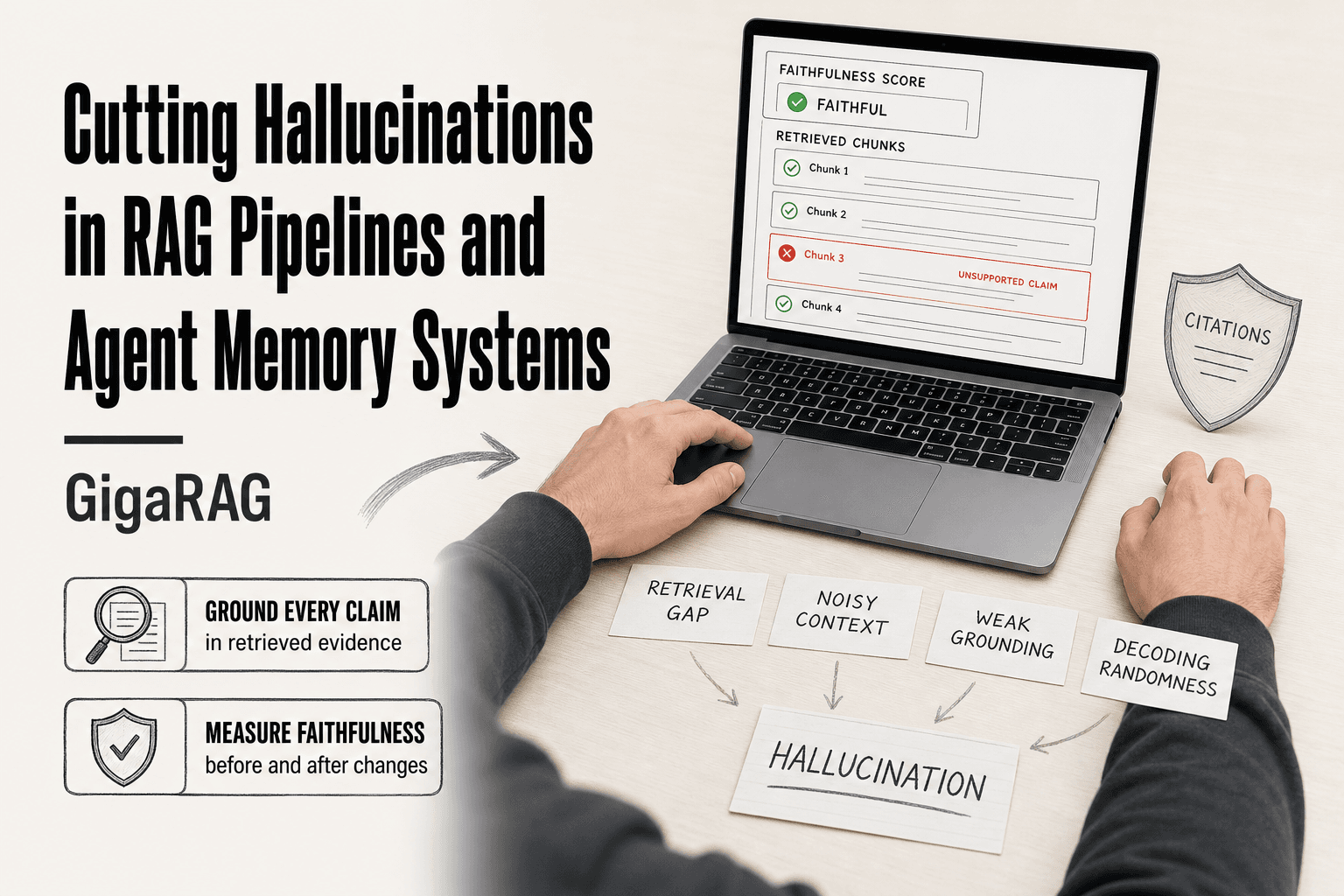
| Root causes | Retrieval gaps, noisy context, weak grounding, decoding randomness |
| Top mitigation | Ground every claim in retrieved evidence with citations |
| Retrieval quality | Hybrid search plus reranking beats embedding-only retrieval |
| Evaluation metrics | Faithfulness, answer relevance, context precision and recall |
| Hard limit | You can reduce hallucinations, never fully eliminate them |
| Agent memory | Stale or conflicting memory is a hidden hallucination source |
In This Guide
- What Are Hallucinations in RAG Pipelines?
- Prompt-Only Guardrails vs Retrieval and Memory Fixes
- Root Causes of Hallucinations in Retrieval-Augmented Generation
- Cutting Hallucinations: A Step-by-Step Guide
- Cutting Hallucinations at the Retrieval Layer
- Cutting Hallucinations at the Generation Layer
- Agent Memory Systems: A Different Hallucination Surface
- How to Measure Hallucination Reduction
- What You Cannot Fix: Honest Limits of Hallucination Reduction
- A Prioritized Checklist for Cutting Hallucinations
What Are Hallucinations in RAG Pipelines?
A hallucination in RAG is when the model generates an answer that is not supported by the retrieved documents. The model either ignores the context it was given or fills gaps with its own parametric knowledge. It sounds confident either way.
Hallucination vs. irrelevance vs. contradiction
These are three different failure modes, and you'll want to name them correctly when debugging.
- Irrelevance: the answer is on-topic but not from the retrieved docs. The model answered a related question, not yours.
- Contradiction: the answer directly conflicts with the retrieved docs. The context says one thing, the model says the opposite.
- Fabrication: the answer invents facts not in any source. No retrieved document supports it, and neither does the model's training data.
Why RAG was supposed to fix this, and why it didn't
RAG gives the model a set of documents and says: answer from these. In theory, that grounds the output. In practice, the model still has its own weights, and it doesn't always obey the instruction. Retrieval can fail, the context can be too long, or the prompt can be too weak. The model falls back on what it already knows, and that's where fabrication starts.
A concrete example of a RAG hallucination
You ask: "What's the refund policy for the Pro plan?" The retriever pulls the pricing page, not the refund page. The model, seeing pricing but no refund info, answers: "Pro plans come with a 30-day money-back guarantee." That's a fabrication. It sounds plausible, it's the kind of thing SaaS companies say, but it's not in the retrieved context. The model invented it to fill the gap.
[!note] Hallucinations in RAG systems are not the same phenomenon as clinical hallucinations; in this context the term refers to model outputs that are fluent but not grounded in the retrieved source documents.
Prompt-Only Guardrails vs Retrieval and Memory Fixes
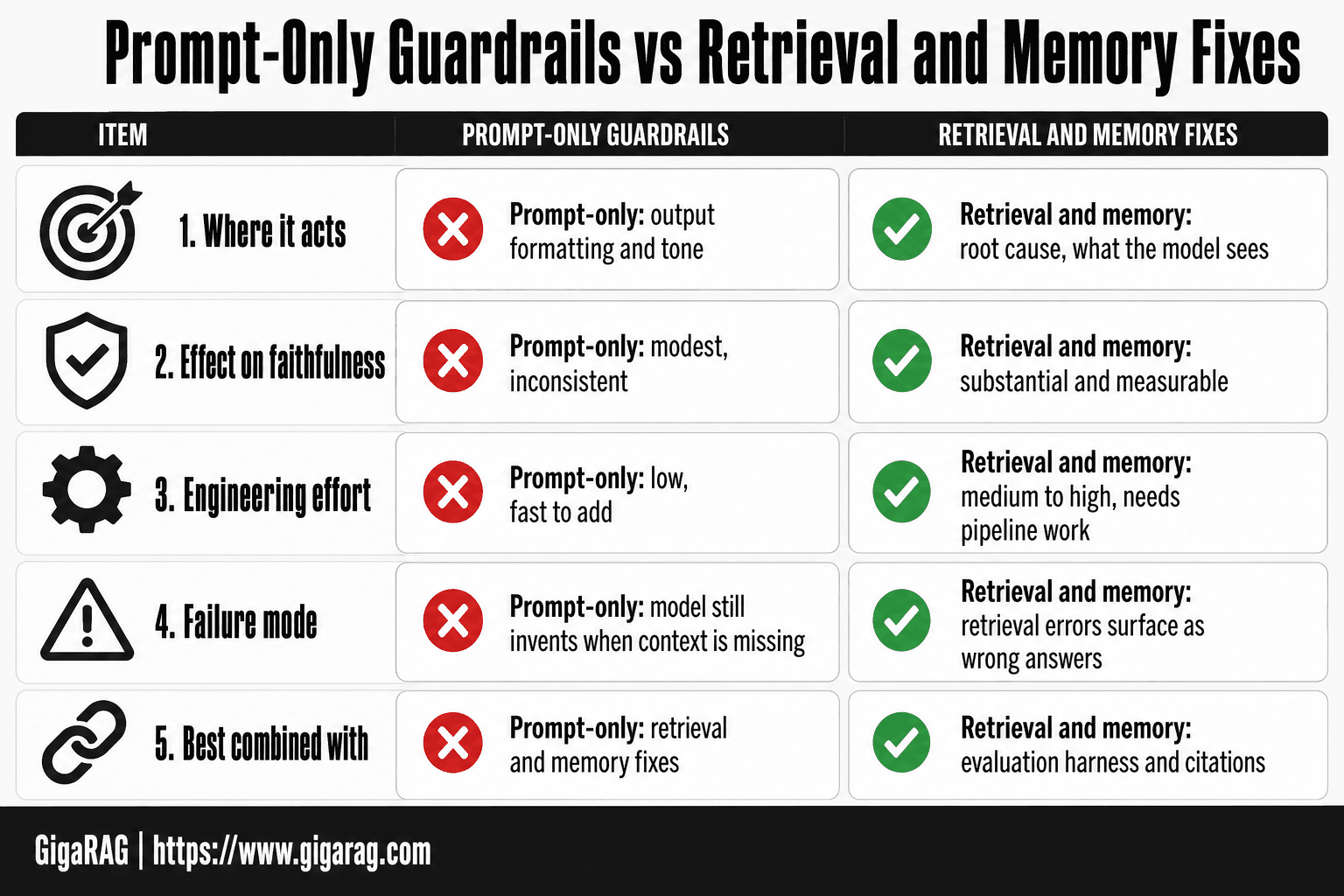
| Factor | Prompt-Only Guardrails | Retrieval and Memory Fixes |
|---|---|---|
| Where it acts | Output formatting and tone | Root cause: what the model sees |
| Effect on faithfulness | Modest, inconsistent | Substantial and measurable |
| Engineering effort | Low, fast to add | Medium to high, needs pipeline work |
| Failure mode | Model still invents when context is missing | Retrieval errors surface as wrong answers |
| Best combined with | Retrieval and memory fixes | Evaluation harness and citations |
Root Causes of Hallucinations in Retrieval-Augmented Generation
Four failure points account for most RAG hallucinations. Each one is fixable, but you need to know which one you're dealing with before you start changing code.
Retrieval failure: the right document never made it
The retriever pulls the wrong documents, or misses the right one entirely. The model then answers from its own weights, because that's all it has. This is the most common cause, and it's usually a problem with embeddings or search strategy, not the model itself. If your top-k results don't contain the answer, no prompt will save you.
Context overflow and poor chunking
Retrieved docs are too long, or chunked badly, so the key fact gets truncated before it reaches the model. A 10,000-token document split into 500-token chunks might bury the answer in chunk 14 of 20. The model never sees it. The fix is chunking strategy, not a better model.
Weak grounding in the prompt
The prompt doesn't force the model to constrain itself to retrieved context. Without explicit instructions to answer only from the provided documents, the model treats retrieval as a suggestion, not a boundary. It fills gaps with parametric knowledge and sounds just as confident.
Source quality: garbage in, garbage out
The knowledge base itself contains conflicting, outdated, or low-quality documents. Two docs say different things about the same policy. The model picks one, or blends them, and the result is a hallucination relative to ground truth. No retrieval or prompt fix can compensate for a bad source.
[!tip] For agent memory systems, treat every memory write as untrusted input: validate it against source evidence before storing, and version entries so a bad memory can be rolled back instead of silently poisoning future retrievals.
Cutting Hallucinations: A Step-by-Step Guide
- Instrument the pipeline to log retrieved chunks, prompts, and outputs for every query.
- Measure faithfulness and context relevance on a labeled evaluation set before changing anything.
- Fix retrieval first: add hybrid search, reranking, and chunk-size tuning to raise context precision.
- Constrain generation: require citations, allow 'I don't know', and lower sampling temperature.
- Add a verification pass that checks each claim against retrieved evidence before returning it.
- Audit agent memory for stale, duplicated, or conflicting entries and add write-time validation.
- Re-run the evaluation set after each change and track hallucination rate over time.
Cutting Hallucinations at the Retrieval Layer
The retrieval layer is where most hallucinations start. If the right document never reaches the model, the model fills the gap from its own weights. Fix retrieval first, then worry about prompts.
Chunking strategy: size, overlap, and semantic boundaries
Chunk size is the first lever. Too small and you lose context; too large and the embedding dilutes. Start with 256 to 512 tokens for dense passages, and add 10 to 20 percent overlap so facts near chunk boundaries don't get orphaned. Semantic boundaries matter more than size. Split on paragraph or section breaks, not arbitrary token counts. A fact split across two chunks is a fact the retriever can't find.
Embedding optimization and domain-specific models
General-purpose embedding models underperform on domain text. If your knowledge base is legal, medical, or highly technical, test a domain-specific model before fine-tuning. Fine-tuning embeddings on your own query-document pairs helps when you have a few thousand labeled examples. Without that volume, it's not worth the complexity.
Hybrid search: dense + sparse retrieval
Dense embeddings miss exact terms like product codes, error numbers, or names. Sparse retrieval (BM25) catches those. Run both and merge results. This fixes the "right document, wrong embedding" failure without much added infrastructure.
Reranking to boost precision
Retrieve more candidates than you need, then rerank with a cross-encoder. A cross-encoder reads the query and document together, so it scores relevance far more accurately than a bi-encoder embedding. This boosts precision@k meaningfully. The cost is latency: cross-encoders are slower. Worth it when your top-k is noisy.
Cutting Hallucinations at the Generation Layer
Retrieval gets the right documents into context. Generation decides whether the model actually uses them. A model can sit on perfect context and still invent an answer from its weights. The prompt and decoding strategy are the last line of defense.
Prompt patterns that force grounding
The simplest grounding instruction is explicit: "Answer only from the provided context. If the context does not contain the answer, say so." That single line cuts hallucination rates measurably in most RAG setups. Put it in the system prompt, not buried in the user turn. Models weight system instructions more heavily.
Requiring citations and 'I don't know' responses
Require a citation for every factual claim. "Cite the chunk number or source ID for each sentence." Models that must point to evidence are less likely to fabricate. Then train the refusal path: "If the context is insufficient, respond with 'I don't know' and nothing else." Without that explicit permission, models default to answering anyway.
Structured output and constrained decoding
Force JSON or a fixed schema. A model constrained to output {"answer": "...", "citations": [...]} has less room to ramble into unsupported territory. Constrained decoding goes further: block tokens that would violate the schema, or restrict generation to spans copied from retrieved context. This is the strongest generation-side control available.
Why prompt engineering alone is not enough
Prompts reduce hallucinations. They do not eliminate them. A model can still paraphrase retrieved text incorrectly, or blend context with parametric memory when the instruction is ambiguous. If retrieval returns the wrong document, no prompt fixes that. Grounding prompts and retrieval quality are two halves of the same fix.
Agent Memory Systems: A Different Hallucination Surface
Retrieval and generation fixes assume a single turn. Agents break that assumption. They accumulate state across turns, write to memory stores, and later retrieve from those stores. Each write is a chance to store something wrong. Each read is a chance to retrieve something stale.
Why agent memory amplifies hallucination risk
An agent that "remembers" a conversation is not remembering anything. It is summarizing, compressing, and re-embedding prior turns into a store. Compression loses detail. Summarization introduces paraphrase errors. The agent then retrieves that lossy memory and treats it as ground truth. A hallucination stored in memory becomes a hallucination repeated with confidence on every future turn.
Memory scoping: session vs. long-term
Scope memory deliberately. Session memory holds state for one conversation and dies with it. Long-term memory persists across sessions and is where stale facts accumulate. The fix: treat session memory as disposable and long-term memory as a curated store. Write to long-term memory only when a fact is verified against retrieved context, not when the model merely asserts it.
Conflict resolution between memory and retrieval
When memory contradicts retrieved context, retrieved context wins. That is the rule. Memory is a compressed, lossy representation. Retrieved documents are the source. Implement an explicit check: if a memory entry conflicts with a retrieved chunk, discard the memory entry and log the conflict. Do not let the model arbitrate. Models are bad at that.
Memory consolidation and eviction
Consolidate memory on a schedule, not on every turn. Batch-summarize related entries, drop entries that have not been accessed in N turns, and expire facts that contradict newer retrieved context. GigaRAG's memory layer applies this scoping and eviction logic to reduce exactly this class of hallucination. Eviction is not optional. Unbounded memory is a hallucination generator.
How to Measure Hallucination Reduction
You can't fix what you don't measure. Mitigations feel effective in demos and fail in production. The only way to know if chunking, reranking, or grounding prompts actually cut hallucinations is to track a number before and after each change.
Faithfulness and groundedness metrics
Faithfulness measures whether every claim in the answer is supported by the retrieved context. RAGAS computes this by breaking the answer into atomic claims and checking each against the context. TruLens groundedness does the same with a different scoring approach. Context relevance measures whether the retrieved chunks actually address the question. Answer relevance measures whether the answer addresses the question at all. Citation accuracy checks whether the model's citations point to chunks that actually contain the cited claim. Run all four. Faithfulness alone misses retrieval failures.
Building a golden evaluation dataset
Start with 50 to 100 question-answer pairs where you know the ground truth. Pull real questions from your logs. For each, mark which documents contain the correct answer. This dataset is your benchmark. It does not need to be huge. It needs to be representative of the queries your system actually gets.
Before/after measurement workflow
Run the golden set through your pipeline. Record the hallucination rate as a percentage: answers with at least one unsupported claim divided by total answers. Change one thing. Rerun. Compare. One change at a time, or you won't know what moved the number.
When human evaluation is still required
No metric catches everything. A claim can be faithful but misleading, or technically supported but wrong because the source is wrong. For high-stakes deployments, sample 20 to 30 outputs per week and have a human score them. Metrics catch regressions. Humans catch the rest.
What You Cannot Fix: Honest Limits of Hallucination Reduction
You can cut hallucinations dramatically. You cannot eliminate them. Any vendor who says otherwise is selling something.
You cannot eliminate hallucinations entirely
LLMs are probabilistic. They sample from a distribution, and occasionally they sample wrong. Even with perfect retrieval, clean chunking, and a grounding prompt that demands citations, the model will sometimes generate a claim the context does not support. The rate drops. It does not hit zero. Plan for that. Build guardrails that catch the failures instead of pretending they won't happen.
You cannot fix a bad knowledge base with prompts
If your source documents are outdated, contradictory, or just wrong, no prompt pattern saves you. The model will faithfully cite garbage. Garbage in, garbage out still applies. Audit the knowledge base first. Fix the sources before you touch chunking or reranking.
You cannot skip evaluation
Trusting your gut after a mitigation feels right is how regressions ship. You need the golden dataset, the before/after numbers, and the weekly human sample. No tool replaces that. Metrics catch what your demo missed.
A Prioritized Checklist for Cutting Hallucinations
Here's the order that saves you the most time. Each step builds on the one before it.
The 7-step priority order
- Audit your knowledge base quality. Fix contradictory or outdated sources first, because every downstream fix is wasted on bad input.
- Fix chunking. Retrieval quality is capped by how you split documents, so get boundaries and overlap right before touching search.
- Implement hybrid search plus reranking. Dense retrieval alone misses keyword matches; adding BM25 and a cross-encoder reranker boosts precision@k measurably.
- Add grounding prompts with citations. Once retrieval returns the right context, force the model to use only that context and cite its sources.
- Implement memory scoping for agents. Session memory and long-term memory need different eviction and conflict rules, or agents hallucinate about what they remember.
- Set up faithfulness evaluation. Build a golden dataset and track hallucination rate before and after each change.
- Iterate. Run the eval, read the failures, fix the worst cause, repeat.
Why this order matters
You cannot prompt your way out of a retrieval failure. If the right document never reaches the context window, no grounding instruction helps. That's why retrieval-layer fixes come before generation-layer fixes. And you cannot measure any of it without evaluation in place, which is why step six gates step seven. Cutting hallucinations is a loop, not a one-time fix.
Frequently Asked Questions
How can I reduce hallucinations in a RAG pipeline?
Start with retrieval quality, because most hallucinations trace back to missing or noisy context. Add hybrid search and reranking, require the model to cite retrieved chunks, and allow it to answer 'I don't know' when evidence is absent. Then measure faithfulness on a labeled set so you can tell whether each change actually helped.
Can hallucinations be eliminated entirely?
- No prompt, model, or retrieval configuration makes an LLM fully faithful to its sources. The realistic goal is to reduce the frequency and severity of hallucinations and to detect them when they occur, which is why evaluation and citation checks matter as much as generation settings.
What is the best way to deal with hallucinations in agent memory?
Treat memory as a data quality problem rather than a prompting problem. Validate entries before writing, deduplicate and expire stale memories, and keep provenance so you can trace a bad answer back to the memory that caused it. Conflicting memories should be resolved explicitly, not left for the model to reconcile at inference time.
Which metrics should I track to catch hallucinations?
Track faithfulness (are claims supported by retrieved context), answer relevance, and context precision and recall. Faithfulness catches invented content, while context precision and recall tell you whether the retrieval step is feeding the model the right evidence in the first place.
Does lowering temperature stop hallucinations?
Lowering temperature reduces random variation in outputs but does not fix grounding. A model with poor retrieved context will still produce confident, unsupported answers at low temperature. Treat decoding settings as a minor lever and prioritize retrieval and verification.
How do I know if my RAG system is hallucinating?
Build a small labeled evaluation set of questions with known correct answers and run it after every pipeline change. Log retrieved chunks alongside outputs so you can distinguish a retrieval failure from a generation failure, since the two require different fixes.
About GigaRAG
GigaRAG is for agent memory and RAG pipeline builders. get this right. Whether you are working through cutting hallucinations or something adjacent, we publish what we have actually tested, including where it falls short.


