Debugging Agentic Retrieval Loops: A Practical Guide for RAG Pipeline Builders
Debugging agentic retrieval loops is a special kind of frustration for RAG pipeline builders. Your agent works fine in testing, then in production it rewrites the same query fifteen times or returns results that went stale three turns ago. You check the logs and see a wall of traces that tell you everything except why the loop broke. Most debugging guides stop at "add logging" or hand you a vendor dashboard and call it a day. They don't name the failure modes. They don't tell you what you can't fix.
The honest answer is that agentic retrieval loops fail in non-obvious ways, and no amount of tracing will make them fully deterministic. But you can get a lot closer. This guide covers a tool-agnostic debugging workflow: a taxonomy of retrieval loop failure modes, a five-step diagnosis process, and the limitations you should stop fighting. It works whether you're on LangChain, LlamaIndex, or a custom RAG stack. GigaRAG can help with agent memory observability, but everything here stands on its own.
| At a glance | Details |
|---|---|
| Core problem | Agents rewrite queries or re-retrieve endlessly |
| Top failure modes | Infinite rewriting, retrieval staleness, context poisoning |
| First diagnostic | Log every query, retrieval, and decision step |
| Key guardrail | Cap loop iterations and retrieval calls |
| Hard truth | Deterministic reproduction is often impossible |
| Tooling | Works across LangChain, LlamaIndex, or custom stacks |
In This Guide
- What Are Agentic Retrieval Loops?
- Infinite Query Rewriting vs Context Poisoning: Which Failure Mode Are You Seeing?
- Why Debugging Agentic Retrieval Loops Is Harder Than You Think
- Debugging Agentic Retrieval Loops: A Step-by-Step Guide
- A Taxonomy of Retrieval Loop Failure Modes
- Step 1: Instrument Your Retrieval Loop with Granular Observability
- Step 2: Isolate and Reproduce the Failure
- Step 3: Root Cause Analysis for Retrieval Loops
- Step 4: Debugging Multi-Hop Retrieval Chains
- Step 5: Continuous Improvement and Regression Testing
- Common Mistakes When Debugging Agentic Retrieval Loops
What Are Agentic Retrieval Loops?
An agentic retrieval loop is a cycle where an LLM agent retrieves context, evaluates it, and decides whether to retrieve again. The agent rewrites queries, follows references across multiple hops, and stores intermediate results in memory. Each iteration changes what the next retrieval sees.
The retrieval loop lifecycle
A loop starts with a query. The agent retrieves candidates, scores them, and either answers or rewrites the query for another pass. Multi-hop retrieval chains link these passes: the output of one retrieval becomes the input to the next. The loop ends when the agent judges it has enough context, or when a step limit trips.
Where agent memory fits in
Agent memory holds what the loop has learned so far: retrieved passages, rewritten queries, and intermediate conclusions. That state shapes every later decision. When memory drifts or corrupts, the loop retrieves against a false picture of what it already knows.
[!note] Agentic retrieval loops are non-deterministic by nature: the same input can produce different retrieval paths across runs, so you should expect to debug statistically (patterns across many runs) rather than reproduce a single failing trace exactly.
Infinite Query Rewriting vs Context Poisoning: Which Failure Mode Are You Seeing?
| Factor | Infinite Query Rewriting | Context Poisoning |
|---|---|---|
| Primary symptom | Agent keeps reformulating the same query without progress | Answers degrade as irrelevant or wrong chunks accumulate |
| Typical trigger | No stop condition or convergence check on the rewrite loop | Over-broad retrieval or stale index feeding bad context |
| Where it shows up | Latency spikes, token burn, repeated near-identical queries | Confident but incorrect answers, contradictions across turns |
| First diagnostic move | Log rewrite count and query similarity per iteration | Inspect retrieved chunks and their relevance scores |
| Immediate mitigation | Cap iterations and require a convergence threshold | Tighten retrieval filters and re-rank before generation |
Why Debugging Agentic Retrieval Loops Is Harder Than You Think
A traditional bug reproduces. You fix it, you test it, you move on. Retrieval loops don't work that way. The same query can take different paths on different runs, and the failure you saw yesterday may not appear today.
Non-determinism in LLM-driven retrieval
Every retrieval decision passes through an LLM. Temperature, sampling, and prompt context all shift outputs between runs. A loop that retrieves correctly nine times can fail on the tenth for no reason you changed. That's not a bug in your code. It's the model doing what models do.
What you cannot expect: deterministic reproducibility
You can't pin a retrieval loop failure to a single line of code. You can narrow it, snapshot it, and replay it, but the same inputs won't always produce the same retrieval path. Expect to debug patterns, not reproductions.
[!tip] For engineers building agent memory systems, keep a small 'loop regression suite' of 10-20 prompts that previously caused infinite rewriting or context poisoning, and run it on every change to the agent's control logic or retriever config.
Debugging Agentic Retrieval Loops: A Step-by-Step Guide
- Instrument every step: log each query rewrite, retrieval call, retrieved chunk IDs, scores, and the agent's decision at each turn.
- Reproduce with a fixed seed and a frozen index snapshot so you can compare runs without chasing moving targets.
- Identify the failure mode: check for repeated near-identical queries (infinite rewriting), stale or missing chunks (retrieval staleness), or irrelevant high-scoring chunks (context poisoning).
- Add hard guardrails: cap rewrite iterations, cap retrieval calls per turn, and set a convergence or similarity threshold to stop looping.
- Tighten retrieval: add metadata filters, re-rank results, and verify the index freshness pipeline is actually running.
- Isolate the failing component by swapping in a stub retriever or a fixed query to see whether the loop is in the agent logic or the retrieval layer.
- Re-run the same scenario and confirm the loop terminates with a correct, grounded answer before shipping the fix.
A Taxonomy of Retrieval Loop Failure Modes
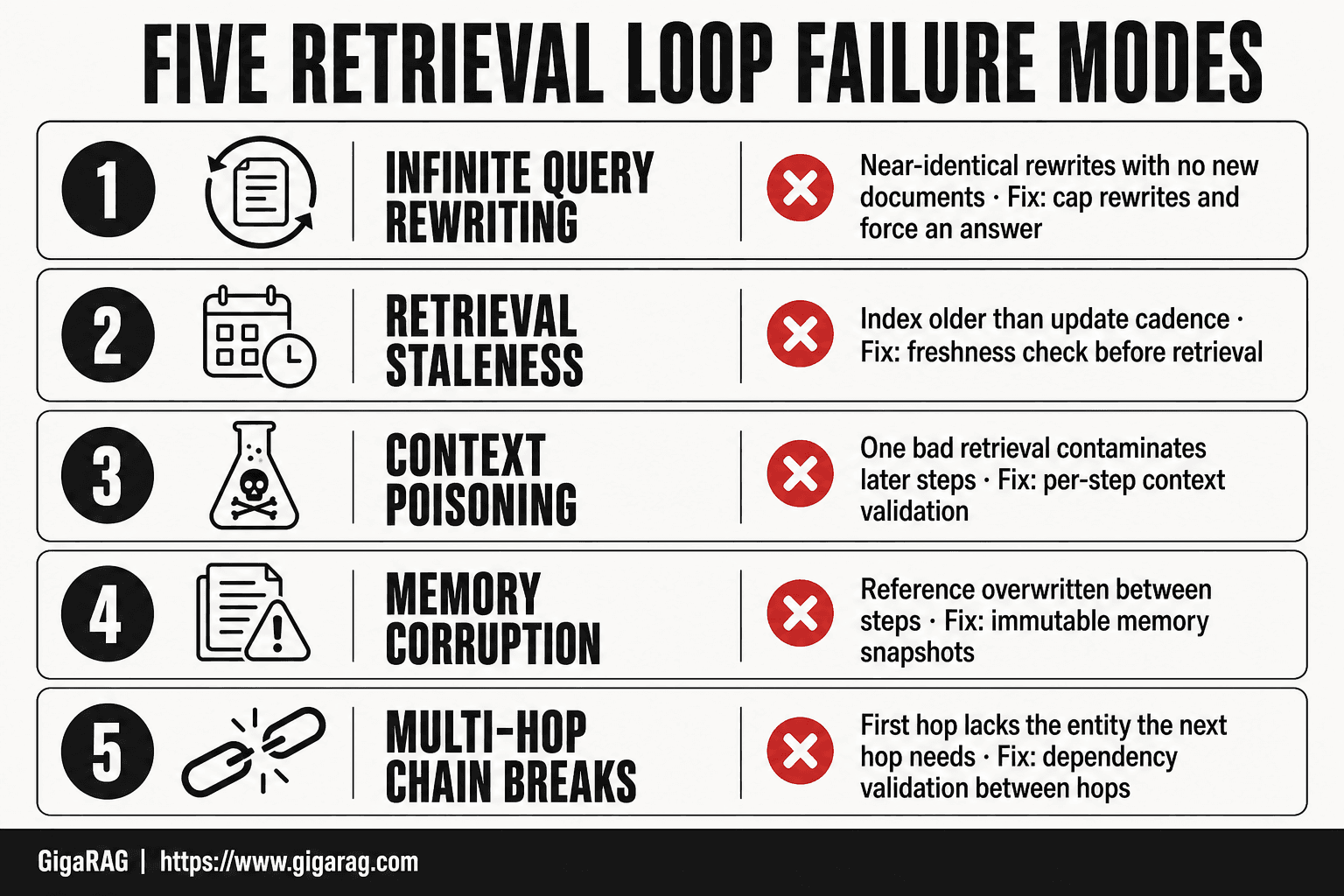
Agentic retrieval loops fail in five predictable ways: infinite query rewriting, retrieval staleness, context poisoning, memory corruption, and multi-hop chain breaks. Each has a diagnostic signature you can spot in traces.
Infinite query rewriting loops
The agent rewrites a query, retrieves, decides the results are insufficient, and rewrites again. Nothing new comes back. The signature is a trace showing ten or more rewrite steps with near-identical queries and no change in retrieved documents. The fix is a rewrite budget: cap rewrites at three, then force the agent to answer with what it has or return a "can't answer" response.
Retrieval staleness
Your vector index hasn't been updated since last Tuesday. The agent retrieves confidently from stale data and answers as if it's current. The signature is retrieved documents with timestamps older than your update cadence. The fix is a freshness check before retrieval: compare index metadata against a known watermark and trigger reindexing or a fallback source when stale.
Context poisoning across iterations
One bad retrieval in step two contaminates the agent's working memory. Every subsequent step builds on that bad context, and the final answer is confidently wrong. The signature is a correct first retrieval followed by a sharp quality drop that never recovers. The fix is per-step context validation: score each retrieval against the query before it enters memory, and drop low-scoring results.
Memory corruption between retrieval steps
The agent stores a document ID or embedding in memory, then retrieves a different document in the next step because the reference was overwritten or miskeyed. The signature is a trace where step N retrieves document A, but step N+1 acts on document B. The fix is immutable memory snapshots: version each memory write and log every read so you can see exactly when the reference changed.
Multi-hop retrieval chain failures
A two-hop question breaks because the first hop's answer doesn't contain the entity the second hop needs. The signature is a second-hop query that's missing a key term from the first hop's result. The fix is dependency validation: check that each hop's output contains the required input for the next hop before proceeding.
Step 1: Instrument Your Retrieval Loop with Granular Observability
You can't debug what you can't see. Before touching code, make every retrieval step visible: the query as written, the query as rewritten, the documents returned, the scores assigned, and the memory state before and after each step.
What to trace in a retrieval loop
Trace five things per step: the input query, any rewrite applied, the retrieval call with its parameters, the documents returned with scores, and the agent's memory state. Skip any of these and you'll be guessing later. OpenTelemetry works across LangChain, LlamaIndex, and custom stacks. LangSmith and LlamaIndex tracing give you the same spans with less setup. GigaRAG is one option here, not the only one.
Logging query rewrites and retrieval decisions
Log the rewrite as its own span, separate from the retrieval call. That separation is what lets you spot an infinite rewrite loop: you'll see ten rewrite spans with near-identical text and no retrieval spans between them. Record the retrieval decision too. Why did the agent pick these documents? What score threshold did it apply?
Capturing agent memory state
Snapshot memory before and after each step. A memory write that changes a document reference between step N and step N+1 is invisible unless you log both states. Version each write. Log each read. That's the difference between seeing a corrupted retrieval and seeing exactly when it corrupted.
Step 2: Isolate and Reproduce the Failure
A trace shows you the failure happened. Isolation shows you why. Strip the loop down until only the failing behaviour remains.
Snapshotting agent memory for replay
Save the full memory state at the moment the failure starts. That means the conversation history, any retrieved documents, and the agent's internal scratchpad. Replay from that snapshot, not from the beginning. You'll save minutes per attempt and remove unrelated steps from the picture.
Minimal reproducible retrieval loops
Cut the query to its smallest form that still fails. Remove hops. Remove tools. If the loop still breaks with one retrieval step and one rewrite, you have your case. Non-determinism means one replay won't prove anything. Run the same snapshot five times. If it fails three times, you have a pattern. If it fails once, you have noise.
Step 3: Root Cause Analysis for Retrieval Loops
You've isolated the failure. Now trace it from symptom to cause. The taxonomy from earlier gives you the map: each failure mode has a diagnostic signature. Match the signature, then verify the mechanism.
Decision tracing vs. execution tracing
Execution tracing shows what the system did. Decision tracing shows why it chose to do that. Persist the chain-of-thought reasoning at each retrieval step. Don't just log the query rewrite; log the reasoning that produced it. An infinite rewrite loop looks identical in execution traces. The decision trace shows whether the agent kept rewriting because it thought results were irrelevant, or because it forgot it had already rewritten.
Mapping symptoms to failure modes
Start with the symptom. A loop that never terminates points to infinite query rewriting or memory corruption. Results that look correct but outdated point to retrieval staleness. A response that drifts off-topic across hops points to context poisoning. Work backwards from the symptom to the mechanism. If the decision trace shows the agent re-issuing the same query with no memory of prior attempts, that's memory corruption, not a rewrite loop. Fix the memory, not the rewrite logic.
Step 4: Debugging Multi-Hop Retrieval Chains
Multi-hop chains break silently. One bad intermediate result poisons every downstream hop, and the final answer looks plausible but is wrong. You can't debug the chain by looking only at the last step.
Tracing dependencies between retrieval hops
Log the input and output of every hop. Include the retrieved documents, the query rewrite, and the agent's decision to continue or stop. When a chain fails, walk backwards from the final answer. Find the first hop where the retrieved documents no longer support the next query. That's your breakpoint.
Validating intermediate retrieval results
Don't trust the chain's self-assessment. Check each hop against the original question. Does hop two's query still answer what the user asked, or has it drifted? A chain that retrieves correct documents for the wrong question fails just as badly as one that retrieves nothing. Validate the question, not just the results.
Step 5: Continuous Improvement and Regression Testing
Debugging one failure fixes one failure. Regression tests prevent it from coming back. Every retrieval loop bug you fix should become a test case.
Building retrieval loop regression tests
Start with the failure you just fixed. Capture the query, the agent memory state, and the expected retrieval path. Store it as a test. Run it on every change to your retrieval logic, your prompts, or your embedding model. A test that passes once and never runs again is worthless.
CI integration for agentic RAG
Add retrieval loop tests to your CI pipeline. Run them on every pull request that touches the agent or the retrieval stack. Keep the suite fast: ten representative cases beat a hundred flaky ones. Non-determinism means some tests will fail intermittently. Mark those as flaky and track their rate. A rising flake rate is itself a signal.
Common Mistakes When Debugging Agentic Retrieval Loops
Most debugging time is wasted on the wrong layer. You chase a bad retrieval result when the real bug is in agent memory state. You fix a prompt when the loop itself is broken.
Ignoring agent memory state
The retrieval loop reads from memory every iteration. If that memory is stale or corrupted, every downstream step fails. Check memory before touching retrieval logic.
Over-relying on a single trace
One trace shows one path. Agentic loops branch. You need five to ten traces of the same failure to see the pattern.
Treating retrieval loops like traditional code bugs
Traditional bugs are deterministic. Retrieval loops are not. The same input can produce different paths. Debugging agentic retrieval loops means hunting distributions, not single causes.
Frequently Asked Questions
Why does my agentic RAG pipeline work in testing but loop endlessly in production?
Test environments usually have smaller, cleaner indexes and simpler queries, so the agent converges quickly. In production, noisier data, larger candidate sets, and ambiguous user queries give the agent more reasons to keep rewriting or re-retrieving. Add iteration caps and convergence checks before shipping.
What is context poisoning in an agentic retrieval loop?
Context poisoning happens when irrelevant, outdated, or contradictory chunks get retrieved and fed into the generation step, causing the model to produce confident but wrong answers. It often compounds across turns as the agent builds on bad context. Tightening retrieval filters and re-ranking before generation is the first line of defense.
How do I stop an agent from rewriting the same query over and over?
Set a hard cap on rewrite iterations and add a similarity or convergence threshold so the loop exits when successive queries stop changing meaningfully. Logging each rewrite helps you tune the threshold. Without a stop condition, the agent has no signal to terminate.
Can I reproduce agentic retrieval loop failures deterministically?
Usually not. LLM sampling, embedding drift, and index updates all introduce variability, so the same input can take different retrieval paths. Instead of chasing a single trace, collect patterns across many runs and build a regression suite of known-bad prompts.
What should I log to debug retrieval loops effectively?
Log every query rewrite, every retrieval call with chunk IDs and relevance scores, the agent's decision at each turn, and the final answer with its cited sources. This gives you the full trace needed to spot infinite rewriting, staleness, or poisoning. Structured logs make it easier to diff runs.
Is retrieval staleness the same as a caching problem?
Not exactly. Retrieval staleness means the index itself is behind the source data, so even a fresh query returns outdated chunks. Caching is a separate layer that can mask or worsen staleness. Verify your index refresh pipeline independently of any query cache.
Do I need a specific framework like LangChain or LlamaIndex to debug these loops?
- The debugging workflow—instrumentation, guardrails, failure-mode identification, and isolation—applies to any agentic RAG stack, including custom implementations. Frameworks may offer built-in tracing, but the diagnostic approach is tool-agnostic.
About GigaRAG
GigaRAG is for agent memory and RAG pipeline builders. get this right. Whether you are working through debugging agentic retrieval loops or something adjacent, we publish what we have actually tested, including where it falls short.


