Entity Extraction and Resolution: A Practical Guide for RAG and Agent Memory Builders
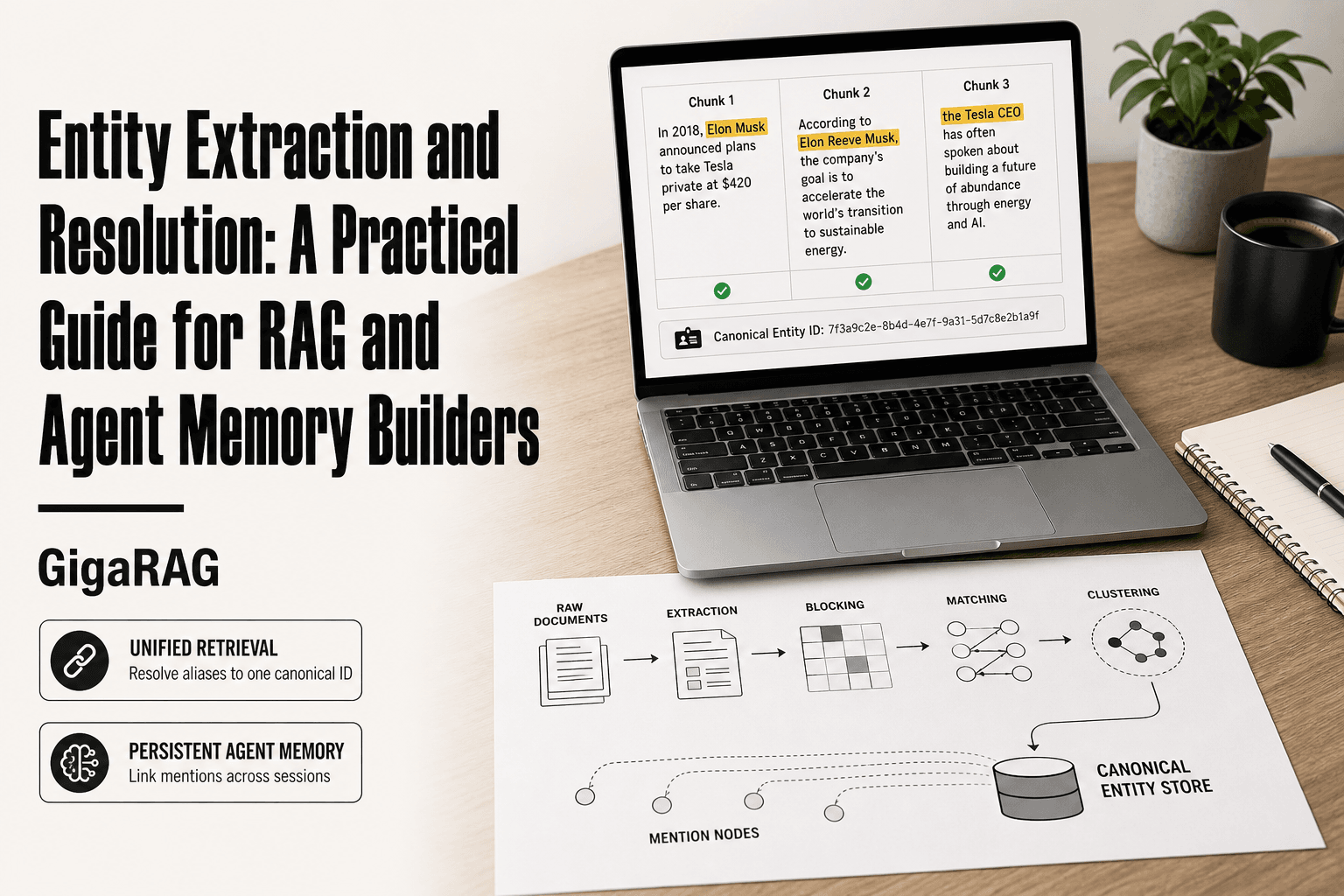
Entity extraction and resolution is the difference between a RAG pipeline that returns documents and one that knows who and what those documents are about. If you're building retrieval or agent memory, you've already hit the wall: three chunks mention "Elon Musk," "Elon Reeve Musk," and "the Tesla CEO," and your system treats them as three unrelated strings. Extraction finds those mentions and labels them as a person, an organization, a date. Resolution decides all three point to the same real-world entity and gives them one canonical ID. The good news is both are tractable in modern LLM-based systems. The main catch is that resolution is probabilistic, and it fails in predictable ways most guides won't tell you about. Platforms like GigaRAG bundle these steps into the ingestion path, but you still need to understand what's happening underneath. This guide covers the concepts, the implementation patterns that work, and the failure modes you'll hit.
| At a glance | Details |
|---|---|
| Extraction | Find mentions of people, orgs, places, products |
| Resolution | Decide which mentions refer to the same entity |
| Why it matters | Unifies fragmented retrieval and agent memory |
| Common approaches | Rules, embeddings, LLMs, or hybrid pipelines |
| Hard part | Ambiguity, aliases, and context-dependent identity |
| Typical stack | NER model + blocking + matching + canonical store |
In This Guide
- What Is Entity Extraction?
- Rules vs Embeddings vs LLMs vs Hybrid for Entity Resolution
- What Is Entity Resolution?
- Entity Extraction And Resolution: A Step-by-Step Guide
- The Critical Difference Between Extraction and Resolution
- How Entity Extraction and Resolution Fit into RAG Pipelines
- Entity Resolution for Agent Memory Systems
- Implementation Approaches: Rules, Embeddings, LLMs, and Hybrids
- What Entity Extraction and Resolution Cannot Do
- Common Failure Modes and How to Mitigate Them
- Choosing Tools for Entity Extraction and Resolution
- Final Thoughts on Entity Extraction and Resolution
What Is Entity Extraction?
Entity extraction is the process of automatically identifying and classifying named things in unstructured text: people, organizations, locations, dates, products, and any custom type you define. It turns raw sentences into structured data your RAG pipeline can index, filter, and query.
Here's why it matters for retrieval. A document that says "Elon Musk announced Tesla's new factory in Austin" contains four distinct entities. Without extraction, your vector index sees one blob of text. With extraction, you can tag that chunk with person=Elon Musk, org=Tesla, location=Austin, and retrieve it when a query mentions any of those things, even if the query uses different phrasing.
Entity extraction vs. named entity recognition (NER)
The honest answer is they're the same thing in practice. NER is the academic term. Entity extraction is what engineers call it when they're building a pipeline. Both mean the same operation: scan text, find spans that refer to named things, and label each span with a type.
The distinction that does matter is extraction versus resolution. Extraction finds the mentions. Resolution decides which mentions point to the same real-world thing. Keep the split in your head from the start.
Common entity types: people, organizations, locations, dates, products
Most off-the-shelf NER models handle a standard set: PERSON, ORG, LOCATION, DATE, and sometimes PRODUCT or MONEY. That covers a lot of ground for RAG use cases. A support ticket mentions a customer name, a company, a city, and a date. A news article mentions a politician, a party, a country, and an event date.
Custom entity types are where you'll likely need to do more work. If your domain is healthcare, you want DRUG, DOSAGE, CONDITION. If it's finance, you want TICKER, CURRENCY, REGULATOR. Standard models won't catch these out of the box. You'll need fine-tuning, few-shot prompting with an LLM, or a dictionary-based approach.
How extraction works in a RAG ingestion pipeline
Extraction happens at ingestion time, before or alongside chunking. The typical flow: you split a document into chunks, run each chunk through your extractor, and store the extracted entities as metadata on each chunk. That metadata becomes a filterable field in your vector database.
In practice, you'll run extraction as a separate step from embedding. The extractor produces structured entity records. The embedder produces vectors. Both get attached to the same chunk. At query time, you can filter by entity metadata before or after vector search, depending on your retrieval strategy.
The main catch is that extraction adds latency and cost to ingestion. For a million-document corpus, running an LLM-based extractor on every chunk gets expensive fast. Rule-based or dictionary approaches are cheaper but miss more. You'll need to decide where the accuracy-cost tradeoff lands for your use case.
[!note] Entity extraction finds mentions; entity resolution decides which mentions refer to the same real-world entity. You need both for coherent retrieval and memory.
Rules vs Embeddings vs LLMs vs Hybrid for Entity Resolution
| Factor | Rules / Deterministic | Embeddings / ML |
|---|---|---|
| Setup effort | High manual rule writing | Medium: need labeled pairs |
| Accuracy on clean data | Very high when patterns hold | High with good training data |
| Handling ambiguity | Poor: brittle to new cases | Moderate: depends on features |
| Cost per mention | Very low after setup | Low at inference |
| Best for | Structured, stable domains | Large-scale, repetitive matching |
What Is Entity Resolution?
Entity resolution is the process of determining when different records or mentions refer to the same real-world entity. Extraction finds the mentions. Resolution connects them. If your RAG pipeline extracts "Elon Musk" from one document, "Elon Reeve Musk" from another, and "the Tesla CEO" from a third, resolution is what decides those three strings point to one person.
That decision is not free. It requires comparing attributes, context, and sometimes external knowledge to make a probabilistic call. You're never 100% certain. You're deciding, based on evidence, whether two mentions should share one canonical entity ID.
Entity resolution vs. record linkage vs. deduplication
These terms overlap, but they're not interchangeable. Record linkage is the older, database-centric term: matching rows across tables that lack a shared key. Deduplication is narrower: finding duplicate records within a single dataset and merging them. Entity resolution is the broader umbrella that covers both, plus the harder case of resolving mentions across unstructured text, not just structured rows.
In a RAG context, you'll mostly hear "entity resolution" because your mentions come from free text, not clean database columns. The mechanics are similar, but the messiness is higher. Text mentions carry less structure than a customer record with a phone number and address.
The core challenge: no common identifier
Here's the problem in one sentence: real-world entities don't come with primary keys. A person has no universal ID stamped on every mention of them. Neither does a company, a product, or a location. So resolution has to infer identity from signals: name similarity, co-occurring attributes, context overlap, and sometimes external knowledge bases like Wikidata.
That inference is where things get hard. "Apple" could be the company or the fruit. "John Smith" could be any of thousands of people. Without a common identifier, you're left comparing fuzzy signals and setting thresholds, and thresholds are where most resolution systems fail.
Why resolution matters for agent memory
An agent that can't resolve entities has no persistent memory. Every conversation restarts from zero. If a user mentions "my company, Acme Corp" in session one, and says "Acme" in session three, an unresolved agent treats those as two separate things. It can't accumulate knowledge about the entity over time.
Resolution gives the agent a stable handle: a canonical entity ID that accumulates attributes, facts, and interaction history. That's the difference between a chatbot with a transcript and an agent that remembers who it's talking to and what it knows about them. The memory store becomes a graph of resolved entities, not a pile of raw messages.
[!tip] For RAG builders: store the canonical entity ID alongside each chunk's metadata, then use it as a filter or boost in retrieval. This turns 'find documents about Apple' into 'find documents about the entity Apple Inc.' and dramatically reduces false positives from the fruit or other Apples.
Entity Extraction And Resolution: A Step-by-Step Guide
- Define the entity types your RAG or agent memory actually needs (e.g., person, org, product) and the canonical attributes you will store.
- Choose an extraction method: start with a pretrained NER model or an LLM prompt, and measure recall on a sample of your own documents.
- Normalize mentions: lowercase, strip punctuation, and expand known aliases (e.g., 'IBM' vs 'International Business Machines').
- Generate candidate pairs using blocking keys (e.g., shared tokens, phonetic codes, or embedding similarity) to avoid comparing every pair.
- Score candidate pairs with a matcher: rules, a trained classifier, or an LLM judge; set a threshold that balances precision and recall for your use case.
- Cluster matched mentions into canonical entities and assign a stable ID; store aliases and provenance for each mention.
- Integrate canonical IDs into your retrieval index and agent memory so chunks and memories link to the same entity node.
- Monitor precision/recall on a labeled sample and retrain or adjust thresholds as your data drifts.
The Critical Difference Between Extraction and Resolution
Extraction finds mentions. Resolution connects identities. That's the whole distinction in eight words, but the consequences for your pipeline are large enough to break a system if you get it wrong.
Extraction finds mentions; resolution connects identities
Extraction is a labeling task. You scan text and tag spans: this is a person, this is an organization, this is a date. The output is a list of mentions with entity types. Nothing in that list tells you that two mentions refer to the same thing.
Resolution is a matching task. You take those mentions and decide which ones point to the same real-world entity. The output is a canonical ID that groups related mentions together. Extraction gives you fragments. Resolution gives you identity.
Example: 'Musk', 'Elon', and 'Tesla CEO' in three different documents
Document one says "Musk announced the launch." Document two says "Elon testified before Congress." Document three says "the Tesla CEO visited Berlin." Extraction tags all three as person mentions. That's it.
Without resolution, your entity index has three separate entries. A query for "Elon Musk" retrieves document two, maybe, but misses documents one and three because the strings don't match. Your retrieval is only as good as your string matching, and string matching is terrible at identity.
With resolution, all three mentions get the same canonical entity ID. A query for any one of them pulls all three documents. The system now knows something the raw text never said explicitly: Musk, Elon, and the Tesla CEO are one person.
Why both are required for reliable retrieval
Skip extraction and you have no entity index at all. Skip resolution and your index is fragmented, with duplicate entries for the same real-world thing. Retrieval quality depends on both working together.
The honest answer is that neither step is optional if you want entity-aware retrieval. Extraction without resolution is just a pile of labels. Resolution without extraction has nothing to resolve. You need the mentions first, then the connections.
How Entity Extraction and Resolution Fit into RAG Pipelines
You don't bolt entity extraction onto a RAG pipeline as an afterthought. It sits at four specific points: ingestion, indexing, query time, and post-retrieval. Each point does different work, and skipping any one of them leaves a gap you'll feel in retrieval quality.
Ingestion-time extraction: building an entity index
When a document enters your pipeline, you run extraction before you chunk it. That's deliberate. Chunking splits text into pieces sized for embedding, but entity mentions don't respect chunk boundaries. A person named in paragraph one might be referred to as "she" in paragraph four. Extract first, on the full document, and you catch mentions that chunking would scatter.
The output is a sidecar structure: a list of mentions with their entity types and positions in the source text. You store this alongside your chunks, not inside them. The entity index becomes a separate retrieval surface, one that answers "which documents mention this person" without forcing you to search raw text.
Resolution at index time: canonical entity IDs
After extraction, you resolve. Each mention gets mapped to a canonical entity ID, or flagged as new if no existing entity matches. This is where your entity store starts to look like a knowledge graph: nodes are entities, edges are mentions pointing back to source chunks.
The key decision is when to run resolution. At index time, you pay the cost once per document. At query time, you pay it on every retrieval. For most pipelines, index-time resolution is the right trade. Your entity store grows incrementally, and queries hit a pre-resolved structure instead of doing fuzzy matching on the fly.
Query-time entity-aware retrieval
Here's where the entity index earns its keep. A user asks "What did Elon Musk say about AI safety?" Your pipeline extracts "Elon Musk" from the query, resolves it to the canonical ID, and retrieves chunks linked to that ID. You're no longer matching strings. You're matching identity.
This catches what vector search misses. Embeddings are good at semantic similarity, but they don't know that "Musk" and "the Tesla CEO" are the same person. The entity index does. Hybrid retrieval, combining vector similarity with entity ID matching, consistently outperforms either alone because the two signals fail in different ways.
Post-retrieval entity enrichment
After you retrieve chunks, you can enrich the context you send to the LLM. Pull the resolved entity's profile from your entity store: aliases, related entities, recent mentions. Append that to the prompt.
The benefit is disambiguation. If a retrieved chunk says "Apple announced a new chip," the LLM doesn't know whether that's the company or the fruit. Your entity store does. Enrichment gives the model the context it needs to interpret the chunk correctly, which reduces hallucinations and wrong answers.
The honest catch is that enrichment adds latency. You're making an extra lookup per retrieved entity. For most RAG use cases, the accuracy gain is worth it. For high-throughput, low-latency systems, you may skip enrichment and accept the occasional misread.
Entity Resolution for Agent Memory Systems
A RAG pipeline retrieves documents. An agent has to remember. Those are different jobs, and message history alone won't cover the second one. If your agent only keeps a transcript of past turns, it forgets who the customer is the moment the session ends. Entity resolution is what turns scattered mentions into a persistent memory the agent can query.
Why agents need entity-level memory, not just message history
Message history is a log. It records what was said, in order, with no structure. When a user says "my company uses Snowflake" in turn three, that fact sits buried in a transcript. Ten turns later, the agent has no way to pull it forward unless the context window happens to still hold it.
Entity memory is different. You extract "Snowflake" as an organization, resolve it to a canonical entity, and attach the fact "customer's company uses Snowflake" to that entity. The next time the user asks about their data stack, the agent retrieves the entity, not the old message. It's the difference between remembering a conversation and knowing a customer.
Storing resolved entities in a memory store
The memory store is a database keyed by canonical entity ID. Each entity gets a profile: type, aliases, attributes, and pointers back to the conversations where it appeared. You can build this on a graph database, a document store, or even a vector database with entity embeddings. The choice matters less than the discipline: every new mention must resolve to an existing ID or create a new one.
Session memory lives and dies with the session. Long-term memory persists across sessions, which means your resolution logic has to run against everything the agent has ever seen, not just the current conversation. That's a harder problem, and it's where most agent memory systems quietly fall apart.
Updating entity knowledge as new information arrives
Entities change. A customer switches from Snowflake to BigQuery. A contact gets a new job title. Your memory store needs an update path, not just an append path.
When new information arrives, you resolve the mention, find the existing entity, and decide whether the new fact conflicts with what's stored. If it does, you need a policy: overwrite, version, or flag for confirmation. Overwriting is dangerous when the new fact is wrong. Versioning keeps history but complicates retrieval. Flagging for confirmation is safest but adds a step. There's no single right answer, but you need to pick one before you ship.
Example: an agent that remembers a customer's company across sessions
A support agent handles a ticket from Priya in session one. She mentions her company runs on AWS. The agent extracts "AWS" as an organization, resolves it, and stores the relationship: Priya works at a company using AWS.
Session two starts a week later. Priya asks about a billing issue. The agent doesn't have her message history from session one, but it does have her entity profile. It retrieves the AWS fact, sees she's on a corporate plan, and routes the ticket to the enterprise billing queue without asking her to repeat herself.
That's the payoff. Not smarter retrieval. Continuity.
Implementation Approaches: Rules, Embeddings, LLMs, and Hybrids
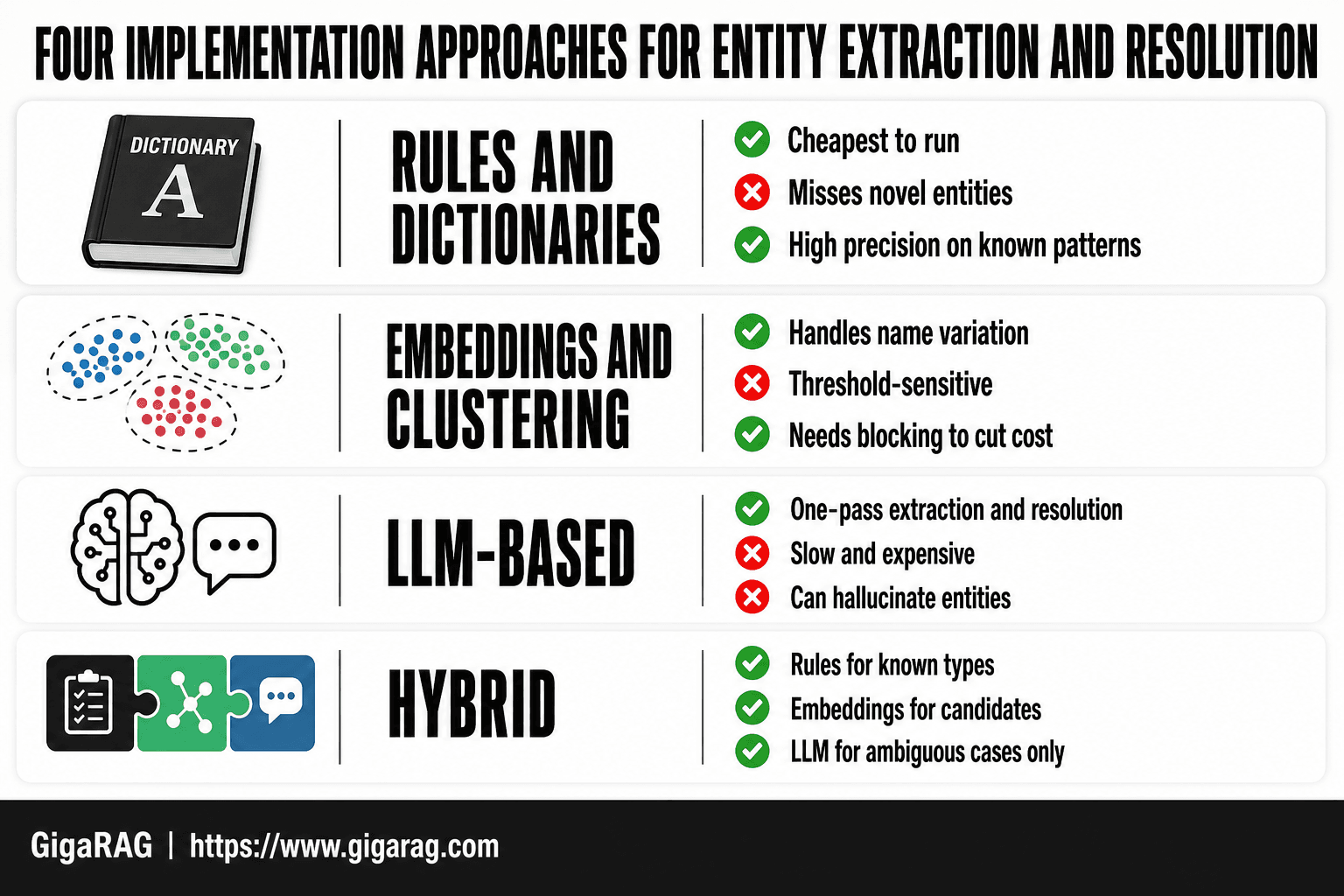
You can build entity extraction and resolution four ways: with rules, with embeddings, with LLMs, or with a combination. Each has a different failure profile, and the right choice depends on your data, your latency budget, and how much you're willing to babysit the system.
Rule-based and dictionary approaches
Rules are the oldest approach and still the cheapest to run. You define patterns: a regex for dates, a gazetteer of company names, a list of known aliases. When text matches, you extract or link. spaCy's NER models are rule-trained at their core, and many production systems still lean on dictionaries for high-precision entity types like product SKUs or internal project codes.
The main catch is coverage. Rules only catch what you've already written down. A new company name, a novel spelling, a person you've never seen before: all missed. Maintaining rule sets becomes a full-time job as your domain grows. For resolution, rules work well when you have a stable identifier, like an email address or a customer ID. Without one, they fall apart fast.
Embedding-based similarity and clustering
Embeddings turn entity mentions into vectors, then you measure distance. Two mentions are the same entity if their vectors sit close enough. This handles variation that rules can't: "Elon Musk" and "the Tesla CEO" won't match a dictionary, but their embeddings land near each other because they appear in similar contexts.
The trade-off is threshold sensitivity. Set the similarity cutoff too high and you under-merge, leaving the same entity fragmented across multiple IDs. Set it too low and you over-merge, collapsing "Apple the company" and "apple the fruit" into one entity. Blocking helps: you only compare candidates that share a token or a type, which cuts the quadratic comparison cost. But blocking itself can miss matches when aliases share nothing in common.
LLM-based extraction and resolution
LLMs handle both jobs in one pass. You prompt the model to extract entities and link them to existing IDs, and it reasons over context in ways rules and embeddings can't. The arXiv multi-stage approach uses an LLM to extract, then another pass to resolve, with a verification step in between. That's the pattern to copy if you go this route.
The honest answer is that LLMs are slow and expensive compared to the other two. A single extraction call might take a second or more, which is fine for ingestion but painful at query time. They also hallucinate: the model invents an entity that isn't in the text, or links two mentions that a human would keep separate. You need a verification step, and that step needs to be cheap or you've just moved the cost around.
Hybrid approaches: when to combine methods
Most production systems are hybrids because no single method covers the failure modes of the others. A common pattern: rules for high-precision extraction of known types, embeddings for candidate generation during resolution, and an LLM for the final disambiguation pass on ambiguous cases only.
That last part matters. You don't run the LLM on every mention. You run it on the 5% of cases where embeddings are uncertain, where the similarity score sits in the gray zone between 0.7 and 0.85. That keeps costs down while still catching the hard cases. The rule of thumb: use the cheapest method that works for the majority, escalate only when confidence drops.
What Entity Extraction and Resolution Cannot Do
Every system that extracts and resolves entities fails sometimes. The failure isn't a bug you can patch out. It's built into the problem. Here's what you should not expect, no matter which approach you picked from the previous section.
Resolution is probabilistic, not deterministic
Resolution returns a confidence score, not a verdict. When your system links "Elon Musk" in document A to "Elon Reeve Musk" in document B, it's saying these are probably the same person. Probably. The score might be 0.92, which feels certain, but 8% of the time that link is wrong. You can't eliminate the uncertainty. You can only decide what score threshold you'll trust and what you'll do with the links that fall below it.
Extraction misses novel or ambiguous entities
Any extractor trained on past data will miss things it hasn't seen. A new company name, a product launched last week, a person who just became relevant: all invisible to a model that learned from older text. Rules miss them because nobody wrote the pattern yet. Embeddings miss them because there's no context to anchor the vector. LLMs do better, but they still skip entities when the text is dense or the mention is implicit. "The CEO announced layoffs" contains an entity, but no extractor reliably pulls it out without more context.
LLM hallucination in entity extraction
LLMs invent entities. The model reads a sentence about a merger and confidently extracts "Acme Corp" when the text never names a company. Or it links two mentions that a human would keep separate because the model pattern-matched a surface similarity. This isn't rare. It happens often enough that you need a verification step, and that step adds latency and cost. If you skip verification, your entity store fills with ghosts.
The cold-start problem for new entities
A new entity has no history. No prior mentions, no aliases, no embedding cluster to join. Your resolution system can't link it to anything because there's nothing to link it to. The first time "Nova Labs" appears in your corpus, it gets a fresh ID. The second time, if the mention is phrased differently, it might get another fresh ID. Until enough mentions accumulate to form a pattern, resolution is guessing. This is why early-stage entity stores are fragmented, and why the problem gets worse before it gets better.
Common Failure Modes and How to Mitigate Them
The previous section covered what these systems can't do in principle. This one covers what goes wrong in practice, and what you can actually do about it. Each failure mode has a mitigation, but none of them are free.
Over-merging: when two entities become one
Over-merging happens when your resolution system links two distinct entities because they share a name or enough surface features. "John Smith" the customer in London and "John Smith" the vendor in Toronto become one entity. Your agent then greets the vendor with the customer's order history. That's a real failure, not a theoretical one.
The fix is context. Add location, organization, or role as blocking keys before you run similarity matching. Two "John Smith" records that don't share a company or city never get compared. You'll still over-merge occasionally, but blocking cuts the error rate sharply.
Under-merging: when one entity stays fragmented
Under-merging is the opposite problem. "Elon Musk", "Elon Reeve Musk", and "the Tesla CEO" all refer to one person, but your system assigns three different IDs. Your retrieval returns three separate entity cards, and your agent can't connect them.
The mitigation here is alias expansion. Maintain an alias table that maps known variants to a canonical ID. Populate it from structured sources like Wikidata, then update it as your system encounters new variants. LLMs help here too: ask the model to generate likely aliases for each extracted entity before resolution runs.
Threshold sensitivity in similarity matching
Your similarity threshold is a dial, and it's set wrong somewhere. Set it too high and you under-merge. Set it too low and you over-merge. There's no single correct value. The threshold that works for people names fails for product names, and the threshold that works for English fails for languages with different name structures.
The practical fix is per-type thresholds. People, organizations, locations, and products each get their own similarity cutoff. Tune them on labeled data, not intuition. And log every link that falls within 10% of the threshold so you can review the borderline cases manually.
Context-dependent identity: "Apple" the company vs. the fruit
"Apple" in a financial report is a company. "Apple" in a recipe is a fruit. Same string, different entity. No string-matching or embedding approach resolves this without context. The word "apple" embeds near both "iPhone" and "orchard", so the vector alone can't decide.
The mitigation is document-level context. Before resolving an ambiguous mention, look at the surrounding text for disambiguating signals: other entities, topic keywords, or the document's source domain. An LLM can do this well if you prompt it to explain its reasoning before committing to a link. It's slower and costs more, but it's the only reliable way to handle names that mean different things in different contexts.
Choosing Tools for Entity Extraction and Resolution
The honest answer to "what's the best software for entity resolution" is: it depends on your data volume, your latency budget, and whether you need custom entity types. No single tool wins across all three.
Open-source libraries (spaCy, Stanford NER, etc.)
spaCy is the default starting point for most builders. It runs locally, costs nothing, and handles common entity types (people, orgs, locations, dates) out of the box. Stanford NER offers stronger accuracy on formal text but runs slower and requires Java. Both let you train custom models, though that takes labeled data and real effort.
The main catch: these libraries do extraction well but resolution poorly. You'll need to build the matching, blocking, and canonicalization layers yourself.
Cloud APIs (AWS Comprehend, Azure Text Analytics, etc.)
Cloud APIs trade control for convenience. AWS Comprehend and Azure Text Analytics handle extraction at scale without infrastructure work. You pay per unit of text, and latency is network-bound. Custom entity support exists but is limited compared to training your own model.
For resolution, these APIs offer entity linking to knowledge bases like Wikipedia, but not arbitrary record linkage across your own documents.
Integrated platforms for RAG and agent memory
Platforms like GigaRAG bundle extraction, resolution, and retrieval into one pipeline. That's the appeal: you don't stitch together five libraries. The trade-off is less control over the individual stages. If you need a custom resolution algorithm or a specific blocking strategy, a platform may not expose those knobs.
Evaluation criteria: accuracy, cost, latency, custom entity support
Test before you commit. Run your own labeled data through any candidate tool and measure precision and recall on extraction, then on resolution. Check per-1,000-document cost for cloud APIs. Measure end-to-end latency from raw text to resolved entity ID. And confirm the tool supports your custom entity types, because "person" and "organization" won't cover every RAG use case.
Final Thoughts on Entity Extraction and Resolution
Entity extraction and resolution aren't optional polish for RAG and agent memory systems. They're the difference between a system that retrieves documents and one that knows who and what those documents are about.
The pattern is straightforward: extract mentions at ingestion time, resolve them to canonical entity IDs, and store those IDs alongside your chunks. Retrieval then works on entities, not just text similarity. Agents get persistent memory that survives across sessions because "Elon Musk" in one conversation and "the Tesla CEO" in another resolve to the same entity.
The honest limits still apply. Resolution is probabilistic. Extraction misses novel entities. LLMs hallucinate. You'll tune thresholds, build blocking rules, and accept that some entities stay fragmented no matter what you do.
If you're building this yourself, start with a library like spaCy for extraction and add resolution incrementally. If you want the pipeline assembled for you, platforms like GigaRAG handle the extraction-to-resolution-to-retrieval flow without the stitching. Either way, entity extraction and resolution is foundational work. Skip it, and your retrieval quality caps out early.
Frequently Asked Questions
What does entity extraction mean?
Entity extraction (often called named entity recognition, or NER) is the process of identifying spans of text that refer to real-world objects—such as people, organizations, locations, dates, or products—and classifying them into predefined types. In a RAG pipeline, extraction turns raw text into structured mentions that can be linked and retrieved.
What does entity resolution mean?
Entity resolution (also called entity linking or deduplication) is the process of determining whether different mentions refer to the same real-world entity. For example, 'Apple', 'Apple Inc.', and 'AAPL' might all resolve to the same organization. Resolution typically involves blocking, matching, and clustering steps to group mentions into canonical entities.
Can you explain what NER is and how it works?
Named Entity Recognition (NER) is a subtask of information extraction that locates and classifies named entities in text. Modern NER often uses transformer-based models (e.g., BERT variants) fine-tuned on labeled data, or large language models prompted to output entity spans. It works by predicting token-level labels (like B-PER, I-PER) and then grouping them into entity mentions.
What is the best software for entity resolution?
There is no single best tool; the right choice depends on your scale, data, and team. Open-source libraries like spaCy (for NER), Dedupe, and Splink offer strong baselines, while commercial platforms provide managed resolution. For RAG builders, a hybrid approach—pretrained NER plus a lightweight matcher—often balances cost and accuracy without locking into a vendor.
How does entity resolution improve RAG retrieval?
By linking mentions to canonical entities, resolution lets you retrieve all chunks about the same entity even if they use different names. This reduces fragmentation and improves recall for queries about specific people, organizations, or products. It also enables entity-centric filtering and ranking in your vector store.
What are common failure modes in entity resolution?
Common failures include over-merging distinct entities with similar names (e.g., 'John Smith' vs 'John Smyth'), under-merging aliases that lack shared context, and handling entities that change over time (e.g., a company rebrand). Domain-specific jargon and ambiguous abbreviations also trip up both rules and models. No approach is perfect; you must measure and tune for your data.
Can LLMs replace traditional NER and entity resolution?
LLMs can perform both extraction and resolution in a zero- or few-shot manner, which is powerful for messy or evolving schemas. However, they can be slower, costlier, and less consistent than specialized models at scale. Many production systems use a hybrid: LLMs for hard cases or bootstrapping, and lighter models for high-volume processing.
About GigaRAG
GigaRAG is for agent memory and RAG pipeline builders. get this right. Whether you are working through entity extraction and resolution or something adjacent, we publish what we have actually tested, including where it falls short.