FDE Portfolio Projects That Prove You Can Ship
Most FDE portfolio advice you'll find online is written for generalist engineers who built a CRUD app and called it a day. That advice won't help you if you're building agent memory systems or RAG pipelines, because your interviewers aren't asking about your React frontend. They're asking whether you can ship a retrieval system that doesn't hallucinate, stays fast under load, and remembers context across sessions.
Here's the problem: almost no portfolio guidance speaks to that. You're left guessing which FDE portfolio projects actually prove you can handle deployment, integration, and the messy reality of customer data. GigaRAG is built for exactly this kind of work, but even the right tool won't save a portfolio that doesn't show your thinking.
This guide covers three FDE portfolio projects built around agent memory and RAG challenges, the evaluation metrics interviewers actually check, and what a portfolio cannot prove no matter how polished it looks.
| At a glance | Details |
|---|---|
| Role Focus | Forward Deployed Engineer (FDE) |
| Key Skills | Agent memory, RAG pipelines, deployment |
| Project Types | Memory layer, retrieval evaluation, integration |
| Metrics to Show | Retrieval precision, latency, memory accuracy |
| What Portfolio Proves | You can build and ship production-grade systems |
| What It Can't Prove | Scale and incident response experience |
In This Guide
- What Interviewers Actually Look For in FDE Portfolio Projects
- Agent Memory vs RAG Pipeline Projects: Which to Build?
- What Is the FDE Role and Why Is It Booming?
- FDE Portfolio Projects: A Step-by-Step Guide
- FDE Portfolio Projects for Agent Memory Builders
- How to Measure Success: Evaluation Metrics for FDE Portfolio Projects
- What to Avoid: Red Flags in FDE Portfolio Projects
- How to Present Your FDE Portfolio Projects
- What a Portfolio Cannot Prove
- Portfolio Projects vs. Open-Source Contributions
- Final Thoughts on FDE Portfolio Projects
What Interviewers Actually Look For in FDE Portfolio Projects
FDE interviewers look for evidence you can ship working software into a real environment, not just write code that passes tests. They scan for deployment proof, customer-facing problem solving, and a GitHub repo that tells a clear story without needing you in the room to explain it.
Signals of deployment readiness
A repo with a README and some unit tests won't get you past the first screen. Interviewers want to see that your project ran somewhere outside your laptop. A live URL, a Docker image, a deployed API endpoint, a CI pipeline that actually built and shipped. The bar isn't production scale. It's proof you understand what "deployed" means: environment variables, error handling, logging, a fallback when the model call fails.
For RAG and agent memory builders, deployment readiness shows up in specific ways. Did you persist the memory layer to a database, or does context reset every time the process restarts? Did you handle rate limits on your embedding calls? Did you log retrieval latency so you could debug a slow query? These details signal you've thought past the demo.
Evidence of customer-facing problem solving
FDE work starts with a customer's messy, specific problem and ends with software that solves it. Interviewers look for projects that name a real user and a real constraint. Not "a chatbot for documents" but "a support agent that answers questions from 40,000 Zendesk tickets without leaking PII."
The honest answer is that most portfolio projects fail this test. They solve a technical problem the builder found interesting, not a problem someone else actually had. You can fix that by writing the problem statement first, in plain language, before any code. If you can't name who uses it and why, it's not an FDE project yet.
Why GitHub repos matter more than resumes
Resumes claim. Repos show. An interviewer can open your repo and see the commit history, the README, the tests, the deployment config. They can tell whether you built it over a weekend or iterated over weeks. They can see if you wrote documentation for someone else to run it.
The main catch is that a repo only helps if it's readable in under five minutes. A clear README with a one-line problem statement, a screenshot or demo link, and setup instructions beats a technically impressive codebase buried in unexplained folders. Interviewers don't have time to reverse-engineer your architecture. Make the first screen answer their questions.
[!note] A portfolio project cannot prove you can handle production-scale traffic or respond to live incidents; those are typically assessed through on-the-job experience or interviews.
Agent Memory vs RAG Pipeline Projects: Which to Build?
| Factor | Agent Memory Project | RAG Pipeline Project |
|---|---|---|
| Core Challenge | Designing persistent, context-aware memory for agents | Building robust retrieval and ranking systems |
| Key Metrics | Memory accuracy, recall, latency | Retrieval precision, recall, latency |
| Integration Complexity | High: requires state management and consistency | Medium: focuses on data ingestion and querying |
| FDE Relevance | Demonstrates handling stateful, long-running systems | Shows ability to deploy and optimize data pipelines |
| Typical Tools | Vector databases, session stores, caching layers | Embedding models, vector search, rerankers |
What Is the FDE Role and Why Is It Booming?
A Forward Deployed Engineer sits between the product team and the customer. They take software that works in the lab and make it work inside a messy, specific, real-world environment. That means integration, configuration, debugging on-site, and translating customer pain into engineering fixes. The role is part engineer, part consultant, part firefighter.
Origins of the FDE role
Palantir popularized the title, but didn't invent the function. The company built its early business by embedding engineers directly inside customer organizations, often government agencies, to deploy its data platforms. Those engineers wrote code, configured systems, and sat with users until the software actually produced value. Other enterprise companies noticed and copied the model.
Why demand is rising
Companies are buying AI tools faster than they can deploy them. The gap between a working model and a working system inside a customer's infrastructure is wide, and most software engineers don't want to close it. FDEs do. Demand tracks the rise of RAG pipelines and agent systems, which break in customer-specific ways that no amount of internal testing catches.
How FDE differs from traditional SWE
A traditional software engineer builds features against a spec. An FDE starts with a customer's problem and works backward. The deliverable isn't a pull request. It's a working deployment, a trained user, and a documented integration. The honest answer is that FDE work is messier, more social, and harder to measure than feature work. That's exactly why portfolio projects that show deployment and customer context carry weight.
[!tip] For FDE roles, focus on projects that integrate multiple systems (e.g., a RAG pipeline that feeds an agent with memory) and include a monitoring dashboard to show you think about operations.
FDE Portfolio Projects: A Step-by-Step Guide
- Choose a project that solves a real problem in agent memory or RAG pipelines.
- Define clear evaluation metrics (e.g., retrieval precision, latency, memory accuracy).
- Implement the system with a focus on production readiness (error handling, logging, scalability).
- Deploy the project on a cloud platform (AWS, GCP, or Azure) and document the architecture.
- Create a demo or write-up that highlights the problem, solution, and measured outcomes.
- Open-source the code on GitHub with a clear README and usage instructions.
- Prepare to discuss trade-offs, failures, and lessons learned in interviews.
FDE Portfolio Projects for Agent Memory Builders
Most portfolio advice tells you to build a to-do app or a weather dashboard. That's fine for a junior SWE role. It says nothing about whether you can ship a retrieval system that holds context across turns, evaluates its own output, and plugs into real enterprise data. If you're building agent memory and RAG pipelines, your portfolio should prove you can do those three things.
Project: Build an agent memory layer with persistent context
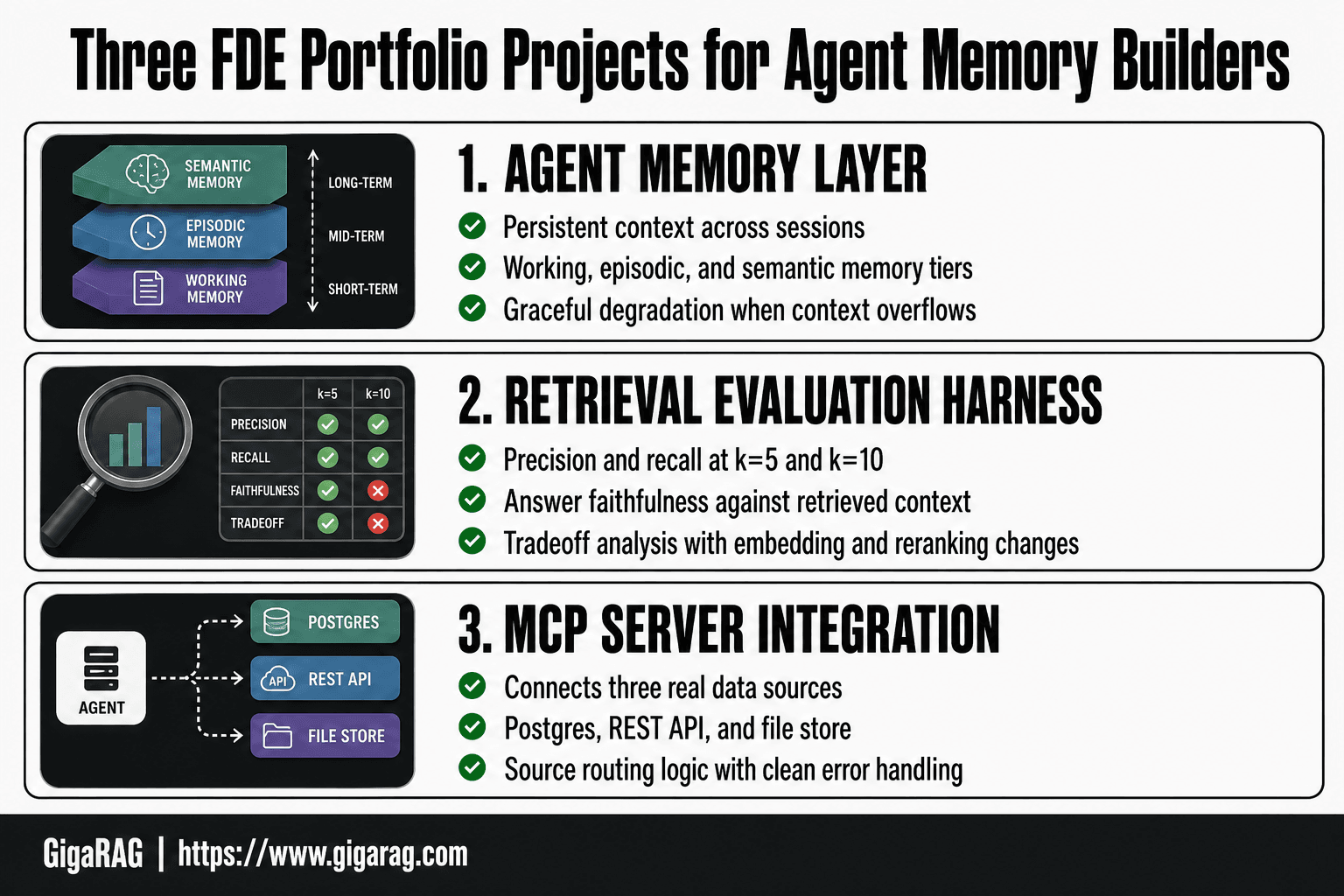
Start with a single agent that answers questions over a document set. Then add memory. Not a vector store bolted on as an afterthought. A real memory layer with three tiers: working memory for the current conversation, episodic memory for past sessions, and semantic memory for facts the agent has learned.
Here's what happens behind the scenes. Each turn gets summarized and stored. On the next turn, the agent retrieves relevant past context before answering. You'll hit the hard problems fast: what gets stored, what gets retrieved, when memory hurts instead of helps. That's the point. Document those decisions in an architecture decision record. Interviewers read those.
The main catch is that a toy memory layer is easy. One that degrades gracefully when context overflows, when summaries drift, when the same fact appears in three sessions with conflicting values, that's the project that gets you hired.
Project: Evaluate retrieval quality with concrete metrics
Build a small RAG pipeline, then build the evaluation harness around it. Generate a test set of 50 to 100 questions with known relevant passages. Measure retrieval precision and recall at k=5 and k=10. Measure answer faithfulness against the retrieved context. Measure latency end to end.
Don't stop at reporting numbers. Show what you changed when the numbers were bad. Swapped the embedding model and precision went up 8 points. Added reranking and latency went up 40ms but recall improved 12 points. That tradeoff analysis is the actual work of an FDE.
Keep in mind that synthetic test sets have limits. Real user queries are messier, more ambiguous, and full of domain shorthand. Say that in your README. It reads as honesty, not weakness.
Project: MCP server connecting 3+ real data sources
Build an MCP server that exposes three real data sources to an agent: a Postgres database, a REST API, and a file store or document repository. The agent has to decide which source to query based on the user's question. That routing logic is where the project gets interesting.
In practice, you'll spend most of your time on schema mapping, error handling, and auth. That's the job. An FDE who can show a working MCP server with clean error messages and a documented setup process is showing deployment readiness, not just coding ability.
The honest answer is that this project won't prove you can handle production scale. It will prove you can integrate real systems and make them talk to each other, which is the part most candidates skip.
How to Measure Success: Evaluation Metrics for FDE Portfolio Projects
A portfolio project without numbers is a story. With numbers, it's evidence. Interviewers can't run your code during a screen. They read your README, look at your charts, and decide whether you know what "better" means. So measure everything you can, and report it plainly.
Retrieval precision and recall
Precision is the share of retrieved passages that are relevant. Recall is the share of relevant passages you actually retrieved. Both matter, and they trade off. Report both at k=5 and k=10, not just one number.
Build a test set of 50 to 100 questions with known relevant passages. Run your pipeline, score the results, and put the table in your README. A precision of 0.82 at k=5 with a recall of 0.71 tells an interviewer far more than "good retrieval."
The main catch is that your test set is synthetic. Real queries are messier. Say so, then show you know the gap exists.
Latency benchmarks
Latency is the time from query to answer. Report it end to end, not just the embedding call. Include retrieval time, reranking time, and generation time as separate rows.
Measure p50 and p95, not just average. A p95 of 900ms with a p50 of 300ms tells a real story about tail behavior. If you added reranking and latency jumped, show the tradeoff against recall gains. That's the analysis interviewers want.
Memory accuracy and consistency
If your project has an agent memory layer, measure whether the agent remembers correctly. Track how often it retrieves the right past context, how often it contradicts itself across turns, and how often stale memory changes an answer.
A simple metric: run 20 multi-turn conversations, then check each final answer against the ground truth context. Report the error rate. If memory hurts performance on some turns, say which ones and why.
Don't pad this section with adjectives. Numbers, tables, and one honest sentence about what the numbers don't capture.
What to Avoid: Red Flags in FDE Portfolio Projects
Some projects hurt you more than no project at all. The common thread is a portfolio that looks like coursework, not like work. Interviewers see hundreds of repos. They can tell the difference in under a minute.
Overly generic projects
A todo app with a RAG wrapper is still a todo app. If the project could be built by following a tutorial, it doesn't prove you can ship. Pick a problem with constraints: a specific data source, a real latency budget, an awkward integration. Constraints force decisions, and decisions are what interviewers read for.
No deployment evidence
A repo with no deployed instance is a promise, not a proof. Deploy it. A live URL, even a small one, shows you handled environment variables, secrets, and a hosting provider. If you can't deploy, say why in the README. A missing deployment with no explanation reads as unfinished.
Ignoring data privacy
If your demo ingests real user data, redact it. Interviewers notice when a portfolio project leaks emails or API keys. Use synthetic data or a public dataset with a clear license. Name the license in your README. A candidate who ignores privacy in a demo will ignore it in production.
How to Present Your FDE Portfolio Projects
The project itself is half the work. The other half is making it legible to a reviewer who has 90 seconds and 40 other repos to look at. Presentation is where most candidates lose points they already earned.
Structuring your GitHub repo
Your README is the first thing a reviewer reads. Make it answer three questions in the first screen: what this does, why it exists, and how to run it. Put the architecture diagram near the top, not buried at the bottom. A reviewer who has to scroll to understand your project will move on.
Keep the repo focused. One project, one repo. If you built an evaluation framework and an MCP server, those are two repos. A monorepo with five half-finished experiments reads as clutter, not range.
Handling confidential or private work
Most FDE work happens behind an NDA. You can't push the real thing to GitHub. That's fine. What you can do is build a sanitized version: same architecture, same problem shape, synthetic data. Write a README section that says what you changed and why. "This mirrors a production system I built for a logistics client. Names and data are synthetic." That sentence tells the reviewer you've done the real work without breaking an agreement.
Don't describe confidential work in vague terms. "I worked on a large-scale system" proves nothing. Specifics about constraints, tradeoffs, and metrics do.
Writing a compelling case study
A case study is a short document that walks through a problem, your approach, and the outcome. Keep it under 500 words. Start with the problem and the constraint. Then the decision you made and why. End with the metric that moved.
The honest answer is that most case studies fail because they skip the constraint. A project with no constraints has no decisions, and decisions are what interviewers read for.
What a Portfolio Cannot Prove
A portfolio shows what you built. It doesn't show what you survived. Interviewers know this, and they'll probe for the gaps. Being honest about those gaps is better than pretending they don't exist.
Scale and load
Your demo handles 10 requests a minute. Production handles 10,000. A portfolio project can't show how your retrieval pipeline behaves when the index has 50 million vectors, or when 200 agents hit the memory layer at once. You can simulate load with tools like Locust, and you should. But a simulation is not the same as a real user base hammering a system at 3 a.m. Say so in your case study. The reviewer will respect the honesty more than a fake benchmark.
Production incident response
Nobody's portfolio includes the night the vector database ran out of memory and took down three customer deployments. That's the work that actually matters in an FDE role. You can't fabricate it, and you shouldn't try. What you can do is write a post-mortem for an incident you caused in your own project. Document what broke, how you diagnosed it, and what you changed. That shows the thinking pattern without pretending you've been paged at 2 a.m.
Real customer interaction
The hardest thing to fake is the conversation where a customer says one thing, means another, and the actual requirement is a third thing entirely. Portfolio projects have no customers. You are the user, the PM, and the engineer. That's fine for demonstrating technical skill. It proves nothing about your ability to translate vague business needs into a working system. If you have any client work, even freelance, put it in the case study. If you don't, say what you'd ask a customer in the first week.
Portfolio Projects vs. Open-Source Contributions
The honest answer is it depends on what you're missing. Portfolio projects prove you can ship something end to end. Open-source contributions prove you can work inside someone else's codebase. FDE hiring leans on both, but at different stages.
When portfolio projects win
Portfolio projects win when you need to show ownership. A memory layer you built from scratch, with your own evaluation harness and your own post-mortem, tells a story no merged pull request can. You controlled the tradeoffs. You can explain why you chose one embedding model over another, or why you capped context at a certain size. That narrative is what interviewers pull on. Open-source work rarely gives you that depth because you're fitting into decisions someone else already made.
When open-source contributions win
Open-source wins when you need to prove you can read unfamiliar code and follow project conventions. A merged PR to a RAG framework like LlamaIndex or LangChain shows you can navigate a large codebase, write tests that maintainers accept, and respond to review feedback. That's closer to what an FDE does on day one at a customer site: drop into a system you didn't build and fix it.
How to combine both
Don't choose. Do one of each. Build the portfolio project to show depth and ownership. Make two or three solid open-source PRs to show you can collaborate. The combination covers more ground than either alone.
Final Thoughts on FDE Portfolio Projects
You don't need ten projects. You need two or three that show deployment, evaluation, and honesty about what broke. That's the whole game. Interviewers skim repos in minutes, and they're looking for evidence you shipped something real, measured it, and can talk about the parts that didn't work.
The FDE portfolio projects that stand out for agent memory and RAG builders share three traits. First, they run somewhere a reviewer can hit them, not just in a README. Second, they carry numbers: retrieval precision, latency, memory accuracy. Third, they name their failures. A post-mortem that says "we hit 340ms p95 latency and here's why" beats a polished demo with no caveats.
What a portfolio can't prove matters just as much. It can't show how you handle a production incident at 2am. It can't show how you talk to a frustrated customer. It can't show scale beyond what your free tier allowed. Say that plainly in your case study. Interviewers respect the boundary more than the bluff.
If you're building an agent memory layer or a RAG evaluation harness, GigaRAG gives you a starting point that handles the plumbing: persistent memory, retrieval, and evaluation hooks you can wire into your own project. It won't build the portfolio for you. But it removes enough boilerplate that you can spend your time on the parts interviewers actually ask about.
Build less. Measure more. Be honest about the rest.
Frequently Asked Questions
What is the FDE project?
The FDE project refers to a portfolio project that demonstrates skills relevant to a Forward Deployed Engineer role, such as building and deploying agent memory systems or RAG pipelines. It should showcase your ability to solve real-world problems and integrate systems.
What are some good ideas for portfolio projects?
Good ideas include building a memory layer for an agent that persists context across sessions, creating a RAG pipeline with evaluation metrics for retrieval quality, or developing an end-to-end system that integrates multiple data sources. Focus on projects that highlight deployment and customer-facing problem-solving.
Did Palantir create FDE?
Palantir is widely credited with popularizing the Forward Deployed Engineer role, but the concept of embedding engineers with customers exists in other companies as well. The role emphasizes direct customer engagement and rapid deployment of solutions.
Is the FDE role booming?
The demand for Forward Deployed Engineers has grown as companies seek to bridge the gap between engineering and customer success, particularly in AI and data-intensive fields. However, the role's prevalence varies by industry and company size.
How do I present my FDE portfolio projects?
Present projects by clearly stating the problem, your approach, the technologies used, and measurable outcomes. Include a demo or code repository, and be ready to discuss challenges and how you overcame them.
What metrics should I include in my portfolio project?
Include metrics such as retrieval precision, recall, latency, and memory accuracy. These demonstrate your ability to evaluate and optimize system performance, which is crucial for FDE roles.
About GigaRAG
GigaRAG is for agent memory and RAG pipeline builders. get this right. Whether you are working through FDE portfolio projects or something adjacent, we publish what we have actually tested, including where it falls short.


