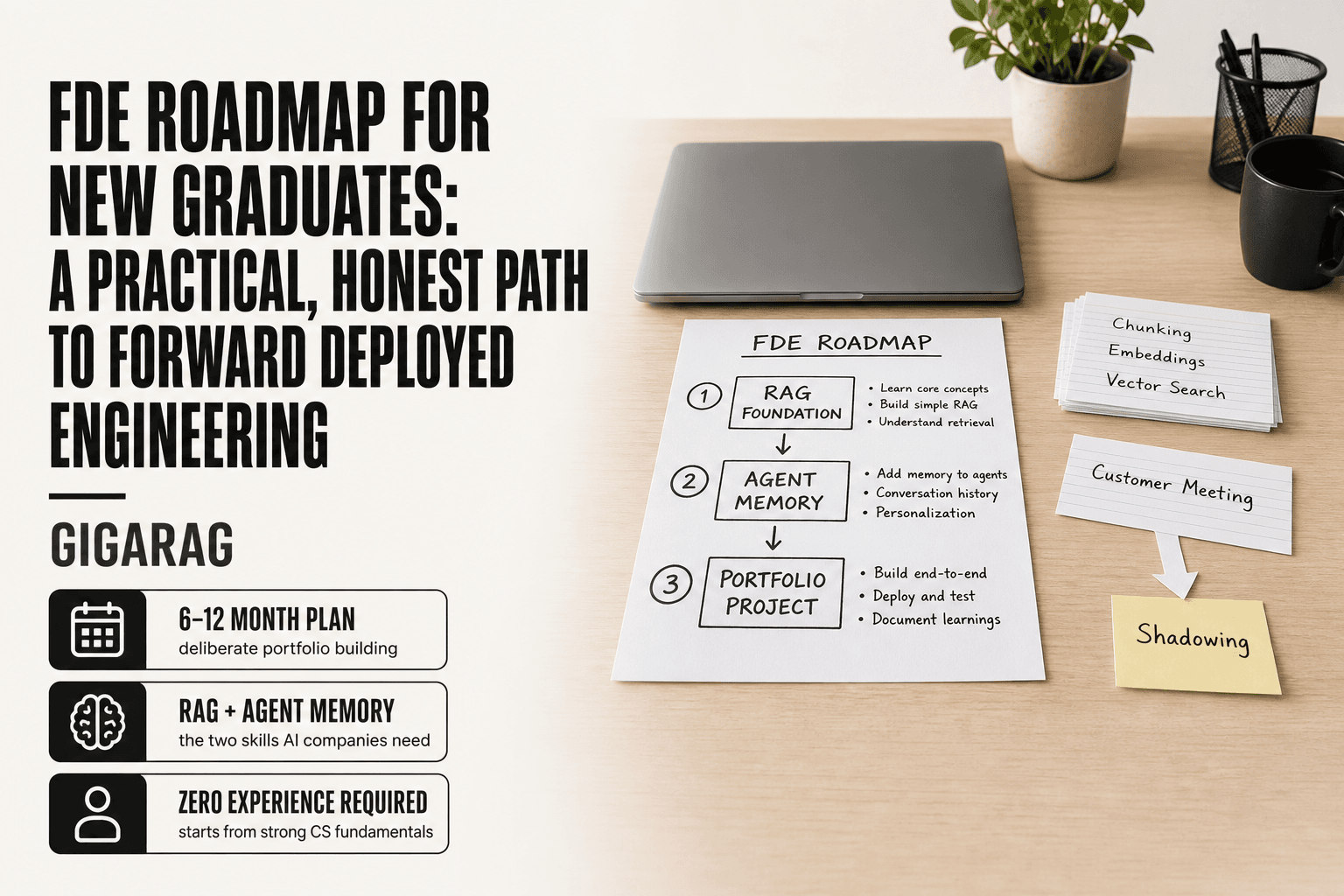
FDE Roadmap for New Graduates: A Practical, Honest Path to Forward Deployed Engineering
FDE roadmap for new graduates sounds like a contradiction: every AI company wants forward deployed engineers right now, but every roadmap assumes you've already shipped software into a customer's environment. You haven't. You just finished your degree, and the job postings asking for three years of deployment experience don't tell you how to get the first year. This guide starts from zero. No assumed experience, no career-transition framing, no vague advice about networking. It's a 6-12 month plan built around the two skills AI companies actually need from FDEs: agent memory systems and RAG pipeline building. You'll learn both by building a portfolio project that runs, not by collecting certificates. GigaRAG shows up later as the tool you'll use to implement memory persistence without writing glue code from scratch. The honest answer is you won't lead customer engagements on day one. This guide covers the FDE role itself, the skill stack you need, a week-by-week build plan, and what to expect in your first year.
| At a glance | Details |
|---|---|
| Target role | Forward Deployed Engineer (FDE) at AI companies |
| Starting point | Zero professional experience, strong CS fundamentals |
| Core skills | RAG pipelines, agent memory, deployment, client-facing debugging |
| Timeline | 6–12 months of deliberate portfolio building |
| Portfolio project | One production-style RAG app with persistent agent memory |
| First-year reality | You support, you don't architect; expect heavy shadowing |
In This Guide
- What Is a Forward Deployed Engineer?
- FDE vs. Traditional Software Engineer: What New Grads Should Know
- The FDE Skill Stack for New Graduates
- FDE Roadmap For New Graduates: A Step-by-Step Guide
- Phase 1: Build Your RAG Foundation (Weeks 1-4)
- Phase 2: Master Agent Memory Systems (Weeks 5-8)
- Phase 3: Build a Portfolio RAG Project (Weeks 9-16)
- What New Graduates Cannot Do (And Should Not Expect)
- FDE Roadmap for New Graduates: Salary and Market Reality
- Common Mistakes When Following an FDE Roadmap
- Your First 90 Days as a Junior FDE
What Is a Forward Deployed Engineer?
A forward deployed engineer (FDE) is a software engineer who works directly inside a customer's environment, building and deploying solutions on-site rather than shipping generic product features from a central office. The role blends engineering, consulting, and customer support into one job.
FDE vs. traditional software engineer
A traditional software engineer builds features for a broad user base. They write code, open pull requests, and rarely talk to customers. An FDE does the opposite. They sit with a specific customer, understand that customer's data and workflows, and build custom integrations, pipelines, or tools that solve that customer's problem right now.
The code an FDE writes often never becomes a product feature. It's bespoke. It lives in the customer's cloud account, connects to the customer's internal systems, and gets maintained by whoever owns the relationship. That's the job.
Why AI companies need FDEs
AI products are not plug-and-play. A customer buys an LLM platform or an agent framework, but their data is messy, their APIs are inconsistent, and their security requirements are strict. Someone has to make the thing work in that specific environment.
That someone is the FDE. They handle the last mile: connecting the model to the customer's database, tuning retrieval for the customer's documents, and debugging why the agent hallucinates on the customer's support tickets. Without FDEs, AI companies would sell software that works in demos but breaks in production.
The customer-facing reality of the role
You will spend more time in customer meetings than a typical engineer. You'll read their documentation, ask about their pain points, and demo what you built. You'll also hear "this doesn't work" a lot.
The honest answer is that FDE work is half engineering, half relationship management. If you want to write code in isolation, this role will frustrate you. If you like solving messy, real-world problems with people watching, it's a good fit.
[!note] Most FDE job postings ask for 2+ years of experience, but many AI startups hire new grads into associate or junior FDE roles if they can demonstrate a working RAG project with agent memory. The catch is that you will likely start in a support capacity, not leading deployments.
FDE vs. Traditional Software Engineer: What New Grads Should Know
| Factor | Forward Deployed Engineer | Traditional Software Engineer |
|---|---|---|
| Primary output | Working deployments inside customer environments | Shipped product features in your own codebase |
| Customer contact | High — you sit with users and debug live | Low to none in most new-grad roles |
| Skill emphasis | RAG, agent memory, integration, communication | Algorithms, system design, code quality |
| Ambiguity tolerance | Very high — requirements change weekly | Moderate — specs are usually defined |
| First-year scope | Support existing deployments, small fixes | Own small features end-to-end |
The FDE Skill Stack for New Graduates
Your CS degree gave you a foundation. It did not give you the FDE skill stack. The gap between what you learned in school and what an FDE does daily is real, but it's narrower than you'd think. Here's the breakdown, layer by layer.
Core software engineering (what your degree already covers)
You already have this layer. Data structures, algorithms, version control, basic system design, and at least one or two programming languages. That's the floor, not the ceiling.
What your degree didn't cover: writing code that runs in someone else's environment, under their constraints, with their data. You'll learn that on the job. But the fundamentals, the ability to read a codebase and reason about tradeoffs, that's already yours. Don't rebuild it.
LLM and prompt engineering fundamentals
This layer is new for almost everyone, including experienced engineers. You need to understand how LLMs actually work: tokens, context windows, temperature, and why models hallucinate. Not the math behind transformers. The operational layer.
Prompt engineering matters less than you'd think. The real skill is knowing when a prompt fails and why. Is the context too long? Is the instruction ambiguous? Is the model missing information it needs? That diagnostic instinct matters more than clever prompt templates.
Agent memory systems and RAG pipelines
This is where FDE work actually happens. Retrieval-augmented generation means the model pulls from a knowledge base instead of relying on what it memorized. Agent memory means the system remembers context across turns, sessions, or tasks.
You need to understand embeddings, vector search, chunking strategies, and how to wire a retrieval pipeline into an agent. You also need to know when RAG fails: when chunks are too small, when the vector search returns irrelevant results, when the agent ignores retrieved context entirely. These failure modes are the job.
Customer communication and deployment skills
No CS degree teaches this. You need to explain technical tradeoffs to non-technical stakeholders without condescension. You need to write deployment documentation someone else can follow. You need to sit in a meeting, hear "it's broken," and ask the right questions to figure out what "broken" means.
This layer is uncomfortable for most new graduates. It's also the one that separates FDEs from regular engineers. Start practicing now: write docs for your own projects, explain your code to a non-technical friend, and get used to saying "I don't know, but I'll find out."
[!tip] When building your portfolio RAG project, document every failure mode you hit — hallucinated retrievals, memory bloat, latency spikes — and how you fixed them. FDE hiring managers care more about your debugging process than your final accuracy score, because that is the job.
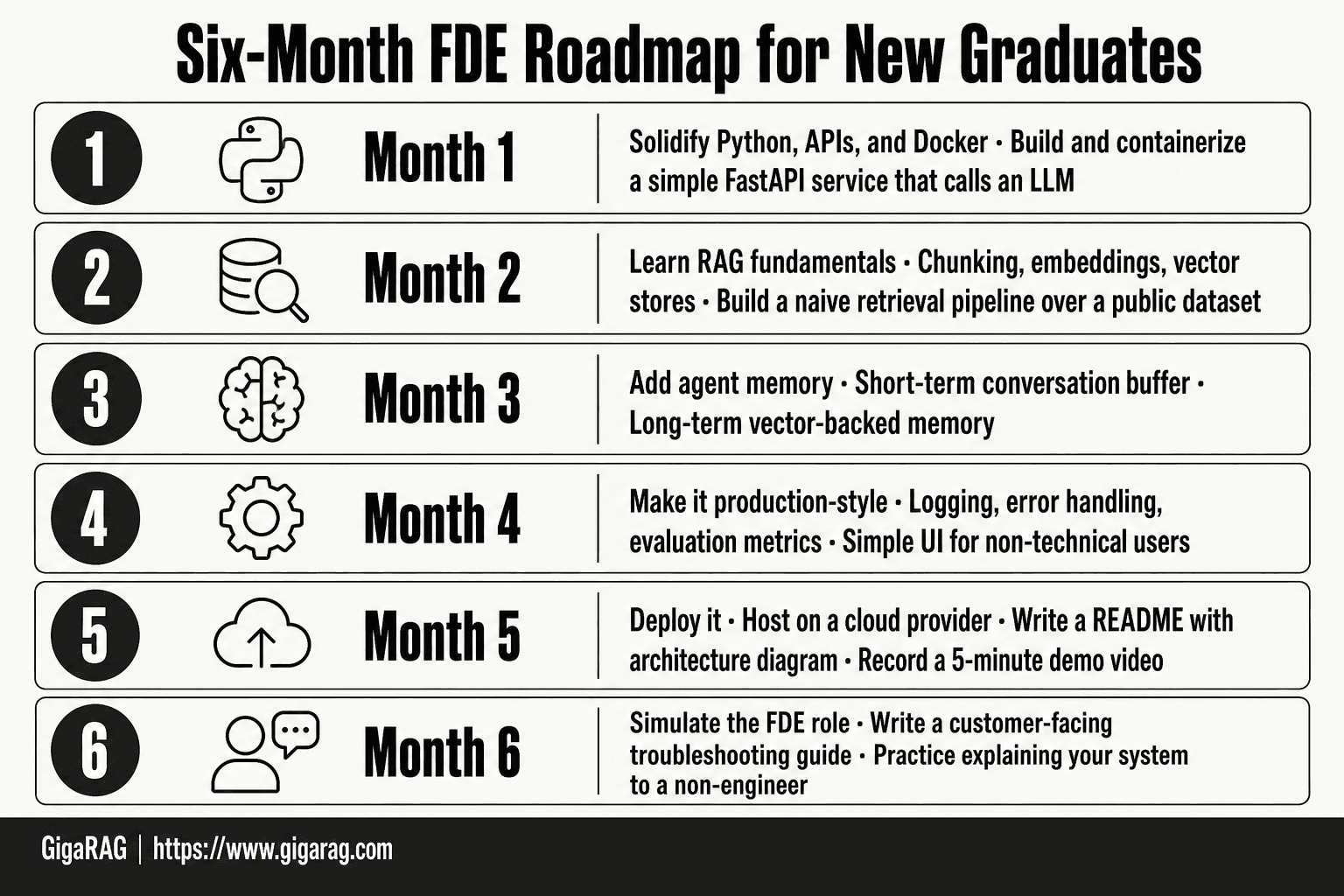
FDE Roadmap For New Graduates: A Step-by-Step Guide
- Month 1: Solidify Python, APIs, and Docker — build and containerize a simple FastAPI service that calls an LLM.
- Month 2: Learn RAG fundamentals — chunking, embeddings, vector stores — and build a naive retrieval pipeline over a public dataset.
- Month 3: Add agent memory — implement short-term (conversation buffer) and long-term (vector-backed) memory in your RAG app.
- Month 4: Make it production-style — add logging, error handling, evaluation metrics, and a simple UI for non-technical users.
- Month 5: Deploy it — host on a cloud provider, write a README with architecture diagram, and record a 5-minute demo video.
- Month 6: Simulate the FDE role — write a customer-facing troubleshooting guide and practice explaining your system to a non-engineer.
- Ongoing: Apply to FDE roles and adjacent positions (solutions engineer, AI engineer) while iterating on your portfolio project.
Phase 1: Build Your RAG Foundation (Weeks 1-4)
The first month is about building the retrieval layer you'll use in every FDE project after this. You won't build anything impressive yet. You'll build something that works, and you'll understand why it works. That's the foundation.
Understand embeddings and vector search
Embeddings turn text into numbers. A sentence becomes a vector, a list of floats, where similar sentences land close together in vector space. That's the entire mechanism. Vector search finds the nearest neighbours to your query vector.
Don't read papers on embedding models. Use one. Pick a small model, embed a hundred sentences, and plot them. Watch similar sentences cluster. Then break it: embed two sentences that mean the same thing but share no words. If the model still puts them close, you've seen semantic search work. If it doesn't, you've learned something about model limits.
Set up a vector database (Pinecone, Weaviate, or pgvector)
You need somewhere to store vectors and query them fast. Pinecone is managed and easiest to start. Weaviate gives you more control. pgvector lives inside Postgres, which you already know.
Start with Pinecone's free tier. Insert a few thousand vectors, run a query, and read the response. Don't optimize yet. Just confirm you can store and retrieve.
Build a basic RAG pipeline from scratch
Wire it together: take a document, split it into chunks, embed each chunk, store them, then query with a question and feed the top results into an LLM as context. That's RAG. Fifty lines of Python.
The honest answer is this pipeline will be bad. Chunks will be wrong, retrieval will miss, the LLM will ignore context. That's fine. You need to see the failure modes before you can fix them.
Learn chunking strategies and their tradeoffs
Chunk size is the first real decision. Small chunks retrieve precisely but lose context. Large chunks keep context but bury the answer in noise. Overlap helps at the boundaries.
Test three sizes on the same document: 200, 500, and 1000 tokens. Ask the same questions against each. You'll see the tradeoff immediately. There's no right answer, only what works for your data.
Phase 2: Master Agent Memory Systems (Weeks 5-8)
Phase 1 gave you retrieval. Phase 2 gives the agent a memory. Without memory, every query starts from zero. With memory, the agent remembers what you told it three turns ago and uses that to answer better. That's the whole point.
Short-term vs. long-term agent memory
Short-term memory is the conversation itself. Everything in the current context window: the user's last few messages, the retrieved chunks, the agent's previous responses. It's fast and it's gone when the session ends.
Long-term memory is anything that persists across sessions. User preferences, past decisions, facts learned in earlier conversations. You store these in a database or vector store and retrieve them when relevant.
The distinction matters because they fail differently. Short-term memory fails when the context window overflows. Long-term memory fails when retrieval pulls the wrong memory or none at all.
Context window limitations and workarounds
Context windows are finite. GPT-4o handles 128k tokens, Claude 3.5 Sonnet handles 200k. That sounds like a lot until you stuff in ten documents and a long conversation history.
The workarounds are summarization and selective retrieval. Summarize old turns instead of keeping them verbatim. Retrieve only the chunks that match the current query. Don't dump everything in.
In practice, you'll hit the limit faster than you expect. Test it. Push a conversation until the model starts forgetting the first message. That's your real budget.
Implementing memory persistence with GigaRAG
GigaRAG is one tool that handles the plumbing for you. Instead of writing your own summarization and retrieval logic, you configure memory settings and it manages what gets stored, what gets retrieved, and what gets dropped.
The main catch is you still need to understand what's happening under the hood. If retrieval pulls the wrong memory, you need to know why. GigaRAG simplifies implementation, not understanding.
Testing memory retrieval quality
Build a test set. Ten questions that require memory from earlier in the conversation. Run them against your agent. Count how many it answers correctly.
Then break it. Ask a question that requires a memory from ten turns ago. Ask a question where the wrong memory would mislead the agent. See where it fails.
The honest answer is you'll find failures. That's the point of testing before you ship anything to a customer.
Phase 3: Build a Portfolio RAG Project (Weeks 9-16)
You've built the pieces. Now you assemble them into something an employer can see. A portfolio project is your only real answer to the experience paradox. It doesn't replace a job, but it gives a hiring manager something concrete to evaluate.
Choosing a project scope that impresses employers
Pick a problem you can finish in eight weeks. Not a platform, not a framework. A problem. "A support agent that answers questions from a company's docs" beats "a general-purpose RAG system" every time.
The scope that impresses is narrow and deployed. One domain. One data source. One clear user. Employers want to see you can ship something real, not that you can start something ambitious.
Building the RAG pipeline with agent memory
Start with the pipeline from Phase 1. Add memory from Phase 2. Wire them together so the agent remembers what a user asked three turns ago and uses that context in the next answer.
Keep the data small. Fifty to a hundred documents is plenty. You're demonstrating the architecture, not indexing the internet. Test retrieval quality the same way you did in Phase 2. Fix what breaks.
Deploying to a cloud environment
Deploy it somewhere public. A free tier on Render, Railway, or Fly.io works. The point is a URL someone can click.
Deployment will take longer than you expect. Environment variables, API keys, cold starts. Budget a full week for it. A project that runs locally but not in the cloud doesn't count.
Writing documentation that shows FDE thinking
Write a README that explains your decisions. Why this chunking strategy. Why this vector store. What you tested and what failed.
That last part matters most. An FDE documents tradeoffs, not just features. "I chose pgvector because it kept everything in one database, but retrieval latency was 200ms slower than Pinecone" tells an employer you think like an engineer who ships, not a student who followed a tutorial.
What New Graduates Cannot Do (And Should Not Expect)
You will not lead customer engagements in year one. You will not own enterprise deployment decisions. You will not be the person a VP calls when production breaks. Anyone telling you otherwise is selling a course.
You will not lead customer engagements in year one
Your first year is shadowing, note-taking, and running small tasks under supervision. A senior FDE owns the relationship. You own the follow-up: reproducing a bug, writing a status update, testing a fix in staging.
That's not a demotion. It's the job. Customer trust is earned through repeated small wins, and you haven't had time to earn any yet.
Enterprise deployment is harder than tutorials suggest
Tutorials give you a clean API and a sandbox. Enterprises give you a VPN, a legacy auth system, and a security review that takes six weeks. Your RAG pipeline that worked locally will break in ways you didn't anticipate: proxy timeouts, data residency rules, permissions you don't have.
Expect to spend your first months learning why things fail in production, not building new things.
Mentorship is non-negotiable
Don't take an FDE role without a senior engineer assigned to you. A new graduate with no mentor will flounder. You need someone reviewing your code, checking your customer emails, and telling you when to escalate.
If a company can't name your mentor in the interview, that's a red flag.
Failure modes you will encounter
You'll overpromise to a customer because you wanted to seem competent. You'll ship something that works in your environment and breaks in theirs. You'll spend three days debugging a problem that was a missing environment variable.
These aren't career-ending. They're expected. The difference between a good junior FDE and a struggling one is how fast you surface the failure and ask for help.
FDE Roadmap for New Graduates: Salary and Market Reality
The honest answer is that entry-level FDE salaries are strong, but the market is split. AI companies are hiring, yet most postings still ask for two to three years of experience. You're applying into a gap.
Entry-level FDE salary ranges
New graduate FDE roles at AI startups and mid-size companies typically pay $90,000 to $130,000 base, with equity on top. Larger tech companies can push total compensation higher, but those roles are rarer and more competitive. Don't anchor on the top of the range. Most new graduates land in the middle.
Why most postings ask for experience
FDE work is customer-facing from day one. A company can't put someone with zero deployment experience in front of a paying client and expect it to go well. The posting asks for experience because the role demands judgment that only comes from shipping things that break.
That's the catch-22. The work requires experience, but the only way to get experience is to do the work.
How to position yourself as a new graduate
Your portfolio project is your substitute for experience. A deployed RAG pipeline with agent memory, real documentation, and a public GitHub repo shows you can ship something end-to-end. That's what a hiring manager actually needs to see.
Apply to junior FDE roles and adjacent titles: solutions engineer, deployment engineer, technical account manager. These feed into FDE work and are more open to new graduates. Target smaller startups first. They're more willing to take a bet on someone without a track record.
Common Mistakes When Following an FDE Roadmap
Most new graduates don't fail because the roadmap is wrong. They fail because they follow it halfway, or they follow the easy parts and skip the uncomfortable ones. Here are the four mistakes I see most often.
Skipping fundamentals for shiny tools
You'll see people jump straight to LangChain, vector databases, and agent frameworks before they can write a clean function or debug a broken API call. That's backwards. The fundamentals are what make the shiny tools work. If you can't trace a bug through your own code, you can't debug a RAG pipeline that's returning garbage.
Spend the first two weeks on Python, HTTP, and basic data structures. Not because they're exciting. Because everything else sits on top of them.
Collecting certifications instead of building
Certifications feel like progress. They're not. A hiring manager for an FDE role cares about one thing: can you ship something that works in front of a customer. No certification proves that.
One deployed project is worth more than five certificates. Build the RAG pipeline. Deploy it. Document it. That's your credential.
Building projects that never get deployed
A GitHub repo with a half-finished RAG pipeline is not a portfolio. It's a todo list. The deployment is the hard part, and it's the part that separates people who can actually do FDE work from people who just read about it.
Deploy your project to a cloud environment. Make it accessible via a URL. Write the README so someone else can run it. If you can't deploy it, you haven't finished it.
Ignoring the customer-facing half of the job
FDE work is not just engineering. It's engineering in front of a customer. You'll be explaining tradeoffs, managing expectations, and translating technical decisions into business language. If you only practice the coding half, you're practicing half the job.
Practice explaining your project out loud. Record yourself walking through the architecture. Write documentation that a non-engineer could follow. These are FDE skills, not soft skills.
Your First 90 Days as a Junior FDE
You got the job. Now the real roadmap starts. The first 90 days decide whether you become a trusted engineer or a liability the senior team works around.
Week 1-2: Learn the product and the customer
Read every piece of internal documentation. Then read the customer's. You can't solve a problem you don't understand, and you can't understand the problem without knowing how the customer actually uses the product.
Ask questions. Lots of them. Better to look uninformed in week one than to make a wrong assumption in week eight.
Week 3-6: Shadow senior FDEs
Sit in on customer calls. Watch how senior FDEs handle objections, explain tradeoffs, and say no without losing trust. Take notes on what they say and what they don't say.
Ask to review their deployment checklists. The unglamorous stuff is where the real knowledge lives.
Week 7-12: Own a small deployment task
Not a full customer engagement. A small, well-scoped task: a data migration, a configuration change, a bug fix in a staging environment. Something with clear boundaries and a senior FDE reviewing your work.
The goal is to ship something real without overpromising. Deliver it on time. Document what you did. That's how trust gets built.
An FDE roadmap for new graduates ends where the job begins. You've built the retrieval layer, wired in agent memory, and shipped a project that runs in the cloud. The next step is walking into a customer's environment and doing it again, under constraints you didn't choose. That's the work. The roadmap got you ready for it.
Frequently Asked Questions
Can a new graduate really become an FDE with no professional experience?
Yes, but usually through an associate or junior FDE title at a startup, not a standard FDE role at a large company. You need a portfolio that proves you can build and debug a RAG pipeline with agent memory. Expect your first year to be heavily supervised.
What is the difference between an FDE and a solutions engineer?
FDEs write production code inside customer environments and often own technical outcomes. Solutions engineers focus more on configuration, demos, and pre-sales support. The lines blur at small AI companies, where one person may do both.
Which tools should I learn first for agent memory and RAG?
Start with Python, a vector database (such as pgvector, Chroma, or Qdrant), and an orchestration framework like LangChain or LlamaIndex. Then learn how to implement conversation buffers and long-term memory stores manually before relying on abstractions.
How long does it take to build an FDE-ready portfolio from scratch?
With consistent part-time effort, expect 6 to 12 months. The minimum viable portfolio is one deployed RAG application with persistent agent memory, a public GitHub repo, and a written explanation of your architecture decisions.
What should new graduates NOT expect in their first FDE role?
You should not expect to architect systems, lead customer engagements, or make independent deployment decisions in your first year. Most of your time will go to shadowing, fixing small issues, and learning how the product behaves in real customer environments.
Do FDE roles require travel?
Many do, especially at companies that deploy on-premise or in regulated industries. Travel expectations vary widely by employer, so ask about it explicitly during interviews rather than assuming.
Is a computer science degree required for forward deployed engineering?
Not strictly, but strong fundamentals in programming, data structures, and system design are. A degree helps with initial screening, but a working portfolio project with agent memory and RAG can outweigh a lack of formal credentials at startups.
About GigaRAG
GigaRAG is for agent memory and RAG pipeline builders. get this right. Whether you are working through FDE roadmap for new graduates or something adjacent, we publish what we have actually tested, including where it falls short.


