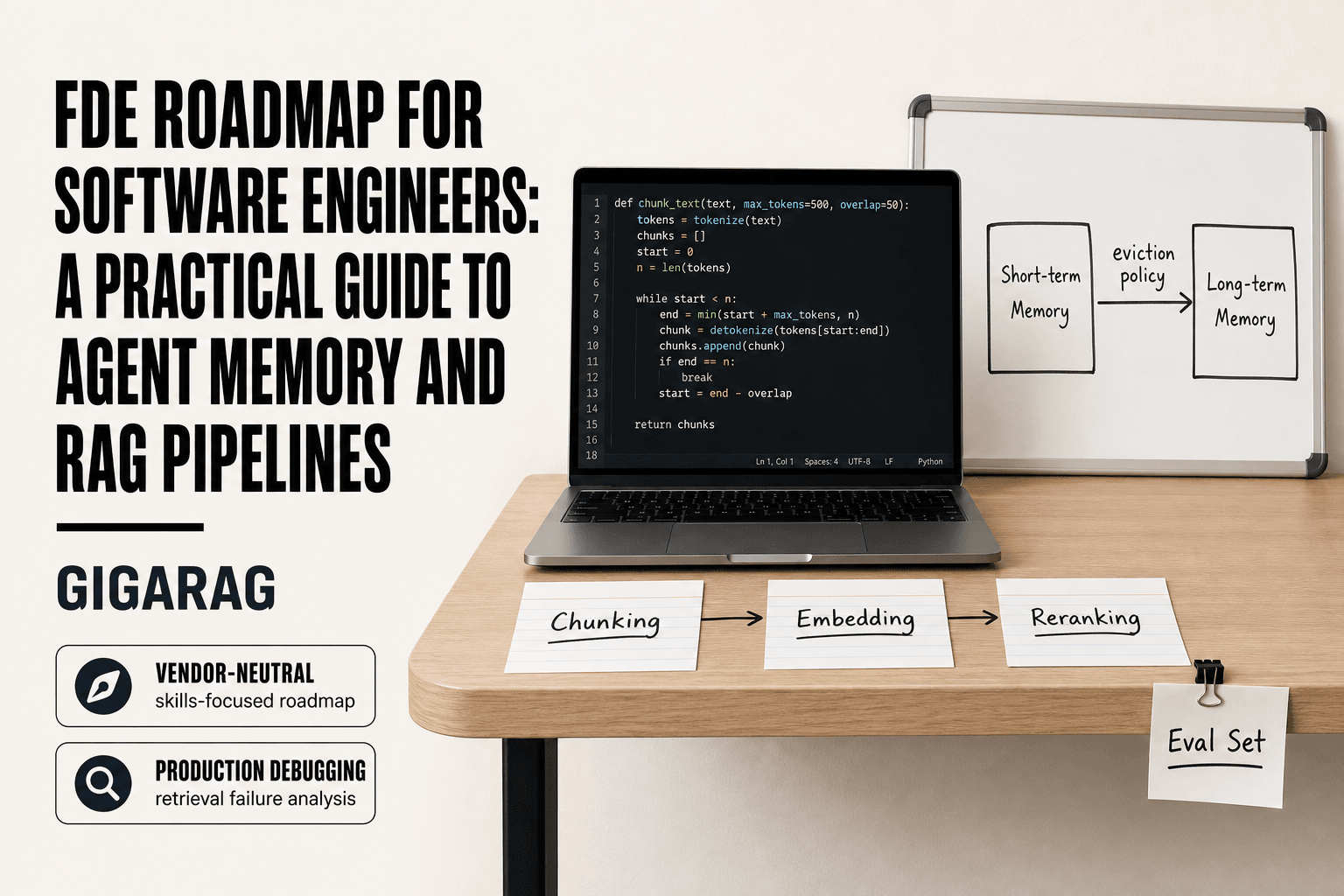
FDE Roadmap for Software Engineers: A Practical Guide to Agent Memory and RAG Pipelines
Most FDE roadmaps for software engineers are either vendor pitches dressed up as career advice, or generic lists of soft skills that could apply to any customer-facing role. Neither tells you how to do the actual job. The hard part of forward deployed work at an AI company isn't the travel or the slide decks. It's building agent memory and RAG pipelines that retrieve the right information under real customer constraints: messy source data, tight latency budgets, and users who expect the system to just know. That's the gap this guide fills. It's vendor-neutral, built for engineers with 2 to 5 years of experience, and it focuses on the part of the role that gets the least honest coverage. Tools like GigaRAG exist to simplify memory and retrieval infrastructure, but this roadmap is about the skills, not the product. You'll learn what to build, what to skip, and what you cannot fix no matter how good your chunking strategy is. Here's the path: from LLM foundations through memory architecture, RAG pipeline design, evaluation, and the transition into an FDE role.
| At a glance | Details |
|---|---|
| Role focus | Embed with customers to ship AI features |
| Core stack | RAG pipelines, vector DBs, agent memory |
| Key skills | Retrieval design, prompt engineering, debugging |
| Time to transition | 6-12 months of focused effort |
| Biggest pitfall | Overpromising what memory/RAG can do |
| Salary range | Varies widely; check levels.fyi (verify at publish) |
In This Guide
- What Is a Forward Deployed Engineer (FDE)?
- FDE vs SDE: What Changes When You Go Forward Deployed?
- Why Agent Memory and RAG Pipelines Are the Core of Modern FDE Work
- FDE Roadmap For Software Engineers: A Step-by-Step Guide
- FDE Skills Required for Agent Memory and RAG Pipeline Building
- FDE vs SDE: What Actually Changes in the Day-to-Day
- The FDE Roadmap for Software Engineers: A Step-by-Step Path
- Agent Memory Architecture: What FDEs Need to Build
- RAG Pipeline Design: Chunking, Embedding, and Reranking in Practice
- What FDEs Cannot Fix: Honest Limitations of Agent Memory and RAG
- How to Transition into an FDE Role
- Salary, Demand, and Career Growth for FDEs
- Put This FDE Roadmap to Work
What Is a Forward Deployed Engineer (FDE)?
A forward deployed engineer (FDE) is a software engineer who works directly inside customer environments, building and deploying solutions on-site rather than shipping code from a distance. The role sits between core engineering and customer success: FDEs write production code, but they write it against real customer problems, with the customer in the room.
Definition and origin of the FDE role
Palantir created the FDE role in the mid-2000s as a way to deploy its data integration platform into government and enterprise environments that resisted off-the-shelf software. The problem was simple: Palantir's software was powerful but generic, and every customer had messy, proprietary data that didn't fit the product's assumptions. Sending core engineers to every customer didn't scale. Hiring consultants who couldn't write code didn't work either.
The FDE was the answer. A hybrid: an engineer who could read a customer's database schema in the morning, write a custom integration by afternoon, and sit in a status meeting with the customer's VP of engineering before dinner. The role spread from Palantir to other enterprise software companies, and now to AI companies where the integration problem is even harder.
Why enterprise AI companies need FDEs
Enterprise AI products don't work out of the box. A customer buys an agent platform, but their data lives in Snowflake, their documents are in SharePoint, their permissions are in Active Directory, and their users expect answers in under two seconds. None of that is in the product's default configuration.
An FDE closes that gap. You write the connectors, tune the retrieval pipeline for the customer's actual data, and debug why the agent hallucinates on page 47 of their internal wiki but not on page 12. Core engineers build the general system. FDEs make it work for one specific customer, then feed what they learned back to the product team.
How FDE differs from a traditional software engineer
A traditional software engineer owns a codebase. An FDE owns an outcome at a customer site. You still write code, but you also run discovery sessions, manage expectations, and debug in a conference room while the customer watches. The scope is narrower technically but broader socially. You ship less infrastructure and more integration. You measure success by whether the customer renews, not just whether the tests pass.
[!note] FDEs cannot fix fundamental data quality issues or unrealistic customer expectations; memory and RAG systems often fail when the underlying data is messy, incomplete, or not aligned with the use case.
FDE vs SDE: What Changes When You Go Forward Deployed?
| Factor | Forward Deployed Engineer (FDE) | Software Development Engineer (SDE) |
|---|---|---|
| Primary focus | Customer-facing problem solving | Product feature development |
| Work location | Often on-site or embedded with customer | Usually in company office or remote |
| Success metric | Customer outcomes and adoption | Code quality, features shipped, reliability |
| Technical breadth | Broad: integrations, data, ML, infra | Deep: specific domain or system |
| Career path | Solutions architect, technical lead, PM | Senior/Staff engineer, engineering manager |
Why Agent Memory and RAG Pipelines Are the Core of Modern FDE Work
Most FDE time goes to memory and retrieval, not model training. You won't fine-tune models on customer data. You'll build systems that decide what an agent remembers, what it retrieves, and what it forgets. That's the job.
What agents need to remember: short-term vs long-term memory
An agent's short-term memory is the conversation. It holds the current turn, recent turns, and whatever the agent has done so far. It's bounded by the context window, and it's volatile: once the session ends, it's gone.
Long-term memory is everything the agent should know across sessions. Customer preferences, past decisions, facts about the user's data, and lessons from previous failures. You store this outside the context window, usually in a vector store or a database, and retrieve it when relevant.
The hard part isn't storing either type. It's deciding what moves from short-term to long-term, and what gets retrieved back into the context window when a new session starts. Get that wrong and the agent either forgets everything or drowns in irrelevant context.
Why retrieval quality determines agent usefulness
An agent with perfect reasoning and bad retrieval is useless. It will confidently answer questions using the wrong document, the wrong customer record, or a stale fact from three months ago. The model can't tell the difference between good context and bad context. It just generates from what you give it.
Retrieval quality is the ceiling on agent usefulness. If the right chunk isn't in the top five results, the agent fails. No amount of prompt engineering fixes a retrieval pipeline that returns the wrong document. This is why FDEs spend so much time on chunking, embedding, and reranking. Those choices determine whether the agent answers the customer's actual question or a question that sounds similar.
The FDE's role in designing memory and retrieval systems
Core engineers build the general retrieval framework. You tune it for one customer's data. That means reading their document structure, testing chunk sizes against their actual content, and adjusting the embedding model to their domain. It also means debugging why a specific query returns garbage while a nearly identical query works fine.
You'll also make judgment calls the product team can't make from a distance. When does a customer's data need hybrid search instead of pure vector search? When does reranking add latency that kills the user experience? When should the agent write something to long-term memory versus keeping it in the session? These decisions are specific to each deployment, and they're yours to make.
The honest answer is that most of this work is unglamorous. You'll spend more time inspecting retrieval results than writing clever agent logic. But retrieval is where enterprise AI deployments live or die, and that's exactly where FDEs earn their keep.
[!tip] For software engineers targeting FDE roles: build a small RAG demo that includes a failure case and how you debugged it—this shows you understand production realities, not just happy-path tutorials.
FDE Roadmap For Software Engineers: A Step-by-Step Guide
- Master the fundamentals of retrieval-augmented generation (RAG): chunking, embeddings, vector search, and reranking.
- Learn agent memory types: short-term (context window), long-term (vector store), episodic (event logs), and semantic (knowledge graphs).
- Build a simple RAG pipeline end-to-end using open-source tools (e.g., LangChain, LlamaIndex) and a vector database.
- Practice debugging retrieval failures: measure recall, precision, and relevance; implement logging and evaluation.
- Develop customer-facing skills: requirements gathering, expectation management, and translating business needs to technical solutions.
- Create a portfolio project that demonstrates an agent with memory and retrieval, and document tradeoffs and limitations.
- Apply for FDE roles at companies that build AI products, and prepare for system design interviews focused on RAG and memory.
FDE Skills Required for Agent Memory and RAG Pipeline Building
FDE skills in IT are the specific technical and consulting abilities a forward deployed engineer uses to deploy, tune, and debug AI systems on customer infrastructure. For agent memory and RAG work, that means vector stores, embedding models, chunking, reranking, prompt engineering, evaluation, and observability. You need all of them, not a subset.
Core engineering skills: Python, APIs, system design
Python is the default language for every RAG stack. You'll write scripts to test chunking strategies, inspect retrieval results, and build evaluation harnesses. If you can't read and write Python fluently, you can't debug a pipeline.
APIs are the connective tissue. You'll call embedding endpoints, vector store APIs, and LLM providers. You'll also build APIs for customers to integrate with their own systems. System design matters because memory and retrieval systems have real constraints: latency budgets, rate limits, and cost per query. You need to reason about where a bottleneck lives and what to trade off.
Memory-specific skills: vector stores, embedding models, chunking strategies
Vector stores are where long-term memory lives. You need to know how they index, how similarity search works, and when a vector store is the wrong tool. Not every memory problem needs embeddings. Sometimes a Postgres table with a good query is faster and cheaper.
Embedding models turn text into vectors. You need to know which models work for which domains, how dimension size affects quality and cost, and when to re-embed. Chunking strategies determine what actually gets embedded. Fixed-size chunks are simple but split sentences mid-thought. Semantic chunking respects document structure but costs more to compute. You'll test all of it against real customer data.
Retrieval-specific skills: reranking, hybrid search, query rewriting
Reranking takes the top candidates from vector search and reorders them with a more expensive model. It helps when the embedding model gets the general topic right but the exact answer wrong. It hurts when latency is tight and the extra model call pushes response time past what users tolerate.
Hybrid search combines vector similarity with keyword matching. It's essential for customer data with product codes, IDs, or domain jargon that embeddings handle poorly. Query rewriting fixes bad user queries before they hit retrieval. If a customer asks "what did we decide about the thing last week," you rewrite it into something searchable.
Evaluation and observability skills
You can't improve what you can't measure. Evaluation means building test sets of real queries with known-good answers, then checking retrieval hit rates and answer quality. Observability means tracing every step: what got embedded, what got retrieved, what got reranked, and what the model finally saw. Without traces, a bad answer is a mystery. With traces, it's a bug you can fix.
Consulting and communication skills
FDE work is customer-facing. You'll explain why the agent gave a wrong answer, what you changed to fix it, and what the customer needs to do on their side. You'll also push back on unrealistic expectations. That takes clear writing and the willingness to say no when a customer asks for something the system can't deliver.
FDE vs SDE: What Actually Changes in the Day-to-Day
The skills list overlaps. The job doesn't. An SDE builds a product that ships to many customers. An FDE builds a deployment for one customer, on their infrastructure, with their data, and then stays until it works.
FDE vs SDE: ownership, customer contact, and scope
An SDE owns a codebase. The work ends when the PR merges and CI passes. An FDE owns an outcome: the customer's agent retrieves the right documents and answers correctly in production. That means debugging on a customer's VPC at 9pm, reading their logs, and explaining what went wrong to a non-technical stakeholder the next morning.
Scope is narrower and deeper. An SDE might build a vector store integration once and move on. An FDE tunes chunk size, embedding model, and reranking threshold for one customer's specific document types. You'll run the same experiment twenty times with different parameters. That's the job.
Customer contact is the biggest shift. SDEs get requirements through a PM. FDEs sit on calls with the customer's engineers and operators. You hear the problem directly, often phrased badly, and you translate it into a technical fix. The consulting motion is real: you're part engineer, part translator, part project manager.
FDE vs solutions architect and sales engineer
Solutions architects design the system before the sale. They draw diagrams, estimate scope, and hand off. Sales engineers demo the product and answer technical questions during procurement. Both roles end when the contract is signed.
The FDE starts after the signature. You implement what the SA designed, discover what the SA got wrong, and fix it. You also discover what the product can't do, which the sales engineer never mentioned. The FDE is the one who has to say "that feature doesn't exist" to a customer who was promised it.
In practice, the roles blur at small companies. You might do the demo, write the SOW, and then build the integration. At larger companies, the lines are cleaner but the FDE still owns the post-sale technical relationship.
What L1-L4 levels mean in an FDE context
L1 through L4 are support tiers, not engineering levels. They describe how a customer issue escalates.
L1 is first contact: triage, basic troubleshooting, password resets, "is the service up" checks. L2 handles configuration issues and known bugs with documented workarounds. L3 is where FDEs usually enter: novel problems, integration failures, and anything requiring code changes or deep system knowledge. L4 is the core engineering team that owns the product codebase.
An FDE sits at L3 and pushes into L4. You're the bridge between "the customer says it's broken" and "here's the root cause in the retrieval pipeline." When you can't fix it, you write the bug report that L4 actually needs: reproduction steps, logs, traces, and what you already ruled out.
The FDE Roadmap for Software Engineers: A Step-by-Step Path
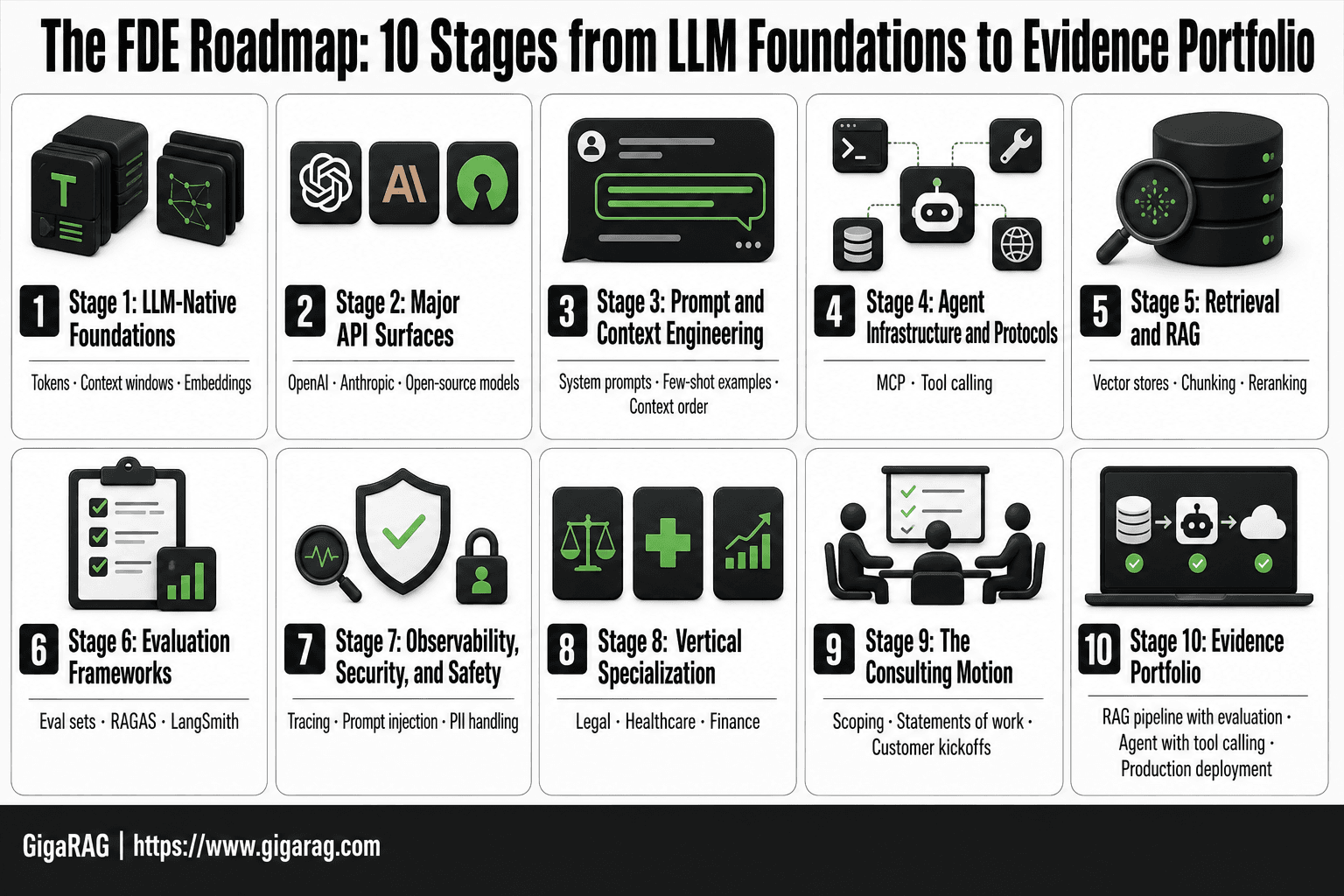
Most roadmaps list topics. This one orders them by what you'll actually touch on the job. Start at stage 1. Don't skip to RAG because it sounds more impressive. The foundations are where most self-taught FDEs fall apart.
Stage 1: LLM-native foundations (tokens, context windows, embeddings)
Before you touch an API, understand what a token is, how context windows work, and what an embedding actually represents. You can't debug retrieval quality if you don't know why a 512-token chunk behaves differently from a 2,048-token chunk. Build a tiny tokenizer from scratch. It takes a weekend and teaches you more than any course.
Stage 2: Major API surfaces (OpenAI, Anthropic, open-source models)
Learn one commercial API deeply, then one open-source model. OpenAI's API is the default starting point. Anthropic's is similar enough that switching takes a day. Run Llama or Mistral locally so you understand what changes when you control the model. The honest answer: most enterprise FDE work uses commercial APIs. Open-source matters for cost-sensitive customers and on-prem deployments.
Stage 3: Prompt and context engineering
Prompts are the UI for LLMs. You'll write hundreds. Learn system prompts, few-shot examples, and how context order changes outputs. The main catch: prompt engineering is empirical. You test, observe, adjust. There's no theory that predicts what works.
Stage 4: Agent infrastructure and protocols (MCP, tool calling)
Agents need to act, not just chat. Tool calling is the mechanism. MCP (Model Context Protocol) is the emerging standard for connecting agents to external systems. Build a simple agent that calls three tools: search, calculate, and fetch. Watch where it fails. That failure pattern is your real curriculum.
Stage 5: Retrieval and RAG (vector stores, chunking, reranking)
This is the core. Start with a basic RAG pipeline: embed documents, store in a vector database, retrieve on query, feed to LLM. Then break it deliberately. Change chunk sizes. Swap embedding models. Add reranking. Each change teaches you what actually affects retrieval quality. Pinecone, Weaviate, and pgvector are all reasonable starting points.
Stage 6: Evaluation frameworks
You can't improve what you can't measure. Build a small eval set: 50 questions with known-good answers. Run your pipeline against it after every change. RAGAS and LangSmith exist, but a simple script comparing retrieved chunks to expected chunks works fine at first. The habit matters more than the tool.
Stage 7: Observability, security, and safety
Production agents fail in ways dev agents don't. Latency spikes, prompt injection, PII leaking into logs. Learn to trace a request end-to-end. Langfuse and Arize Phoenix are worth knowing. Security basics: never log raw user input, sanitize tool outputs, and assume any retrieved content is untrusted.
Stage 8: Vertical specialization
Pick an industry: legal, healthcare, finance, support. Each has document types, compliance rules, and retrieval patterns that change your pipeline design. Legal contracts chunk differently than support tickets. Specialization is what makes you valuable to a specific customer base.
Stage 9: The consulting motion
FDE work is half engineering, half consulting. Learn to scope a deployment, write a statement of work, and run a customer kickoff. Practice explaining technical tradeoffs to non-technical stakeholders. You'll do this weekly on the job.
Stage 10: Evidence portfolio
Build three projects that demonstrate the full stack: a RAG pipeline with evaluation, an agent with tool calling and memory, and a production deployment with observability. Put them on GitHub with clear READMEs. This portfolio is what gets you interviews, not certificates.
Agent Memory Architecture: What FDEs Need to Build
Memory is where most agent deployments fall apart. The model can reason fine. It forgets the wrong thing at the wrong time, or remembers everything and drowns in noise. Your job as an FDE is to design what gets stored, where, and for how long.
Short-term vs long-term memory in agents
Short-term memory is the context window plus a scratchpad. It holds the current conversation, recent tool outputs, and intermediate reasoning. It's fast and cheap, but it's volatile. When the context window fills, older entries get truncated or summarized. Long-term memory is anything that persists across sessions: user preferences, past decisions, document embeddings, facts about the customer's business. It lives in a database, not in the prompt.
The honest answer: most agents need both, but most teams overbuild long-term memory first. Start with short-term. Add persistence only when a real failure occurs.
Episodic vs semantic memory: what to store and why
Episodic memory stores specific events: what happened in a past session, what the user asked, what the agent did. Semantic memory stores general facts: the customer's pricing model, their escalation policy, their product names. Episodic memory helps with continuity. Semantic memory helps with correctness.
In practice, store episodic memory as session logs with timestamps. Store semantic memory as structured records or embeddings in a vector store. Don't mix them. Mixing them is how you get retrieval that returns a conversation snippet when you needed a policy.
Memory hierarchy design: from scratchpad to vector store
A working hierarchy looks like this:
- Scratchpad: in-context, ephemeral, for the current task only.
- Session store: key-value or SQL, holds the current conversation and tool outputs.
- Vector store: embeddings of documents, policies, and past interactions for semantic retrieval.
- Structured store: Postgres or similar, holds user profiles, preferences, and business facts that need exact lookup.
Each layer trades speed for persistence. The scratchpad is instant but gone when the session ends. The vector store is slower but survives indefinitely. The main catch: every layer you add increases latency and failure surface. Three layers is usually enough.
Common memory failure modes in production
Context pollution is the most common. The agent stuffs too much into the prompt, and retrieval quality drops because the model can't distinguish signal from noise. Stale embeddings are second. Documents change, but the embeddings don't get updated, so retrieval returns outdated answers. Retrieval drift is third: over time, the agent starts retrieving from the wrong part of the corpus because query patterns shifted but the index didn't.
You can't fix these with better prompts. You fix them with eviction policies, re-embedding schedules, and eval sets that catch drift before the customer does.
RAG Pipeline Design: Chunking, Embedding, and Reranking in Practice
Memory architecture decides what to store. The retrieval pipeline decides what comes back. Get the pipeline wrong and the best memory design still returns garbage.
Chunking strategies: fixed, semantic, and recursive
Fixed-size chunking splits text every N characters or tokens, usually 256 to 512. It's fast and predictable, but it cuts sentences in half. Semantic chunking splits on meaning: paragraph boundaries, section headers, or embedding similarity shifts. It's slower to build but returns cleaner units. Recursive chunking starts with a large block, then splits it into smaller pieces only when retrieval needs finer granularity.
In practice, start with fixed 512-token chunks with 10% overlap. Move to semantic chunking when you see retrieval returning fragments that don't answer the question. Recursive is for long documents where you need both broad and narrow context.
Embedding model selection: when to use which model
It depends on your corpus and your latency budget. For general English text, OpenAI's text-embedding-3-small is cheap and good enough for most enterprise documents. For code or technical content, a code-tuned model like Voyage's code embeddings beats general models on retrieval accuracy. For multilingual corpora, use a multilingual model like BGE-M3 or Cohere's embed-multilingual.
The main catch: embedding quality is only as good as your chunking. A great model on bad chunks returns bad results. Test on your own data before committing.
Hybrid search: combining vector and keyword retrieval
Vector search finds semantic matches. Keyword search finds exact matches. Hybrid search runs both and merges results. You need hybrid when your corpus contains product names, error codes, or IDs that embeddings blur together. A customer searching for "API-402 error" needs keyword match, not semantic similarity.
The standard approach is reciprocal rank fusion: take the rank of each result from both retrievers, combine them, and return the merged list. It's simple and works.
Reranking: when it helps and when it hurts
Reranking runs a second model over the top 50 to 100 retrieved chunks and scores them for relevance to the query. It helps when your initial retrieval returns many partially relevant chunks and you need precision. It hurts when latency is tight or when your corpus is small enough that the initial retrieval is already accurate.
A cross-encoder reranker like Cohere's rerank or a local model like bge-reranker adds 50 to 200 milliseconds per query. For a customer-facing agent, that's often worth it. For a batch job, skip it.
A decision tree for retrieval strategy selection
Start with the question: does your corpus contain exact-match terms that embeddings will miss? If yes, add keyword search. If no, vector-only is fine.
Then ask: is your corpus under 1,000 chunks? If yes, skip reranking. If no, test reranking on your eval set and measure the precision gain against the latency cost.
Then ask: are your documents long and structured? If yes, use semantic or recursive chunking. If no, fixed chunking is enough.
The honest answer: most production RAG pipelines need hybrid search and semantic chunking. Reranking is the first thing to cut when latency matters.
What FDEs Cannot Fix: Honest Limitations of Agent Memory and RAG
You can build the cleanest pipeline in the world. The model will still hallucinate. The source data will still be wrong. The customer will still expect magic. Knowing what you cannot fix is half the job.
When not to use RAG
RAG helps when your corpus is stable, queryable, and relevant to the question. It does not help when the answer isn't in your documents. If a customer asks for a prediction, a legal opinion, or a creative recommendation, retrieval returns the closest match, not the right answer. The model then dresses that match up as confident prose.
Skip RAG when latency is under 200 milliseconds and you can't cache. Skip it when the corpus changes faster than you can re-embed. Skip it when the customer's real problem is data quality, not retrieval.
Memory pitfalls: context pollution, stale embeddings, retrieval drift
Context pollution happens when old or irrelevant memories crowd the prompt. The agent starts answering from yesterday's conversation instead of today's. You fix it with aggressive pruning and recency weighting, but you never eliminate it.
Stale embeddings are worse. A customer updates their pricing page. Your vector store still holds last quarter's numbers. The agent retrieves the old chunk and answers with confidence. Re-embedding on a schedule helps, but there's always a gap between the change and the refresh.
Retrieval drift is the slow failure. Over months, the queries customers actually ask shift. Your eval set doesn't. Retrieval quality drops and nobody notices until a customer complains.
Unrealistic customer expectations and how to reset them
Customers think the agent will read their entire knowledge base and answer anything. It won't. It answers what's in the chunks you embedded, ranked by similarity to the query. That's it.
Reset expectations in the first meeting. Say: "The system retrieves passages from your documents and summarizes them. It does not reason about your business. It does not know what's not written down." Write that in the scope document. Repeat it when the pilot starts.
What to tell customers when the system fails
Don't blame the model. Don't blame the data. Say what happened in plain terms: "The system retrieved an outdated version of your pricing page. We've scheduled re-embedding every 24 hours to close that gap." Then do it.
The honest answer is that some failures are structural. Hallucinations will happen. Retrieval will miss. Your job is to make failures visible, explainable, and less frequent. Not to promise they'll disappear.
How to Transition into an FDE Role
You don't need a PhD. You don't need to be a machine learning researcher. You need evidence that you can build memory and retrieval systems that work in production, and you need to show it to the right people.
Building an evidence portfolio: projects that matter
A GitHub repo with a toy chatbot won't get you an interview. Build one project that solves a real retrieval problem end to end.
Start with a RAG pipeline over a messy, real-world corpus: a product manual, a support ticket archive, a legal document set. Show the chunking strategy, the embedding model choice, the reranking step. Show the eval results. Show where it fails.
The portfolio piece that matters most is a failure analysis. Write up what broke, why, and what you changed. That's the document an FDE hiring manager actually reads.
The 90-day transition plan
Here's a realistic sequence if you're working full time.
Days 1 to 30: build the foundations. Learn embeddings, vector stores, and chunking by building a simple RAG pipeline. Ship it. Break it. Fix it.
Days 31 to 60: add memory. Implement short-term conversation memory and long-term vector memory. Add evaluation: a small eval set with retrieval metrics, not just vibes.
Days 61 to 90: build the evidence portfolio and start applying. Write the failure analysis. Record a five-minute demo walking through the pipeline and its tradeoffs.
Networking and finding FDE roles at AI companies
FDE roles are rarely posted with that exact title. Search for "forward deployed engineer," "solutions engineer," "deployment strategist," and "AI field engineer." Read the job description: if it mentions customer onboarding, production debugging, and retrieval or RAG, it's an FDE role.
The fastest path is a referral from someone already inside. Find FDEs on LinkedIn at companies you're targeting. Ask for 15 minutes. Ask what they built last week. Don't ask for a job.
Interview preparation for FDE positions
Interviews split into three parts: a standard coding round, a system design round focused on retrieval, and a customer scenario round.
For the system design round, practice designing a RAG pipeline on a whiteboard. Be ready to defend your chunking strategy, your embedding model choice, and your reranking decision. The interviewer will push on tradeoffs. That's the point.
For the customer scenario round, you'll get something like: "A customer says the agent gave wrong pricing. What do you do?" The answer they want: reproduce the failure, trace the retrieval, find the stale chunk, explain the fix in plain language, and set a re-embedding schedule. Not: "the model hallucinated."
The honest answer is that the transition takes three to six months of focused work. The engineers who make it are the ones who built something real and can talk about what broke.
Salary, Demand, and Career Growth for FDEs
FDE pay tracks senior software engineering, with a premium for the customer-facing work. The honest answer on demand: yes, IT engineers are in demand, but the demand is specific. Companies aren't hiring generic engineers. They're hiring engineers who can ship retrieval systems and stand in front of a customer.
FDE salary ranges in USD and INR
US FDE roles at enterprise AI companies typically land between $150,000 and $220,000 base, with equity pushing total compensation higher. Early-stage startups pay less base and more equity. Large labs pay more base and less upside.
In India, FDE salaries range from roughly 25 to 60 lakh INR per year for mid-level roles, with senior FDEs at top AI companies crossing 80 lakh. The spread is wide because the title is still loose. A "forward deployed engineer" at one company is a solutions engineer at another, and the pay follows the scope.
Demand for FDEs in enterprise AI
The demand is real and growing, but it's concentrated. Every enterprise AI company that sells to banks, hospitals, or logistics firms needs people who can deploy in the field. The bottleneck isn't model training. It's making retrieval work on a customer's actual data.
That's the skill in short supply. If you can build a RAG pipeline, debug a stale embedding in production, and explain the fix to a non-technical stakeholder, you'll have options.
Career growth: from FDE to solutions architect, product, or engineering leadership
FDE is a launchpad, not a terminal role. The three common exits:
Solutions architect. You go deeper on pre-sales and system design, less on code. Pay rises, coding drops.
Product. FDEs see what customers actually need. That's the raw material for product management. The transition is natural if you can write and prioritize.
Engineering leadership. FDEs who stay technical and build a track record of shipping retrieval systems move into leading platform or infrastructure teams.
The main catch: FDE work is exhausting. Travel, customer firefighting, and context switching burn people out. The engineers who thrive treat it as a three-to-five-year chapter, not a career.
Put This FDE Roadmap to Work
The roadmap only matters if you start. Here's the sequence that gets you from reading to interviewing.
This week: start with LLM foundations and build a simple RAG pipeline
Pick one embedding model and one vector store. Don't research for a week. Use OpenAI's text-embedding-3-small and a local Chroma instance. Chunk a small document set, embed it, and run ten queries. You'll hit the real problems immediately: chunks that split mid-sentence, queries that return irrelevant results, embeddings that miss synonyms.
That's the point. You can't learn retrieval from a tutorial.
This month: implement memory architecture and evaluation
Add short-term memory to your pipeline: a scratchpad that holds the last few turns. Then add long-term memory: a vector store that persists across sessions. Write a small evaluation script that measures retrieval hit rate on twenty hand-labeled queries.
Don't skip evaluation. It's the skill that separates FDEs from engineers who just call an API.
This quarter: build an evidence portfolio and apply to FDE roles
Ship one project that shows the full loop: ingestion, chunking, embedding, retrieval, reranking, and evaluation. Write up what broke and how you fixed it. That writeup is your portfolio.
Tools like GigaRAG can handle the memory infrastructure so you can focus on the skills that get you hired. But the FDE roadmap for software engineers ends the same way it starts: build the thing, break it, and show the work.
Frequently Asked Questions
What are FDE skills in it?
FDE skills include a mix of software engineering, data engineering, and customer-facing abilities. Specifically for AI roles, you need expertise in RAG pipelines, vector databases, agent memory architectures, prompt engineering, and the ability to debug retrieval and generation issues in production.
Are IT engineers in demand?
Yes, IT engineers with AI and data skills are in high demand, especially those who can bridge technical and business needs. Forward deployed engineers are particularly sought after by AI startups and enterprises deploying AI solutions.
What is the roadmap to become a software engineer?
A typical roadmap includes learning programming fundamentals, data structures, algorithms, and building projects. For FDE roles, add specialized skills in RAG, agent memory, and customer-facing engineering, and gain experience through internships or open-source contributions.
What is L1, L2, L3, and L4 developer?
These levels generally refer to seniority: L1 is entry-level, L2 is mid-level, L3 is senior, and L4 is staff or principal. In FDE roles, progression often emphasizes customer impact and technical leadership alongside coding skills.
How long does it take to transition from software engineer to FDE?
With focused effort, a software engineer with 2-5 years of experience can transition in 6-12 months by learning RAG, agent memory, and customer-facing skills, and building relevant projects.
Do FDEs need to know machine learning?
Not necessarily deep ML, but FDEs should understand how to integrate ML models, especially for retrieval and generation. Practical knowledge of embeddings, vector search, and prompt engineering is more important than training models from scratch.
What are common pitfalls in agent memory and RAG pipelines?
Common pitfalls include poor chunking strategies, ignoring retrieval evaluation, overcomplicating memory architectures, and failing to set realistic customer expectations. FDEs must balance technical elegance with practical constraints.
About GigaRAG
GigaRAG is for agent memory and RAG pipeline builders. get this right. Whether you are working through FDE roadmap for software engineers or something adjacent, we publish what we have actually tested, including where it falls short.


