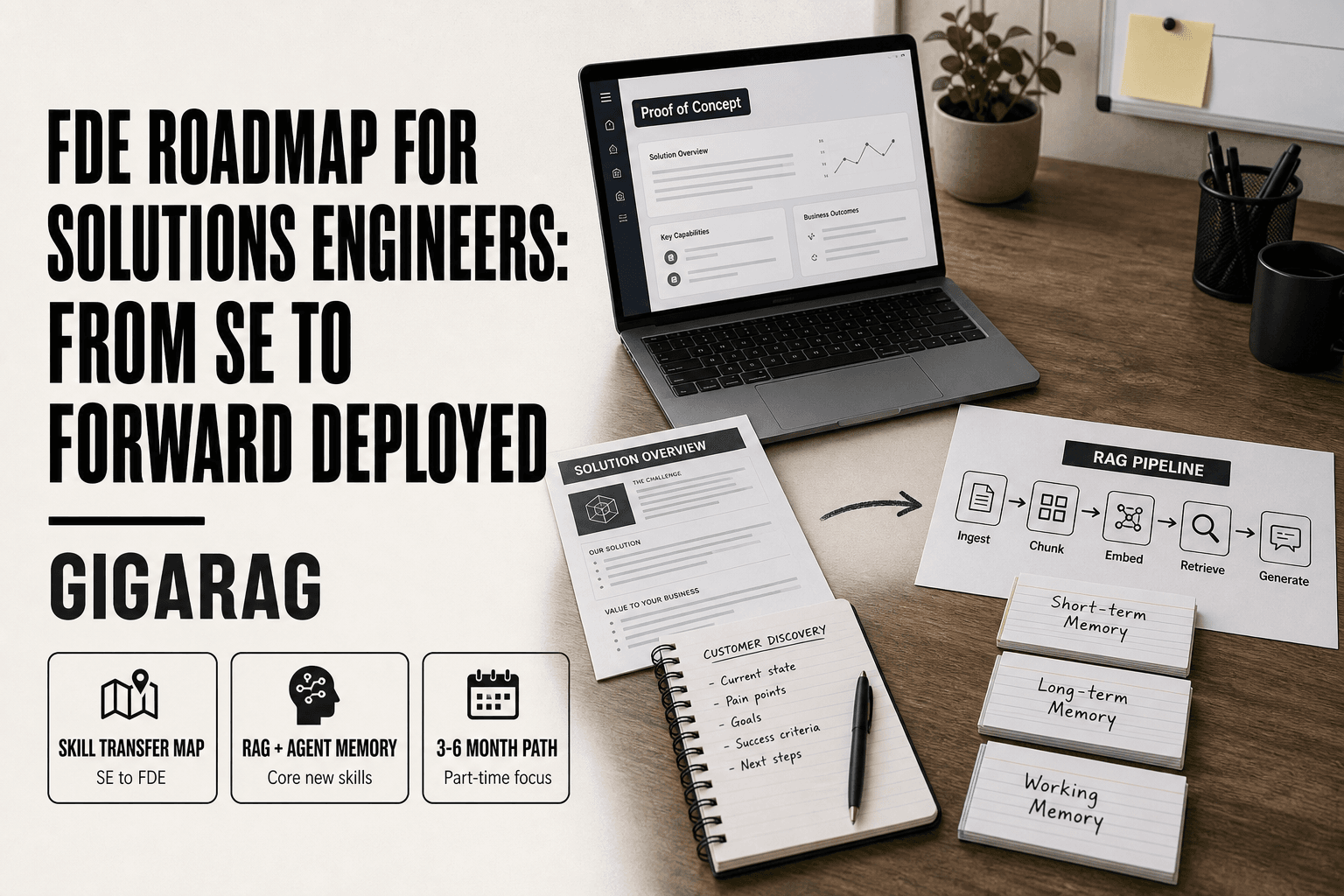
FDE Roadmap for Solutions Engineers: From SE to Forward Deployed
You already build demos, run proof-of-concepts, and sit across from customers. You can scope a problem and make the product look good in a live room. Then you read an FDE job description and it asks for agent memory and RAG pipeline building, and you're not sure whether those are skills you half-have or things you'd need to learn from zero.
The honest answer is both. Some of what you do transfers directly. Some of it doesn't.
This FDE roadmap for solutions engineers maps the transition without pretending you're starting over. It covers which SE skills carry into forward deployed work, which ones need sharpening, and the agent memory and RAG pipeline skills you'll have to build from scratch. GigaRAG shows up later as one tool for that pipeline work, but the roadmap doesn't depend on it. It also tells you plainly what an FDE cannot do, because the job postings won't.
| At a glance | Details |
|---|---|
| Best for | Solutions engineers moving into FDE roles |
| Core new skills | Agent memory, RAG pipelines, evals |
| Timeline | 3-6 months of focused part-time work |
| What transfers | Customer empathy, demos, discovery, debugging |
| What doesn't | Production ownership, deep ML research |
| Proof to show | One deployed agent with memory and RAG |
In This Guide
- What a Forward Deployed Engineer Actually Does
- Solutions Engineer vs Forward Deployed Engineer: What Actually Changes
- The FDE Roadmap for Solutions Engineers: Skill Transfer Map
- FDE Roadmap For Solutions Engineers: A Step-by-Step Guide
- Technical Skills: What You Need to Learn
- Agent Memory and RAG Pipeline Building for FDEs
- Non-Technical Skills: Consulting, Communication, and Strategy
- Step-by-Step FDE Roadmap: From SE to Forward Deployed
- What You Cannot Do as an FDE (Honest Limitations)
- Interview Preparation for FDE Roles
- Final Thoughts on Your FDE Roadmap
What a Forward Deployed Engineer Actually Does
A forward deployed engineer ships working AI software inside a customer's environment, owns the deployment end to end, and stays until it works in production. You don't demo. You deploy.
An FDE sits between the product team and the customer's real infrastructure. You take the product, adapt it to the customer's data, their auth, their compliance rules, and you make it run. Then you stay. You debug. You iterate. You build the missing piece the customer needs and the product team hasn't shipped yet.
FDE vs Solutions Engineer: The Core Difference
You already build demos and run proof-of-concepts. That's the overlap. The difference is what happens after the POC succeeds.
A solutions engineer hands off. An FDE does not. You own the deployment through production, including the parts the product doesn't cover. You write code that ships to real users, not slideware. You're measured on whether the customer renews, not whether the demo impressed.
What FDEs Own vs What They Influence
You own the deployment: the integration, the data pipeline, the model configuration, the customer-specific features. You influence the product roadmap by reporting what customers actually need, but you don't set it.
You own the relationship with the customer's engineers. You influence the account's commercial outcome, but you don't own the contract.
Why FDE Demand Exploded in the AI Era
AI products don't work out of the box. They need customer data, custom prompts, retrieval pipelines, and evaluation against the customer's actual use cases. That's deployment work, not sales work.
Companies can't hire enough engineers who will do that work on-site, inside the customer's environment, with the customer's constraints. So they created a role for it. That role is FDE.
[!note] FDE roles vary widely by company: at some AI startups you own production deployments and are on-call, while at others you hand off to a platform team. Always clarify the ownership boundary in interviews before accepting an offer.
Solutions Engineer vs Forward Deployed Engineer: What Actually Changes
| Factor | Solutions Engineer | Forward Deployed Engineer |
|---|---|---|
| Primary output | Demos, POCs, technical wins | Deployed systems in customer environments |
| Customer relationship | Supports sales, often pre-close | Owns technical success post-close |
| Technical depth | Integration and configuration | Agent memory, RAG, evals, deployment |
| Success metric | Deal progression and POC outcomes | Production adoption and customer outcomes |
| On-call / ownership | Rarely on-call | Often on-call for deployed systems |
The FDE Roadmap for Solutions Engineers: Skill Transfer Map
You're not starting from zero. You're starting from a specific set of skills that most FDE candidates don't have. The question is which ones carry over, which ones need reshaping, and which ones you'll have to build from nothing.
Skills That Transfer Directly
Customer discovery transfers. You already know how to ask a customer what they're actually trying to do, not what they say they want. That's the core FDE skill, and it's the one engineers without SE backgrounds struggle with most.
Demo building transfers, but with a caveat. You know how to make a product look good in a controlled environment. FDE work is the opposite: making a product work in an uncontrolled environment. The instinct to isolate variables carries over. The instinct to hide rough edges doesn't.
Stakeholder communication transfers wholesale. You can explain technical tradeoffs to a VP who doesn't code and a staff engineer who does. FDEs do this daily.
Technical scoping transfers. You already estimate effort, flag risks, and set expectations before a POC. FDEs do the same before a deployment.
Skills That Need Adaptation
Your coding skills need to move from script-level to production-level. You've written integration code and demo glue. FDEs write code that runs in customer environments for months, handles edge cases, and gets reviewed by the customer's engineers. Same language, different standard.
Your debugging approach needs to shift. SE debugging is fast and shallow: find the issue, patch it, move on. FDE debugging is systematic. You trace a failure through the customer's stack, the model's behavior, and the data pipeline, then fix the root cause.
Your relationship skills need to expand from sales-cycle relationships to deployment-cycle relationships. You'll work with the customer's engineers daily for weeks, not just their stakeholders for an hour.
Skills You Must Build From Scratch
RAG pipeline building is the big one. You've probably used retrieval tools, but you haven't built a pipeline from ingestion to embedding to retrieval to generation. That's a new skill, and it's the one FDE job postings screen for hardest.
Agent memory is the second. You need to understand how agents store context across turns, across sessions, and across users. This is not a demo skill. It's a production architecture skill.
Cloud infrastructure basics are the third. You need to deploy into AWS, GCP, or Azure, handle auth, manage secrets, and read logs. Not at DevOps depth, but enough to own a deployment.
The transfer map is uneven. Your soft skills carry you further than you'd expect. Your technical gaps are real and specific. The next section covers exactly what to learn and in what order.
[!tip] As a solutions engineer, your unfair advantage is customer empathy. When building your RAG and agent memory project, record a short video walking through the architecture as if explaining it to a customer — this doubles as an interview artifact and proves you can communicate complex systems.
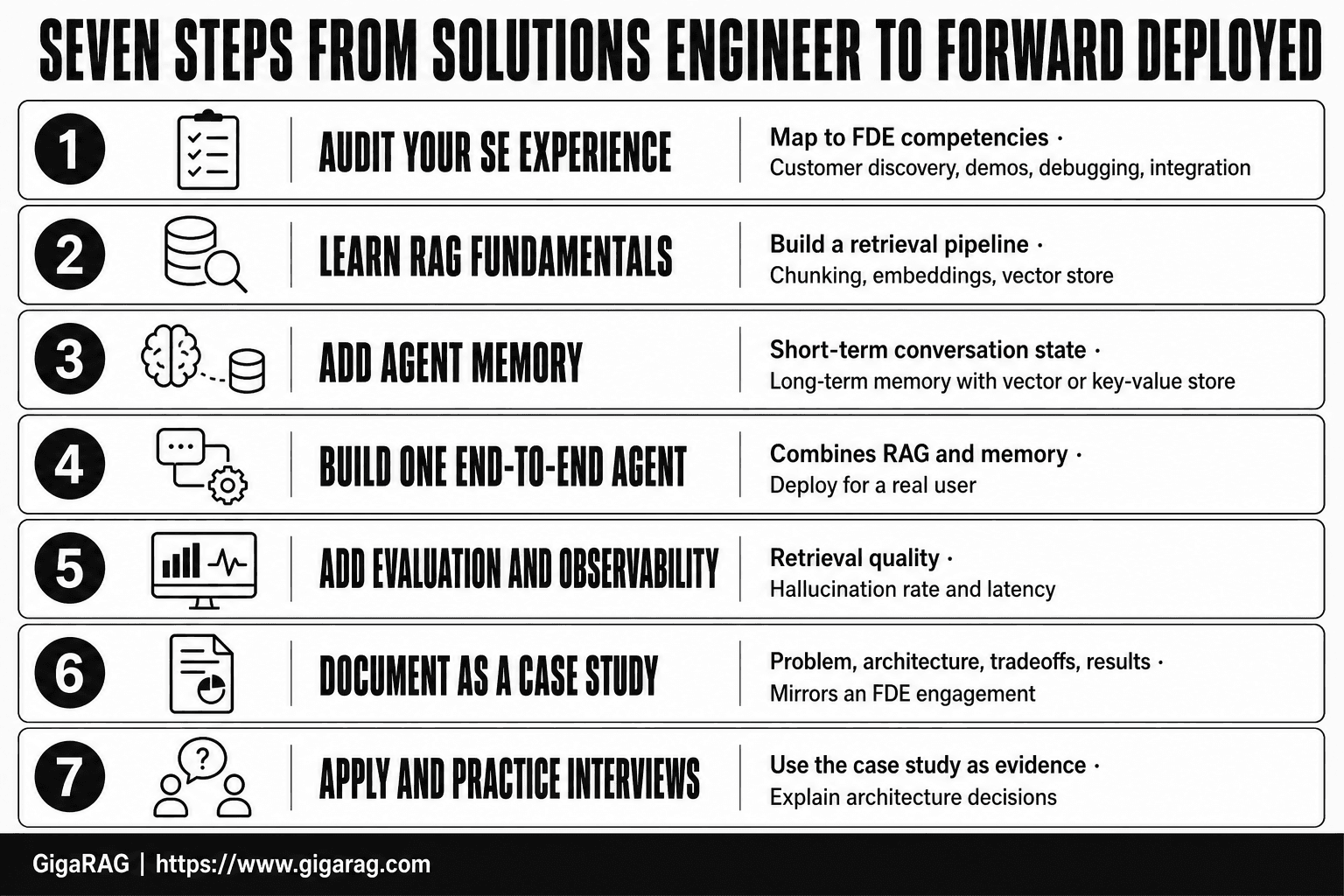
FDE Roadmap For Solutions Engineers: A Step-by-Step Guide
- Audit your SE experience and map it to FDE competencies: customer discovery, demos, debugging, and integration work all transfer.
- Learn RAG fundamentals by building a retrieval pipeline over a real document set, including chunking, embeddings, and a vector store.
- Add agent memory by implementing short-term conversation state and long-term memory with a store like a vector database or key-value memory layer.
- Build one end-to-end agent that uses both RAG and memory, then deploy it somewhere a real user can access it.
- Add evaluation and observability: track retrieval quality, hallucination rate, and latency with a simple eval harness.
- Document the project as a case study that mirrors an FDE engagement: problem, architecture, tradeoffs, and results.
- Apply to FDE roles with that case study, and practice explaining your architecture decisions in interviews.
Technical Skills: What You Need to Learn
You don't need to become a machine learning researcher. You need enough applied skill to ship working AI systems into customer environments. The order matters: applied AI first, then data engineering, then enough cloud to not get stuck.
Applied AI Engineering Fundamentals
Start with embeddings and vector search. You need to understand how text becomes vectors, how similarity search works, and why retrieval quality determines output quality. This is the foundation for everything else.
Then learn LLM APIs and prompting at a systems level. Not just writing prompts, but structuring them, handling context windows, and managing token budgets. You'll write code that calls models, not chat interfaces.
Finally, learn evaluation. How do you know a RAG pipeline is working? Build small eval sets, measure retrieval hit rates, and track where the model fails. This separates FDEs from demo builders.
Data Engineering for FDEs
You'll spend more time on data than on models. Learn to ingest documents, clean text, chunk it sensibly, and store embeddings. Chunking strategy changes retrieval results more than most model choices.
Learn basic ETL. You'll pull data from customer systems, transform it, and load it into vector databases. Python and SQL cover most of this. You don't need Spark or streaming.
Cloud & DevOps Basics
You need enough cloud to deploy without hand-holding. Learn one provider well: AWS, GCP, or Azure. Focus on compute, storage, IAM, and networking basics.
Learn Docker. Most AI deployments ship as containers, and you'll debug inside them. Learn to read logs, set environment variables, and manage secrets.
You don't need Kubernetes. Most FDE deployments run on managed services or simple container setups. If a customer runs K8s, their platform team handles it. You need to know enough to not break things.
This is a 3-6 month learning curve for a solutions engineer who already codes. The RAG and agent memory work in the next section is where the real depth lives.
Agent Memory and RAG Pipeline Building for FDEs
This is the skill that separates FDEs from demo builders. You'll build retrieval systems that hold up under real customer data, not toy examples. The good news is you already understand customer problems. You just need the technical patterns.
Core RAG Pipeline Architecture
A RAG pipeline has five stages: ingest, chunk, embed, retrieve, generate. Ingest pulls documents from customer systems. Chunking splits text into pieces the model can handle. Embedding converts chunks to vectors. Retrieval finds relevant chunks for a query. Generation feeds those chunks to the LLM as context.
Start with a simple stack: Python, a vector database like Pinecone or pgvector, and an embedding model like OpenAI's text-embedding-3-small. Don't reach for LangChain first. Write the pipeline yourself so you understand each stage. Then add frameworks when you know what they're abstracting.
Chunk size matters more than most model choices. Start with 500-800 tokens per chunk with 10-15% overlap. Test different sizes against your eval set. Retrieval quality changes fast.
Agent Memory Patterns
Agent memory is how an agent remembers context across turns and sessions. Three patterns cover most FDE work.
Short-term memory is the conversation window. You manage it by summarizing older turns and keeping recent ones verbatim. This prevents context overflow.
Long-term memory stores facts about the user or project in a vector database. When the agent needs context, it retrieves relevant memories. Think of it as RAG where the documents are past interactions.
Working memory is scratch space for the current task. It holds intermediate results, tool outputs, and partial reasoning. You implement it as a simple key-value store or Python dict.
The main catch: memory retrieval is only as good as your embeddings and query construction. A poorly phrased memory query returns irrelevant context, and the agent acts on noise.
Common Pitfalls and How to Avoid Them
Don't chunk documents blindly. Splitting mid-sentence or mid-table destroys retrieval quality. Respect document structure: headings, paragraphs, and tables.
Don't skip evaluation. Build a small eval set of 20-50 real queries before you touch production data. Measure retrieval hit rate and answer quality. Without this, you're guessing.
Don't over-engineer memory. Most customer deployments need short-term memory plus a simple long-term store. Multi-agent orchestration and complex memory graphs are rarely worth the debugging time.
Don't ignore token costs. Every retrieval adds tokens to the prompt. Cache frequent queries, deduplicate chunks, and cap context length. Customers notice bills.
RAG and agent memory are iterative skills. You'll build a pipeline, find it fails on real data, and rebuild it. That's the job.
Non-Technical Skills: Consulting, Communication, and Strategy
You already do most of this. Solutions engineers run discovery calls, manage expectations, and translate between technical and business stakeholders. FDE work sharpens those skills under longer timelines and messier deployments. The gap isn't ability. It's depth.
Stakeholder Management
FDEs sit between the customer's engineers, their executives, and your own product team. Each group wants different things. Engineers want working code. Executives want ROI numbers. Your product team wants feature requests that generalize.
You'll need to run three conversations at once without promising any group something you can't deliver. The skill is triage: know which stakeholder needs a response today, which can wait until Friday, and which needs a written summary they'll forward to their boss.
Don't skip the written updates. A two-paragraph status note sent every Tuesday prevents most escalations before they start.
Scoping and Expectation Setting
The main catch: FDE scoping happens before you fully understand the customer's problem. You'll commit to a proof-of-concept timeline, then discover their data is messier than the sales call suggested.
Write scopes as ranges, not dates. "Two to three weeks" survives a bad data surprise. "Next Friday" doesn't.
Separate what you'll build from what you'll investigate. Customers remember the build promise and forget the investigation caveat. Put both in writing, in the same sentence, every time.
Strategic Thinking in Customer Deployments
Strategic thinking here means knowing which customer problems are worth solving with code and which are worth solving with a conversation. Not every request deserves a pipeline.
Before you build anything, ask: does this solve one customer's problem, or does it reveal a pattern across five customers? The first is support work. The second is product signal. FDEs get paid to find the second.
You'll also need to say no. Not "no, we can't," but "no, that's not the right use of this deployment." Customers respect a clear boundary more than a vague yes that ships late.
Step-by-Step FDE Roadmap: From SE to Forward Deployed
You don't need to start from zero. You need to fill specific gaps in a specific order. Each phase below builds on the last, and each one assumes you're still working your SE job while you learn.
Phase 1: Solidify Your SE Foundation
Before you touch RAG or agent memory, make sure your current skills are sharp. You already run demos, scope proof-of-concepts, and manage stakeholders. That's the floor, not the ceiling.
The move here is to start documenting your work. Write down how you scoped your last three POCs. Note where the timeline slipped and why. When you interview for FDE roles, you'll need concrete stories about customer deployments, not vague claims about "owning the technical sale."
Don't spend more than a month here. If you've been an SE for two years, you have the foundation. Move on.
Phase 2: Build RAG and Agent Memory Projects
This is the gap that matters. FDE job descriptions ask for RAG pipeline and agent memory experience, and most SEs don't have it.
Start with one small project. Build a RAG pipeline that answers questions from your own documentation or a public dataset. Use a vector database like Pinecone or Weaviate, an embedding model, and a simple retrieval loop. Get it working end to end before you add complexity.
Then add memory. Give your agent a way to remember previous turns in a conversation, store user preferences, and retrieve relevant context across sessions. The architecture matters less than the reps. Build two or three of these and you'll have real answers in interviews.
Phase 3: Deploy in Real Customer Environments
A RAG pipeline that works on your laptop is a toy. An FDE deploys in customer environments: cloud VPCs, on-prem servers, sometimes air-gapped networks with no internet access.
Find a way to deploy your project somewhere real. Offer to build an internal tool for your current company. Help a friend's startup with a proof-of-concept. The point is to hit the friction that only shows up in production: auth, rate limits, data cleaning, model fallbacks.
Document every failure. Those stories are interview gold.
Phase 4: Interview and Land the Role
Start applying when you have two deployed projects and can explain your architecture choices in plain English. Target AI startups between seed and Series B. They hire FDEs before they can afford a full solutions team.
Practice case studies out loud. Walk through how you'd scope a deployment for a hypothetical customer. Show your work: the questions you'd ask, the timeline you'd propose, the risks you'd flag.
Timing matters. FDE hiring is lumpy. You might interview for three months before the right role opens. Keep building while you wait.
What You Cannot Do as an FDE (Honest Limitations)
Most FDE content skips this part. That's a disservice. You'll waste months chasing a role that doesn't match the job description if you don't know the boundaries now.
You Won't Own Production Systems
FDEs deploy into production, but they don't run it. You'll build the integration, configure the pipeline, and hand it off to the customer's platform team or your company's SREs. When the system breaks at 2 a.m., you're not the one paged.
That's a feature, not a bug. Your value is in the deployment and the relationship, not in keeping servers alive. If you want deep ownership of infrastructure, FDE is the wrong role. Look at platform engineering instead.
You Can't Fix Every Customer Problem
Some problems are product gaps. Some are customer data problems. Some are political. Your job is to scope what's solvable and say no to the rest.
The best FDEs I've worked with are comfortable saying "that's not something we can do" in the first meeting. It saves everyone months. If you need every customer to walk away happy, this role will burn you out.
You Won't Become a Pure AI Researcher
You'll work with LLMs, embeddings, and vector databases every day. You won't publish papers or train foundation models. FDE work is applied: take existing models, wire them into customer systems, make them reliable.
If research is your goal, this role won't get you there. It'll make you a better engineer, but the ceiling is applied work, not novel architecture.
Interview Preparation for FDE Roles
FDE interviews test what you can build under constraints, not what you can recite. You'll face three formats that differ from standard SE loops: case studies, technical screens, and consulting scenarios.
Case Study Interviews
You'll get a customer problem and 45 minutes to propose a solution. The interviewer plays the customer. They push back on scope, timeline, and tradeoffs.
Practice by taking a real product you know and walking through a deployment plan out loud. Name the integration points, the data flow, and the failure modes. Don't wait for permission to ask questions. The best case answers start with three clarifying questions before any architecture.
Technical Screen Expectations
The bar is lower than a pure SWE loop but higher than most SE screens. Expect live coding in Python, basic SQL, and system design focused on data pipelines.
You won't be asked to invert a binary tree. You'll be asked to parse a JSON payload, write a retry loop, or sketch a RAG pipeline on a whiteboard. Practice building a simple retrieval system end to end before you interview. If you can't explain embeddings and vector search in plain terms, fix that first.
Consulting Scenario Questions
These probe judgment under ambiguity. A customer wants a feature that doesn't exist. A stakeholder demands a timeline you can't hit. A deployment is failing and nobody knows why.
The interviewer wants to see you scope, communicate, and make a call. Say what you'd do, then say why. Don't hedge. The honest answer is often "I'd push back on that requirement" followed by the tradeoff you'd surface.
Final Thoughts on Your FDE Roadmap
The FDE roadmap for solutions engineers isn't a list of courses to finish. It's a set of projects to build and conversations to have. You already hold the consulting instincts. The gap is applied AI work: RAG pipelines, agent memory, and deployment under customer constraints.
Start with one real project. Build a retrieval system that answers questions from a customer's docs. Add memory so the agent remembers context across turns. Deploy it somewhere messy. That single project teaches more than six months of tutorials.
GigaRAG can help with the agent memory and RAG pipeline work described here. It handles the infrastructure so you can focus on the parts that matter: retrieval quality, memory patterns, and customer fit. It won't make you an FDE. Only shipped work does that.
Most SEs who transition successfully do it in six to twelve months of focused building, not passive reading. Pick a project this week. Ship something broken. Fix it in front of a customer.
Frequently Asked Questions
What is an FDE roadmap for solutions engineers?
It is a structured plan that maps your existing solutions engineering skills to the gaps FDE roles require, mainly agent memory, RAG pipelines, evaluation, and production deployment. The goal is to build one credible end-to-end project and use it as interview evidence.
Do I need a machine learning degree to become an FDE?
- Most FDE work is applied engineering: integrating models, building retrieval pipelines, and deploying systems. You need strong software engineering and customer skills more than research-level ML.
How long does it take to transition from SE to FDE?
With focused part-time effort, most solutions engineers can build the required project and skills in three to six months. The timeline depends on your existing coding depth and how much time you can dedicate weekly.
What is agent memory and why does it matter for FDEs?
Agent memory is how an AI agent retains context across interactions, including short-term conversation state and long-term facts stored in a database. FDEs need it because customers expect agents that remember preferences and past issues, not stateless chatbots.
Can I become an FDE without production experience?
It is harder but possible. You can close the gap by deploying your own project to a real environment, adding monitoring, and documenting how you handled failures. Be honest in interviews about your production experience and show how you would ramp up.
What should I build for an FDE portfolio?
Build one agent that combines RAG over a real document set with persistent memory, deployed where someone can use it. Include a written case study covering architecture, tradeoffs, and evaluation results.
What can FDEs not do?
FDEs typically do not own core platform architecture, set long-term product roadmap, or replace dedicated ML researchers. They also should not overstep customer relationship boundaries owned by account teams. Clarify these limits with your employer.
About GigaRAG
GigaRAG is for agent memory and RAG pipeline builders. get this right. Whether you are working through FDE roadmap for solutions engineers or something adjacent, we publish what we have actually tested, including where it falls short.


