The FDE Skills Matrix for Agent Memory and RAG Pipeline Builders
Most FDE skills matrix content you'll find is either a generic engineering checklist or a vendor pitch dressed up as career advice. Neither helps if you're building agent memory systems or RAG pipelines. A skills matrix is a structured table that maps competencies to proficiency levels, so you can see what someone can actually do, not what their resume claims. This one is built for RAG and agent memory work: vector databases, retrieval algorithms, embedding strategies, chunking, and evaluation. Not industrial deployments, not general software consulting. GigaRAG builds agent memory infrastructure, and the matrix below reflects what actually matters in that work. It's a practical assessment tool for self-assessment, hiring, or team planning.
| At a glance | Details |
|---|---|
| Primary focus | Agent memory and RAG pipelines |
| Matrix structure | Technical, domain, soft skills |
| Proficiency levels | Beginner to expert |
| Key technical areas | Vector DBs, retrieval, embeddings |
| Honest limitations | What FDEs cannot deliver |
| Use cases | Self-assessment, hiring, team planning |
In This Guide
- What Is Forward Deployed Engineering?
- Generic FDE Skills Matrix vs. Agent Memory & RAG-Specific Matrix
- The FDE Skills Matrix: A Structured Framework
- FDE Skills Matrix: A Step-by-Step Guide
- Technical Skills for Agent Memory and RAG Pipelines
- Domain Expertise: What an FDE Must Understand
- Soft Skills That Make or Break an FDE
- Day-to-Day Responsibilities of an FDE
- Common Mistakes When Building an FDE Skills Matrix
- What You Cannot Do or Should Not Expect
- How to Use This FDE Skills Matrix
- Final Thoughts on the FDE Skills Matrix
What Is Forward Deployed Engineering?
Forward deployed engineering is a role where an engineer works directly at a client site, building and shipping solutions against real customer problems instead of working on internal product features. The FDE sits between the product team and the client, turning messy, specific requirements into working systems.
The FDE role in one paragraph
An FDE is an engineer who gets deployed into a customer's environment to solve problems that the core product doesn't handle out of the box. You're not just writing code. You're reading the client's data, understanding their workflows, and building integrations, custom retrieval pipelines, or agent memory systems that fit how they actually work. The job ends when the solution runs in production and the client's team can use it without you standing next to them.
How FDE differs from software engineering and consulting
A software engineer builds the product. An FDE bends the product to fit a specific client. That's the core split. The software engineer works from a backlog, ships to a general user base, and rarely meets the people using the code. The FDE works from a client's problem, ships to one deployment, and sits in the same room as the people who'll use it.
Consulting is closer, but it stops short. A consultant diagnoses and recommends. An FDE diagnoses, builds, deploys, and owns the outcome. You don't hand over a slide deck. You hand over a running system.
The main catch is scope. FDE work is inherently custom, which means it doesn't scale the way product engineering does. Every client deployment is a new set of constraints.
[!note] The FDE role in agent memory and RAG is not a one-size-fits-all solution; it requires a blend of deep technical expertise and client-facing skills, and no single individual is likely to be expert in all areas.
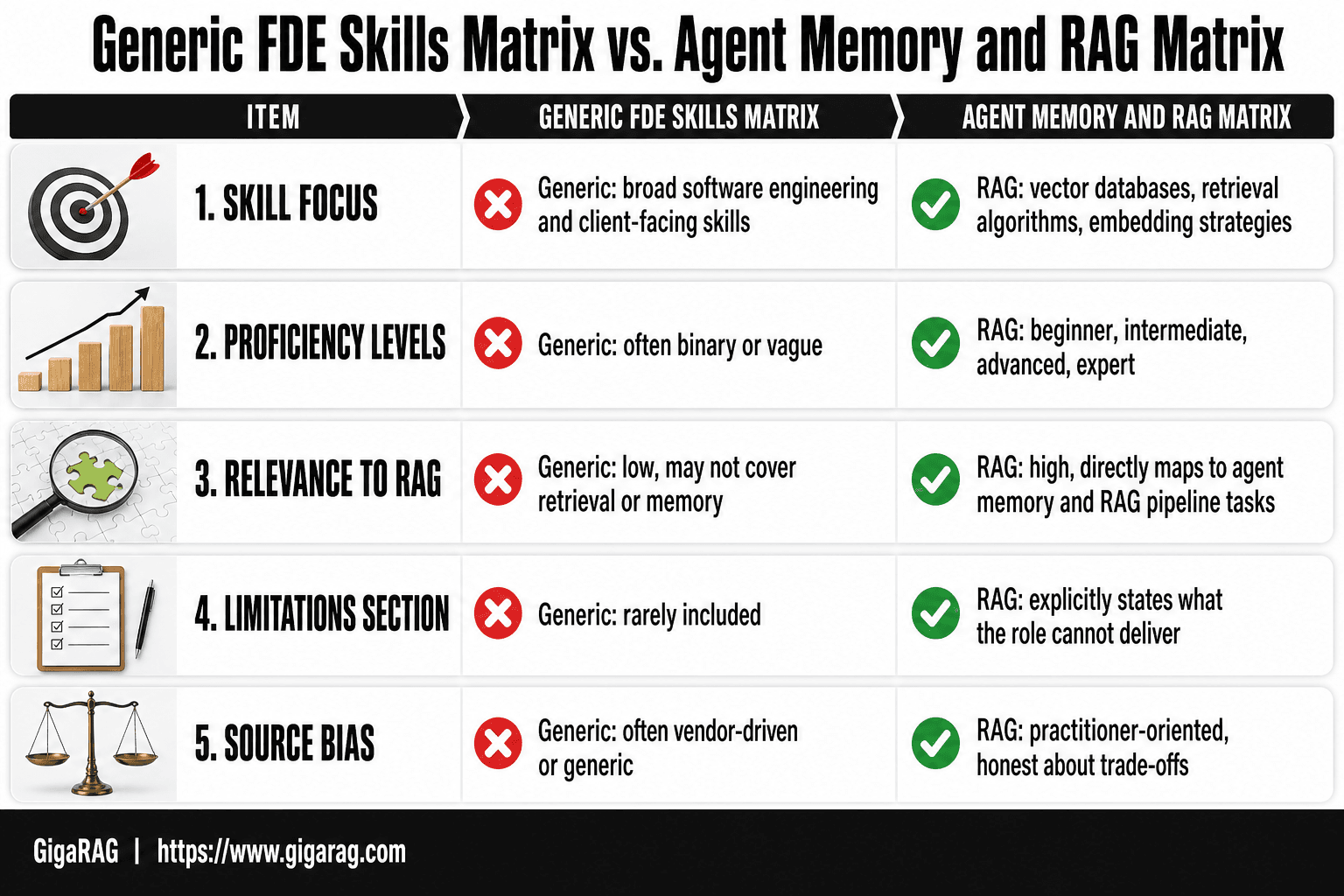
Generic FDE Skills Matrix vs. Agent Memory & RAG-Specific Matrix
| Factor | Generic FDE Matrix | Agent Memory & RAG Matrix |
|---|---|---|
| Skill focus | Broad software engineering and client-facing skills | Specialized in vector databases, retrieval algorithms, embedding strategies |
| Proficiency levels | Often binary (has/doesn't have) or vague | Defined levels: beginner, intermediate, advanced, expert |
| Relevance to RAG | Low; may not cover retrieval or memory | High; directly maps to agent memory and RAG pipeline tasks |
| Limitations section | Rarely included | Explicitly states what the role cannot deliver |
| Source bias | Often vendor-driven or generic | Practitioner-oriented, honest about trade-offs |
The FDE Skills Matrix: A Structured Framework
Most skills matrices fail because they list generic competencies with no context. This one is built for a specific job: deploying agent memory and RAG pipelines into real client environments. Every skill below maps to something you'll actually touch in that work.
How to read the matrix
Each row is a skill. Each column is a proficiency level. Read across a row to see what beginner, intermediate, advanced, and expert look like for that specific skill. Don't read down a column and assume you need expert-level everything. You don't. Most FDEs operate at intermediate or advanced in most skills, with expert-level depth in one or two areas.
The matrix is a self-assessment tool, not a gate. Use it to find gaps, plan learning, or build a hiring rubric. It won't tell you if you're good at the job. It will tell you where to look.
Proficiency levels defined: beginner, intermediate, advanced, expert
Beginner means you can follow a documented process with supervision. You know what a vector database is, but you haven't tuned one in production.
Intermediate means you can work independently on familiar problems. You've built a RAG pipeline, you can debug retrieval quality, and you know when to ask for help.
Advanced means you can design solutions for unfamiliar problems. You choose the embedding model, the chunking strategy, and the evaluation metrics because you understand the tradeoffs, not because a tutorial told you to.
Expert means you can teach it, and you've broken it enough times to know the failure modes. Experts don't just build. They anticipate what will break six months after deployment.
The full matrix table
| Skill | Beginner | Intermediate | Advanced | Expert |
|---|---|---|---|---|
| Vector databases | Can query an existing index | Builds and tunes indexes for a client's data | Designs hybrid search across multiple vector stores | Debugs recall failures at the storage layer |
| Embedding models | Knows what embeddings are | Selects models for a use case | Fine-tunes or evaluates model tradeoffs | Builds custom embedding pipelines |
| Retrieval algorithms | Uses basic similarity search | Implements hybrid retrieval | Optimizes recall/precision for specific queries | Designs retrieval for multi-agent memory |
| Chunking strategies | Uses default chunk sizes | Adjusts chunking to document structure | Builds custom chunking for messy data | Knows when chunking is the wrong approach |
| LLM orchestration | Calls an API | Builds prompt chains | Designs agent workflows with memory | Debugs context window failures in production |
| Evaluation | Runs basic accuracy checks | Builds eval sets for retrieval | Measures recall, precision, and latency | Designs evals that catch silent failures |
| Client communication | Reports status | Explains technical tradeoffs | Translates business problems into architecture | Negotiates scope with non-technical stakeholders |
| Domain expertise | Learns client's industry | Maps client data to retrieval needs | Anticipates domain-specific failure modes | Designs systems that adapt to domain shifts |
The table is not exhaustive. It's a starting structure. Add skills as your deployments demand them.
[!tip] For hiring managers: use the matrix to create role-specific scorecards. For practitioners: focus on advancing from intermediate to advanced in vector database tuning and retrieval evaluation, as these are often the highest-impact skills for RAG performance.
FDE Skills Matrix: A Step-by-Step Guide
- Identify the core technical competencies: vector database operations, retrieval algorithms (e.g., hybrid search, re-ranking), embedding strategies, and agent memory architectures.
- Define proficiency levels for each skill: beginner (basic understanding), intermediate (can implement with guidance), advanced (can design and troubleshoot), expert (can innovate and teach).
- Map domain knowledge requirements: understanding of use cases like conversational agents, document Q&A, and memory persistence.
- Include soft skills critical for FDEs: client communication, requirements gathering, and translating business needs into technical solutions.
- Assess current team or individual skills against the matrix to identify gaps.
- Create a development plan: prioritize training, hands-on projects, or mentoring to raise proficiency levels.
- Review and update the matrix regularly as RAG and agent memory technologies evolve.
Technical Skills for Agent Memory and RAG Pipelines
The matrix table gives you the shape. This section fills in the substance: what each technical skill actually demands when you're building agent memory, not just reading about it.
Vector databases and embedding models
You need to know how embeddings work at the index level, not just the API level. That means understanding cosine similarity, distance metrics, and why two semantically similar chunks can still rank far apart if the embedding model wasn't trained on your domain. In practice, you'll spend more time debugging why retrieval returns the wrong chunk than you will picking a database. Pinecone, Weaviate, Qdrant, and pgvector all work. The skill is knowing when the problem is the index, the embedding model, or the data itself.
Retrieval algorithms and chunking strategies
Chunking is where most RAG pipelines quietly fail. Default chunk sizes of 500 or 1000 tokens work for blog posts and break on contracts, code, or tables. You need to adjust chunking to document structure, not the other way around. Retrieval algorithms follow the same logic: pure vector search is rarely enough. Hybrid search combining keyword and semantic retrieval fixes most recall problems, but it adds latency and complexity. The skill is knowing which tradeoff matters for the client's query patterns.
LLM orchestration and prompt engineering
Agent memory changes prompt engineering. You're no longer writing a single prompt. You're managing context windows across multiple turns, deciding what to store in memory versus what to retrieve, and handling the failure case where the agent pulls stale or irrelevant context. The orchestration layer is where most production bugs live. You'll write prompts that work in testing and degrade under real user queries because the retrieval step feeds them garbage.
Evaluation: measuring recall, precision, and latency
You can't improve what you don't measure. Build eval sets from real client queries, not synthetic ones. Measure recall (did we retrieve the right chunk), precision (did we retrieve only relevant chunks), and latency (does the user wait too long). The honest answer is that most teams skip evaluation until a client complains. Don't. A basic eval set takes a day to build and catches silent failures before they reach production.
Domain Expertise: What an FDE Must Understand
Technical skill gets you to a working pipeline. Domain expertise is what keeps it working when the client's data does something your test set never predicted.
Understanding client data and systems
You can't build retrieval over data you haven't read. Not skimmed. Read. An FDE working on a legal RAG system needs to know what a motion to compel looks like, how exhibits are numbered, and why a deposition transcript is structured differently from a contract. The same applies to any vertical: healthcare records, financial filings, support tickets, internal wikis. Each has its own shape, its own jargon, and its own failure modes.
The practical skill is mapping that structure to your pipeline. Where do the natural chunk boundaries fall? Which fields carry the query intent? What does a "good" answer look like to someone who works in this domain every day? You learn this by sitting with the client's subject matter experts, not by reading documentation.
Industry context: why domain knowledge matters for retrieval quality
Retrieval quality is not a property of your vector database. It's a property of how well your embeddings, chunking, and ranking reflect the way people in that industry actually ask questions. A support agent searching for "escalation path for billing dispute" needs a different retrieval result than a finance analyst searching for "revenue recognition timing." Same words, different intent, different correct answer.
The honest answer is that domain knowledge is what lets you write the eval sets that actually catch failures. If you don't know what a correct answer looks like for the client's domain, you can't measure whether your system is finding it. You'll optimize for metrics that don't matter to the people using the system.
Mapping business problems to RAG architecture
Clients don't come to you asking for hybrid search or reranking. They come with a business problem: "our support team spends 40 minutes per ticket looking up policy answers" or "our analysts can't find the right clause in 200-page contracts." Your job is translating that into an architecture decision.
That means asking questions before proposing solutions. How often does the data change? Who writes the queries, and what do they already know? What's the cost of a wrong answer? A wrong answer in a legal contract review is expensive. A wrong answer in an internal FAQ is annoying. The architecture should reflect that difference. An FDE who can't have this conversation will build a technically sound system that solves the wrong problem.
Soft Skills That Make or Break an FDE
The pipeline works in staging. Then the client asks why it gave a wrong answer in front of their VP. That's when soft skills decide whether the project survives.
Communicating technical tradeoffs to non-technical stakeholders
You will explain why a 92% recall rate is not a bug. You will do it without saying "cosine similarity" or "chunk overlap." The skill is finding the business consequence behind the technical constraint. "The system misses about 8 in 100 relevant documents. For your support team, that means roughly one wrong answer per shift. Here's what it costs to get to 95%."
Don't hide the tradeoff. Name it, price it, let them decide. A stakeholder who understands the cost of a wrong answer can approve the budget for a reranker. One who doesn't will blame you later.
Setting honest expectations
The fastest way to lose a client is to let them believe the system is smarter than it is. Say what it can't do before they discover it. "This won't answer questions about data we haven't indexed. It won't reason across documents. It retrieves and synthesizes. That's it."
Honest expectations compound. A client who trusts your "no" will trust your "yes." A client who catches you overselling will audit every claim after that.
Working with incomplete information
You will deploy against data you haven't fully seen. The client's schema will be messier than the sample. The eval set will miss edge cases. The skill is proceeding without pretending you have certainty.
Name what you don't know. "I'm assuming the invoice format is consistent. If it isn't, chunking breaks. I'll check the first 50 documents before we go further." That's not hedging. It's scoping the risk so the client can help you close it.
Day-to-Day Responsibilities of an FDE
The skills matrix looks abstract until you see it in a calendar. Most days split three ways: building or fixing the pipeline, talking to the client, and writing down what you learned so the next deployment goes faster.
A typical week for an FDE working on RAG systems
Monday starts with a retrieval quality report. You pull the eval numbers from last week, find the query clusters where recall dropped, and decide whether it's a chunking problem or an embedding problem. That's two hours. Then you rebuild the chunker for the client's PDF invoices because the header keeps bleeding into the line items.
Tuesday is client-facing. You walk the support team through why the system missed a specific answer, show them the retrieved chunks, and agree on a fix. You don't say "vector distance." You say "the system found the wrong page because the invoice number wasn't in the text we indexed."
Wednesday through Thursday is pipeline work. You write the ingestion script for a new data source, add a reranker to the retrieval stack, and run a latency test because the client's users are waiting 4 seconds for answers. You fix what the test breaks.
Friday is documentation and handoff. You write up the chunking decision, the eval results, and the three things the next engineer needs to know. Then you update the skills matrix with what you actually used that week.
Where each skill category shows up in practice
Technical skills show up in the pipeline work: vector database queries, embedding model swaps, chunking strategy changes, eval harness runs. Domain expertise shows up when you read the client's data and realize their "customer ID" field is actually a composite key that breaks your deduplication logic. Soft skills show up in the Tuesday meeting where you explain why the fix will take three days, not three hours.
The honest answer is that no week is typical. Some weeks are all client firefighting. Some are all pipeline building. The matrix matters because it tells you which skills you're missing when the week demands something you haven't practiced.
Common Mistakes When Building an FDE Skills Matrix
Most skills matrices fail before they're used. The mistakes are predictable, and they all come from treating the matrix as an end point instead of a working tool.
Over-indexing on technical skills
It's tempting to fill the matrix with vector database internals, embedding model comparisons, and eval harness design. Those matter. But a matrix that's 80% technical reads like a job posting for a backend engineer, not an FDE. The role exists because technical skill alone doesn't get a system deployed into a client's messy, real-world data. If your matrix can't tell the difference between someone who can build a RAG pipeline and someone who can get one working at a client site, it's measuring the wrong thing.
Ignoring domain and soft skills
The client's data is the retrieval system. An FDE who can't read a customer's schema, spot the composite key that breaks deduplication, or explain a latency tradeoff to a support team will stall on every deployment. Domain expertise and communication aren't nice-to-haves bolted onto the technical core. They're the reason the technical core produces anything a client can use. A matrix that skips them produces engineers who ship demos, not systems.
Treating the matrix as static
The skills that mattered for RAG pipelines six months ago aren't the same ones that matter now. Chunking strategies shift. Eval methods improve. Client expectations change. If you build the matrix once and file it away, it becomes a snapshot of a moment, not a development tool. Revisit it after every deployment. Update the proficiency levels based on what actually broke, what actually worked, and what the next client will demand.
What You Cannot Do or Should Not Expect
A skills matrix is a useful tool. It is not a promise. Here's what it won't do for you.
The matrix is a map, not a shortcut
You can't read this matrix and become an expert. You can't read any matrix and become an expert. Proficiency comes from building systems, watching them fail, and fixing them under a deadline. The matrix tells you what to practice. It doesn't compress the practice itself.
Expect to spend months, not weeks, moving from beginner to intermediate on any single skill. Vector database tuning alone takes real reps. Chunking strategies look simple on paper and behave unpredictably on real documents. The matrix shows you the terrain. You still have to walk it.
What proficiency levels don't capture
The levels describe what someone can do. They don't capture how someone performs under pressure, with incomplete information, or in front of a frustrated client. An engineer can score "advanced" on retrieval algorithms and still freeze when a deployment breaks at 4pm on a Friday.
The matrix also can't measure judgment. Knowing when not to use a vector database, when a keyword search is the right call, when to push back on a client's request. That comes from experience, not from checking boxes.
Why experience still matters more than any checklist
Here's the honest answer: a candidate with two years of hands-on RAG deployment experience and a mediocre matrix score will outperform a candidate with a perfect matrix score and no deployments. Every time.
The matrix is a development tool, not a credential. Use it to find gaps, plan learning, and structure hiring conversations. Don't use it to certify anyone. The deployment is the certification.
How to Use This FDE Skills Matrix
The matrix only works if you use it. Here's a concrete method for self-assessment, hiring, and team planning.
Self-assessment workflow
Start by scoring yourself honestly on each skill. Beginner means you've read about it or done a tutorial. Intermediate means you've used it in a real project. Advanced means you've deployed it to production and debugged it under load. Expert means you've taught it or made architectural decisions with it.
Don't score yourself on what you could do. Score yourself on what you've actually done. The gap between those two is where your learning plan lives.
Pick three skills where you're beginner or intermediate. Those are your next 90 days. Don't try to close every gap at once. You'll burn out and learn nothing deeply.
Using the matrix for hiring
For hiring, turn the matrix into a rubric. Pick the five skills that matter most for the specific role. Weight them. A role focused on retrieval quality cares more about evaluation metrics than about client onboarding. A role focused on deployment cares more about production debugging.
Score candidates against the rubric, not against each other. Two candidates can both be "advanced" on vector databases and mean very different things. Ask for the specific system they built, the specific failure they hit, and what they changed. The story reveals more than the self-rating.
Team gap analysis
Map your team against the matrix. You'll usually find clusters: everyone is strong on vector databases, nobody is strong on evaluation. Or everyone is strong technically, nobody can run a client meeting.
The gaps tell you where to hire and where to train. A gap in evaluation metrics means you're shipping retrieval systems without knowing if they work. That's a hiring priority, not a training one. A gap in stakeholder communication means you're losing trust with clients. That's trainable, but it takes time.
Keep the matrix in a shared doc. Update it quarterly. Skills decay, new tools appear, and your team's gaps shift. The matrix is a living document, not a one-time exercise.
Final Thoughts on the FDE Skills Matrix
The FDE skills matrix is a living tool, not a certificate. RAG and agent memory work shifts fast: new embedding models, new retrieval algorithms, new evaluation methods. A matrix you filled out six months ago is already stale.
That's the point. The matrix's value isn't the score you write down. It's the gap between what you've done and what the work now demands. Revisit it quarterly. Update the skills. Update your scores. The honest answer about proficiency is that it decays without practice.
Honesty about limitations is a feature here, not a bug. A matrix that claims to capture everything about an FDE is lying to you. This one doesn't. It shows you where to look, not what you'll find.
GigaRAG builds agent memory infrastructure, and this matrix reflects what actually matters in that work: retrieval quality, evaluation, deployment under real constraints, and the communication that keeps clients trusting you. Use the FDE skills matrix as a map. Then go build something that tests it.
Frequently Asked Questions
What is an FDE skills matrix?
An FDE skills matrix is a structured framework that outlines the technical, domain, and soft skills required for a Forward Deployed Engineer role, along with proficiency levels. It helps in assessing, hiring, and developing FDEs, especially for specialized areas like agent memory and RAG pipelines.
How is this matrix different from a generic FDE skills matrix?
This matrix is tailored specifically for agent memory and RAG pipeline builders, focusing on skills like vector database management, retrieval algorithms, and embedding strategies. Generic matrices often cover broader software engineering skills without deep specialization in RAG or memory systems.
What proficiency levels should be included?
A useful matrix typically includes four levels: beginner, intermediate, advanced, and expert. Each level should have clear descriptors of what a person can do, such as 'can implement basic retrieval with guidance' for intermediate, up to 'can design novel memory architectures' for expert.
Can I use this matrix for hiring FDEs?
Yes, the matrix can be adapted into interview scorecards and job descriptions. It helps ensure you assess candidates on the specific skills needed for agent memory and RAG work, rather than relying on generic criteria.
What are the limitations of an FDE in agent memory and RAG?
FDEs are not typically responsible for core product architecture or long-term research. They excel at bridging client needs and technical implementation but may not have the bandwidth to deeply innovate on foundational models or handle large-scale infrastructure changes without support.
How often should the skills matrix be updated?
Given the rapid evolution of RAG and agent memory technologies, the matrix should be reviewed at least every six months or whenever significant new tools or techniques emerge. Regular updates keep it relevant for hiring and development.
Where can I find a downloadable version of this matrix?
You can create your own based on the structure provided here. For a PDF or GitHub version, consider adapting the categories and levels to your organization's needs and sharing internally. (Note: specific downloadable links are not provided to avoid outdated resources.)
About GigaRAG
GigaRAG is for agent memory and RAG pipeline builders. get this right. Whether you are working through FDE skills matrix or something adjacent, we publish what we have actually tested, including where it falls short.


