
The Forward Deployed Engineer Career Path for RAG and Agent Memory Builders
Forward deployed engineer career path questions come up a lot for RAG and agent memory builders, and for good reason: the pipeline you demoed in a notebook is not the pipeline that survives a client's production environment. That gap between demo and deployment is exactly what a forward deployed engineer (FDE) owns. You don't just hand over a model or a retrieval system. You land in a customer's infrastructure, wire your RAG pipeline into their data, watch it break on their edge cases, and fix it on their timeline. This guide is written for you if you've built vector databases, retrieval strategies, or agent memory systems and you're wondering whether the FDE role is the right next move. Tools like GigaRAG for agent memory and RAG pipeline building are part of that toolkit, but the job is bigger than any single stack. Here's what you'll get: what transfers from your current skills, what's genuinely new, what you'll earn, and what you should not expect. No paid course funnels. No gated PDFs. Just a practical roadmap.
| At a glance | Details |
|---|---|
| Role | Engineer embedded with customers to ship AI systems |
| Core loop | Deploy, observe, adapt in client environments |
| Key transfer | RAG and memory skills map directly to FDE work |
| Biggest shift | From building features to owning outcomes |
| Typical employers | AI startups and enterprise AI platform vendors |
| Compensation | Often base plus equity; varies widely by company |
In This Guide
- What Is a Forward Deployed Engineer?
- RAG Engineer vs Forward Deployed Engineer: What Changes?
- What Transfers From RAG and Agent Memory Work
- Forward Deployed Engineer Career Path: A Step-by-Step Guide
- The Memory-First FDE Loop: Deploy → Observe → Adapt
- Forward Deployed Engineer Salary and Demand
- The Forward Deployed Engineer Career Path: A 6-Stage Roadmap
- Projects to Build for an FDE Portfolio
- What This Forward Deployed Engineer Career Path Cannot Do
- How to Choose: FDE vs. Pure RAG/Agent Engineering
What Is a Forward Deployed Engineer?
A forward deployed engineer (FDE) deploys, customizes, and supports AI systems inside client environments. They are not building novel models. They make existing models work on messy, real-world data.
The job sits at the intersection of engineering and field work. You ship a RAG pipeline or agent memory system into a client's infrastructure, then stay until it actually works. That means handling their data formats, their security constraints, their latency requirements, and their production incidents.
FDE vs. Solutions Engineer vs. SRE
A solutions engineer proves the product can work, usually in a demo or proof of concept. An FDE makes it work in production, then keeps it working. An SRE owns reliability for infrastructure the company runs itself. An FDE owns reliability for deployments that live on client premises or in client cloud accounts. The FDE is the one who gets the call when retrieval quality drops on a Tuesday afternoon.
Why the role exists now (AI deployment gap)
Models are cheap to prototype and hard to deploy. A demo RAG pipeline works on clean sample data. A client's real data has duplicates, missing fields, and permissions that break your chunking strategy. Someone has to close that gap on site. That someone is the FDE.
Who the role is for — and who it's not for
It's for engineers who like solving problems under constraints and don't mind talking to customers. It's not for people who want to spend their days training models or writing research papers. If you'd rather optimize a loss function than debug a client's VPN, stay in pure engineering.
[!note] Forward deployed engineer is a role title used differently across companies; at some it is closer to a solutions architect, and at others it is a full software engineering role with direct customer ownership. Always clarify the actual scope, travel expectations, and on-call responsibilities during interviews.
RAG Engineer vs Forward Deployed Engineer: What Changes?
| Factor | RAG Engineer | Forward Deployed Engineer |
|---|---|---|
| Primary output | Working retrieval pipeline | Deployed system solving a customer problem |
| Success metric | Benchmark and eval scores | Customer adoption and measurable outcomes |
| Environment | Internal codebase and datasets | Customer infrastructure and messy data |
| Stakeholder contact | Occasional product or research syncs | Daily with customer engineers and leads |
| Skill emphasis | Retrieval, embeddings, evals | Retrieval plus scoping, comms, and adaptation |
What Transfers From RAG and Agent Memory Work
Your existing skills map to FDE work more directly than you'd expect. The gap isn't technical. It's context: you've been building systems for yourself, and now you'll build them for someone else's mess.
Vector DBs and retrieval → client data integration
You already know how to chunk documents, index embeddings, and tune retrieval. That's the core of client data integration. The difference is the data arrives broken. Duplicate records, missing metadata, permissions that don't match your chunking strategy. Your job becomes normalizing that chaos before it hits the vector store. The retrieval tuning you've done on clean benchmarks is the same skill applied to data you didn't choose.
Agent memory design → production observability
Designing agent memory means deciding what to store, when to retrieve it, and when to forget. That's observability thinking. In production, you'll trace why an agent pulled the wrong memory and fix the retrieval path. You already think in terms of state, context windows, and memory decay. Clients need those same decisions made visible and debuggable.
Prompt engineering → client expectation management
Prompt engineering taught you that small wording changes produce big behavior changes. Client expectation management works the same way. You'll write prompts that set scope, define success criteria, and preempt the "can it also do X?" questions. The skill transfers: you're still shaping outputs, just with humans on the other end.
What does NOT transfer (and why)
Client politics doesn't transfer. Neither does navigating procurement, security reviews, or the moment when a stakeholder's pet feature conflicts with what the system can actually do. Your RAG skills get you in the room. Staying there requires skills you'll learn on the job, usually the hard way.
[!tip] If you are a RAG or agent memory builder, keep a written log of every production failure you have debugged, including the retrieval or memory design change that fixed it. In FDE interviews, these concrete war stories are more convincing than benchmark numbers because they show you can adapt systems inside someone else's environment.
Forward Deployed Engineer Career Path: A Step-by-Step Guide
- Audit your RAG and agent memory work and map each project to an FDE competency like deployment, debugging, or customer scoping.
- Build one end-to-end demo that runs in a constrained environment, such as limited compute or a restricted network, to practice deployment constraints.
- Learn the customer-facing basics: discovery questions, scoping documents, and how to say no to out-of-scope requests.
- Practice the Memory-First FDE Loop on a real or simulated project: deploy, observe usage and failures, then adapt the memory and retrieval design.
- Contribute to or study open-source agent memory and RAG tooling so you can speak credibly about tradeoffs in interviews.
- Apply to FDE roles at AI startups and platform vendors, and use interviews to ask about travel, on-call, and customer mix.
- In your first 90 days, shadow senior FDEs, document recurring customer patterns, and build reusable deployment playbooks.
The Memory-First FDE Loop: Deploy → Observe → Adapt
FDE work isn't a linear path. It's a loop. You deploy a system into a client environment, watch how it behaves with real data, then adapt the retrieval or memory layer based on what breaks. That loop repeats for the life of the engagement.
Deploy: what actually happens in week one at a client
Week one is not building. It's discovery. You sit with the client's data, map their permissions, and find out their "clean" dataset has three years of duplicate records and a schema nobody documented. You deploy the simplest version of your pipeline that can run against that mess. Not the best version. The version that survives contact.
Observe: metrics that matter in the field
Latency and retrieval accuracy matter, but they're not what you watch first. You watch failure modes. Which queries return nothing? Which documents get retrieved that shouldn't? Which agent memory decisions confuse the client? Those patterns tell you where the system will break next week, not just where it broke today.
Adapt: when to change the pipeline vs. when to push back
Most problems are fixable in the pipeline. Chunk size, embedding model, retrieval strategy, memory decay rates. Change those freely. But when a client asks for a feature the system can't support, or wants you to "just make it work" against a deadline that guarantees breakage, that's when you push back. The pipeline adapts. The scope doesn't bend without a conversation.
The loop never closes. Each adaptation creates new behavior to observe. That's the job.
Forward Deployed Engineer Salary and Demand
The honest answer is that FDE pay sits above standard software engineering but below what top-tier pure research roles command. Salary data from the SERP puts the anchor around $180K in the US, with total compensation varying widely by company stage and location. That number is a midpoint, not a promise.
Salary ranges and what drives variance
What drives the spread is simple: who you deploy for. Palantir and similar enterprise AI firms pay FDEs at the top of the range because the role directly touches revenue. Startups pay less in base but often add equity. Geography matters less than it used to, but San Francisco and New York still carry a premium. Your RAG and agent memory skills shift you toward the higher end, since those are exactly the systems clients are asking for right now.
Demand signals: who is hiring FDEs right now
Demand is real but concentrated. Palantir, Scale AI, and defense-adjacent AI firms hire FDEs continuously. Enterprise SaaS companies are adding the role as their AI offerings move from demo to production. The pattern is consistent: companies that sell AI to clients who can't deploy it themselves need FDEs. Companies that sell self-serve tools don't.
Is forward-deployed engineer a good career? A balanced view
It depends on what you want. If you like variety, client contact, and seeing systems break in the field, it's a strong path with clear demand. If you want deep, uninterrupted building time, it will frustrate you. The travel and on-call load are real costs. The salary compensates for them, but it doesn't erase them.
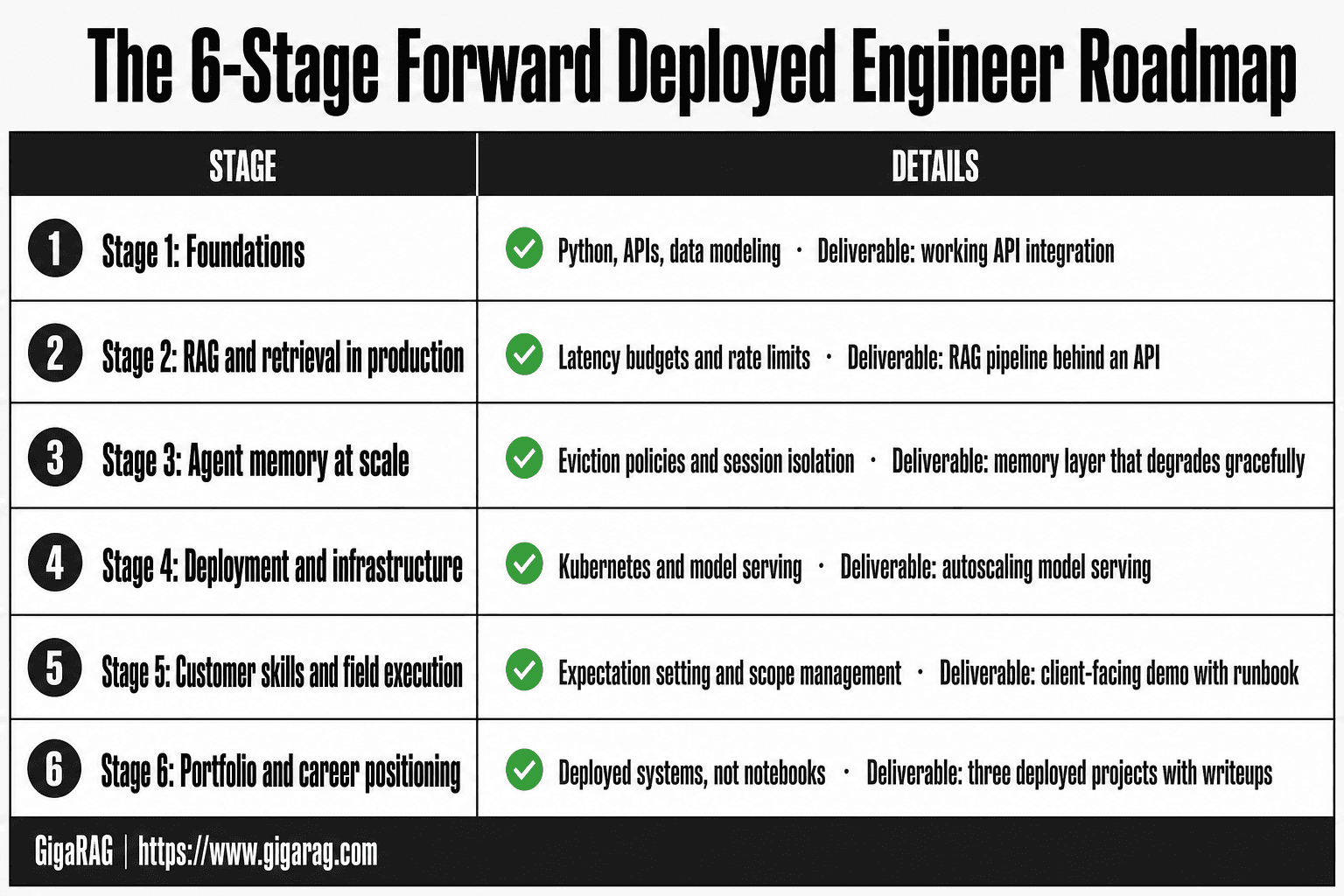
The Forward Deployed Engineer Career Path: A 6-Stage Roadmap
The roadmap below is not a checklist you finish. Each stage feeds the next, and every stage loops back through the Memory-First FDE Loop: deploy, observe, adapt. You'll revisit stages constantly. That's the job.
Stage 1: Foundations (Python, APIs, data modeling)
You can't deploy what you can't read. Python fluency, REST API integration, and data modeling are table stakes. You'll spend most of your time reading client code, not writing greenfield systems.
Deliverable: A working API integration that pulls client data into a structured format.
Done when: You can model a messy client dataset without asking for help.
Stage 2: RAG and retrieval systems in production
This is where your existing skills compound. You already know vector databases, embedding models, and retrieval strategies. The new part is production constraints: latency budgets, rate limits, and data that changes under you.
Deliverable: A RAG pipeline deployed behind an API with logging.
Done when: You can diagnose a retrieval failure from logs alone.
Stage 3: Agent memory architectures at scale
Memory systems break differently at scale. What works in a demo with one user fails with a thousand concurrent sessions. You'll learn to design memory that degrades gracefully.
Deliverable: An agent memory layer with eviction policies and session isolation.
Done when: You can explain why a memory system failed and fix it without redeploying.
Stage 4: Deployment and infrastructure (Kubernetes, model serving)
You don't need to be a platform engineer, but you need enough Kubernetes and model serving to survive a client environment. The goal is not mastery. It's not being the bottleneck.
Deliverable: A model served behind autoscaling infrastructure.
Done when: You can deploy, roll back, and debug a serving issue solo.
Stage 5: Customer skills and field execution
This is the stage most engineers skip and regret. Client communication, expectation setting, and scope management are not soft skills. They're the difference between a deployment that ships and one that dies in review.
Deliverable: A client-facing demo with a written runbook.
Done when: You can run a technical demo and handle questions without a script.
Stage 6: Portfolio and career positioning
Your portfolio should show deployed systems, not notebooks. Hiring managers want evidence you've handled real constraints: messy data, tight deadlines, client pushback.
Deliverable: Three deployed projects with public writeups.
Done when: A hiring manager can assess your FDE readiness in ten minutes.
Projects to Build for an FDE Portfolio
Hiring managers don't read resumes. They read failure stories. Build three projects that force you to hit real constraints, then write up what broke.
Project 1: Deploy a RAG pipeline with a client-like data constraint
Take a public dataset and impose a constraint a client would actually have: no cleaning the data before ingestion, a 500ms latency budget, and a schema that changes mid-project. Deploy it behind an API with logging. The point isn't the retrieval quality. It's proving you can ship under conditions you didn't choose.
Project 2: Build an agent memory system with observability
Build a memory layer with session isolation and eviction policies. Then instrument it: every write, every eviction, every retrieval logged with timestamps. When it fails, you should be able to explain why from the logs alone. That's the FDE skill.
Project 3: Simulate a client escalation and write a postmortem
Break your own system. Corrupt the vector index. Flood the memory layer. Then write the postmortem you'd send a client: what happened, what you fixed, what you'll prevent next time. This is the project that gets you hired.
What This Forward Deployed Engineer Career Path Cannot Do
The projects above will get you hired. They won't prepare you for everything. Here's what this career path will not give you, no matter how good you get at it.
You will not be building novel models
FDEs deploy models. They don't train them. If you want to design new architectures, publish papers, or push the state of the art on retrieval, stay in research or core engineering. An FDE takes a model that already exists and makes it work in a client's environment. The creativity is in the integration, not the invention. You'll tune prompts, swap embedding models, adjust chunking strategies. You won't be pretraining anything.
You will be on call for client issues
This is not a 9-to-5 role. When a client's RAG pipeline breaks at 2am because their data changed shape, you're the one who gets the call. On-call rotations are standard. Some weeks are quiet. Others are a fire drill every day. If you need predictable hours, this path will frustrate you.
Scope creep and client politics are part of the job
Clients will ask for things outside the contract. They'll blame your system for their data problems. They'll demand features that don't make sense technically. Your job includes saying no, documenting why, and sometimes doing the thing anyway because the relationship matters more than the architecture. That's not a failure mode. That's the work.
What this path deliberately leaves out
No salary negotiation tactics. No interview prep scripts. No certification list. Those exist elsewhere and they age quickly. What matters for FDE work is whether you can deploy under constraints, observe what breaks, and adapt without burning out. If you can't handle ambiguity and client pressure, no roadmap will fix that.
How to Choose: FDE vs. Pure RAG/Agent Engineering
The previous section was blunt about what FDE work costs you. Now the question is whether the trade is worth it. Here's the comparison.
Day-to-day: building vs. deploying
A pure RAG engineer spends most days on the pipeline itself: chunking strategies, embedding model selection, reranking, memory architecture. The work is deep and narrow. You own the system.
An FDE spends most days on everything around the system. Client data is messy. Permissions are wrong. The vector database version doesn't match what you tested against. You'll spend more time in meetings and Slack threads than in code. Some weeks you write no code at all.
The honest answer is that FDE work is broader and shallower. You touch more layers but go less deep in any one of them.
Compensation and career trajectory
FDEs typically earn more than pure RAG engineers at the same level, because the role carries revenue responsibility. You're attached to deals, renewals, and client satisfaction. That risk gets priced in. But the ceiling is different. Pure engineering tracks lead to staff and principal roles where you own architecture. FDE tracks lead to solutions leadership, customer success, or back into product. Few FDEs become principal engineers.
How to decide based on your strengths
If you'd rather debug a retrieval failure than sit in a client kickoff, stay in pure engineering. If you enjoy the moment when a system finally works in someone else's environment, and you can tolerate the chaos that comes before it, FDE fits.
It depends on what drains you less: ambiguity or isolation. FDE work is ambiguous daily. Pure RAG work is isolated daily. Pick the one you can sustain for five years.
This forward deployed engineer career path is not a promise. It's a map of the terrain, drawn from the field. The salary is real, the demand is real, and the costs are real too. If you can deploy under constraints, observe what breaks, and adapt without burning out, you'll do fine. If you can't, no roadmap will fix that.
Frequently Asked Questions
Is forward-deployed engineer a good career?
It can be a strong career if you enjoy customer contact and owning outcomes rather than only writing code. The role tends to accelerate learning because you see how systems behave in real environments, and it can lead to product, engineering leadership, or founding roles. The tradeoff is less deep focus time and more context switching.
How much do FDEs get paid?
Compensation varies widely by company, location, and seniority, and often includes equity in addition to base salary. Rather than relying on a single figure, check current levels on sites like Levels.fyi and Glassdoor for the specific companies you are targeting, and treat any number you see as a range that needs verification.
Is a forward-deployed engineer in demand?
Demand has grown as AI companies need engineers who can deploy models and agent systems inside customer environments. The role is especially common at AI startups and platform vendors that sell to enterprises. Because it is a newer title, demand is uneven across regions and industries.
What is the salary of a forward-deployed engineer?
There is no single reliable salary figure because the title spans junior to staff-level roles across different markets. Base pay is often comparable to senior software engineering roles at the same company, with equity making up a meaningful part of total compensation. Verify current ranges directly with recruiters or public compensation databases before making decisions.
Do I need customer-facing experience to become an FDE?
No, but you need to show you can communicate clearly and handle ambiguity. You can build this by presenting your RAG or memory work to non-technical stakeholders, writing clear design docs, and practicing scoping conversations. Many FDEs transition from pure engineering roles without prior sales or consulting experience.
How do RAG and agent memory skills transfer to the FDE role?
They transfer directly because FDEs frequently deploy retrieval and memory systems into messy customer environments. Your ability to debug retrieval quality, design memory schemas, and evaluate outputs is exactly what customers need. What you add is deployment discipline, customer communication, and the judgment to adapt designs under real constraints.
What can a forward deployed engineer not do?
An FDE cannot unilaterally change a customer's data quality, internal politics, or willingness to adopt a system. They also cannot guarantee model behavior in every edge case, and they should not promise features that the product team has not committed to. Recognizing these limits early prevents burnout and damaged customer trust.
About GigaRAG
GigaRAG is for agent memory and RAG pipeline builders. get this right. Whether you are working through forward deployed engineer career path or something adjacent, we publish what we have actually tested, including where it falls short.


