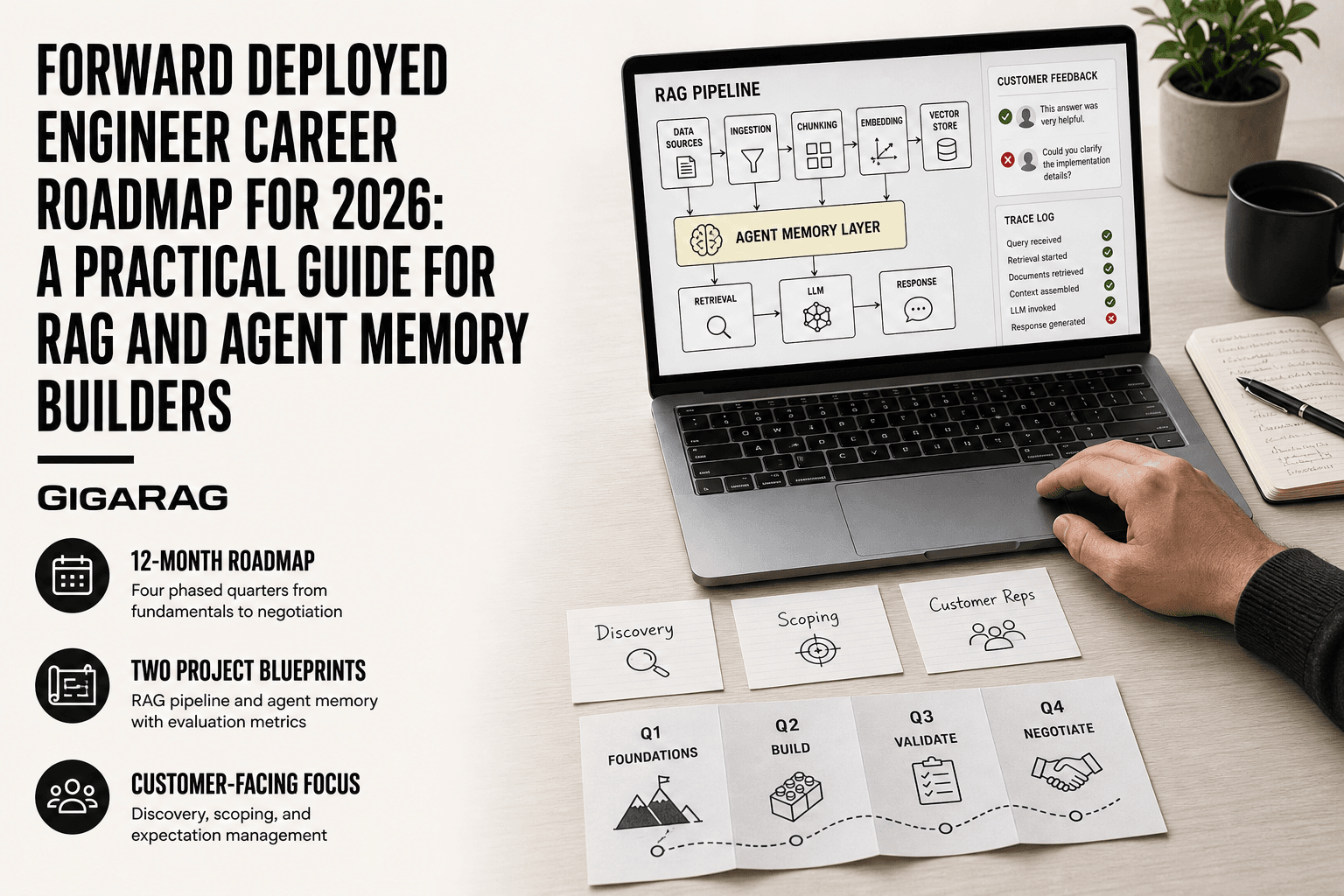
Forward Deployed Engineer Career Roadmap for 2026: A Practical Guide for RAG and Agent Memory Builders
Most forward deployed engineer career roadmaps for 2026 are recycled skill lists with no grounding in what you'll actually do. If you build RAG pipelines and agent memory systems, you're closer to the role than most people who read those roadmaps. You already handle chunking strategies, vector databases, embedding models, and retrieval optimization. What you don't have yet is the customer-facing reps, the scoping discipline, and the honest understanding of where the job stops. That's the gap this guide fills.
Here's what you won't get elsewhere: a 12-month plan built for RAG and agent memory builders, two project blueprints with evaluation criteria you can actually measure against, and a plain statement of what an FDE cannot do. Tools like GigaRAG can help with the agent memory infrastructure side, but the career work is yours.
| At a glance | Details |
|---|---|
| Role Focus | Customer-facing engineer deploying RAG and agent memory |
| Typical Experience | 2–5 years in software or data engineering |
| Core Skills | RAG pipelines, vector DBs, agent memory, communication |
| Key Tools | LangChain, LlamaIndex, Pinecone, Weaviate, Python |
| Salary Range | Competitive; varies by location and company (verify at publish) |
| Outlook 2026 | Growing demand as AI adoption accelerates |
In This Guide
- What Is a Forward Deployed Engineer in 2026?
- Forward Deployed Engineer vs. Solutions Architect vs. ML Engineer
- The Forward Deployed Engineer Career Roadmap for 2026 at a Glance
- Forward Deployed Engineer Career Roadmap For 2026: A Step-by-Step Guide
- Skills You Need for a Forward Deployed Engineer Career in 2026
- Months 1-3: Assess Your Gaps and Build Fundamentals
- Months 4-6: Build and Ship RAG and Agent Memory Projects
- Months 7-9: Specialize and Get Customer-Facing Reps
- Months 10-12: Portfolio, Applications, and Negotiation
- What You Cannot Do as a Forward Deployed Engineer
- FDE vs. Solutions Architect vs. ML Engineer: Which Role Fits You?
- Common Mistakes When Pursuing a Forward Deployed Engineer Career Roadmap for 2026
- Final Thoughts: Your Forward Deployed Engineer Career Roadmap for 2026
What Is a Forward Deployed Engineer in 2026?
A forward deployed engineer (FDE) is a software engineer who works inside customer environments, building and shipping solutions on top of a company's core product. They write production code, debug live systems, and own the technical relationship with the customer. In 2026, for RAG and agent memory builders, that increasingly means deploying retrieval pipelines, vector databases, and memory layers directly into a customer's infrastructure.
The three careers combined: engineer, consultant, and salesperson
An FDE does three jobs at once. You write code like an engineer. You scope problems and advise like a consultant. And you handle discovery, demos, and relationship management like a salesperson. The split varies by company. At Palantir, the role leans heavily toward deployment and integration. At smaller AI startups, you might spend 40% of your week in customer calls and 60% building.
Why FDE is not an entry-level role
You can't start here. FDEs need enough engineering depth to debug production systems without hand-holding, plus enough communication skill to explain technical tradeoffs to non-technical stakeholders. Most FDEs come from 2-5 years as a backend, data, or ML engineer. The customer-facing reps come later, on the job.
How 2026 changed the FDE: AI infrastructure and agent memory
The role shifted. Five years ago, FDEs deployed dashboards and data pipelines. Now they deploy RAG systems, configure embedding models, tune chunking strategies, and wire up agent memory layers that persist across sessions. Customers don't just want software installed. They want retrieval that works on their data, with their latency budgets, under their compliance rules. That's the job now.
[!note] As an FDE, you cannot single-handedly change a customer's data infrastructure or guarantee model performance without their cooperation; success depends on close collaboration and realistic scoping.
Forward Deployed Engineer vs. Solutions Architect vs. ML Engineer
| Factor | Forward Deployed Engineer | Solutions Architect |
|---|---|---|
| Primary Focus | Deploy and optimize AI systems at customer sites | Design high-level technical solutions |
| Customer Interaction | High: daily collaboration with customers | Medium: works with customers but less hands-on |
| Coding vs. Design | Heavy coding and debugging | More design and documentation |
| RAG/Agent Memory Work | Direct implementation and tuning | May design architecture but not implement |
| Travel | Frequent travel to customer locations | Some travel |
The Forward Deployed Engineer Career Roadmap for 2026 at a Glance
Here's the full arc before we get into the details. Twelve months, four phases, one goal: turn your RAG and agent memory experience into a customer-facing FDE role.
Months 1-3: Fundamentals and gap assessment
You already have the hard part: you build retrieval systems. This quarter is about finding what's missing. Assess your cloud and API skills against what FDE job posts actually ask for. Shore up system design basics. Start learning discovery and scoping, the customer-facing work most engineers skip until it's too late.
Months 4-6: Build and ship RAG/agent memory projects
Two projects, built to production standards. A RAG pipeline with evaluation metrics you can show a hiring manager. An agent memory system with retrieval optimization that survives real queries. You'll measure latency, cost, and relevance, not just "it works."
Months 7-9: Specialize and get customer-facing reps
This is where most roadmaps go soft. You need actual customer contact: freelance work, open-source maintainership, or internal projects at your current job. Deploy your RAG systems into messy environments where data is dirty and requirements shift mid-call.
Months 10-12: Portfolio, applications, and negotiation
Package the projects. Target companies that actually need RAG and agent memory FDEs, not every company with "AI" in the job title. Negotiate with real salary data for 2026.
That's the shape. The details matter more.
[!tip] When building your portfolio, focus on demonstrating how you debugged and optimized a RAG pipeline in a real or simulated customer environment—hiring managers value problem-solving stories over just listing tools.
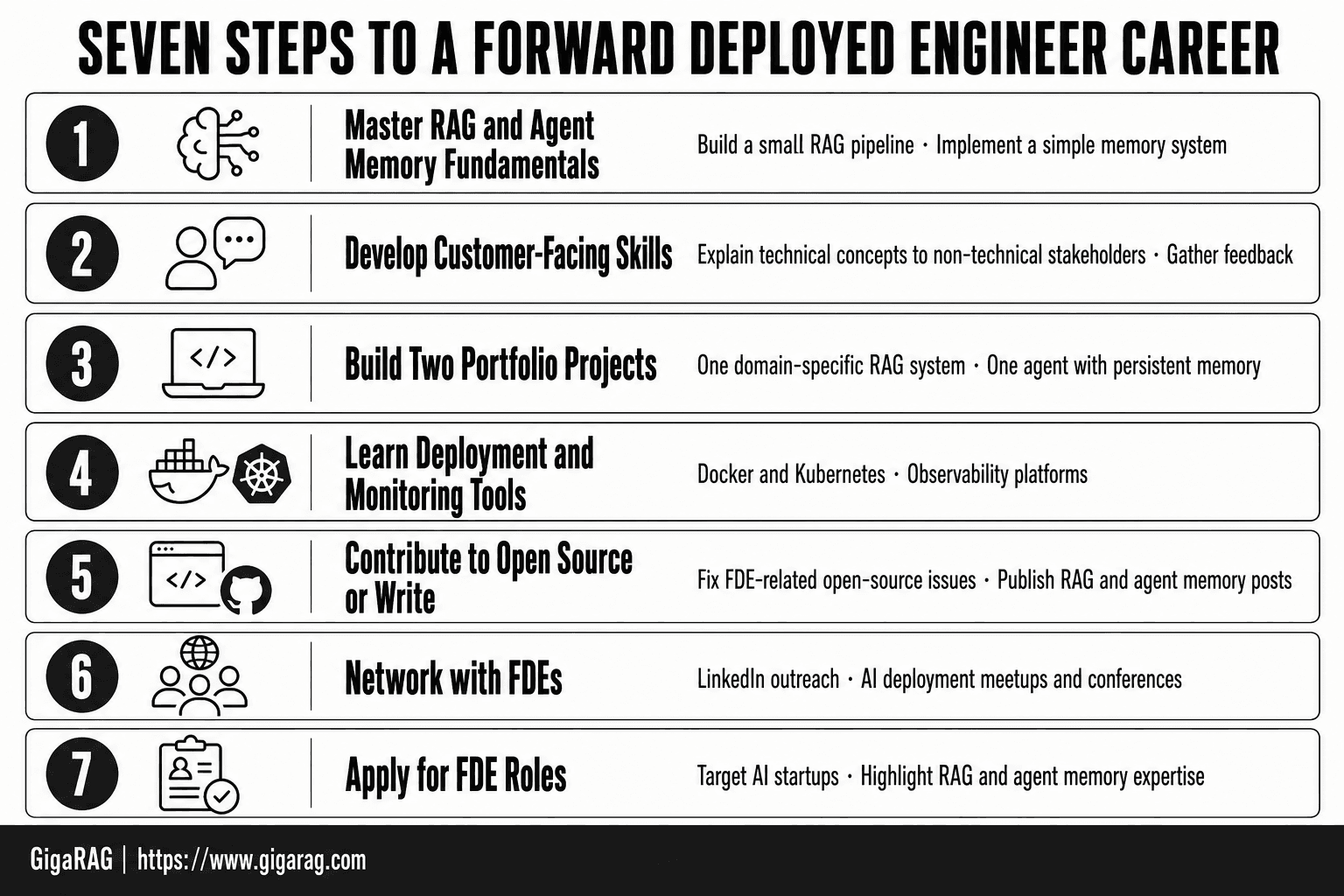
Forward Deployed Engineer Career Roadmap For 2026: A Step-by-Step Guide
- Master RAG and agent memory fundamentals: build a small RAG pipeline with a vector database and implement a simple memory system.
- Develop customer-facing skills: practice explaining technical concepts to non-technical stakeholders and gather feedback.
- Build two portfolio projects: one RAG system for a specific domain (e.g., legal or medical) and one agent with persistent memory.
- Learn deployment and monitoring tools: Docker, Kubernetes, and observability platforms like LangSmith or Arize.
- Contribute to open-source FDE-related projects or write blog posts about your RAG/agent memory implementations.
- Network with FDEs on LinkedIn and attend industry meetups or conferences focused on AI deployment.
- Apply for FDE roles at AI startups or companies with forward-deployed engineering teams, highlighting your RAG and agent memory expertise.
Skills You Need for a Forward Deployed Engineer Career in 2026
The skills break into four buckets. You already have pieces of each from building RAG pipelines. The gap is usually in the customer-facing bucket, not the technical one.
Core engineering: Python, APIs, cloud infrastructure
Python is non-negotiable. You'll write it daily, often inside a customer's environment where you can't rely on your own tooling. APIs matter more than frameworks: you'll integrate with customer systems that were never designed for AI. Cloud infrastructure means you can stand up a deployment without waiting on someone else. Know one cloud well enough to debug a production issue at 2 a.m. That's the bar.
RAG and agent memory specifics: vector databases, embedding models, chunking strategies
This is your home turf. Vector databases: you need to know when to use pgvector versus a dedicated store, and what happens to latency at 10 million vectors. Embedding models: you should understand tradeoffs between cost, dimensionality, and retrieval quality. Chunking strategies: this is where most RAG systems fail in production. You need to know how chunk size and overlap change retrieval behavior for different document types. Agent memory adds another layer: conversation history, long-term memory stores, and the retrieval logic that decides what the agent actually sees.
Customer-facing skills: discovery, scoping, demos, and expectation management
Discovery means asking questions that reveal what the customer actually needs, not what they say they need. Scoping means writing down what you'll build, what you won't, and what it costs. Demos: you'll run them weekly. Expectation management is the skill that keeps projects alive. When a customer asks for a feature that will take three weeks, you say so plainly, then offer the two-day version that solves 80% of the problem.
Evaluation and observability: metrics, tracing, and debugging retrieval systems
You cannot improve what you cannot measure. For RAG, that means relevance metrics: precision, recall, and something like NDCG on your retrieval results. For agent memory, you need to trace what the agent retrieved and why. Tracing tools show you the full path from query to response. Debugging retrieval systems means you can look at a bad answer, trace it back to a bad chunk or a bad embedding, and fix it. This is the skill that separates FDEs from engineers who only build demos.
Months 1-3: Assess Your Gaps and Build Fundamentals
You already have the hard part. RAG builders walk in knowing vector databases, embedding models, and chunking strategies. The first quarter is about finding what's missing and filling it before you touch a customer.
Self-assessment: what RAG builders already have vs. what FDEs need
Start with a two-column list. Left column: what you can do today. Right column: what an FDE does weekly. You'll find overlap on the technical side and a gap on the customer side. Most RAG builders have never run a discovery call or scoped a project with a paying customer. That's the gap to close first.
Filling engineering gaps: cloud, APIs, and system design
If you've only deployed locally or on a managed platform, spend these months on cloud fundamentals. Pick one provider and learn to deploy, monitor, and debug a service without help. APIs matter more than frameworks: you'll integrate with customer systems that were never designed for AI. System design means you can explain why a pipeline fails at scale, not just that it does.
Learning the customer-facing basics: discovery and scoping
Discovery is asking questions that reveal what a customer actually needs, not what they say they need. Scoping is writing down what you'll build, what you won't, and what it costs. Practice both on internal stakeholders or open-source users. You don't need to be polished yet. You need reps.
Months 4-6: Build and Ship RAG and Agent Memory Projects
The first quarter closed your gaps. This quarter proves you can ship. Two projects matter here: a production RAG pipeline and an agent memory system. Both need evaluation metrics, not just working demos.
Project blueprint 1: A production RAG pipeline with evaluation metrics
Build a RAG pipeline that ingests a real dataset, chunks it, embeds it, and serves answers with citations. Use a public dataset with messy formatting: SEC filings, support tickets, or documentation from a product you actually use. The mess is the point.
Here's what makes it production-grade. You need a chunking strategy you can defend, not just a default splitter. You need retrieval evaluation: precision@k, recall@k, and mean reciprocal rank on a held-out query set. You need latency tracking per stage: embedding time, retrieval time, generation time. Log all three.
The main catch is evaluation data. You'll write 50 to 100 query-answer pairs by hand. That's tedious but non-negotiable. Without it, you can't measure whether a change to chunk size or embedding model actually helped.
Project blueprint 2: An agent memory system with retrieval optimization
This project tests whether you understand memory, not just retrieval. Build an agent that maintains conversation history, extracts facts, and retrieves relevant context for follow-up questions. The hard part is deciding what to store and when to retrieve it.
Start with a simple memory store: a vector database holding conversation turns and extracted facts. Then add retrieval optimization: query rewriting, recency weighting, and deduplication. Measure retrieval hit rate on a set of multi-turn conversations where the answer depends on something said three turns earlier.
Keep in mind that agent memory fails silently. A wrong retrieval doesn't throw an error. It just gives a plausible but wrong answer. Your evaluation needs to catch that.
Success criteria: latency, cost, relevance, and reliability benchmarks
Ship both projects with a benchmark sheet. Four numbers matter:
- Latency: end-to-end response under 2 seconds for RAG, under 3 for agent memory with multi-step retrieval.
- Cost: per-query cost under $0.01 for RAG, under $0.03 for agent memory. Track token usage per stage.
- Relevance: precision@5 above 0.7 on your held-out set. Below that, your chunking or embedding choice needs work.
- Reliability: 99% uptime over a two-week period with synthetic traffic hitting it daily.
These numbers aren't arbitrary. They're the floor for a customer demo. If you can't hit them on your own data, you won't hit them on a customer's messier data.
Months 7-9: Specialize and Get Customer-Facing Reps
You've shipped two projects with real evaluation numbers. Now the work changes. Months 7-9 are about getting in front of actual customers and watching your systems break in ways your test data never predicted.
Finding customer-facing reps: freelance, open source, and internal projects
Three paths get you reps. Pick the one you can start this week.
Freelance work on Upwork or through your network is the fastest route to real customers. You'll find small businesses that need a RAG system for their docs or support tickets. The pay is low. The experience is the point. You'll scope, build, deploy, and handle complaints.
Open source is slower but compounds. Find a RAG or agent framework with open issues, then fix bugs that users have actually reported. You're not building features in a vacuum. You're responding to real people with real problems. That's the FDE muscle.
Internal projects work if you're already employed. Ask to shadow a customer call or take on a deployment for another team. Most engineers never ask. The ones who do get the reps.
Deploying RAG systems in messy real-world environments
Your clean benchmark data lied to you. Customer data has duplicate documents, broken HTML, PDFs that are actually scanned images, and queries that don't match anything in the corpus. Here's what happens behind the scenes: your chunking strategy that hit 0.8 precision on your test set drops to 0.5 on their data.
The fix is not a better model. It's better preprocessing and honest scoping. You'll write parsers for formats you didn't know existed. You'll add fallback retrieval for when the vector search returns nothing useful. You'll learn that most customer problems are data problems, not model problems.
Handling customer feedback and iteration loops
Customers don't report bugs the way you expect. They say "it gave a wrong answer" without telling you the query, the retrieved context, or what they expected. Your job is to extract that information without frustrating them.
Build a feedback loop into every deployment. Log every query, every retrieved chunk, every generated answer. When a customer says something is wrong, you pull the trace and see exactly where it failed. Then you fix it and show them the before and after.
The honest answer is that most of your time in months 7-9 goes to communication, not code. You'll write more emails explaining retrieval behavior than you'll write retrieval logic. That's the job.
Months 10-12: Portfolio, Applications, and Negotiation
You've got customer-facing reps and two shipped projects. Now you package that into a job offer.
Building a portfolio that demonstrates customer impact
Don't list projects. Show outcomes. For each RAG or agent memory system you built, write three lines: the customer's problem, what you deployed, and the number that moved. Latency dropped from 4 seconds to 800ms. Retrieval precision went from 0.5 to 0.7 after chunking fixes. Support tickets deflected: 30%.
A GitHub repo with clean code matters less than a one-page writeup with those numbers. Hiring managers for FDE roles skim. Make the impact visible in ten seconds.
Targeting companies that need RAG and agent memory FDEs
The obvious targets are AI infrastructure startups: vector database vendors, LLM platform companies, agent framework builders. They hire FDEs to get their tools deployed inside customer environments.
Less obvious: any B2B company with a large document corpus. Legal tech, healthcare admin, financial services. They're building internal RAG systems and need someone who can both build and talk to stakeholders.
Apply where your specific projects match their specific pain. A generic application to 50 companies loses to five targeted ones.
Salary expectations and negotiation for 2026
FDE roles at AI startups pay $140k to $220k base, with equity on top. Enterprise companies pay less base but more stability. The range is wide because the role is new and titles are inconsistent.
Negotiate on the customer impact you've already demonstrated, not on years of experience. You shipped a RAG system that cut support tickets by 30%. That's leverage. Don't accept the first number if you have that evidence.
What You Cannot Do as a Forward Deployed Engineer
Most FDE roadmaps skip this part. They list skills, projects, and salary bands, then stop. But the role has hard boundaries, and knowing them before you start will save you from burnout and bad expectations.
You cannot fix a broken product alone
You can patch, configure, and work around. You cannot rewrite a vector database's core indexing logic in a customer's production environment. When the product has a fundamental flaw, your job is to surface it clearly to engineering, not to heroically code around it for six weeks.
The honest answer: your leverage is diagnosis, not repair. You find the failure, reproduce it, and hand over a precise bug report. If you try to fix everything yourself, you'll burn out and the customer still won't have a working system.
You cannot control customer timelines or priorities
A customer will tell you they need the RAG pipeline live by Friday. Then their legal team takes three weeks to approve the data access. Then the stakeholder who championed the project goes on parental leave. None of that is yours to fix.
You can set expectations, document dependencies, and escalate blockers. You cannot make a customer's procurement process move faster. The main catch: your performance review may still measure deployment velocity, even when the delay isn't yours. Learn to document the gap between your work and the customer's timeline.
You cannot be an expert in everything: scope boundaries
You'll be asked about embedding models, chunking strategies, vector databases, cloud networking, security reviews, and pricing. You cannot be deep on all of them. Pick two or three areas where you're genuinely strong, and be honest about the rest.
Saying "I don't know, but I'll find out and get back to you by tomorrow" builds more trust than a confident wrong answer. The customer already has vendors who bluff. They'll keep you around because you don't.
FDE vs. Solutions Architect vs. ML Engineer: Which Role Fits You?
You know the boundaries now. The next question is whether FDE is even the right lane. If you build RAG pipelines and agent memory systems, three roles will show up in your job search: forward deployed engineer, solutions architect, and ML engineer. They overlap on paper. In practice, they reward different instincts.
FDE vs. solutions architect: depth vs. breadth
A solutions architect designs the system. An FDE builds it, deploys it, and stays until it works in the customer's environment. The SA draws the diagram. The FDE opens a terminal and makes the diagram true.
SAs typically span multiple accounts and products. They go wide. FDEs embed with one or two customers for weeks or months. They go deep. If you'd rather understand one customer's data, one pipeline's failure modes, and one production system's quirks, FDE is the better fit. If you'd rather think across ten different architectures and move on after the design review, SA is.
The tradeoff: SAs rarely touch production code after the initial scoping. FDEs live in it. That's the difference between breadth and depth, and it's the main reason builders often find SA work frustrating after six months.
FDE vs. ML engineer: customer-facing vs. research-focused
An ML engineer trains models, tunes embeddings, and improves retrieval quality in a controlled environment. An FDE takes whatever the ML team built and makes it work in a customer's messy, under-documented, latency-sensitive production stack.
ML engineers optimize for benchmark scores. FDEs optimize for a specific customer's query patterns, data formats, and SLA. The ML engineer asks, "Does this embedding model improve recall on our eval set?" The FDE asks, "Why does retrieval fail for this customer's PDFs with scanned tables, and what do we ship by Thursday?"
The honest answer: if you love the research loop and hate context-switching to customer calls, stay on the ML track. If you find customer problems more interesting than model architectures, FDE will fit better.
A simple decision framework to assess fit
Ask yourself three questions. Answer honestly.
Do you prefer one hard problem for months, or many problems for days? One hard problem points to FDE. Many problems points to SA.
Do you want to own production outcomes, or model quality? Production outcomes point to FDE. Model quality points to ML engineer.
Does a customer call energize you or drain you? Energize points to FDE. Drain points to ML engineer or a backend role.
Two out of three pointing to FDE is a reasonable signal. One out of three is not. Don't talk yourself into a customer-facing role if the customer part is the part you dread. The role will punish that mismatch daily.
Common Mistakes When Pursuing a Forward Deployed Engineer Career Roadmap for 2026
Most aspiring FDEs fail for the same three reasons. They're not technical failures. They're positioning failures. You can build a flawless RAG pipeline and still lose the role because you never learned to talk to a customer. Here's what actually sinks people.
Over-indexing on technical skills and ignoring customer communication
RAG and agent memory builders fall into this trap constantly. You spend months tuning chunking strategies, swapping embedding models, and optimizing vector search latency. Then you get on a discovery call and can't explain why retrieval failed for the customer's specific use case in plain language.
The FDE interview loop tests both. A hiring manager will ask you to walk through a technical tradeoff, then ask you to explain it to a non-technical stakeholder. If you can only do the first, you're a backend engineer, not an FDE.
Fix it early. Record yourself explaining a retrieval failure to an imaginary customer. If you use jargon like "cosine similarity threshold" without defining it, you're not ready.
Building projects without evaluation metrics or production constraints
A portfolio project that returns relevant chunks in a Jupyter notebook proves nothing. An FDE ships systems that run under real constraints: latency budgets, cost limits, and noisy customer data. If your project has no eval set, no latency measurement, and no cost tracking, it's a toy.
Build with constraints from day one. Set a p95 latency target. Track cost per query. Define what "relevant" means with a labeled eval set. Then show the numbers in your portfolio. A project that says "retrieval latency under 200ms at $0.003 per query" beats a project that says "works well" every time.
Applying to FDE roles before gaining any customer-facing experience
This is the most common mistake, and the most avoidable. You don't need a formal FDE title to get customer-facing reps. You need any experience where you talked to a user, scoped a problem, and shipped a fix.
Freelance work counts. Open-source maintainership counts. Internal projects where you deployed a RAG system for a non-technical team count. If you've never had a customer tell you your solution didn't work and then iterated on it, you're applying too early.
The honest answer: get at least three customer-facing interactions before you apply. Not three projects. Three conversations where you scoped, delivered, and got feedback. That's the minimum bar.
Final Thoughts: Your Forward Deployed Engineer Career Roadmap for 2026
You already have the hard part. You build RAG pipelines and agent memory systems. Most people trying to become FDEs in 2026 are starting from zero on the technical side. You're starting from zero on the customer side, and that's a smaller gap to close.
The roadmap is simple: assess your gaps, build two production-grade projects with real evaluation metrics, get three customer-facing reps, then apply. Don't skip the reps. Don't build toys. Don't wait until you feel ready.
When you're building those portfolio projects, use infrastructure that handles agent memory well. GigaRAG is one option worth checking if you need persistent memory across sessions without managing vector database infrastructure yourself. It's not a requirement. It's a time-saver.
Start this month. Pick one gap from the Months 1-3 section and close it. By December 2026, you'll either be an FDE or you'll know exactly why you're not.
Frequently Asked Questions
What does a forward deployed engineer do?
A forward deployed engineer works directly with customers to deploy, customize, and optimize AI systems like RAG pipelines and agent memory. They bridge engineering and customer success, often traveling to customer sites to integrate solutions and troubleshoot issues.
What skills are required to become a forward deployed engineer?
Key skills include proficiency in Python, experience with RAG pipelines and vector databases, knowledge of agent memory systems, and strong communication and problem-solving abilities. Familiarity with cloud platforms and containerization is also important.
How does the forward deployed engineer career roadmap for 2026 differ from previous years?
The 2026 roadmap emphasizes agent memory and RAG pipeline expertise due to the rapid adoption of AI agents. It also includes updated tools and frameworks, and a stronger focus on customer-facing deployment skills as more companies seek to integrate AI into their products.
What is the salary range for a forward deployed engineer?
Salaries vary widely by location, company size, and experience. In the US, forward deployed engineers can expect a competitive compensation package, often including equity. For precise figures, check current sources like Glassdoor or Levels.fyi (verify at publish).
Can I become a forward deployed engineer without a traditional engineering degree?
Yes, many FDEs come from diverse backgrounds, including bootcamps and self-study. What matters most is a strong portfolio demonstrating your ability to build and deploy AI systems, along with proven customer-facing skills.
What are the limitations of a forward deployed engineer role?
FDEs cannot control customer infrastructure or data quality, and they often face time constraints during deployments. They must work within the customer's environment and may not have the authority to make sweeping architectural changes without buy-in.
How can I gain experience with RAG and agent memory for an FDE role?
Build personal projects that implement RAG pipelines and agent memory using open-source tools like LangChain and Chroma. Contribute to relevant open-source projects, and document your process in blog posts or GitHub repositories to showcase your skills to potential employers.
About GigaRAG
GigaRAG is for agent memory and RAG pipeline builders. get this right. Whether you are working through forward deployed engineer career roadmap for 2026 or something adjacent, we publish what we have actually tested, including where it falls short.


