Forward Deployed Engineer Day in the Life: What Actually Happens
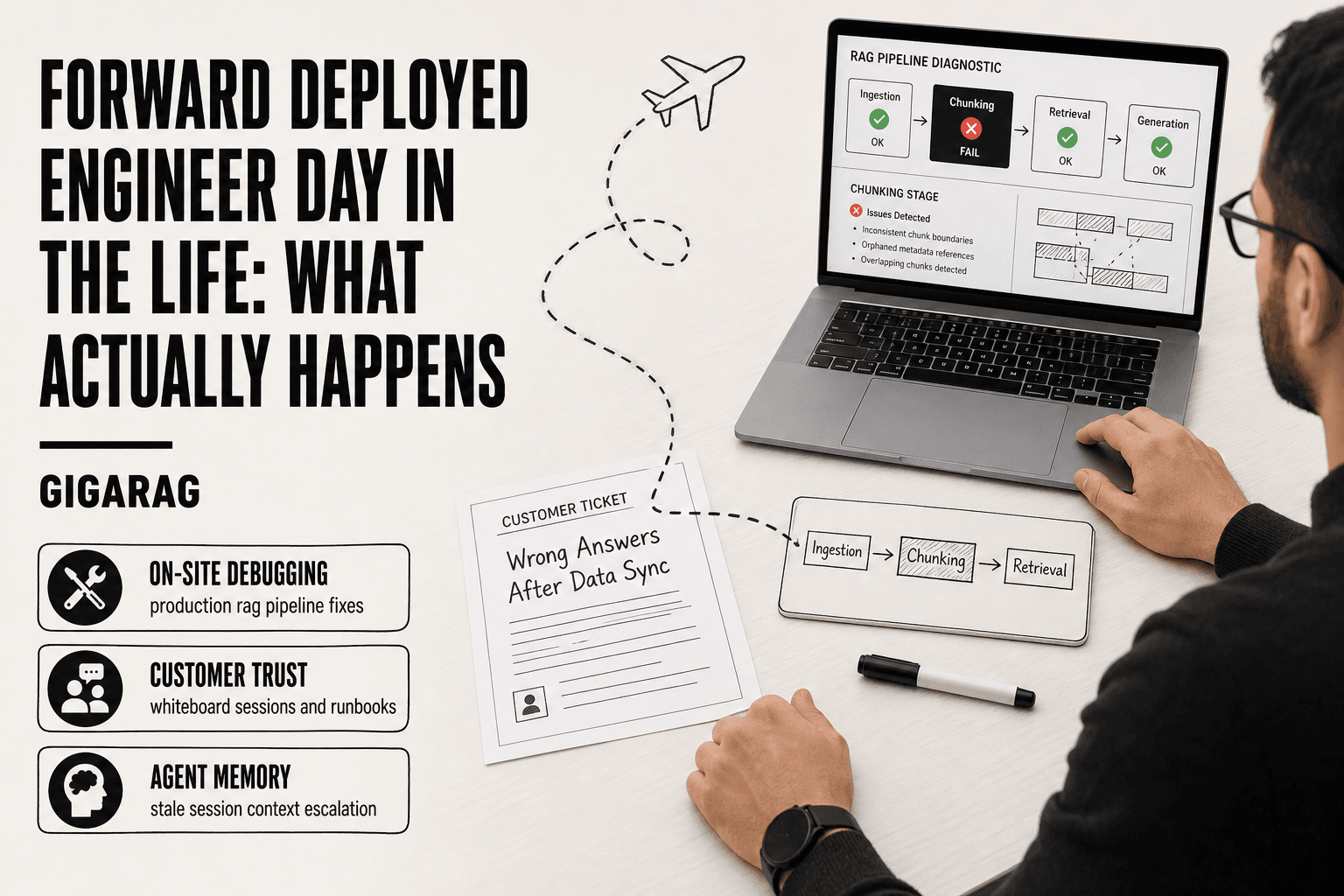
A forward deployed engineer's day in the life starts at 6:30am with a flight to a customer site where a production RAG pipeline broke overnight. You land, skip the hotel, and walk into a conference room where a skeptical engineering lead has already drawn a diagram of your agent memory system on the whiteboard, with three boxes marked "why is this slow?" An FDE is the engineer who gets deployed into a customer's environment to make your product actually work there: integrating, debugging, and earning trust in person. If you build RAG pipelines or agent memory systems, this role is either your future or your closest collaborator. The honest problem is that most content about FDEs is either glamorized marketing or vague opinion pieces with no practical detail. Tools like GigaRAG exist to make the memory layer of agent systems less painful to deploy, but the human work of deployment is still the hard part. This guide covers the hour-by-hour schedule, the skills that matter, the real downsides, and what the top search results won't tell you.
| At a glance | Details |
|---|---|
| Role | Customer-facing engineer building RAG and agent systems |
| Typical day | Split between coding, customer calls, and travel |
| Travel load | Varies; can be frequent or minimal depending on company |
| Key skills | RAG pipelines, agent memory, communication, debugging |
| Main challenge | Balancing deep technical work with customer demands |
| Career outlook | Growing demand as AI adoption increases |
In This Guide
- What Is a Forward Deployed Engineer?
- Forward Deployed Engineer vs Backend Engineer: What's the Difference?
- Why Forward Deployed Engineers Are the Rage Right Now
- Forward Deployed Engineer Day In The Life: A Step-by-Step Guide
- A Realistic Forward Deployed Engineer Day in the Life
- The Skills That Actually Matter for an FDE
- What You Cannot Do or Should Not Expect
- Is Forward Deployed Engineer a Good Career?
- How Much Do Forward Deployed Engineers Get Paid?
- How to Become a Forward Deployed Engineer
- Common Mistakes When Working as a Forward Deployed Engineer
What Is a Forward Deployed Engineer?
A forward deployed engineer (FDE) is an engineer who works on-site with customers to deploy, integrate, and debug a company's product in the customer's own environment. They sit between product engineering and the customer's technical team, doing whatever it takes to make the software work in production.
The role started at Palantir, where engineers embedded with government and enterprise clients for months at a time. The model spread because it solved a real problem: software that works in a demo often breaks in a customer's messy, specific infrastructure. An FDE is the person who fixes that gap.
FDE vs. solutions engineer vs. technical account manager
The boundaries are blurry but real. A solutions engineer is pre-sales: they build demos, answer technical questions, and help close deals. Once the contract is signed, they move on. A technical account manager is post-sales but non-coding: they manage the relationship, escalate issues, and track customer health.
An FDE does both and neither. They write code, debug production systems, and build integrations, but they also sit in customer meetings and own the technical relationship. The FDE is the only one of the three who ships working software into a customer's environment.
Where the role sits in the org chart
FDEs typically report to a deployment or field engineering org, not core product engineering. That matters. It means their incentives are customer success, not feature velocity. They're measured on whether the customer's pipeline works, not on how many lines of code they shipped to the main repo.
[!note] The exact daily schedule of a forward deployed engineer varies significantly by company, customer, and project phase. Some days may be entirely coding, while others are dominated by meetings and travel.
Forward Deployed Engineer vs Backend Engineer: What's the Difference?
| Factor | Forward Deployed Engineer | Backend Engineer |
|---|---|---|
| Primary focus | Customer-specific solutions and deployments | Building and maintaining core product infrastructure |
| Customer interaction | High: direct work with clients, often on-site | Low: mostly internal team communication |
| Travel | Frequent, depending on customer locations | Rare or none |
| Technical scope | RAG pipelines, agent memory, integrations, debugging | APIs, databases, microservices, scalability |
| Success metric | Customer satisfaction and successful deployment | System reliability, performance, and uptime |
Why Forward Deployed Engineers Are the Rage Right Now
The simplest answer: AI products are easy to demo and hard to deploy. A model that answers questions beautifully in a sandbox falls apart when it hits a customer's real data, permissions, and infrastructure. Companies discovered they needed engineers who could sit in the customer's environment and make the thing actually work. That's the FDE.
The deployment gap in AI products
The gap between building and deploying has always existed, but AI made it wider. A traditional SaaS product ships once and works mostly the same everywhere. An AI product behaves differently with every customer's data. Retrieval pipelines return wrong chunks. Embeddings drift. Prompts that worked in testing produce garbage on a customer's domain-specific documents.
The honest answer is that most AI startups underestimated this. They hired ML engineers to build models and backend engineers to build APIs, but nobody owned the messy middle: getting the system to work on a customer's actual data, with their actual security constraints, in their actual production environment. FDEs filled that hole.
Why RAG and agent memory systems made FDEs essential
RAG pipelines and agent memory systems are the worst offenders. They're not deterministic. A customer's vector database might be tuned for one embedding model, then break when you swap models. Their chunking strategy might work for legal documents but fail on chat logs. Agent memory systems need to persist context across sessions, handle conflicting user identities, and respect data retention policies. None of this shows up in a demo.
That's why companies pay a premium for engineers who understand both the model layer and the deployment layer. An FDE who can debug a vector index, rewrite a retrieval query, and explain the fix to a skeptical customer's CTO is worth more than two engineers who can only do one of those things. The demand isn't hype. It's the market pricing in the cost of deployment complexity that most AI companies ignored until customers started churning.
[!tip] For engineers building RAG pipelines and agent memory systems, focus on developing strong debugging skills and the ability to explain complex technical concepts to non-technical stakeholders. These are often more critical than deep expertise in a single framework.
Forward Deployed Engineer Day In The Life: A Step-by-Step Guide
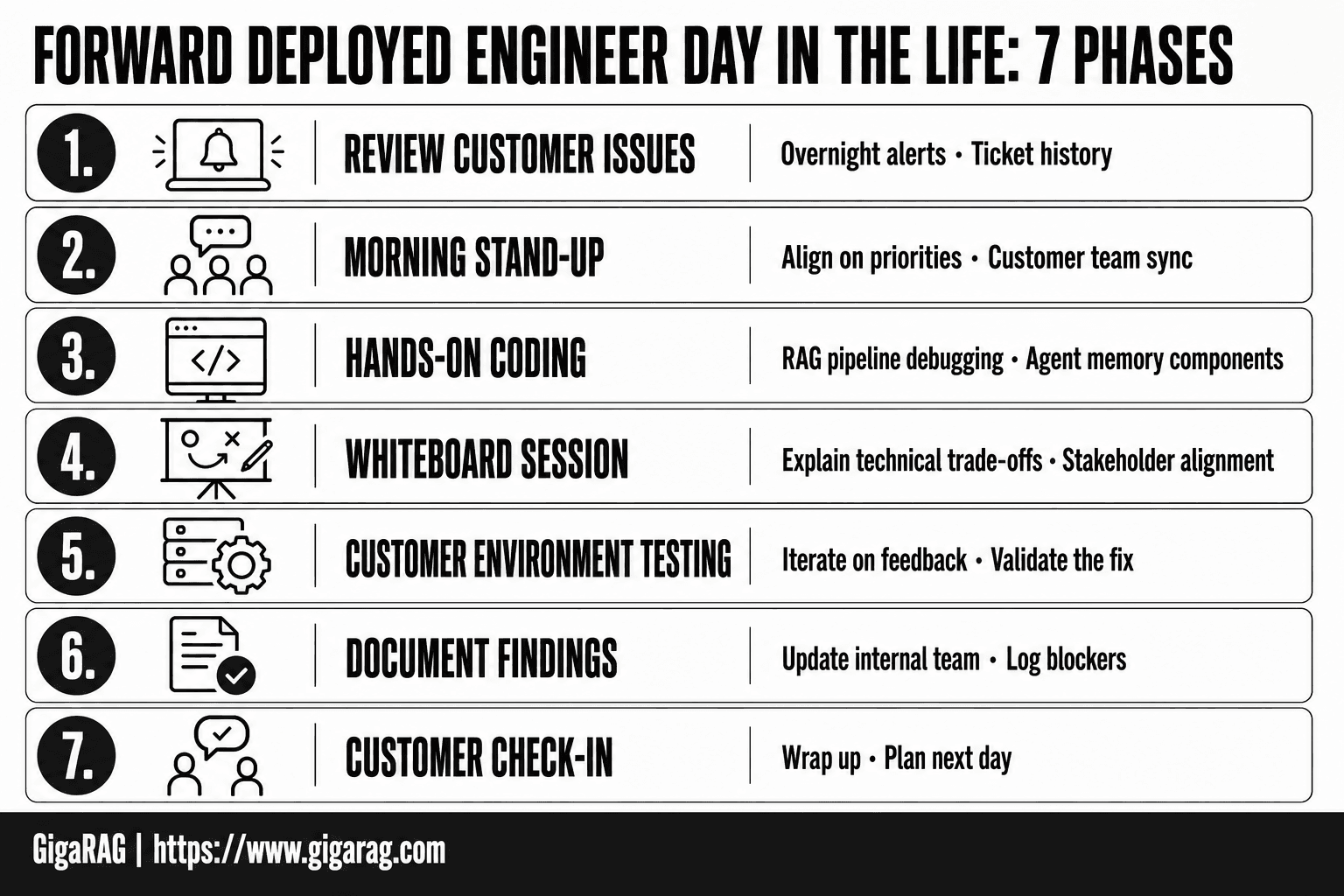
- Start early with a quick review of customer issues and overnight alerts.
- Join a morning stand-up with the customer's team to align on priorities.
- Dive into coding: build or debug RAG pipelines and agent memory components.
- Conduct a whiteboard session to explain technical trade-offs to stakeholders.
- Test the solution in the customer's environment and iterate based on feedback.
- Document findings and update the internal team on progress and blockers.
- Wrap up with a customer check-in and plan for the next day.
A Realistic Forward Deployed Engineer Day in the Life
Here's the schedule nobody posts on LinkedIn. It's a Tuesday. You're on a 6:30am flight to a customer site because their RAG pipeline started returning wrong answers after a weekend data sync. You land, grab coffee, and open your laptop in the rideshare. The day doesn't wait for you to feel ready.
6:30–9:00 AM: Travel and pre-meeting prep
You review the customer's ticket history while in transit. The pipeline broke after they added 40,000 new documents to their vector database without re-running the chunking step. You check the embedding model version, the chunk size settings, and the retrieval query. You draft three hypotheses before you even walk in. You also skim the stakeholder list: the CTO is skeptical, the data engineer is defensive, and the PM just wants it fixed. You prepare for all three.
9:00–11:00 AM: Customer discovery and whiteboarding
The first two hours are not coding. They're listening. The data engineer walks you through their ingestion flow. The CTO asks why this keeps happening. You whiteboard the pipeline: ingestion, chunking, embedding, indexing, retrieval, generation. You point to the chunking step. "This is where it broke," you say. "Your new documents are formatted differently. The old chunker split on headers. These don't have headers." You don't fix anything yet. You confirm the diagnosis with the people who live in the system daily.
11:00 AM–1:00 PM: Hands-on integration work
Now you code. You write a new chunking function that handles both document formats. You re-index a sample of 5,000 documents and run retrieval tests. The results improve, but you notice the agent memory layer is also stale: user session context from last week is still being pulled into prompts. You flag it. You don't fix it yet. That's a separate workstream, and you need the customer's sign-off before touching their memory architecture.
1:00–3:00 PM: Internal sync and escalation
You eat lunch at your laptop on a call with your internal team. The chunking fix is straightforward. The agent memory issue is not. You escalate it to the platform team and document the exact failure mode: stale session embeddings being retrieved with higher similarity scores than fresh ones. You assign it a severity level. You update the customer's Slack channel with a plain-English summary. No jargon. The PM replies "thanks, this is the first update I've actually understood."
3:00–5:00 PM: Production debugging and documentation
You deploy the chunking fix to staging, run the full test suite, and watch the retrieval metrics. Precision is up. Latency is flat. You write the runbook: what broke, why it broke, how to prevent it, and what to do if it happens again. You hand it to the data engineer. "This is yours now," you say. "If it breaks at 2am, you won't need me."
The Skills That Actually Matter for an FDE
The schedule above only works if you have the right foundation. Here's what separates FDEs who thrive from those who burn out in six months.
Technical skills: RAG pipelines, vector DBs, agent memory
You need working knowledge of the full retrieval stack. Not research depth. You need to read a chunking function and spot why it fails on a new document format. You need to know when a vector index needs re-indexing versus when the embedding model itself is the problem. Agent memory is the newest non-negotiable: you'll debug stale session context, similarity score thresholds, and memory eviction policies. You won't design new architectures. You'll diagnose and fix the ones already in production.
Communication and stakeholder management
The CTO who's skeptical, the data engineer who's defensive, the PM who just wants it fixed. You're talking to all three in the same room. The skill is translation: technical diagnosis into plain English without losing the mechanism. You write the runbook the customer's team actually reads at 2am. You update Slack channels with summaries that don't need a follow-up call. If you can't do this, your technical skill doesn't matter. The customer won't trust the fix if they don't understand it.
Ambiguity tolerance and context switching
You'll start the day debugging a chunking failure and end it documenting an agent memory escalation. You'll switch between code, whiteboards, and stakeholder calls every hour. The honest answer is that some people can't do this. They need a single codebase and a clear spec. FDE work is the opposite: the spec is the customer's half-articulated problem, and the codebase changes every week. If you need closure on every task before moving to the next, this role will exhaust you.
What You Cannot Do or Should Not Expect
The skills section makes the role sound demanding but doable. It is. What it doesn't tell you is what you give up. Here's the honest version.
Travel and burnout: the real numbers
Most FDE roles carry 30 to 60 percent travel. That's not a commute. That's 12 to 25 weeks a year in airports, hotels, and customer conference rooms. You'll miss birthdays. You'll eat dinner alone in a city you don't care about. The burnout risk isn't hypothetical: the combination of travel fatigue, context switching, and customer urgency is the top reason FDEs leave the role within two years. If you have a partner, kids, or a routine you value, do the math before you sign. The salary section below won't fix a missed year of your kid's life.
The trust paradox: you're always proving yourself
You're an outsider. Every new customer, every new internal team, you start at zero. The customer's engineers have been burned by vendors before. Your own product team wonders why you're not shipping features. You'll re-earn trust with every deployment, and it resets with every new account. That's the paradox: the role is built on trust, but the role never lets you keep it. Some people thrive on this. Most find it exhausting by month nine.
What FDE work is not: no deep research, no core product ownership
You won't design new retrieval architectures. You won't publish papers. You won't own a codebase for years and watch it mature. You'll patch, integrate, debug, and move on. The deep technical work happens back at headquarters, and you're not there. If your identity is tied to building things that last, this role will frustrate you. You're a fixer, not a builder. That's the trade.
Is Forward Deployed Engineer a Good Career?
It depends on what you want from the next three years. If you want compensation, variety, and a fast track to customer-facing leadership, it's one of the best roles in software. If you want deep technical ownership and a predictable schedule, it's a poor fit. The honest answer is that the role rewards a specific personality, and punishes everyone else.
The pros: compensation, variety, and impact
FDEs get paid well because they sit at the intersection of revenue and engineering. Base salaries run from $130,000 to $200,000 at most startups, with equity pushing total compensation higher. You'll also learn faster than almost any other role: every week brings a new customer, a new codebase, and a new production failure to fix. The impact is immediate. When you unblock a customer's RAG pipeline, you see the result in the same meeting, not in a quarterly report.
The cons: travel, burnout, and the trust paradox
The previous section covered the travel numbers. They're real, and they're the main reason people leave. Burnout compounds because you're always on: customer emergencies don't respect your calendar, and internal teams expect you to be the bridge even when you're exhausted. The trust paradox adds a layer of emotional labor. You'll prove yourself to every new customer, every new account team, every skeptical engineering lead. It never stops. If you need stability to do your best work, this role will drain you.
Who should and shouldn't pursue this role
Pursue it if you like variety more than depth, if you're comfortable with ambiguity, and if you can build trust quickly with strangers. Your RAG and agent memory experience is a genuine advantage here: customers deploying LLM infrastructure need someone who understands retrieval, vector databases, and memory systems, not just someone who can run a sales demo. Skip it if you want to own a codebase long-term, if travel wrecks your health, or if you need clear boundaries between work and life. The role won't give you those things. It will give you money, learning velocity, and a front-row seat to how AI products actually get deployed. Whether that's a good trade is a question only you can answer.
How Much Do Forward Deployed Engineers Get Paid?
The honest answer is that FDE compensation varies more than almost any other engineering role. Base salary, equity, geography, company stage, and your technical specialization all move the number. A realistic range for total compensation in the US is $150,000 to $300,000, with outliers on both ends. Anyone quoting a single "average salary" is hiding the variance.
Base salary, equity, and total compensation
Base salary for an FDE at a Series A or B startup typically lands between $130,000 and $180,000. At larger companies or late-stage startups, base can reach $200,000 to $220,000. Equity is where the real spread shows up. Early-stage companies offer 0.1% to 0.5% for a senior FDE, which could be worth nothing or could be worth millions depending on the exit. Late-stage companies offer less equity but more predictable value.
Geography matters less than it used to, but it still matters. San Francisco and New York pay 15% to 25% more than remote roles based in lower-cost regions. Some companies have adjusted for remote work; many haven't. Ask about the comp band before you interview, not after.
How RAG and agent memory specialization affects pay
If you can debug a production RAG pipeline, tune a vector database, and design agent memory systems that actually work, you're not competing with generalist FDEs. You're competing with a much smaller pool. That scarcity commands a premium. Companies deploying LLM infrastructure will pay 10% to 20% above their standard FDE band for someone who can walk into a customer site and fix retrieval quality on day one.
The catch is that this premium only materializes if you can prove the skill. A GitHub repo with a working RAG pipeline is table stakes. A track record of deploying agent memory systems in production, even at small scale, is what moves the number.
How to Become a Forward Deployed Engineer
The path into FDE work is shorter if you already build RAG pipelines or agent memory systems. You have the technical half. What you need to add is the deployment half: customer context, production debugging under pressure, and the willingness to own outcomes you didn't create.
Leverage your RAG and agent memory experience
Your existing work is the strongest asset you have. Most engineers applying for FDE roles can write code. Few can explain why a retrieval pipeline returns irrelevant chunks, or how to fix a vector index that's silently degrading. That gap is your opening.
Start by documenting what you've built. Write down the failure modes you've hit: embedding drift, context window overflow, memory collisions in agent state. Then practice explaining each one in plain language to a non-technical audience. If you can't explain it to a sales lead in two minutes, you can't explain it to a customer's CTO in a whiteboard session.
Build a deployment-focused portfolio
A portfolio that shows shipped work beats a portfolio that shows clever work. Pick one RAG pipeline or agent memory system you've built and take it through a full deployment cycle: staging, production, monitoring, rollback plan. Write up the deployment story, not just the architecture.
Include at least one project where you integrated with a customer's existing stack. That means their auth system, their data sources, their weird legacy constraints. FDE hiring managers look for evidence you've worked inside someone else's environment, not just your own.
Target the right companies and roles
Look for companies selling AI infrastructure or LLM tooling to technical customers. These are the places where RAG and agent memory expertise translates directly. Avoid companies where FDE is just a renamed solutions engineer role with no production access.
When you interview, ask one question early: "Do FDEs here get production access and the authority to push fixes?" If the answer is no, you're applying for a sales support job. Keep looking.
Common Mistakes When Working as a Forward Deployed Engineer
Most FDE mistakes come from trying to be too many things at once. You're the engineer, the diplomat, and the firefighter. Each role pulls in a different direction.
Overpromising and under-documenting
The classic failure: you tell a customer "we can have that done by Friday" because you want to build trust. Then the integration hits a snag, Friday slips, and trust erodes faster than it would have if you'd said no. The fix is boring but works. Write down every promise, every assumption, every workaround. When the customer asks what happened, you have the trail.
Neglecting internal relationships
You spend four days a week on-site and forget the people back home. Then you need a core engineer to fix a bug, and they don't know who you are. That's not their fault. It's yours. Block thirty minutes a week to update your internal team on what customers are hitting. It pays off the first time you need an escalation.
The forward deployed engineer day in the life is full of these traps. The ones who last learn to document relentlessly and invest in both sides of the org.
Frequently Asked Questions
Is forward deployed engineer a good career?
Yes, for engineers who enjoy customer interaction and solving real-world problems. It offers a blend of technical depth and business impact, with growing demand as companies adopt AI. However, it requires adaptability and often involves travel.
Why are forward-deployed engineers the rage?
They bridge the gap between product engineering and customer needs, especially for complex AI systems like RAG pipelines. Their ability to deploy and customize solutions on-site drives faster adoption and higher customer satisfaction.
How much do FDEs get paid?
Compensation varies widely by company, location, and experience. In the US, total compensation for forward deployed engineers often ranges from $150,000 to $250,000 or more, including equity. Verify current ranges at publish.
What is the average salary of a forward deployed engineer?
Average base salaries in the US typically fall between $120,000 and $180,000, with total compensation higher due to bonuses and equity. This can be higher at top AI companies. Check the latest data for accuracy.
What skills are most important for a forward deployed engineer?
Strong coding skills, especially in Python and data engineering, are essential. Equally important are communication, problem-solving, and the ability to learn quickly. Experience with RAG pipelines and agent memory systems is increasingly valuable.
Do forward deployed engineers travel a lot?
Travel frequency depends on the company and customer. Some FDEs travel weekly to customer sites, while others work remotely with occasional visits. It's best to clarify expectations during the interview process.
How does a forward deployed engineer differ from a solutions architect?
FDEs are more hands-on with coding and implementation, often embedding with customer teams. Solutions architects focus more on high-level design and may not code as much. Both require strong communication skills.
About GigaRAG
GigaRAG is for agent memory and RAG pipeline builders. get this right. Whether you are working through forward deployed engineer day in the life or something adjacent, we publish what we have actually tested, including where it falls short.


