Forward Deployed Engineer: Complete Role, Skills, and Career Guide
Forward deployed engineer is a title that confuses most technical professionals, even ones who have worked alongside the role for years. It sounds like a field technician who shows up at a customer site with a laptop, but in practice it functions closer to a technical founder embedded inside someone else's company. You build, you debug in production, you sit in customer meetings, and you own the outcome when the deployment works or when it doesn't. The honest answer is that most job descriptions get this wrong. They list the skills but miss the shape of the work. This guide is written for builders working with agent memory and RAG pipelines, where the forward deployed engineer role is changing fastest. Tools like GigaRAG are part of that modern stack, but the role itself is older than the AI hype. You'll get a concrete breakdown of what an FDE actually does day to day, which skills matter and which don't, what it pays at different stages, what the role cannot do, and how to prepare if you decide it's worth pursuing.
| At a glance | Details |
|---|---|
| Role type | Customer-facing software engineer embedded with clients |
| Core focus | Ship production code inside customer environments |
| Typical background | Software engineering, data science, or solutions architecture |
| Key skills | Full-stack coding, LLM/RAG systems, stakeholder communication |
| Common employers | AI/LLM startups and enterprise software vendors |
| Career outlook | Strong near-term demand; long-term path varies by company |
In This Guide
- What Is a Forward Deployed Engineer?
- Forward Deployed Engineer vs Solutions Engineer: What's the Difference?
- How the FDE Role Evolved and Why AI Revived It
- Forward Deployed Engineer: A Step-by-Step Guide
- Technical Skills That Matter for Forward Deployed Engineers
- Soft Skills That Get You Hired (and Kept)
- Forward Deployed Engineer Salary and Compensation
- FDEs in the Age of Agent Memory and RAG Pipelines
- What Forward Deployed Engineers Cannot Do
- FDE vs. Adjacent Roles: Solutions Engineer, TAM, and More
- Is Forward Deployed Engineer a Good Career Path?
- How to Prepare for a Forward Deployed Engineer Role
- Final Thoughts on the Forward Deployed Engineer Career
What Is a Forward Deployed Engineer?
A forward deployed engineer (FDE) is a software engineer embedded directly with customers, building and shipping solutions on top of a company's product to solve real customer problems. They write code, debug in production, and own outcomes, not just tickets.
The core definition: engineer embedded with customers
An FDE sits inside the customer's environment. Not as a consultant billing hours. Not as a support rep triaging tickets. As an engineer who writes production code against the customer's actual systems, data, and constraints.
The role blends three things most engineering jobs keep separate: building software, deploying it, and staying accountable for whether it works in the customer's hands. You don't hand off code and walk away. You ship it, watch it run, and fix what breaks.
How FDE differs from a traditional software engineer
A traditional software engineer builds features for a product used by many customers. The spec comes from a product manager. The feedback loop is slow.
An FDE builds for one customer at a time. The spec comes from the customer's actual problem, often discovered in the room with them. The feedback loop is immediate: you deploy, you watch, you iterate the same day.
Traditional engineers optimize for scale and generality. FDEs optimize for fit. The code may not generalize. That's fine. It solves the customer's problem now.
Where the role came from: Palantir and the origins of FDE
Palantir coined the title in the late 2000s. Their software, Gotham and later Foundry, was powerful but hard to configure. Customers couldn't adopt it alone. So Palantir sent engineers to sit with government agencies and large enterprises, build the integrations, and make the product work in production.
The model worked. Other enterprise startups copied it. The title stuck.
[!note] Forward deployed engineer is not a standardized title — responsibilities vary significantly between companies, and some organizations use it interchangeably with solutions architect or field engineer. Always read the specific job description rather than assuming a universal definition.
Forward Deployed Engineer vs Solutions Engineer: What's the Difference?
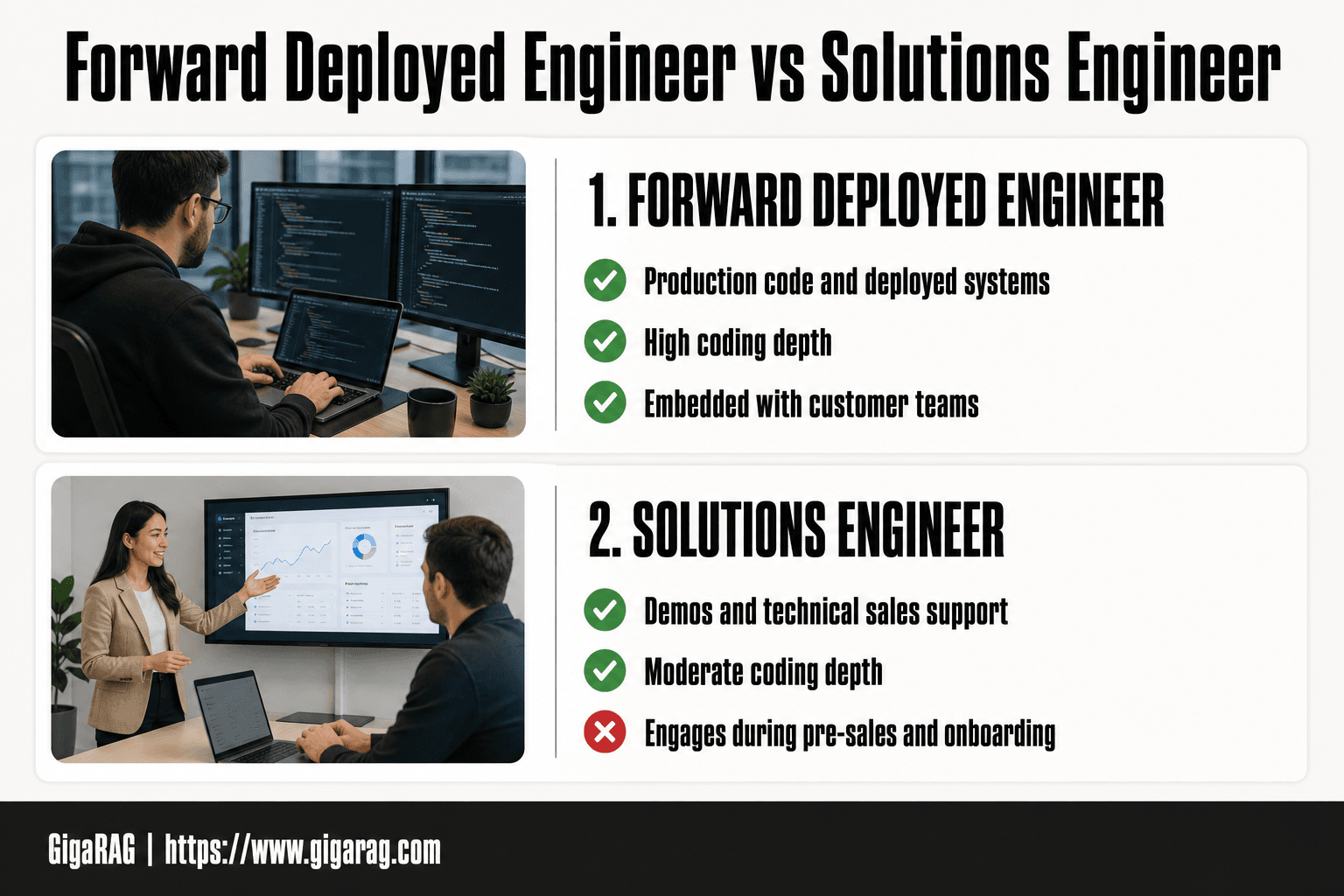
| Factor | Forward Deployed Engineer | Solutions Engineer |
|---|---|---|
| Primary output | Production code and deployed systems | Demos, integrations, and technical sales support |
| Coding depth | High — writes and maintains production software | Moderate — scripts, configs, and prototypes |
| Customer proximity | Embedded on-site or in customer Slack/standups | Engages during pre-sales and onboarding phases |
| Success metric | Customer system works in production | Deal closes and technical win is achieved |
| Typical team | Engineering or field engineering org | Sales or revenue org |
How the FDE Role Evolved and Why AI Revived It
From Palantir to startups: the FDE origin story
Palantir proved the model worked in government and defense. Then startups copied it. The pattern spread because enterprise software kept getting more powerful and harder to adopt. Customers needed someone who could both understand the product deeply and write code against their systems.
The role survived because it solved a real problem: software that requires configuration, integration, and iteration to deliver value. Not every company needs FDEs. Those selling complex infrastructure or data products usually do.
Why LLMs made FDEs essential again
LLMs changed the economics. A model that can generate text, reason over documents, and call APIs is powerful but unpredictable. Customers can't just install it and get value. They need retrieval pipelines, prompt tuning, evaluation, and guardrails.
That's FDE work. Someone has to sit with the customer, understand their data, build the RAG pipeline, and debug why the model hallucinated on page 14 of a PDF. The model is general. The deployment is specific.
What changed: from dashboards to agent memory and RAG
Early FDEs built dashboards and data integrations. Modern FDEs build retrieval systems, embedding pipelines, and agent memory layers. The core job is the same: make a general product work for a specific customer. The tools changed.
Agent memory is the new frontier. Customers want AI systems that remember context across sessions. FDEs are the ones wiring that memory into production.
[!tip] If you are targeting AI/LLM companies, build a public demo that shows a RAG pipeline with agent memory deployed on real infrastructure — hiring managers at these firms consistently report that a working deployment beats a resume bullet.
Forward Deployed Engineer: A Step-by-Step Guide
- Build and deploy a small RAG pipeline end-to-end — ingest documents, embed, retrieve, and generate answers with citations.
- Practice debugging in unfamiliar environments: containerize an app, deploy it to a cloud VM, and fix a broken dependency chain.
- Write a short technical explainer for a non-engineer audience — this mirrors the FDE communication workload.
- Learn one agent memory pattern (e.g., conversation buffer or vector-backed memory) and document its tradeoffs.
- Do a mock customer discovery call: ask about their data, constraints, and success criteria before proposing a solution.
- Contribute to an open-source LLM tool or write a public post-mortem of a deployment you ran.
- Prepare STAR-format stories about shipping under ambiguity and managing customer expectations.
Technical Skills That Matter for Forward Deployed Engineers
Most FDE job descriptions read like a generic backend engineer posting. The actual work is narrower and stranger. You need enough engineering depth to debug production issues, plus enough product sense to know which problems are worth solving in the first place.
Core engineering skills: programming, debugging, APIs
You'll write Python or TypeScript daily. Not greenfield features. Scripts that pull data from a customer's CRM, transform it, and push it into a vector store. One-off integrations that live for six months.
Debugging in production is the core skill. You can't reproduce a customer's issue locally because you don't have their data, their network, or their permissions. You read logs, write temporary instrumentation, and reason about systems you can't fully see.
APIs are your primary interface. REST, gRPC, webhooks, sometimes SOAP if the customer is old enough. You'll read documentation written by people who left the company three years ago.
AI-specific skills: LLMs, embeddings, vector databases
You don't need to train models. You need to use them well. That means prompt construction, context window management, and knowing when a model is confidently wrong.
Embeddings matter more than most engineers admit. Choosing the right embedding model for a customer's domain changes retrieval quality by 20 to 30 percent. You'll evaluate models on the customer's actual data, not benchmark scores.
Vector databases are just databases with a distance function. Learn one well: Pinecone, Weaviate, or pgvector. The concepts transfer.
Agent memory and RAG pipeline skills: what FDEs actually build
RAG pipelines are the bread and butter. Chunking strategy, retrieval reranking, and evaluation sets. You'll build the same pipeline a dozen times, each one slightly different because each customer's data is shaped differently.
Agent memory is newer and messier. You'll wire short-term memory into a session, decide what gets persisted, and build retrieval over conversation history. The honest answer: most teams are still figuring this out. You'll be figuring it out with them.
Infrastructure and deployment: cloud, containers, CI/CD
You need enough cloud knowledge to deploy into a customer's VPC without breaking their compliance rules. Docker is non-negotiable. Kubernetes is nice but not required everywhere.
CI/CD matters less than you'd think. Customers have their own pipelines. You'll adapt to theirs rather than impose yours. The skill is reading someone else's infrastructure and finding the seam where your product fits.
Soft Skills That Get You Hired (and Kept)
Technical skills get you the interview. Soft skills keep you in the role past the first churn review. The FDEs who last are the ones who can sit in a room with a frustrated customer, hear what they actually need, and translate that into something engineering can build.
Communication: translating between customers and engineering
You are the only person in the room who speaks both languages. The customer says "the search feels slow." Engineering hears "latency regression in the retrieval path." Your job is to make sure neither side loses information in translation.
Write everything down. A customer's offhand comment in a meeting becomes a ticket, a spec, or a decision record. If it's not written, it didn't happen.
Ownership: what "own the outcome" actually means
Owning the outcome means you don't close a ticket when the code works. You close it when the customer's problem is gone. That's a different bar.
In practice: the customer wanted to reduce support tickets by 30 percent. You shipped the feature. Tickets dropped 12 percent. You're not done. You dig into why, adjust the retrieval strategy, and check again next week. Nobody asked you to. That's the job.
Ambiguity tolerance: working without a spec
Customers rarely know what they want. They know what hurts. Your first week on an engagement, there's no spec, no acceptance criteria, and no one to ask.
You build the spec. You write down assumptions, validate them with the customer, and turn a vague complaint into a scoped project. If you need a ticket with clear requirements before you can start, this role will break you.
Emotional resilience: handling customer frustration
Customers get angry. Sometimes at you. Usually at the product, the timeline, or their own boss. You absorb it without taking it personally and without promising things you can't deliver.
The skill is staying calm while someone tells you their quarter is ruined. Then asking the next question: what does fixed look like for you? That question turns a rant into a requirements list.
Forward Deployed Engineer Salary and Compensation
The honest answer is that FDE compensation tracks senior engineering pay, plus a premium for the customer-facing part. You won't find a single number. It depends on experience, company stage, and geography. Here's what you can actually expect.
Salary ranges by experience level
Entry-level FDEs (0-2 years) typically land between $110,000 and $150,000 base. Mid-level (3-5 years) runs $150,000 to $200,000. Senior FDEs (6+ years) can push $200,000 to $260,000 base. These are US figures. (verify at publish)
How company stage affects compensation
Startups pay less cash and more equity. A Series A might offer $130,000 base with meaningful options. Palantir and other large players pay higher base but the equity upside is smaller. The tradeoff is risk versus stability.
Equity, bonuses, and total compensation
Total comp often lands 20 to 40 percent above base. Bonuses tie to deployment success and customer retention, not just code shipped. Equity at startups can be worthless or life-changing. Nobody can promise which.
Geographic variations
San Francisco and New York pay 15 to 25 percent above the national average. Remote roles increasingly normalize pay bands, but a few companies still adjust by location. Check the specific offer.
FDEs in the Age of Agent Memory and RAG Pipelines
Most FDE job descriptions don't mention RAG or agent memory. The work still lands on your desk. When a customer's AI product returns wrong answers, you're the one who flies in and fixes it.
What FDEs actually do with RAG pipelines
A RAG pipeline pulls relevant chunks from a vector database, stuffs them into a prompt, and asks an LLM to answer. That's the theory. In practice, you'll spend your time on three things: chunking strategy, embedding quality, and retrieval relevance. You tune each one against the customer's actual data, not a benchmark.
Debugging retrieval quality in production
Here's what happens behind the scenes. A customer says the system returns stale answers. You check the vector index and find documents that should have been re-embedded after an update. Or the chunk size is too large, so the retriever pulls paragraphs that bury the answer. You fix the chunking, re-embed, and re-test. Most retrieval problems are data problems, not model problems.
Agent memory: why it matters and how FDEs manage it
Agent memory is what lets an AI remember context across turns or sessions. Without it, every query starts cold. FDEs decide what gets stored, how long it persists, and when it should be forgotten. You'll write memory policies: keep user preferences indefinitely, drop transient task state after the session. Get this wrong and the agent either forgets everything or leaks stale context into new conversations.
A practical example: deploying a RAG pipeline for a customer
You land at a customer site. They have 50,000 support tickets and want an AI assistant that answers from them. You start by inspecting the data. The tickets are messy: duplicates, HTML tags, half-empty fields. You clean them, choose a chunk size around 500 tokens with 10 percent overlap, and pick an embedding model that handles their domain vocabulary. Then you build the retrieval loop, test it against 50 real questions, and find 12 that return irrelevant chunks. You adjust the metadata filters, re-rank the results, and get 46 of 50 right. Tools like GigaRAG handle parts of this stack, but the judgment calls are yours. The customer doesn't care about your vector database. They care that the answer is right.
What Forward Deployed Engineers Cannot Do
The FDE title sounds like a superhero job. It isn't. You'll hit walls that no amount of customer empathy or debugging skill can break through.
FDEs are not salespeople (but they sell)
You won't close contracts or negotiate pricing. That's the account executive's job. But you will sell constantly: the product's value, the technical approach, the timeline. Customers read your confidence as the company's confidence. Get comfortable with that tension.
FDEs cannot fix broken products alone
If the core product is unstable, you can't patch it from a customer site. You'll write workarounds, configure fallbacks, and buy time. But the fix belongs to the product team. An FDE who promises otherwise burns out fast.
What FDEs should not expect: travel, burnout, scope creep
Travel varies. Some FDEs fly weekly; others work remote with quarterly onsites. Burnout is real when every customer treats you as their personal engineer. Scope creep follows: you'll get pulled into sales calls, support tickets, and internal roadmap debates. Set boundaries early or the role consumes you.
Common misconceptions about the role
You are not a consultant. You are not a support engineer. You are not a product manager. You're an engineer who ships in someone else's environment, under someone else's constraints. That's the honest shape of it.
FDE vs. Adjacent Roles: Solutions Engineer, TAM, and More
Job titles blur. FDE, Solutions Engineer, TAM, Sales Engineer. Recruiters use them interchangeably. The work doesn't.
FDE vs. Solutions Engineer
A Solutions Engineer (SE) designs and demos. They show prospects how the product could work. An FDE builds it. SEs live in the sales cycle; FDEs live in the deployment. The SE answers "can this work?" The FDE answers "here it is, working."
FDE vs. Technical Account Manager
A Technical Account Manager (TAM) owns the relationship after the sale. They coordinate support, track SLAs, and escalate issues. They rarely write code. An FDE writes code daily. The TAM is the customer's advocate inside the company. The FDE is the company's engineer inside the customer's environment.
FDE vs. Sales Engineer
Sales Engineer and Solutions Engineer are nearly the same role. The difference from FDE is sharper: Sales Engineers stop at the proof of concept. FDEs start there. A Sales Engineer leaves when the contract is signed. An FDE stays until the system runs in production.
Which role is right for you?
Pick SE or Sales Engineer if you like demos, discovery calls, and moving between prospects. Pick TAM if you prefer relationships and process over code. Pick FDE if you want to build in production, under customer constraints, for months at a time.
The honest tradeoff: FDE pays less than sales engineering at most companies, and burns hotter than TAM work. But you ship real systems. That's the draw.
Is Forward Deployed Engineer a Good Career Path?
It depends on what you want from the next five years. If you want to build in production, learn fast, and get paid well for it, yes. If you want predictable hours and a clean separation between work and life, no.
The upside: learning, impact, and compensation
You'll learn faster than almost any other engineering role. You ship weekly, not quarterly. You debug live systems with customers watching. You see what breaks in production, which is where real engineering judgment comes from.
Impact is direct. You're the reason a customer's deployment works or doesn't. That's rare in software. Compensation runs 10-20% above backend engineering at the same level, because the role demands more.
The downside: burnout, travel, and ambiguity
The main catch is burnout. You're on call for customers, not just systems. Travel runs 30-50% at some companies. You'll work without specs, without clear ownership, and sometimes without a team.
Ambiguity is constant. You'll be asked to do things outside your job description. That's the point of the role. It's also exhausting.
Who should pursue FDE roles
Pursue it if you like building, hate being siloed, and can handle customer pressure without taking it personally. You need strong debugging instincts and the ability to say "I don't know, but I'll find out" without panicking.
Who should not pursue FDE roles
Skip it if you need clear requirements, predictable hours, or a manager who shields you from customers. Skip it if travel drains you. Skip it if you want to go deep on one codebase for years.
The honest answer: FDE is a great path for a specific kind of engineer. Not for everyone.
How to Prepare for a Forward Deployed Engineer Role
You don't need to be an FDE to prepare like one. The skills transfer from backend engineering, data work, and customer-facing roles. Here's the path.
Step 1: Build the technical foundation
Get sharp on two things: debugging in production and APIs. You'll spend most of your time tracing failures through logs, dashboards, and customer reports. Practice on real systems. Break something, then fix it while someone watches.
APIs are your interface to customer systems. Know REST, auth patterns, and how to read someone else's messy integration code. If you're targeting AI-focused FDE roles, add embeddings, vector databases, and basic prompt engineering to the list.
Step 2: Practice customer-facing scenarios
The technical part is table stakes. The differentiator is communicating under pressure. Practice explaining a production outage to a non-technical stakeholder without jargon. Practice saying "I don't know yet" and following it with a plan.
Role-play with a friend. Have them play a frustrated customer whose system is down. You have five minutes to diagnose and explain. Do this weekly.
Step 3: Work on real projects (including RAG pipelines)
Build something you can deploy for a real user. A RAG pipeline is ideal: it touches embeddings, retrieval, API integration, and production debugging. Deploy it, let someone use it, then fix what breaks.
Document everything. FDE interviews ask about tradeoffs you made, not just what you built.
Step 4: Prepare for the FDE interview loop
Expect four rounds: technical screen, systems design, customer scenario, and a take-home or live debugging exercise. The customer scenario matters most. Practice walking through a deployment plan with constraints: budget, timeline, legacy systems.
A 90-day readiness plan
Days 1-30: technical foundation. Days 31-60: build and deploy a RAG pipeline. Days 61-90: mock interviews and customer scenarios. Ship something real by day 60.
Final Thoughts on the Forward Deployed Engineer Career
The forward deployed engineer role isn't for everyone. It's for builders who want customer context without losing their hands on the keyboard. The pay is strong, the learning curve is steep, and the burnout risk is real.
If you're already working with agent memory and RAG pipelines, you're closer to FDE-ready than you think. The gap isn't technical. It's communication under pressure and ownership without a spec.
Start with one real deployment. Ship it, debug it in front of a user, and document what broke. That single project teaches more than any course.
Tools like GigaRAG handle the memory and retrieval plumbing so you can focus on the customer problem. But the tool won't make you a forward deployed engineer. The reps will.
Frequently Asked Questions
What skills are needed to be a forward deployed engineer?
Core skills include proficiency in at least one backend language (Python, Go, or TypeScript), experience with cloud infrastructure and containers, and working knowledge of LLM application patterns such as RAG and agent memory. Equally important are communication and stakeholder management — FDEs spend significant time translating between customer needs and engineering constraints.
Is forward deployed engineer a good career path?
It can be, especially if you enjoy variety and customer contact. The role builds rare skills at the intersection of engineering and delivery. However, it can be demanding — travel, context-switching, and customer pressure are common. Long-term, FDEs often move into senior engineering, product, or field leadership roles.
How much do FDEs get paid?
Compensation varies widely by company stage, location, and experience. At AI/LLM startups, total compensation for mid-level FDEs often includes a base salary plus equity, while enterprise vendors may offer base plus bonus. Because reliable public data is limited, candidates should benchmark against senior software engineer ranges in their market and negotiate equity carefully. (Verify current ranges at publish.)
How to prepare for a forward deployed engineer role?
Focus on three areas: shipping code in ambiguous environments, explaining technical tradeoffs to non-engineers, and hands-on LLM deployment. A portfolio project that demonstrates a deployed RAG or agent system is highly effective. Practice mock customer scenarios and be ready to discuss how you handle scope changes and production incidents.
What does a forward deployed engineer do day-to-day?
A typical day mixes coding, customer calls, and debugging. You might start by fixing a data ingestion issue in a customer's environment, then join a scoping call to define the next milestone, then write code to add a retrieval feature. The ratio shifts by company, but expect significant time in customer-facing contexts.
How is a forward deployed engineer different from a solutions engineer?
The key difference is depth of engineering ownership. FDEs write and maintain production code inside customer systems, while solutions engineers typically focus on demos, integrations, and technical sales support. FDEs are usually part of an engineering org; solutions engineers often sit in sales or revenue.
What are the limitations of the forward deployed engineer role?
FDEs cannot single-handedly fix a customer's data quality, organizational misalignment, or unclear product strategy. The role also has limited control over product roadmap and may face burnout from travel and context-switching. It is not a substitute for a dedicated product or platform team.
About GigaRAG
GigaRAG is for agent memory and RAG pipeline builders. get this right. Whether you are working through forward deployed engineer: complete role, skills, and career guide or something adjacent, we publish what we have actually tested, including where it falls short.


