
How to Build a Forward Deployed Engineer Portfolio That Gets You Hired
Most advice on how to build a forward deployed engineer portfolio tells you to practice interview questions and read about customer discovery. Almost none of it tells you what to actually put on the page. If you're a builder working on agent memory and RAG pipelines, that gap is worse: the generic "show your projects" guidance doesn't map to the work you actually do. This guide gives a concrete framework for building a portfolio that proves you can solve customer problems with retrieval and memory systems, not just ship code. You'll get two project briefs you can build this month, a reusable 6-section structure, and the mistakes that get portfolios ignored. The honest limits come too: a portfolio won't replace customer-facing experience, and it won't guarantee an interview. You can use GigaRAG in the projects described later, but the framework works with any stack.
| At a glance | Details |
|---|---|
| Who it's for | Engineers moving into forward deployed roles |
| Core projects | RAG pipeline and agent memory builds |
| Portfolio format | Case studies with problem, build, outcome |
| Key signal | Customer-facing problem solving, not just code |
| Time to build | Weeks to a few months, depending on depth |
| What it can't do | Guarantee interviews or replace referrals |
In This Guide
- What a Forward Deployed Engineer Portfolio Actually Is
- RAG Pipeline Project vs Agent Memory Project: Which to Build First?
- Why Customer Problem Understanding Comes Before Code
- How To Build A Forward Deployed Engineer Portfolio: A Step-by-Step Guide
- The 5 Technical Skills Your FDE Portfolio Must Prove
- Two Portfolio Projects That Prove You Can Build RAG and Agent Memory Systems
- How to Structure Your Forward Deployed Engineer Portfolio
- Common Mistakes When Building a Forward Deployed Engineer Portfolio
- What a Portfolio Cannot Guarantee
- How to Use Your Portfolio During the FDE Interview Process
- A 4-Week Plan to Build Your Forward Deployed Engineer Portfolio
- Final Thoughts on Building a Forward Deployed Engineer Portfolio
What a Forward Deployed Engineer Portfolio Actually Is
A forward deployed engineer portfolio is a collection of projects that shows you can take a customer's messy business problem, build a working technical solution for it, and explain what changed for that customer. It is not a gallery of personal coding experiments.
Most software engineering portfolios prove you can write clean code. An FDE portfolio has to prove something harder: that you can figure out what a customer actually needs, build the right thing fast, and measure whether it worked. The code matters, but it is evidence, not the point.
How an FDE portfolio differs from a SWE portfolio
A standard SWE portfolio leads with the stack. You list the languages, the frameworks, the architecture diagrams. The reader assumes the problem was handed to you.
An FDE portfolio leads with the customer. Who were they? What were they losing money on? What did you build, and what number moved after you shipped it? The stack appears later, as supporting detail.
The honest answer is that most FDE hiring managers will skim your code. They will read your problem statement carefully. That is where you win or lose.
The three audiences for your portfolio: recruiters, hiring managers, technical leads
Recruiters scan for keywords and role fit. They need to see "customer", "deployment", "RAG", "agent memory" in the first two lines of each project. Don't make them dig.
Hiring managers read for judgment. They want to see that you scoped a problem sensibly, picked a boring tool when a boring tool worked, and knew what to measure. Your narrative matters more than your code.
Technical leads will open the repo. They check whether your evaluation metrics are real, whether your chunking strategy makes sense, and whether you can defend your latency numbers. For them, one deep project beats four shallow ones.
[!note] A portfolio demonstrates your ability to build and explain solutions, but it cannot guarantee an interview or replace referrals, direct outreach, or interview performance. Treat it as one signal among several in the FDE hiring process.
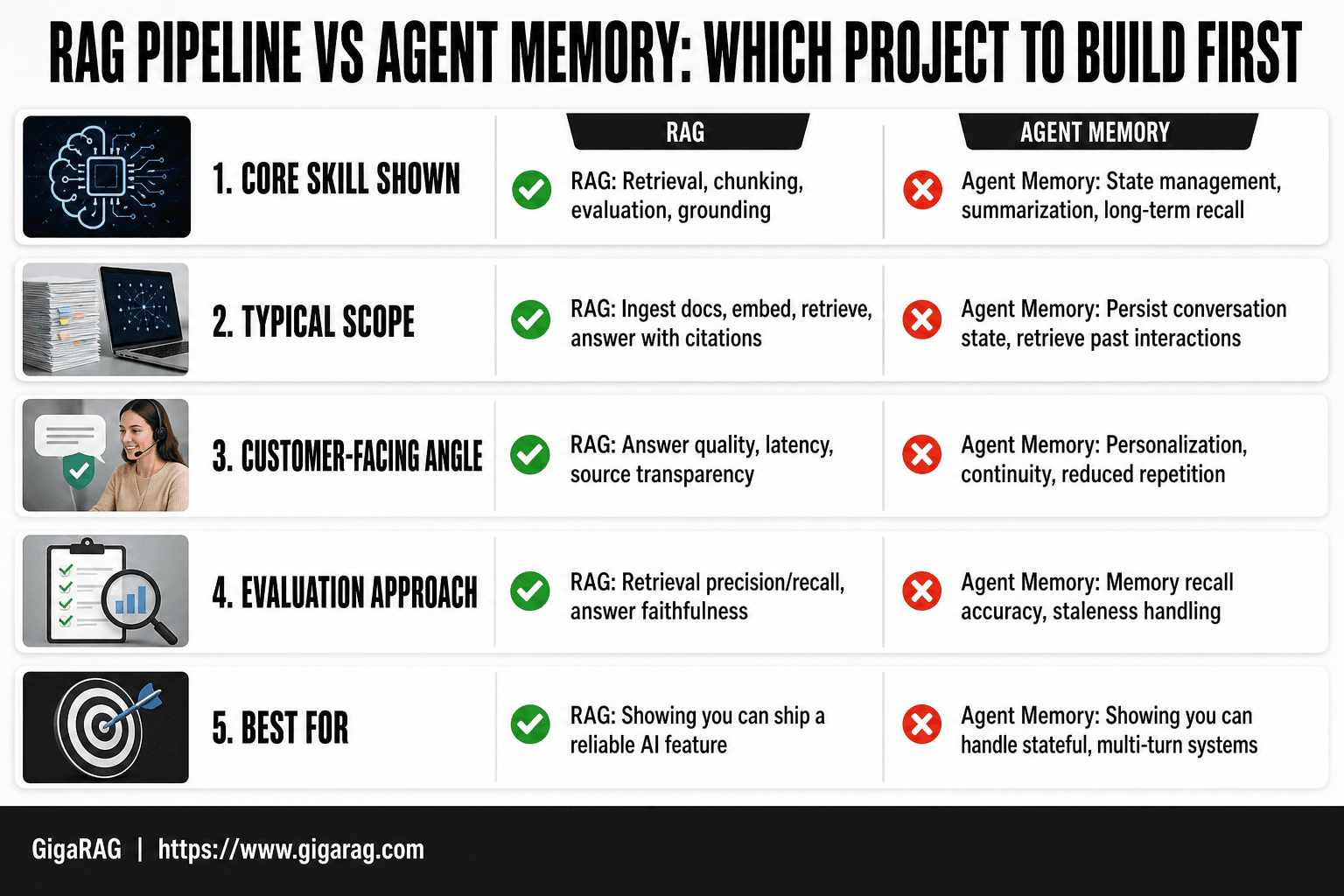
RAG Pipeline Project vs Agent Memory Project: Which to Build First?
| Factor | RAG Pipeline Project | Agent Memory Project |
|---|---|---|
| Core skill shown | Retrieval, chunking, evaluation, grounding | State management, summarization, long-term recall |
| Typical scope | Ingest docs, embed, retrieve, answer with citations | Persist conversation state, retrieve past interactions |
| Customer-facing angle | Answer quality, latency, source transparency | Personalization, continuity, reduced repetition |
| Evaluation approach | Retrieval precision/recall, answer faithfulness | Memory recall accuracy, staleness handling |
| Best for | Showing you can ship a reliable AI feature | Showing you can handle stateful, multi-turn systems |
Why Customer Problem Understanding Comes Before Code
Most engineers build a portfolio to show what they can build. An FDE portfolio has to show something earlier in the pipeline: that you can identify which problem is worth building for. The customer problem is the whole game. The stack is just how you played it.
Here's the test. Take any project in your portfolio and remove the tech. If what's left is a vague idea like "a chatbot for documents" or "an AI assistant," you don't have a project yet. You have a demo. A real FDE project starts with a specific person losing a specific amount of money or time, and ends with that number changing.
What customer-first portfolio projects look like
A customer-first project names the customer before it names the model. Not "a RAG pipeline for PDFs" but "a support team of 12 that spent 9 hours a week searching old tickets, so I built retrieval over 40,000 past conversations and cut search time to under a minute."
The difference is not cosmetic. It changes what you build. When you start from the customer's loss, you make different choices about chunk size, about whether you need agent memory at all, about what "good" means. When you start from the stack, you optimize for what's fun to build.
Keep in mind: the customer does not have to be a paying company. A local nonprofit, a friend's small business, an open source community you're part of. What matters is that someone had a real problem and you solved it for them.
How to write a problem statement that hiring managers actually read
Start with the loss. One sentence. "A three-person legal team spent 6 hours a week manually redacting contracts." That's it. No preamble about AI, no mention of your stack.
Then the constraint. What made this hard? "The contracts varied in format, so a simple regex approach failed on 40% of documents." This shows you understood the problem before touching a tool.
Then the outcome. One number. "Redaction time dropped to 20 minutes a week." If you don't have a number, you don't have a problem statement yet. Go back and measure something.
The main catch is that most candidates write the problem statement last, as an afterthought. Write it first. If you can't write it in three sentences, you haven't scoped the project tightly enough to build anything worth showing.
[!tip] For each project, write a short 'customer brief' section that states who the user is, what they needed, and how you validated the solution with them (even if the 'customer' is a peer or a simulated scenario). FDE hiring managers look for evidence of discovery and communication, not just technical depth.
How To Build A Forward Deployed Engineer Portfolio: A Step-by-Step Guide
- Pick two anchor projects: one RAG pipeline and one agent memory system, each solving a realistic customer problem.
- Write a one-page case study for each: problem, constraints, architecture, trade-offs, and measurable outcome.
- Document your evaluation method: how you tested retrieval quality, memory recall, and failure modes.
- Record a short walkthrough video (2-3 minutes) explaining your decisions as if to a customer.
- Publish the code with a clear README that states assumptions, setup, and what you would do differently.
- Create a portfolio index page that maps each project to FDE competencies like discovery, delivery, and communication.
- Get feedback from someone in a customer-facing engineering role and revise the weakest case study.
The 5 Technical Skills Your FDE Portfolio Must Prove
You don't need to be a research scientist. You need to show you can ship working systems that solve a named problem. These five skills cover what hiring managers actually probe for in FDE interviews.
RAG pipeline design and evaluation
Build one pipeline where you chose the chunking strategy, the embedding model, and the retrieval method yourself. Then measure it. Precision and recall on a test set you assembled. The artifact: a GitHub repo with an eval script that prints numbers, not vibes.
Agent memory architecture
Show you understand the difference between short-term context and long-term memory. Build an agent that remembers facts about a user across sessions, and explain where you stored what and why. The artifact: a working agent with a memory layer, plus a README that diagrams the memory flow.
API integration and system design
FDEs live at the boundary between systems. Prove you can design an integration that handles rate limits, retries, and schema mismatches. The artifact: one project where your system calls at least two external APIs and degrades gracefully when one fails.
Latency and cost optimization
Every customer asks the same two questions: how fast, and how much. Show you've measured both. The artifact: a before-and-after log from a real optimization, like cutting retrieval latency from 900ms to 200ms by switching from a naive top-k to a reranking step.
Production deployment basics
You don't need Kubernetes. You need evidence you've put something live and kept it running. The artifact: a deployed endpoint with monitoring, logging, and a basic CI pipeline. Docker and a cloud function are enough.
Two Portfolio Projects That Prove You Can Build RAG and Agent Memory Systems
Most portfolio advice stops at "build something." That's not enough. You need projects that map to what an FDE actually does: take a customer problem, build a working system, and measure whether it helped. These two briefs are scoped so you can finish each in a week of evenings.
Project 1: Customer support RAG pipeline with evaluation metrics
The problem. A small SaaS company has 400 support tickets a month and a knowledge base nobody reads. Customers ask the same questions repeatedly. Support agents spend 30% of their time copying answers from docs.
The stack. Python, a vector database (Pinecone, Weaviate, or pgvector), an embedding model (OpenAI's text-embedding-3-small or a local option like bge-small), and a retrieval eval framework like RAGAS or a simple custom script.
What you build. Ingest 50 to 100 real support articles into a vector store. Chunk them two different ways: fixed-size chunks and semantic chunks split on section boundaries. Run the same 30 test questions against both. Measure precision@3, recall@3, and latency. Write a short report showing which chunking strategy won and why.
What it proves. You didn't just wire up a RAG demo. You made a design decision, tested it, and can defend the tradeoff. That's the FDE job in miniature.
The deliverable. A GitHub repo with the ingestion script, the eval script, the test set, and a README that opens with the business problem, not the tech stack.
Project 2: Agent memory layer with persistent context across sessions
The problem. A user asks a coding assistant for help debugging a Python script on Monday. On Thursday they come back and say "still broken." A stateless agent starts from zero. That's a bad experience, and it's the exact gap agent memory fills.
The stack. Python, an LLM API, a vector store for long-term memory, and a simple session store (SQLite is fine). No agent framework required. LangChain or LlamaIndex are optional, but building the memory flow yourself teaches you more.
What you build. An agent that extracts durable facts about the user (their project, their stack, their preferences) and stores them as embeddings. On each new session, it retrieves relevant memories and injects them into the system prompt. The agent should answer "what do you remember about me?" and show its memory store.
What it proves. You understand the difference between context window and persistent memory. You can explain where each piece of information lives, how it's retrieved, and when it goes stale. That architecture conversation comes up in almost every FDE interview about agents.
The deliverable. A working agent with a memory layer, a README that diagrams the memory flow, and a short demo video showing two sessions where the second one benefits from the first.
Both projects are small enough to finish, but deep enough to talk about for 20 minutes in an interview. That's the bar.
How to Structure Your Forward Deployed Engineer Portfolio
You've built the projects. Now you need a page that gets a hiring manager to actually read about them. Most engineers treat their portfolio like a code dump. An FDE portfolio is a sales document with technical receipts.
The 6-section portfolio template
Here's the structure I'd use. It works on a personal site, a GitHub README, or a Notion page.
1. One-line positioning statement. Who you are and what you do. "Forward deployed engineer building RAG and agent memory systems for customer support teams." Not a paragraph. One line.
2. Two featured projects. Your RAG pipeline and agent memory projects go here. Each gets a problem statement, a screenshot or diagram, and three bullet points of measurable outcomes. Nothing else.
3. A short "how I work" section. Three to four sentences about how you approach customer problems. This is where you show the FDE mindset without writing an essay. Mention discovery, scoping, and honest tradeoffs.
4. Skills mapped to evidence. Don't list "Python, vector databases, LLMs." Instead: "RAG pipeline design: built and evaluated two chunking strategies on 100 support articles." Each skill points to a project.
5. A one-paragraph "what I'm learning" note. Shows you're current. Keep it specific: "Exploring agent memory decay and staleness policies." Not "passionate about AI."
6. Contact and links. GitHub, LinkedIn, email. That's it.
How much detail to include for each project
Enough to answer three questions: What was the customer problem? What did you build? How did you measure it? That's roughly 150 to 200 words per project.
Write the problem statement in plain business language. "Support agents spent 30% of their time copying answers from docs." Then the technical detail. Then the numbers: precision@3, recall@3, latency before and after.
Skip the architecture deep dive. A diagram beats three paragraphs of explanation. If a hiring manager wants more detail, they'll ask in the interview. That's what you want.
What to leave out
Leave out anything that doesn't serve the three questions above. No "about me" origin story. No list of every technology you've ever touched. No tutorial projects: the to-do app, the weather dashboard, the "I followed a YouTube video" RAG demo.
Also leave out unearned claims. "Production-grade" means you deployed it and users touched it. If you didn't, don't say it. An FDE hiring manager will ask how many users, what broke, and what you changed. Have the answer or cut the claim.
Keep the whole page under 600 words. If it takes longer than two minutes to read, you've lost the recruiter.
Common Mistakes When Building a Forward Deployed Engineer Portfolio
Most FDE portfolios fail for the same four reasons. They read like a standard SWE portfolio with "forward deployed" pasted into the title. Here's what actually sinks candidates, and how to fix each one.
Leading with tech stack instead of business impact
The first line of your project should name the customer problem, not the tools. "Built a RAG pipeline with LangChain, Pinecone, and GPT-4" tells a hiring manager nothing about why the work mattered. "Cut support response time from 4 hours to 20 minutes for a 40-person team" tells them everything.
Fix it by rewriting every project description so the first sentence answers: what changed for the customer? The stack goes in the second or third sentence. If you can't state the business impact in one plain sentence, you don't understand the project well enough to present it.
No evaluation metrics or measurable outcomes
A project without numbers is a tutorial. Hiring managers for FDE roles see dozens of portfolios where candidates built a RAG demo and stopped. The demo proves you can follow documentation. The metrics prove you can evaluate whether what you built actually works.
Include at least two of these per project: precision@k, recall@k, latency before and after, cost per query, user adoption, time saved, or error rate. If you didn't measure anything, go back and measure it. A RAG pipeline with no evaluation is not a portfolio project. It's a homework assignment.
Too many toy projects, not enough depth
Five shallow projects lose to two deep ones every time. A hiring manager wants to see that you can take a system from vague customer request to deployed, evaluated, and iterated. That's impossible to show in a weekend project.
Cut anything that took less than two weeks of real work. Keep the two projects where you hit a wall, changed your approach, and can explain why. Depth means you can talk about the tradeoffs you made, not just the happy path.
Ignoring the customer-facing narrative
The technical work is only half the FDE job. The other half is sitting with a customer, understanding their problem, and scoping a solution they'll actually use. If your portfolio reads like a solo coding exercise, you're signaling you don't understand the role.
For each project, add two or three sentences about the customer context: who you talked to, what they said they needed, what you discovered they actually needed, and how you scoped the first version. This doesn't require a real customer. You can interview a friend who works in support, or document the assumptions you'd validate with a real user. The point is showing you think about the person on the other side of the API.
What a Portfolio Cannot Guarantee
A portfolio gets you a conversation. It does not get you the job. That distinction matters more for forward deployed engineer roles than for standard SWE roles, because the interview loop tests things no GitHub repo can show.
The limits of a portfolio in FDE hiring
The honest answer is that a portfolio cannot replace customer-facing experience. If you've never sat in a room with a customer, scoped a vague request into a buildable first version, or handled a stakeholder who changed requirements mid-project, no amount of polished project writeups will cover that gap. Hiring managers for FDE roles probe for these moments specifically. They ask "tell me about a time a customer asked for the wrong thing" and they listen for how you handled it, not what you built.
A portfolio also won't compensate for weak communication. You can have the best RAG pipeline on the page, but if you can't explain why you chose a chunking strategy in plain English, the portfolio works against you. It sets an expectation you then fail to meet in the interview.
And it won't guarantee interviews. Referrals, timing, headcount, and your resume still matter. A strong portfolio improves your odds. It does not make them certain.
What actually gets you the interview
Two things, in this order: a resume that passes a 30-second screen, and a referral or inbound signal that gets your resume read at all. The portfolio matters most after the screen, when a hiring manager clicks through to see if your claimed experience holds up.
So build the portfolio. But treat it as evidence you can defend in conversation, not as a substitute for the conversation itself.
How to Use Your Portfolio During the FDE Interview Process
Your portfolio is a prop, not a script. The interviewer will not read it cover to cover. They'll skim it before the call, then ask you to walk through one project live. What you say in that walkthrough matters more than what's on the page.
Which project to lead with in an interview
Lead with the project that had the messiest customer problem. Not the most technically impressive one. If your agent memory project started with a customer who couldn't articulate what "remembering" meant, that's the one to open with. It gives you a story with tension: the vague ask, the wrong first assumption, the correction, the working system.
Keep the walkthrough to 90 seconds. Name the customer, the problem, the constraint, and the outcome. Then stop. Let the interviewer pull the thread they care about. If you talk for five minutes, you've chosen the thread for them, and it's probably not the one they wanted.
How to talk about tradeoffs without undermining your work
Every RAG and agent memory system has tradeoffs. Yours does too. The mistake is hiding them. The fix is naming them before the interviewer does.
Say it plainly: "I used a 512-token chunk size because the support docs were short and dense. That hurt retrieval on long troubleshooting guides, and I'd switch to parent-child chunking if I rebuilt it." That sentence does three things. It shows you know why you made the choice. It shows you know what it cost. It shows you know what you'd do differently.
Don't frame tradeoffs as failures. Frame them as decisions under constraints. The interviewer isn't testing whether your system is perfect. They're testing whether you can reason about it out loud, in front of a customer, without getting defensive.
Keep one metric in your back pocket for each project. Latency, recall@5, cost per query, whatever you actually measured. When the interviewer asks "how do you know it worked," you answer with the number, not the adjective.
A 4-Week Plan to Build Your Forward Deployed Engineer Portfolio
Four weeks is enough if you already know how to code. It's not enough if you're learning Python, vector databases, and LLM APIs from scratch. This plan assumes you can build, and it compresses the portfolio work into one deliverable per week. Cut scope before you cut the customer problem.
Week 1: Problem selection and project scoping
Pick two problems. One for the RAG pipeline, one for the agent memory layer. Don't pick problems that sound impressive. Pick problems you can actually talk to a user about, even if that user is a friend who runs a small business or a colleague who handles support tickets.
Write a one-page scope for each project. The scope has four lines: the customer, the problem, the constraint, and the metric you'll measure. If you can't name a metric, you don't understand the problem yet. Go back.
Week 2: Build the RAG pipeline project
Build the smallest version that works end to end. Ingest documents, chunk them, embed them, store vectors, retrieve on query, generate an answer. Use whatever stack you know. Don't optimize chunk size or embedding model yet.
The deliverable is not the code. It's a working pipeline plus one evaluation metric. Recall@5 is the easiest to compute. Run ten test queries, check whether the right chunk shows up in the top five, write down the number. That number goes in your portfolio.
Week 3: Build the agent memory project
This one is harder because "memory" is vague. Define it narrowly. Persistent context across sessions means the agent remembers what the user told it last time. Build a simple memory store: save key facts to a database, retrieve them on the next session, inject them into the prompt.
Test it with a scenario that breaks. Ask the agent something across three sessions, then change one fact in session two and see if session three gets confused. Write down what happened. The failure is as useful as the success.
Week 4: Write the portfolio narrative and get feedback
Write the problem statement first, then the outcome, then the stack. One page per project. No more. Send it to two people: one technical, one not. Ask the non-technical person to explain what problem each project solves. If they can't, rewrite.
Final Thoughts on Building a Forward Deployed Engineer Portfolio
The honest answer is that most portfolios fail for one reason: they read like a list of technologies, not a record of problems solved. You now have the opposite. Two projects, each with a named customer, a constraint, and a metric. That's the whole game.
Here's what to remember. The customer problem goes first, always. The stack is evidence, not identity. Evaluation metrics are the difference between "I built a RAG pipeline" and "I built a RAG pipeline that retrieves the right chunk 8 out of 10 times." The second sentence gets you the interview. The first gets you a polite nod.
Your portfolio cannot replace customer-facing experience. It cannot guarantee a callback. What it can do is give a hiring manager something concrete to ask you about, and give you something concrete to defend. That's more than most candidates bring.
If you're building the RAG project and want to skip the boilerplate, GigaRAG handles ingestion, chunking, and retrieval out of the box. You still need to write the problem statement, pick the metric, and run the evaluation. No tool does that part for you, and that's the part that matters.
Build the two projects. Measure them. Write the problem statement like a human being. Then stop polishing and start applying. The portfolio is a door opener, not the door.
Frequently Asked Questions
What projects should a forward deployed engineer portfolio include?
Include at least one RAG pipeline project and one agent memory project, each framed as a customer problem with constraints and outcomes. Add a short case study for each that explains your trade-offs and how you evaluated success. These two project types cover the core technical and customer-facing skills FDE roles demand.
How is a forward deployed engineer portfolio different from a software engineer portfolio?
A standard software portfolio emphasizes code quality and technical complexity. An FDE portfolio must also show discovery, scoping, communication, and delivery under real constraints. Hiring managers want to see how you translate ambiguous customer needs into working systems, not just that you can build.
Do I need a portfolio to become a forward deployed engineer?
No, a portfolio is not strictly required, but it is one of the few ways to demonstrate customer-facing engineering work if you lack direct FDE experience. It can strengthen your application and give you concrete stories for interviews. However, it cannot replace referrals, direct outreach, or strong interview performance.
How long should each portfolio project take?
Aim for projects you can complete in a few weeks to a couple of months, depending on scope. The goal is depth of reasoning and clear documentation, not months of polishing. A focused, well-explained project is more valuable than a sprawling, undocumented one.
What should I include in a portfolio case study for an FDE role?
Include the problem statement, constraints, your architecture and key decisions, trade-offs you made, how you evaluated the solution, and the outcome. Add a reflection on what you would change and how you communicated with stakeholders. Keep it concise and outcome-oriented.
Can a portfolio guarantee I get hired as a forward deployed engineer?
- A portfolio can demonstrate relevant skills and give you material to discuss in interviews, but hiring also depends on referrals, interview performance, timing, and team fit. Use it as one part of a broader job search strategy.
How do I show customer-facing skills in a portfolio?
Document how you identified the problem, who the user was, and how you validated the solution with them. Include any feedback loops, iterations, or communication artifacts like briefs or demos. This shows you can operate in customer-facing contexts, not just write code.
About GigaRAG
GigaRAG is for agent memory and RAG pipeline builders. get this right. Whether you are working through how to build a forward deployed engineer portfolio or something adjacent, we publish what we have actually tested, including where it falls short.


