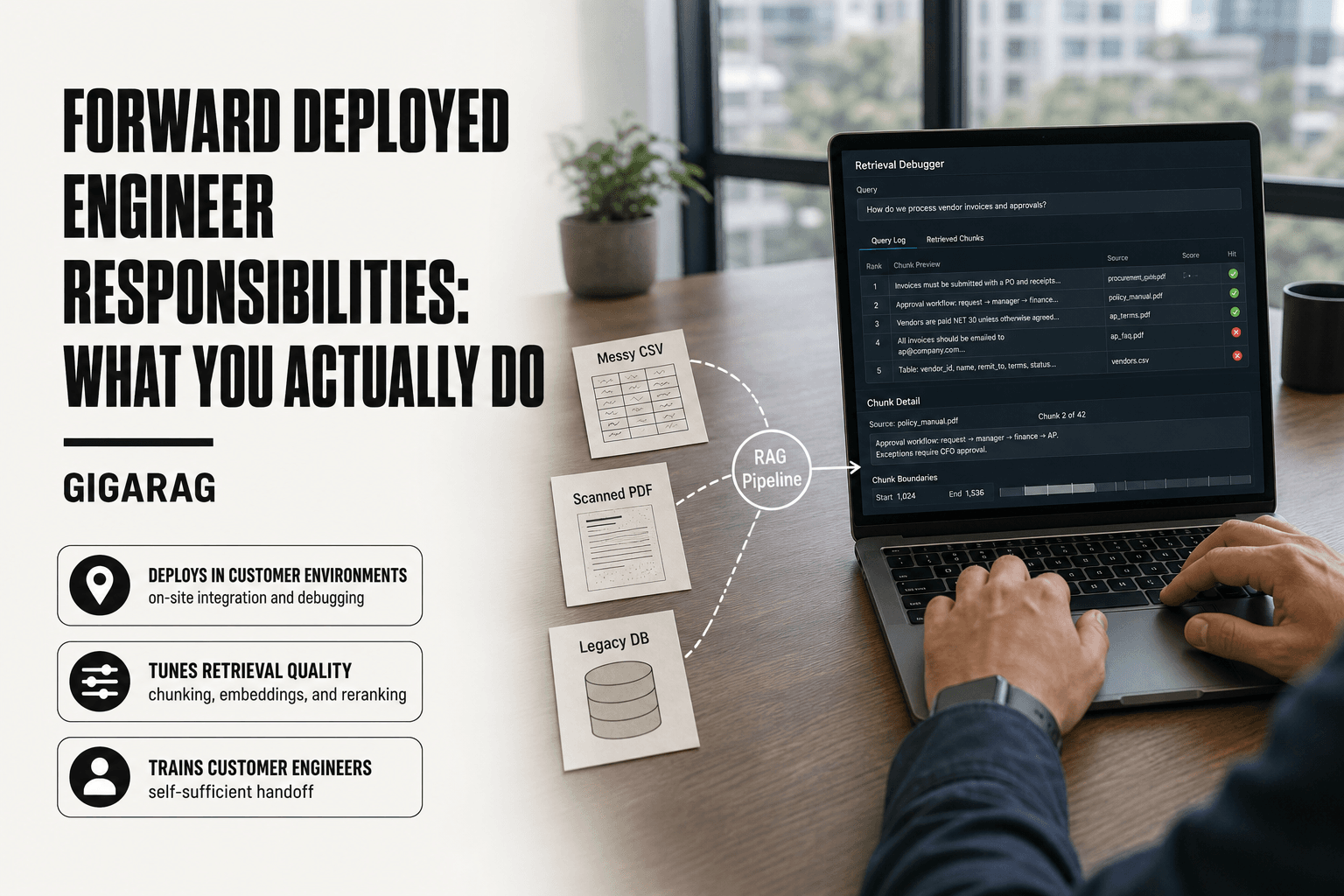
Forward Deployed Engineer Responsibilities: What You Actually Do
Forward deployed engineer responsibilities confuse almost everyone who reads the title. It sounds like a military posting, but the reality is a hybrid engineering and consulting job that sits inside enterprise software teams. Picture this: an FDE deploys a RAG pipeline into a customer's environment, then stays to debug retrieval quality issues, tune agent memory, and train the customer's engineers before flying home. That's the job. This guide is for builders of agent memory and RAG systems who want to know what an FDE actually does day-to-day, not what a job board says. GigaRAG, a platform for agent memory and RAG pipelines, is one example of the infrastructure FDEs work with in the field. The honest answer is that the role has real limits, and most guides won't tell you what they are.
| At a glance | Details |
|---|---|
| Core role | Embedded engineer solving customer problems on-site |
| Key skills | Coding, communication, domain adaptability |
| Typical tasks | Deploy, integrate, customize, debug, train |
| RAG relevance | Deploy pipelines, tune retrieval, manage memory |
| Not responsible for | Core product roadmap, sales quotas, long-term support |
| Seniority | Often mid-to-senior, varies by company |
In This Guide
- What Is a Forward Deployed Engineer?
- Forward Deployed Engineer vs. Core Product Engineer
- Forward Deployed Engineer Responsibilities: The Core Duties
- Forward Deployed Engineer Responsibilities: A Step-by-Step Guide
- A Day in the Life of an FDE
- FDE Responsibilities for RAG Pipeline and Agent Memory Builders
- Skills Required for Forward Deployed Engineer Responsibilities
- What Forward Deployed Engineers Cannot Do
- FDE vs Solutions Engineer, SRE, and Cloud Architect
- Forward Deployed Engineer Salary and Seniority
- Is FDE a Good Role? Honest Pros and Cons
- Why Forward Deployed Engineers Are in Demand
- Final Thoughts on Forward Deployed Engineer Responsibilities
What Is a Forward Deployed Engineer?
A forward deployed engineer (FDE) is a hybrid role that combines software engineering, technical consulting, and customer-facing problem solving. FDEs embed with customers to deploy, integrate, and debug software in the customer's own environment, then feed what they learn back to the product team.
The title sounds military, and that's not an accident. Palantir coined it, borrowing the language of troops sent ahead of the main force. But the work is civilian: you sit in a customer's office, or on their Slack, and you make the product work in their world.
The hybrid nature: engineering + consulting
An FDE writes code, but not the way a core product engineer does. You write integration code, deployment scripts, and one-off fixes that solve a specific customer's problem. You also run meetings, scope requirements, and translate between what the customer says they need and what the product actually does.
That dual role is the point. A pure consultant can't debug a failing API call. A pure engineer can't sit in a room with a frustrated customer and figure out what's actually broken. An FDE does both in the same afternoon.
Why enterprise software created this role
Enterprise software fails in the gap between "works in our test environment" and "works in yours." Customers have legacy systems, odd security policies, and data in formats nobody documented. The product team can't fly out for every deployment. Support teams escalate tickets slowly.
FDEs exist to close that gap. They're the people who show up, get the integration working, and come back with a list of product gaps the roadmap team never would have found on their own.
[!note] Forward deployed engineers are not typically responsible for setting product strategy or long-term support; those fall to product managers and support teams.
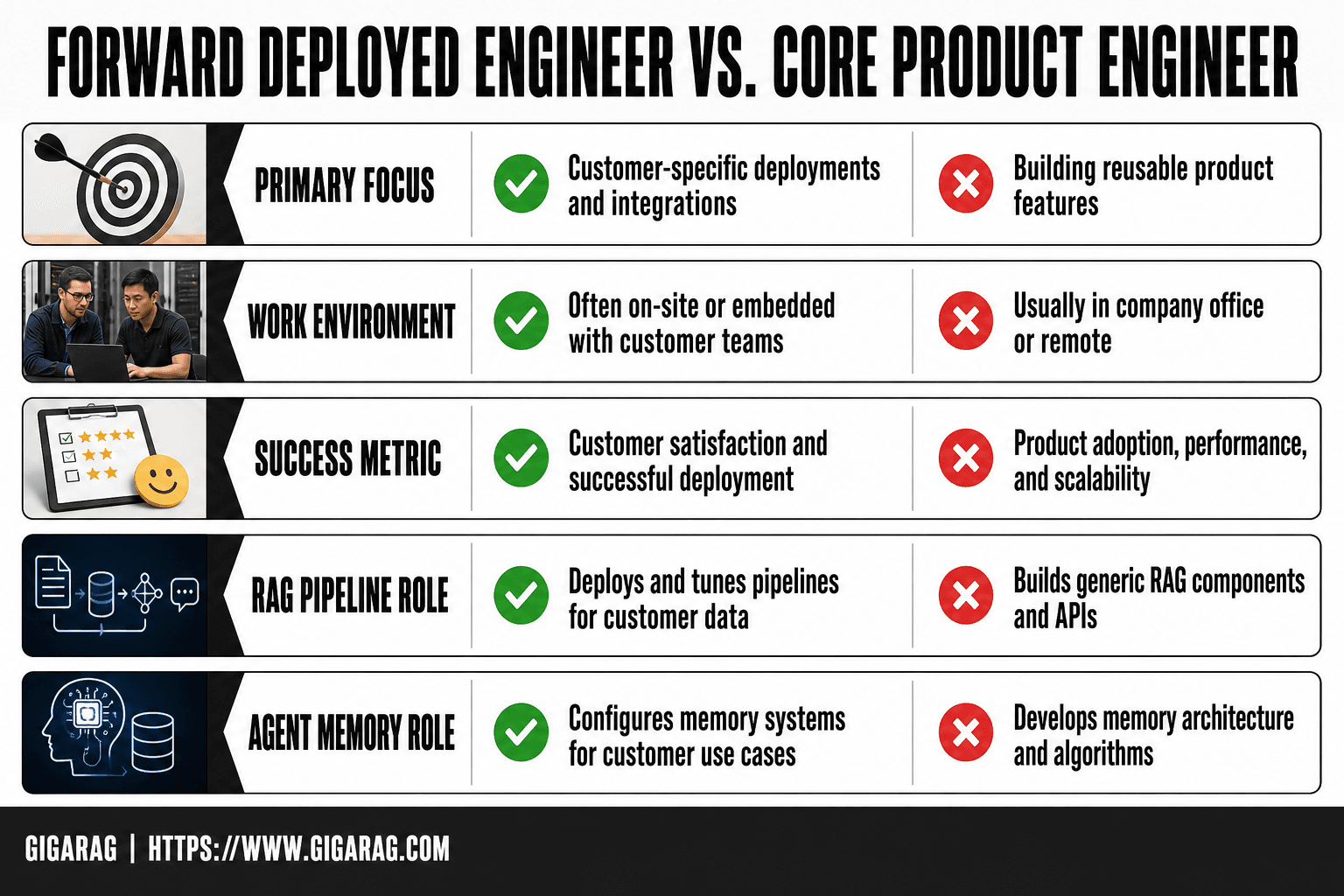
Forward Deployed Engineer vs. Core Product Engineer
| Factor | Forward Deployed Engineer | Core Product Engineer |
|---|---|---|
| Primary focus | Customer-specific deployments and integrations | Building reusable product features |
| Work environment | Often on-site or embedded with customer teams | Usually in company office or remote |
| Success metric | Customer satisfaction and successful deployment | Product adoption, performance, and scalability |
| RAG pipeline role | Deploys and tunes pipelines for customer data | Builds generic RAG components and APIs |
| Agent memory role | Configures memory systems for customer use cases | Develops memory architecture and algorithms |
Forward Deployed Engineer Responsibilities: The Core Duties
Most writeups list FDE responsibilities as a vague cloud of "customer work" and "technical work." That's not useful. Here's the actual breakdown, organized by what you do in a given week.
Pre-sales and scoping
Before a deal closes, an FDE often gets pulled in to prove the product works on the customer's data. You build a proof of concept, run it against a sample of their environment, and write up what broke. You also sit in scoping calls to catch requirements the sales team missed.
The main catch is that you're not selling. You're testing feasibility. If the customer's data is too messy for the product to handle, you say so before the contract is signed. That honesty saves the company from a failed deployment later.
Integration and deployment
This is the core of the job. You take the product and make it run inside the customer's infrastructure, which is never as clean as the docs assume. You write API connectors, configure authentication, and map the customer's data model to what the product expects.
For RAG pipeline work, this means standing up the vector database, wiring the embedding model to the customer's document store, and making sure retrieval returns results in under a second. You'll write deployment scripts, not production features.
Debugging in customer environments
When something fails, you're the one who reproduces it. That means reading logs you didn't write, tracing requests through systems you didn't build, and figuring out whether the bug is in the product or in the customer's setup.
Most of the time it's the customer's setup. A firewall rule blocks an endpoint. A proxy strips a header. A data format changed without notice. Your job is to find it, fix it, and document it so the next FDE doesn't burn a day on the same issue.
Stakeholder communication and training
You run weekly check-ins with the customer's engineers and monthly reviews with their leadership. You translate technical problems into business impact: "retrieval latency is 800ms, which means your support agents wait almost a second per query."
You also train the customer's team to use what you built. That means writing runbooks, walking through the deployment with their engineers, and leaving them able to operate the system without you. If they can't, you haven't finished the job.
[!tip] When deploying RAG pipelines, always start with a small, representative dataset to validate retrieval quality before scaling to full production data.
Forward Deployed Engineer Responsibilities: A Step-by-Step Guide
- Understand the customer's data sources and retrieval needs.
- Set up the RAG pipeline in the customer's environment, ensuring compatibility.
- Integrate the pipeline with existing systems and APIs.
- Tune retrieval parameters and embedding models for relevance.
- Configure agent memory to persist context across sessions.
- Test end-to-end with real queries and iterate on failures.
- Train customer engineers on maintenance and basic troubleshooting.
A Day in the Life of an FDE
No two days look the same, but the shape is consistent. You split time between the customer's problems and your own company's needs. Here's a realistic Tuesday.
Morning: customer standup and debugging
You start with the customer's daily standup, usually at 9am their time. You're not running it. You're listening for what broke overnight and what their team is blocked on. One engineer mentions a retrieval query returning empty results for a specific document set.
After the call, you reproduce it. You pull the query logs, check the embedding model's output for those documents, and find the chunking step split a table across two vectors. You patch the chunking config, re-index the affected documents, and confirm the query returns results. That's the morning.
Afternoon: integration work and internal sync
The afternoon is for building. You're wiring a new data source into the customer's RAG pipeline, which means writing a connector that pulls from their internal wiki, normalizes the format, and pushes into the vector database. You test it against a staging copy first.
Then you sync with your own team. You flag a product bug you found during debugging, update the internal runbook with the chunking fix, and check whether another FDE hit the same issue at a different customer. If they did, you push for a product-level fix instead of another workaround.
Evening: documentation and follow-up
You end the day writing. You update the customer's deployment doc with the new connector's config, note the re-indexing steps, and send a short summary to the customer's lead engineer. No meeting. Just a written record they can act on tomorrow.
Then you close your laptop. The work is done when the customer can operate without you, not when you've answered every message.
FDE Responsibilities for RAG Pipeline and Agent Memory Builders
RAG pipelines and agent memory systems fail in customer environments for reasons that never show up in a demo. An FDE owns those failures. You're the person who gets the pipeline working on the customer's actual data, not the sample set.
Deploying RAG pipelines into customer environments
The customer's data is messier than yours. Documents have inconsistent formatting, permissions are scattered across systems, and the embedding model behaves differently on their domain-specific vocabulary. You don't hand them a container and walk away.
You map their data sources, write connectors for the ones that don't exist, and handle auth. You test retrieval against their real queries, not synthetic ones. When a query returns garbage, you trace whether it's the chunking, the embedding, or the reranking step. Then you fix it in their environment, not yours.
Tuning agent memory for production workloads
Agent memory breaks in production because context windows fill up, old memories conflict with new ones, and retrieval latency spikes under load. You tune the memory eviction policy, adjust the relevance threshold, and decide what gets stored versus what gets summarized.
The honest answer is that agent memory is still an unsolved problem. You'll spend more time patching around model limitations than you expect. An FDE's job is to make the system useful despite that, not to pretend the limitations don't exist.
Debugging retrieval quality issues
Retrieval quality is the hardest thing to debug because it's subjective. The customer says "the answer is wrong" but can't tell you why. You reproduce the query, inspect the retrieved chunks, and figure out whether the right document was retrieved but poorly summarized, or never retrieved at all.
Most retrieval failures come down to three things: bad chunking, weak embeddings for the customer's domain, or a query that needs rewriting before it hits the vector store. You learn to check those three first. It saves hours.
Skills Required for Forward Deployed Engineer Responsibilities
The skills split into three buckets. You need all three. Missing one means you can deploy but can't debug, or debug but can't explain what you fixed.
Technical skills: APIs, data pipelines, debugging
You'll write API integrations daily. REST, gRPC, webhooks, whatever the customer's stack uses. Data pipelines matter because most deployments fail at the ingestion step, not the model step. You need to read a broken pipeline and know where it's choking.
Debugging is the core skill. Not writing perfect code. Reproducing a failure in someone else's environment, isolating the cause, and fixing it without breaking something else.
Soft skills: communication, stakeholder management
You translate between the customer's business problem and your engineering team's implementation. That means saying "the model is hallucinating on your product names" to a VP without losing their trust, and saying "the customer's data has no consistent schema" to your team without losing theirs.
Stakeholder management is not politicking. It's knowing who signs off on what, and getting the right person in the room before you build the wrong thing.
AI-specific skills: RAG, embeddings, agent memory
You need to understand chunking strategies, embedding model tradeoffs, and why retrieval fails. Agent memory adds another layer: eviction policies, relevance thresholds, and the tension between storing everything and summarizing aggressively.
You don't need to train models. You need to know where they break in production and what to do when they do.
What Forward Deployed Engineers Cannot Do
The FDE title invites scope creep. You're technical, you're on-site, you're trusted. People will ask you to own things you shouldn't.
Not a replacement for dedicated support teams
FDEs fix deployment blockers. They don't run a ticket queue. Once the integration is stable, hand it to support. If you stay on every incident, you stop deploying and start firefighting. That's a different job with a different title.
Not a replacement for product management
You'll surface customer feedback constantly. You're not the one prioritizing the roadmap. An FDE can say "three customers hit this same schema issue," but deciding what to build next belongs to product. Mixing the two roles means short-term customer wins quietly eat the long-term product.
Not a long-term on-site consultant
FDEs embed for weeks, not quarters. The goal is to make the customer self-sufficient, then leave. If you're still on-site six months later doing the same integration work, something went wrong: either the customer never learned the system, or the product needs more engineering than deployment.
FDE vs Solutions Engineer, SRE, and Cloud Architect
The FDE title overlaps with three other roles. Here's where the lines actually sit.
FDE vs Solutions Engineer
Solutions engineers live in pre-sales. They build demos, answer technical questions, and prove the product can work before a contract is signed. FDEs show up after the signature. You inherit whatever the SE promised and make it real in the customer's environment. The SE sells the bridge. You build it.
FDE vs Site Reliability Engineer
SREs own uptime, latency, and capacity for systems they control. FDEs work inside systems the customer controls. An SRE gets paged when your own service degrades. An FDE gets called when the customer's firewall blocks your API, or their vector database runs out of memory mid-ingestion. SRE is about keeping your infrastructure healthy. FDE is about making your infrastructure work in someone else's.
FDE vs Cloud Architect
Cloud architects design systems before they're built. They draw the diagrams, pick the services, and set the patterns. FDEs debug systems after they're deployed. You're not choosing whether the customer should use Postgres or Pinecone. You're figuring out why their embeddings are returning garbage under their specific data shape. Architects plan the road. FDEs walk it with the customer.
Forward Deployed Engineer Salary and Seniority
Salary data for FDEs is scattered, and most public numbers cluster around Palantir, which skews high. The honest answer is that pay tracks closer to a senior software engineer plus a premium for travel and customer-facing work.
Salary ranges by company stage
At early-stage startups, expect $120,000 to $160,000 base with meaningful equity. Mid-stage companies land around $150,000 to $190,000. Palantir and similar enterprise shops pay $170,000 to $220,000 base, with total comp pushing past $250,000 when bonuses and stock hit. These are ranges, not guarantees. Location and negotiation move the needle more than the title does.
Is FDE a senior role?
Yes, in practice. You can't do the job without shipping production code, debugging other people's infrastructure, and holding a room with customer executives. Most FDEs arrive with three to five years of engineering experience first. The title itself doesn't confer seniority, but the work demands it.
Is FDE a Good Role? Honest Pros and Cons
It depends on what you want from your career. If you want deep, uninterrupted technical work, FDE will frustrate you. If you want variety, customer exposure, and a fast track to understanding how software actually gets used, it's one of the best seats in the industry.
Pros: variety, impact, learning
The variety is real. One week you're debugging a customer's vector database, the next you're scoping a new integration, the next you're training their engineers. You rarely do the same thing twice. The impact is direct: you see your code running in a customer's production environment within weeks, not quarters. And the learning curve is steep in the best way. You'll absorb sales, product, and engineering simultaneously because the role forces you to.
Cons: travel, ambiguity, burnout risk
Travel is the biggest hidden cost. Some FDE roles expect 50% or more time on the road, and that wears on you faster than the technical work does. The ambiguity is constant: you're often the first person to encounter a problem nobody has defined yet, and there's no playbook. Burnout risk is real. The combination of customer pressure, travel, and context-switching burns people out in two to three years if they don't set boundaries. The role rewards people who can say no to scope creep and protect their own time.
Why Forward Deployed Engineers Are in Demand
The honest answer is that enterprise software has gotten harder to deploy, not easier. A decade ago, shipping a SaaS product meant handing over an API key. Now customers run hybrid clouds, on-premise clusters, and custom data pipelines. They don't want a login. They want the thing working inside their own environment, connected to their own systems, within a quarter.
That's the gap FDEs fill. A sales engineer can demo the product. A support engineer can answer tickets. But someone has to sit in the customer's environment, write the integration code, debug the permissions issue, and make the pipeline actually run. That's engineering work, and it can't be done from a distance.
AI has made this worse, not better. RAG pipelines and agent memory systems depend on customer data: embeddings, vector stores, retrieval quality. Every deployment is different because every customer's data is different. The demand for engineers who can deploy and tune these systems on-site, or at least deeply embedded with the customer, has grown faster than the supply.
Final Thoughts on Forward Deployed Engineer Responsibilities
The core of forward deployed engineer responsibilities is simple: you ship the product into a customer's environment and make it work there. That means writing integration code, debugging in production, and translating between the customer's team and your own. It's engineering with a customer attached.
The role isn't for everyone. Travel, ambiguity, and context-switching burn people out. But if you like variety and seeing your work run in the real world, few roles offer that faster.
If you're building RAG pipelines or agent memory systems, the FDE skill set maps directly. Platforms like GigaRAG give you the infrastructure to deploy and tune those systems. The FDE is the person who makes that deployment stick.
Frequently Asked Questions
How much do FDEs get paid?
Compensation varies widely by company, location, and experience. FDE roles often command competitive salaries similar to senior software engineers, sometimes with equity or performance bonuses. For specific figures, check industry salary surveys or levels.fyi.
Is forward deployed engineer a senior role?
It can be mid-to-senior depending on the company. Many FDE positions require several years of engineering experience and strong customer-facing skills. Some companies hire junior FDEs but expect rapid growth.
Is FDE a good role?
It can be highly rewarding for engineers who enjoy variety, customer interaction, and solving real-world problems. However, it may involve travel and context-switching, which isn't for everyone.
Why are forward-deployed engineers the rage?
As AI and data infrastructure companies scale, they need engineers who can bridge product and customer needs. FDEs help ensure successful deployments and gather feedback for product improvement, making them valuable in fast-growing sectors.
What do forward deployed engineers do on a daily basis?
Daily tasks include writing code to integrate systems, debugging deployment issues, meeting with customer stakeholders, and customizing solutions. They often work directly within customer environments to ensure smooth operation.
Can forward deployed engineers work remotely?
Some FDE roles allow remote work, but many require on-site presence at customer locations. The need for close collaboration often means travel or relocation is part of the job.
About GigaRAG
GigaRAG is for agent memory and RAG pipeline builders. get this right. Whether you are working through forward deployed engineer responsibilities or something adjacent, we publish what we have actually tested, including where it falls short.


