Forward Deployed Engineer Skills: The Complete 2026 Guide
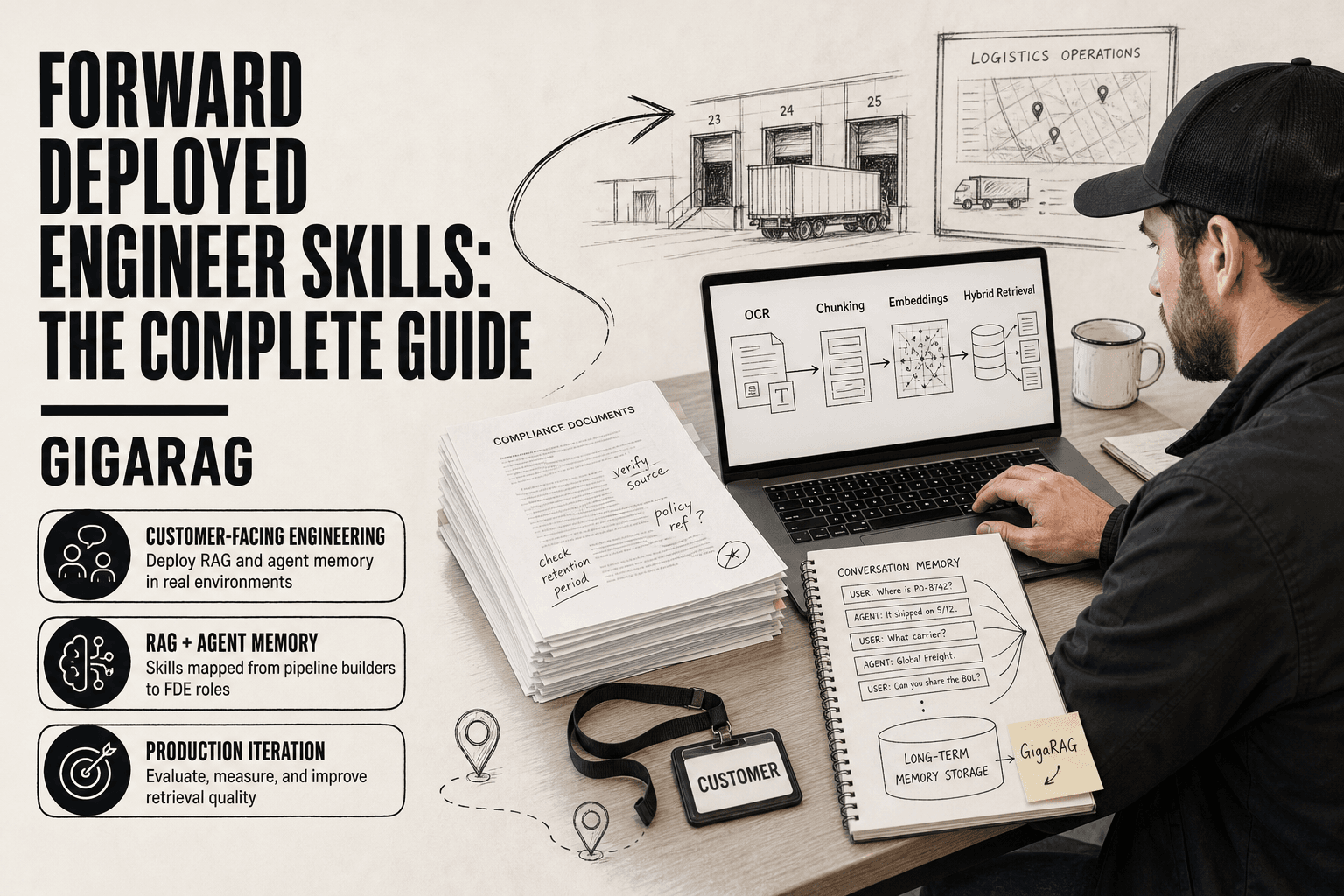
You build RAG pipelines or agent memory systems, and you keep seeing "forward deployed engineer" in job posts without a clear picture of what the role actually is. Here's the short version: an FDE is the engineer who ships your AI stack into a customer's environment, makes it work on their data, and owns the outcome. The good news is your RAG and agent work already covers most of the technical half. The main catch is the other half: customer discovery, deployment constraints, and honest trade-offs that no skill list mentions. This guide covers forward deployed engineer skills for 2026, written for builders who already know RAG and agents. You'll get a real customer deployment scenario, a map of your existing skills to FDE competencies, and the explicit limitations competitors skip. GigaRAG shows up once, in the agent memory step of the walkthrough, because that's where FDEs actually need a tool like it. No recycled skill lists here.
| At a glance | Details |
|---|---|
| Core skill | Customer-facing engineering |
| Top technical skill | RAG and agent memory |
| Key soft skill | Discovery and translation |
| Typical background | Software or ML engineer |
| Main limitation | Not a product role |
| Growth path | Senior FDE or solutions architect |
In This Guide
- What Is a Forward Deployed Engineer?
- Forward Deployed Engineer vs. Core Software Engineer
- FDE vs Other Technical Roles: Where RAG Builders Fit
- Forward Deployed Engineer Skills: A Step-by-Step Guide
- Essential Forward Deployed Engineer Skills for 2026
- AI-Specific Skills: RAG, Agents, and LLMOps for FDEs
- A Real Customer Scenario: Deploying a RAG Pipeline as an FDE
- What Forward Deployed Engineers Cannot Do
- How to Transition Into an FDE Role from RAG or Agent Work
- Salary, Compensation, and Career Paths for FDEs
- Final Thoughts: Is Forward Deployed Engineering Right for You?
What Is a Forward Deployed Engineer?
A forward deployed engineer (FDE) is a software engineer who works on-site with customers to deploy, customize, and integrate a company's product into the customer's real environment. You ship code, but you ship it inside someone else's infrastructure, against someone else's deadlines, with someone else's data.
The core definition: engineering + customer deployment
An FDE sits at the point where the product stops being a demo and starts being a production system. You're not building the core product. You're taking what the product team built and making it work in a hospital's network, a bank's compliance environment, or a manufacturer's factory floor. That means writing integration code, debugging data pipelines, and sitting in the customer's office while their IT team asks why the API returns a 403.
The honest answer is that FDE is a hybrid role. You need enough engineering depth to modify production code, and enough customer judgment to know when the customer is asking for something the product should never do.
Why FDE emerged from Palantir and spread to AI companies
Palantir coined the term in the late 2000s. Their products were powerful but hard to deploy, so they sent engineers to live with customers for months. The model worked: the engineers learned what customers actually needed, and the customers got working software instead of a license key and a manual.
AI companies adopted the role for the same reason. RAG pipelines and agent systems don't fail in demos. They fail in production, when the customer's documents are messy, their permissions are tangled, and their users ask questions nobody anticipated. An FDE is the person who shows up and fixes that.
What FDEs actually do day-to-day
A typical week includes writing integration code, debugging a customer's data pipeline, running a technical workshop, and translating a customer complaint into a product requirement. You'll spend less time on greenfield development than a traditional SWE and more time on configuration, data cleaning, and communication. The code you write is real, but it's code in service of a specific deployment, not a reusable feature.
[!note] Forward deployed engineers often work directly with customers, but they are not typically responsible for closing sales or managing account relationships—those are handled by sales and customer success teams.
Forward Deployed Engineer vs. Core Software Engineer
| Factor | Forward Deployed Engineer | Core Software Engineer |
|---|---|---|
| Customer contact | High: embedded with customers | Low: internal stakeholders |
| Work location | Often on-site or customer-adjacent | Usually company office or remote |
| Problem definition | Ambiguous, discovered with customer | Well-defined by product or manager |
| Success metric | Customer outcome and adoption | Feature delivery and system reliability |
| Technical focus | Integration, RAG, agent memory | Scalable systems and infrastructure |
FDE vs Other Technical Roles: Where RAG Builders Fit
The FDE role overlaps with solutions engineering, technical account management, and traditional software engineering. The differences come down to who owns the deployment and who owns the roadmap.
FDE vs Solutions Engineer: who owns the deployment
A solutions engineer proves the product can work. They build demos, run proof-of-concepts, and answer technical questions during the sales cycle. Once the contract is signed, they move to the next prospect.
An FDE stays. You own the deployment after the sale, which means you're the one who discovers the demo didn't account for the customer's weird authentication layer or their 40,000 malformed PDFs. Solutions engineers sell the bridge. FDEs build it and then stand on it while the customer drives trucks across.
FDE vs SWE: customer-facing vs product-facing
A traditional SWE builds features for many users. The work is product-facing: you optimize for the median user, follow the product roadmap, and hand code to a QA team. An FDE builds for one customer. The work is customer-facing: you optimize for a specific environment, follow the customer's timeline, and hand code to the customer's IT department.
The trade-off is real. FDEs write less reusable code and more glue. But they see their work used immediately, which product engineers sometimes wait quarters for.
Why RAG pipeline builders are natural FDE candidates
If you've built RAG pipelines, you've already done FDE work without the title. You've debugged why retrieval returns irrelevant chunks. You've handled messy documents, broken embeddings, and context windows that overflow. You've explained to someone non-technical why the model hallucinated.
That's the job. The customer-facing piece is the part most engineers lack, and it's learnable. The RAG piece is harder to fake.
[!tip] If you already build RAG pipelines, start documenting your work as customer case studies: describe the problem, your technical approach, and the measurable outcome. This portfolio directly demonstrates the translation skill FDE hiring managers look for.
Forward Deployed Engineer Skills: A Step-by-Step Guide
- Audit your current RAG or agent-memory projects for customer-facing moments.
- Practice discovery: run mock customer interviews to uncover real pain points.
- Build a small end-to-end RAG demo that solves a specific business problem.
- Learn to explain technical trade-offs to non-technical stakeholders.
- Contribute to open-source or internal tools that require deployment and support.
- Seek a rotation or shadowing opportunity with a customer-facing team.
- Apply for junior FDE or solutions engineering roles to gain on-the-job experience.
Essential Forward Deployed Engineer Skills for 2026
The skills that matter in 2026 aren't a flat list. They're a sequence: you write code, you deploy it into someone else's infrastructure, you model their data, and you explain what you did to people who don't care about the implementation. Each skill only matters in relation to the others.
Core programming: Python, TypeScript, SQL
Python is the default for RAG pipelines, agent orchestration, and anything touching an LLM API. You'll write it daily. TypeScript matters because most customer-facing UIs and internal dashboards run on it, and you'll need to modify both. SQL is non-negotiable: customer data lives in warehouses, and you'll query it constantly to understand what you're indexing.
The honest answer is you don't need to be an expert in all three. You need Python fluency, TypeScript competence, and SQL that doesn't embarrass you when a customer's data engineer reviews your query.
Cloud infrastructure and API integration
FDEs deploy into AWS, Azure, or GCP environments they don't control. You'll configure IAM roles, set up VPC peering, and debug why a Lambda function can't reach a customer's on-prem database. API integration is the daily bread: most enterprise systems expose REST endpoints with inconsistent auth schemes and undocumented rate limits.
You'll spend more time reading vendor API docs than writing novel algorithms. That's the job.
Data modeling and pipeline design
Before you build a RAG pipeline, you have to understand the customer's data. That means designing schemas for documents, chunks, embeddings, and metadata. It means deciding what gets indexed, what gets filtered, and what gets ignored. A bad data model produces bad retrieval, and no amount of prompt engineering fixes it.
Pipeline design is where FDEs earn their keep. You'll build ingestion jobs that handle PDFs, CSVs, and whatever proprietary format the customer's legacy system exports. You'll handle deduplication, versioning, and incremental updates. The customer won't notice when this works. They'll notice immediately when it doesn't.
Communication and stakeholder management
The skill most engineers underestimate. You'll present architecture decisions to a CTO who hasn't written code in a decade. You'll explain to a compliance officer why embeddings aren't a security risk. You'll negotiate scope with a project manager who wants everything by Friday.
Communication isn't soft. It's the difference between a deployment that ships and one that dies in review. You need to write clearly, speak plainly, and know when to say no without burning the relationship.
AI-Specific Skills: RAG, Agents, and LLMOps for FDEs
The skills above get you in the room. These get the system working. In 2026, RAG pipelines and agent memory aren't optional add-ons for FDEs. They're the deployment itself.
RAG pipeline design and deployment
You already know retrieval-augmented generation from building it. As an FDE, you design it for someone else's data, someone else's latency budget, and someone else's compliance constraints. That changes the decisions. Chunk size, embedding model, reranking strategy, and retrieval depth all shift when the customer's documents are legal contracts rather than blog posts.
Deployment means the pipeline runs in their cloud, behind their firewall, with their auth. You'll handle cold starts, cache invalidation, and fallback behavior when the vector store returns nothing useful. The customer won't ask about any of this. They'll ask why the answer was wrong.
Agent memory architecture and context management
Agents fail when they forget what happened three turns ago. Your job is to design memory that doesn't blow the context window. That means deciding what goes into short-term conversation state, what gets written to long-term storage, and what gets summarized and discarded. Tools like GigaRAG handle the long-term memory layer, but you still design the retrieval strategy that decides what the agent actually sees.
Context management is a budget problem. Every token you keep is a token you can't spend on reasoning. FDEs who understand this tradeoff ship agents that work. Those who don't ship demos.
LLMOps: evaluation, monitoring, iteration
You can't improve what you don't measure. FDEs build eval sets from real customer queries, not synthetic benchmarks. You monitor retrieval quality, answer relevance, and latency in production. When a customer says "it got worse," you need the eval data to show exactly what changed and when.
Iteration is the actual job. Ship, measure, adjust, repeat. The customer sees the improvements. You see the eval curves.
Vector databases and embedding strategies
Pinecone, Weaviate, Qdrant, pgvector: you'll pick one based on the customer's scale and existing stack. Embedding strategy matters more than the database choice. The same document chunked and embedded differently produces wildly different retrieval quality. You'll test embeddings against the customer's actual queries, not a generic benchmark.
The main catch: embeddings drift as models update. A pipeline tuned in January behaves differently in June. Plan for re-embedding before the customer notices.
A Real Customer Scenario: Deploying a RAG Pipeline as an FDE
Here's what the role looks like end to end. A mid-size healthcare logistics company, call them MedTrans, needs a system that answers questions from 40,000 pages of compliance documents and shipping manifests. Their engineers tried a naive RAG setup. It returned plausible-sounding wrong answers. They called your company.
Step 1: Understanding the customer's actual problem
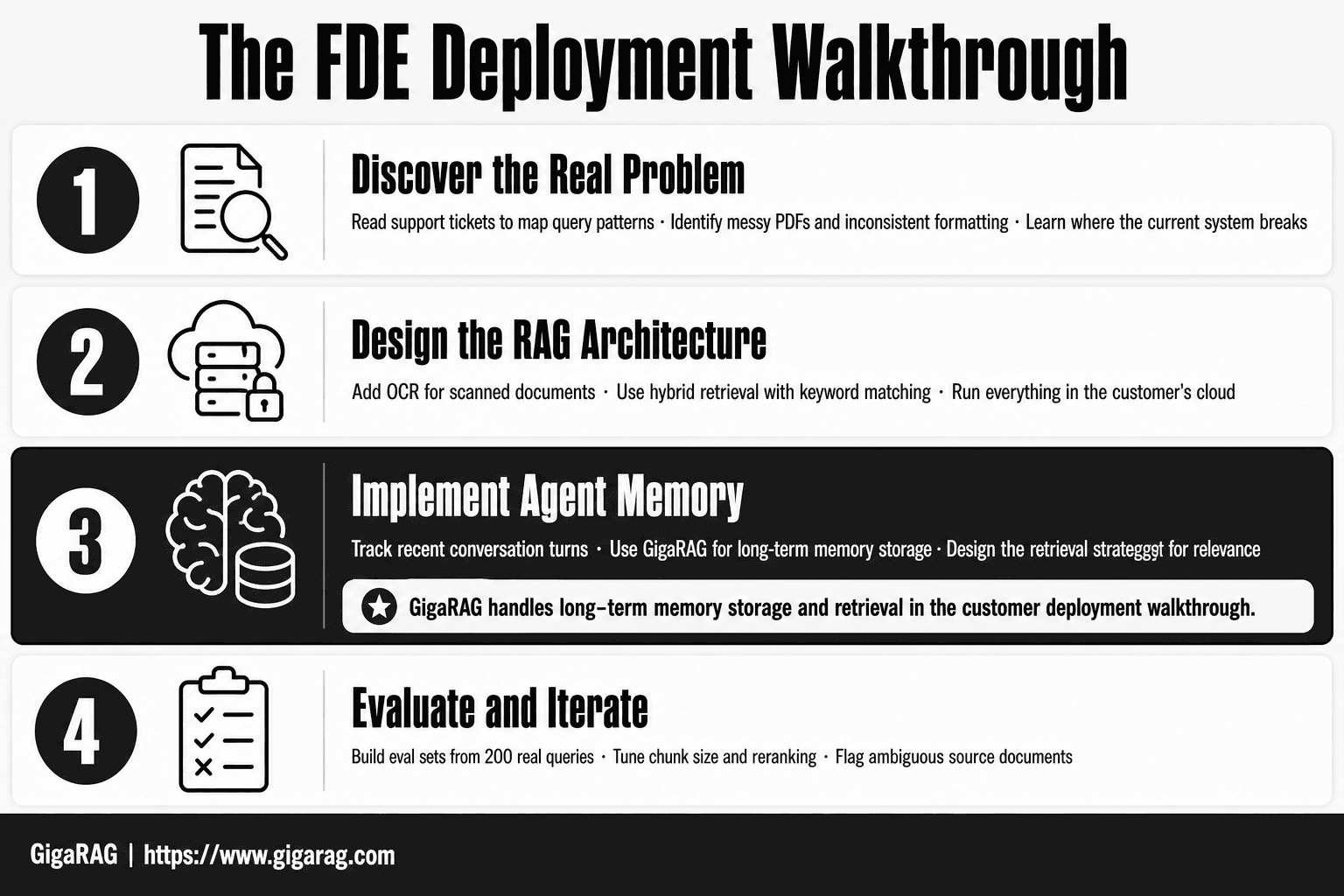
You don't start with architecture. You start with their support inbox. Three days of reading tickets shows the real query patterns: drivers asking about temperature rules for specific drug classes, dispatchers checking cross-border documentation requirements, compliance officers searching for audit trails. The questions are repetitive but high-stakes. A wrong answer means a spoiled shipment or a failed audit.
The discovery work is unglamorous. You sit on calls, read their internal wiki, and map where the current system breaks. You learn their documents are PDFs with inconsistent formatting, some scanned, some born-digital. That detail changes everything downstream.
Step 2: Designing the RAG architecture
The architecture follows from the constraints. Scanned PDFs need OCR before chunking. Compliance documents need source tracking so every answer can cite the exact page and paragraph. Latency matters less than accuracy here: a driver can wait three seconds for a correct temperature rule.
You propose a pipeline: OCR layer, chunking by section headers, embeddings with a model tuned for regulatory language, hybrid retrieval combining vector search with keyword matching on drug names and regulation codes. The customer's IT team reviews it. They ask about data residency. You adjust: everything runs in their cloud account.
Step 3: Implementing agent memory with GigaRAG
The first version answers single questions well. It fails when a dispatcher asks a follow-up: "What about refrigerated shipments to Ontario?" The system doesn't know "what about" refers to the previous question about temperature rules.
This is where agent memory matters. You add a conversation layer that tracks recent turns and pulls relevant context from long-term storage. GigaRAG handles the long-term memory piece: storing past interactions, indexing them, and retrieving what's relevant when a new question arrives. You still write the logic that decides what counts as relevant. The tool stores and retrieves. You design the retrieval strategy.
Step 4: Evaluating retrieval quality and iterating
You build an eval set from 200 real customer queries collected during discovery. Not synthetic ones. Real questions drivers actually asked. You measure retrieval precision, answer correctness, and latency. The first run scores 71% on answer correctness. Not good enough for compliance work.
You iterate. Chunk size changes from 1,000 tokens to 400. You add a reranking step. You tune the hybrid search weights. Three weeks later, correctness hits 89%. The remaining failures cluster around ambiguous queries where the document itself is unclear. You flag those to the customer: the system can't fix source documents that contradict each other.
That's the FDE job in one scenario. Discovery, design, implementation, evaluation, iteration. The code matters. The customer context matters more.
What Forward Deployed Engineers Cannot Do
The scenario above shows the role at its best. Here's what it can't do.
FDEs don't own the product roadmap
You ship what the customer needs now. That's the job. You don't decide what the core product becomes next quarter. Product managers own that. Your feedback shapes the roadmap, but you don't set it. If you want to design the long-term architecture everyone uses, stay in product engineering.
When customer demands exceed engineering reality
Some customers ask for things that can't be built. A compliance team wants 100% accuracy on contradictory source documents. A logistics firm wants real-time answers from a pipeline that takes three seconds per query. You can't fix bad data with better retrieval. You can't make latency disappear because the customer wants it gone.
The honest answer is no, sometimes. You say it in a way that keeps the relationship. But you still say it.
Burnout risk and travel expectations
FDEs travel. Some roles expect 50-70% time on customer sites. You're on calls across time zones, debugging at midnight because a customer's deployment broke. The emotional labor is real: you absorb customer frustration, translate it into engineering work, and carry the relationship.
Burnout is common. The role rewards people who thrive on intensity. It breaks people who need predictable weeks.
What FDE work deliberately leaves out
You won't build the foundational model. You won't design the vector database. You won't write the core RAG framework your company sells. You'll integrate, configure, extend, and debug it. If you want to build the engine, this role puts you in the driver's seat of someone else's car.
That's the trade. Customer impact now, product ownership never.
How to Transition Into an FDE Role from RAG or Agent Work
You already have the hard part. RAG pipeline builders and agent developers possess the exact technical skills FDE roles demand in 2026. What you lack is customer exposure, and that's learnable.
Mapping your RAG skills to FDE requirements
Your retrieval pipeline work maps directly. Vector database selection, embedding strategies, chunking decisions, evaluation metrics: these are the same problems FDEs solve on customer data. Agent memory architecture translates to context window management and state persistence in production systems. You've debugged hallucination and retrieval failures. That's the daily work.
What you're missing: SQL fluency for customer data exploration, cloud deployment experience beyond your local environment, and the ability to explain trade-offs to non-engineers in under five minutes.
Building customer-facing experience
Start where you are. Volunteer to demo your team's work to stakeholders. Write documentation that a salesperson can understand. Join customer calls as the technical observer. Take a support rotation if one exists.
If your current role has zero customer contact, build it externally. Contribute to open-source projects with active user communities. Answer questions on forums where people struggle with RAG deployments. Every interaction where you diagnose a stranger's problem and explain the fix is FDE practice.
Project portfolio that demonstrates FDE readiness
One deployed project beats ten GitHub repos. Build a RAG system for a real user, even a small one. A local business, a nonprofit, a friend's startup. Deploy it, monitor it, iterate on retrieval quality based on their actual queries. Document the failures and what you changed.
That portfolio shows what FDE hiring managers look for: shipped software, real users, and evidence you can handle the messy parts.
Salary, Compensation, and Career Paths for FDEs
FDE compensation runs higher than standard software engineering because the role carries customer risk. You're on site, you own the deployment, and when it breaks, you're the one who gets the call.
FDE salary ranges in 2026
Base salaries for FDEs at AI companies typically land between $140,000 and $220,000, with total compensation reaching $250,000 to $400,000 once equity and performance bonuses are included. Palantir, the role's originator, pays at the lower end of base but compensates heavily in stock. Early-stage startups pay less cash but offer more equity upside. (verify at publish)
Career progression: FDE to leadership
The path forks. Some FDEs move into FDE team lead or head of deployment roles, managing other forward deployed engineers across customer accounts. Others transition into product management or solutions architecture, where their customer knowledge becomes the asset. A third path leads to founding a company: FDEs see unsolved customer problems before anyone else does.
How AI specialization impacts compensation
RAG and agent deployment skills command a premium in 2026. Companies building on LLMs need engineers who can debug retrieval failures and manage agent memory in production, and there aren't enough of them. Expect 10 to 20 percent above the standard FDE range if you can demonstrate shipped RAG systems with real users. The premium comes from scarcity, not from the skills being harder.
Final Thoughts: Is Forward Deployed Engineering Right for You?
The honest answer is it depends on what you want your week to look like. If you'd rather debug a customer's retrieval pipeline than debate a product roadmap, FDE work will fit. If you want deep, uninterrupted build time, it won't.
FDEs live in the gap between what a product promises and what a customer actually runs. That means context switching, travel, and saying no to scope creep. Some engineers thrive on it. Others burn out in six months.
You should pursue FDE if you already ship RAG pipelines or agent memory systems and want those skills in front of real users. The forward deployed engineer skills you've built map directly. When you deploy agent memory in production, tools like GigaRAG handle the persistence layer so you can focus on the customer's retrieval problem instead of rebuilding memory infrastructure.
Skip it if you need a quiet calendar. The role rewards people who like the mess of real deployments.
Frequently Asked Questions
What are the key skills for a forward deployed engineer?
Forward deployed engineers need a blend of technical and interpersonal skills. On the technical side, proficiency in RAG pipelines, agent memory systems, API integrations, and cloud deployment is essential. On the soft side, customer discovery, clear communication, and the ability to translate ambiguous problems into working solutions are critical.
How does forward deployed engineering differ from solutions engineering?
Forward deployed engineers are typically more embedded in the customer's environment and often write production code alongside the customer's team. Solutions engineers focus more on pre-sales technical validation and product demonstrations. The lines can blur, but FDEs generally own post-sale technical success and deeper integration work.
Can I become a forward deployed engineer without customer-facing experience?
Yes, but you will need to demonstrate customer empathy and communication skills. Start by seeking internal projects that involve stakeholder interaction, or contribute to open-source projects where you explain your work to users. Mock customer interviews and documenting your RAG projects as case studies can also help bridge the gap.
What technical skills are most important for FDEs in 2026?
RAG pipeline construction, agent memory management, vector database integration, and API orchestration are highly sought after. Familiarity with LLM frameworks and the ability to deploy and monitor AI systems in customer environments will set you apart. Soft skills like discovery and expectation management remain equally important.
What are the limitations of the forward deployed engineer role?
FDEs are not product managers or salespeople; they do not set long-term product roadmap or close deals. The role can also be stressful due to direct customer pressure and frequent context switching. It may not suit engineers who prefer deep, uninterrupted technical work without external demands.
How do I transition from a RAG engineer to a forward deployed engineer?
Start by framing your RAG work in terms of customer outcomes—what problem did it solve and how did it help users? Then seek opportunities to interact directly with customers, such as joining a customer-facing team or taking on a support rotation. Building a portfolio of customer-facing projects will make your transition credible.
About GigaRAG
GigaRAG is for agent memory and RAG pipeline builders. get this right. Whether you are working through forward deployed engineer skills: the complete 2026 guide or something adjacent, we publish what we have actually tested, including where it falls short.


