Is Forward Deployed Engineering Consulting? What Builders Need to Know
Forward deployed engineering consulting sounds like consulting, but it isn't. Not in the way most builders mean the word. An FDE is an engineer who ships working code inside your stack, on your timeline, and stays accountable for whether the system actually runs in production. A traditional consultant delivers a report and leaves. The distinction matters most for teams building RAG pipelines and agent memory systems, where the gap between a slide deck and a working vector database integration is the entire ballgame. Tools like GigaRAG exist because managing agent memory well is hard, and an FDE who understands that layer can compress weeks of trial and error into days. This guide covers what forward deployed engineering consulting actually is, what it isn't, what FDEs can't do, and a straight decision framework for when hiring one makes sense for your AI infrastructure.
| At a glance | Details |
|---|---|
| What FDE consulting is | Embedded engineers who build in your environment |
| Core difference | Ships working systems, not slide decks |
| Best fit | RAG, embeddings, and agent memory pipelines |
| Typical engagement | Weeks to months, embedded with your team |
| Main limitation | Not a substitute for long-term ownership |
| Decision trigger | You need a working system, not strategy |
In This Guide
- What Is Forward Deployed Engineering Consulting?
- Forward Deployed Engineering vs Traditional Consulting
- What Does a Forward Deployed Engineer Actually Do?
- Forward Deployed Engineering Consulting: A Step-by-Step Guide
- FDE vs. Traditional Consulting: The Key Differences
- The FDE Lifecycle: Scoping, Prototyping, Production
- What Forward Deployed Engineering Consulting Cannot Do
- When to Hire a Forward Deployed Engineer for RAG and Agent Memory
- Skills to Look for in an FDE for AI Infrastructure
- Forward Deployed Engineering Consulting: Compensation and Career Path
- Common Mistakes When Evaluating Forward Deployed Engineering Consulting
What Is Forward Deployed Engineering Consulting?
Forward deployed engineering consulting means embedding a hands-on engineer inside your team to build working software, not to write reports. The FDE writes code against your real systems, ships it, and stays until it runs in production. The deliverable is a working system, not a deck.
The core definition
A forward deployed engineer (FDE) is a software engineer who works at the client's site, on the client's problems, using the vendor's product. Palantir coined the role. The FDE sits between the product team and the customer: close enough to the customer to see what's broken, technical enough to fix it in code.
In practice, an FDE might spend a morning reading your vector database schema, an afternoon rewriting your embedding pipeline, and the next day pairing with your team on a retrieval bug. The work is engineering, not advice.
Why "consulting" is a misleading label
Traditional consulting produces analysis. You get a report, a set of recommendations, maybe a roadmap. Someone else does the building.
FDE work produces code. The FDE is accountable for whether the thing works, not whether the analysis was sound. That's a different job with a different failure mode. A consultant fails by being wrong. An FDE fails by shipping something that doesn't run.
The label sticks because FDEs are hired for a fixed engagement, often through a vendor. But the work itself is closer to a staff engineer on loan than to a management consultant.
FDE consulting vs. staff augmentation
Staff augmentation gives you extra hands. You manage them, you assign the work, you own the outcome.
An FDE brings the vendor's product knowledge and a mandate to make the integration work. They don't just write code you specify. They push back on scope, surface product gaps, and feed what they learn back to the vendor's roadmap.
The difference matters for RAG and agent memory work. A staff aug engineer will build what you ask for. An FDE will tell you your chunking strategy won't survive production and then help you fix it.
[!note] Forward deployed engineering originated in companies like Palantir, where engineers work directly with customers to adapt software to real operational needs; it is not a formal certification or a standard job title across the industry.
Forward Deployed Engineering vs Traditional Consulting
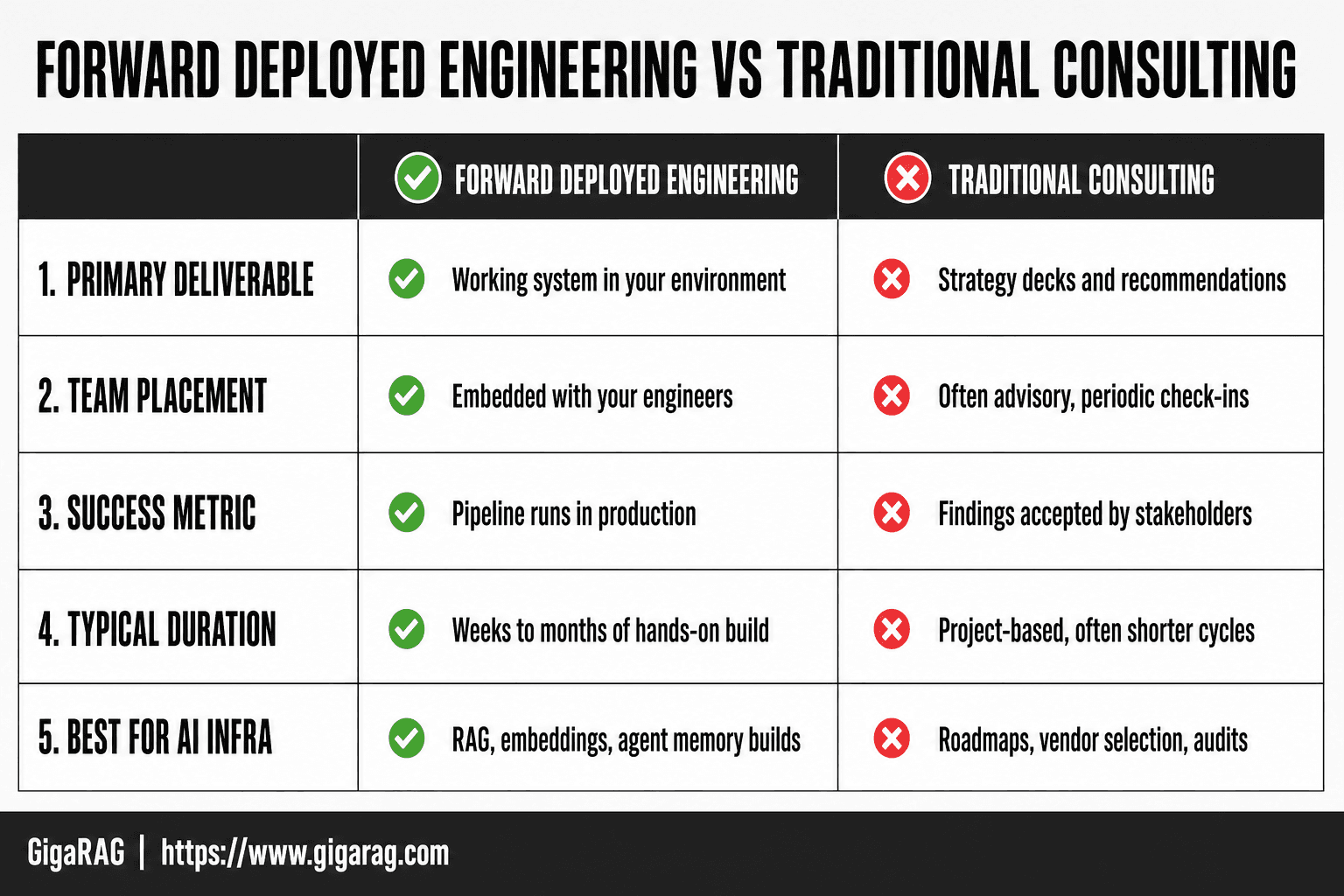
| Factor | Forward Deployed Engineering | Traditional Consulting |
|---|---|---|
| Primary deliverable | Working system in your environment | Strategy decks and recommendations |
| Team placement | Embedded with your engineers | Often advisory, periodic check-ins |
| Success metric | Pipeline runs in production | Findings accepted by stakeholders |
| Typical duration | Weeks to months of hands-on build | Project-based, often shorter cycles |
| Best for AI infra | RAG, embeddings, agent memory builds | Roadmaps, vendor selection, audits |
What Does a Forward Deployed Engineer Actually Do?
The job splits into three loops that run in parallel: discovery, building, and feedback. An FDE moves between them daily, not in phases.
Client immersion and discovery
You sit with the team that will use the system. You read their code, their data, their failure logs. You ask what breaks at 2 a.m. and what they've already tried. For a RAG pipeline, that means tracing how documents flow from ingestion to retrieval, then finding where the embeddings drift from the queries users actually type.
Building and shipping code
Then you write code. Not a prototype in a sandbox. Code against their real vector database, their real embedding model, their real traffic. You ship it, watch it run, and fix what breaks. The FDE owns the pull request, the deploy, and the incident.
Feeding insights back to the product team
Every FDE carries two reporting lines. You report to the client on what shipped. You report to your own product team on what the client needed that the product doesn't do yet. That second channel is what makes the role different from staff augmentation. The product roadmap changes because of what you saw in the field.
A week in the life: RAG pipeline example
Monday: you pair with the client's search engineer and find their chunking splits documents mid-sentence. Tuesday: you rewrite the chunker and re-embed a test corpus. Wednesday: retrieval quality drops 12% on their benchmark, so you roll back and try a different split. Thursday: you ship the fix and write a short note to your product team about why the default chunker failed. Friday: you hand the client a working pipeline and a list of what still needs hardening.
That's the job. Code, shipped, on someone else's systems, with your own product team learning from every failure.
[!tip] For RAG and agent memory work, ask a prospective FDE consultant to walk through a past pipeline they built end to end, including how they handled embedding drift or memory eviction, before you sign anything.
Forward Deployed Engineering Consulting: A Step-by-Step Guide
- Define the concrete system you need built, such as a retrieval pipeline or agent memory store.
- Assess whether your team lacks the specific skills or bandwidth to build it now.
- List what a working system must do, including latency, accuracy, and data constraints.
- Interview FDE consultants on past builds in vector databases, embeddings, or agent memory.
- Agree on a scoped engagement with a clear definition of done and handover plan.
- Plan for knowledge transfer so your team can own and extend the system after the engagement.
FDE vs. Traditional Consulting: The Key Differences
The confusion is understandable. Both roles show up at your office, ask questions, and bill for their time. But the output is different in kind, not degree. A traditional consultant leaves you with a document. An FDE leaves you with a running system.
Deliverables: working code vs. recommendations
A consultant's deliverable is a deck, a report, or a set of recommendations. You still have to build the thing. An FDE's deliverable is a pull request against your repo. For a RAG pipeline, that means the chunking logic, the embedding calls, the retrieval loop, and the evaluation harness all exist and run before the engagement ends.
The gap between a recommendation and working code is where most AI infrastructure projects die. A consultant can tell you that your chunk size is too large. An FDE changes the chunk size, re-embeds your corpus, and shows you the retrieval metrics before and after.
Accountability: outcomes vs. advice
Consultants are accountable for the quality of their advice. If the advice was sound and you didn't follow it, that's on you. FDEs are accountable for whether the system works. If the RAG pipeline returns irrelevant chunks in production, the FDE owns that failure and fixes it.
This changes the relationship. A consultant can walk away after the final presentation. An FDE can't walk away until the code passes tests in your environment, because the code is the deliverable.
Time horizon: embedded vs. episodic
Traditional consulting is episodic. A two-week discovery sprint, a six-week strategy engagement, then the consultants leave. FDE work is embedded. The FDE sits with your team for weeks or months, ships code continuously, and stays through the messy middle where the first version breaks in production.
For agent memory systems, that middle is where the real work happens. The first memory pipeline works in the demo. The second week is when you discover that your embeddings drift as your document corpus grows, and someone has to be there to fix it.
Technical depth: hands-on vs. advisory
Consultants operate at the level of frameworks and best practices. FDEs operate at the level of your actual stack. They read your code, run your queries, and debug your vector database. The technical depth isn't a bonus. It's the entire job.
That's the tradeoff. You pay for hands-on work, and you get a system that runs. You pay for advice, and you get a document that tells you what to build. For RAG and agent memory work, the document is rarely the bottleneck.
The FDE Lifecycle: Scoping, Prototyping, Production
An FDE engagement isn't a single undifferentiated block of time. It moves through three phases, and each phase has a different goal, a different pace, and a different kind of output. Knowing what each phase looks like helps you set expectations and spot when an engagement is drifting.
Scoping: defining the problem and success criteria
Scoping is where most FDE engagements succeed or fail before any code gets written. The FDE sits with your team, reads your existing code, and pins down exactly what problem the system needs to solve. For a RAG pipeline, that means defining what a good retrieval looks like: which queries should return which chunks, what latency is acceptable, and what recall threshold counts as working.
The output is a short document, not a deck. It lists the problem, the success criteria, the constraints, and what's explicitly out of scope. If you can't agree on success criteria in scoping, the rest of the engagement will be an argument about whether the thing works.
Prototyping: building a working proof of concept
Prototyping is where the FDE builds the smallest version of the system that proves the approach. For agent memory, that might be a pipeline that ingests conversation history, generates embeddings, stores them in a vector database, and retrieves relevant context for the next turn. It won't handle edge cases. It won't be optimized. It just has to work end to end.
The prototype exists to kill bad assumptions early. Maybe your embedding model doesn't capture the distinctions your retrieval needs. Maybe your chunking strategy fragments context in ways that break the agent's reasoning. Better to find that in week two than month four.
Production: hardening, deploying, and handing off
Production is where the prototype becomes something your team can run without the FDE in the room. That means adding error handling, monitoring, retries, and logging. It means load testing the retrieval path and tuning the vector index. It means writing the runbooks and documentation your engineers will actually use.
The handoff is the critical part. A good FDE doesn't leave you with a system only they understand. They leave you with code your team has reviewed, tests your team can run, and a deployment process your team has executed at least once. If the handoff is a code dump and a wave goodbye, the engagement failed, no matter how well the prototype worked.
What Forward Deployed Engineering Consulting Cannot Do
The honest answer is that FDEs are not a substitute for the things only you can do. They accelerate, they unblock, they build alongside you. They don't remove the fundamental work of building a product. Here's what you should not expect from an FDE engagement.
They don't replace your product team
An FDE is additive, not a replacement. They embed for a defined period, build a specific system, and leave. Your product team still owns the roadmap, the architecture decisions, and the day-to-day maintenance. If you're hoping to hire one FDE instead of two backend engineers, you're setting yourself up for a gap when the engagement ends. The FDE's job is to make your team faster, not to be your team.
They don't guarantee outcomes
No FDE can promise your RAG pipeline will hit a specific recall score or that your agent memory system will reduce hallucination by some percentage. They can commit to a process: scoping, prototyping, production hardening, handoff. But the outcome depends on your data quality, your infrastructure, your team's willingness to adopt the system, and a dozen other factors outside the FDE's control. Anyone who guarantees a specific metric before seeing your data is selling something other than engineering.
They don't own long-term maintenance
When the engagement ends, the FDE leaves. The system they built is now yours. If you don't have someone on your team who understands the vector database, the embedding pipeline, and the retrieval logic, you'll be paying someone else to fix it later. A good handoff mitigates this. It doesn't eliminate it. Budget for the fact that your team will own the system for years, not weeks.
They can't fix broken product-market fit
An FDE can build you a working RAG pipeline. They cannot make users want the product that pipeline powers. If the underlying problem is that nobody needs what you're building, no amount of forward deployed engineering will change that. The FDE will build the thing you asked for, and it will work, and it still won't matter. Sort out product-market fit before you spend money on FDE consulting.
When to Hire a Forward Deployed Engineer for RAG and Agent Memory
The decision comes down to one question: do you have a specific, well-scoped problem that's blocking a working system? If yes, FDE consulting is worth evaluating. If the problem is fuzzy or the system doesn't exist yet, it probably isn't.
Signals FDE consulting is worth it
You have a RAG pipeline that works in demos but falls apart on real data. Retrieval returns irrelevant chunks, embeddings drift, or your agent forgets context mid-conversation. An FDE can dig into the retrieval logic, tune chunking, and rebuild the memory layer in weeks, not months.
You're a small team with a clear deadline. A founder and two engineers can't simultaneously ship product features and fix vector database performance. An FDE owns the infrastructure problem while your team keeps shipping.
You need production hardening, not greenfield building. The prototype exists. It needs monitoring, fallback logic, and a handoff plan. That's exactly what FDEs do.
Signals it's not worth it
You don't have a working prototype yet. FDEs are expensive accelerators, not idea validators. Build the rough version yourself first.
The problem is product-market fit, not engineering. If users don't want the product, a better memory system won't change that.
You can't articulate what "done" looks like. No clear success criteria means no clear engagement. The FDE will burn hours chasing a moving target.
A simple decision checklist
Answer these three questions:
- Do you have a specific technical blocker you can describe in one sentence?
- Can you define success with a measurable outcome (latency under X ms, recall above Y%, memory persistence across N turns)?
- Do you have someone on your team who can own the system after the FDE leaves?
Three yeses: FDE consulting is worth a scoping call. Two yeses: fix the missing piece first. One yes or fewer: don't hire an FDE yet.
Example: evaluating FDE consulting for an agent memory project
Say you're building a customer support agent that needs to remember user preferences across sessions. Your prototype stores everything in a single prompt, which works for five turns then degrades. You've tried a naive vector store but retrieval quality is inconsistent.
That's a clear blocker with a measurable target: memory persistence across 20+ turns without context bloat. You have an engineer who can maintain the system afterward. FDE consulting makes sense here.
Now flip it. You're not sure whether users even want a support agent with memory. You have no prototype. The FDE would be building from scratch against an unvalidated assumption. That's a product discovery problem, not an FDE problem.
Skills to Look for in an FDE for AI Infrastructure
Hiring an FDE for RAG or agent memory work means screening for skills most generalist FDEs don't have. The baseline matters, but the AI-specific layer is what separates someone who ships from someone who stalls.
Core FDE competencies
You want someone who has shipped production code under a deadline, not just advised. Look for evidence of owning a system end to end: scoping, building, deploying, handing off. Strong FDEs communicate with non-technical stakeholders without losing technical precision. They write clean code fast and document what they built. They also know when to stop building and start handing off.
AI infrastructure skills that matter
For RAG work, the FDE should understand embeddings, chunking strategies, and vector database tradeoffs. They should know why retrieval fails on real data and how to debug it. For agent memory, look for experience with context windows, memory persistence, and fallback logic when retrieval returns nothing useful. They don't need to train models. They need to build systems around them.
Red flags to watch for
Beware the FDE who only talks about models and never about latency, cost, or failure modes. That's a researcher, not an engineer. Watch for vague answers about past projects. A real FDE can describe the specific system they built, the constraint they hit, and how they fixed it. If they can't articulate what "done" looks like for your project, walk away.
Forward Deployed Engineering Consulting: Compensation and Career Path
Compensation is where the "consulting" label finally works in the FDE's favor. You pay for outcomes, not hours, and the rates reflect that.
What FDE consulting costs
FDE consulting engagements typically run $200 to $400 per hour, or $30,000 to $80,000 per month for a full-time embedded engineer. Shorter scoping engagements cost less: $10,000 to $25,000 for a two-to-four-week discovery phase. The honest answer is that you're paying senior-engineer rates plus a premium for the deployment skill set. Most firms bill on a project basis with milestone payments tied to working prototypes, not slide decks.
FDE compensation ranges
Full-time FDEs earn well above standard software engineers because the role demands both technical depth and client-facing stamina. Entry-level FDEs start around $120,000 to $150,000 base. Mid-career FDEs with three to five years of experience land between $180,000 and $250,000 total compensation. Senior FDEs at firms like Palantir can reach $300,000 to $385,000 when you include bonuses and equity (verify at publish for current figures). The premium exists because FDEs carry revenue responsibility: their work directly determines whether a client renews.
Career paths for FDEs
FDEs don't stay FDEs forever. The role burns people out, and the skills transfer cleanly. Common exits include product management, where the client-immersion experience pays off immediately. Some move into solutions architecture or technical sales leadership. Others found startups, having spent years watching real customers struggle with real problems. A smaller group stays in the FDE track and climbs to principal or director level, where they manage teams of deployed engineers across multiple accounts.
Common Mistakes When Evaluating Forward Deployed Engineering Consulting
Most builders don't fail because they hire a bad FDE. They fail because they hire the right FDE for the wrong engagement.
Mistaking FDEs for traditional consultants
You'll ask for a strategy document and get working code instead. That's not a failure, but it means you paid deployment rates for something you could have bought cheaper. If you want recommendations, hire an advisor. If you want a RAG pipeline that runs, that's FDE territory. The mistake is hiring one when you need the other.
Expecting FDEs to replace your team
An FDE embeds, ships, and leaves. They won't be there when the vector database hits a scaling wall six months later. If you don't have anyone in-house who understands the system after handoff, you've bought a prototype, not a product. Budget for at least one internal engineer to pair with the FDE from day one.
Skipping the scoping phase
The scoping phase feels like money spent on nothing. It's not. A two-week scoping engagement costs $10,000 to $25,000 and tells you whether the project is even feasible. Skipping it means you'll discover the embedding model doesn't fit your data three weeks into a $60,000 build. That's the expensive way to learn.
Ignoring the handoff plan
The handoff plan is where forward deployed engineering consulting succeeds or fails. Without it, you get a working system and no one who can maintain it. Ask for documentation, runbooks, and a defined ownership transfer before you sign. If the FDE can't articulate the handoff, walk away.
Frequently Asked Questions
What is a forward deployed engineer at Palantir?
At Palantir, a forward deployed engineer works directly with customers to adapt and implement software in their environments. They combine engineering skills with close customer collaboration, often building custom integrations and workflows. The role is less about generic advice and more about making the product work in practice.
What is a consulting engineering firm?
A consulting engineering firm provides expert engineering services to clients, often on a project or retainer basis. Deliverables can range from design and analysis to implementation support. The key distinction from forward deployed engineering is that consulting firms may advise rather than embed and build alongside your team.
What is L1, L2, L3, and L4 engineer?
These levels typically describe seniority or support tiers in engineering organizations. L1 is usually entry-level or first-line support, while L4 indicates senior or lead responsibility. The exact definitions vary by company, so treat any specific mapping as organization-specific.
What are the big 4 in engineering?
The phrase is ambiguous because it can refer to large professional services firms or to major engineering companies depending on context. In consulting, the Big 4 usually means Deloitte, PwC, EY, and KPMG. In engineering, it depends on the sector and region.
Is forward deployed engineering the same as consulting?
No, though they overlap. Forward deployed engineers embed with your team and build working systems, while traditional consultants often deliver analysis and recommendations. For AI infrastructure like RAG pipelines, the build-focused approach is usually what you need.
When is FDE consulting worth it for RAG or agent memory work?
It is worth it when you need a working pipeline quickly and lack the specific expertise in vector databases, embeddings, or agent memory. It is less worth it if you already have the skills and only need a roadmap. The decision hinges on whether you need building or advice.
What can forward deployed engineers not do?
They are not a replacement for long-term product ownership or ongoing maintenance by your team. They also should not be expected to provide generic strategy without deep context. Their strength is building and adapting systems in your environment, not running your organization.
About GigaRAG
GigaRAG is for agent memory and RAG pipeline builders. get this right. Whether you are working through is forward deployed engineering consulting or something adjacent, we publish what we have actually tested, including where it falls short.


