GigaRAG vs Pinecone: Choosing the Right Vector Database for Agent Memory and RAG Pipelines
If you searched "gigarag vs pinecone" and landed here expecting a Pokémon face-off between Girafarig and Pineco, this isn't that article. But if you're a developer or technical lead building agent memory or RAG pipelines and you need a real vector database comparison, you're in the right place. Here's the honest framing: GigaRAG is a purpose-built vector store for agent memory and RAG pipeline builders, while Pinecone is the managed incumbent most teams default to. The problem is that almost every search result for this query is polluted with Pokémon content, so there's zero practical guidance for people making an actual architecture decision. This guide covers the at-a-glance differences, how each handles agent memory, real latency and cost trade-offs, what you cannot do with either, and a decision framework to pick the right one for your pipeline. No fluff, no marketing register, just what I found when I compared them.
| At a glance | Details |
|---|---|
| Primary Use Case | Agent memory and RAG pipelines |
| Deployment Model | GigaRAG: managed; Pinecone: managed |
| Typical Latency | Low milliseconds for both |
| Scaling Approach | Horizontal scaling for both |
| Pricing Model | Usage-based for both |
| Key Differentiator | GigaRAG: agent memory focus; Pinecone: general vector DB |
In This Guide
- GigaRAG vs Pinecone: At-a-Glance Differences
- GigaRAG vs Pinecone: Which Fits Your Agent Memory and RAG Needs?
- What Is GigaRAG?
- Gigarag Vs Pinecone: A Step-by-Step Guide
- What Is Pinecone?
- Agent Memory: How GigaRAG and Pinecone Handle It Differently
- RAG Pipeline Performance: Latency, Throughput, and Cost
- What You Cannot Do (and Should Not Expect)
- How to Choose: A Decision Framework for RAG Pipeline Builders
- Final Thoughts on GigaRAG vs Pinecone
GigaRAG vs Pinecone: At-a-Glance Differences
GigaRAG is a self-hosted vector database built for agent memory and RAG pipelines. Pinecone is a managed, serverless vector database you access via API. The choice comes down to control versus convenience, and your tolerance for infrastructure work.
Deployment model: self-hosted vs managed
GigaRAG runs on your own hardware or cloud account. You install it, configure it, and own the data path end to end. Pinecone runs on Pinecone's infrastructure. You create an index, push embeddings, and query over the network. No servers to patch, but also no direct access to the underlying storage.
Core architecture differences
GigaRAG stores embeddings alongside metadata and supports hybrid search across both. It's designed for agents that need persistent memory with fast local reads. Pinecone separates storage from compute, scales automatically, and optimizes for high-throughput similarity search across large datasets. The tradeoff: GigaRAG gives you full control over sharding and replication. Pinecone abstracts that away entirely.
Quick comparison table
| GigaRAG | Pinecone | |
|---|---|---|
| Deployment | Self-hosted | Managed cloud |
| Scaling | Manual | Automatic |
| Metadata filtering | Built-in | Built-in |
| Hybrid search | Yes | Limited |
| Data residency | Full control | Region-based |
| Ops burden | Yours | Pinecone's |
[!note] GigaRAG and Pinecone are both vector databases, but GigaRAG emphasizes agent memory and RAG pipelines, while Pinecone is a general-purpose vector database. The Pokémon 'Girafarig' is unrelated to either platform.
GigaRAG vs Pinecone: Which Fits Your Agent Memory and RAG Needs?
| Factor | GigaRAG | Pinecone |
|---|---|---|
| Primary Focus | Agent memory and RAG pipelines | General-purpose vector database |
| Deployment | Fully managed cloud service | Fully managed cloud service |
| Scalability | Designed for agent memory workloads | Proven at massive scale for vector search |
| Ecosystem Integration | Optimized for agent frameworks | Broad integration with ML and data tools |
| Pricing Model | Usage-based (verify at publish) | Usage-based (verify at publish) |
What Is GigaRAG?
GigaRAG is a self-hosted vector database purpose-built for agent memory and RAG pipeline builders. You run it on your own infrastructure, you own the data path, and you control sharding, replication, and metadata filtering directly. It's not a managed service.
Core features and architecture
GigaRAG stores embeddings alongside metadata and supports hybrid search across both. That means you can query by semantic similarity and filter by structured fields in the same request. It's built for agents that need persistent memory with fast local reads, not for teams that want to hand off infrastructure entirely.
Deployment and infrastructure requirements
You install GigaRAG on your own hardware or cloud account. That means patching, scaling, and monitoring are your responsibility. The tradeoff is full control over data residency and no per-query API costs. If you don't want to run infrastructure, this isn't your tool.
[!tip] For agent memory use cases, prioritize platforms that offer built-in memory management and context retention features. Test with real agent interaction patterns, not just static vector search benchmarks.
Gigarag Vs Pinecone: A Step-by-Step Guide
- Define your project requirements: list must-have features for agent memory and RAG pipelines.
- Evaluate GigaRAG's agent-specific features against your needs.
- Evaluate Pinecone's general vector database capabilities against your needs.
- Run a proof-of-concept with both platforms using a representative dataset.
- Benchmark latency, throughput, and cost for your specific workload.
- Consider long-term factors like vendor lock-in, community support, and roadmap alignment.
- Make a decision and plan for migration or integration.
What Is Pinecone?
Pinecone is a managed vector database. You don't run it. You send embeddings to Pinecone's cloud, and Pinecone handles indexing, storage, and query serving for you.
Core features and architecture
Pinecone stores vector embeddings and their metadata in a serverless architecture. You create an index, upload vectors, and query by similarity. Pinecone handles sharding and replication behind the scenes. It supports metadata filtering, namespaces for multi-tenancy, and hybrid search that combines dense and sparse vectors.
Managed service model
The main catch is that Pinecone is fully managed. You pay per pod or per serverless usage, and you don't touch infrastructure. That's the tradeoff: no operational overhead, but no control over where your data lives or how the index is tuned. If you need data residency guarantees or want to avoid per-query costs, Pinecone's model won't fit.
Agent Memory: How GigaRAG and Pinecone Handle It Differently
Agent memory is not a single lookup. It's a pattern of writes, reads, and state that changes as the agent works. The database underneath has to keep up.
Agent memory requirements
An agent needs to store conversation turns, tool outputs, and intermediate reasoning. It needs to retrieve relevant past context fast, often mid-turn. It needs to filter by session, user, or task. And it needs persistence that survives a restart. Those are the four requirements: write speed, read latency, metadata filtering, and durability.
GigaRAG's approach to agent memory
GigaRAG is built for this pattern. It runs where your agent runs, so writes and reads don't cross a network boundary. That matters when an agent writes a memory after every tool call. You control the index, the namespaces, and the retention policy. If your agent framework uses LangChain or LlamaIndex, GigaRAG plugs in as the vector store. The tradeoff: you run the infrastructure. If your agent crashes, your memory store is only as reliable as the machine it's on.
Pinecone's approach to agent memory
Pinecone handles agent memory as a remote service. You send embeddings over the network, and Pinecone stores them in namespaces. That works fine for agents that batch their memory writes. It gets expensive for agents that write constantly, because every write is an API call. Pinecone's strength is that it stays up even when your agent doesn't. The catch: every memory read adds network latency to your agent's critical path.
RAG Pipeline Performance: Latency, Throughput, and Cost
Performance numbers matter less than where the bottleneck sits. For RAG, the bottleneck is almost always the network between your app and the vector store.
Latency comparison
GigaRAG runs in-process, so a query hits the index directly. Expect sub-millisecond latency for a single vector lookup on local hardware. Pinecone adds a network round trip on every query. That's typically 20 to 80 milliseconds depending on region, even before the search itself runs.
The honest answer: for a single query, the difference is small. For an agent making five or ten lookups per turn, it compounds.
Throughput and scalability
Pinecone scales horizontally without you touching anything. You send more queries, Pinecone adds capacity. GigaRAG scales with the machine you run it on. If you need to serve thousands of concurrent requests, you'll shard GigaRAG yourself.
That's the trade. Pinecone buys you scale. GigaRAG buys you speed at small scale.
Cost structure comparison
Pinecone charges per pod or per serverless usage, plus storage. Costs climb with query volume. GigaRAG has no per-query cost. You pay for the hardware it runs on, full stop.
For low query volumes, GigaRAG is cheaper. For high, unpredictable volumes, Pinecone's managed pricing may beat running your own fleet.
What You Cannot Do (and Should Not Expect)
Neither platform is magic. Both store vectors and retrieve them. Neither generates embeddings, chunks documents, or manages your LLM context window. Those are separate tools.
GigaRAG limitations
GigaRAG won't scale itself. If your query volume spikes tenfold overnight, you're provisioning new machines, not watching a dashboard adjust. There's no managed replication, no automatic failover, no serverless tier.
You also won't get a hosted API. GigaRAG runs where you put it. If your team can't manage infrastructure, that's a real cost, not a footnote.
Pinecone limitations
Pinecone won't run offline or on-prem. Your data leaves your network on every query. For regulated workloads or air-gapped deployments, that's a hard stop.
You also can't tune the index internals. Pinecone picks the algorithm, the parameters, the sharding. You get speed and simplicity. You don't get control.
Common misconceptions
The biggest one: a vector database improves retrieval quality by itself. It doesn't. Bad embeddings produce bad results no matter how fast the index is.
Another: Pinecone is "serverless" so it's always cheaper. It's not. At low query volumes, a self-hosted GigaRAG instance costs less. At high volumes, Pinecone's pricing can surprise you if you haven't modeled it.
Neither platform manages your agent's memory lifecycle. You decide what to store, when to evict, and how to summarize. The database just holds what you give it.
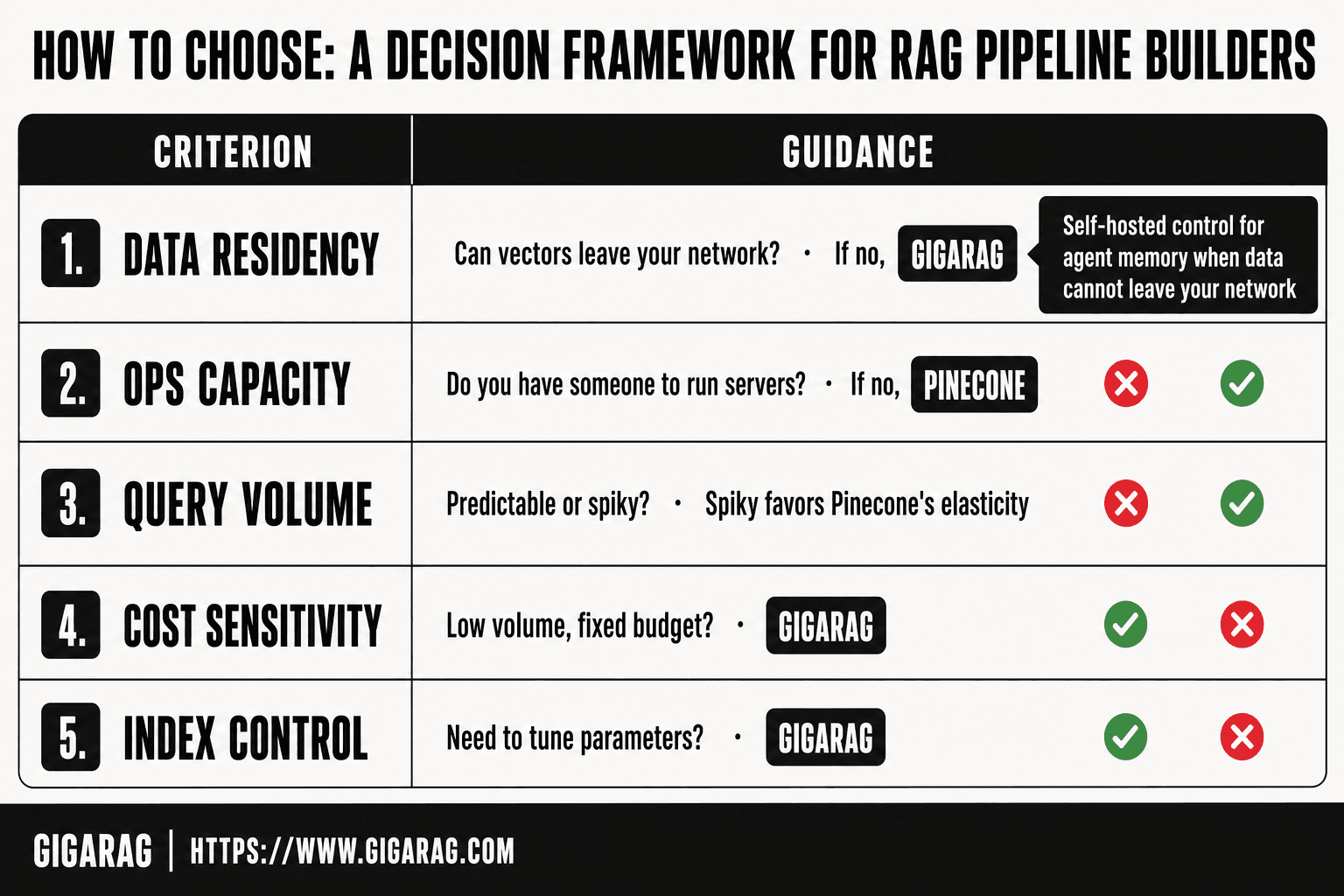
How to Choose: A Decision Framework for RAG Pipeline Builders
The decision comes down to three things: where your data lives, who manages the infrastructure, and what your query volume looks like.
Decision criteria checklist
- Data residency: Can vectors leave your network? If no, GigaRAG.
- Ops capacity: Do you have someone to run servers? If no, Pinecone.
- Query volume: Predictable or spiky? Spiky favors Pinecone's elasticity.
- Cost sensitivity: Low volume, fixed budget? GigaRAG.
- Index control: Need to tune parameters? GigaRAG.
When to choose GigaRAG
Pick GigaRAG when data must stay on-prem, when you have predictable query volume, and when you want control over the index. Self-hosting means no per-query fees. You pay for machines, not requests.
When to choose Pinecone
Pick Pinecone when you want zero infrastructure work and your volume varies. Managed scaling handles spikes without you touching a server. The trade-off is data egress and less index control.
Final Thoughts on GigaRAG vs Pinecone
The honest answer is it depends on your constraints. Data residency and predictable volume push you toward GigaRAG. Zero ops and spiky traffic push you toward Pinecone.
For agent memory specifically, GigaRAG's self-hosted control matters when context persistence can't leave your network. If you're building RAG pipelines and want per-query pricing gone, GigaRAG earns its place.
The "gigarag vs pinecone" question isn't about which is better. It's about which fits your infrastructure.
Frequently Asked Questions
What is the difference between GigaRAG and Pinecone?
GigaRAG is designed specifically for agent memory and RAG pipelines, offering features tailored to those use cases. Pinecone is a general-purpose vector database that can be used for a wide range of similarity search applications. The choice depends on whether you need specialized agent memory features or broader vector search capabilities.
Can I use Pinecone for agent memory?
Yes, Pinecone can be used for agent memory as it provides vector storage and retrieval. However, it may require additional development to implement memory management features that GigaRAG provides out of the box. Evaluate whether the extra effort aligns with your project timeline and resources.
Is GigaRAG suitable for large-scale RAG pipelines?
GigaRAG is built for RAG pipelines and agent memory, so it should handle large-scale deployments. However, you should verify its scalability limits and performance characteristics through a proof-of-concept with your expected data volume and query load.
How do GigaRAG and Pinecone compare in pricing?
Both GigaRAG and Pinecone typically use usage-based pricing models, but exact costs depend on factors like data volume, query throughput, and features used. You should request current pricing from both vendors and model your expected usage to compare costs accurately.
What are the limitations of GigaRAG and Pinecone?
GigaRAG may have a narrower focus, which could mean fewer general-purpose features compared to Pinecone. Pinecone, while versatile, might require more custom development for agent-specific memory management. Neither platform is a one-size-fits-all solution; assess your specific needs.
Can I migrate from Pinecone to GigaRAG or vice versa?
Migration between vector databases is possible but requires planning, as data schemas and APIs differ. You'll need to export vectors and metadata, then re-ingest them into the new platform. Consider the effort and potential downtime when making a decision.
Which platform is better for beginners?
Both platforms offer documentation and onboarding resources. Pinecone, being more general-purpose, may have a broader community and more tutorials. GigaRAG's focus on agent memory might provide a more guided experience for that specific use case. Try free tiers or trials to assess ease of use.
About GigaRAG
GigaRAG is for agent memory and RAG pipeline builders. get this right. Whether you are working through gigarag vs pinecone or something adjacent, we publish what we have actually tested, including where it falls short.


