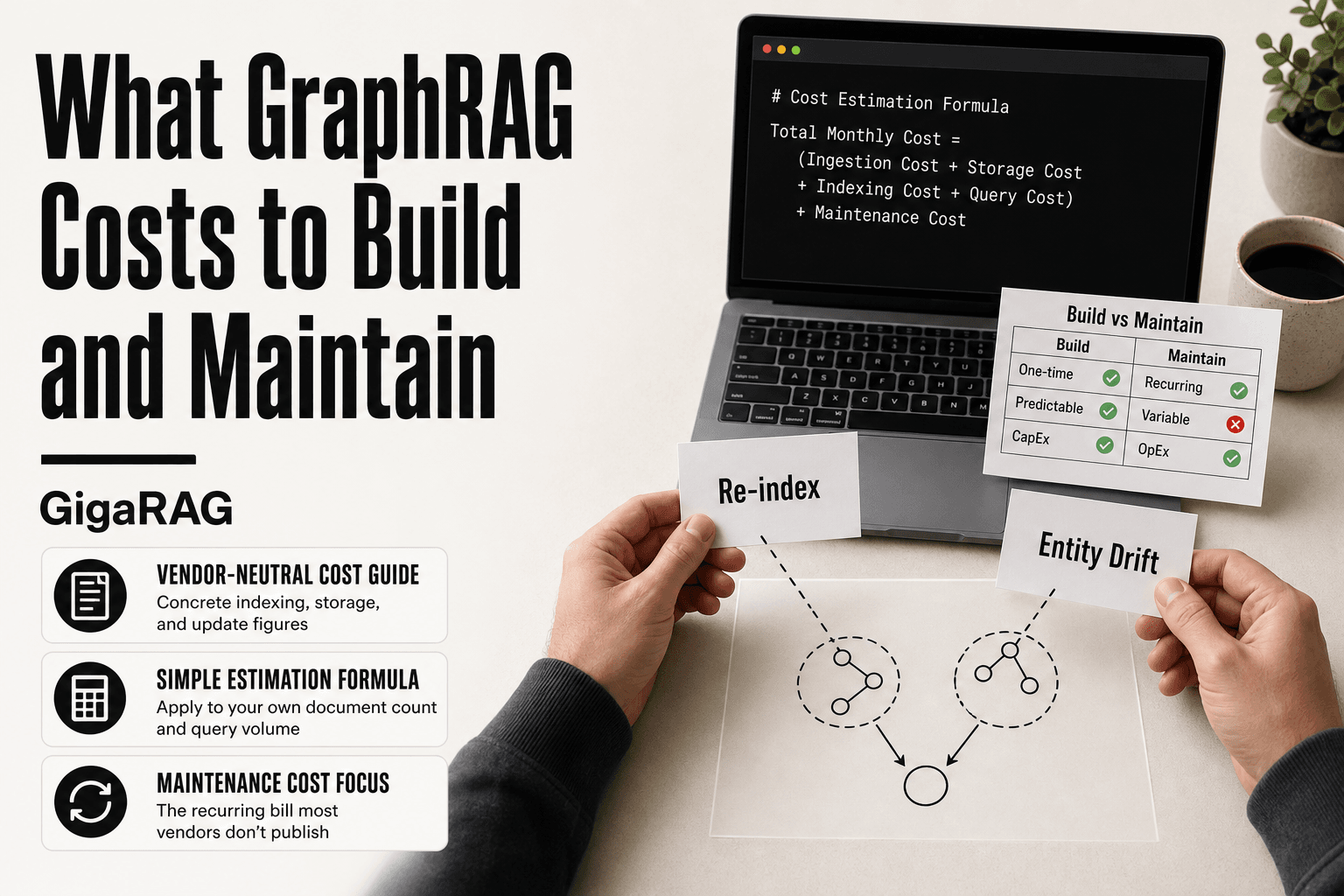
What GraphRAG Costs to Build and Maintain
What GraphRAG costs to build and maintain is a question most vendors won't answer with a straight number. If you're a developer or technical lead building agent memory or a RAG pipeline, you've probably found the same thing: blog posts quote an initial indexing bill, then go quiet. The honest answer is that the build cost is only the beginning. The maintenance bill is where budgets quietly die.
Most published cost discussions stop at extraction tokens and storage. They ignore re-indexing triggers, entity resolution drift, and graph growth that compounds with every agent interaction. GigaRAG exists to reduce that maintenance overhead, but this is a vendor-neutral cost guide first. You'll get concrete figures for indexing, storage, and ongoing updates, a simple estimation formula you can apply to your own document count and query volume, and an honest assessment of when GraphRAG is not worth the investment.
| At a glance | Details |
|---|---|
| Build cost range | Low thousands to tens of thousands USD |
| Maintenance cost | Often 30–50% of build annually |
| Storage growth | Graph data can double or triple vector-only |
| Re-indexing trigger | New documents, entity drift, schema changes |
| Best for | Multi-hop reasoning, connected data |
| Not for | Simple lookup, tight budgets, static data |
In This Guide
- GraphRAG vs Vector RAG: Where the Costs Diverge
- GraphRAG vs Vector RAG: Cost and Maintenance
- The Real Build Cost of GraphRAG: Indexing, Extraction, and Storage
- What Graphrag Costs To Build And Maintain: A Step-by-Step Guide
- Ongoing Maintenance Costs: The Bill Nobody Publishes
- GraphRAG for Agent Memory: A Different Cost Profile
- A Simple Cost Estimation Framework for GraphRAG
- What GraphRAG Cannot Do and When You Should Not Use It
- Choosing the Right GraphRAG Implementation for Your Budget
- Final Thoughts: Is GraphRAG Worth the Cost for You?
GraphRAG vs Vector RAG: Where the Costs Diverge
Vector RAG is cheap because it skips the hard part. You chunk documents, embed the chunks, and store vectors. Retrieval finds similar text. That's it. The build cost is mostly embedding tokens, which run a few dollars per million tokens on mainstream models. No entity extraction, no relationship mapping, no graph database.
The catch: vector RAG can't answer questions that require connecting facts across documents. Ask "which supplier shipped the part that failed in the Texas plant" and a vector search returns chunks mentioning suppliers, parts, failures, or Texas. It won't stitch them into an answer. You get fragments, not reasoning.
Vector RAG: cheap to build, limited on multi-hop
Vector RAG costs roughly $0.50 to $2 per 1,000 documents to embed, depending on chunk size and model. Storage is a few gigabytes for tens of thousands of documents. Queries cost one embedding call plus a similarity search, often under a cent. The whole system fits on a single server.
The limitation is structural. Multi-hop questions need explicit relationships, and vectors only capture semantic similarity. If your queries are single-hop ("what's the refund policy"), vector RAG is the right tool and GraphRAG is overkill.
GraphRAG: expensive to build, powerful on relationships
GraphRAG adds an extraction pass: an LLM reads each chunk, identifies entities, and maps relationships between them. That pass can cost 10 to 50 times more than embedding alone, because it processes every chunk through a larger prompt and often multiple times for validation. Storage grows too, since you're keeping nodes, edges, and metadata alongside vectors.
What you buy is relationship traversal. The same multi-hop question that stumps vector RAG becomes a graph query: find the supplier node, follow the shipped edge to the part, follow the failed edge to the plant. The answer emerges from structure, not similarity.
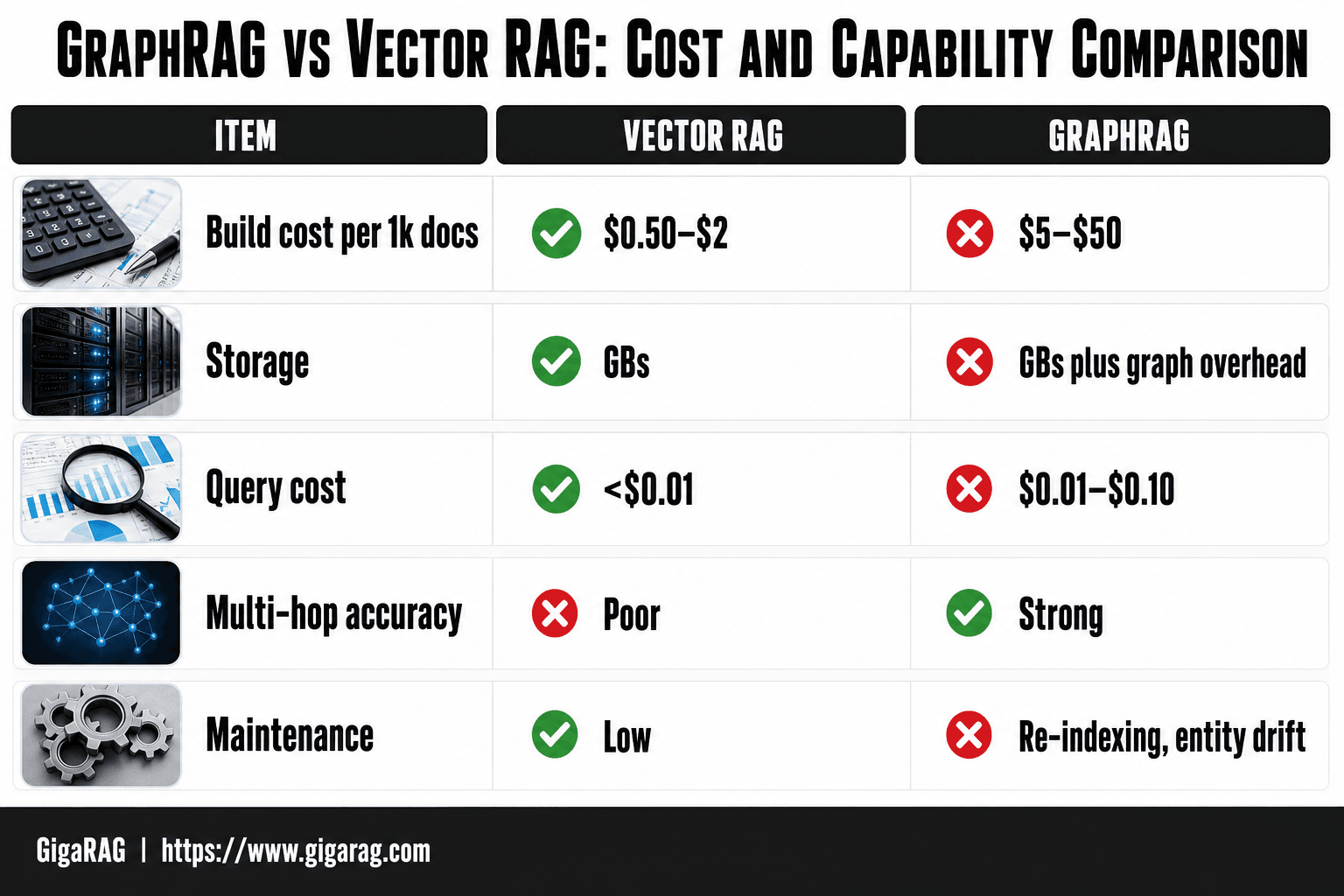
The cost delta in one table
| Vector RAG | GraphRAG | |
|---|---|---|
| Build cost per 1k docs | $0.50–$2 | $5–$50 |
| Storage | GBs | GBs plus graph overhead |
| Query cost | <$0.01 | $0.01–$0.10 |
| Multi-hop accuracy | Poor | Strong |
| Maintenance | Low | Re-indexing, entity drift |
The honest answer: GraphRAG costs 10 to 25 times more to build, and the maintenance bill is where it compounds. Whether that's worth it depends on your query mix.
[!note] GraphRAG costs vary widely based on document volume, entity density, and chosen LLM; always run a small pilot to calibrate your estimates.
GraphRAG vs Vector RAG: Cost and Maintenance
| Factor | GraphRAG | Vector RAG |
|---|---|---|
| Initial build cost | High: entity extraction, graph construction, pipeline setup | Low: embed and index documents |
| Ongoing maintenance | High: re-indexing, entity resolution, graph updates | Low: periodic re-embedding |
| Storage requirements | High: graph + vectors + metadata | Moderate: vectors + metadata |
| Query performance | Slower for simple lookups, better for multi-hop | Fast for similarity search |
| Ideal use case | Complex reasoning over connected entities | Straightforward Q&A over documents |
The Real Build Cost of GraphRAG: Indexing, Extraction, and Storage
The initial GraphRAG build typically costs $5 to $50 per 1,000 documents in LLM token fees, takes 90 to 130 minutes of indexing time for a few thousand documents, and adds graph storage overhead on top of your vector store.
Those numbers come from running the pipeline, not from a vendor's slide deck. The build has three cost centres: extraction tokens, indexing time, and graph storage. Each scales differently, and each has a hidden component.
LLM token costs for entity and relationship extraction
Extraction is the expensive pass. The LLM reads every chunk, identifies entities, and maps relationships between them. A single chunk can trigger 500 to 2,000 output tokens depending on entity density. Run that across 1,000 documents and you're looking at $5 to $50, with the range driven by model choice and whether you validate extractions with a second pass.
The hidden cost: failed extractions. When the LLM misidentifies an entity or misses a relationship, you either accept the error or re-run the chunk. Re-runs multiply your token bill on the messiest 10 to 20 percent of your corpus.
Indexing time: what 5,500–7,700 seconds means in practice
Microsoft's reference implementation took 5,500 to 7,700 seconds to index a small corpus. That's 90 to 130 minutes of wall-clock time. It's not a dealbreaker for a one-time build, but it changes your iteration loop. Every schema tweak, every prompt adjustment, every extraction quality fix means re-running the full index.
You won't iterate quickly. Budget for that.
Graph storage: nodes, edges, and the hidden metadata tax
The graph itself is small compared to your vector store. Nodes and edges for a few thousand documents fit in hundreds of megabytes. The tax is metadata: entity descriptions, relationship attributes, source citations, and provenance links. That metadata can double or triple your graph storage.
Keep in mind that graph databases also need indexes for traversal speed. Those indexes add another 20 to 40 percent on top of raw graph size.
[!tip] For agent memory systems, start with a hybrid approach: use vector RAG for simple retrieval and add GraphRAG only for queries that require multi-hop reasoning, to control costs.
What Graphrag Costs To Build And Maintain: A Step-by-Step Guide
- Count your documents and estimate average entities per document.
- Choose an LLM for entity extraction and estimate token cost per document.
- Calculate graph construction cost: documents × tokens × LLM price.
- Estimate storage: graph size (entities + relationships) plus vector index size.
- Determine update frequency and estimate re-indexing cost per update cycle.
- Add maintenance overhead: 30–50% of build cost annually for entity resolution and drift.
- Sum build + (annual maintenance × years) for total cost of ownership.
Ongoing Maintenance Costs: The Bill Nobody Publishes
The build cost is a one-time hit. Maintenance is the recurring bill that decides whether GraphRAG stays affordable or quietly drains your budget. Most published cost discussions stop at indexing. That's the mistake.
What triggers a re-index and what it costs
New documents, changed documents, or deleted documents all trigger re-indexing. The cost isn't the full build price. You re-run extraction only on the affected chunks, then merge the new entities and relationships into the existing graph. A 10 percent corpus update costs roughly 10 percent of your initial extraction bill, plus merge overhead.
The merge is where it gets expensive. New entities must be resolved against existing ones. That's an LLM call per candidate match. If your update touches 100 entities and each resolution costs $0.01 to $0.05, you're paying $1 to $5 per update cycle. Run that weekly and it adds up.
Entity resolution drift: the silent cost multiplier
Entity resolution drift happens when the same real-world thing gets stored as two different nodes. "Acme Corp" and "Acme Corporation" both exist in your graph. Queries miss connections. Answers degrade.
Fixing drift means running resolution passes over your entity set. Each pass is an LLM call comparing candidate pairs. The cost scales with the square of your entity count, not linearly. A graph with 10,000 entities has millions of candidate pairs. You won't check them all. You'll sample, and drift will persist.
Schema changes and extraction quality fixes
Every schema change forces a re-index. Add a relationship type, change an entity definition, adjust the extraction prompt. The full corpus runs through extraction again. That's your build cost, repeated.
Extraction quality fixes are worse. You notice the LLM keeps misclassifying a certain entity type. You adjust the prompt. You re-run extraction on every chunk that contains that entity type. You can't target it precisely, so you re-run more than you need.
Storage growth: how fast graphs expand
Graphs grow faster than document counts. Each new document adds entities, relationships, and metadata. But it also adds duplicate entities that need resolution later. A 10 percent document increase can grow your graph by 15 to 25 percent before cleanup.
The metadata tax compounds. Entity descriptions, relationship attributes, and provenance links accumulate. Your graph database indexes grow with them. Storage costs double every 12 to 18 months on a corpus that grows 10 percent monthly. Budget for that trajectory, not the initial size.
GraphRAG for Agent Memory: A Different Cost Profile
Agent memory flips the GraphRAG cost equation on its head. A document corpus is mostly static: you index once, update occasionally, and query often. An agent's memory is the opposite. Every interaction adds nodes. Every session changes relationships. The graph never stops growing, and the extraction bill never stops arriving.
How agent interactions grow the graph
Each agent turn can add entities: a user mentions a project, a preference, a deadline. The agent stores these as nodes with relationships to existing memory. A single conversation might add 10 to 50 new entities. Run 100 conversations a day and you're adding thousands of nodes daily.
The growth isn't linear. Agents connect new information to old information. Each new node can create multiple edges. A graph that starts at 10,000 entities can double in weeks, not months. Storage costs follow the same curve described earlier, but compressed into a much shorter window.
Memory consolidation: recurring extraction costs
Document-based GraphRAG extracts entities once per chunk. Agent memory extracts continuously. Every conversation turn is a potential extraction event. You're paying LLM token costs not just at indexing time, but on every interaction.
Consolidation adds another layer. Agents accumulate raw observations, then periodically merge them into stable memories. That merge is entity resolution at scale. Duplicate entities appear constantly: the user says "my boss" in one conversation and "Sarah Chen" in another. Resolving those requires LLM calls, and the frequency is tied to interaction volume, not document updates.
Latency implications for real-time agents
Retrieval latency becomes a budget line item. A document RAG pipeline can tolerate 2 to 3 seconds of graph traversal. An agent responding in a conversation cannot. Every hop through the graph adds milliseconds. Multi-hop queries that work fine in batch processing stall a real-time agent.
The fix is caching and pre-computed paths, which adds infrastructure cost. Or you accept slower responses, which degrades the agent's usefulness. Either way, agent memory makes latency a cost you measure per query, not per batch.
A Simple Cost Estimation Framework for GraphRAG
You don't need a spreadsheet to get a rough TCO. You need three numbers: document count, update frequency, and query volume. The formula below gets you within a reasonable planning range.
The formula: documents × extraction cost + updates × re-index cost
Total cost = (documents × per-document extraction cost) + (updates per month × per-update re-index cost) + (queries per month × per-query retrieval cost).
Extraction cost is your dominant variable. A 1,000-token chunk costs roughly $0.01 to $0.05 in LLM calls for entity and relationship extraction, depending on model choice. Re-indexing a single document costs about the same as the initial extraction. Retrieval is cheap by comparison: fractions of a cent per query.
Worked example with realistic numbers
Say you have 5,000 documents. Extraction at $0.03 per document runs $150 upfront. You update 10% of your corpus monthly, so 500 documents re-indexed at $0.03 each adds $15 per month. At 10,000 queries monthly, retrieval adds maybe $5. Your first-year TCO lands around $390.
That's the optimistic case. Add entity resolution failures, schema changes, and graph growth, and the maintenance line item can triple.
Where to plug in your own variables
Swap in your actual document count and update rate. If your documents average 2,000 tokens, double the extraction cost. If you update daily rather than monthly, multiply the re-index line by 30. The formula is deliberately simple. It won't catch every cost, but it will tell you whether GraphRAG is a rounding error or a budget line before you commit.
What GraphRAG Cannot Do and When You Should Not Use It
GraphRAG fails in predictable ways. The failures aren't edge cases; they're structural. If your data doesn't have clean, stable entities, the graph becomes noise you pay to maintain.
When entity resolution fails and costs spiral
Entity resolution is the step where the system decides whether "Acme Corp," "Acme Corporation," and "ACME" are the same thing. When it gets this wrong, you get duplicate nodes, split relationships, and queries that return partial answers. The cost isn't just bad results. Every duplicate node adds extraction tokens, storage, and retrieval time. Fixing resolution errors means re-indexing, which means paying for the same documents twice. If your source text uses inconsistent naming, expect resolution failures on 10-20% of entities. That's not a bug; it's the current state of LLM-based extraction.
Graph explosion: when your graph becomes a liability
Graph explosion happens when entities connect to too many other entities. A node for "United States" linked to every document that mentions it creates a hub with thousands of edges. Queries that touch that hub slow down. Storage grows faster than your document count. You end up paying for a structure that makes retrieval worse, not better. The fix is pruning and filtering rules, which is more engineering time on top of the build cost.
Low-relationship datasets: paying for structure you don't need
If your documents are mostly standalone, like product specs or individual support tickets, there's little relationship to extract. You pay full extraction costs to build a graph that's basically a list. Vector RAG handles this case for a fraction of the price. The honest answer: if your queries don't require multi-hop reasoning across entities, skip GraphRAG entirely.
Choosing the Right GraphRAG Implementation for Your Budget
Your implementation choice changes the cost profile more than any other decision. The same document set can cost three times more on one stack than another.
Microsoft GraphRAG: powerful but token-hungry
Microsoft's GraphRAG is the reference implementation. It does entity extraction, community detection, and summarization in one pipeline. The catch: it runs everything through an LLM, so token costs scale directly with document size. You pay for extraction, then pay again for community summaries. For a 5,000-document corpus, expect indexing costs in the hundreds of dollars range, not tens. You also need Azure OpenAI or an OpenAI API key, which locks you into per-token pricing with no ceiling.
Open-source options: lower cost, higher effort
Open-source alternatives like LightRAG and nano-graphrag strip out the community detection layer. That cuts extraction tokens by 30-50%. You can run them against local models like Llama 3, which drops per-token costs to near zero if you have the GPU. The trade-off is engineering time. You handle schema design, entity resolution tuning, and re-indexing triggers yourself. Budget 20-40 hours of setup and ongoing maintenance per month for a production system.
Managed services: predictable pricing, less control
Managed GraphRAG services bundle indexing, storage, and retrieval into a monthly fee. Pricing typically runs $500-$2,000 per month for small to mid-size corpora. You get predictable costs and zero infrastructure work. You give up control over the extraction prompt, the graph schema, and when re-indexing happens. If your data changes frequently, you pay for re-indexing on their schedule, not yours.
The honest answer: if you have engineering capacity and predictable data, open source wins on cost. If you need it running tomorrow, managed services earn their fee. Microsoft GraphRAG sits in the middle: powerful defaults, but the token bill follows you every time the graph updates.
Final Thoughts: Is GraphRAG Worth the Cost for You?
The honest answer: it depends on your query patterns and update frequency. If your users ask multi-hop questions across documents, GraphRAG earns its overhead. If they ask simple lookups, vector RAG does the job for a fraction of the price.
The decision comes down to one number: how often your data changes. Weekly updates make maintenance costs a permanent line item. Static corpora amortize the build cost over months.
If you decide GraphRAG is worth it, the maintenance overhead is where budgets die. GigaRAG automates re-indexing and entity resolution so you're not paying an engineer to babysit the graph. But that's only relevant once you've confirmed the architecture fits. What GraphRAG costs to build and maintain is a question you can now answer with your own numbers.
Frequently Asked Questions
What is the typical cost to build a GraphRAG system?
Build costs range from a few thousand dollars for small-scale prototypes to tens of thousands for production systems, driven primarily by LLM token costs for entity extraction and engineering time.
How much does GraphRAG maintenance cost annually?
Ongoing maintenance often runs 30–50% of the initial build cost per year, covering re-indexing, entity resolution, and storage growth.
When should I not use GraphRAG?
Avoid GraphRAG if your queries are simple lookups, your data is static, or your budget is tight. Vector RAG is more cost-effective for those cases.
What triggers re-indexing in GraphRAG?
Re-indexing is triggered by new document ingestion, entity drift (new entities or changed relationships), and schema updates. Each trigger adds cost.
How does GraphRAG storage cost compare to vector RAG?
GraphRAG typically requires more storage because it maintains both a graph structure and vector embeddings, plus metadata. Expect 2–3x the storage of vector-only RAG.
Can I reduce GraphRAG costs?
Yes, by using cheaper LLMs for extraction, batching updates, and pruning low-value entities. However, these may impact accuracy.
Is GraphRAG worth the cost for agent memory?
It can be if your agent needs to reason over connected entities and relationships. For simple memory recall, vector RAG is usually sufficient and cheaper.
About GigaRAG
GigaRAG is for agent memory and RAG pipeline builders. get this right. Whether you are working through what graphrag costs to build and maintain or something adjacent, we publish what we have actually tested, including where it falls short.


