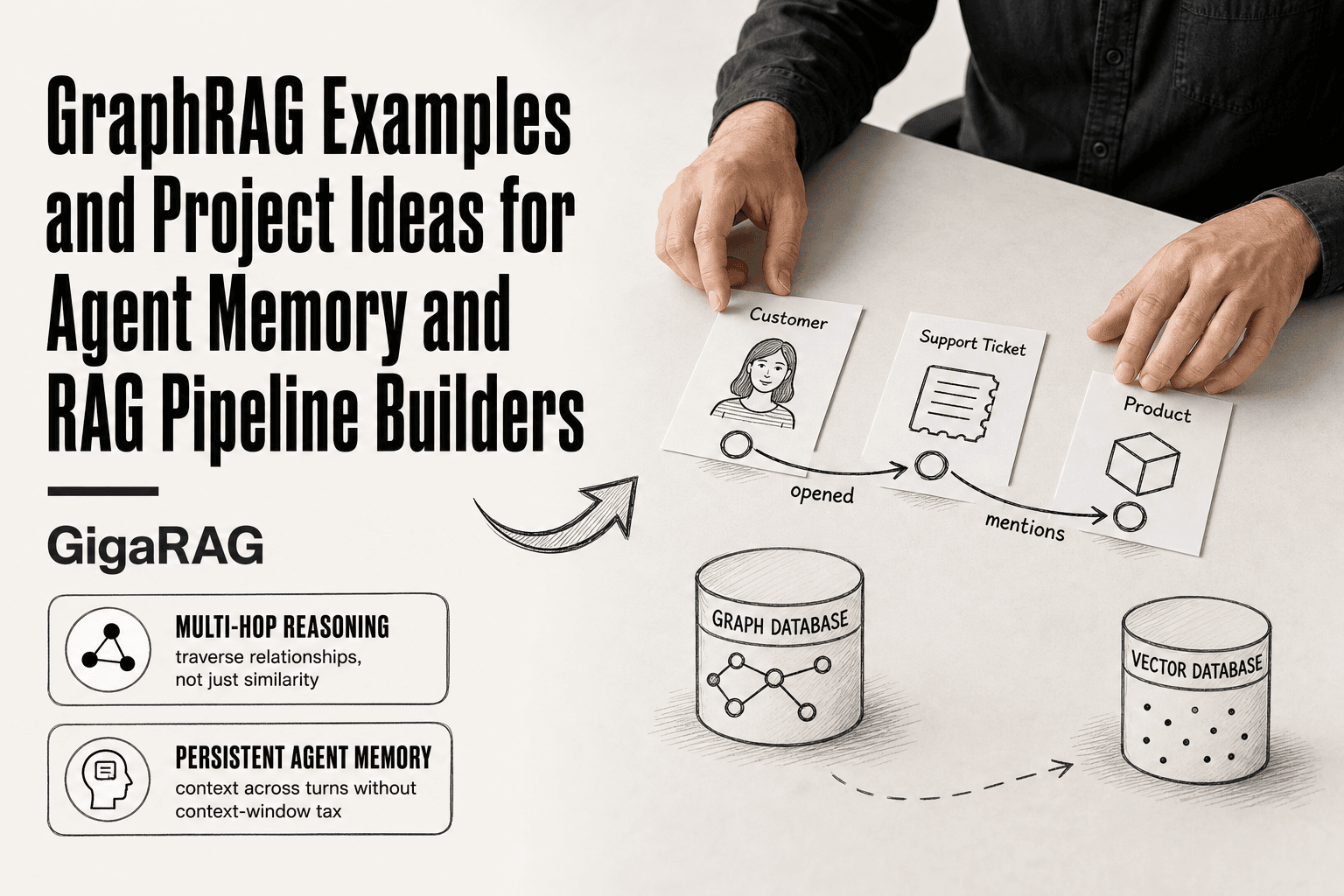
GraphRAG Examples and Project Ideas for Agent Memory and RAG Pipeline Builders
GraphRAG examples and project ideas matter most to you if you're building agent memory or RAG pipelines and you've already hit the ceiling of vector-only retrieval. Vector search is great at similarity. It's weak at relationships, multi-hop reasoning, and keeping persistent context across turns. You've probably felt that. You ask a question that requires connecting three facts, and the vector database returns three fragments with no thread between them.
GraphRAG changes the retrieval layer: entities become nodes, relationships become edges, and traversal replaces pure similarity scoring. Every top result says that. None of them tell you what to actually build. That's the gap this guide fills.
GigaRAG is one tool built for exactly this audience, but this isn't a pitch. It's a practical walkthrough. You'll get three concrete GraphRAG project ideas with difficulty levels and outcomes, a plain section on what GraphRAG won't solve, and an FAQ that answers the questions the top results skip.
| At a glance | Details |
|---|---|
| What it is | GraphRAG combines knowledge graphs with retrieval-augmented generation |
| Core benefit | Handles multi-hop and relationship-heavy queries better than vector RAG |
| Typical stack | LLM + graph database (e.g., Neo4j) + vector store |
| Best for | Agent memory, complex reasoning, connected data |
| Not ideal for | Simple lookup queries or small, static datasets |
| Effort level | Moderate to high; requires graph modeling and LLM integration |
In This Guide
- What Is GraphRAG? A Quick Definition for RAG Builders
- GraphRAG vs Vector RAG: Which Should You Build?
- Why GraphRAG Matters for Agent Memory and RAG Pipelines
- Graphrag Examples And Project Ideas: A Step-by-Step Guide
- 5 Things a Graph Needs Before You Build GraphRAG
- GraphRAG Examples: 3 Project Ideas You Can Build This Week
- GraphRAG Frameworks Compared: Python, Neo4j, LangChain, and GigaRAG
- Common Use Cases for Neo4j in GraphRAG Projects
- GraphRAG Limitations: What Not to Expect
- How to Choose the Right GraphRAG Project for Your Skill Level
- Final Thoughts on GraphRAG Examples and Project Ideas
What Is GraphRAG? A Quick Definition for RAG Builders
GraphRAG is retrieval augmented generation that uses a knowledge graph, not just vector embeddings, to find the context your LLM needs. It stores entities as nodes and their relationships as edges, then traverses those connections to answer questions that span multiple facts.
You already know vector RAG. You chunk documents, embed them, and pull the nearest neighbours for a query. That works until a question needs two facts that live in different chunks with no lexical overlap. GraphRAG fixes that by making the relationships explicit.
How GraphRAG differs from vector-only RAG
Vector search measures similarity. It finds text that looks like your query. It does not know that Alice works for Acme, Acme acquired Beta, and Beta owns a patent. Those are three separate chunks. A vector index might return all three, but only if the query mentions enough overlapping terms.
GraphRAG stores those as nodes and edges: Alice, Acme, Beta, and the patent are entities. "works for", "acquired", and "owns" are relationships. When you ask "who owns the patent from the company that acquired Acme?", the graph traversal follows the edges in order. It does not guess based on similarity. It walks the path.
The main catch is that building the graph takes work. You need entity extraction, relationship extraction, and a graph store. Vector RAG needs none of that.
The core idea: entities, relationships, and graph traversal
Here's what happens behind the scenes. First, you extract entities from your source text: people, companies, products, dates, places. Then you extract the relationships between them: who did what, what belongs to whom, what happened before what. You store these in a property graph, where nodes and edges can carry attributes.
At query time, you either traverse the graph directly or use a hybrid approach: vector search to find entry points, then graph traversal to expand outward. The traversal is what enables multi-hop reasoning. You start at one node, follow an edge, land on another node, follow another edge. Each hop is a fact you can verify because the edge exists in your data.
That's the shared vocabulary. The rest of this article assumes you understand nodes, edges, and traversal in this sense.
[!note] GraphRAG is not a replacement for vector RAG; it complements it. Many production systems use a hybrid approach, routing queries to the appropriate retrieval method.
GraphRAG vs Vector RAG: Which Should You Build?
| Factor | GraphRAG | Vector RAG |
|---|---|---|
| Data structure | Entities and relationships in a graph | Embeddings in a vector space |
| Query type | Multi-hop, relationship-heavy | Semantic similarity, single-hop |
| Setup complexity | Higher: needs graph schema and extraction | Lower: embed and index |
| Explainability | High: paths and subgraphs are traceable | Low: similarity scores are opaque |
| Best use case | Agent memory, knowledge graphs | Document Q&A, search |
Why GraphRAG Matters for Agent Memory and RAG Pipelines
Vector RAG hits a wall the moment your queries stop being about similarity and start being about connection. You can embed every document in your corpus, but embeddings don't know that a support ticket about a billing error is related to a product change shipped three weeks earlier. They just know the words look sort of alike.
The vector RAG ceiling: where similarity search fails
Similarity search assumes the answer lives near the question in embedding space. That holds for lookup-style queries: "what's our refund policy?" It breaks for anything that requires stitching facts across documents. A customer asks why their invoice doubled. The answer sits in three places: their account record, a pricing change announcement, and a support ticket from another customer who reported the same issue. Vector search might return all three chunks, but only if the query terms overlap enough. More often, it returns the pricing announcement and misses the account record entirely.
The honest answer is that vector RAG is a retrieval shortcut. It works when one chunk contains the answer. It fails when the answer is a path.
How graphs enable multi-hop reasoning
Graphs store the path explicitly. You don't hope the retriever finds the right chunks. You traverse the edges that already exist in your data. Ask "which customers were affected by the pricing change in March?" and the graph follows: pricing change node, to affected accounts, to support tickets, to resolution status. Each hop is a fact you can verify because the edge is stored, not inferred.
That's the mechanism. Vector search ranks by proximity. Graph traversal walks by relationship. For multi-hop questions, the second one wins because it doesn't need to guess which chunks connect. It already knows.
Agent memory as a graph: persistent context across turns
Agents have a memory problem. They process one turn, then forget everything unless you stuff the conversation history back into the context window. That works for short sessions. It degrades fast when an agent needs to remember a user's preferences, past decisions, and the entities they've mentioned across fifty turns.
A graph gives you persistent context without the context window tax. Store each user, preference, and action as a node. Store the relationships between them as edges. When the agent needs to recall "what did this user say about their budget last month?", it queries the graph instead of replaying the entire history. The context window stays small. The memory stays intact.
That's the gap none of the top results address. They explain what GraphRAG is. None of them show you why it matters for the systems you're actually building.
[!tip] Start with a small, well-defined domain to avoid graph explosion. Use an LLM to generate the initial schema and extraction prompts, then manually review a sample to ensure quality before scaling.
Graphrag Examples And Project Ideas: A Step-by-Step Guide
- Define the scope: choose a domain (e.g., personal assistant, research) and list the entity types and relationships your agent needs to remember.
- Set up a graph database: install Neo4j (or another graph DB) and create a schema for nodes (entities) and edges (relationships).
- Extract entities and relationships: use an LLM to parse text and output structured triples (subject, predicate, object).
- Ingest into the graph: load the triples into the database, ensuring deduplication and consistency.
- Integrate with your RAG pipeline: when a query arrives, use the graph to retrieve relevant subgraphs and feed them to the LLM.
- Add vector search for hybrid retrieval: store embeddings of nodes/edges to enable semantic search over the graph.
- Test and iterate: evaluate on multi-hop questions and refine extraction prompts and graph schema.
5 Things a Graph Needs Before You Build GraphRAG
A graph is not a diagram. It's a data structure, and it needs five specific pieces before any traversal or GraphRAG query will work. Skip one and you don't have a graph. You have a list with extra steps.
Nodes (entities)
Nodes are the things in your graph: users, tickets, products, documents. Each node represents one distinct entity. If two records refer to the same real-world thing, they must be the same node. Duplicate nodes are the most common source of noisy traversal results.
Edges (relationships)
Edges connect nodes and carry meaning. A directed edge from "customer" to "ticket" with the label "opened" tells you who did what. Without edges, you have a collection of isolated facts. The edges are where the multi-hop reasoning lives.
Properties (attributes on nodes and edges)
Properties hold the actual data: a user's name, a ticket's status, the timestamp on an edge. Nodes and edges without properties are just shapes. You need values to filter, rank, and return useful results.
Labels or types
Labels group nodes and edges into categories: Person, Ticket, Product, "opened", "resolved_by". Types let you write queries that target all tickets instead of one specific ticket. They also keep your graph schema honest.
A query or traversal mechanism
You need a way to walk the graph: Cypher in Neo4j, Gremlin in TinkerPop, or a library like NetworkX in Python. The query language is what turns stored structure into answers. Without it, the graph is a database you can't ask questions of.
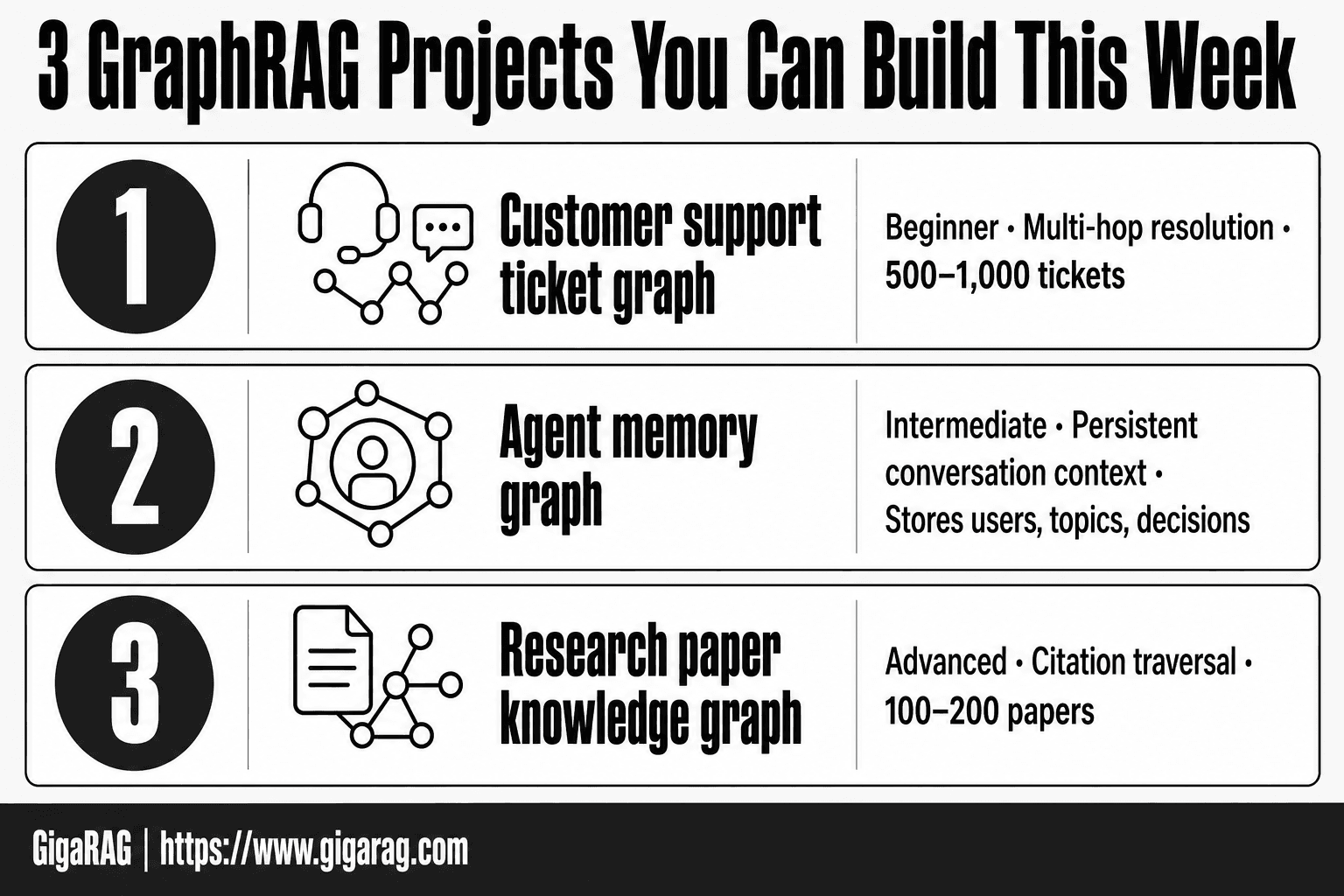
GraphRAG Examples: 3 Project Ideas You Can Build This Week
You have the graph fundamentals. Now you need something to build. These three projects start small and get progressively harder, but each one produces a working system you can demo by the end of the week.
Project 1: Customer support ticket graph for multi-hop resolution (Beginner)
Start with a dataset you probably already have: support tickets. Export 500 to 1,000 tickets from your helpdesk, then build a graph where each ticket is a node, each customer is a node, and each product or feature is a node. Edges connect customers to tickets ("opened"), tickets to products ("mentions"), and tickets to other tickets ("duplicates" or "related_to").
The extraction step is simple enough to do by hand or with a basic LLM call. For each ticket, pull out the customer ID, the product mentioned, and any ticket IDs referenced in the body. That's it. No community detection, no fancy embeddings.
The payoff comes when you query it. "Which customers reported the same product bug across multiple tickets?" becomes a two-hop traversal: customer to ticket, ticket to product, then filter for products with more than one ticket from the same customer. Vector search can't answer that without you already knowing which tickets to compare.
Keep the scope tight. Five hundred tickets is enough to show the pattern. Ten thousand is a data-cleaning project, not a GraphRAG project.
Project 2: Agent memory graph for persistent conversation context (Intermediate)
This one targets the reader who's already built a vector RAG agent and watched it forget everything between sessions. The fix is a graph that stores what the agent learns about each user across conversations.
Nodes are users, topics, entities the user mentioned, and past decisions. Edges carry the relationship: "user_prefers", "worked_on", "rejected", "asked_about". When the agent starts a new session, it queries the graph for everything connected to that user within one or two hops, then injects that context into the system prompt.
The hard part is extraction. You need the agent to write to the graph after each turn, not just read from it. That means a separate extraction step that decides what's worth storing. A user's name is worth storing. A passing comment about the weather is not. You'll need a small schema and a rule for what gets written.
In practice, this cuts down repeated questions dramatically. The agent stops asking "which project are we working on?" every session because the answer is already in the graph, connected to the user node.
Project 3: Research paper knowledge graph with citation traversal (Advanced)
Take a corpus of 100 to 200 research papers in one narrow field. Build a graph where papers are nodes, authors are nodes, and citations are directed edges from citing paper to cited paper. Add edges for shared authors and shared keywords.
The extraction is the challenge. You need to pull citation data from each paper's reference list, which means parsing PDFs or using an API like Semantic Scholar. Expect noise. Citation strings are messy, and author name disambiguation is a known hard problem.
The payoff is traversal-based discovery. "Show me the papers that cite this foundational paper and were published after 2022" is a simple graph query. "Show me the chain of citations connecting paper A to paper B" is a shortest-path traversal that vector search cannot do at all.
This project will take longer than a week if you're parsing PDFs from scratch. Use an existing citation dataset or API for your first pass, then add your own extraction only where the data is missing.
GraphRAG Frameworks Compared: Python, Neo4j, LangChain, and GigaRAG
You've seen the project ideas. Now you need a stack. The honest answer is that no single framework covers everything, and most teams end up combining two or three tools. Here's the lay of the land.
Microsoft GraphRAG vs. LlamaIndex vs. LangChain
Microsoft GraphRAG does the heavy lifting on graph construction. It runs entity and relationship extraction over your documents, builds a community hierarchy, and generates summaries at each level. The tradeoff is cost: the indexing step makes many LLM calls, and you'll feel that on large corpora. It's best when you need global, dataset-level questions answered, not just local retrieval.
LlamaIndex takes a different route. It gives you property graph indexes and query engines you can wire into an existing RAG pipeline without rebuilding everything. You control the extraction prompts and the schema. That control costs you time, but it means you can tune for your domain instead of accepting a generic graph.
LangChain is not a GraphRAG framework at all. It's a glue layer. You can use it to connect a graph database to an LLM, but you're writing the extraction, the traversal, and the prompt logic yourself. Use it when you already have LangChain in production and want to add graph retrieval incrementally.
Neo4j as the graph database layer
Neo4j is the default choice for storing the graph once you've built it. Cypher, its query language, is readable enough that a traversal like "find all tickets connected to this customer within two hops" reads almost like English. It handles property graphs natively, which means your nodes and edges can carry attributes without a separate lookup table.
The main catch is operational. Running Neo4j means another service to deploy, monitor, and back up. For a weekend project, that's overhead you don't need. For production agent memory, it's worth it.
Where GigaRAG fits for agent memory and RAG pipelines
GigaRAG targets the specific case this article opened with: agent memory that persists across sessions. It handles graph construction and retrieval behind one API, so you're not stitching together extraction prompts and a graph database yourself. That's the pitch, and it's a narrow one. If you need fine-grained control over your schema or you're building a research tool with custom traversal logic, you'll want the lower-level frameworks instead.
Common Use Cases for Neo4j in GraphRAG Projects
Neo4j shows up in three GraphRAG patterns more than any others. Each one maps to a project you can actually build, not a vendor slide deck.
Fraud detection and risk analysis
Fraud lives in relationships. A single transaction looks fine. The pattern of a shared device, a shared address, and a shared bank account across five transactions does not. Neo4j stores those connections as edges, and Cypher traverses them in milliseconds.
The GraphRAG angle: you extract entities from transaction records and customer communications, link them into the graph, then let the LLM reason over the subgraph. The model sees the connected accounts, not just the one flagged transaction. Banks have run this pattern for years. You can run a smaller version on any dataset where bad actors hide in plain sight.
Recommendation engines
Recommendation systems are graph problems wearing a vector costume. A user liked item A. Other users who liked A also liked B. That's a two-hop traversal. Neo4j does it natively.
GraphRAG adds a layer here: instead of returning item IDs, the pipeline retrieves the connected items and their shared attributes, then asks the LLM to explain why the recommendation makes sense. That explanation is the part vector-only systems can't produce. The graph gives you the path. The LLM gives you the sentence.
Knowledge management and semantic search
This is the use case most RAG builders start with. You have documents, policies, or research notes. You extract entities and relationships, store them in Neo4j, and query the graph alongside your vector index.
The win is multi-hop questions. "Which policy covers contractors who work with healthcare data?" is not one document. It's three nodes: contractor, healthcare data, and the policy that links them. Neo4j finds the path. Vector search returns three documents and hopes you can piece it together.
Keep in mind: all three use cases assume your graph is built well. A sparse or noisy graph makes every one of them fail.
GraphRAG Limitations: What Not to Expect
GraphRAG solves a real problem, but it is not a replacement for vector RAG. It's an addition. The honest answer is that most RAG pipelines should keep their vector index and add a graph layer only where relationships actually matter.
When vector-only RAG is still the better choice
If your queries are single-hop and similarity-driven, stick with vectors. "Find documents about Kubernetes pod security" needs no graph. A vector index returns that in milliseconds with far less setup. GraphRAG adds extraction, entity resolution, and graph maintenance on top of retrieval. That overhead buys you nothing when the answer lives in one document.
The same goes for small corpora. Under a few hundred documents, you can often fit everything in context or retrieve it with a simple keyword search. Building a graph for that is ceremony, not engineering.
Graph construction overhead and maintenance cost
The main catch: someone has to build and maintain the graph. Entity extraction runs on every document you ingest. Relationships need validation. Your graph drifts as source data changes. A document update means re-extracting entities, re-linking relationships, and cleaning up orphaned nodes.
That is not a one-time cost. It's a pipeline you run forever. If your data changes daily, your graph maintenance runs daily. Budget for it.
Failure modes: sparse graphs, noisy extraction, and traversal explosion
Sparse graphs fail silently. If extraction misses key entities or relationships, your traversal returns nothing. The LLM then answers from an empty subgraph and sounds confident anyway. That's worse than no graph at all.
Noisy extraction is the opposite problem. The extractor links everything to everything. Your traversal explodes, latency climbs, and the LLM drowns in irrelevant nodes. You need thresholds, filters, and human review. None of that is free.
Traversal explosion is the worst case. A two-hop query on a dense graph can touch thousands of nodes. Without limits on hop count and edge weight, your "fast" graph query becomes slower than vector search.
How to Choose the Right GraphRAG Project for Your Skill Level
The right project is the one you can finish. Pick based on what you already run in production, not what you want to learn someday.
Beginner: start with a small, well-defined graph
Take one bounded dataset: support tickets, product docs, or a single codebase. Extract entities and relationships, load them into Neo4j, and write three traversal queries. You'll learn extraction quality and graph maintenance without drowning in scale.
Intermediate: add agent memory to an existing RAG pipeline
You already have vector retrieval working. Add a graph layer that stores entities and relationships from past conversations. Point your agent at it for follow-up questions that span turns. The graph doesn't replace your vector index. It sits beside it.
Advanced: build a multi-hop research assistant
This is Project 3 from earlier: citation traversal across papers, with hop limits and edge weights to prevent traversal explosion. Only attempt this after you've run a smaller graph in production for a month. The failure modes compound at this scale.
Start one level below where you think you are. The beginner project teaches you what breaks before it costs you a week.
Final Thoughts on GraphRAG Examples and Project Ideas
The pattern across every project idea is the same: start small, define your entities and relationships by hand, and only add complexity when a query actually needs it. GraphRAG earns its overhead on multi-hop questions and persistent agent context. It doesn't earn it on similarity search.
The honest limitation bears repeating: graph construction is real work, and a sparse or noisy graph will underperform a plain vector index. If your queries are single-hop or keyword-driven, stay with vector RAG.
For agent memory and RAG pipeline builders who need relationship-aware retrieval without building extraction pipelines from scratch, GigaRAG handles the graph layer for you. That's the soft sell. The hard advice is to pick one graphrag example from this list, build it this week, and measure whether traversal actually improves your answers before you commit further.
Frequently Asked Questions
What are some good topics in graph theory for a project?
For GraphRAG, focus on knowledge graph construction, entity resolution, and multi-hop reasoning. Projects like building a personal knowledge graph from notes or a domain-specific graph (e.g., biomedical) are practical and impactful.
What are some simple graph ideas?
Start with a small graph of people and relationships (e.g., a family tree) or a product recommendation graph. These are easy to model and let you test GraphRAG queries without complex extraction.
What are 5 things a graph needs?
A graph needs nodes (entities), edges (relationships), properties (attributes), a schema (optional but helpful), and a query language (e.g., Cypher). For GraphRAG, you also need a way to map text to these elements.
What are some common use cases for Neo4j?
Neo4j is commonly used for knowledge graphs, recommendation engines, fraud detection, network analysis, and identity management. In GraphRAG, it serves as the graph store for agent memory and retrieval.
How does GraphRAG improve on vector RAG?
GraphRAG captures explicit relationships between entities, enabling multi-hop reasoning and more accurate answers for queries that require connecting disparate pieces of information. Vector RAG struggles with such queries because it relies on semantic similarity alone.
What are the limitations of GraphRAG?
GraphRAG requires significant upfront effort to build and maintain the graph. It may not be cost-effective for simple queries or small datasets. Extraction errors can propagate, and scaling to large, dynamic graphs is challenging.
Can I use GraphRAG with existing vector databases?
Yes, many implementations combine graph databases with vector stores. You can store embeddings in a vector DB and use the graph for relationship traversal, creating a hybrid retrieval system.
About GigaRAG
GigaRAG is for agent memory and RAG pipeline builders. get this right. Whether you are working through graphrag examples and project ideas or something adjacent, we publish what we have actually tested, including where it falls short.


