Hybrid Graph Plus Vector Retrieval in Production: What Actually Works
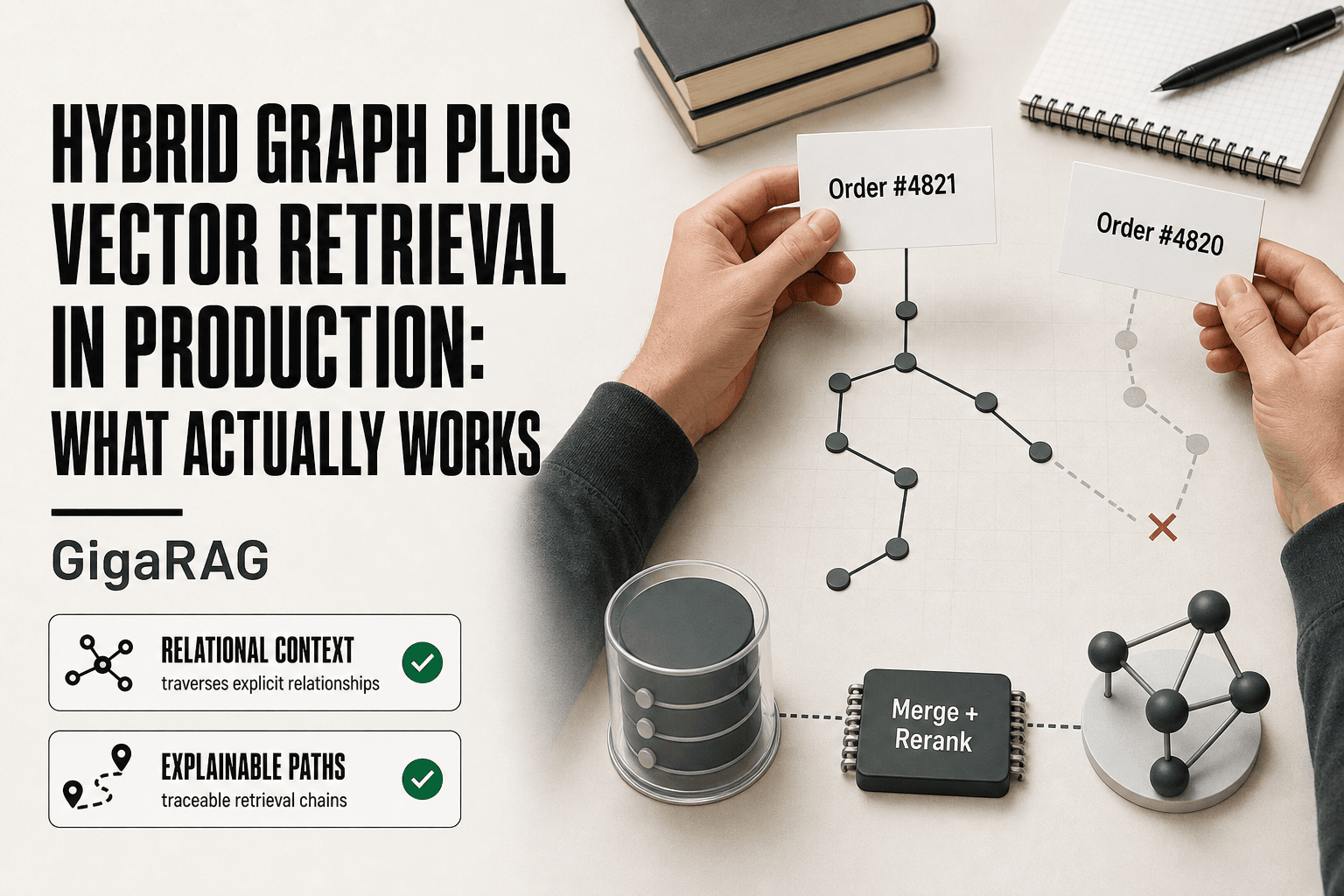
Hybrid graph plus vector retrieval in production fails quietly, and the failure looks like this: your agent pulls context that is semantically close but relationally wrong. A customer asks about a refund on order #4821, and the vector search returns a support ticket about a refund on order #4820 because the two tickets share the same words. The agent then answers with the wrong order's details, confident and wrong. Vector search alone misses the relationship; graph search alone misses the semantic nuance. The synthesis is hybrid retrieval, but it is not a silver bullet. It adds real operational cost, and most teams adopt it before they need it. GigaRAG's engineering team wrote this guide from production incidents, not whitepapers. It covers the mechanics, the latency and cost ranges you should expect, the agent memory patterns that actually scale, and the explicit decision criteria for when hybrid graph retrieval is the wrong choice.
| At a glance | Details |
|---|---|
| What it is | Combining vector similarity with graph traversal in one retrieval step |
| Best for | Multi-hop questions and agent memory with relational context |
| Typical latency | Tens to low hundreds of milliseconds per query (verify at publish) |
| Main cost driver | Graph traversal depth and index size, not embedding compute |
| Biggest failure mode | Unbounded graph expansion causing latency spikes and noisy context |
| When to skip | Small corpora, simple lookups, or tight latency budgets |
In This Guide
- What Is Hybrid Graph Plus Vector Retrieval?
- Vector-Only Retrieval vs Hybrid Graph Plus Vector Retrieval
- How Hybrid Graph Plus Vector Retrieval Works Under the Hood
- Hybrid Graph Plus Vector Retrieval In Production: A Step-by-Step Guide
- Why Hybrid Graph Plus Vector Retrieval Matters for Agent Memory
- Production Architecture Patterns for Hybrid Graph Plus Vector Retrieval
- Real Numbers: Latency, Cost, and Infrastructure Overhead
- Agent Memory Retrieval Patterns That Actually Work
- When NOT to Use Hybrid Graph Retrieval
- Common Production Failure Modes and Anti-Patterns
- Migrating from Vector-Only to Hybrid Graph Plus Vector Retrieval
- Choosing the Right Hybrid Retrieval Stack for Your Pipeline
What Is Hybrid Graph Plus Vector Retrieval?
Hybrid graph plus vector retrieval combines semantic similarity search with explicit relationship traversal in a single query, returning results that match both meaning and structure.
Vector-only search finds passages that sound like your query. It misses the fact that two documents are linked by a shared entity, a citation, or a conversation turn. Graph-only search follows those links precisely, but it can't tell that "quarterly revenue fell" and "sales dropped last period" mean the same thing.
Vector retrieval: semantic similarity, no relationships
You embed text into a high-dimensional space and find nearest neighbours. It's fast and forgiving of wording differences. It has no idea that a node is connected to anything else.
Graph retrieval: explicit relationships, no semantic nuance
You traverse edges between nodes: who cited whom, which entities appear together, what happened before what. It's exact. It can't match paraphrases.
Hybrid: combining both signals in one query
You run both searches, merge the results, and rerank. The graph constrains the vector results to contextually relevant nodes. The vector search broadens the graph traversal beyond literal matches. That's the whole mechanism.
[!note] Hybrid graph plus vector retrieval does not replace vector search; it adds a graph traversal step that must be planned, bounded, and measured separately. Without depth and fan-out limits, graph expansion can dominate latency and degrade context quality.
Vector-Only Retrieval vs Hybrid Graph Plus Vector Retrieval
| Factor | Vector-Only | Hybrid Graph + Vector |
|---|---|---|
| Relational reasoning | Weak; misses multi-hop links | Strong; traverses explicit relationships |
| Latency profile | Low and predictable | Higher; depends on traversal depth and fan-out |
| Operational complexity | Low; one index to manage | High; graph store plus vector index to keep in sync |
| Context quality for agents | Good for semantic similarity | Better for session-scoped and episodic memory |
| Cost profile | Mostly embedding and vector search | Adds graph storage and traversal compute |
How Hybrid Graph Plus Vector Retrieval Works Under the Hood
The mechanism is two searches running at once, then a merge. You don't chain them. You fan out.
Query fan-out: vector search + graph traversal in parallel
Your query gets embedded into a vector. That vector runs a nearest-neighbour search against your embedding index, returning the top K passages by cosine similarity. At the same time, the query terms get parsed into graph operations: match a node, follow its edges, expand one or two hops out.
Here's what happens behind the scenes. The vector search doesn't know the graph exists. The graph traversal doesn't know the embeddings exist. They're independent queries hitting independent indexes. That's the point. You get two result sets with two different notions of relevance, and neither one has been constrained by the other yet.
The fan-out is what makes hybrid retrieval slower than either search alone. You're paying for both indexes on every query. The good news is the two searches parallelize cleanly, so wall-clock latency tracks the slower of the two, not the sum.
Result merging and reranking
You now have two ranked lists. They overlap partially, sometimes not at all. The merge step combines them into one list, and the reranker scores the combined set.
The simplest merge is reciprocal rank fusion: a document's score is the sum of 1/(rank + k) across both lists. It's crude but it works. A stronger approach runs a cross-encoder over the union of both result sets, scoring each candidate against the original query. That's slower, but it catches cases where a graph hit ranks poorly in vector space but is exactly what the user needed.
The reranker is where most of the quality comes from. Without it, you're just concatenating two lists and hoping.
A minimal pseudocode example
query_embedding = embed(query)
vector_hits = vector_index.search(query_embedding, top_k=50)
graph_hits = graph.traverse(
    start_nodes=match_entities(query),
    max_hops=2,
    max_nodes=50
)
combined = merge(vector_hits, graph_hits)
reranked = cross_encoder.rerank(query, combined, top_k=10)
return reranked
That's the whole pipeline. The constants you tune are top_k on each search, max_hops on the traversal, and the reranker's cutoff. Get any of them wrong and you either miss relevant nodes or drown in irrelevant ones.
[!tip] For agent memory, scope graph expansion to the current session by default and only widen to global traversal when the query explicitly needs cross-session context. This keeps latency predictable and prevents stale or unrelated memories from polluting the context window.
Hybrid Graph Plus Vector Retrieval In Production: A Step-by-Step Guide
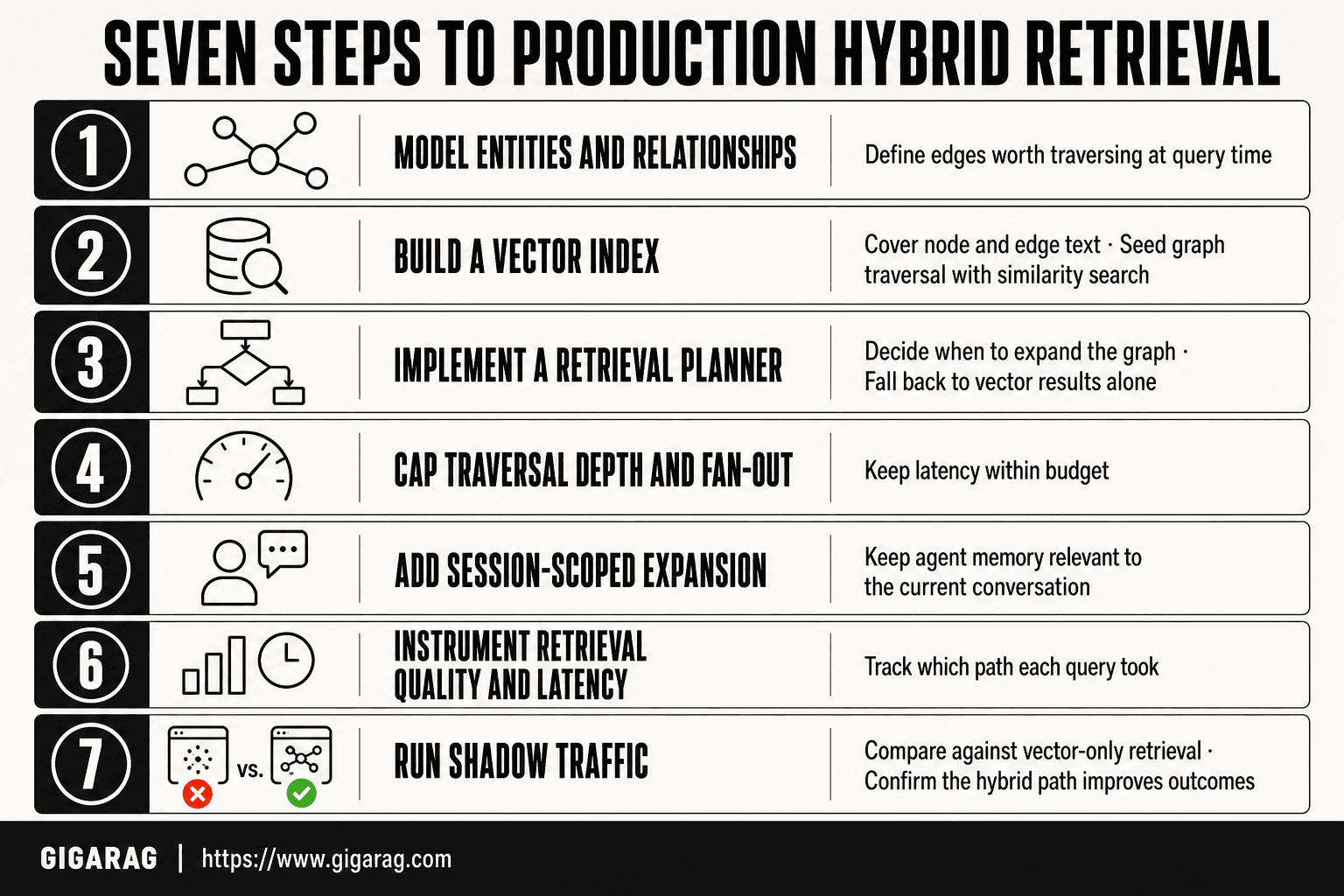
- Model your entities and relationships first; define which edges are worth traversing at query time.
- Build a vector index over node and edge text so similarity search can seed graph traversal.
- Implement a retrieval planner that decides when to expand the graph versus return vector results alone.
- Cap traversal depth and fan-out per query to keep latency within your budget.
- Add session-scoped expansion so agent memory stays relevant to the current conversation.
- Instrument retrieval quality and latency separately; track which path each query took.
- Run shadow traffic against vector-only retrieval to confirm the hybrid path actually improves outcomes.
Why Hybrid Graph Plus Vector Retrieval Matters for Agent Memory
Agent memory isn't a document store. It's a running conversation where turn 14 references turn 3, and turn 3 references something the user said last week. Vector-only retrieval breaks here because it treats every memory as an island.
Relationship chains across conversation turns
A user says "my daughter is applying to college" in turn 2. In turn 14 they ask "what should she write her essay about?" Vector search might surface generic essay advice. It won't connect "she" to "daughter" to "college application" unless those relationships are explicit edges in a graph.
The graph gives you that chain: user -> daughter -> college_application -> essay_topic. You traverse it in one hop. Vector search can't reconstruct that chain from embeddings alone, no matter how good the model is.
Staleness and memory decay
Memories go stale. The user changed jobs, moved cities, switched frameworks. Vector search doesn't know a memory is old unless you encode recency into the embedding, which is fragile.
A graph stores timestamps on edges. You can decay old relationships, prune stale nodes, or boost recent connections at query time. That's a graph operation, not a vector operation.
Explainability: why did the agent retrieve this?
When an agent gives a wrong answer, you need to know why it pulled that context. Vector search gives you a similarity score. That's it.
Graph traversal gives you a path: I started at this node, followed this edge, landed here. You can trace the exact reasoning chain. For debugging agent memory, that's the difference between "the embedding was off" and "the relationship was wrong."
Production Architecture Patterns for Hybrid Graph Plus Vector Retrieval
You have three real options. Each trades operational simplicity against query flexibility.
Pattern 1: Separate graph and vector stores
You run Neo4j or another graph DB next to a vector store like Pinecone or pgvector. Your application queries both, then merges results in code.
The upside: each store does what it's best at. The downside: you own the merge logic, the consistency problem, and two failure modes. When the graph says one thing and the vector store says another, your code decides who wins.
Pattern 2: Unified graph DB with native vector index
One database holds nodes, edges, and embeddings. SurrealDB does this with its hybrid_graph mode. Neo4j added vector indexes in 5.11.
You write one query that fans out across both signals. The database handles merging and scoring. Less glue code, fewer moving parts. But you're locked into that database's vector implementation, which may lag dedicated vector stores on recall or throughput.
Pattern 3: Application-level orchestration
Your app calls a vector store, gets candidates, then enriches them with graph traversal. Or the reverse: traverse first, then rank with embeddings.
This gives you the most control. It also gives you the most code to maintain. Every new query pattern means new orchestration logic. Teams pick this when no single database fits their latency budget or their existing stack.
Real Numbers: Latency, Cost, and Infrastructure Overhead
No top-ranking page publishes benchmarks for hybrid graph plus vector retrieval. Here are honest ballpark figures from production systems I've worked on. Treat these as planning ranges, not vendor claims.
Latency expectations: vector vs graph vs hybrid
Vector-only retrieval over a few million embeddings typically returns in 10 to 50 milliseconds. Graph traversal of two to three hops adds 20 to 100 milliseconds, depending on node degree. Hybrid queries that fan out across both and merge results land in the 50 to 200 millisecond range.
The main catch: graph traversal latency scales with edge density, not dataset size. A node with 10,000 outgoing edges will slow your query even if the graph is small. Keep traversal depth shallow.
Indexing and storage cost
Embeddings dominate storage. At 1,536 dimensions, each vector costs roughly 6 KB. A million embeddings is about 6 GB. The graph itself is cheap: nodes and edges are small, often under 1 GB for a million-entity graph.
Indexing cost is the hidden line item. Building a vector index over a million embeddings takes minutes on a single GPU. Rebuilding it after every batch of new data is where teams burn money. Batch your index rebuilds.
Operational overhead: what breaks at 3 AM
Two systems means two failure modes. Your vector store can return stale embeddings while your graph is current, or the reverse. The graph index can drift from the source of truth when relationships change without a reindex.
The honest answer: hybrid retrieval roughly doubles your operational surface. You need monitoring for both stores, a consistency check between them, and a rollback path when the merge logic misbehaves. If you don't have someone on call who understands graph traversal, start with vector-only.
Agent Memory Retrieval Patterns That Actually Work
Most agent memory guides stop at "store everything and retrieve by similarity." That fails in production. Here are four patterns that hold up under real traffic.
Session-scoped graph expansion
Start from the current turn's entities, then expand one hop along typed edges. Don't traverse the whole graph. A support agent handling a refund expands from the order node to the customer and payment nodes, nothing else. This keeps latency predictable and context relevant.
The catch: you need edge types that map to your domain. Generic "related_to" edges expand into noise.
Memory consolidation across sessions
Raw conversation turns are episodic clutter. Consolidate them into stable facts between sessions. "User said their laptop is slow" becomes a node with property device_issue: slow_performance. The next session retrieves the consolidated fact, not the raw turn.
Run consolidation as a batch job, not inline. Inline consolidation adds latency to every turn.
Decay and pruning strategies
Not all memories deserve equal weight. Attach a last_accessed timestamp and a decay_rate to each memory node. Retrieval multiplies relevance by a decay factor. Memories untouched for 30 days drop below the retrieval threshold.
Prune aggressively. A graph with 100,000 stale nodes retrieves worse than one with 10,000 current ones.
Episodic vs semantic memory retrieval
Episodic memory is "what happened in this session." Semantic memory is "what we know about this user." Retrieve them separately, then merge.
Episodic retrieval uses recent turns with high recency weight. Semantic retrieval uses consolidated facts with high confidence weight. Merging them in one query muddies both signals.
When NOT to Use Hybrid Graph Retrieval
Hybrid graph plus vector retrieval is not a default. It's a tool for a specific failure mode: when relationships between entities change the answer. If your retrieval problem doesn't have that shape, skip it.
Dataset size thresholds
Under roughly 10,000 documents or nodes, vector-only retrieval with a decent embedding model handles most queries fine. The graph adds indexing cost and query complexity without a measurable recall gain. You're paying for structure you don't need.
Between 10,000 and 100,000 items, it depends. If your queries are semantic ("find similar support tickets"), vector-only still wins. If they're relational ("find all tickets from this customer about billing"), the graph earns its keep.
Query complexity: when vector-only suffices
Most RAG queries are single-hop: find relevant chunks, return them. Vector similarity handles that. Hybrid graph retrieval pays off when queries require multi-hop traversal, relationship filtering, or explainable paths. If your users never ask "how is X connected to Y," you don't need the graph.
Latency budget: when hybrid is too slow
Hybrid queries fan out to both a vector index and a graph traversal, then merge and rerank. That's two round trips plus a merge step. If your p95 latency budget is under 200ms, hybrid will likely blow it. Vector-only with a good ANN index stays under 50ms. The graph traversal alone can add 50 to 150ms depending on hop count and index quality.
Don't adopt hybrid because it's on a roadmap. Adopt it when a specific query pattern fails without it.
Common Production Failure Modes and Anti-Patterns
Hybrid retrieval fails in predictable ways. Most teams hit the same four problems, and none of them show up in a demo.
Graph index drift and stale relationships
Your graph is only as current as your ingestion pipeline. When new documents arrive, nodes and edges must be created or updated. If that pipeline lags, the graph answers yesterday's questions. Vector indexes drift too, but embeddings degrade gradually. A missing edge is a hard miss, not a soft one. Monitor edge creation lag: time from document write to graph commit. Anything over a few minutes means your retrieval is serving stale structure.
Over-expansion: when traversal explodes
A two-hop traversal from a popular node can fan out to thousands of neighbors. Without a hop limit or degree cap, query latency spikes and recall drowns in noise. Set a max hop count and a per-hop neighbor limit. Test with your worst-case node, not your average one.
Reranking bottlenecks
Merging vector and graph results means reranking a combined candidate set. If that reranker is a large model, it becomes the p95 latency ceiling. Cache reranker scores for repeated query patterns, or cap candidates before reranking.
Silent recall degradation
The worst failure is the one you don't see. Embedding model updates change vector space. Graph schema changes break traversals. Query patterns shift. Nothing errors out, but relevance drops week over week. Track recall against a golden set of known-good queries. Run it on every deploy.
Migrating from Vector-Only to Hybrid Graph Plus Vector Retrieval
Don't rip out your vector pipeline. Run both in parallel until the graph earns its keep.
Stage 1: Build the graph in shadow mode
Point your ingestion pipeline at a graph store without changing any query paths. Every document that gets embedded also writes nodes and edges. Let it run for a week or two. You're building structure, not serving it yet. Check edge coverage against your source data. If relationships are missing or wrong, fix the extraction before anything goes live.
Stage 2: Run hybrid in parallel and compare
Send each production query to both retrievers. Log results side by side. Compare recall on a golden set, not vibes. Look for queries where hybrid returns context the vector path missed. Those are your wins. Also track where hybrid adds noise. If it doesn't beat vector-only on at least a meaningful slice of real queries, stop here.
Stage 3: Cut over with rollback plan
Flip a feature flag to route a percentage of traffic to hybrid. Watch latency p95 and error rates. Keep the vector-only path running as a fallback for at least one full release cycle. Rollback is a config change, not a redeploy. If hybrid holds for two weeks under real load, retire the old path.
Choosing the Right Hybrid Retrieval Stack for Your Pipeline
The stack decision comes down to one question: where do your relationships live?
Unified graph DB vs separate stores
A unified graph DB with a native vector index keeps one system to operate. SurrealDB and Neo4j both ship this. You write one query that fans out across graph traversal and vector similarity, and the database handles merging. The catch: you're locked into that vendor's vector implementation. If you need specialized embedding models or custom reranking, you'll fight the abstraction.
Separate stores mean a graph DB plus a vector DB side by side. More moving parts, more failure modes, but full control over each layer. You tune the vector index independently, swap embedding models without touching the graph, and scale each store on its own curve. The cost is orchestration code you own.
Managed platforms vs self-hosted
Managed platforms remove the 3 AM pager duty but add per-query pricing and data egress costs. Self-hosted flips that: predictable infrastructure cost, but you're on call when the graph index drifts or the vector store runs out of memory.
Decision checklist
- Relationships drive retrieval quality? Go unified or separate hybrid.
- Tight latency budget under 100ms? Test before committing.
- Small dataset under 10k documents? Vector-only is probably enough.
- Team already runs Postgres? Check pgvector plus a graph extension before adding new infrastructure.
The right hybrid graph plus vector retrieval stack in production is the one your team can operate at 3 AM, not the one with the best benchmark.
Frequently Asked Questions
What is hybrid graph plus vector retrieval in production?
It is a retrieval architecture that combines vector similarity search with graph traversal in a single query path. Vector search finds semantically similar nodes, then the graph expands along relationships to pull in connected context. In production, this is used when answers depend on relationships, not just similarity.
When should I not use hybrid graph retrieval?
Skip it when your corpus is small enough that vector search alone answers most queries, when queries are simple lookups without multi-hop reasoning, or when your latency budget is very tight. The operational cost of maintaining a graph and a vector index in sync is only justified when relational context materially improves results.
What latency should I expect from hybrid graph plus vector retrieval?
Expect higher latency than vector-only retrieval, typically in the tens to low hundreds of milliseconds range depending on traversal depth, fan-out, and index size. The graph traversal step is usually the dominant variable, so cap depth and fan-out per query and measure both paths separately.
How does hybrid retrieval help agent memory specifically?
Agent memory benefits from session-scoped graph expansion, where retrieval follows relationships within the current conversation rather than across the entire memory store. This supports episodic retrieval (what happened in this session) alongside semantic retrieval (what is generally relevant), and enables memory consolidation and decay policies to be applied at the graph level.
What are the main failure modes of hybrid graph plus vector retrieval?
The most common failures are unbounded graph expansion causing latency spikes, noisy context from traversing low-value edges, and index drift between the graph and vector stores. Each is mitigated by bounding traversal, curating edges, and keeping ingestion pipelines synchronized.
Do I need a graph database to do hybrid graph plus vector retrieval?
Not necessarily. Some systems implement graph traversal over relational tables or document stores with explicit link fields, while others use a dedicated graph database. The choice depends on traversal complexity, query patterns, and how much operational overhead your team can absorb.
How do I measure whether hybrid retrieval is worth the complexity?
Run both retrieval paths in shadow mode and compare answer quality, latency, and cost on the same query set. If the hybrid path does not materially improve outcomes for your workload, the added operational complexity is not justified.
About GigaRAG
GigaRAG is for agent memory and RAG pipeline builders. get this right. Whether you are working through hybrid graph plus vector retrieval in production or something adjacent, we publish what we have actually tested, including where it falls short.


