Knowledge Graph vs RAG: What Agent Builders Actually Need to Know
Your agent retrieves the right chunks, then answers the wrong question because it can't connect two facts that live in different documents. If you build RAG pipelines or agent memory, you've hit this wall. The knowledge graph vs RAG question isn't academic. It's about whether you add a graph database to fix multi-hop reasoning, or whether you're reaching for complexity your use case doesn't earn.
The honest answer is: it depends on whether your queries need relationships or just similarity. Most builders don't need a knowledge graph. Some genuinely do.
GigaRAG gives you both paths in one platform, but this guide won't push you either way. It gives you the criteria to decide for yourself: what each approach does well, what knowledge graphs can't do for agent memory, and how to implement a hybrid without over-engineering. You'll get a decision framework and an FAQ at the end that answers the questions top results skip.
| At a glance | Details |
|---|---|
| Core difference | Vector RAG matches text similarity; graphs model explicit relationships |
| Best for | Graphs: multi-hop reasoning and stateful agent memory |
| Weakness of graphs | No fuzzy semantic matching; adds indexing complexity |
| Hybrid approach | Vector search for recall, graph for traversal |
| When overkill | Simple single-hop Q&A with stable, small corpora |
| Implementation | Graph RAG Python libraries; Neo4j is a database, not a technique |
In This Guide
- What is a Knowledge Graph?
- Knowledge Graph vs Vector RAG for Agent Memory
- What is RAG (Retrieval-Augmented Generation)?
- Knowledge Graph Vs Rag: A Step-by-Step Guide
- Knowledge Graph vs RAG: Side-by-Side Comparison
- When to Choose Knowledge Graph vs. RAG for Agent Memory
- What Knowledge Graphs Cannot Do for Agent Memory
- Hybrid Approach: Combining Knowledge Graphs with RAG
- Practical Implementation Steps for RAG Pipeline Builders
- Common Mistakes When Building a Knowledge Graph vs RAG Pipeline
- Final Thoughts: Choosing the Right Tool for Your Agent
What is a Knowledge Graph?
A knowledge graph stores information as a network of entities connected by typed relationships. Instead of documents or chunks, you get nodes (people, products, events), edges (works_at, purchased, caused_by), and properties on both (name, date, confidence score). That structure is the whole point: the relationships are first-class data, not something an embedding happens to capture.
Entities, relationships, and properties
An entity is a thing your agent needs to reason about. A relationship is a named, directed connection between two entities. A property is a key-value pair attached to either one. So a node for "Acme Corp" might have properties like founded=2009 and headquarters=Berlin. An edge from "Acme Corp" to "Jane Doe" carries the label employs and a property since=2021.
The value for agent builders is that you can query this structure directly. You don't ask "which chunks mention Acme and Jane." You ask "who does Acme employ, and what else do those people work on?" The graph answers by walking edges, not by guessing from text similarity.
How graph traversal differs from vector similarity search
Vector search finds chunks whose embeddings are close to your query embedding. It's fuzzy matching over meaning. Graph traversal follows explicit connections from node to node. It doesn't care whether two entities sound similar. It cares whether an edge exists between them.
Here's the practical difference. A vector search for "companies Jane Doe has influenced" returns chunks that mention Jane and companies in the same passage. A graph traversal starts at Jane's node, follows the works_at edge to Acme, then follows the acquired edge to a subsidiary. That second hop is the multi-hop reasoning everyone talks about. Vector search can surface the pieces. The graph connects them.
[!note] A knowledge graph does not replace vector search for fuzzy semantic matching, nor does it eliminate hallucination — it structures relationships, but the LLM can still generate unsupported claims. It also adds indexing and maintenance complexity that may not pay off for simple retrieval tasks.
Knowledge Graph vs Vector RAG for Agent Memory
| Factor | Knowledge Graph | Vector RAG |
|---|---|---|
| Retrieval mechanism | Traverses explicit nodes and edges | Matches embeddings by cosine similarity |
| Multi-hop reasoning | Native: follows relationship paths | Limited: needs query decomposition or re-ranking |
| State across turns | Persistent graph memory per entity | Stateless unless external memory added |
| Fuzzy semantic matching | Weak: exact relationship types required | Strong: handles paraphrases and synonyms |
| Setup complexity | Higher: schema design, entity extraction, graph maintenance | Lower: chunk, embed, index |
What is RAG (Retrieval-Augmented Generation)?
RAG is the baseline most agent builders already have. You chunk your documents, embed each chunk into a vector, store those vectors in a database, and at query time retrieve the chunks most similar to the user's question. The LLM then generates an answer grounded in those retrieved chunks instead of relying on its training data alone.
The vector retrieval pipeline: chunk, embed, search
The pipeline has four stages. First, you split documents into chunks, typically 200 to 800 tokens, with some overlap so context doesn't get cut at the boundary. Second, an embedding model converts each chunk into a vector, a list of numbers that captures its semantic meaning. Third, you store those vectors in a vector database like Pinecone, Weaviate, or pgvector. Fourth, at query time you embed the question, run a similarity search (usually cosine similarity), and pull the top-k nearest chunks.
That's the whole mechanism. The retrieval is fuzzy: it finds chunks that mean something similar to the query, not chunks that are structurally connected to each other.
What plain vector RAG does well
Plain vector RAG is genuinely good at recall over unstructured text. If your agent needs to answer "what does the Acme support policy say about refunds," vector search finds the relevant passage fast, and the LLM summarizes it. It handles paraphrasing well. You don't need to know the exact wording of the source document.
It's also cheap to set up. You need an embedding model, a vector store, and a retrieval loop. No schema design, no entity resolution, no graph database to maintain. For single-hop questions over documents, that's often enough.
The limitation shows up when the answer requires connecting facts across chunks. Vector search returns the pieces. It doesn't tell you how they relate. That's where the comparison gets interesting.
[!tip] For agent builders, start with a hybrid approach: keep your vector store for recall, and add a lightweight graph only for the entities and relationships your agent must reason over across turns. This avoids over-engineering while capturing most multi-hop benefits.
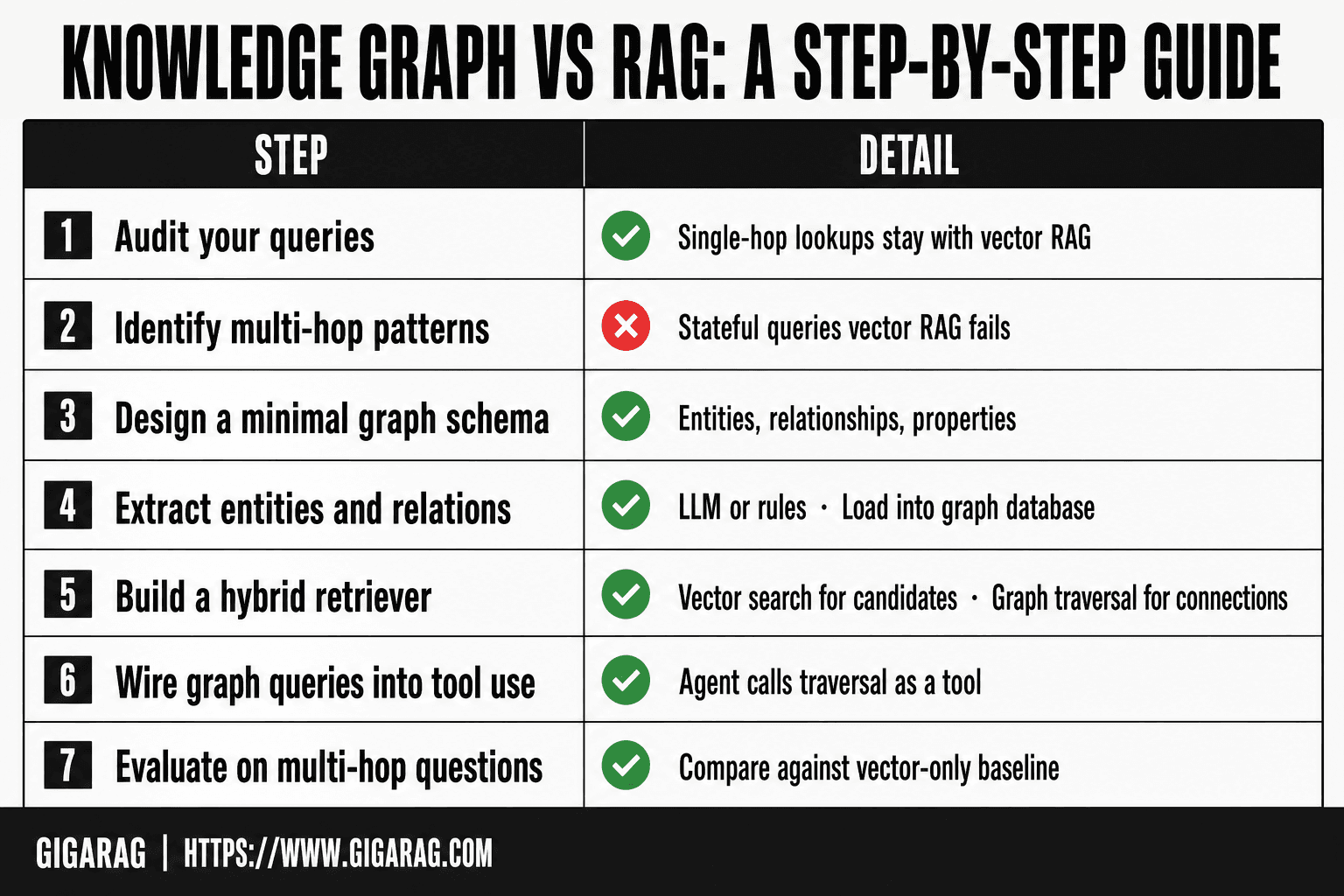
Knowledge Graph Vs Rag: A Step-by-Step Guide
- Audit your queries: if most are single-hop lookups, stay with vector RAG.
- Identify multi-hop or stateful patterns (e.g., 'how does X affect Y through Z?') that vector RAG fails.
- Design a minimal graph schema: entities, relationships, and properties your agent actually needs.
- Extract entities and relations from your corpus using an LLM or rules; load into a graph database.
- Build a hybrid retriever: vector search for candidate chunks, graph traversal for connected facts.
- Wire graph queries into your agent's tool-use layer so it can call traversal as a tool.
- Evaluate on a held-out set of multi-hop questions; compare against vector-only baseline.
Knowledge Graph vs RAG: Side-by-Side Comparison
The honest answer: it depends on whether your agent's queries require reasoning across relationships or just finding relevant text. Plain vector RAG wins for single-hop questions over unstructured documents. A knowledge graph wins when the answer requires traversing connections between entities. Most agent builders need both, not one or the other.
Retrieval mechanism: similarity search vs. graph traversal
Vector RAG retrieves by semantic similarity. You embed the query, find the nearest chunks in vector space, and feed them to the LLM. The retrieval is fuzzy and fast, but it has no concept of how chunks relate to each other.
Graph traversal works differently. You start at a specific entity, then follow typed edges to connected entities. A query like "which customers bought products from suppliers in the same region" becomes a path through the graph: customer to product to supplier to region. The structure does the work, not similarity scoring.
Multi-hop reasoning capability
This is where the gap is widest. Vector RAG struggles with multi-hop questions because each hop requires a separate retrieval, and the LLM has to stitch the pieces together from whatever chunks come back. If the connecting fact isn't in the top-k results, the chain breaks.
Knowledge graphs handle multi-hop natively. The traversal itself follows the relationship path. You don't retrieve disconnected chunks and hope the LLM infers the connection. You walk the edges that are already there.
Relationship handling and entity resolution
Vector RAG treats relationships as implicit. If two chunks mention the same entity, the similarity search might surface both, but it doesn't know they're connected. Entity resolution, the task of deciding that "Acme Corp" and "Acme Corporation" are the same thing, is not something vector search does at all.
Knowledge graphs make relationships explicit and typed. "works_for", "supplies", "located_in" are stored as edges with direction and properties. Entity resolution is a required step during graph construction, not an afterthought. That's a cost, but it's also the source of the graph's reasoning power.
Implementation complexity and maintenance overhead
Plain vector RAG is simple. Chunk, embed, store, retrieve. You can stand up a working pipeline in an afternoon.
A knowledge graph requires schema design, entity extraction, relationship mapping, and ongoing maintenance as new data arrives. Every new entity type or relationship type means updating the schema. The indexing pipeline is more complex, and query latency can be higher if your traversals span many hops.
The tradeoff is real: you pay in implementation complexity for what you gain in reasoning capability.
When to Choose Knowledge Graph vs. RAG for Agent Memory
The decision comes down to one question: does your agent need to reason across relationships, or just find relevant text? If you can't answer that clearly, you're not ready to choose either.
When plain vector RAG is sufficient
Stay with vector RAG when your agent answers questions from unstructured documents and the answer lives in one or two chunks. Support tickets, documentation search, meeting transcripts, internal wikis. The query is "what does the refund policy say" or "how do I reset my password." Single-hop. The chunk contains the answer.
Vector RAG is also the right call when you're prototyping. You can stand up a working pipeline in an afternoon, and if the retrieval quality is good enough, you're done. Don't add a graph because you might need it later. Add it when the failure mode shows up in your logs.
When a knowledge graph adds genuine value
A knowledge graph earns its complexity when your agent's queries require traversing typed relationships. Multi-hop questions like "which suppliers in the same region shipped products that failed QA" are graph-shaped problems. Vector search can't walk that path.
Stateful memory is the other trigger. If your agent needs to track entities across turns, remember that a user mentioned a specific project, and connect new information to that project, a graph gives you persistent structure. Vector stores forget relationships between turns unless you rebuild them each time.
Relationship-heavy data is the third signal. If your domain is naturally a network, supply chains, org charts, financial transactions, knowledge graphs match the data's shape.
When a hybrid approach is best
Most production agent memory systems land here. Vector search handles fuzzy semantic matching: "find passages about customer dissatisfaction." Graph traversal handles structured reasoning: "which customers are connected to this supplier through these orders."
The pattern is straightforward. Vector retrieval gets you recall, the broad set of relevant chunks. Graph traversal gets you precision, the specific relationship path that answers the question. You don't replace one with the other. You route queries based on what they're asking for.
The honest tradeoff: hybrid means maintaining two indexes, two query paths, and the glue between them. That's real operational cost. But for agents that need both fuzzy recall and structured reasoning, it's cheaper than trying to force either system to do the other's job.
What Knowledge Graphs Cannot Do for Agent Memory
Knowledge graphs solve a specific problem: reasoning over typed relationships. They don't solve retrieval, and they don't solve generation. If you're expecting a graph to fix your agent's fuzzy matching or stop your LLM from making things up, you'll be disappointed.
Knowledge graphs don't replace vector search for fuzzy matching
Vector search finds passages that are semantically similar to your query, even when the words don't match. "Customer was angry about the delay" retrieves chunks about frustration, complaints, shipping problems. A knowledge graph can't do that. It stores entities and edges: Customer A, Order 482, status "delayed." If your query doesn't map cleanly onto those entities, the graph returns nothing.
The honest answer is that these are different retrieval modes. Graphs excel at exact relationship traversal. Vector search excels at approximate semantic recall. Your agent needs both for most real queries, which is why hybrid architectures exist. But don't expect the graph to pick up the slack when your embeddings are weak.
Knowledge graphs don't eliminate hallucination
A common pitch is that grounding your LLM in a knowledge graph reduces hallucination. It can, but only for the facts explicitly stored in the graph. If the relationship isn't there, the LLM will still fill the gap with something plausible and wrong.
Worse, a graph can give false confidence. The LLM sees structured data and treats it as authoritative, then extrapolates beyond what the graph actually contains. You've swapped one failure mode for another: instead of hallucinating from retrieved text, it hallucinates from incomplete graph structure. The fix is the same as with vector RAG: constrain the LLM to answer only from what's retrieved, and test that constraint.
The indexing and maintenance cost you should expect
Building a knowledge graph means entity resolution, relationship extraction, and schema design. That's not a one-time cost. Every new data source requires mapping it onto your existing entities. Every schema change ripples through your queries.
In practice, expect to spend meaningful engineering time on graph quality before you see retrieval gains. If your data isn't naturally relational, you'll spend more time forcing it into a graph shape than you'll save on query precision. The main catch: graphs are only as good as the entity resolution underneath them. Get that wrong, and you've built an expensive index that returns wrong answers with confidence.
Hybrid Approach: Combining Knowledge Graphs with RAG
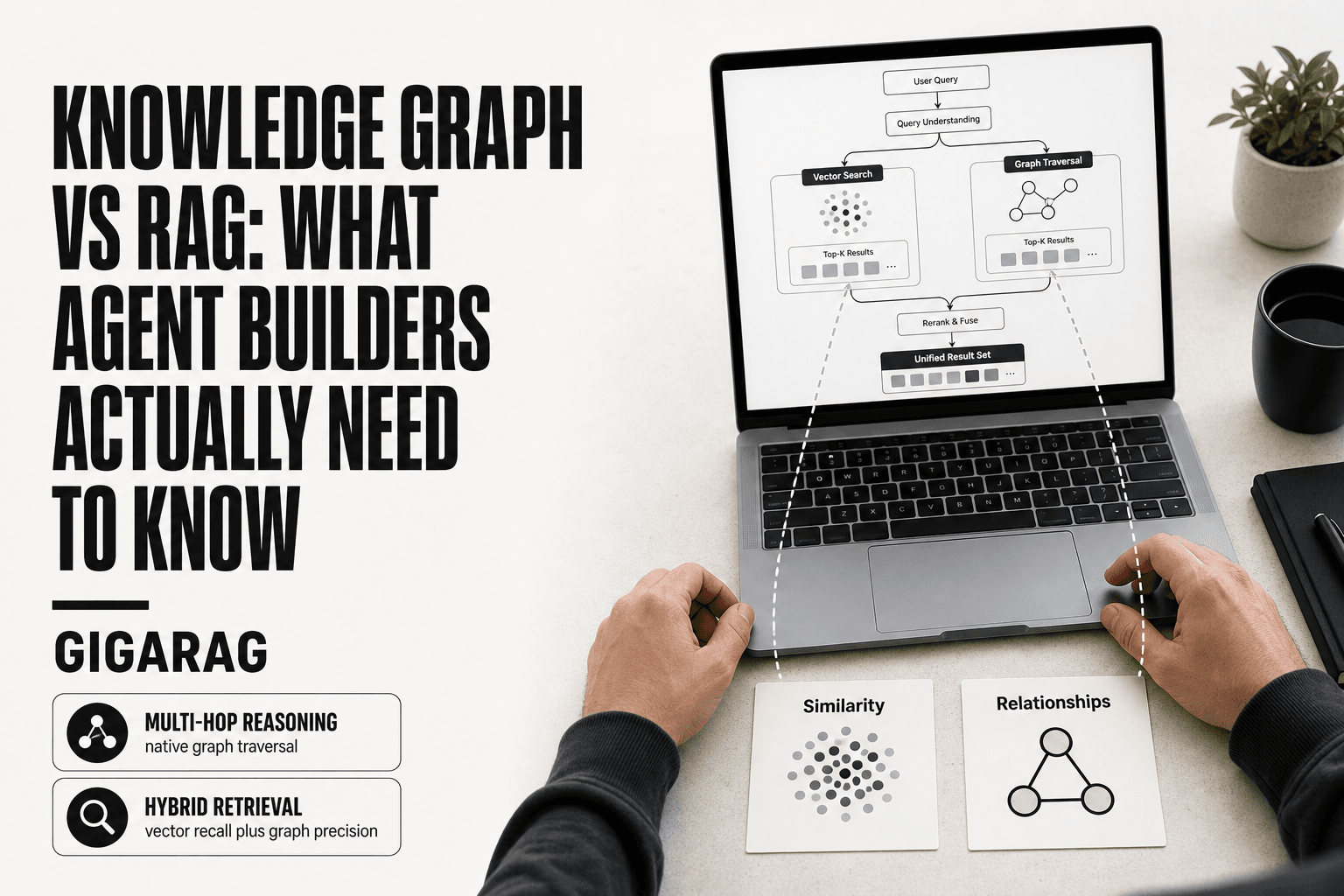
A knowledge graph RAG is a retrieval pipeline that runs two searches in parallel: vector search for fuzzy semantic recall, and graph traversal for exact relationship reasoning. The results get merged before the LLM sees them. You get the best of both, but you also pay for both.
Graph search as an augmentation to vector retrieval
Vector search answers "what is similar to this query?" Graph search answers "what is connected to this entity?" Those are different questions. A query like "which customers bought products from vendors in the same region as our top supplier?" is trivial for a graph and nearly impossible for vector search alone. The chunks don't contain the relationship; the graph does.
The augmentation works in both directions. Graph traversal can expand the context window with related entities before vector search runs, giving the embedding model more signal. Or vector search can identify candidate entities first, and graph traversal can walk from those entities to find what the chunks missed. In practice, most hybrid systems run vector search first, then use graph traversal to enrich the results.
Architecture pattern: vector search for recall, graph traversal for reasoning
Here's a pattern that works for agent memory. Store your documents as chunks in a vector database. Store your entities and relationships in a graph database. When a query arrives, run vector search to get candidate chunks. Extract entities from those chunks, then traverse the graph to pull in connected entities and their properties. Merge both result sets, rank them, and pass the top items to the LLM.
The key is that neither system is the source of truth. The vector database owns recall. The graph owns reasoning. Your agent's memory becomes stateful because the graph persists relationships across turns, while the vector index handles the fuzzy matching that graphs can't do.
When hybrid is over-engineering
If your queries are single-hop and your data isn't naturally relational, a hybrid system adds latency and complexity without improving answers. You're maintaining two indexes, two schemas, and a merge step that can introduce its own bugs. The honest answer: start with vector RAG. Add a graph only when you can point to specific queries in your logs that fail on multi-hop reasoning. If you can't name those queries, you don't need the graph yet.
Practical Implementation Steps for RAG Pipeline Builders
You don't need to rip out your vector pipeline to test whether a knowledge graph helps. The path is incremental: audit what's failing, find the relationship-heavy queries, then prototype a hybrid before you commit to a full graph build.
Step 1: Audit your current retrieval failures
Start by collecting the queries your agent gets wrong. Not the ones where the LLM hallucinated, but the ones where retrieval returned the wrong chunks or missed the answer entirely. Log the query, the retrieved chunks, and the final response. Then sort failures into two buckets: fuzzy matching failures and relationship failures.
Fuzzy matching failures happen when the right chunk exists but the embedding similarity didn't surface it. A knowledge graph won't fix those. Relationship failures happen when the answer requires connecting two or more entities across chunks, like "which vendor supplied the part that failed in the customer's last order?" Those are your graph candidates.
If you can't produce a list of at least 10 relationship failures from real traffic, you don't have evidence a graph will help. That's the gate.
Step 2: Identify relationship-heavy queries in your agent logs
Look for queries with multiple entities and a connector word: "which", "who", "that", "same as", "related to". These signal multi-hop reasoning. Count how often they appear. If they're under 5% of total queries, a graph is premature. If they're 15% or more and your agent consistently fails them, you have a case.
Also check whether your agent loses state across turns. If a user asks a follow-up like "what about the supplier for that part?" and your agent can't resolve "that part" without re-searching everything, a graph's persistent entity IDs can anchor that state. Vector search alone has no notion of identity across turns.
Step 3: Start with a hybrid prototype before committing
Don't build a production graph. Extract entities and relationships from a small slice of your data, maybe 500 to 1,000 documents, and load them into a graph database. Run your existing vector search, then add a graph traversal step that pulls connected entities for the top results. Compare answers on the 10 relationship queries you identified in step 1.
Measure two things: answer quality and added latency. If quality improves on those queries and latency stays under your agent's budget, expand the graph incrementally. If quality doesn't move, stop. You've spent a week, not a quarter, and you have your answer.
Common Mistakes When Building a Knowledge Graph vs RAG Pipeline
Most failed graph projects die from the same four errors. None of them are technical mysteries. They're judgment calls made before the first node gets created.
Over-engineering for simple retrieval use cases
The most common mistake is reaching for a graph when your queries don't need one. If your agent answers questions from single documents, or the relationships between entities rarely matter, a graph adds indexing work without improving answers. You'll spend weeks building an entity extraction pipeline for a problem vector search already solves. The test is simple: can you name ten real queries from your logs that require connecting two or more entities? If not, you're over-engineering.
Neglecting entity resolution quality
Entity resolution is the unglamorous part that determines whether your graph works at all. If "Acme Corp", "Acme Corporation", and "Acme" become three separate nodes, your traversals miss connections and your graph quietly fails. Most builders spend their time on the graph database and skip the deduplication step. That's backwards. A graph with sloppy entity resolution is worse than no graph, because it looks authoritative while returning incomplete results.
Ignoring query latency in agent loops
Graph traversal isn't free. A multi-hop query that touches hundreds of nodes can add 200 to 500 milliseconds to your agent's response time. In a loop where the agent makes multiple retrieval calls per turn, that compounds fast. Builders who prototype offline and then deploy into a live agent loop discover this the hard way. Measure traversal latency under your actual query patterns before you commit, not after.
Treating the knowledge graph as a vector search replacement
A knowledge graph and vector search solve different problems. The graph handles structured relationships and multi-hop traversal. Vector search handles fuzzy semantic matching where the wording doesn't match exactly. If you route all retrieval through the graph, you lose the ability to find "car repair" when the user typed "fix my vehicle". The graph has no notion of semantic similarity. Use both, or use vector search alone. Don't use the graph alone.
Final Thoughts: Choosing the Right Tool for Your Agent
The decision comes down to one question: do your agent's queries require connecting multiple entities? If yes, a knowledge graph earns its place. If no, vector RAG is enough and you should stop there.
Knowledge graphs and RAG aren't competitors. They solve different retrieval problems. Vector search handles fuzzy semantic matching where wording varies. Graph traversal handles structured relationships where the connection itself is the answer. Most agent builders land somewhere in the middle: vector search for recall, graph traversal for reasoning over what was recalled.
The honest answer is that most agents don't need a knowledge graph today. If your retrieval failures are about missing synonyms or paraphrased queries, fix your embedding model or chunking strategy first. If your failures are about connecting facts across documents, that's when a graph pays off.
GigaRAG supports both patterns in one platform, so you can start with vector RAG and add graph capabilities incrementally as your agent's reasoning needs grow. The knowledge graph vs RAG choice isn't a fork in the road. It's a dial you turn as your agent's queries get harder.
Frequently Asked Questions
Is the knowledge graph still relevant?
Yes, especially for agent memory and multi-hop reasoning where explicit relationships matter. Vector RAG remains better for fuzzy semantic search, so many production systems use both. Relevance depends on whether your queries require traversing connections rather than just matching text.
Is Neo4j a graph RAG?
No, Neo4j is a graph database, not a RAG technique. Graph RAG is an approach that combines knowledge graphs with retrieval-augmented generation; Neo4j is one of several databases you can use to store and query the graph. Other options include Amazon Neptune, TigerGraph, or in-memory graph libraries.
When to use graph RAG vs RAG?
Use graph RAG when your queries involve multi-hop reasoning, stateful memory across turns, or explicit relationship traversal that vector similarity cannot capture. Stick with vector RAG for single-hop factual lookups, fuzzy matching, and small, stable corpora. A hybrid approach often works best when both needs exist.
What is a knowledge graph RAG?
Knowledge graph RAG (often called Graph RAG) augments a retrieval-augmented generation pipeline with a knowledge graph. Instead of retrieving only text chunks by embedding similarity, the system also queries structured entities and relationships to provide context. This helps the LLM answer questions that require connecting multiple facts.
Can a knowledge graph replace vector search?
No, a knowledge graph cannot fully replace vector search because it lacks fuzzy semantic matching. Vector search handles paraphrases, synonyms, and unstructured text, while graphs excel at precise relationship traversal. Most robust systems combine both for complementary strengths.
How do I implement graph RAG in Python?
You can implement graph RAG in Python using libraries like LangChain or LlamaIndex with a graph database connector (e.g., Neo4j). The typical flow: extract entities and relations, store them in a graph, then at query time retrieve relevant subgraphs and feed them to the LLM. Start with a small schema and iterate based on evaluation.
Does a knowledge graph eliminate hallucination?
No, a knowledge graph does not eliminate hallucination. It provides structured facts that can ground the LLM, but the model can still generate unsupported statements if not properly constrained. You still need prompt engineering, validation, and fallback mechanisms to reduce hallucination.
About GigaRAG
GigaRAG is for agent memory and RAG pipeline builders. get this right. Whether you are working through knowledge graph vs rag or something adjacent, we publish what we have actually tested, including where it falls short.


