Knowledge Graphs for LLM Retrieval: What Builders Need to Know
Your knowledge graph for LLM retrieval project hits a wall the moment a user asks a multi-hop question: "Which engineer led the team that built the service our last support ticket mentioned?" Vector search returns chunks that are semantically similar but factually disconnected. The LLM stitches them into a confident, wrong answer. That's the failure mode builders hit with vector-only RAG, and it's why structured retrieval keeps coming up in agent memory and pipeline design.
A knowledge graph encodes entities and relationships as nodes and edges, so the retrieval step can follow connections instead of guessing from embedding proximity. The good news is you don't need a graph database PhD to get started. The honest answer is that it's not always worth it, and this guide will tell you exactly when it isn't.
GigaRAG is one tool that helps builders implement this pattern without hand-rolling every extraction and traversal step. This guide covers the core components, a step-by-step build path, agent memory specifics, real use cases, limitations, and the mistakes that sink most first attempts.
| At a glance | Details |
|---|---|
| What it is | Graph structure linking entities and relations for retrieval |
| Main benefit | Multi-hop reasoning and factual grounding |
| Core components | Entities, relations, graph store, traversal/query layer |
| Typical stack | Graph DB plus vector index plus LLM orchestrator |
| Best for | Multi-hop queries and agent memory |
| Watch out for | Extraction errors and graph maintenance cost |
In This Guide
- What Is GraphRAG? Knowledge Graphs vs. Traditional RAG
- Knowledge Graph Retrieval vs Vector-Only RAG
- Core Components of a Knowledge Graph Retrieval System
- Knowledge Graphs For Llm Retrieval: A Step-by-Step Guide
- How to Build Knowledge Graphs for LLM Retrieval
- Knowledge Graphs for Agent Memory: State, Context, and Multi-Hop Reasoning
- Real-World Applications and Use Cases
- Limitations and When NOT to Use Knowledge Graphs for LLM Retrieval
- Common Mistakes When Building Knowledge Graphs for LLM Retrieval
- Choosing the Right Tools for Graph-Based Retrieval
- Final Thoughts: Is GraphRAG Right for Your Pipeline?
- FAQ
What Is GraphRAG? Knowledge Graphs vs. Traditional RAG
GraphRAG is a retrieval method that combines a knowledge graph's structured entities and relationships with vector search, so the LLM gets both semantic similarity and factual connections when answering a query.
How traditional RAG works (and where it breaks)
Traditional RAG splits documents into chunks, embeds each chunk into a vector, and stores those vectors in an index. At query time, the system embeds the question, finds the nearest chunks by cosine similarity, and stuffs them into the LLM's context window.
It works for simple lookups. "What's the refund policy?" retrieves the refund policy chunk. Done.
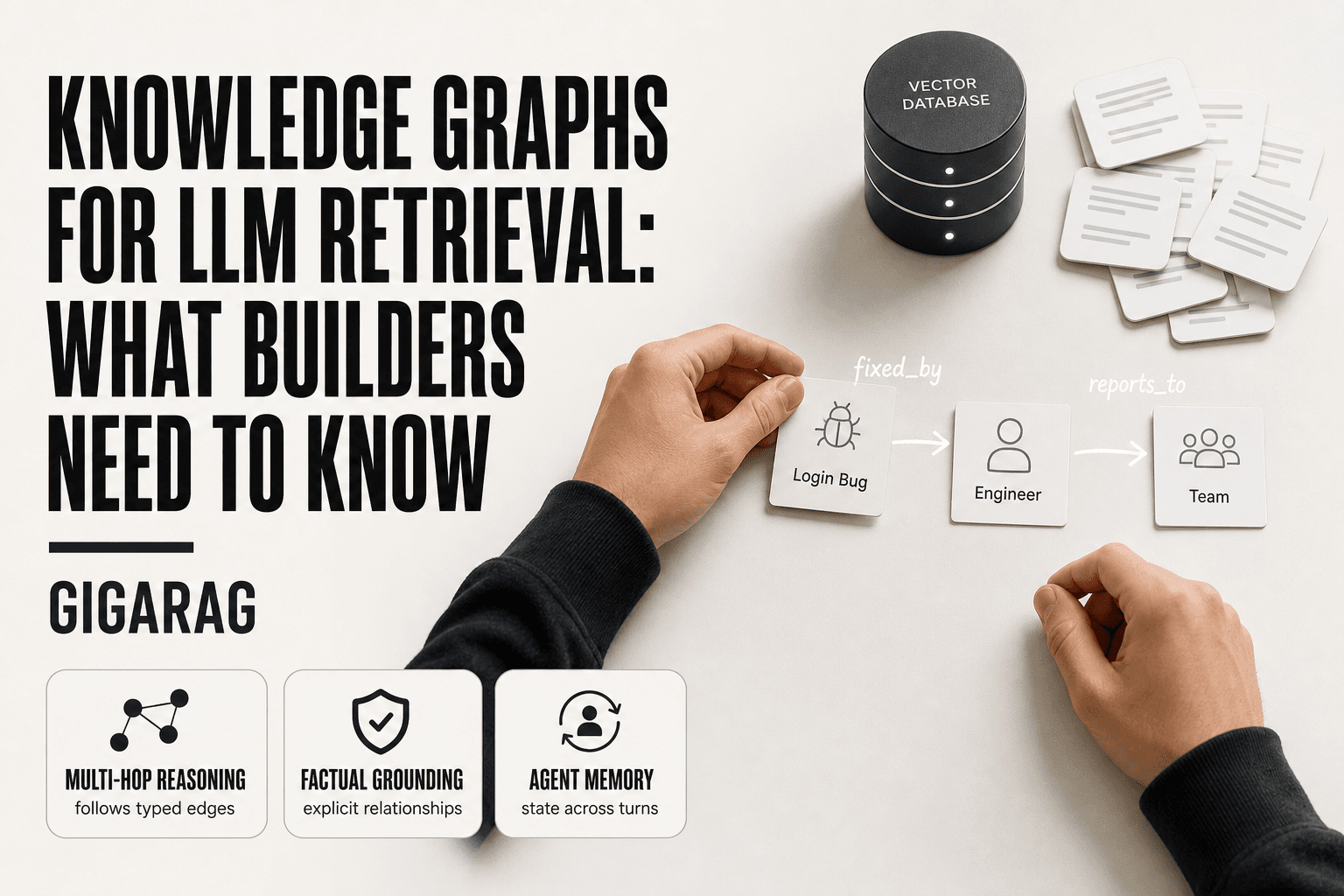
It breaks on multi-hop questions. Ask "Which team does the engineer who fixed the login bug report to?" and vector search returns chunks mentioning engineers, login bugs, and teams. But nothing connects them. The chunks are semantically similar to parts of the question, not factually related to each other. The LLM then guesses, and the guess becomes a hallucination.
The core problem: vector similarity measures meaning, not relationship. Two chunks can be close in embedding space and have nothing to do with each other factually.
What a knowledge graph adds: entities, relationships, and structure
A knowledge graph stores information as nodes and edges. Nodes are entities: people, products, teams, bugs. Edges are typed relationships: "reported_by", "assigned_to", "fixed_by", "reports_to".
The same multi-hop question becomes a traversal. Start at the login bug node, follow the "fixed_by" edge to the engineer, follow the "reports_to" edge to the team. Three hops, exact answer, no guessing.
The structure does the work that similarity can't. The graph encodes that this specific engineer fixed this specific bug and reports to this specific team. Vector search only knows these concepts are somewhat related.
GraphRAG vs. vector RAG: a side-by-side comparison
| Vector RAG | GraphRAG | |
|---|---|---|
| Retrieval signal | Semantic similarity | Relationships + similarity |
| Multi-hop queries | Poor, guesses across chunks | Strong, follows typed edges |
| Setup cost | Low, embed and index | High, extract entities and build graph |
| Query latency | Fast, single vector lookup | Slower, traversal plus search |
| Best for | Factoid lookup, FAQ | Connected reasoning, agent memory |
The honest answer is that GraphRAG isn't a replacement for vector search. It's a layer on top. Most production systems run both: vector search for fast candidate retrieval, graph traversal for relationship-aware context. The graph fixes what vectors can't see, and vectors keep the graph from having to do everything.
[!note] Knowledge graphs improve retrieval by making relationships explicit, but they do not replace vector search — most production systems combine both, using the graph for structure and vectors for semantic recall over unstructured text.
Knowledge Graph Retrieval vs Vector-Only RAG
| Factor | Knowledge Graph Retrieval | Vector-Only RAG |
|---|---|---|
| Retrieval unit | Entities and relations with typed edges | Text chunks ranked by embedding similarity |
| Multi-hop queries | Traverses explicit links across hops | Often misses or conflates intermediate facts |
| Factual grounding | Relations are explicit and inspectable | Similarity can surface plausible but wrong text |
| Setup complexity | Higher: schema, extraction, graph store | Lower: chunk, embed, index |
| Maintenance | Ongoing: entity resolution, graph updates | Periodic re-embedding of changed content |
Core Components of a Knowledge Graph Retrieval System
A graph retrieval system has four moving parts: building the graph, extracting entities and relations, indexing what you've built, and querying it at runtime. Each part has trade-offs that show up later as latency or accuracy problems.
Graph construction: nodes, edges, and triples
The graph stores facts as triples: subject, predicate, object. "Alice fixed bug-142" becomes a node for Alice, a node for bug-142, and a "fixed" edge between them. Nodes carry properties like names, dates, or IDs. Edges carry a type and sometimes a weight or confidence score.
You don't need a formal ontology to start. A loose schema with a handful of edge types gets you further than a 40-class taxonomy you'll never maintain. Start with the relationships your queries actually need.
Entity and relation extraction with LLMs
LLMs do the extraction. You feed a chunk of text to a model and ask for entities and the relationships between them, usually as JSON. The prompt specifies the edge types you care about.
The catch is consistency. The same person might appear as "Alice Chen", "A. Chen", and "[email protected]" across three documents. Entity resolution, merging those into one node, is where most extraction pipelines leak accuracy. You'll need a resolution step, either rule-based matching or another LLM pass.
Indexing strategies: graph embeddings vs. property graphs
Two storage approaches. A property graph (Neo4j, Neptune) stores nodes and edges directly and supports fast traversal. A graph embedding approach converts nodes and edges into vectors and stores them in a vector index, which supports similarity search over the graph structure.
Property graphs win for exact traversal: follow this edge, get that node. Graph embeddings win for fuzzy matching: find nodes similar to this one even if the edge isn't explicit. Most systems use property graphs for traversal and keep a separate vector index for the fuzzy part.
Query time: traversal, vector search, and hybrid approaches
At query time you have three options. Traversal starts at a known node and follows edges. Vector search embeds the query and finds similar nodes or chunks. Hybrid runs both and merges results.
The hybrid approach is the default for a reason. Traversal alone misses things when you don't know the starting node. Vector search alone misses the relationship structure. Run vector search to find candidate nodes, then traverse from those candidates to pull in connected context. That's the pattern most production GraphRAG systems use.
[!tip] For agent memory specifically, store each memory as a node with typed edges to entities, timestamps, and source turns, so the agent can traverse from a current task to relevant past context instead of relying on similarity alone.
Knowledge Graphs For Llm Retrieval: A Step-by-Step Guide
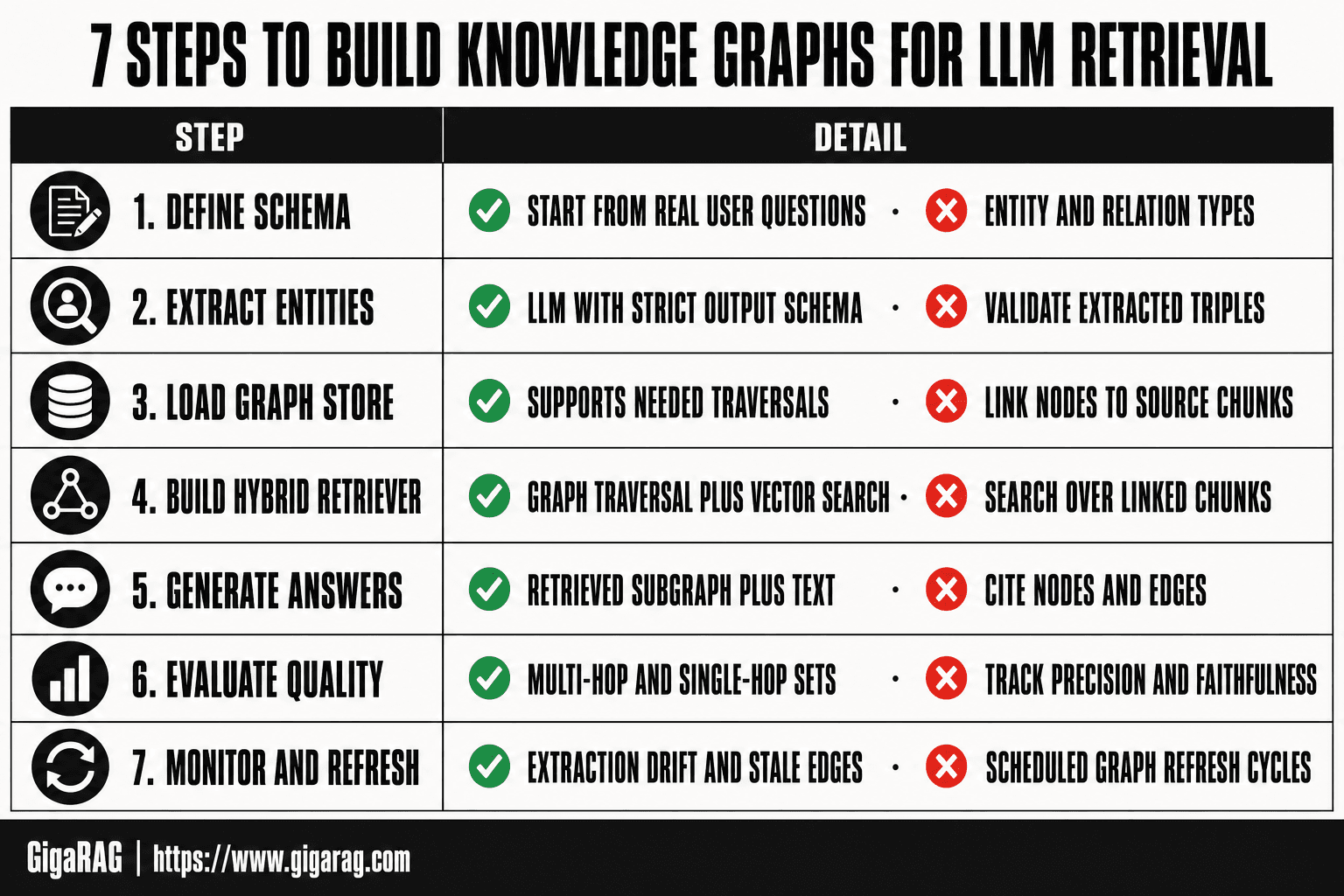
- Define the entity and relation schema your queries actually need, starting from real user questions.
- Extract entities and relations from source documents using an LLM with a strict output schema, then validate.
- Load the graph into a store that supports the traversals you need, and link nodes to source chunks.
- Build a hybrid retriever that combines graph traversal with vector search over linked chunks.
- Generate answers from the retrieved subgraph plus supporting text, citing nodes and edges.
- Evaluate on multi-hop and single-hop question sets, tracking retrieval precision and answer faithfulness.
- Add monitoring for extraction drift and stale edges, and schedule graph refresh cycles.
How to Build Knowledge Graphs for LLM Retrieval
You can build a working graph retrieval system in a week. Not a production one, but something you can query and measure. Here's the path.
Step 1: Define your schema and ontology
Start with the queries you need to answer. If you're building agent memory, you need edges like "mentioned_in", "worked_on", "reported_to". If you're building customer support retrieval, you need "caused_by", "fixes", "depends_on".
Write down five to ten edge types. No more. Every edge type you add is extraction work and maintenance work later. The schema should cover the relationships your queries actually traverse, not the relationships that exist in your domain.
Step 2: Extract entities and relationships from your corpus
Feed chunks to an LLM with a prompt that specifies your edge types and asks for JSON output. Validate the JSON. Reject malformed triples.
The hard part is entity resolution. Run a second pass that merges aliases into canonical nodes. Rule-based matching on names and emails gets you 80% of the way. An LLM pass on ambiguous cases handles the rest.
Step 3: Store and index the graph
Use a property graph database. Neo4j is the default choice. Amazon Neptune works if you're already on AWS.
Load nodes and edges. Create indexes on the properties you'll filter on. Keep a separate vector index for your text chunks, not for the graph structure. You'll use both at query time.
Step 4: Integrate graph retrieval into your RAG pipeline
The pattern: embed the query, run vector search to find candidate chunks, map those chunks to graph nodes, then traverse one or two hops to pull in connected context. Merge the graph context with the vector results and pass everything to the LLM.
Don't replace vector search. Augment it. The graph adds structure; the vectors add recall.
Step 5: Evaluate retrieval quality
Build a test set of 50 to 100 queries with known answers. Include multi-hop questions that vector-only RAG gets wrong. Measure recall and answer accuracy before and after adding graph retrieval.
If graph retrieval doesn't beat vector-only on your test set, you've either built the wrong schema or your queries don't need graph structure. That's a signal, not a failure.
Knowledge Graphs for Agent Memory: State, Context, and Multi-Hop Reasoning
Agent memory is different from document retrieval. You're not answering a one-off query. You're maintaining state across turns, remembering what the user said three messages ago, and connecting that to what they're asking now. Vector stores handle similarity. They don't handle state.
Why vector memory fails for multi-turn agents
A vector store retrieves chunks that look like the current query. That works for "find me the pricing page." It breaks when the user says "what about the enterprise tier?" and the agent needs to know they were just discussing the starter plan.
The problem is that relevance in a conversation is temporal and relational, not semantic. "It" and "that" and "the second option" carry meaning only through the conversation graph. Vector similarity can't reconstruct that. The agent either loses the thread or stuffs the entire history into the context window and burns tokens.
Modeling agent state as a graph
Model each conversation turn as a node. Add edges for what the turn references, what it confirms, what it rejects. Add user entities: their plan, their role, their open tickets.
The graph becomes the agent's working memory. When the user asks a follow-up, the agent traverses from the current turn back through the conversation edges and pulls the connected state. No semantic guesswork. The relationship is explicit.
Retrieving context across conversation turns
The retrieval pattern: take the current turn, find its node, traverse one or two hops along conversation edges, and collect the connected turns and entities. Merge that with any vector results for factual grounding.
Keep the traversal shallow. Two hops covers most follow-ups. Deeper traversal pulls in noise and adds latency. The graph's job is to reconstruct the thread, not to explore the entire history.
Multi-hop reasoning with graph traversal
Multi-hop questions need paths, not just neighbors. "Which team owns the service that broke last Tuesday?" requires traversing from the incident to the service to the owning team. A vector store returns chunks mentioning incidents, services, and teams, but not the path connecting them.
Graph traversal returns the path. You can pass that path to the LLM as structured context: incident node, caused_by edge, service node, owned_by edge, team node. The LLM reasons over the structure instead of assembling it from fragments.
The honest trade-off: you're building and maintaining that graph. For a single-turn Q&A bot, it's overhead. For an agent that needs to remember and reason across turns, it's the difference between a working system and a demo.
Real-World Applications and Use Cases
Graph retrieval earns its keep in systems where relationships between entities drive the answer. Three use cases show the pattern clearly.
Customer support and knowledge base QA
Support tickets reference products, versions, error codes, and account tiers. A vector search returns chunks that mention the same words. A graph returns the path: this error code, on this product version, under this account tier, with this known workaround.
The win shows up in multi-hop questions. "Why can't I export after the last update?" requires connecting the export feature to the version to the known regression. Graph traversal returns that chain. Vector search returns fragments that may or may not connect.
Research and document analysis
Research assistants need to trace claims across papers, authors, and citations. The graph encodes who cited whom, which experiments used which methods, and which results contradict which prior findings.
When a researcher asks "what evidence supports this claim?", the graph returns the citation path, not just semantically similar paragraphs. The LLM can then distinguish between direct evidence and adjacent discussion.
Recommendation systems with conversational context
Recommendations fail when they ignore what the user already said. A graph stores user preferences, past interactions, and item relationships as connected nodes. When the user says "something like the last one but cheaper," the agent traverses from the last item through similarity and price edges.
The honest catch: all three use cases require a well-built graph. Construction cost is real. For a static FAQ bot, vector RAG is enough. For support triage, research tracing, or conversational recommendations, the graph pays for itself in retrieval quality.
Limitations and When NOT to Use Knowledge Graphs for LLM Retrieval
Knowledge graphs solve a specific problem: retrieval that depends on relationships, not similarity. They are not a general upgrade to every RAG pipeline. For many systems, the added complexity buys nothing.
Construction cost and maintenance overhead
Building a graph means extracting entities, resolving duplicates, and defining relationships. That work is not free. A corpus of 10,000 documents can produce hundreds of thousands of triples, many of them wrong or redundant. Every schema change forces a re-extraction pass. Every new document type needs new extraction rules.
Maintenance compounds. Entities drift. Relationships change. The graph goes stale unless you build a pipeline to update it. That pipeline is another system to monitor, debug, and pay for.
Latency and scalability concerns
Graph traversal is fast for shallow queries. It slows down when a query touches many nodes. A multi-hop question that spans 50 entities can take seconds, not milliseconds. Vector search stays roughly constant regardless of query complexity.
Scaling is harder too. Graph databases handle millions of nodes, but query patterns matter. Dense traversals on a large graph can saturate memory. You will tune indexes, denormalize hot paths, and cache subgraphs. Vector databases scale more predictably.
When vector RAG is sufficient
Use vector RAG when the answer lives in one or two chunks. FAQ bots, documentation search, and simple Q&A over a static corpus do not need relationship structure. The chunks already contain the answer. Semantic similarity finds them.
The honest test: does your query require connecting two or more facts that live in different chunks? If no, skip the graph. You will spend weeks building infrastructure that does not improve retrieval quality.
Common failure modes in graph extraction
LLM-based extraction is noisy. It invents relationships that do not exist in the source text. It misses entities that use unusual phrasing. It splits the same entity into multiple nodes because the name varies slightly.
Entity resolution is the hardest part. "Apple" the company and "apple" the fruit are different nodes. "iPhone 15" and "iPhone 15 Pro" may or may not be the same entity depending on your schema. Getting this wrong pollutes the graph with false connections.
The graph is only as good as its extraction. Bad triples produce confident, wrong answers. A vector index with bad embeddings degrades gracefully. A graph with bad edges fails in ways that are harder to detect.
Common Mistakes When Building Knowledge Graphs for LLM Retrieval
Most failed graph retrieval projects share the same four errors. You can avoid all of them before writing a single line of extraction code.
Over-engineering the ontology
Builders design a 40-entity schema before touching real data. That's backwards. Start with five entity types and three relationship types. Add more only when a real query needs them. Every unused node type is extraction noise you pay for at query time.
Skipping entity resolution
"Apple" the company and "apple" the fruit are different nodes. "iPhone 15" and "iPhone 15 Pro" may or may not be. If you skip resolution, the graph fills with duplicate entities and false edges. The result: confident, wrong answers. Resolution is tedious. It's also the difference between a graph that works and one that misleads.
Ignoring retrieval latency
A multi-hop query touching 50 entities can take seconds. Vector search stays roughly constant. If your agent needs sub-second responses, test traversal depth before committing to a graph. Cache hot subgraphs. Denormalize frequent paths. Don't discover the latency problem in production.
Treating the graph as a replacement for embeddings
The graph encodes relationships. Embeddings encode similarity. You need both. Use vector search to find candidate nodes, then traverse the graph to pull related context. A graph alone misses paraphrased queries. Embeddings alone miss multi-hop connections. Hybrid retrieval is the pattern that actually works.
Choosing the Right Tools for Graph-Based Retrieval
Your stack choice depends on two things: how much data you have, and whether you need a managed service or can run your own infrastructure.
Graph databases: Neo4j, Amazon Neptune, and alternatives
Neo4j is the default choice for most builders. It runs Cypher, has a mature Python driver, and supports both property graphs and vector indexes in the same database. That last part matters: you can store embeddings alongside nodes and run hybrid queries without a separate vector store.
Amazon Neptune is the managed alternative. It handles replication, backups, and scaling for you, but it locks you into AWS and costs more at small scale. If you're already on AWS and need production reliability, Neptune is worth it. If you're prototyping, Neo4j Community Edition is free and runs locally.
Alternatives like ArangoDB and Memgraph exist, but they have smaller communities and fewer GraphRAG examples. Choose them only if you have a specific reason.
Frameworks: LlamaIndex, LangChain, and nano-graphrag
LlamaIndex has the most complete graph retrieval abstractions. Its KnowledgeGraphIndex handles extraction, storage, and querying with minimal code. LangChain offers similar building blocks but with more assembly required. Both add dependency weight.
nano-graphrag is a lightweight alternative that strips the framework down to the essentials. It's easier to debug and modify, but you'll write more glue code yourself.
GigaRAG sits in this space as a practical option for builders who want graph retrieval without framework overhead. It handles the extraction-to-query pipeline with sensible defaults, so you can start with a working system and customize later.
When to use a managed solution vs. building in-house
Use a managed database when uptime matters more than cost. Use a framework when you need to ship fast. Build in-house when your schema is unusual or your latency budget is tight enough that you need control over every query.
The honest answer: most teams should start with Neo4j plus LlamaIndex or GigaRAG, then replace pieces only when a specific bottleneck appears.
Final Thoughts: Is GraphRAG Right for Your Pipeline?
It depends on your queries. If your users ask multi-hop questions that require connecting facts across documents, a knowledge graph pays for itself. If they ask simple lookup questions, it doesn't.
The honest answer: knowledge graphs for LLM retrieval are powerful but not a silver bullet. They add construction cost, maintenance overhead, and query complexity. You accept that trade when the structure earns its keep, which happens when relationships matter more than similarity.
Start with vector RAG. Add a graph when you hit a specific failure: multi-hop reasoning, agent state across turns, or entity-level precision that embeddings can't deliver. Don't build the graph first and hope the queries justify it later.
GigaRAG is a practical option for builders who want to test this pattern without assembling the whole pipeline by hand. It handles extraction to query with sensible defaults, so you can see whether graph retrieval helps before committing to infrastructure.
If your pipeline needs structure, build it. If it doesn't, don't.
FAQ
What is the difference between GraphRAG and traditional RAG?
Traditional RAG retrieves chunks by semantic similarity. GraphRAG adds a knowledge graph layer, so retrieval can follow typed relationships between entities. The difference shows up on multi-hop questions: vector search returns related chunks, graph traversal returns connected facts.
When should I use a knowledge graph instead of vector search?
Use a knowledge graph when your queries require connecting facts across chunks, maintaining state across conversation turns, or tracing relationships like "reported_by" or "depends_on". If the answer lives in one or two chunks, vector search is enough.
How do I extract entities and relationships for a knowledge graph?
Feed chunks to an LLM with a prompt that specifies your edge types and asks for JSON output. Validate the JSON, then run an entity resolution pass to merge aliases into canonical nodes. Rule-based matching handles most cases; an LLM pass handles the ambiguous ones.
What are the main limitations of knowledge graphs for LLM retrieval?
Construction cost, maintenance overhead, and query latency. Building a graph means extracting entities and resolving duplicates. Keeping it current means running an update pipeline. Multi-hop queries that touch many nodes can take seconds.
Can knowledge graphs reduce LLM hallucinations?
They can reduce one class of hallucination: the kind caused by stitching together semantically similar but factually disconnected chunks. They don't fix hallucinations caused by bad extraction, missing entities, or an LLM that ignores the retrieved context.
What graph database should I use for a RAG pipeline?
Neo4j is the default for most builders. It supports property graphs and vector indexes in the same database. Amazon Neptune is the managed alternative if you're on AWS. Choose ArangoDB or Memgraph only if you have a specific reason.
How do knowledge graphs improve agent memory?
They model conversation turns and user entities as nodes and edges, so the agent can traverse from the current turn back through the conversation graph. That reconstructs the thread without semantic guesswork or stuffing the entire history into the context window.
Is GraphRAG worth the added complexity?
It depends on your queries. If you need multi-hop reasoning, agent state across turns, or entity-level precision, the graph earns its keep. If you're building a static FAQ bot, skip it. Vector RAG is enough.
Frequently Asked Questions
When should I use a knowledge graph instead of vector-only RAG?
Use a knowledge graph when your queries require multi-hop reasoning, explicit relationships, or auditable facts — such as 'which suppliers are affected by this regulation?' Vector-only RAG struggles when the answer depends on connecting facts across documents. For simple single-hop lookups, vector search alone is often sufficient and cheaper.
How do I build a knowledge graph from unstructured documents?
Start with a defined schema of entity and relation types, then use an LLM with structured output to extract triples from chunks. Validate extractions against a sample, resolve duplicate entities, and load the graph into a store that supports your traversal patterns. Keep links back to source chunks for citation.
What are the main limitations of knowledge graphs for LLM retrieval?
Extraction is error-prone, so graphs can contain wrong or missing relations. Schema design is hard and domain-specific, and graph maintenance adds ongoing cost. Graphs also handle unstructured nuance poorly compared to embeddings, which is why hybrid retrieval is common.
Can I combine a knowledge graph with vector search?
Yes, and most production systems do. Use vector search to find relevant chunks or seed entities, then traverse the graph to gather connected facts. This hybrid approach improves recall and precision, especially for multi-hop questions.
How do knowledge graphs help with agent memory?
They let an agent store memories as nodes with typed links to entities, tasks, and time, so it can retrieve context by traversing relationships rather than relying only on embedding similarity. This supports state tracking and reduces contradictory or stale recall.
What tools or databases are used for knowledge graph retrieval?
Common choices include property graph databases, RDF triplestores, and graph extensions in existing databases. Many teams pair a graph store with a vector index and an orchestration layer that routes queries between them. Selection depends on query patterns, scale, and team familiarity.
How do I evaluate retrieval quality with a knowledge graph?
Build a test set of multi-hop and single-hop questions with known answers, then measure retrieval precision, recall, and answer faithfulness. Track whether the graph traversal surfaced the correct nodes and edges, and monitor for extraction drift over time.
About GigaRAG
GigaRAG is for agent memory and RAG pipeline builders. get this right. Whether you are working through knowledge graphs for llm retrieval or something adjacent, we publish what we have actually tested, including where it falls short.


