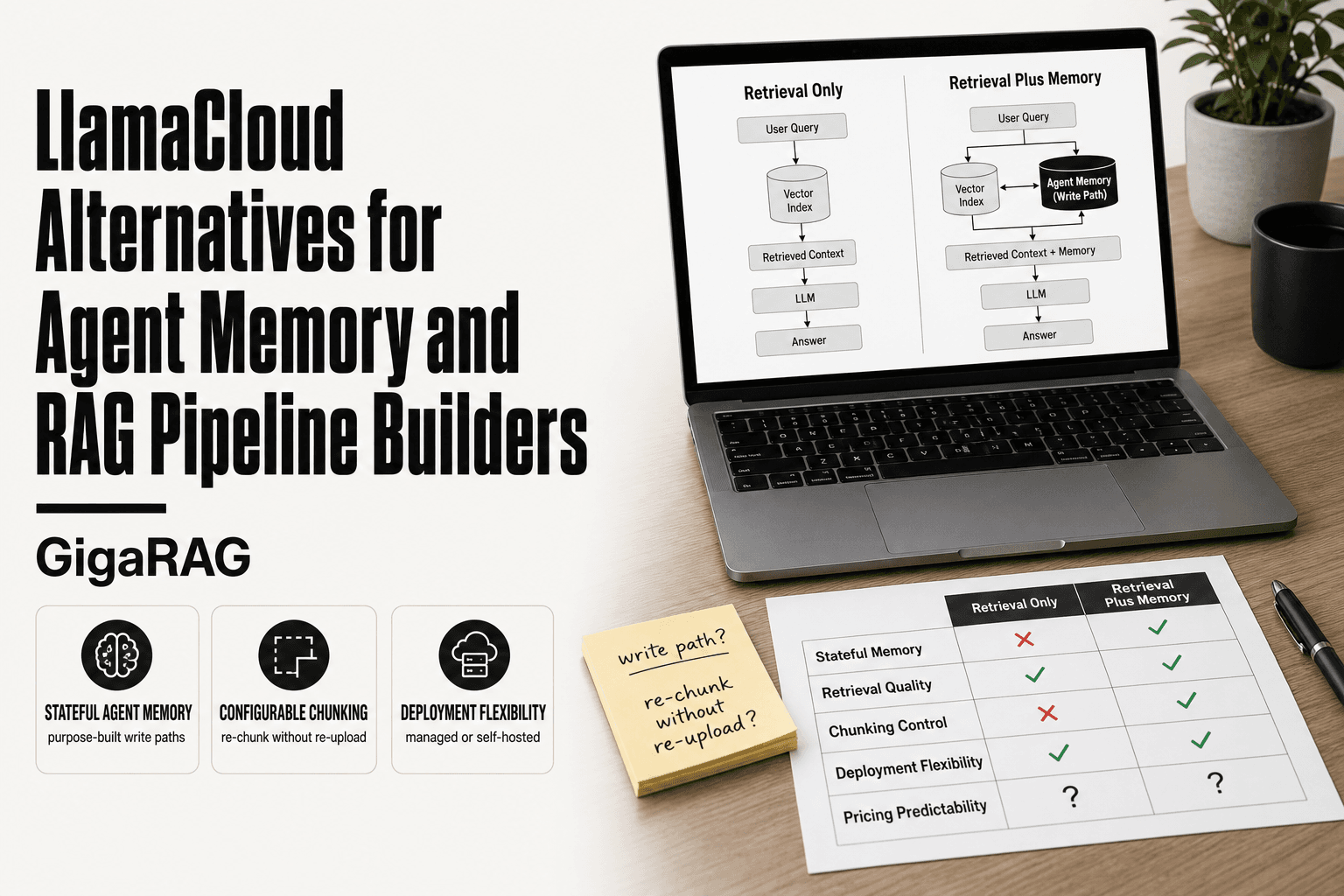
LlamaCloud Alternatives for Agent Memory and RAG Pipeline Builders
LlamaCloud alternatives are everywhere if you're just parsing PDFs, but agent memory builders need something far more specific: stateful context that survives across turns, retrieval quality that doesn't degrade as your pipeline grows, and deployment options that don't handcuff you to a vendor's roadmap. Most comparison lists don't get this. They're generic directories or thinly veiled vendor pitches that treat document ingestion as the whole problem. It isn't. The honest answer is that no drop-in replacement exists, and pretending otherwise wastes your evaluation time. GigaRAG, for what it's worth, is purpose-built for agent memory and RAG pipeline builders, and I'll evaluate it honestly alongside every other option, limitations included. This guide covers a decision framework built around stateful memory, retrieval quality, chunking strategy, deployment flexibility, and pricing models, so you can pick the LlamaCloud alternative that actually fits your pipeline instead of the one with the best landing page.
| At a glance | Details |
|---|---|
| What it is | Managed document parsing and indexing for RAG |
| Best for | Teams wanting managed parsing without ops overhead |
| Agent memory | Not a dedicated stateful memory layer |
| Lock-in risk | Varies by alternative; open-source reduces it |
| Cost model | Usage-based; predictability depends on provider |
| Migration effort | Low to moderate with API-compatible abstractions |
In This Guide
- What Is LlamaCloud and Why Builders Look for Alternatives
- Managed LlamaCloud vs Self-Hosted Open-Source Stack
- How to Evaluate LlamaCloud Alternatives for Agent Memory
- Llamacloud Alternatives: A Step-by-Step Guide
- LlamaCloud Alternatives at a Glance: Comparison Table
- Self-Hosted LlamaCloud Alternatives for Full Control
- Managed LlamaCloud Alternatives for RAG Pipelines
- GigaRAG: Purpose-Built for Agent Memory and RAG Pipelines
- Migrating from LlamaCloud: What to Expect
- What You Cannot Expect from LlamaCloud Alternatives
- How to Choose the Right LlamaCloud Alternative
- FAQ: LlamaCloud Alternatives
What Is LlamaCloud and Why Builders Look for Alternatives
LlamaCloud is the managed service layer from LlamaIndex, the open-source data framework for building RAG pipelines and LLM applications. LlamaIndex handles document ingestion, indexing, and retrieval. LlamaCloud adds hosted parsing, storage, and API access so you don't run those pieces yourself.
What LlamaCloud offers (and what it doesn't)
LlamaCloud gives you managed document parsing through LlamaParse, hosted indexes, and retrieval endpoints. You upload files, it chunks and embeds them, and you query via API. That's the core loop.
What it doesn't offer is stateful agent memory. LlamaCloud is built around retrieval, not conversation state. If your agents need to remember context across sessions, track user preferences, or maintain working memory during multi-step tasks, you're building that yourself on top of the retrieval layer. The same goes for fine-grained control over chunking strategy once documents are in the hosted index.
Common pain points for agent memory builders
Cost is the first complaint. LlamaCloud charges per page for parsing and per token for retrieval, which gets unpredictable as document volume grows. Builders report bills that scale faster than their usage justifies.
Vendor lock-in is the second. Your parsed documents, chunk boundaries, and embeddings live in LlamaCloud's infrastructure. Exporting them means re-parsing and re-embedding elsewhere.
The third pain point is the memory gap itself. Agent memory needs write paths, not just read paths. You need to store conversation turns, update beliefs, and retrieve relevant history alongside document chunks. LlamaCloud doesn't provide that. You bolt on a separate memory store and hope the two layers stay in sync.
Why "alternatives" means different things to different teams
A team running a simple document Q&A bot might just want a cheaper parser. A team building a multi-agent system with persistent memory needs something closer to a memory platform. A third team might want full control over their pipeline and accept the engineering cost of self-hosting.
That's why no single "best alternative" exists. The right choice depends on whether you're replacing the parser, the retrieval layer, or the entire managed stack.
[!note] LlamaCloud is a managed service from the LlamaIndex team focused on document parsing and indexing; it is not itself a dedicated agent memory store, so stateful memory usually requires a separate vector or key-value layer regardless of which alternative you pick.
Managed LlamaCloud vs Self-Hosted Open-Source Stack
| Factor | Managed (LlamaCloud-style) | Self-Hosted Open Source |
|---|---|---|
| Setup effort | Low; API key and SDK | Higher; infra, storage, and orchestration |
| Agent memory | Limited; bring your own store | Full control; plug in any vector or state store |
| Cost predictability | Usage-based; scales with volume | Fixed infra cost; scales with engineering time |
| Vendor lock-in | Higher; tied to provider APIs | Low; portable across clouds and models |
| Maintenance burden | Provider handles parsing and indexing | You own upgrades, scaling, and failures |
How to Evaluate LlamaCloud Alternatives for Agent Memory
The short version: evaluate alternatives on five criteria: stateful memory support, retrieval quality, chunking control, deployment flexibility, and pricing predictability. If a tool fails on memory or retrieval, nothing else matters.
Stateful memory: what it means for RAG pipelines
Stateful memory means the system remembers context across turns, sessions, and tasks. A stateless RAG pipeline answers each query from scratch. A stateful one pulls in conversation history, user preferences, and prior task outcomes alongside document chunks.
Here's the test: can the tool write to memory, not just read from it? LlamaCloud reads from an index. Agent memory needs write paths for conversation turns, belief updates, and working state. If the alternative only offers retrieval endpoints, you're building the memory layer yourself. That's not disqualifying, but it changes your engineering budget.
Retrieval quality and chunking strategy
Retrieval quality depends on how documents get chunked and embedded. Most managed tools pick a default chunk size and don't let you change it after ingestion. That's fine for simple Q&A. It breaks down when your documents have tables, code blocks, or mixed content types.
Ask whether the tool exposes chunk size, overlap, and per-document chunking rules. Ask whether you can re-chunk without re-uploading. If the answer is no to both, retrieval quality is whatever the vendor decided for you.
Deployment flexibility: self-hosted vs managed
Self-hosted means you run the parser, index, and retrieval layer yourself. Full control, full maintenance burden. Managed means someone else runs it, but you accept their chunking defaults, their rate limits, and their uptime.
The honest tradeoff: self-hosted tools like Unstructured or PDFBox give you chunking control that managed platforms don't. Managed platforms give you operational simplicity that self-hosted tools can't match. Pick based on whether your team has the engineering capacity to run infrastructure.
Pricing models: per-page, per-token, or flat-rate
LlamaCloud charges per page for parsing and per token for retrieval. That gets expensive as volume grows. Alternatives use different models: flat-rate subscriptions, per-document fees, or usage-based pricing with caps.
The question isn't which model is cheapest. It's which model is predictable for your workload. If your document volume spikes seasonally, per-page pricing hurts. If your retrieval volume is steady, per-token might be fine. Calculate your projected cost under each model before committing.
API compatibility and migration effort
No alternative is a drop-in replacement for LlamaCloud's API. Expect to rewrite your ingestion code, your query code, or both. The migration cost depends on how tightly your application is coupled to LlamaCloud's specific endpoints.
Check whether the alternative offers a Python SDK, REST API, or both. Check whether it supports the same file types you're already parsing. The less abstraction you built around LlamaCloud, the easier the move.
[!tip] For agent memory specifically, decouple the memory store from the retrieval provider: keep conversation state in a dedicated store (for example a vector database plus a key-value store) so switching RAG providers later never forces you to migrate memory. This is the single change that most reduces lock-in for builders.
Llamacloud Alternatives: A Step-by-Step Guide
- Inventory every LlamaCloud API call in your codebase, including parsing, indexing, and retrieval endpoints.
- Abstract those calls behind an internal interface so the provider becomes a swappable implementation detail.
- Choose a target: a managed alternative, a self-hosted open-source stack, or a hybrid of both.
- Re-ingest a representative document sample and compare retrieval quality against your LlamaCloud baseline.
- Wire in a dedicated agent memory store (vector plus key-value) if stateful memory is a requirement.
- Run both pipelines in parallel, shadow-testing queries before cutting over production traffic.
- Cut over gradually, keep the old path available for rollback, and monitor cost and latency per query.
LlamaCloud Alternatives at a Glance: Comparison Table
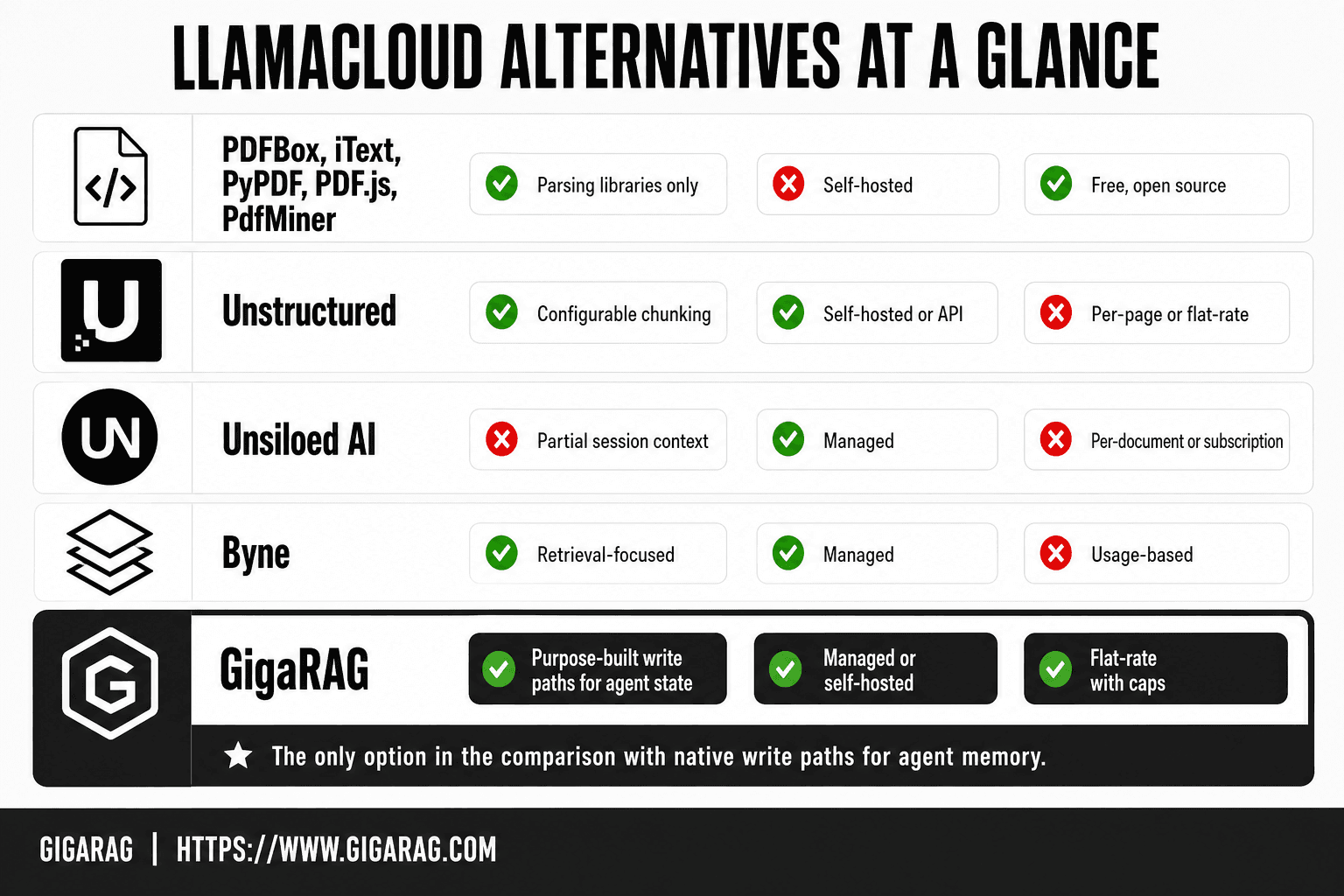
The table below maps each alternative category to the five criteria from the previous section. It's a quick filter, not a verdict. Use it to narrow your list before reading the detailed sections.
Comparison matrix: memory, retrieval, deployment, pricing
| Tool / Category | Stateful Memory | Retrieval Quality | Deployment | Pricing Model |
|---|---|---|---|---|
| PDFBox, iText, PyPDF, PDF.js, PdfMiner | None. Parsing libraries only. | Depends entirely on your chunking code. | Self-hosted | Free (open source) |
| Unstructured | None out of the box. You build the memory layer. | Good defaults, configurable chunking. | Self-hosted or API | Per-page or flat-rate |
| Unsiloed AI | Partial. Session context, not full agent state. | Strong on mixed document types. | Managed | Per-document or subscription |
| Byne | None. Retrieval-focused. | Solid for standard text. | Managed | Usage-based |
| GigaRAG | Yes. Purpose-built write paths for agent state. | Configurable chunking, re-chunk without re-upload. | Managed or self-hosted | Flat-rate with caps |
Keep in mind: "stateful memory" here means the tool can write to memory, not just read from an index. Most alternatives in this table can't do that without custom engineering.
Category breakdown: document parsers, RAG frameworks, managed platforms
Document parsers (PDFBox, iText, PyPDF, PDF.js, PdfMiner) extract text from files. That's it. No retrieval, no memory, no indexing. You build everything downstream. Best for teams that want full control over chunking and embedding, and have the engineering capacity to maintain the pipeline.
RAG frameworks (Unstructured, LlamaIndex itself) handle ingestion, chunking, and retrieval. They give you chunking control that managed platforms don't. But memory is still your problem. You wire conversation history and agent state yourself.
Managed platforms (Unsiloed AI, Byne, GigaRAG) run the infrastructure for you. The tradeoff is control: you accept their chunking defaults, rate limits, and uptime. GigaRAG is the only one in this table with native write paths for agent memory. The others treat memory as a feature you bolt on.
Self-Hosted LlamaCloud Alternatives for Full Control
Self-hosting means you own the parsing, chunking, embedding, and retrieval code. No vendor API keys, no per-page fees, no data leaving your infrastructure. The tradeoff is that every layer becomes your problem. For agent memory specifically, that problem compounds fast.
Document parsing libraries: PDFBox, iText, PyPDF, PDF.js, PdfMiner
These libraries extract text from files. Nothing else. PDFBox and iText are Java; PyPDF and PdfMiner are Python; PDF.js runs in the browser or Node. Each handles different file quirks: iText is stronger on form fields, PdfMiner on layout preservation, PDF.js on rendering fidelity.
What they don't do: chunk, embed, index, retrieve, or remember anything. You write that code yourself. For a RAG pipeline, that means a parsing library is maybe 10% of the work. The other 90% is chunking strategy, embedding model selection, vector storage, and retrieval logic.
Unstructured for document ingestion
Unstructured sits one layer above raw parsing libraries. It detects document elements (headings, tables, lists, code blocks) and outputs structured JSON. That structure feeds cleaner chunking downstream. It supports PDF, DOCX, HTML, email, and a dozen other formats through one API.
The catch: Unstructured still doesn't do memory. It ingests documents and hands you structured text. Conversation history, agent state, write paths to memory, all of that is on you. Unstructured also has a managed API tier, but the self-hosted version is what gives you full control over your data.
What self-hosted options cannot do for agent memory
None of these tools write to memory. They read documents and output text. Agent memory requires state: what the agent learned, what the user said three turns ago, what changed since the last session. That's a database problem, not a parsing problem. You'll need Postgres, Redis, or a vector store with write paths, plus the application logic to decide what gets stored and when.
Self-hosted options also can't give you retrieval quality out of the box. Retrieval quality comes from chunking strategy, embedding model choice, and reranking. Those are decisions you make and maintain. A parsing library won't tell you if your chunks are too big or your embeddings are stale.
Engineering effort and maintenance costs
Plan for real ongoing work. A self-hosted RAG pipeline with agent memory means maintaining: the parsing code, the chunking logic, the embedding pipeline, the vector database, the memory store, and the retrieval service. That's six components before you write any application logic.
The honest answer is that self-hosting makes sense when data sovereignty or cost at scale outweighs engineering time. If you're processing millions of pages a month, per-page fees from managed services add up. If you're processing thousands, the math rarely works in self-hosting's favor.
Managed LlamaCloud Alternatives for RAG Pipelines
Managed platforms handle parsing, chunking, embedding, and retrieval for you. You send documents in, you query an API, you get answers back. The tradeoff is control: you can't change the chunking strategy, you can't swap the embedding model, and your data lives on someone else's servers. For teams that want RAG without the six-component maintenance burden, that tradeoff is often worth it.
Unsiloed AI: strengths and limitations for agent memory
Unsiloed AI positions itself as a managed RAG platform with document ingestion and retrieval built in. It handles the parsing and indexing pipeline, so you don't write chunking code. The platform supports multiple document formats and provides an API for querying your indexed data.
The limitation is agent memory. Unsiloed AI is built for document retrieval, not for maintaining stateful conversation history or agent-specific memory stores. You can build a RAG pipeline on top of it, but the memory layer (what the agent remembers across sessions, what it learned from past interactions) is still your application code. Unsiloed gives you retrieval; memory is a separate problem you solve yourself.
Byne: pricing model and retrieval capabilities
Byne takes a different approach: it's a managed platform focused on document processing and retrieval with a per-page pricing model. You pay based on the number of pages you process, which makes costs predictable for small to medium document volumes but can get expensive at scale.
Retrieval capabilities are solid for straightforward document Q&A. Byne handles chunking and indexing automatically, and its API returns relevant passages for a given query. What it doesn't offer is fine-grained control over chunking strategy or embedding model choice. If your documents have unusual structure (dense tables, mixed code and prose, long technical specifications), the default chunking may not serve you well, and you can't fix it from the outside.
Other managed platforms worth evaluating
Several other managed options exist, each with a different emphasis. Some focus on enterprise document workflows with compliance features. Others prioritize speed of setup over retrieval quality. A few offer hybrid models where you can bring your own embedding model but use their infrastructure for indexing and serving.
The honest answer is that most managed RAG platforms converge on the same core: parse, chunk, embed, retrieve. The differences show up in pricing models, document format support, and whether they expose any control over the pipeline. If you need agent memory specifically, check whether the platform has a write path for storing conversation state or agent-specific knowledge. Most don't. That's the gap that forces builders to bolt on their own memory layer anyway.
What managed options cannot do: vendor lock-in and customization limits
Managed platforms lock you in. Your documents are indexed in their system, your embeddings live in their vector store, and your retrieval queries go through their API. Moving off means re-ingesting everything into a new system. That's not a bug; it's the price of not running infrastructure yourself.
Customization is the other hard limit. You can't change the chunk size, the overlap, the embedding model, or the reranking logic. If retrieval quality drops on your specific document types, you can't tune it. You can only file a support ticket or switch platforms. For builders who need control over retrieval quality, that's a real constraint, not a theoretical one.
GigaRAG: Purpose-Built for Agent Memory and RAG Pipelines
GigaRAG is built for the gap most managed platforms leave open. It's a RAG platform that treats agent memory as a first-class feature, not an afterthought. You get document ingestion, chunking, embedding, and retrieval, plus a write path for storing conversation state and agent-specific knowledge. That's the difference: most alternatives give you retrieval and leave memory to your application code.
How GigaRAG approaches agent memory
GigaRAG stores memory as structured, queryable state rather than a flat conversation log. Agents can write facts, preferences, and learned context to a memory store, then retrieve relevant memory alongside document chunks during a query. The retrieval step pulls from both sources: your documents and what the agent has accumulated over time.
In practice, that means an agent can remember a user's project constraints from a previous session and apply them to a new query without you rebuilding context from scratch. The memory layer is part of the platform, not something you bolt on.
RAG pipeline features and retrieval quality
The pipeline covers parsing, chunking, embedding, and retrieval through a single API. GigaRAG exposes some control over chunking and embedding choices, which matters if your documents have unusual structure. Retrieval quality depends on your chunking strategy and embedding model, same as any RAG system. GigaRAG doesn't solve that problem for you; it gives you the knobs to tune it.
Where GigaRAG fits (and where it doesn't)
GigaRAG fits builders who need agent memory and RAG in one system without running separate infrastructure for each. If you're already maintaining a vector store and a memory layer, GigaRAG may not replace them. It's a platform, not a library, so you're still committing to its API and infrastructure. The honest answer is that GigaRAG is worth evaluating if agent memory is a core requirement, not a nice-to-have. If you only need document retrieval, simpler managed options may serve you better.
Migrating from LlamaCloud: What to Expect
No drop-in replacement exists. That's the first thing to accept before you start. LlamaCloud's API, chunking defaults, and data format are specific to its platform, and every alternative makes different choices. Migration is an engineering project, not a configuration change. Plan for it accordingly.
Exporting data from LlamaCloud
Your documents are the easy part. LlamaCloud stores the files you uploaded, and you can retrieve them through its API or dashboard. What you won't get is a clean export of your chunked, embedded, and indexed state. The chunks and vectors live in LlamaCloud's infrastructure, tied to its embedding model and chunking parameters.
That means you'll re-ingest your source documents into the new system from scratch. The good news is that raw documents are portable. The catch is that any metadata, labels, or manual chunk adjustments you made inside LlamaCloud may not carry over cleanly. Export what you can as JSON or CSV, but expect to rebuild the index.
API compatibility: what changes and what stays
The concepts stay the same. Every RAG platform has an ingestion endpoint, a query endpoint, and some way to manage documents. The function names, request shapes, and authentication patterns will differ.
You'll rewrite the integration layer. If you abstracted LlamaCloud behind your own interface, you're in better shape: swap the implementation and keep the rest of your application intact. If you called LlamaCloud's API directly throughout your codebase, budget for a broader refactor. Either way, don't expect a shim that maps LlamaCloud calls to another provider. None exists that's worth using.
Re-chunking and re-embedding considerations
Chunk size and overlap are the two parameters that most affect retrieval quality. LlamaCloud has defaults, and your new platform has different defaults. If you don't match them, your retrieval results will shift, sometimes dramatically.
Re-embedding is non-negotiable. You can't reuse LlamaCloud's vectors with a different embedding model, and even if you could, the chunk boundaries wouldn't line up. Run a small evaluation set before you commit: take 20 to 50 representative queries, run them against the new system, and compare results to what you had. That's the only way to know if your chunking strategy survived the move.
Realistic migration timelines and effort
For a small pipeline with a few hundred documents, expect a day or two of focused work. For a production system with thousands of documents, custom chunking logic, and agent memory wired in, plan for one to two weeks. The document re-ingestion is fast. The integration rewrite, evaluation, and tuning are what eat the time.
Agent memory adds another layer. If you built memory on top of LlamaCloud's retrieval, you'll need to port that logic to the new platform's memory model, or rebuild it if the alternative doesn't have one. That's the part most migration guides skip, and it's the part that takes the longest.
What You Cannot Expect from LlamaCloud Alternatives
Every alternative makes tradeoffs. Some are obvious from the pricing page. Others only show up after you've built on top of them. Here's what to expect before you commit.
No drop-in replacement exists
You already know this if you read the migration section. But it bears repeating: nothing swaps in for LlamaCloud without engineering work. The API shapes differ. The chunking defaults differ. The way documents map to indexes differs.
The honest answer is that "alternative" means "rebuild on a different foundation," not "point at a new endpoint." If a vendor tells you migration takes an afternoon, they're selling something. Budget for a real project.
Agent memory is still an emerging capability
Most RAG platforms treat memory as an afterthought. They'll give you conversation history or a vector store you can query, but stateful memory that persists across sessions, tracks what the agent has already retrieved, and updates as new information arrives? That's rare.
The tools that do offer it are young. APIs change between versions. Documentation lags the actual behavior. You'll hit edge cases where memory works in the demo but breaks under production load. That's the state of the field right now, not a flaw in any single vendor.
Retrieval quality varies significantly across tools
Two platforms can both claim "RAG support" and produce wildly different results on the same queries. The difference comes down to chunking strategy, embedding model choice, and how the retriever ranks results. None of that is visible from a feature list.
You won't know until you test. Run your own evaluation set against any alternative before you commit. Twenty to fifty representative queries is enough to expose the gaps. Skip this step and you'll discover the problems after you've already migrated.
How to Choose the Right LlamaCloud Alternative
You've seen the options. Now the question is which one fits your constraints. It depends on three things: budget, engineering capacity, and how much agent memory you actually need.
Decision framework: budget, engineering capacity, memory needs
Start with memory. If your agents need stateful memory that persists across sessions and tracks what they've already retrieved, that eliminates most self-hosted document parsers immediately. They don't do memory at all. You'd be building that layer yourself.
Next, engineering capacity. Self-hosted options like Unstructured or PDFBox give you full control but demand real maintenance. Managed platforms offload that work but lock you into their pricing and API. If you have one or two engineers, managed is usually the right call. If you have a team that's already running infrastructure, self-hosted becomes viable.
Budget matters last, not first. A free parser that costs you three weeks of engineering time isn't free. Price the migration and maintenance effort alongside the subscription cost.
When to choose self-hosted vs managed
Choose self-hosted when you need data control, predictable costs at scale, or custom chunking logic that managed platforms won't expose. Choose managed when you want to ship fast and don't have the team to run parsing and retrieval infrastructure.
The main catch: managed platforms change pricing and APIs without your input. Self-hosted means you own every bug.
When GigaRAG is the right fit
GigaRAG is worth a close look if agent memory is your core requirement and you don't want to build stateful memory from scratch. It's purpose-built for that use case, which means the memory layer isn't bolted on after the fact.
It's not the right fit if you only need document parsing, or if you have a team that's already built custom memory infrastructure and just wants a parser. In that case, a self-hosted library does the job for less.
For builders evaluating LlamaCloud alternatives specifically because agent memory is the missing piece, GigaRAG addresses that gap directly. Test it against your own queries before you commit.
FAQ: LlamaCloud Alternatives
What are the best free LlamaCloud alternatives?
For document parsing, PyPDF, PDF.js, and PdfMiner are free and open source. For RAG pipelines, LlamaIndex core is free if you self-host. None of these include managed agent memory. You build that yourself.
Is there a free LlamaCloud alternative for document parsing?
Yes. Unstructured offers a free tier for limited pages per month. PyPDF and PDF.js cost nothing but handle only basic extraction. Complex layouts, tables, and forms will need more work.
How do I get a LlamaCloud API key?
Sign up at llamacloud.com, create a project, and generate a key from the dashboard. The key authenticates API calls to LlamaParse and other services. Keep it out of client-side code.
What is the difference between LlamaCloud and LlamaIndex?
LlamaIndex is the open source framework. LlamaCloud is the managed service built on top of it. You can use LlamaIndex without LlamaCloud. You cannot use LlamaCloud without paying for the managed layer.
Can I use LlamaParse without LlamaCloud?
- LlamaParse is a LlamaCloud service. You need a LlamaCloud account and API key to call it. The parser itself is not open source.
What is the best LlamaCloud alternative for agent memory?
GigaRAG is purpose-built for stateful agent memory. Most alternatives treat memory as an afterthought. If memory is your core requirement, test GigaRAG against your own queries.
How hard is it to migrate from LlamaCloud to another tool?
It depends on how much you've built on LlamaCloud-specific APIs. Expect to re-chunk and re-embed documents. Budget one to three weeks for a typical pipeline.
Are there self-hosted LlamaCloud alternatives?
Yes. PDFBox, iText, PyPDF, PDF.js, PdfMiner, and Unstructured all run self-hosted. You own the infrastructure and the maintenance burden. None of them provide managed agent memory out of the box.
Frequently Asked Questions
What are the best LlamaCloud alternatives for RAG pipelines?
The right choice depends on how much ops you want to own. Managed alternatives reduce maintenance but keep you tied to a provider; self-hosted open-source stacks (parsing, embedding, and vector store components) give portability at the cost of engineering time. Most builders land on a hybrid: managed parsing plus a self-hosted retrieval and memory layer.
Are there free LlamaCloud alternatives?
Yes, in the sense that open-source parsing, embedding, and vector store components can be self-hosted at no license cost. You still pay in infrastructure and engineering time. Free tiers on managed services exist but typically cap volume or features, so check current limits before committing.
Does LlamaCloud handle agent memory?
LlamaCloud focuses on document parsing and indexing rather than stateful agent memory. For agents that need to remember prior turns or long-term facts, you generally add a separate memory layer such as a vector store for semantic recall and a key-value store for session state.
How hard is it to migrate off LlamaCloud?
Migration difficulty depends on how tightly your code couples to its APIs. If you abstract parsing, indexing, and retrieval behind an internal interface, swapping providers is mostly a re-ingestion and quality-validation exercise. Direct, scattered API calls make migration significantly harder.
What about LlamaIndex and LlamaParse?
LlamaIndex is the open-source framework, while LlamaParse is the parsing component associated with the managed offering. You can use the open-source framework independently of the managed cloud service, which is often the lowest-friction path for builders who want to keep their options open.
Do I need a LlamaCloud API key or login to use alternatives?
- Alternatives have their own authentication, and self-hosted open-source stacks typically need no external account at all. If you are evaluating multiple managed providers, expect to manage several API keys during the comparison phase.
How do I keep costs predictable when switching?
Track cost per query and per ingested document rather than monthly totals, since usage-based pricing hides unit economics. Set budget alerts and cap re-ingestion jobs, because reprocessing large corpora is usually the biggest surprise cost during a migration.
About GigaRAG
GigaRAG is for agent memory and RAG pipeline builders. get this right. Whether you are working through llamacloud alternatives or something adjacent, we publish what we have actually tested, including where it falls short.


