Product Thinking for FDEs: What It Is, Why It Matters, and How to Apply It
Product thinking for FDEs starts the moment a customer asks for a feature that would push their RAG pipeline's latency past what the use case can tolerate. You're the one who has to decide: build it anyway, push back, or reframe the problem so the real need gets solved without the performance hit. Most FDEs make that call on instinct, and the results are inconsistent. One week you over-promise and ship something that degrades retrieval quality. The next week you under-deliver and the customer wonders what they're paying for.
This guide is for forward deployed engineers specifically, not generic product managers and not pure backend engineers. It maps product thinking to the decisions you actually face: memory eviction policies, retrieval quality versus cost, and customer expectations around how an AI agent should behave. If you're building RAG pipelines, GigaRAG is one tool worth knowing, but the framework here applies regardless of your stack. Here's what you'll get: a working definition, a four-step framework you can use this week, hands-on exercises tied to real agent memory scenarios, and an honest section on what product thinking cannot do for you.
| At a glance | Details |
|---|---|
| Primary audience | Forward Deployed Engineers on RAG and agent memory |
| Core skill | Deciding what to build, defer, or reframe |
| Key trade-off | Retrieval quality vs latency and cost |
| Common failure mode | Over-indexing on loud customer requests |
| When to skip it | Pure engineering problems with clear specs |
| Main takeaway | Product thinking guides judgment, not replaces it |
In This Guide
- What Is Product Thinking for FDEs?
- Product Thinking vs Pure Engineering Mindset for FDEs
- What Product Thinking Is Not
- Product Thinking For FDEs: A Step-by-Step Guide
- Why Product Thinking Matters for FDEs Building Agent Memory and RAG Pipelines
- A Practical Framework for Applying Product Thinking as an FDE
- Product Thinking Exercises for FDEs Working on RAG Pipelines
- What Product Thinking Cannot Do for FDEs
- Common Mistakes When Applying Product Thinking for FDEs
What Is Product Thinking for FDEs?
Product thinking for FDEs is the habit of deciding what to build based on the customer's underlying problem, not the requested feature, while weighing technical trade-offs like latency, cost, and retrieval quality against that problem's actual value.
The FDE's unique position: engineering, customer success, and product
An FDE sits where three roles overlap. You write code, you sit in customer calls, and you shape what gets built next. A pure engineer optimizes for technical elegance. A pure product manager optimizes for roadmap alignment. You have to do both at once, often in the same afternoon.
Product thinking vs. engineering mindset for FDEs
The engineering mindset asks: can we build this? Product thinking asks: should we, and what does the customer actually get? Neither replaces the other. You need the engineering mindset to know a memory eviction change will add 40ms of latency. You need product thinking to decide whether the recall improvement justifies that cost for this customer.
A working definition for agent memory and RAG pipeline work
For FDEs building agent memory and RAG pipelines, product thinking means treating every retrieval decision as a customer-value decision. Which chunks get cached? What gets evicted? How much latency is acceptable before the agent feels slow? These aren't just technical settings. They're product choices with customer consequences.
[!note] Product thinking is a decision-making aid, not a substitute for engineering judgment. For well-specified, technically bounded problems, a pure engineering mindset is often faster and more appropriate.
Product Thinking vs Pure Engineering Mindset for FDEs
| Factor | Product Thinking | Pure Engineering Mindset |
|---|---|---|
| Primary question | What problem are we solving for the user? | How do we build this correctly and efficiently? |
| Best used when | Requirements are ambiguous or conflicting | Requirements are clear and technically bounded |
| Trade-off handling | Weighs user impact against cost and latency | Optimizes for performance, reliability, and elegance |
| Customer interaction | Reframes requests to underlying needs | Implements requests as specified |
| Risk | Over-analyzing and delaying delivery | Building the wrong thing perfectly |
What Product Thinking Is Not
Product thinking gets misread as a customer-pleasing exercise. It isn't. The fastest way to wreck a RAG pipeline is to treat every feature request as a mandate.
Not customer service: saying no is part of the job
Customer service resolves complaints. Product thinking decides which complaints point to a real problem worth solving. When a customer asks for a retrieval feature that would add 200ms to every query, saying yes isn't helpful. It's negligence. The product-thinking move is to find out what they're actually trying to accomplish, then propose a change that gets them there without the latency hit. Sometimes the answer is still no. A clear no with a reason beats a vague yes that degrades the system.
Not abandoning technical excellence
Some engineers hear "product thinking" and assume it means shipping sloppy work fast. It doesn't. You still need indexing that scales, eviction policies that don't leak memory, and retrieval that returns relevant chunks. Product thinking changes which technical problems you solve first. It doesn't lower the bar for how well you solve them.
Not a replacement for deep engineering judgment
Product thinking tells you what matters to the customer. Engineering judgment tells you what's possible and what it costs. You need both. A product thinker who can't read a latency graph will promise things the pipeline can't deliver. An engineer who ignores customer context will build elegant systems nobody asked for. The skill is holding both at once.
[!tip] When a customer requests a feature that would hurt latency or cost, ask 'What user outcome are you trying to achieve?' and propose a lower-cost alternative that meets that outcome. This reframing often reveals a simpler solution.
Product Thinking For FDEs: A Step-by-Step Guide
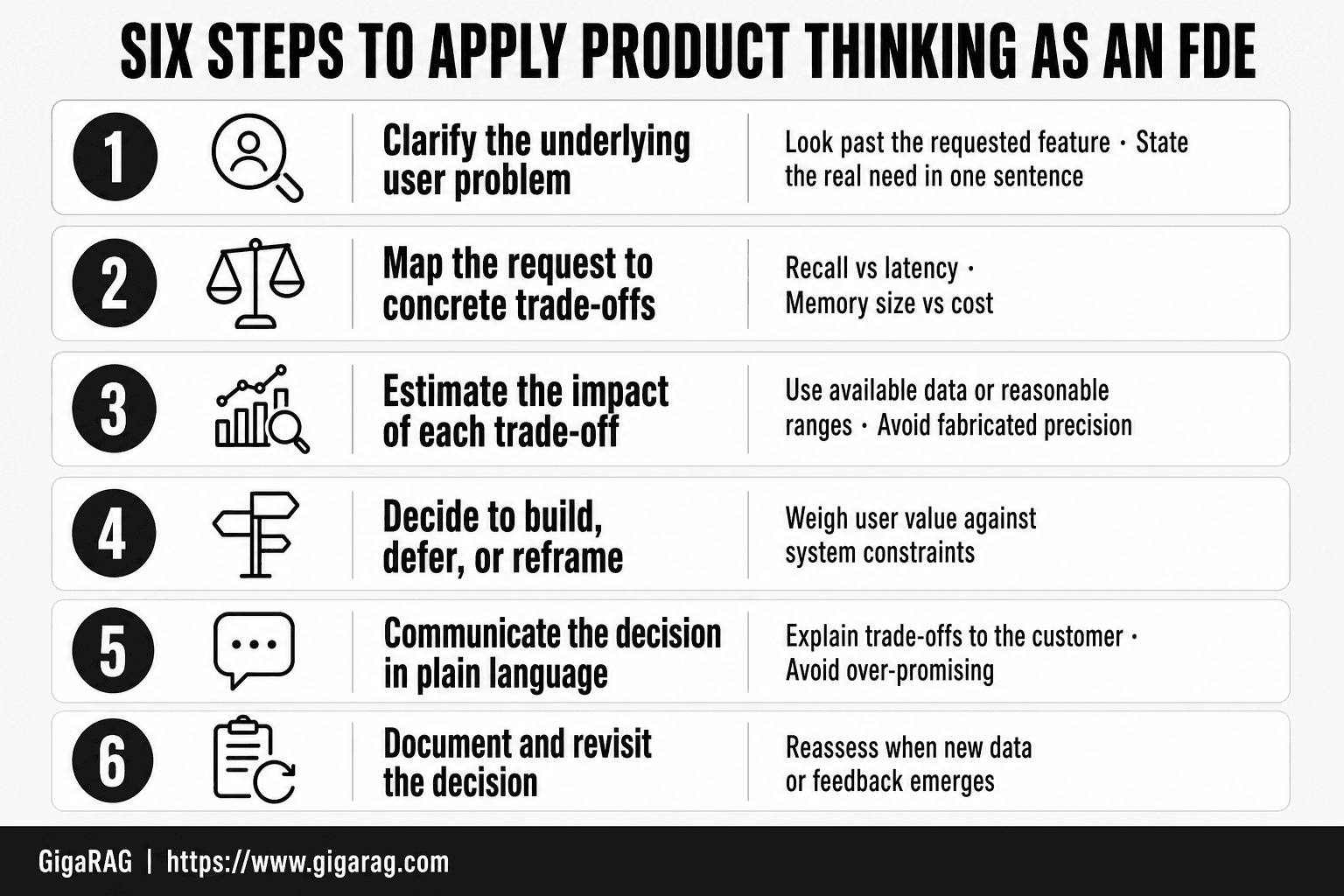
- Clarify the underlying user problem behind the customer's feature request.
- Map the request to concrete trade-offs in your RAG pipeline (e.g., recall vs latency, memory size vs cost).
- Estimate the impact of each trade-off using available data or reasonable ranges, not fabricated precision.
- Decide whether to build, defer, or reframe the request based on user value and system constraints.
- Communicate the decision and trade-offs to the customer in plain language, avoiding over-promising.
- Document the decision and revisit it when new data or feedback emerges.
Why Product Thinking Matters for FDEs Building Agent Memory and RAG Pipelines
Generic product advice assumes you're building a SaaS dashboard. You're not. You're tuning retrieval quality against query latency, deciding what an agent remembers, and explaining to a customer why their AI doesn't behave the way they expected. Those decisions don't show up in a product management textbook.
The trade-off triangle: latency, cost, and retrieval quality
Every RAG pipeline sits inside a triangle. You can have fast responses, cheap inference, or high retrieval quality. Pick two. Add a reranking step and recall improves, but every query costs more and takes longer. Strip it out and the pipeline gets snappy, but the agent starts hallucinating from irrelevant chunks. Product thinking is what tells you which corner of the triangle matters most for this customer, this week. A support chatbot needs sub-second responses. A legal research tool can afford three seconds if the citations are right. Same architecture, different answer.
Memory eviction decisions are product decisions
Agent memory doesn't scale forever. At some point you have to evict old context to make room for new. Which memories go? Recency says drop the oldest. Relevance says drop the least useful. The customer's mental model says something else entirely: they expect the agent to remember the thing they mentioned three weeks ago because it mattered to them. That expectation is a product constraint, not an engineering one. If you evict by recency alone, you'll ship a system that's technically sound and feels broken to the person using it. The eviction policy is a product decision with engineering consequences.
Customer expectations vs. technical reality in AI systems
Customers don't think in terms of chunk size or embedding models. They think the agent "should just know." When it doesn't, they file a bug. Your job is to close the gap between what they expect and what the system can actually deliver, without promising a fix that would triple infrastructure cost. That gap is where product thinking lives. You can't close it with better prompts alone, and you can't close it by ignoring the customer. You close it by understanding what they're trying to do, then shaping the pipeline to serve that outcome within the constraints you have.
A Practical Framework for Applying Product Thinking as an FDE
The framework below adapts a generic four-step product thinking process to the FDE role. Each step maps to a decision you'll actually face on a RAG pipeline or agent memory system.
Step 1: Identify the underlying problem, not the requested feature
Customers ask for features. They rarely ask for what they need. A customer says "add a reranking step" when what they actually want is fewer irrelevant chunks surfacing in answers. A customer says "increase the context window" when what they actually want is for the agent to remember a conversation from last Tuesday. Your first job is to ask what outcome they're trying to reach, then work backward to the retrieval or memory problem underneath. Write the problem down in one sentence before you touch any code.
Step 2: Start small — validate with the smallest possible change
Don't rebuild the pipeline because a customer asked. Change one thing: adjust the top-k value, tweak the similarity threshold, add a single metadata filter. Ship it to a subset of queries. Measure what happens. If the change moves the metric you care about, expand it. If it doesn't, you've spent an afternoon instead of a sprint. The smallest change that tests your hypothesis is the right size.
Step 3: Adapt based on production behavior, not demos
A pipeline that looks great in a demo falls apart under real traffic. Queries you never anticipated show up. Embeddings drift. Memory fills faster than you planned. Watch what production actually does, then adjust. If customers keep asking the same follow-up question, that's a signal your retrieval is missing something. If latency spikes at 2pm every day, that's a signal about load, not about your chunking strategy. Let production tell you what to fix next.
Step 4: Get buy-in from customers and internal engineering
You can't ship a product decision alone. The customer needs to understand why you're changing the eviction policy instead of adding the feature they asked for. Internal engineering needs to understand why you're prioritizing a latency fix over a refactor. Get both sides aligned before you build. Show the customer the trade-off in terms they care about: cost, speed, accuracy. Show engineering the same trade-off in terms they care about: maintainability, technical debt, incident risk. Buy-in isn't a meeting. It's the work of making the decision legible to everyone who has to live with it.
Product Thinking Exercises for FDEs Working on RAG Pipelines
Reading about product thinking won't change how you make decisions. Doing it will. These four exercises take under an hour each and map directly to agent memory and RAG pipeline work.
Exercise 1: Write a one-page trade-off memo for a memory eviction change
Pick a real eviction policy you're considering changing: FIFO to LRU, time-based to relevance-based, fixed window to sliding window. Write one page. State the current policy, the proposed change, what improves, what degrades, and who notices. Force yourself to name the customer who benefits and the customer who loses. If you can't name both, you don't understand the trade-off yet.
Exercise 2: Map a customer feature request to the underlying retrieval problem
Take the last feature request you received. Write the request verbatim at the top. Underneath, write what the customer is actually trying to accomplish. Then write the retrieval or memory problem underneath that. Example: "add semantic search" maps to "customers can't find documents when they don't know the exact keyword." The gap between request and problem is where product thinking lives.
Exercise 3: Run a pre-mortem on a latency or cost increase
Assume your pipeline's latency doubles next quarter. Or your embedding cost triples. Write down every decision that led there. Which one was yours? Which one did you defer? The point isn't to predict the future. It's to find the decisions you're making today that you'd regret under pressure. Fix the one you can fix now.
Exercise 4: Shadow a customer support call and list the top three pain points
Sit in on one support call. Don't speak. Write down every moment the customer sounds confused, frustrated, or resigned. Then list the top three pain points and map each to a retrieval or memory decision. If none of them map, you're listening to the wrong call or building the wrong thing.
What Product Thinking Cannot Do for FDEs
Product thinking is a decision framework, not a substitute for knowing how your system works. It won't make a bad retrieval pipeline good. It won't resolve a customer conflict where the customer is simply wrong about what they need. And it won't remove the hard trade-offs: latency versus recall, cost versus quality, speed versus correctness. Those stay hard.
When a pure engineering mindset is more appropriate
When you're debugging a memory leak or optimizing an embedding index, product thinking adds nothing. You need the engineering mindset: isolate the variable, measure, fix. A customer's opinion about your vector store's eviction policy doesn't matter if the policy is crashing the process. Technical correctness comes first. Product thinking enters after the system works, not before.
The risk of over-indexing on customer requests
The main catch with product thinking is that it can become customer service in disguise. You start every conversation with "what does the customer want" and end up building whatever they ask for. That's not product thinking. That's feature collection. A customer asking for longer memory windows may not understand that doubling the window quadruples your embedding cost. Your job is to know that and say no, or reframe the request. Product thinking without technical judgment is just appeasement.
Product thinking cannot replace technical depth
You can't make good product decisions about a RAG pipeline if you don't understand chunking, embedding models, or retrieval latency. The framework helps you weigh options. It doesn't generate the options. Those come from technical depth. An FDE who knows product thinking but not their own stack is a project manager with extra steps.
Common Mistakes When Applying Product Thinking for FDEs
Most FDEs pick up product thinking on the job, which means they learn it through mistakes. Here are the three I see most often in RAG and agent memory work.
Treating every customer request as a product opportunity
A customer asks for longer memory retention. You hear "product opportunity" and start scoping it. But not every request maps to a real problem worth solving. Sometimes the customer is testing whether you'll say yes. Sometimes they're describing a symptom, not the cause. The fix: ask what breaks for them today without the feature. If they can't name a concrete failure, it's a nice-to-have, not a product decision. Build the things that unblock real work.
Ignoring internal engineering constraints
Product thinking doesn't mean the customer's timeline wins. I've watched FDEs commit to a two-week memory eviction change, then discover the existing index doesn't support incremental deletion. The customer heard "two weeks." Engineering heard "six weeks and a migration." The product decision was made without the constraint on the table. Before you promise anything, check what the current system can actually do. Your internal constraints are part of the product, not an obstacle to it.
Confusing product thinking with product management
Product thinking is a lens for your own decisions. Product management is a role with a roadmap, a backlog, and stakeholder meetings. FDEs who confuse the two start writing PRDs and scheduling roadmap reviews, then wonder why their engineering output dropped. You don't need to become a PM. You need to ask better questions before you build. Keep the framework. Skip the ceremony.
Product thinking for FDEs is a skill you build by using it. Start with one trade-off memo this week. Name the customer who benefits and the one who loses. If you can do that honestly, you're already ahead of most FDEs. And if you're building RAG pipelines, GigaRAG gives you a place to put those decisions into practice.
Frequently Asked Questions
What is product thinking for FDEs?
Product thinking for FDEs is the practice of evaluating technical decisions through the lens of user value, business impact, and system constraints. It helps FDEs decide what to build, what to defer, and how to communicate trade-offs when embedded with customers.
How does product thinking apply to RAG pipelines?
In RAG pipelines, product thinking guides trade-offs like retrieval quality versus latency, memory eviction policies versus cost, and feature scope versus delivery time. It ensures technical choices align with the end user's needs and the customer's business goals.
When should an FDE not use product thinking?
When the problem is purely technical with clear requirements and no ambiguity, a pure engineering mindset is more efficient. Over-applying product thinking can delay delivery and add unnecessary analysis.
What are common mistakes FDEs make with product thinking?
Common mistakes include over-indexing on the loudest customer request, ignoring system constraints like latency or cost, and failing to reframe requests into underlying user problems. Another mistake is treating product thinking as a replacement for engineering judgment.
How can FDEs balance customer requests with technical constraints?
FDEs can balance requests by clarifying the user outcome, mapping it to technical trade-offs, and proposing alternatives that meet the outcome within constraints. Transparent communication about trade-offs builds trust and avoids over-promising.
What is an example of product thinking in agent memory work?
An example is deciding on a memory eviction policy: a customer might want to retain all conversation history, but product thinking weighs the cost and latency of large memory against the user value of long-term recall, leading to a tiered or summarized memory approach.
About GigaRAG
GigaRAG is for agent memory and RAG pipeline builders. get this right. Whether you are working through product thinking for FDEs or something adjacent, we publish what we have actually tested, including where it falls short.


