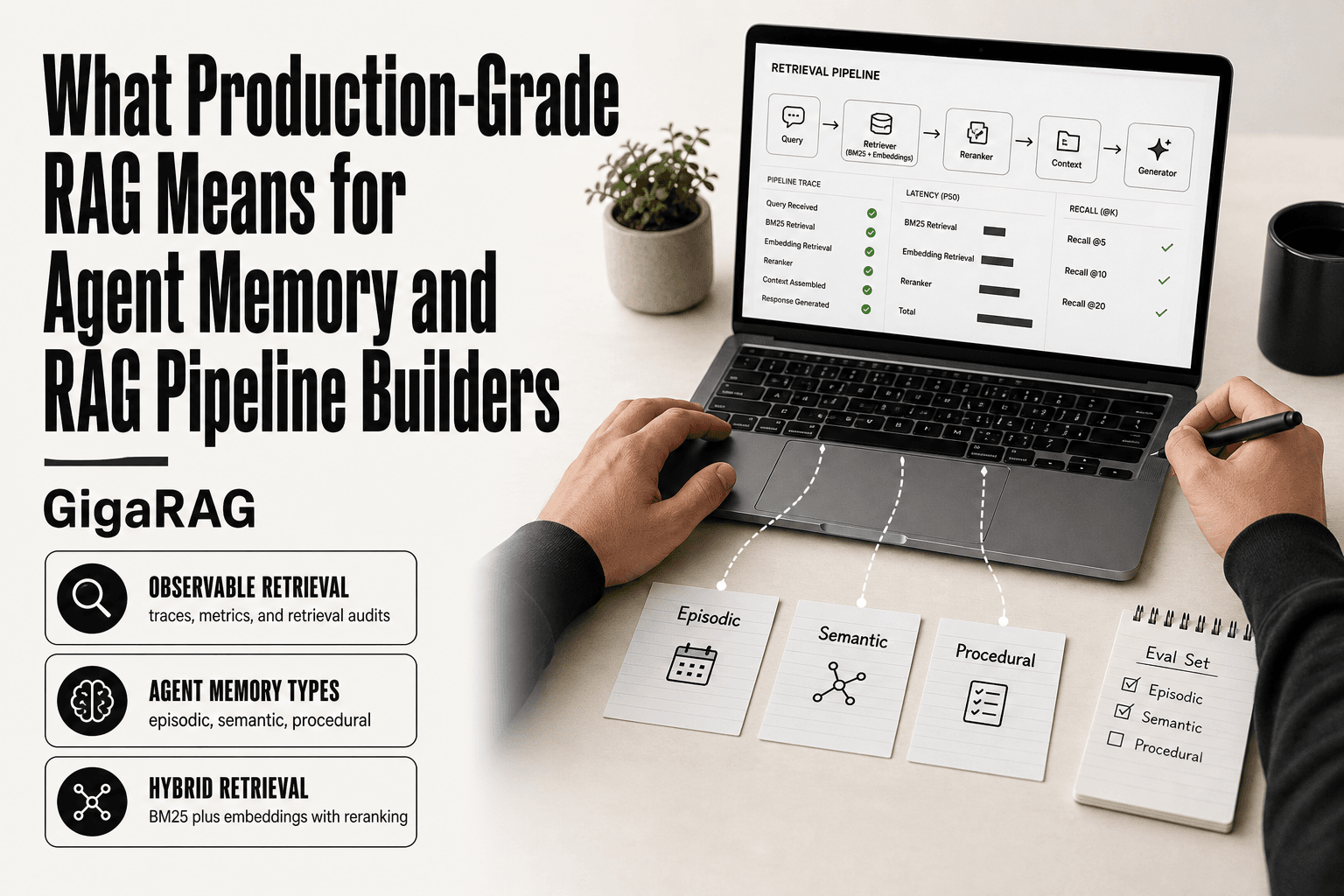
What Production-Grade RAG Means for Agent Memory and RAG Pipeline Builders
What production-grade RAG means for agent memory builders is the difference between a notebook demo that works once and a system your agent depends on every single call. You can wire up a vector store, embed some documents, and get impressive answers in an afternoon. Then you ship it. The agent starts retrieving stale context, hallucinating on gaps, and blowing your latency budget on a Tuesday afternoon. That's the real test.
The good news is the bar is knowable. Production-grade RAG means retrieval that stays accurate under real load, chunking that survives messy source data, observability that tells you when retrieval fails, and guardrails that keep bad context out of the answer. None of it is magic. Most of it is unglamorous engineering.
GigaRAG treats this as infrastructure for agent memory, not a demo feature. This guide covers what production-grade RAG actually requires, how it serves as external memory for agents, what it cannot do, and the mistakes that sink pipelines before they ever reach production.
| At a glance | Details |
|---|---|
| Core idea | RAG as reliable agent memory layer |
| Memory types | Episodic, semantic, procedural |
| Key metrics | Latency, recall, freshness, cost |
| Main risk | Stale or wrong retrieved context |
| Hard limit | Cannot fix missing or bad data |
| Build vs buy | Depends on team and scale |
In This Guide
- What RAG Means in Production
- Prototype RAG vs Production-Grade RAG
- Production-Grade RAG as Agent Memory Infrastructure
- What Production-grade Rag Means: A Step-by-Step Guide
- Retrieval Strategies That Survive Production
- Chunking Strategies for Reliable Retrieval
- Observability and Guardrails for Production RAG
- What Production-Grade RAG Cannot Do
- Security, Governance, and Compliance
- Common Mistakes When Building Production-Grade RAG
- How to Build a Production-Grade RAG Pipeline
- Final Thoughts on Production-Grade RAG
What RAG Means in Production
RAG stands for retrieval-augmented generation: a pattern where an LLM pulls relevant context from an external knowledge source before generating a response, instead of answering from its training data alone.
The retrieval step grounds the model's output in documents, records, or memory you control. That's the whole point. The model stops being the source of truth and becomes a reasoning layer over your data.
The basic RAG loop
The loop has four steps. You ingest documents, split them into chunks, and embed each chunk into a vector. When a query arrives, you embed it the same way and find the nearest chunks in vector space. You stuff those chunks into the prompt as context. The model generates an answer from that context.
That's it. A weekend project can do all four steps with a few hundred lines of Python.
Prototype vs production: the real difference
A prototype answers the question "does retrieval improve my answers?" A production system answers a harder question: "does retrieval stay correct, fast, and safe when traffic, data, and failure modes all change at once?"
Here's what changes. A prototype runs one query at a time against a static dataset. Production runs concurrent queries against data that updates daily or hourly. A prototype tolerates a 3-second latency. Production has a latency budget, often 200-500ms for retrieval, because the agent is waiting on that context before it can act. A prototype fails loudly. Production fails silently unless you build observability to catch it.
The honest answer is that most RAG demos are not RAG systems. They're retrieval demos with a chat wrapper.
Why "production-grade" is a reliability bar, not a feature
Production-grade is not a checkbox on a vendor's pricing page. It's a set of properties your system either has or doesn't: retrieval quality you can measure, latency you can bound, failures you can see, and access controls you can enforce.
You don't buy production-grade. You build toward it, and you verify it with evaluation runs, not vibes.
[!note] Production-grade RAG does not guarantee correctness; it makes retrieval reliable, observable, and safe enough for agents to depend on, but it cannot fix missing, outdated, or contradictory source data.
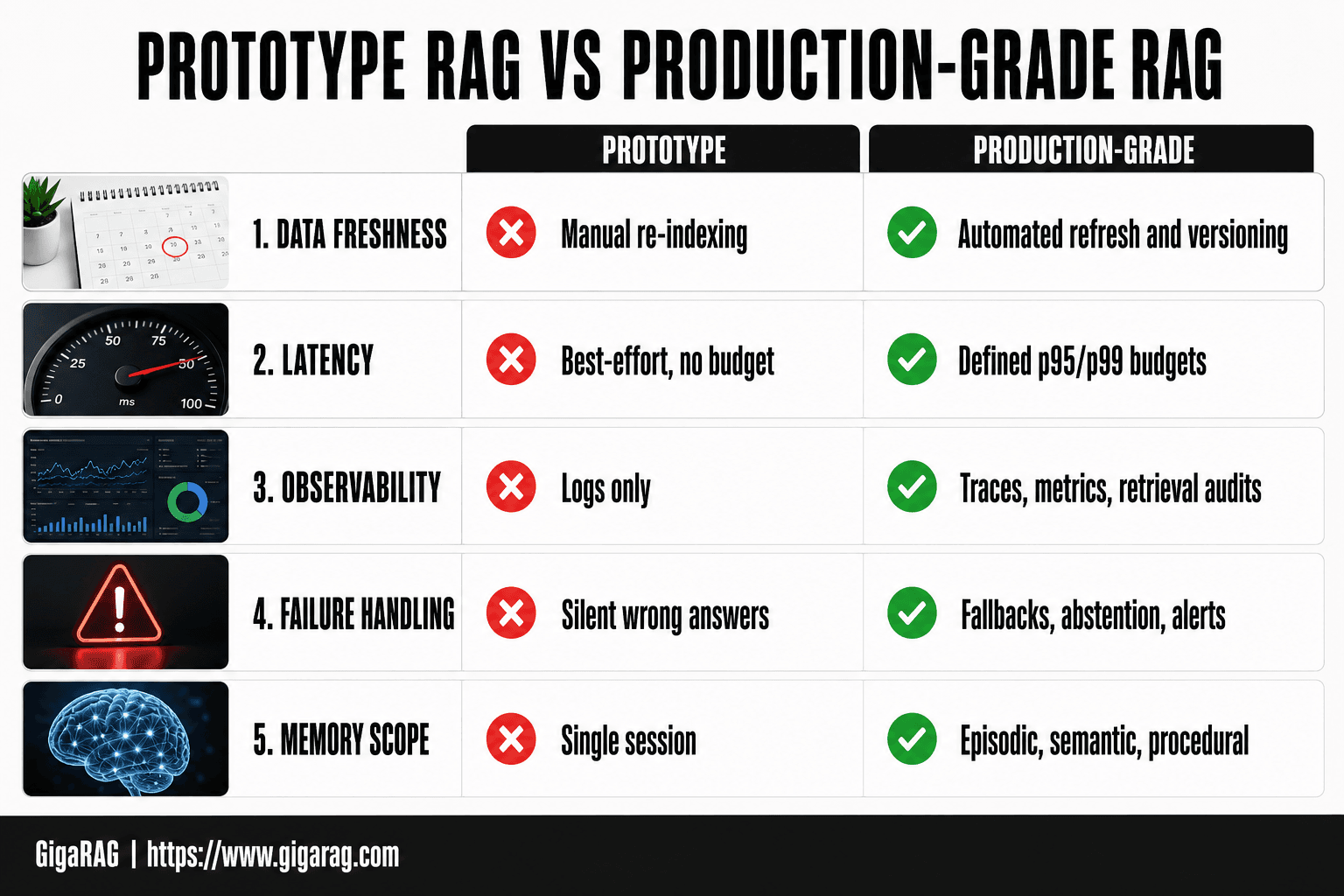
Prototype RAG vs Production-Grade RAG
| Factor | Prototype RAG | Production-Grade RAG |
|---|---|---|
| Data freshness | Manual re-indexing | Automated refresh and versioning |
| Latency | Best-effort, no budget | Defined p95/p99 budgets |
| Observability | Logs only | Traces, metrics, retrieval audits |
| Failure handling | Silent wrong answers | Fallbacks, abstention, alerts |
| Memory scope | Single session | Episodic, semantic, procedural |
Production-Grade RAG as Agent Memory Infrastructure
An agent that can't remember is just a chatbot with extra steps. Memory is what lets an agent act across turns, learn from past interactions, and stop repeating the same mistake. RAG is the cheapest, most controllable way to give an agent that memory without retraining a model.
Episodic, semantic, and procedural memory in agents
Cognitive science splits memory into three types, and the split maps cleanly onto agent architecture.
Episodic memory is the record of what happened: past conversations, past actions, past outcomes. An agent uses it to answer "what did I try last time?" Semantic memory is the store of facts and concepts: your product docs, your policies, your domain knowledge. Procedural memory is the how-to: the skills, workflows, and decision rules the agent follows.
RAG handles the first two well. You store conversation transcripts and action logs as episodic chunks. You store documentation and knowledge base entries as semantic chunks. Procedural memory is different. That lives in the agent's system prompt, its tool definitions, or its fine-tuned weights. RAG can retrieve a procedure, but it doesn't execute one.
How RAG becomes external memory
The mechanism is straightforward. Instead of relying on the model's internal weights to hold everything, you write memory to an external store and retrieve it on demand.
Here's what happens behind the scenes. When an agent finishes a turn, you append a summary or the raw exchange to a memory index. When the next turn starts, you embed the new query, retrieve relevant memory chunks, and stuff them into the context window alongside the current task. The model now has access to information it never saw during training.
The good news is that this memory is inspectable. You can see exactly what the agent retrieved and why. You can delete a bad memory by removing a chunk. You can't do that with fine-tuning without retraining the whole model.
The main catch is that retrieval quality becomes the ceiling on memory quality. If your embedding model doesn't surface the right chunk, the agent acts as if the memory doesn't exist.
Memory refresh and context window management
Context windows are finite. You can't stuff an agent's entire history into every prompt, and you shouldn't try.
In practice, you manage this with a refresh strategy. Summarize old episodic chunks into compressed semantic chunks. Drop or archive chunks that haven't been retrieved in N turns. Set a retrieval budget per turn: top-K chunks, a token cap for retrieved context, and a hard cutoff on chunk age.
The honest answer is that memory refresh is a pipeline problem, not a model problem. It depends on your retrieval latency budget, your chunk size, and how much history your agent actually needs to do its job. A support agent needs the last three turns. A research agent needs a week of context. Build the refresh cadence around the use case, not the other way around.
[!tip] For agent memory, treat episodic, semantic, and procedural memory as separate retrieval indexes with their own refresh cadences and latency budgets — mixing them into one index is a common cause of unreliable agent behavior.
What Production-grade Rag Means: A Step-by-Step Guide
- Define latency, recall, and freshness budgets for each agent memory type.
- Design ingestion pipelines with versioning, deduplication, and refresh schedules.
- Choose retrieval strategies (hybrid, reranking) and tune chunking per memory type.
- Add observability: trace every retrieval, log scores, and monitor drift.
- Implement fallbacks and abstention so agents fail safely when context is weak.
- Test under realistic load and adversarial queries before shipping.
- Review and iterate on memory refresh and context window management regularly.
Retrieval Strategies That Survive Production
Retrieval is where most RAG demos die. A notebook pipeline works because the test queries are close to the chunks. Production queries are messy, ambiguous, and full of terms your embedding model never saw. The fix is not a better embedding model. It's a retrieval stack that combines multiple signals.
Vector search alone is not enough
Vector search finds semantically similar text. That's useful, but it has blind spots. Exact identifiers fail: a query for "error code 503" may surface chunks about server errors generally, not the specific code. Rare terms get diluted. Acronyms and product names often embed poorly because they appear infrequently in training data.
The honest answer is that vector search is a recall tool, not a precision tool. It's good at finding roughly relevant chunks. It's bad at knowing when a chunk is exactly right.
Hybrid retrieval: BM25 plus embeddings
BM25 is a lexical search algorithm that matches exact words and phrases. It's been around for decades and it still works. When you combine BM25 with vector search, you get the strengths of both: semantic matching for paraphrased queries, lexical matching for exact terms and identifiers.
Here's how it works in practice. You run the query through both indexes. You get two ranked lists. You merge them, usually with reciprocal rank fusion, which takes the harmonic mean of the ranks from each list. The merged list goes to the reranker.
The good news is that hybrid retrieval is cheap to add. Most vector databases support BM25 alongside vector search. You don't need a new infrastructure. You need a merge step and a reranker.
Reranking and latency budgets
Reranking is the step that separates production retrieval from demo retrieval. A reranker takes the top 50 or 100 candidates from hybrid retrieval and scores them with a cross-encoder model that reads the query and chunk together. It's slower than embedding search, but far more precise.
The main catch is latency. A cross-encoder reranker adds 50 to 200 milliseconds per query depending on model size and batch. That's fine for a single-turn chatbot. It's a problem for an agent that makes five retrieval calls per turn.
In practice, you set a latency budget and work backward. If your agent has 800 milliseconds total for retrieval, you might spend 50 on embedding search, 100 on BM25, and 200 on reranking the top 20 candidates. The rest goes to generation. Don't rerank 100 chunks if your budget only allows 20.
Make sure you measure the tradeoff. Reranking more candidates improves precision, but the gains flatten quickly. Test with your own queries before you commit to a reranker.
Chunking Strategies for Reliable Retrieval
Chunking is the quiet decision that shapes every retrieval you'll ever run. Split documents wrong and even a perfect hybrid retrieval stack returns fragments that miss the point. Split them right and your agent pulls memory that actually answers the question.
Chunk size and overlap tradeoffs
Chunk size is a precision-recall tradeoff. Small chunks, 100 to 200 tokens, retrieve tightly but lose context. A chunk that says "the server returned it" is useless without the preceding sentence naming the error. Large chunks, 800 to 1,200 tokens, preserve context but dilute the embedding. The vector averages too many ideas and matches nothing well.
Overlap is the cheap fix. A 10 to 15 percent overlap between adjacent chunks keeps boundary sentences from getting orphaned. The cost is storage and a few duplicate retrievals. Worth it for technical docs where definitions span sentence boundaries.
Structure-aware chunking
Don't chunk by character count alone. Respect document structure: headings, code blocks, tables, list items. A code block split across two chunks is broken for retrieval. A table row torn in half loses its meaning.
The practical rule: chunk by section, not by size. When a section runs long, split at paragraph boundaries. When a code block or table appears, keep it whole or move it to its own chunk. This takes a parser, not a regex.
Chunking for agent memory vs document search
Agent memory is not document search. Document search wants the most relevant passage. Agent memory wants the right fact with enough context to act on it.
For episodic memory, chunk by event. Each interaction, decision, or outcome becomes its own chunk with a timestamp. For semantic memory, chunk by concept. A procedure, a policy, a known constraint. Don't mix them in one index.
The main catch is that agent memory chunks need stable IDs. When a memory updates, you replace the chunk, not append a new one. Otherwise your agent retrieves stale facts alongside fresh ones and can't tell which is current.
Observability and Guardrails for Production RAG
A RAG pipeline that works in a notebook tells you nothing about how it will behave under real load. Production means users ask questions you never anticipated, documents drift, and latency budgets get blown. You can't fix what you can't see.
What to monitor in a production RAG pipeline
Start with retrieval quality. Log every query, the chunks retrieved, and the scores assigned. When an answer is wrong, you need to know whether retrieval failed or generation failed. Those are different bugs with different fixes.
Latency is the second thing. Track time-to-first-token and total response time separately. A pipeline that retrieves in 80 milliseconds but generates for 4 seconds has a generation problem, not a retrieval problem. Set a latency budget per query and alert when you cross it.
Hallucination is the third. You can't measure it directly without ground truth, but you can proxy it. Track the semantic distance between retrieved chunks and the generated answer. Large distance means the model is inventing. Track refusal rates too. A model that never says "I don't know" is a model that guesses.
Guardrails: input filtering, output validation, PII redaction
Input filtering catches junk before it hits your pipeline. Block prompt injection attempts, strip markup, and reject queries that are clearly out of scope. Don't over-filter. A query that looks odd to a regex might be legitimate. Log what you block and review it weekly.
Output validation is the harder guardrail. Before an answer reaches the user, check it against the retrieved chunks. If the answer makes claims that don't appear in any chunk, either cite the gap or refuse. This is not a guarantee against hallucination. It's a tripwire.
PII redaction belongs at both ends. Redact PII from documents before embedding, and redact PII from generated answers before returning them. The first protects your index. The second protects your users. Use a named entity recognition pass, not a regex. Regex misses names it has never seen.
Evaluation metrics that matter
Precision and recall at the retrieval layer. Precision measures how many retrieved chunks were relevant. Recall measures how many relevant chunks you found. Both matter, and they trade off. Track them per query type, not just as an average.
Answer faithfulness measures whether the generated answer is supported by the retrieved chunks. Answer relevance measures whether the answer actually addresses the query. These are separate. An answer can be faithful but irrelevant, or relevant but invented.
The honest answer is that you need a labeled evaluation set before any of this works. Fifty to a hundred real queries with known-good answers. Run it on every pipeline change. Without it, you're guessing.
What Production-Grade RAG Cannot Do
Production-grade RAG is a reliability bar, not a magic trick. It makes retrieval dependable under load. It does not make the underlying model truthful. The honest answer is that some failure modes are baked into the architecture, and no amount of observability or guardrails removes them.
No guaranteed zero hallucination
RAG reduces hallucination by grounding generation in retrieved chunks. It does not eliminate it. The model can still ignore the chunks, misread them, or stitch together claims that sound plausible but aren't supported. Retrieval can also fail silently: the right chunk exists but wasn't retrieved, so the model answers from its own weights.
You can measure hallucination with faithfulness metrics. You can tripwire it with output validation. You cannot guarantee zero. Anyone who promises that is selling something.
Not a replacement for fine-tuning
RAG and fine-tuning solve different problems. RAG gives the model access to external knowledge without retraining. Fine-tuning changes how the model behaves: tone, format, task-specific reasoning, domain vocabulary.
If your agent needs to follow a specific output schema or reason in a specialized way, RAG won't get you there. You'll still need fine-tuning or careful prompting. The two work together. RAG handles the knowledge. Fine-tuning handles the behavior. Treating RAG as a substitute for fine-tuning leads to agents that retrieve the right information and then use it wrong.
No real-time memory without extra architecture
A standard RAG pipeline is static. You ingest documents, embed them, and query the index. Nothing about that loop updates itself when new information arrives. If your agent needs to remember something that happened five minutes ago, a vanilla RAG index won't help.
Real-time memory requires additional architecture: a write path that ingests new events, a refresh schedule that re-embeds changed documents, and a retrieval layer that knows what's fresh. Episodic memory, the kind that tracks what an agent did and learned during a session, sits outside the basic RAG loop entirely. You build it on top of RAG, not with RAG alone.
Keep this in mind when you scope a project. RAG gives you a memory store. It does not give you a memory system.
Security, Governance, and Compliance
Memory retrieval is a security surface. When an agent can pull from a knowledge base, it can also pull things it shouldn't. Access control, retention, and compliance aren't add-ons. They're part of the retrieval path itself.
Access control for memory retrieval
The main catch: vector databases don't inherit your app's permissions. You can't just drop documents into an index and assume the right users see the right chunks. You need to filter at query time, passing the user's permissions into the retrieval call so the index only returns chunks they're allowed to see.
This matters more for agent memory. An agent acting on behalf of a user inherits that user's access. If the retrieval layer doesn't enforce it, the agent becomes a privilege escalation vector. Filter before generation, not after.
Data governance and retention
Memory accumulates. Episodic memory especially: every session adds new events, and without a retention policy the index grows without bound. You need explicit rules for what gets stored, how long it stays, and when it gets purged.
PII makes this harder. If your agent remembers user conversations, those embeddings contain personal data. You need redaction at ingestion, not just at output. Once PII is embedded, deleting the source document doesn't remove it from the vector space.
Compliance basics for RAG pipelines
Compliance depends on what you store and where. GDPR gives users the right to be forgotten, which means your index needs a delete path that actually removes vectors, not just marks them inactive. HIPAA and SOC 2 add audit requirements: who retrieved what, when, and why.
The honest answer is that most RAG frameworks don't handle this out of the box. You'll build the audit trail, the retention scheduler, and the access filters yourself. Budget for it before you ship.
Common Mistakes When Building Production-Grade RAG
Most RAG failures aren't architectural. They're operational. The pipeline works in a notebook, then falls over the first time real traffic hits it. Here are the three mistakes I see most often, and what to do instead.
Treating RAG as a one-time setup
A RAG pipeline is not a build-once system. Your documents change, your users ask new questions, your embedding model gets replaced, and your chunking strategy stops fitting the data. If you treat the index as static, retrieval quality decays quietly.
The fix is a refresh schedule. Re-embed when your source data changes, re-evaluate when you swap models, and re-chunk when you change document types. Memory for agents is worse: episodic memory grows every session, so the index needs continuous ingestion, not a batch job.
Ignoring latency and cost
Prototypes hide latency. You call an embedding API, wait 200ms, run a vector search, wait again, then generate. In production, that adds up across every agent turn. A retrieval step that takes 800ms is fine in a demo and unusable in a conversation.
Measure it before you ship. Set a latency budget per retrieval call, then track p50 and p95. Cost is the same story: embedding and generation tokens scale with traffic, and a pipeline that costs $0.02 per query in testing can cost thousands per day in production. Cache what you can, and batch where it makes sense.
Skipping evaluation
You can't improve what you don't measure. Builders ship a RAG pipeline without a single evaluation metric, then wonder why retrieval quality drifts. The honest answer is that evaluation is boring, and it's the only thing that tells you when your pipeline breaks.
Start with a small ground-truth set: 50 to 100 questions with known-good answers. Run them through retrieval, measure recall and answer quality, and track the numbers over time. When you change chunk size or swap embedding models, re-run the set. Without it, every change is a guess.
How to Build a Production-Grade RAG Pipeline
The build path is straightforward. The hard part is doing each step well enough that the pipeline survives contact with real users. Here's the sequence I'd follow, with agent memory as the use case.
Data ingestion and cleaning
Start with the source data, not the model. Your retrieval quality is capped by what you put in. For agent memory, that means session transcripts, tool outputs, user preferences, and any documents the agent has read.
Clean aggressively. Strip HTML, remove boilerplate, deduplicate near-identical chunks, and redact PII before anything gets embedded. A single malformed record won't break your index, but a thousand will quietly degrade retrieval. Normalize timestamps and attach metadata: source, session ID, user ID, access level. Metadata is what lets you filter later, and filtering is what keeps memory retrieval scoped to the right context.
Embedding and indexing
Choose an embedding model that fits your latency and cost budget. You don't need the largest model available; you need one that retrieves well on your data. Test it before committing.
Index into a vector database that supports metadata filtering and hybrid search. Store the raw chunk alongside the embedding so you can return source text without a second lookup. For agent memory, partition the index by memory type: episodic, semantic, procedural. That separation makes retrieval faster and keeps unrelated memories from bleeding into each other.
Retrieval, reranking, and generation
Run hybrid retrieval: BM25 plus vector search, merged. BM25 catches exact terms and rare tokens that embeddings miss. Vector search catches paraphrase and semantic similarity. Combine the two result sets, then rerank.
Reranking is where retrieval quality actually improves. A cross-encoder reranker scores each candidate against the query, and the top 5 to 10 chunks after reranking are what you feed the generator. Keep the context window tight. More chunks is not better; it dilutes the signal and adds latency.
Evaluation and iteration
Build a ground-truth set before you ship. 50 to 100 queries with known-good answers, drawn from your actual data. Run them through the full pipeline, measure recall and answer quality, and store the numbers.
Re-run the set every time you change something: chunk size, embedding model, reranker, prompt template. When a change improves one metric and hurts another, you'll see it in the numbers instead of guessing. Evaluation is the only thing that turns RAG from a demo into a system you can trust.
Final Thoughts on Production-Grade RAG
What production-grade RAG means, stripped down, is this: retrieval you can trust when the agent can't ask a human for help. The demo works in a notebook. Production works at 3 a.m. with a queue backing up and a user waiting on an answer that has to be right.
The honest framing hasn't changed across this piece. You need hybrid retrieval, structure-aware chunking, observability, guardrails, and an evaluation harness you actually run. You need to accept that RAG won't give you zero hallucination, won't replace fine-tuning everywhere, and won't do real-time memory without extra architecture.
If you're building agent memory and RAG pipelines and want the infrastructure handled, GigaRAG is built for exactly that: retrieval, chunking, and evaluation as a managed layer. It won't solve every problem here. Nothing will. But it removes the plumbing so you can spend your time on the parts that need your judgment.
Frequently Asked Questions
How to build a production grade RAG?
Start by defining latency, recall, and freshness budgets for your use case. Then build ingestion with versioning and automated refresh, choose retrieval strategies like hybrid search and reranking, and add observability and fallbacks. Test under realistic load and iterate based on retrieval metrics, not just answer quality.
What does RAG stand for?
RAG stands for Retrieval-Augmented Generation. It combines a retrieval system that fetches relevant context with a generative model that produces answers conditioned on that context. In production, RAG also serves as external memory for agents.
Is ChatGPT a RAG?
ChatGPT is a generative model that can be used within a RAG system, but it is not RAG by itself. RAG requires an external retrieval layer that fetches context for the model. Some ChatGPT features use retrieval, but the model alone is not a RAG pipeline.
What is a RAG rating?
A RAG rating typically refers to a Red-Amber-Green status indicator used in project management to show health or risk. It is unrelated to Retrieval-Augmented Generation, though the acronym overlap can cause confusion.
What are the limitations of production-grade RAG?
Production-grade RAG cannot fix missing, outdated, or contradictory source data. It cannot guarantee factual correctness if the model misinterprets context. It also cannot eliminate latency entirely, and it requires ongoing maintenance of indexes and refresh pipelines.
How does RAG serve as agent memory?
RAG acts as external memory by storing episodic events, semantic facts, and procedural knowledge in retrievable indexes. Agents query these indexes to recall past interactions, ground decisions in facts, and follow learned procedures. Each memory type may need its own retrieval strategy and refresh cadence.
What latency should I target for production RAG?
Latency targets depend on the agent's use case, but interactive agents often aim for retrieval under a few hundred milliseconds and end-to-end responses under a few seconds. Set explicit p95 and p99 budgets and monitor them, rather than relying on averages.
About GigaRAG
GigaRAG is for agent memory and RAG pipeline builders. get this right. Whether you are working through what production-grade rag means or something adjacent, we publish what we have actually tested, including where it falls short.


