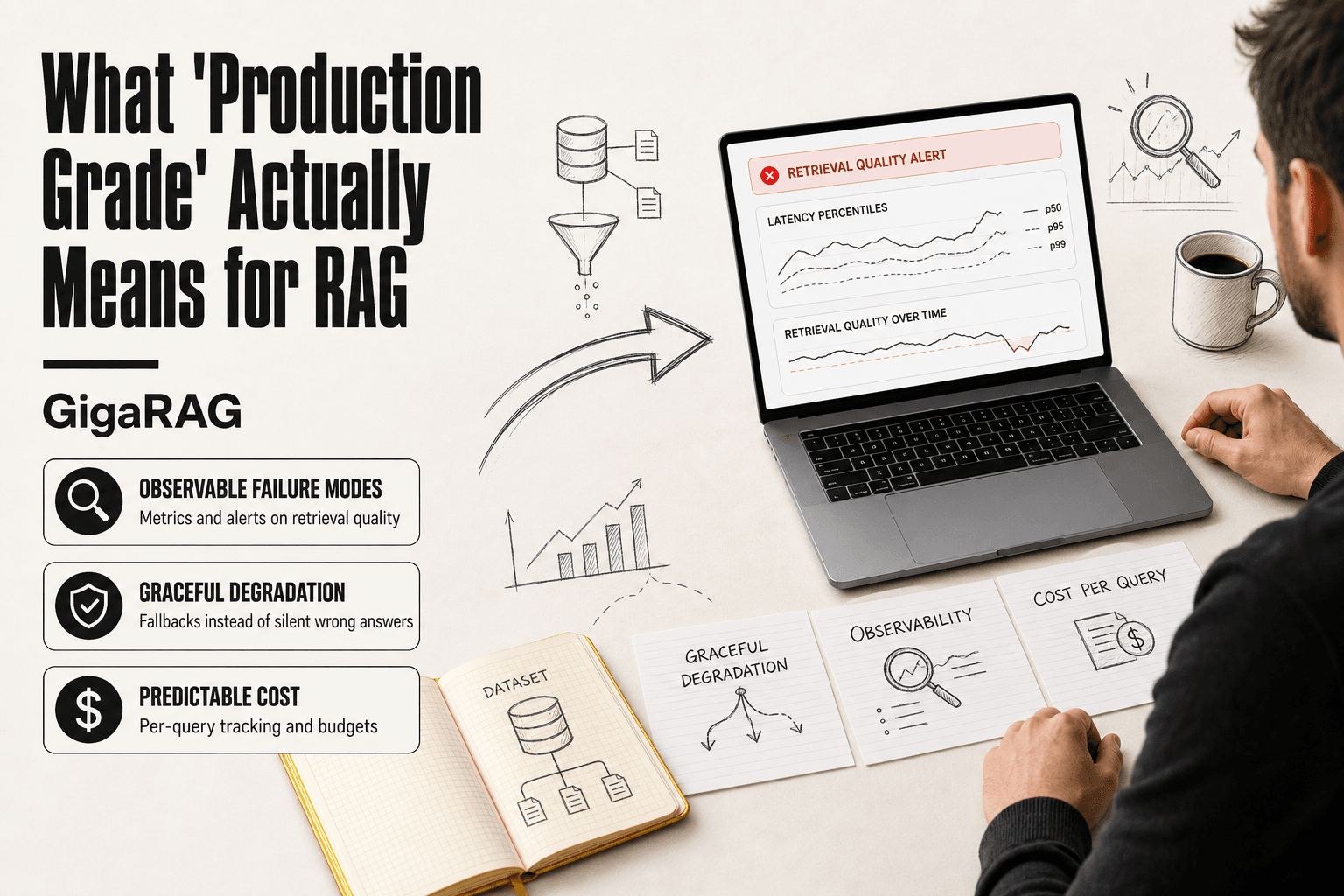
What 'Production Grade' Actually Means for RAG
Production grade RAG is the gap every agent memory and pipeline builder hits the same way: the demo works in a notebook, then you deploy it and retrieval quality degrades, latency spikes, and users complain about hallucinations. The honest answer is that production grade isn't a feature you add. It's a set of properties your system must demonstrate under real conditions: graceful degradation instead of silent failure, metrics you actually track, access control that survives a security review, and cost per query you can predict. Tools like GigaRAG are built for exactly this audience, but no tool makes you production grade by itself. The main catch is that most advice stops at architecture diagrams and skips the failure modes. This guide covers what production grade RAG concretely means, what it does and does NOT guarantee, and a maturity checklist you can apply to your own pipeline today.
| At a glance | Details |
|---|---|
| Core idea | Production grade is proven under real load |
| Biggest myth | Zero hallucination is achievable |
| First priority | Retrieval quality before generation |
| Key metric | Groundedness and citation coverage |
| Common failure | Demo works, production degrades |
| Maturity signal | Observability and fallback paths |
In This Guide
- What Is Production-Grade RAG?
- Prototype RAG vs Production-Grade RAG
- Production-Grade RAG vs. Prototype RAG: The Core Differences
- Production Grade RAG: A Step-by-Step Guide
- The Four Levels of RAG: Where Production-Grade Fits
- Retrieval Quality: The Foundation of Production-Grade RAG
- Evaluation: How to Know Your RAG Is Actually Working
- Scalability: Designing for Growth Without Breaking
- Hallucination Reduction: What's Realistic and What's Not
- What Production-Grade Does NOT Mean
- Agent Memory: The Production-Grade RAG Use Case Nobody Covers
- A Production-Grade RAG Maturity Checklist
- How to Build a Production-Grade RAG Pipeline
- Common Mistakes When Building Production-Grade RAG
- Final Thoughts: What Production-Grade RAG Actually Requires
What Is Production-Grade RAG?
Production-grade RAG is a retrieval-augmented generation system that maintains acceptable retrieval quality, latency, and cost under real user load, with observable failure modes and defined recovery paths. A prototype answers questions correctly in a notebook. A production system keeps answering correctly when traffic spikes, documents change, and nobody is watching the logs.
The gap between demo RAG and production RAG
Your demo worked. You loaded 200 PDFs into a vector database, wired up an embedding model, and asked it questions. The answers looked right. Then you deployed it, and within a week users reported hallucinations, timeouts, and answers that referenced documents deleted months ago.
The gap isn't a missing feature. It's a missing set of properties. A demo needs to work once, for one user, on a fixed dataset. Production needs to work continuously, for concurrent users, on data that changes. Those are different engineering problems.
The main catch is that most RAG tutorials stop at the demo. They show you the happy path: clean documents, perfect queries, no load. Production is the unhappy path, and it's where retrieval quality actually gets tested.
A working definition: properties, not features
Production-grade RAG is defined by properties the system demonstrates, not features it has. You can't buy "production grade" as an add-on. You build it into the system's behavior.
The properties that matter:
- Predictable latency under concurrent load, not just single-query speed
- Graceful degradation when retrieval fails, instead of silent wrong answers
- Observable behavior through metrics and logs that tell you when quality drops
- Reproducible evaluation against a golden dataset, not vibes
- Bounded cost per query, tracked and optimized
A system that lacks any of these is a prototype wearing production clothes. It might work today. It won't survive next week's traffic spike or next month's data refresh.
Why "production grade" is a spectrum, not a checkbox
There's no certification for production-grade RAG. No test you pass and then stop worrying. It's a spectrum, and where you sit depends on your constraints.
A system serving 50 internal users with a 2-second latency budget is production-grade for that context. The same system serving 50,000 external users with a 200-millisecond budget is not. The architecture might be identical. The requirements aren't.
It depends on three things: your user count, your latency budget, and your tolerance for wrong answers. A customer-facing support bot has near-zero tolerance for hallucination. An internal research assistant can absorb more. Both can be production-grade, but they need different levels of rigor.
The honest answer is that most teams don't need the maximum level of everything. They need to know which properties matter for their context, measure those, and stop optimizing the rest.
[!note] Production grade is a set of demonstrated properties under real conditions, not a library or a model choice. A system can use the same stack as a demo and still fail production because it lacks evaluation, observability, and failure handling.
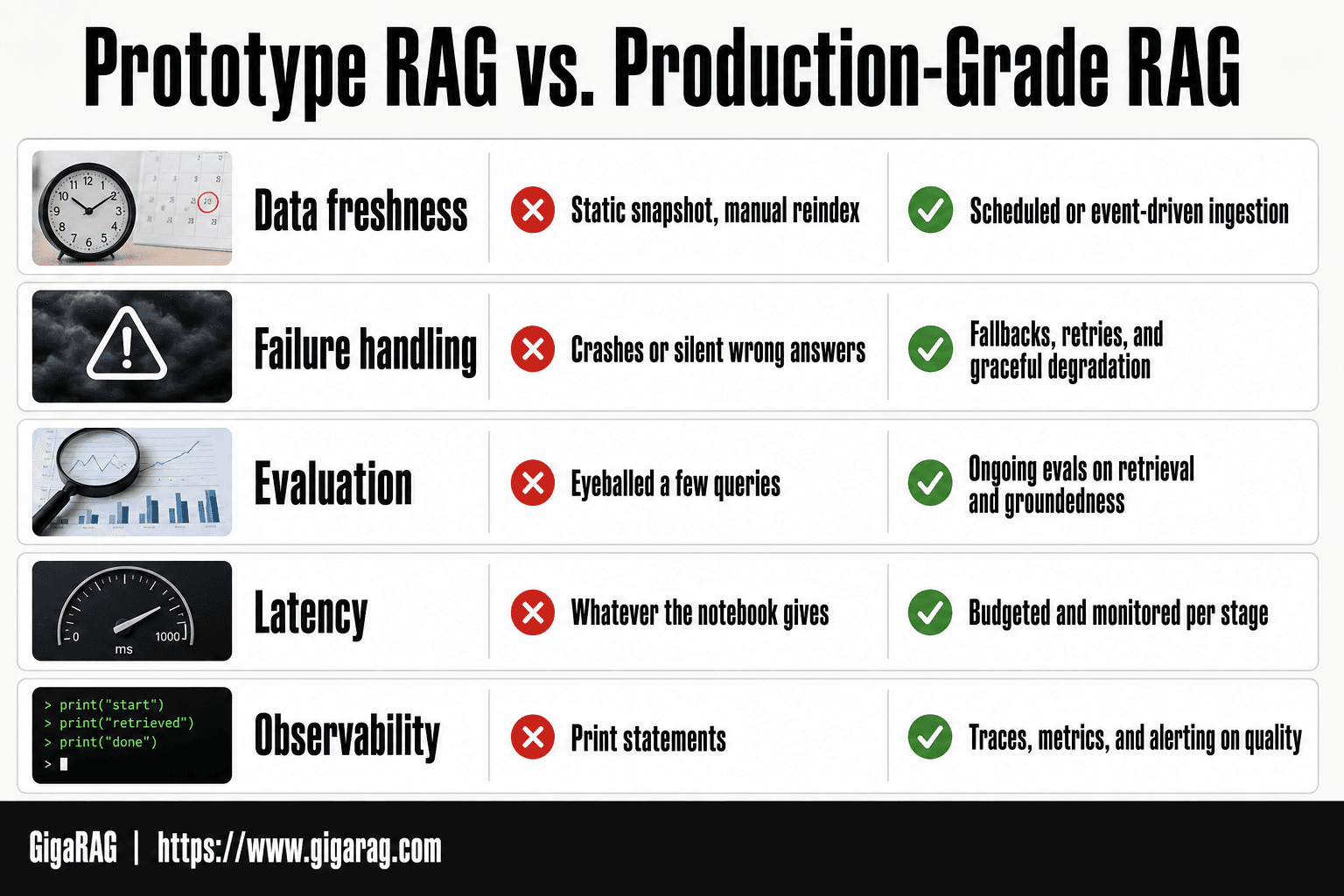
Prototype RAG vs Production-Grade RAG
| Factor | Prototype RAG | Production-Grade RAG |
|---|---|---|
| Data freshness | Static snapshot, manual reindex | Scheduled or event-driven ingestion |
| Failure handling | Crashes or silent wrong answers | Fallbacks, retries, and graceful degradation |
| Evaluation | Eyeballed a few queries | Ongoing evals on retrieval and groundedness |
| Latency | Whatever the notebook gives | Budgeted and monitored per stage |
| Observability | Print statements | Traces, metrics, and alerting on quality |
Production-Grade RAG vs. Prototype RAG: The Core Differences
A prototype and a production system can run the same code. The difference is what happens when something breaks.
Reliability: graceful degradation vs. silent failure
A prototype fails loudly. It crashes, throws an exception, or returns an empty result. You notice, you fix it, you move on.
Production systems fail quietly. The vector database times out, so the retriever returns whatever it found in the first 100 milliseconds. The embedding model returns a slightly wrong vector, so the top result is close but not right. The LLM fills the gap with plausible-sounding text. Nobody sees an error. Users see a wrong answer.
Production-grade RAG handles this with fallback paths. If hybrid search fails, drop to keyword-only. If the reranker times out, serve unreranked results with a quality flag. The system degrades, but it degrades visibly.
Observability: metrics vs. vibes
Prototype evaluation is a feeling. You run ten queries, the answers look good, you ship it.
Production evaluation is a dashboard. You track retrieval precision, latency percentiles, hallucination rate, and cost per query. When precision drops from 0.82 to 0.71, you get an alert, not a user complaint.
The metrics that matter: p50 and p95 latency, retrieval hit rate against your golden dataset, and the rate of "I don't know" responses versus wrong answers.
Security and access control
Prototypes assume one user with full access. Production systems serve multiple users with different permissions.
If your RAG indexes documents from five departments, a query from marketing shouldn't retrieve engineering's roadmap. That means filtering at retrieval time, not after the LLM generates an answer. It also means audit logs for every query and response.
Cost predictability
Prototype cost is whatever your API bill says this month. Production cost is a per-query number you can forecast.
Embedding every document, reranking every candidate, and sending long contexts to the LLM all cost money. Production-grade systems track cost per query, set budgets, and cache aggressively. A prototype that costs $0.04 per query is fine. At 100,000 queries a month, that's $4,000 you didn't plan for.
[!tip] For agent memory builders: treat memory writes as a retrieval problem. If your agent stores everything, retrieval quality drops as memory grows — so add relevance filtering and decay at write time, not just at read time.
Production Grade RAG: A Step-by-Step Guide
- Define quality and latency budgets before writing more code.
- Build an evaluation set from real user queries, not synthetic ones.
- Instrument retrieval and generation stages with traces and metrics.
- Add fallbacks for empty retrieval, timeouts, and low-confidence answers.
- Automate ingestion, reindexing, and freshness checks.
- Run load tests that mimic peak concurrency, not average traffic.
- Set up alerts on groundedness and citation coverage regressions.
The Four Levels of RAG: Where Production-Grade Fits
The four levels of RAG aren't official standards. They're a useful way to describe how systems mature, from a weekend project to something you'd trust with customer data. Production-grade sits at level 3 and above.
Level 1: Naive RAG
Naive RAG is the tutorial version. You chunk documents, embed them, store the vectors, and retrieve the top-k matches when a query comes in. The retrieved chunks get stuffed into a prompt with the question, and the LLM answers.
It works in a notebook. It breaks on real documents with tables, mixed formats, or overlapping topics. There's no reranking, no query rewriting, no fallback. If the top-k chunks are wrong, the answer is wrong.
Level 2: Advanced RAG
Advanced RAG adds the techniques that fix the most obvious failures. Hybrid search combines BM25 keyword matching with vector similarity, so exact terms like "invoice 4471" actually surface. Reranking takes the top 50 candidates and scores them with a cross-encoder, keeping only the best 5. Query rewriting expands or clarifies the user's question before retrieval.
This is where most teams stop. It's good enough for internal tools and low-stakes customer-facing features. But it's still a single pipeline with fixed steps.
Level 3: Modular RAG
Modular RAG breaks the pipeline into swappable components. The retriever, reranker, and generator are separate modules you can replace independently. You might route queries to different retrievers based on intent, or swap embedding models without touching the rest of the system.
Production-grade starts here. Modularity is what makes observability, A/B testing, and incremental improvement possible. You can't measure what you can't isolate.
Level 4: Agentic RAG
Agentic RAG gives the system control over its own retrieval strategy. Instead of a fixed pipeline, an agent decides what to retrieve, when to retrieve it, and whether the retrieved context is sufficient. It can issue multiple queries, refine them based on results, and pull from different sources.
This is where agent memory lives. The system maintains state across turns, decides what's relevant to the current task, and retrieves from both long-term knowledge and recent conversation history. It's the most flexible level and the hardest to evaluate, because the retrieval path changes per query.
Retrieval Quality: The Foundation of Production-Grade RAG
Retrieval quality is the single biggest lever you control. The LLM can only answer from what you hand it. If the right chunk isn't in the top-k, no amount of prompt engineering saves you. Production systems treat retrieval as the product, not a preprocessing step.
Chunking strategies that survive real documents
Fixed-size chunking fails on real documents. A 500-token window cuts through tables, splits code blocks, and orphans headings from their content. Structure-aware chunking respects document boundaries: split on headings, keep tables intact, preserve code fences. Semantic chunking goes further, grouping text by meaning rather than character count. The tradeoff is latency and complexity. Start with structure-aware chunking on your actual documents, not synthetic ones. Test overlap. A 10-15% overlap between chunks recovers context lost at boundaries.
Hybrid search: why BM25 + embeddings beats either alone
Embeddings capture meaning. BM25 captures exact terms. Production queries need both. A user searching for "error code 503" needs keyword matching, not semantic similarity. A user asking "why is my service down" needs embeddings. Hybrid search runs both and merges results, typically with reciprocal rank fusion. It's not optional at production scale. Pure vector search misses identifiers, part numbers, and rare terms that embeddings smooth over.
Reranking as the highest-leverage quality improvement
Retrieval is cheap and approximate. Reranking is expensive and precise. The pattern: retrieve 50-100 candidates with hybrid search, then score them with a cross-encoder that reads the query and document together. Keep the top 5-10. This single change improves retrieval quality more than any embedding model swap. Cross-encoders are slow, so you can't run them on the full index. That's the point. They're a precision filter on top of a recall engine.
Retrieval metrics that matter in production
Recall@k tells you if the right chunk is anywhere in your candidates. It's the metric to optimize first. If recall@50 is below 90%, your retrieval is broken before reranking even runs. MRR measures how high the first relevant result ranks. nDCG weights relevance by position. Track all three on a golden dataset built from real queries, not synthetic ones. Benchmarks lie. Your users' actual questions don't.
Evaluation: How to Know Your RAG Is Actually Working
Benchmark scores tell you how your system performs on someone else's questions. Production tells you how it performs on yours. The gap between those two things is where RAG systems quietly fail.
Why benchmark scores lie about production performance
Public benchmarks are built from clean, well-formed queries. Your users don't write clean queries. They write fragments, typos, and questions that assume context you don't have. A system that scores 95% on a benchmark can still return garbage for "that thing from last week's meeting." Benchmarks also freeze in time. Your knowledge base doesn't. The only evaluation that matters runs on your data, your queries, and your failure modes.
Building a golden dataset for your domain
A golden dataset is a set of query-answer pairs where you've verified the correct answer and the source chunk that supports it. Build it from real user queries, not synthetic ones. Pull from support tickets, Slack questions, and search logs. For each query, record the expected retrieved chunk and the expected answer. Start with 50-100 examples. That's enough to catch regressions. Add to it every time a user reports a wrong answer. The dataset grows with your system's actual failures.
Knowledge freshness monitoring
Retrieval quality decays as your knowledge base changes. A chunk that answered correctly last month may be stale now. Track the age of your indexed documents. Flag anything older than your freshness threshold for re-ingestion. For time-sensitive domains, run scheduled checks: does the system still answer "what's the current pricing" correctly after a price change? Freshness failures are retrieval failures. They just happen slowly.
Load testing and latency budgets
A RAG system that works at 10 queries per minute can collapse at 100. Load test before you ship. Measure p50 and p95 latency under concurrent load. Set a budget: most users tolerate 2-3 seconds for a RAG response. If p95 exceeds that, you need to cut retrieval depth, swap rerankers, or cache embeddings. Latency isn't a quality metric until it is. A correct answer that takes 10 seconds is a wrong answer for most users.
Continuous evaluation: the feedback loop
Evaluation is not a one-time task. It's a loop. Log every query, the retrieved chunks, and the generated answer. Sample a percentage for human review. When a user marks an answer as unhelpful, capture that as a new golden dataset entry. Run your golden dataset on every pipeline change: new embedding model, new chunking strategy, new reranker. If recall drops, you know before users do. The systems that stay reliable are the ones that never stop measuring.
Scalability: Designing for Growth Without Breaking
Scalability isn't about handling 10 million documents someday. It's about what breaks first when you go from 10,000 to 100,000. The failure points are predictable: ingestion, index size, latency, and cost. You can design for all four before they hurt you.
Ingestion pipeline: the critical failure point
Ingestion is where prototypes die. A notebook script that chunks and embeds 1,000 documents in an afternoon will choke on 50,000. The fix is a queue-based pipeline: documents enter a queue, workers pull them, chunk, embed, and index. If a worker crashes, the document goes back on the queue. You don't lose data. You don't block the whole system on one bad PDF.
Throughput matters more than you think. If your pipeline processes 10 documents per minute, a 100,000-document backfill takes a week. That's fine for a one-time load. It's not fine when you need daily freshness. Measure documents per minute, not just "it works."
Index size and memory constraints
Vector indexes live in memory. The honest math: a 1,024-dimension embedding at float32 is 4KB per vector. A million vectors is 4GB. Add overhead for the index structure and you're at 6-8GB. That's fine on one machine. Ten million vectors is 40-80GB. Now you're sharding or paying for bigger instances.
The constraint isn't just RAM. It's recall under memory pressure. When an index doesn't fit in memory, the database swaps to disk. Latency spikes. Some databases handle this gracefully with disk-based indexes. Most don't. Check your vector database's memory behavior before you commit to it.
Latency budgets under concurrent load
One query taking 200ms is easy. A hundred concurrent queries each taking 200ms is a different system. The bottleneck is usually the reranker or the LLM call, not the vector search. Vector search parallelizes well. Reranking a hundred candidate sets at once does not.
Set a p95 latency budget and load test against it. If p95 exceeds 3 seconds under your expected peak load, you have three levers: reduce retrieval depth, cache frequent queries, or move reranking to a batch process. Don't wait for users to tell you it's slow.
Cost per query: the metric nobody tracks
Every query costs money: embedding, vector search, reranking, LLM tokens. Most teams don't know their cost per query. They should. A query that costs $0.01 at 1,000 queries per day costs $300 per month. At 100,000 queries per day, it's $30,000. The difference between a sustainable system and a surprise bill is knowing that number before you scale.
Track cost per query from day one. Break it down by component. When you know where the money goes, you know what to optimize.
Hallucination Reduction: What's Realistic and What's Not
Hallucination reduction is a set of techniques, not a destination. You can cut the rate dramatically. You cannot get it to zero. Anyone who tells you otherwise is selling something.
Grounding techniques that actually work
Grounding means forcing the model to answer from retrieved context, not from its training data. The techniques that move the needle:
- Prompt constraints. Tell the model: "Answer only from the provided context. If the context doesn't contain the answer, say so." This alone cuts hallucination rates meaningfully.
- Citation requirements. Require the model to cite the specific chunk it used for each claim. Models hallucinate less when they have to point at their source.
- Retrieval quality. Most "hallucinations" in RAG are actually retrieval failures. The model answers correctly from the wrong context. Fix retrieval first.
The honest mechanism: grounding works because it narrows the model's output space. It doesn't eliminate the model's tendency to confabulate. It just makes confabulation less likely and easier to catch.
Why "zero hallucination" is a marketing claim, not an engineering target
LLMs generate text probabilistically. There is no mechanism that guarantees factual accuracy on every output. Not prompt engineering. Not retrieval. Not fine-tuning. The model can always produce a plausible-sounding sentence that isn't supported by the context.
What you can measure is a hallucination rate: the percentage of responses that contain unsupported claims. A well-grounded RAG system might get that under 2%. That's a real engineering achievement. It is not zero.
Detecting and logging hallucinations in production
You can't fix what you can't see. Log every response with its retrieved context. Then check for grounding failures.
Two practical approaches:
- Automated checks. Use an LLM to compare the response against the retrieved context and flag unsupported claims. It's not perfect, but it catches most failures.
- Sampling and human review. Pull a random sample of responses daily and have a human check them. This gives you a real hallucination rate, not a benchmark number.
The main catch: detection itself is probabilistic. Your detector will miss some hallucinations and flag some correct answers. Treat it as a signal, not a verdict.
What Production-Grade Does NOT Mean
The phrase gets thrown around like it's a guarantee. It isn't. Production-grade RAG means your system has the properties to survive real conditions. It does not mean the system stops making mistakes. Here's what you should stop expecting.
It does not mean zero hallucinations
No architecture eliminates hallucination. Not RAG, not fine-tuning, not agentic loops. The previous section covered why: LLMs generate probabilistically, and grounding narrows the output space without closing it. Production-grade means you've built detection, logging, and a feedback loop. It means you catch failures fast and fix them. It does not mean failures never happen.
The honest target is a low, measured hallucination rate. Under 2% is achievable with strong grounding and retrieval. Zero is not an engineering goal. It's a sales pitch.
It does not mean set-and-forget
A production RAG system degrades without intervention. Embedding models drift as your data changes. Chunking strategies that worked at 10,000 documents break at a million. User queries shift. New document types appear. The retrieval quality you measured at launch is not the retrieval quality you'll have in six months.
Production-grade means you've built the monitoring to see degradation and the process to respond. It means continuous evaluation, not a one-time test. If you deploy and walk away, you don't have a production system. You have a prototype with extra steps.
It does not mean one-size-fits-all architecture
There is no reference architecture that works for every RAG use case. Agent memory needs different retrieval windows than document search. A compliance-heavy domain needs different access controls than a public knowledge base. A system serving 10 concurrent users has different constraints than one serving 10,000.
Production-grade means you've made deliberate choices about chunking, embedding, reranking, and infrastructure based on your specific constraints. It means you can explain why you chose hybrid search over pure vector search, or why your latency budget is 500ms instead of 200ms. Copying someone else's architecture without understanding the tradeoffs is how systems fail in production.
Agent Memory: The Production-Grade RAG Use Case Nobody Covers
Most RAG writing assumes you're building document search. You're not. You're building agent memory, and the two are different enough that advice for one breaks the other.
Why agent memory is harder than document search
Document search has a stable corpus. The documents exist before the query, they don't change mid-session, and relevance means "does this chunk answer this question." Agent memory has none of that. The corpus grows during the conversation. Facts get superseded. What the user said three turns ago matters more than what they said thirty turns ago, and the system has to know the difference.
The retrieval target also shifts. In document search, you retrieve to answer. In agent memory, you retrieve to maintain state: what has the user already told me, what did I promise, what constraint am I operating under right now. Miss a retrieval and the agent contradicts itself or forgets a commitment. That's a worse failure than a wrong answer, because the user sees it as the agent lying.
Statefulness, session context, and retrieval windows
A production agent memory system needs three things document search can ignore.
First, session boundaries. You need to know what belongs to this conversation and what belongs to the user's long-term profile. Mix them and you get an agent that treats a one-off preference as a permanent fact.
Second, a retrieval window that respects recency. The last five turns should almost always be in context. Older turns need retrieval. The cutoff depends on your use case: a coding agent might need the last 20 turns, a customer support agent might need only the last 5.
Third, write operations. Agent memory isn't read-only. The system writes summaries, extracts facts, and updates beliefs. That write path needs the same evaluation rigor as the read path. A bad write corrupts every future retrieval.
Memory decay and relevance scoring over time
Facts age. The user said they use Python 3.8 six months ago. They probably don't anymore. A production memory system needs decay: a relevance score that drops as facts go unconfirmed or get contradicted.
The mechanics matter less than the policy. You can decay by time, by contradiction, or by explicit user correction. What you can't do is treat every stored fact as equally true forever. That's how agents accumulate stale context and start making confident mistakes.
The honest answer is that agent memory is still an unsolved problem. The primitives exist: vector stores, rerankers, session management. The patterns don't. If you're building this, you're doing original engineering, not following a playbook.
A Production-Grade RAG Maturity Checklist
You've read what production-grade means, what it doesn't mean, and how agent memory changes the picture. Here's the checklist. Apply it to your own system and be honest about where you land. Most teams sit at Level 1 and don't know it.
Level 1: Baseline (what you need to survive)
- Retrieval works end to end. You can ingest documents, embed them, store them, and retrieve relevant chunks for a query. No silent failures in the pipeline.
- You have a golden dataset. Even 50 question-answer pairs from your actual domain beats a benchmark score. You can't improve what you can't measure.
- You log every query and response. When a user says the answer is wrong, you can find the exact retrieval that produced it.
- You have a rollback path. If an embedding model change degrades quality, you can revert to the previous index without downtime.
If you can't check all four boxes, you don't have a production system. You have a demo with extra steps.
Level 2: Reliable (what you need to trust)
- Latency budgets are defined and enforced. You know your p50 and p99 query times, and you alert when p99 crosses your budget. For most agent memory use cases, that's under 500ms for retrieval plus generation.
- Freshness monitoring runs on a schedule. You know how stale your index is right now, not just when you last ran ingestion. A document changed yesterday and your index still serves the old version: that's a bug you can detect.
- Hallucination logging is in place. You have a way to flag responses that cite no retrieved context or contradict it. You review those flags weekly, not quarterly.
- Access control is enforced at retrieval time. A user can't retrieve chunks they don't have permission to see, even if the embedding matches.
The gap between Level 1 and Level 2 is where most production incidents happen. Logging without alerting is just storage.
Level 3: Scalable (what you need to grow)
- Ingestion throughput is measured and load-tested. You know how many documents per minute your pipeline handles before it falls over, and you've tested it at 2x your current load.
- Cost per query is tracked. Not total spend. Per query. You know what a single retrieval plus generation costs, and you can explain why it changed month over month.
- Index rebuilds are non-blocking. You can re-embed your entire corpus without taking the system down or serving stale results during the rebuild.
- Evaluation runs continuously. Every deploy triggers an evaluation run against your golden dataset. A quality regression blocks the deploy.
Level 3 is rare. Most teams never get here because they never needed to. That's fine. What's not fine is claiming Level 3 because you bought a bigger vector database. Scalability is a property you demonstrate, not a feature you purchase.
How to Build a Production-Grade RAG Pipeline
The checklist tells you where you are. This section tells you how to move. Building production-grade RAG is not a linear path from step one to step five. It's a loop, and you'll run it more than once.
Step 1: Define your retrieval quality bar
Before you write a line of pipeline code, decide what "good enough" looks like. Pick a metric you can measure on your own data: recall@k on a golden dataset, or answer accuracy on a held-out set of real user questions. Write the number down. If you can't state your quality bar in one sentence, you're not ready to build anything.
The bar will be domain-specific. A legal research tool might need recall@10 above 0.9. A customer support bot might survive with 0.7 if the fallback is graceful. Don't copy someone else's number. Derive yours from what your users will tolerate.
Step 2: Build the ingestion pipeline
Ingestion is where production systems die. Chunking, embedding, metadata extraction, and index writes all happen here, and any failure is silent until a user asks a question and gets garbage back.
Start with a pipeline that is idempotent. Re-running ingestion on the same document should not create duplicate chunks. Add retries with backoff for embedding API calls. Store raw text alongside embeddings so you can re-chunk without re-fetching from source systems. And version your chunking logic: when you change chunk size or overlap, you need to know which index version used which settings.
Step 3: Implement evaluation from day one
You don't need a fancy evaluation framework to start. You need 50 real questions with known-good answers. Run them through your pipeline after every change. If recall drops, you know exactly which change caused it.
The trap is treating evaluation as a one-time gate. It's not. It's a regression suite. Every embedding model swap, every chunking tweak, every reranker change runs against the same golden dataset. No eval run, no deploy.
Step 4: Add observability and monitoring
Log every query, every retrieved chunk, and every generated response. Store them somewhere you can query. When a user reports a wrong answer, you should be able to pull the exact retrieval that produced it in under a minute.
Then add alerts. Latency p99 crossing your budget. Retrieval returning zero chunks for a query that should match. Embedding API error rates spiking. These are the failures that matter, and they're all detectable before users complain.
Step 5: Iterate on retrieval quality
Here's the part nobody says out loud: your first production deployment will not meet your quality bar. That's expected. The pipeline exists to make iteration cheap.
Start with the highest-leverage change: reranking. A cross-encoder reranker on top of hybrid search improves retrieval quality more than any embedding model swap. Then look at chunking. Then look at your query rewriting. Each change runs through evaluation, and you keep the ones that move the number.
The loop is: measure, change one thing, measure again. Everything else is noise.
Common Mistakes When Building Production-Grade RAG
Most production RAG failures aren't architecture problems. They're process problems. The pipeline was built to pass a demo, not to survive real traffic. Here are the four mistakes I see most often, and what to do instead.
Over-optimizing for benchmarks instead of user outcomes
Benchmark scores measure how well your system retrieves from a dataset nobody uses. Your users ask questions that don't appear in any eval set. The fix is simple: build your golden dataset from real user queries, not from a public benchmark. Log what people actually ask, label the correct answers, and optimize against that. A system scoring 0.95 on a benchmark and 0.6 on your own data is a 0.6 system.
Ignoring the ingestion pipeline
Retrieval quality is set at ingestion time. If chunks are split badly, embeddings are stale, or metadata is missing, no amount of reranking saves you. The mistake is treating ingestion as a one-time batch job. It's not. Documents change, new ones arrive, and old ones go stale. Build ingestion as a continuous process with retries, idempotency, and versioned chunking logic. If you can't re-run ingestion without duplicating data, you don't have a pipeline. You have a script.
Treating evaluation as a one-time task
You ran eval before launch. Great. What happens when you swap embedding models three months later? If the answer is "we'll see," you've already lost. Evaluation is a regression suite, not a gate. Every change to chunking, embedding, or reranking runs against the same golden dataset. No eval run, no deploy. The teams that skip this end up debugging retrieval quality in production, where every wrong answer costs user trust.
Underestimating cost per query
Embeddings, reranking, and LLM calls all cost money per query. At prototype scale, the bill is noise. At production scale, it's a line item that grows linearly with traffic. The mistake is not tracking it from day one. Log cost per query alongside latency and quality. When a reranker adds 30% to quality but doubles your cost, you need to know that tradeoff exists. You can't optimize what you don't measure, and cost is the metric most teams discover too late.
Final Thoughts: What Production-Grade RAG Actually Requires
Production-grade RAG is not a feature you bolt on. It's a set of properties your system demonstrates under real conditions: retrieval quality you can measure, latency you can budget for, costs you can predict, and failure modes you can see. You don't buy it. You build it, and you prove it with a golden dataset and a regression suite.
The honest answer is that most teams already know what to do. The gap isn't knowledge. It's discipline. Run evaluation on every change. Track cost per query from day one. Treat ingestion as a continuous process, not a script. None of this is glamorous. All of it is what separates a system you trust from a demo you hope keeps working.
If you're building agent memory or a RAG pipeline and want the evaluation, observability, and ingestion pieces handled without stitching together five tools, GigaRAG is built for exactly that. But the checklist still applies. The properties are yours to own.
Frequently Asked Questions
What are the four levels of RAG?
A common framing is: naive RAG (retrieve-then-generate), advanced RAG (better chunking, reranking, query rewriting), modular RAG (composable retrieval and generation modules), and agentic RAG (agents that decide when and what to retrieve). Production grade usually means you have moved past naive RAG and can operate whichever level you chose reliably.
Is ChatGPT a RAG LLM?
- ChatGPT is a general-purpose LLM interface. RAG is an architecture pattern where you retrieve external context and pass it to an LLM. Some ChatGPT features use retrieval internally, but the model itself is not a RAG system.
How to build a production grade RAG?
Start with evaluation and observability, not more model tuning. Build a real query set, measure retrieval recall and answer groundedness, add fallbacks for failure modes, automate ingestion, and load test. Production grade is earned through these operational properties, not a single framework choice.
What are the 7 types of RAG?
There is no single canonical list, but commonly cited variants include naive RAG, advanced RAG, modular RAG, agentic RAG, graph RAG, hybrid RAG (dense plus sparse retrieval), and corrective or self-RAG. Treat these as patterns to combine, not a menu to pick one from.
Does production grade RAG mean zero hallucination?
- Zero hallucination is not achievable at scale with current LLMs. Production grade means you measure hallucination rates, bound them, and have fallbacks when confidence is low — not that you eliminate them entirely.
What is the biggest difference between a RAG demo and a production RAG system?
A demo works on a curated set of queries with fresh, small data. A production system must handle stale data, adversarial queries, traffic spikes, and partial failures while maintaining measurable quality. The gap is operational, not architectural.
About GigaRAG
GigaRAG is for agent memory and RAG pipeline builders. get this right. Whether you are working through what 'production grade' actually means for rag or something adjacent, we publish what we have actually tested, including where it falls short.


